
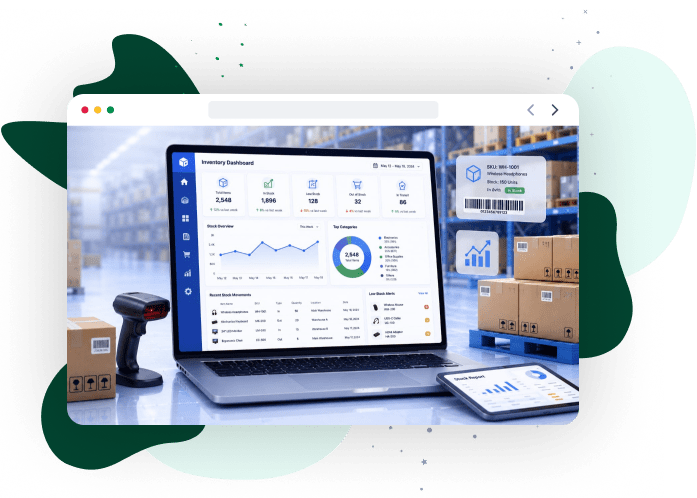
According to McKinsey & Company, AI-powered supply chain planning can reduce inventory and logistics costs by more than 20%. AI-powered supply chain planning can reduce inventory and logistics costs by over 20%, demonstrating how intelligent inventory operations improve efficiency, visibility, and cost control.
This guide explores how digital inventory systems improve inventory visibility, automate stock control, support multi-location operations, and integrate with ERP, warehouse, and logistics platforms to build faster and more scalable supply chain operations.
Go for ImplementationWhat Is Digital Inventory Management?
Digital inventory management is a system-driven approach that controls stock planning, allocation, and movement using real-time transaction data instead of manual updates.
As part of supply chain digital transformation, it connects inventory data with warehousing, production, fulfillment, and transportation systems to maintain a single accurate stock record across all operations.
The system updates stock positions continuously using live transaction data, reducing reconciliation errors, improving allocation decisions, and cutting fulfillment time across multi-location networks.
According to Grand View Research, the inventory management software market will reach USD 7.14 billion by 2033, growing at a CAGR of 8.9% between 2026 and 2033.
What Are the Core Features of Digital Inventory Management Software?
Digital inventory management software has 7 core features that automate stock movement, replenishment, allocation, and fulfillment using real-time transaction processing. These capabilities support inventory management software requirements across logistics and supply chain operations.
Core Functional Capabilities
Manages receipts, transfers, picking, and shipments with controlled inventory rules.
Calculates reorder points and safety stock using demand and lead-time patterns.
Assigns inventory based on order priority, availability, and sourcing logic.
Balances stock across warehouses and distribution networks.
Connects ERP, WMS, TMS, and procurement systems through API-based workflows.
Detects shortages, variances, and allocation conflicts through automated alerts.
Tracks inventory KPIs, operational efficiency, and stock performance.
How Does Real-Time Data Access and Updates Work in Digital Inventory?
Real-time data access in digital inventory works by updating stock positions instantly after every transaction, keeping inventory records accurate across warehouses, transport operations, and fulfillment systems.
These systems support real-time inventory tracking by processing inventory events such as receipts, transfers, picking, and shipments as they occur.
How Real-Time Inventory Updates Work
Record inventory transactions instantly without batch delays.
Validate stock movements before updating inventory states.
Synchronize inventory data across ERP, WMS, and fulfillment systems.
Display live stock visibility through operational dashboards.
Trigger automated workflows for replenishment and exception handling.
Detect allocation conflicts and inventory discrepancies in real time.
How Does Seamless Integration with Supply Chain Platforms Work in Digital Inventory?
Seamless integration connects inventory systems with ERP, warehouse, transportation, and manufacturing platforms through API-based data exchange and automated workflows. This coordination supports integrated supply chain systems by maintaining synchronized inventory and operational data.
Key Integration Functions
- ERP integration synchronizes inventory, financial, and master data
- WMS integration manages putaway, picking, and warehouse movements
- TMS integration tracks shipment status and in-transit inventory
- Manufacturing integration monitors material usage and production output
- API-driven workflows exchange inventory data across connected systems
- Workflow orchestration coordinates inventory from order to fulfillment
How Does Advanced Reporting and Analytics Work in Digital Inventory?
Advanced reporting and analytics in digital inventory work by converting raw transaction data into measurable insights that support demand planning, inventory forecasting, and fulfillment control.
These capabilities operate within supply chain analytics to improve inventory accuracy, demand planning, and fulfillment performance.
Core Analytics Capabilities
Performance measurement
Track KPIs such as fill rate, inventory turns, days of supply, and backorder rate to evaluate inventory efficiency.
Demand forecasting
Use historical consumption and demand patterns to improve forecasting accuracy and replenishment planning.
Calculate reorder points, safety stock, and order quantities using demand variability and lead-time data.
Real-time dashboards
Display live inventory trends, operational metrics, and stock movement through customizable dashboards.
Root-cause analysis
Identify stock imbalances, demand shifts, and operational bottlenecks through drill-down reporting.
Exception detection
Detect abnormal demand patterns, inventory variances, and stock discrepancies using automated thresholds.
How Do Inventory Risk Management Tools Work in Digital Inventory?
Inventory risk management tools work by monitoring stock levels, supplier performance, and demand shifts in real time, giving organizations early warning of disruptions before they affect fulfillment. Through integrated supply chain security controls, these systems improve inventory stability and operational resilience.
The platform monitors stock levels, demand changes, supplier performance, and allocation risks in real time. Automated workflows trigger actions such as inventory reallocation, replenishment updates, and expedited procurement to maintain supply continuity.
How Does Access via Digital Inventory Apps Work in Digital Inventory?
Digital inventory apps extend inventory operations to mobile and web devices, enabling warehouse teams and field staff to execute tasks in real time. Through integrated automated inventory workflows, organizations can improve inventory accuracy, operational speed, and workforce productivity across distributed environments.
Mobile Inventory Execution
Operators can manage receiving, putaway, picking, transfers, and cycle counts directly from handheld devices using guided task workflows.
Real-Time Data Capture
Barcode and QR scanning enable faster SKU, lot, serial, and location validation while reducing manual entry errors.
Offline and Remote Synchronization
The system stores transactions during connectivity loss and automatically synchronizes updates once the connection is restored.
Secure and Role-Based Access
Role-based permissions control access for warehouse operators, supervisors, and field teams to maintain operational security.
Location-Aware Task Management
Tasks are assigned by zones, aisles, bins, or field locations to improve execution efficiency and inventory visibility.
Driving Measurable Results Across Industries
From automating manual calculations to modernizing legacy infrastructure, we build software that directly impacts the bottom line. Our custom solutions consistently reduce operational costs and accelerate process efficiency.
View Our Case Studies
What Are the Fundamentals of a Digital Inventory System?
A digital inventory system is built on core fundamentals that give organizations centralized control over stock tracking, allocation, and fulfillment operations in real time.
Integrated with warehouse management systems, these fundamentals give operations teams accurate stock records, faster warehouse execution, and coordinated supply chain visibility across every location.
Core Fundamentals
- Centralized SKU, lot, serial, and location data management
- Structured warehouse layouts for optimized storage and picking
- Real-time tracking of inventory movement and stock status
- Time-stamped transaction records for traceability and audits
- Automated inventory allocation and replenishment planning
- Integration with ERP, WMS, TMS, and manufacturing systems
- Task sequencing and workflow coordination for operational efficiency
How Does Digital Inventory Work?
Digital inventory works by capturing every stock movement through barcode scanners, RFID devices, and automated workflows within a warehouse operations system, validating and recording each transaction in real time.
Each transaction updates the central inventory record instantly, maintaining accurate stock positions across all warehouses, fulfillment centers, and connected systems.
The system automatically manages stock allocation, replenishment, status updates, and traceability while synchronizing data with order management, procurement, and transport platforms. This enables faster decision-making, improved inventory accuracy, and connected supply chain execution across warehouses and distribution networks.
What Are the Types of Digital Inventory Management Systems?
Digital inventory management systems fall into 4 types, ranging from off-the-shelf platforms for standard operations to custom inventory systems built for complex, high-volume supply chain environments.
The right solution depends on business complexity, scalability, and integration needs.
| System Type | Description | Strengths | Suitable Use Cases |
|---|---|---|---|
| 1. Off-the-Shelf Inventory Software | Uses pre-configured modules with fixed workflows for standard inventory operations | Fast deployment, lower cost, minimal setup effort | Small to mid-sized operations with predictable processes |
| 2. Custom Inventory Systems | Builds inventory logic, workflows, and integrations based on specific business requirements | Full control, scalable architecture, deep system integration | Enterprises with complex supply chains and multi-node operations |
| 3. SaaS-Based Inventory Platforms | Delivers inventory functionality through cloud-hosted applications with subscription access | Low infrastructure cost, remote access, automatic updates | Distributed teams and businesses requiring quick scaling |
| 4. Cloud-Native Inventory Systems | Runs on a microservices architecture with API-first design for flexible deployment | High scalability, modular expansion, and strong integration capability | Large-scale operations with dynamic demand and high transaction volumes |
How Does On-Demand Manufacturing Use Digital Inventory?
On-demand manufacturing uses digital inventory by converting confirmed customer orders directly into production jobs, aligning manufacturing output with actual demand instead of forecast-driven stock builds.
Integrated with production scheduling software, these systems coordinate material availability, production capacity, and order sequencing to reduce idle time and eliminate production delays caused by stock shortages.
How the Process Works
- Converts customer orders directly into production jobs
- Validates material availability before manufacturing begins
- Schedules production based on machine capacity and demand priority
- Tracks work-in-progress inventory across operations
- Automatically records material consumption during production
- Adjusts production schedules for delays or shortages in real time
- Supports small-batch and make-to-order manufacturing
How Do Decentralized and Local Manufacturing Strategies Use Digital Inventory?
Decentralized and local manufacturing strategies use digital inventory to coordinate production, sourcing, and fulfillment based on real-time inventory availability, capacity, and service targets. Systems use supply chain planning solutions to align global inventory visibility with local production and fulfillment decisions.
The system applies decision controls across distributed supply networks:
Source-of-Supply Optimization: Select production or supplier nodes based on cost, capacity, and delivery feasibility.
Cross-Site Order Promising (ATP/CTP): Assign orders across plants and fulfillment partners based on availability and lead time.
BOM Variants and Substitution Rules: Support regional material availability using localized BOMs and approved substitutions.
Supplier Zoning and Trade Controls: Apply regional sourcing, tariff, and compliance requirements.
Inter-Node Transfer Planning: Balance inventory shortages and excess stock across locations.
Regional Buffer Management: Maintain localized safety stock and inventory continuity.
Order Routing Optimization: Route orders based on cost, lead time, and service targets.
Regulatory Traceability: Manage compliance records and cross-border documentation.
How Do Virtual Inventory and Spare Parts Digital Stock Work?
Virtual inventory and spare parts digital stock work by giving organizations real-time visibility and allocation control across multiple locations without physically consolidating stock into a single warehouse. Combined with inventory optimization models, spare parts digital stock improves fulfillment flexibility, reduces excess inventory, and supports faster service operations.
What Are the Benefits of Adopting a Digital Inventory System?
Adopting a digital inventory system delivers the following measurable benefits that increase stock accuracy, accelerate fulfillment, and reduce working capital across warehouse and supply chain operations.
Each benefit maps directly to a specific system capability within stock inventory control, producing measurable improvements in operational performance and financial results.
| Benefit | Operational Mechanism | Business Outcome |
|---|---|---|
| Inventory Accuracy | Executes cycle counts, validates transactions, and enforces master data governance | Reduces discrepancies and improves record reliability |
| Faster Fulfillment | Optimizes picking paths, schedules waves, and balances tasks | Shortens order cycle time and improves on-time delivery |
| Risk Control | Applies demand classification, buffer policies, and allocation rules | Prevents stockouts and excess inventory |
| Scalability | Configures node-level parameters and modular system deployment | Supports expansion across multiple locations |
| Audit and Compliance | Records transaction logs, tracks lot/serial data, and enforces audit checkpoints | Meets regulatory requirements and simplifies audits |
| Working Capital Efficiency | Calculates reorder levels and improves inventory turnover | Reduces capital locked in stock |
| Operational Throughput | Balances workloads and schedules resources | Increases processing capacity |
| Planning Precision | Segments demand and calibrates planning parameters | Improves forecast accuracy and service levels |
McKinsey reports that digital inventory systems can reduce inventory levels by 10–20%. This reduction is driven by more accurate demand planning, optimized stock levels, and controlled inventory execution, which together lower excess inventory and improve working capital efficiency.
What Are the Challenges and Risks with Digital Inventory?
Digital inventory systems introduce 7 challenges related to data accuracy, system integration, security, and compliance that organizations must address to maintain reliable inventory performance.
Structured supply chain compliance controls address each of these risks by enforcing data validation, access management, integration monitoring, and audit documentation across inventory operations.
Common Challenges and Risks
Data Inconsistency
Duplicate records and inaccurate SKU data can impact inventory accuracy.
Security and Access Risks
Weak access controls may lead to unauthorized system usage or data exposure.
Integration Complexity
API mismatches and synchronization failures can disrupt connected systems.
Configuration Errors
Incorrect inventory rules or policy settings can affect replenishment and fulfillment.
Operational Scalability Issues
High transaction volumes may create processing delays and system bottlenecks.
Compliance and Audit Gaps
Missing audit records or weak documentation can increase regulatory risk.
Workforce Adoption Challenges
Limited system training can reduce operational efficiency and execution consistency.
What Are the Best Practices for Digital Inventory Management?
Digital inventory management has 5 best practices built on accurate data, standardized workflows, and continuous operational control that give organizations consistent stock accuracy and fulfillment reliability.
Integrated with inventory counting software, these practices reduce stock discrepancies, lower operational risk exposure, and keep supply chain workflows running without interruption.
Best Practices
- Maintain accurate inventory through cycle counting and centralized master data
- Standardize receiving, picking, and replenishment workflows
- Control inventory rules, configurations, and user access permissions
- Establish response processes for shortages, variances, and exceptions
- Monitor KPIs such as fill rate, throughput, and inventory turns
How Does Digital Inventory Compare to Traditional Inventory Management?
Digital inventory management differs from traditional inventory management by replacing manual updates and periodic stock checks with real-time, system-driven tracking that updates stock positions after every transaction.
Integrated with a perpetual inventory system, digital platforms give operations teams continuous stock visibility, automated workflow control, and end-to-end traceability that traditional systems cannot deliver.
Key Differences
Real-Time Tracking
Digital systems update inventory instantly after each transaction, unlike delayed manual entries.
Higher Accuracy
Continuous cycle counting reduces discrepancies compared to periodic physical stock checks.
End-to-End Traceability
Tracks lot, serial, and transaction history across the supply chain.
Automated Workflow Control
Standardizes inventory processes through system-driven tasks and alerts.
Multi-Location Visibility
Coordinates inventory across warehouses, distribution centers, and regions.
Improved Data Governance
Maintains validated master data and reduces duplicate or inconsistent records.
How to Choose Digital Inventory Management Software?
Choosing the right digital inventory platform requires evaluating scalability, operational fit, integration capability, and long-term business value.
Through effective inventory system selection, organizations can identify solutions that support faster execution, inventory accuracy, and future growth.
Evaluate Operational Requirements
Analyze SKU volume, order flow, warehouse complexity, and transaction loads to ensure the platform can support current and future operations.
Validate System Capabilities
Confirm support for inventory policies, lot and serial tracking, replenishment workflows, automation, and real-time visibility.
Review Integration and Scalability
Ensure seamless integration with ERP, WMS, TMS, and manufacturing systems while validating performance under peak operational demand.
Assess Security and Vendor Support
Verify compliance controls, data protection, implementation expertise, SLAs, and long-term support capabilities.
Conduct Testing and Cost Analysis
Run pilot testing, validate workflows, and evaluate total ownership cost across licensing, integrations, support, and future scaling.
What Questions Should You Ask Inventory Software Vendors?
When selecting a digital inventory platform, you should ask vendors about system architecture, security controls, integration capability, and long-term cost structure before signing any contract.
Within a vendor management system, asking the right questions gives you the information needed to identify system limitations, confirm scalability, and reduce implementation risk before committing to a platform.
Key Questions to Ask Vendors
How is data security, access control, and tenant isolation managed?
Can the platform scale for high transaction volumes and multi-location operations?
How are integrations handled with ERP, WMS, and supply chain systems?
What monitoring, logging, and issue-resolution capabilities are included?
How are configuration changes, updates, and rollbacks controlled?
Are testing, sandbox, and staging environments available?
What tools support data migration and implementation validation?
What SLAs, uptime guarantees, and support commitments are provided?
How does the platform support customization and future scalability?
What are the long-term costs for users, storage, transactions, and integrations?
What Are the Implementation Steps for Digital Inventory Systems?
The implementation steps for a digital inventory system follow a structured rollout that covers data migration, system integration, configuration, testing, and controlled go-live. Combined with supply chain automation, this process reduces deployment risk by validating each phase before moving to the next.
Implementation Process
- Define business requirements, operational scope, and success goals
- Design system architecture, integrations, and security controls
- Prepare and validate inventory and location master data
- Configure inventory rules, workflows, and automation settings
- Integrate ERP, WMS, and connected supply chain systems
- Execute testing, workflow validation, and user training
- Perform controlled go-live and operational transition
- Monitor performance and optimize workflows after deployment
How Do Digital Inventory Systems Get Customized for Industry Needs?
Digital inventory systems get customized for industry needs by configuring data models, workflows, and compliance controls to match sector-specific processes and regulatory requirements through a governed supply chain security framework.
Key capabilities include secure access controls, encrypted data protection, audit logging, compliance management, and continuous security monitoring. The system supports ISO, SOC 2, FDA, HIPAA, GDP, and GMP standards through automated compliance reporting and audit-ready record management.
Backup, disaster recovery, and retention controls give transport and logistics companies the infrastructure to recover from system failures, meet regulatory retention requirements, and maintain inventory operations without data loss.
What Are the Security and Compliance Requirements in Digital Inventory Management?
Security and compliance requirements in digital inventory management protect inventory data, control system access, and ensure regulatory adherence through controls that prevent data breaches, maintain auditability, and support statutory compliance. Within a governed supply chain security framework, these controls give inventory operations teams a structured approach to access management, data protection, and regulatory evidence generation.
Core Security and Compliance Controls
- Role-based access and user accountability
- Encrypted data protection and key management
- Tamper-resistant audit logs and transaction tracking
- Compliance support for ISO, SOC 2, FDA, HIPAA, GDP, and GMP
- Data validation and integrity monitoring
- Continuous security monitoring and incident response
- Backup, disaster recovery, and retention management
- Automated audit reporting and compliance evidence generation
How Do Data Integrity and Audit Trails Work in Digital Inventory?
Data integrity and audit trails in digital inventory work by validating every transaction at the point of entry, tracking inventory movement in real time, and storing tamper-resistant records that support regulatory compliance and loss prevention. Through integrated inventory audit systems, organizations gain greater operational visibility and control across supply chain processes.
Core Capabilities
Transaction Tracking captures inventory activity with timestamps, user actions, and linked source records.
Immutable Audit Records preserves historical transaction data to maintain traceability and prevent unauthorized changes.
Discrepancy and Loss Detection identifies inventory variances, shrinkage, and unusual stock activity automatically.
Override and Approval Logging records manual adjustments with approval history and reason codes.
Compliance Documentation maintains audit-ready records for inspections and regulatory requirements.
Data Validation Controls prevents inaccurate inventory entries through automated validation checks.
How Do Digital Inventory Systems Integrate with Quality and Security Standards?
Digital inventory systems integrate with quality and security standards by mapping system controls to regulatory requirements, validating transactions against compliance rules, and generating audit-ready records through integrated supply chain compliance systems.
The platform supports ISO, SOC 2, FDA, HIPAA, GDP, and GMP standards through controlled inventory workflows, electronic signature controls, tamper-resistant audit trails, and multi-level approval management. It also centralizes documentation, supplier qualification, quality events, and validation records while automating audit reporting and secure record retention.
How Do Digital Warehouses and Virtual Inventory Transform Operations?
Digital warehouses and virtual inventory transform operations by converting physical storage into system-driven execution environments and enabling real-time stock availability across multiple locations without physically consolidating inventory into a single site. Integrated with warehouse management system solutions, these capabilities give warehouse operations teams faster fulfillment execution, lower stock handling costs, and flexible inventory control across distributed networks.
Operational Advantages
- Automated putaway, picking, packing, and dispatch workflows
- Real-time inventory visibility across warehouses and regions
- Intelligent order routing based on cost, capacity, and delivery speed
- Virtual inventory pooling for centralized order fulfillment
- Faster cross-docking and flow-through processing
- Integrated production staging for manufacturing operations
- Centralized coordination with localized execution
- Faster exception handling for shortages and delays
What Is a Digital Warehouse?
A digital warehouse is a system-controlled facility where inventory storage, movement, and fulfillment are managed through automated task execution and real-time tracking that validates every transaction before updating stock records. Integrated with warehouse operations management, it gives warehouse managers accurate bin-level stock positions, automated workflow control, and real-time performance data across all warehouse operations.
Key Capabilities
- Automated task execution
- Real-time inventory tracking
- Structured storage management
- ERP and logistics system integration
- Material handling automation
- Exception and error management
- Throughput and performance monitoring
How Is Virtual Inventory Managed in Manufacturing?
Virtual inventory in manufacturing is managed by connecting production planning, material availability, and demand signals in real time, reducing dependency on excess finished goods stock and enabling make-to-order execution. Through integrated manufacturing inventory control, manufacturers reduce inventory carrying costs and respond to demand changes without building excess stock buffers.
The system supports demand-driven material planning, capacity-based production scheduling, make-to-order execution, and workflow optimization across manufacturing operations. It also coordinates supplier lead times, balances production loads, and maintains lean inventory buffers to improve throughput and reduce delays.
What Are the Best Practices for Managing a Digital Warehouse?
The best practices for managing a digital warehouse cover task execution, storage layout, workflow coordination, and performance monitoring that give warehouse teams measurable improvements in picking speed, stock accuracy, and order throughput. Combined with warehouse optimization practices, these practices give transport and logistics companies a structured approach to reducing execution bottlenecks, reconfiguring storage layouts, and improving workforce productivity without adding warehouse headcount.
Core Digital Warehouse Best Practices
Optimize Pick Paths:
Reduce travel time through intelligent aisle sequencing and route planning.
Use Dynamic Slotting:
Reconfigure storage locations based on demand patterns and inventory movement.
Balance Workloads Efficiently:
Manage wave releases and task queues to prevent operational bottlenecks.
Improve Dock Coordination:
Schedule inbound and outbound activities to reduce congestion and waiting time.
Track Labor Productivity:
Monitor workforce performance to improve execution speed and resource utilization.
Reduce Operational Errors:
Apply validation and error-proofing controls during picking and storage processes.
Monitor Cycle Times:
Identify delays and optimize warehouse workflows continuously.
Continuously Optimize Layouts:
Adjust storage density and warehouse flow to support higher throughput.
What Is the Role of CAD Files and STL Files in Digital Inventory?
CAD and STL files play the role of digital part masters in inventory systems, replacing physical stock storage with version-controlled design assets that enable on-demand manufacturing. CAD files store part specifications, dimensional tolerances, and material requirements, while STL files convert those designs into the triangulated mesh format required by 3D printers and additive manufacturing systems.
Digital inventory systems link CAD and STL files directly to item master records as version-controlled assets with defined release status and approved production methods, ensuring only validated file versions reach production systems. Security controls, including file-level encryption, role-based access management, digital watermarking, and usage-based licensing policies, protect intellectual property during production and distribution across global manufacturing networks.
How Is IP Licensing Managed for 3D Printed Parts?
IP licensing for 3D printed parts is managed through controls that govern how digital part files are accessed, shared, and used across distributed manufacturing environments, protecting intellectual property and preventing unauthorized production. Integrated with supply chain blockchain security, these controls give intellectual property owners and production compliance teams a verifiable and tamper-resistant record of every file access, print authorization, and usage deduction across the manufacturing network.
| Capability | Business Impact |
|---|---|
| Usage-Based Licensing Controls | Restricts print quantity, device access, location, and usage duration for each file |
| Secure Production Authorization | Validates encrypted design access before manufacturing begins |
| Real-Time Print Monitoring | Tracks production activity and license consumption across facilities |
| Digital Watermarking | Identifies unauthorized file sharing or part replication |
| Blockchain Audit Trails | Maintains tamper-resistant records of file access and license activity |
| Revision Compliance Management | Ensures only approved design versions move into production |
| Regional Access Governance | Applies jurisdiction and export-control restrictions automatically |
How Are Digital Parts Stored and Distributed in the Cloud?
Digital parts are stored and distributed in the cloud through controlled access policies, real-time file availability, and traceable delivery workflows that give engineering, procurement, and production teams secure access to CAD and STL files across every facility in a global manufacturing network.
Integrated with a supply chain visibility platform, these systems help transport and logistics companies accelerate part access while maintaining security and operational control.
Core Cloud Distribution Capabilities
How Does iCommuneTech Approach Digital Inventory Management?
iCommuneTech approaches digital inventory management by designing scalable inventory systems built around each client’s operational workflows, transaction volumes, and supply chain complexity rather than adapting clients to pre-configured software templates. Through custom inventory development, the platform helps transport and logistics companies improve inventory accuracy, fulfillment speed, and operational visibility across warehouses, distribution centers, and multi-location supply networks.
The approach combines configurable inventory logic, real-time ERP and WMS integration, and modular system architecture to handle high transaction volumes without disrupting live inventory execution. Phased deployment, validation controls, and continuous optimization reduce implementation risk while maintaining operational stability and inventory accuracy after go-live.
How Does iCommuneTech Deliver Custom-Built Solutions for Complex Inventory Needs?
iCommuneTech delivers custom-built inventory solutions for complex inventory needs by building tailored systems for complex supply chain operations, legacy integrations, and high-volume inventory environments that off-the-shelf platforms cannot support without significant configuration compromises.
Core Capabilities
- Configurable workflows for complex operations
- Legacy and third-party system integration
- Scalable architecture for high transaction volumes
- Flexible data models and rule-based inventory logic
- Multi-region and multi-tenant support
- Modular deployment and system scalability
How Does iCommuneTech Ensure Compliance and Security in Delivery?
iCommuneTech ensures compliance and security in delivery by integrating security controls, compliance frameworks, and continuous monitoring throughout every phase of system implementation. These practices align with supply chain compliance solutions to support secure and audit-ready supply chain environments.
Core Security and Compliance Practices
- Alignment with ISO, SOC 2, FDA, HIPAA, and industry regulations
- Automated access, encryption, and policy enforcement controls
- Secure data protection and encryption key management
- User access monitoring and approval-based control workflows
- System validation, compliance testing, and secure deployments
- Continuous monitoring and incident response management
- Audit logging, compliance reporting, and evidence management
- Regular system hardening, updates, and vulnerability management
Case Studies: How Digital Inventory Management Transformed Fulfillment Operations?
A logistics company improved fulfillment speed and inventory visibility by implementing a digital inventory management system to replace fragmented tracking and manual coordination processes.
The solution centralized inventory data, automated order validation, and synchronized warehouse workflows in real time, significantly improving operational efficiency and execution speed.
This transformation demonstrates how digital inventory systems can accelerate fulfillment, improve visibility, and streamline logistics operations.
Check more success storiesMeasured Impact:
What Is the Future of Digital Inventory Management?
The future of digital inventory management is defined by AI-driven planning, automated execution, and real-time decision-making that give inventory teams faster response times, higher forecast accuracy, and greater supply chain resilience than current rule-based systems deliver. These innovations operate within AI in the supply chain to improve forecast accuracy, response speed, and operational resilience.
Key advancements shaping future inventory systems include:
- AI-based demand forecasting for more accurate replenishment
- Self-adjusting inventory policies based on live operational data
- Digital twins to simulate inventory scenarios before execution
- RFID and IoT tracking for real-time inventory visibility
- Blockchain-based traceability for compliance and product tracking
- Edge-based processing for faster allocation and routing decisions
- Scenario modeling to prepare for supply disruptions and demand spikes
According to McKinsey, AI-driven forecasting can reduce forecast errors by 30–50%, helping companies lower excess inventory and improve replenishment accuracy.
What Are the Costs to Develop a Digital Inventory System?
The costs to develop a digital inventory system depend on customization scope, integration complexity, transaction volume, and operational scale.
Within the inventory system cost factors, each factor scales independently based on the level of customization, operational scale, and performance requirements defined before development begins.
Primary Cost Areas
- System development for inventory tracking, automation, and workflow logic
- ERP, WMS, TMS, and legacy system integration
- Cloud infrastructure for storage, processing, and transaction handling
- Data migration, cleansing, and inventory record mapping
- Configuration of inventory rules, allocation logic, and operational policies
- Testing, validation, and deployment readiness
- User training and operational change management
- Security, compliance, maintenance, and system monitoring
As operations scale, additional investment supports higher transaction volume, multi-location coordination, and performance optimization.
How Should You Get Started with Digital Inventory Management?
Getting started with digital inventory management requires a structured rollout focused on operational fit, system validation, and controlled deployment before scaling to full adoption.
An inventory system demo gives you the opportunity to evaluate workflows, integrations, and scalability under realistic conditions before committing to full deployment.
Implementation Priorities
Operational Assessment
Review inventory workflows, transaction volumes, and data quality requirements.
Goal and KPI Definition
Set measurable targets for inventory accuracy, fulfillment speed, and stock efficiency.
Pilot Deployment
Start with a limited process or location to reduce implementation complexity.
System and Integration Validation
Test ERP, warehouse, and logistics integrations for reliable data synchronization.
Data and User Readiness
Prepare inventory records, configure workflows, and train operational teams.
Phased Expansion
Scale deployment gradually while monitoring system performance and optimization.
What Is the Value of Going Digital with Inventory?
The value of going digital with inventory lies in measurable improvements to stock accuracy, fulfillment speed, and cost efficiency across warehouse and supply chain operations. These improvements contribute directly to supply chain efficiency by enabling better decision-making and operational control.
Key business benefits include:
Working Capital Optimization
Reduce cash tied in inventory through improved stock turnover and tighter days of supply.
Service Level Improvement (OTIF)
Increase on-time, in-full delivery by aligning inventory allocation with demand and constraints.
Operational Throughput
Increase processing speed and order handling capacity through optimized workflows.
Loss Reduction
Minimize shrinkage and write-offs using better tracking and variance control.
Order Promising Accuracy
Improve ATP and CTP calculations to reduce backorders and delivery delays.
Faster Order Fulfillment
Shorten order processing time by removing bottlenecks and delays.
Cost-to-Serve Reduction
Lower fulfillment costs through optimized routing and inventory positioning.
Operational Resilience
Maintain service levels during disruptions using data-driven planning and buffer strategies.
McKinsey reports that AI-driven decision-making generates $450B–$650B in annual value and drives 5–10% revenue growth in advanced industries. Digital inventory systems provide the structured data, real-time execution control, and audit-ready records that supply chain operations need to realize these gains.

Organizations that adopt digital inventory systems improve efficiency, reduce costs, and scale operations with greater control and visibility.
Contact for Custom Build