
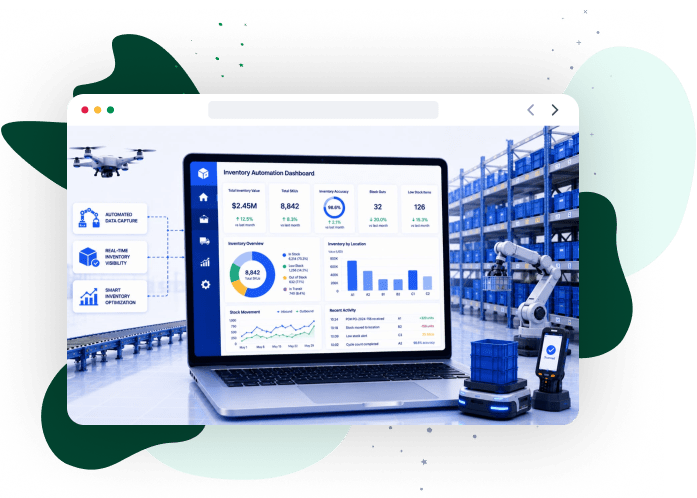
These systems replace manual updates with event-driven processing that records every inventory movement and updates stock positions in real time. According to Grand View Research, the warehouse automation market will reach $59.52 billion by 2030 at a CAGR of 18.7%.
These systems manage stock at the SKU level, integrate with ERP and WMS platforms, and scale across multi-node distribution networks to support high-volume logistics operations. iCommuneTech builds customized inventory automation systems configured with enterprise workflows, integration architectures, and data governance requirements.

Ready to automate your inventory operations? Contact iCommuneTech to scope your implementation.
Start ImplementationWhat Are Inventory Automation Systems?
Inventory automation systems are software platforms that replace manual inventory tracking with system-driven transaction processing, recording stock movement, and validating each update at the SKU level.
These systems execute structured workflows where receiving, putaway, picking, and dispatch events trigger inventory updates and validation checks. An inventory management system maps stock to bin locations, tracks movement across nodes, and logs each transaction against predefined control rules to prevent record drift and allocation conflicts.
Inventory automation removes dependency on manual reconciliation by processing every inventory event in real time and enforcing consistent stock states across locations. High-throughput warehouses, multi-node distribution networks, and omnichannel fulfillment operations depend on automated inventory processing to handle continuous stock movement without data inconsistencies.
Facilities running cross-docking, dynamic slotting, and distributed storage operations apply inventory automation to control stock positioning, maintain accuracy, and support uninterrupted order execution.
What Are the Key Features of Modern Inventory Automation Software?
Modern inventory automation software tracks stock movements, validates transactions, integrates workflows, and generates decision-level insights across supply chain execution.
The following features represent the core functional capabilities buyers evaluate when selecting an inventory automation solution:
| Feature | Function | Operational Outcome |
|---|---|---|
| SKU Identification | Assigns unique SKU, batch, or serial identifiers to each item. | Differentiates items at a granular level and prevents misclassification errors. |
| Inventory Quantification | Calculates stock levels from real-time transaction inputs and system logs. | Eliminates manual counting cycles and stabilizes stock accuracy. |
| Location Association | Links inventory to bin, rack, and zone coordinates within storage layouts. | Directs precise storage placement and retrieval execution. |
| Inventory State Updates | Records stock changes during receiving, picking, and dispatch events. | Keeps inventory positions current during continuous operations. |
| Discrepancy Detection | Compares expected and actual stock states to identify mismatches. | Isolates errors early and triggers controlled correction workflows. |
| Zone Tracking Control | Monitors inventory movement across storage, staging, and picking zones. | Maintains visibility across all operational areas. |
| Data Synchronization | Commits validated updates into connected systems through API-driven workflows. | Aligns inventory records across platforms without lag. |
| Multi-Site Governance | Standardizes inventory rules and execution across distributed facilities. | Maintains consistent operations across multiple warehouse nodes. |
| Analytics and Reporting | Processes inventory data into performance metrics and trend insights. | Supports decision-making on stock levels, demand patterns, and operational efficiency. |
| Mobile Access Enablement | Provides handheld and mobile interfaces for real-time inventory actions. | Allows on-floor execution without dependency on fixed terminals. |
These features integrate with broader supply chain management software to synchronize inventory data, coordinate workflows, and maintain system-wide consistency.
Together, these features address stock inaccuracies, delayed fulfillment, and real-time visibility gaps by converting inventory operations into controlled, system-driven processes.
What Is Real-Time Inventory Visibility and Sync?
Real-time inventory visibility and sync is the system capability that captures inventory movements as they occur and updates stock data across connected systems and locations without batch delays.
These 7 capabilities define how inventory systems capture, process, and synchronize stock data in real time:
1. Inventory State Tracking
Records stock changes at SKU and bin levels during each handling event, keeping inventory positions current.
2. Event Stream Processing
Routes inventory updates through event pipelines, committing changes immediately without batch delays.
3. Distributed Node Alignment
Synchronizes stock data across warehouses, distribution centers, and retail endpoints to prevent data mismatches.
4. Supplier Data Integration
Imports inventory signals from supplier and partner systems, merging external updates with internal records.
5. Exception Monitoring
Identifies missing transactions, duplicate updates, and abnormal stock shifts for targeted investigation.
6. Fulfillment Synchronization
Matches inventory availability with order execution systems to control reservation accuracy during processing.
7. Visibility System Integration
Publishes inventory data streams into monitoring layers within a supply chain visibility framework for centralized tracking.
These 7 capabilities reduce stock discrepancies, prevent fulfillment errors, and improve customer transparency by keeping inventory data accurate and immediately accessible across all operational nodes.
Driving Measurable Results Across Industries
From automating manual calculations to modernizing legacy infrastructure, we build software that directly impacts the bottom line. Our custom solutions consistently reduce operational costs and accelerate process efficiency.
View Our Case Studies
How Do RFID and Barcode Enable Inventory Automation?
RFID and barcode technologies enable inventory automation by identifying items at the point of handling and recording each movement directly within inventory systems.
By capturing item data during receiving, storage, picking, and dispatch activities, RFID and barcode systems eliminate manual entry delays, reduce transaction errors, and accelerate inventory updates across warehouse operations.
These 7 functions define how RFID and barcode drive inventory automation:
Optical Code Capture: Scans SKU, batch, or serial identifiers at handling points to register item identity during operations.
Radio Frequency Identification: Reads tagged items across defined zones using signal transmission, allowing non-line-of-sight item detection without manual scanning.
Receiving Registration: Records inbound items against purchase or transfer orders at dock entry through scan or tag validation.
Dispatch Verification: Matches picked items against shipment instructions using scan validation to prevent dispatch errors.
Cycle Count Execution: Conducts stock audits through scheduled barcode scans or RFID sweeps to verify inventory without manual counting.
Automated Read Zones: Tracks item movement through fixed RFID gateways, capturing transactions without operator intervention.
Device-to-System Integration: Routes captured data into inventory workflows through barcode scanning in logistics, structuring real-time record updates.
These 7 functions reduce manual input dependency, minimize handling errors, and keep inventory records across high-volume environments such as distribution centers, manufacturing facilities, retail networks, and regulated storage operations.
How Does AI-Enabled Inventory Management Improve Automation?
AI-enabled inventory management improves automation by converting demand data into replenishment decisions through predictive models and optimization logic, removing manual intervention from stock control.
By analyzing historical trends, real-time demand signals, and supply variability, AI-enabled inventory systems calculate stock requirements, optimize replenishment timing, and trigger automated inventory actions across supply chain operations. According to Gartner, 60% of supply chain disruptions will be resolved without human intervention by 2031.
The following capabilities define how AI strengthens inventory automation:
Time-Series Forecasting
Calculates demand projections from historical sales patterns and seasonality trends to guide forward stock planning.
Pattern Deviation Detection
Flags abnormal demand behavior and irregular consumption patterns using statistical variance models.
Reorder Parameter Computation
Derives reorder points and quantities using lead time distribution, demand variability, and service level targets.
ABC and Velocity Classification
Segments inventory based on consumption frequency and value contribution to assign differentiated stocking strategies.
Safety Stock Calibration
Computes buffer stock using variability metrics within inventory optimization algorithms to maintain service level targets.
Multi-Source Demand Ingestion
Consolidates demand signals from order streams, sales channels, and planning systems into unified model inputs.
Model Retraining Cycles
Updates forecasting and optimization models using incremental data to align predictions with demand shifts.
These capabilities automate planning decisions, reduce manual intervention in stock control, and improve responsiveness to demand fluctuations across inventory operations.
What Are the Benefits of Cloud-Based Inventory Software?
Cloud-based inventory software delivers 7 operational benefits by running inventory operations on a hosted infrastructure that scales resources, centralizes data, and provides remote system access without on-premise hardware dependency.
Centralized inventory access, scalable infrastructure, and real-time synchronization across locations reduce infrastructure overhead and maintain operational continuity during workload fluctuations. According to the World Economic Forum, digital transformation initiatives have reduced energy costs by up to 40%.
These 7 capabilities define how cloud-based inventory systems reduce cost, expand access, and sustain operations:
- Elastic Compute Provisioning: Adjusts processing capacity based on transaction load to handle demand spikes without hardware expansion.
- Distributed Access Control: Grants secure system access to users across warehouses and operational units through network-based interfaces.
- Centralized Data Management: Stores inventory data within a unified cloud layer to provide consistent access across all locations.
- Managed Release Deployment: Applies system updates and patches through controlled release cycles without local installation dependency.
- Data Replication and Recovery: Replicates inventory datasets across backup nodes to restore operations after system failures.
- Platform Interoperability: Integrates inventory workflows with digital inventory systems architectures using API-driven connections.
- Role-Based Access Governance: Controls user permissions based on operational roles to restrict unauthorized access.
These 7 capabilities reduce infrastructure cost, sustain system uptime, and provide continuous inventory access across distributed operations without local hardware dependency.
How Does ERP-Integrated Inventory Automation Enable End-to-End Control?
ERP-integrated inventory automation enables end-to-end control by connecting inventory transactions with procurement, order management, and financial systems through a unified data flow across enterprise operations.
Integrated ERP workflows connect stock movement with procurement, fulfillment, finance, and replenishment operations to maintain transaction consistency and operational visibility across enterprise supply chain environments.
The following functions define how ERP integration controls inventory execution and financial alignment:
- Master Data Harmonization: Standardizes item, supplier, and location data across ERP modules to eliminate reference mismatches.
- Goods Receipt Posting: Registers inbound stock against purchase orders with quantity and item validation through procurement software integration.
- Order Allocation Binding: Assigns inventory to sales orders based on availability and priority rules to prevent allocation conflicts.
- Ledger Entry Processing: Converts inventory movements into accounting entries that update stock valuation and cost accounts.
- Three-Way Matching: Verifies purchase order, goods receipt, and invoice data to detect and resolve financial discrepancies.
- Costing Method Execution: Calculates inventory value using defined methods such as FIFO or weighted average to maintain financial accuracy.
- Inter-Entity Stock Transfer: Tracks inventory movement across business units while preserving audit trails and transaction traceability.
These functions synchronize inventory operations with financial systems, remove reconciliation delays, and provide complete visibility into stock movement and cost impact across enterprise workflows
How Does Warehouse Management System (WMS) Integration Strengthen Inventory Automation?
WMS integration strengthens inventory automation by connecting inventory systems with warehouse execution processes to control storage, movement, and fulfillment activities in real time.
By synchronizing inventory records with warehouse workflows, WMS integration converts inventory data into real-time execution tasks across receiving, putaway, picking, replenishment, and dispatch operations. This coordination reduces discrepancies between system records and physical inventory activity. According to Gartner, 80% of warehouses and distribution centers will deploy some form of automation equipment by 2028.
The following functions define how WMS integration strengthens inventory automation:
These functions align warehouse execution with inventory data, improve fulfillment speed, and maintain accurate stock positions across storage, picking, and dispatch operations.
How to Successfully Automate Inventory Management?
Organizations successfully automate inventory management by following 8 structured steps that define processes, configure system logic, integrate platforms, and validate execution before full-scale rollout.
A structured implementation approach reduces deployment risk, aligns system behavior with operational workflows, and delivers stable performance across inventory environments. According to the World Economic Forum, digital supply chain initiatives reduce time-to-market by up to 40%, highlighting the value of structured and phased implementation.
The following steps define how organizations implement and scale inventory automation:
Process Mapping and Gap Analysis:
Analyzes existing inventory workflows to identify inefficiencies and define automation scope across receiving, storage, and dispatch.
Data Model Configuration:
Designs item masters, location hierarchies, and transaction schemas to support system-driven inventory control.
System Integration Planning:
Establishes API contracts and data exchange rules across procurement, order management, and finance platforms within a supply chain automation strategy framework.
Workflow Rule Definition:
Configures validation rules, exception handling logic, and authorization controls to regulate inventory transactions.
Pilot Deployment Execution:
Tests system behavior in controlled environments to validate process alignment and data accuracy.
User Role Assignment:
Assigns operator, supervisor, and administrator roles to control access and execution responsibility.
Performance Validation:
Measures system output against KPIs such as inventory accuracy, order fulfillment rate, and processing throughput.
Scale and Rollout Planning:
Expands deployment across facilities based on validated performance and standardized configurations.
These steps reduce implementation errors, align system execution with operational needs, and deliver consistent performance during scale-up.
What Defines Inventory Automation Architecture and Technology Stack?
Inventory automation architecture is defined by 7-layered components that structure how data flows, how devices capture events, and how systems process and exchange inventory information across operational environments.
These components determine system scalability, processing reliability, and integration flexibility by organizing inventory operations into layered execution and communication models.
The following components define how the architecture processes, connects, and manages inventory data:
| Component | Function | Technical Role |
|---|---|---|
| Data Storage Layer | Stores item masters, stock records, and transaction datasets. | Executes structured data persistence and query operations. |
| Processing Layer | Runs transaction logic, validation rules, and workflow execution. | Controls inventory state transitions and rule enforcement. |
| Edge Interface Layer | Interfaces with handheld devices, scanners, and RFID readers at operational points. | Captures inventory events at the source of activity. |
| Device Integration Layer | Integrates RFID gateways and sensor systems across defined zones. | Collects automated input from physical infrastructure. |
| API Interface Layer | Exchanges data with ERP, WMS, and order systems through service endpoints. | Manages system-to-system communication and data exchange. |
| Network Connectivity Layer | Links distributed nodes with centralized systems through network channels. | Maintains communication across locations and environments. |
| Event Processing Layer | Processes inventory events through ingestion and validation pipelines. | Structures event handling and ensures data consistency. |
These components operate within an inventory database architecture framework that organizes data storage, processing layers, and system interfaces for scalable and reliable inventory operations.
They enable high-volume transaction processing, maintain data integrity across systems, and support continuous inventory updates in distributed supply chain environments.
How Is Inventory Automation Tested and Validated?
Inventory automation is tested and validated through 7 structured stages that simulate, execute, and revalidate system behavior across controlled scenarios, live environments, and post-change conditions.
This validation structure confirms that the inventory transactions process correctly under each stage before full deployment.
The following stages define how inventory automation systems are tested and validated:
Scenario Simulation
Executes predefined inventory events against configured rules to verify transaction logic under controlled inputs.
Dataset Verification
Compares system outputs with expected records across item attributes, quantities, and transaction logs to detect inconsistencies.
Interface Validation
Tests data exchange across connected systems using API contracts and message schemas to confirm integration reliability.
Controlled Pilot Execution
Runs limited operations in live environments to measure system performance under actual workload conditions.
Change Impact Testing (Regression Testing)
Revalidates system behavior after configuration or logic updates to ensure existing functions remain unaffected.
Failure Response Testing
Simulates interruption scenarios such as incomplete transactions or processing faults to verify system recovery behavior.
Regulatory Alignment Checks
Compares system outputs against compliance standards using supply chain compliance systems frameworks.
iCommuneTech applies structured validation across simulation, pilot execution, and regression cycles to deliver reliable, production-ready inventory automation systems for mission-critical environments.
What Are the Best Practices for Inventory Automation, Monitoring, and Failover?
The best practices for inventory automation monitoring and failover define how systems monitor performance, detect failures, and switch operations to backup environments without interrupting inventory processing.
These practices structure continuous oversight, anomaly response, and recovery execution to sustain system availability during live operations.
The following practices define how inventory systems operate reliably in production environments:
- Real-Time System Monitoring: Measures transaction throughput, processing latency, and system health metrics to detect performance deviations early.
- Anomaly Detection Controls: Flags transaction failures, data inconsistencies, and processing delays for immediate investigation.
- Alert and Escalation Routing: Directs system alerts to response teams based on severity levels and incident categories to accelerate issue resolution.
- Redundancy Configuration: Deploys parallel system instances and backup nodes to prepare for failover scenarios.
- Automated Failover Execution: Transfers processing to secondary environments upon failure detection to avoid operational disruption.
- Data Replication Management: Replicates datasets across primary and backup systems to preserve data integrity during failover events.
- Access and Security Enforcement: Restricts monitoring and recovery access through controlled permissions using supply chain security systems frameworks.
These practices reduce downtime, isolate system failures before they affect processing, and sustain uninterrupted inventory operations across production environments.
How Are KPIs and ROI Measured in an Automated Inventory Management System?
KPIs and ROI in an automated inventory management system are measured by tracking operational and financial metrics that compare performance outcomes against system investment.
These metrics quantify accuracy, throughput, and cost efficiency improvements while building the financial case for automation investment over time. According to the World Economic Forum, digitally advanced operations report productivity gains of up to 70%.
The following KPIs define how organizations measure inventory performance and ROI:
| KPI / Metric | Measurement Method | Business Impact |
|---|---|---|
| Record Accuracy | Compares system quantities with audit counts across SKUs and locations. | Reduces discrepancies and strengthens audit compliance. |
| Perfect Order Rate | Calculates orders completed without quantity, item, or dispatch errors. | Increases fulfillment reliability and customer satisfaction. |
| Inventory Velocity | Determines stock movement relative to average inventory levels. | Improves capital utilization and reduces excess stock. |
| Holding Cost Ratio | Computes storage, insurance, and capital cost as a percentage of inventory value. | Controls carrying costs and frees working capital. |
| Stockout Incidence | Tracks missed fulfillment events caused by unavailable stock. | Prevents revenue loss and service disruption. |
| Transaction Throughput | Calculates processed inventory transactions per defined interval. | Expands operational capacity and processing speed. |
| Labor Output Ratio | Measures units processed per labor hour across warehouse operations. | Improves workforce productivity and cost efficiency. |
| ROI Index | Compares total cost savings against implementation and operating expenses. | Validates investment return and supports decision-making. |
These metrics integrate within supply chain analytics frameworks to track performance trends, validate ROI, and support data-driven investment decisions.
They provide a measurable basis for improving inventory operations, controlling costs, and justifying automation investments.
How Is Improved Inventory Accuracy Measured After Automation?
Improved inventory accuracy after automation is measured through metrics that compare recorded stock data with physical counts, classify discrepancy sources, and quantify variance at the SKU and location level.
These metrics identify variance sources, quantify inventory loss, and evaluate audit coverage to produce accurate, verifiable stock records after automation. According to McKinsey & Company, digital supply chain technologies reduce forecasting errors by 30% to 50%, reinforcing the role of accurate data in improving overall inventory planning and control.
These metrics isolate error sources, quantify inventory loss, and strengthen audit confidence by ensuring accurate and verifiable stock records across automated environments.
What Are the Key Inventory Automation KPIs for Logistics Success?
The key inventory automation KPIs for logistics success measure fulfillment accuracy, lead times, capacity utilization, and cost performance across warehouse and distribution operations.
These KPIs track operational performance across the logistics execution chain to support fulfillment decisions and identify control gaps before they affect service levels. The following KPIs define how logistics performance is measured in automated inventory environments:
Perfect Order Index: Calculates orders delivered without errors across item, quantity, and documentation checkpoints to maintain service reliability.
Order-to-Ship Lead Time: Tracks time from order confirmation to dispatch to identify delays and improve fulfillment speed.
Pick Line Accuracy: Measures correctness at the line-item level during picking to reduce order errors and rework.
Inventory Days on Hand (DOH): Determines average inventory holding duration to optimize stock levels and reduce excess inventory.
Cost per Unit Handled: Computes total handling cost per unit across inbound, storage, and outbound activities to control operational expenses.
Dock Throughput Rate: Evaluates units processed per dock door within a defined interval to assess processing capacity.
Backlog Volume: Monitors pending order lines awaiting allocation or shipment to detect bottlenecks in fulfillment flow.
Transit Alignment Metric: Matches inventory readiness with transport schedules using transportation analytics models to improve delivery coordination.
These KPIs improve fulfillment speed, reduce operational costs, and maintain service levels by providing clear visibility into logistics performance.
How Is Inventory Automation ROI Calculated?
Inventory automation ROI is calculated by comparing cost savings and productivity gains against total implementation and operating expenses over a defined period.
It converts operational improvements into financial value and measures how quickly the investment recovers its cost. According to the IBM Institute for Business Value, organizations using AI-driven supply chains report 72% higher profits and 17% higher revenue growth, highlighting the financial impact of automation initiatives.
The following steps define how inventory automation ROI is calculated:
Cost Baseline Definition
Calculates pre-deployment costs across labor, storage, loss, and correction activities using inventory cost analysis models.
Post-Deployment Cost Capture
Tracks operational expenses after implementation to identify cost reductions.
Productivity Gain Valuation
Converts improvements in throughput and processing speed into measurable financial value.
Capital and Operating Cost Aggregation
Summarizes investment costs, including software, integration, infrastructure, and support.
Net Cash Flow Computation
Derives net benefit by subtracting total costs from total gains over each period.
ROI Percentage Derivation
Calculates return as total net benefit divided by total investment.
Payback Interval Estimation
Determines the time required for cumulative gains to recover the initial investment.
Scenario Modeling
Tests ROI under varying demand, labor cost, and error rate conditions.
These steps translate operational improvements into financial metrics, validate investment returns, and support business case development for inventory automation.
How Do Inventory Automation Solutions Differ by Industry?
Inventory automation solutions differ by adapting system workflows, control rules, and data models to match industry-specific operational requirements.
Each industry applies inventory automation to address unique constraints such as multi-client management, high SKU velocity, and regulatory compliance.
The following use cases show how inventory automation systems vary across logistics-driven industries:
-
Third-Party Logistics (3PL): Segregates inventory by client, tracks contract-based activities, and records billable operations through 3PL software systems interfaces.
-
E-commerce Fulfillment: Processes high-volume SKU movement, manages order batching, and handles returns to maintain fast order turnaround.
-
Fleet-Coupled Distribution: Links inventory release with load planning, route sequencing, and dispatch schedules to align stock movement with transport operations.
-
Manufacturing Support: Matches component availability with production schedules and bill-of-material consumption to prevent production delays.
-
Retail Networks: Replenishes store inventory using sell-through data and location-level demand patterns to maintain shelf availability.
-
Healthcare and Regulated Storage: Tracks lot numbers, enforces expiry controls, and maintains audit-ready records to meet compliance requirements.
-
Cold Chain Operations: Monitors temperature-controlled inventory handling and logs storage conditions to prevent product degradation.
These industry-specific configurations align inventory control with operational constraints, improve process efficiency, and ensure compliance across diverse logistics environments.
How Does Multi-Vendor Real-Time Inventory Sync Work in Fragmented Supply Chains?
Multi-vendor real-time inventory sync works in fragmented supply chains by processing inventory updates through shared integration and allocation mechanisms that coordinate data across suppliers, warehouses, and sales channels.
It captures inventory changes from multiple sources, standardizes incoming data, and distributes validated updates across connected systems to maintain synchronized availability.
The following mechanisms define how multi-vendor inventory sync operates across real-world supply chain scenarios:
Cross-Docking Orchestration:
Routes inbound consignments directly to outbound lanes within defined time windows to reduce storage time and accelerate fulfillment.
JIT Delivery Alignment:
Schedules inbound deliveries based on consumption timelines to prevent overstocking and ensure timely replenishment.
Omnichannel Commitment Control:
Allocates inventory across sales channels using reservation queues and priority rules to avoid overselling.
Supplier Feed Normalization:
Converts partner data into standardized formats through a vendor management system interface to ensure consistent data processing.
Allocation Arbitration:
Resolves competing inventory demands using rule-based prioritization and service-level targets.
Lead-Time Offset Management:
Adjusts delivery commitments based on supplier variability and transit delays to maintain accurate availability timelines.
Event Bus Distribution:
Distributes validated inventory updates across systems using event streams to keep all nodes synchronized in real time.
These mechanisms coordinate inventory availability across multiple partners, reduce fulfillment delays, and maintain accurate stock visibility in fragmented supply chain environments.
How Can AI-Driven Inventory Automation Be Implemented on a Limited Budget?
Organizations implement AI-driven inventory automation on a limited budget by prioritizing high-impact use cases, reducing infrastructure costs, and deploying models in controlled stages.
This approach limits upfront investment, focuses resources on measurable outcomes, and allows gradual scaling based on performance.
The following strategies define how logistics teams deploy AI-driven inventory automation with controlled spend:
- Usage-Based AI Services: Uses pay-per-execution pricing for forecasting and optimization workloads to eliminate fixed infrastructure costs.
- Selective SKU Modeling: Focuses model training on high-impact SKUs with demand variability to maximize return on investment.
- Hybrid Integration Layer: Integrates AI services with existing systems using custom inventory solutions adapters to avoid full system replacement.
- Incremental Model Deployment: Deploys AI models in phases across product categories or facilities to control risk and cost.
- Pretrained Model Utilization: Uses prebuilt model architectures with minimal customization to reduce development effort and time.
- Compute Resource Optimization: Adjusts processing frequency and runtime allocation to control compute usage and cost.
- Data Pipeline Minimization: Limits data inputs to essential datasets to reduce storage and processing overhead.
These strategies reduce implementation cost, accelerate ROI realization, and allow smaller logistics operations to scale AI capabilities without large upfront investment.
How Should Buyers Choose the Best Inventory Automation Software?
Buyers should choose the best inventory automation software by evaluating how well a system fits operational workflows, integrates with existing platforms, scales with demand, and controls total cost.
This structured evaluation helps decision-makers reduce implementation risk, avoid integration issues, and select solutions that support long-term operational growth.
The following criteria define how buyers assess inventory automation software:
Process Compatibility Check
Compares system capabilities with warehouse workflows, handling constraints, and SKU structures to ensure operational fit.
Interface Compatibility Review
Verifies integration with existing enterprise systems through schema alignment and interface contracts to prevent data silos.
Load Handling Assessment
Simulates peak transaction volumes and concurrent usage to confirm system performance under real conditions.
Rule Configuration Capability
Examines flexibility in configuring workflows, validation rules, and exception handling to support process control.
Support Model Review
Reviews vendor support structure, response times, and update processes to maintain system reliability.
Cost Model Breakdown
Calculates total cost across licensing, implementation, customization, and operations to evaluate long-term affordability.
Demo-Based Validation
Tests system functionality through an inventory system demo aligned with real operational scenarios.
Customization Requirement Analysis
Determines whether custom development is required to meet process-specific needs beyond standard SaaS capabilities.
Custom inventory automation solutions deliver precise process alignment and granular control over system behavior, whereas SaaS platforms offer faster deployment and lower upfront cost. Buyers should choose based on process complexity, integration depth, and scalability requirements.
What Are the Top Software Options for Inventory Sync Automation?
The top software options for inventory sync automation span managed integration platforms, middleware systems, and custom sync engines, each suited to different scalability needs, control requirements, and system complexity levels.
Each software option offers a different balance between flexibility, operational overhead, and deployment speed, allowing buyers to choose based on their integration and performance requirements.
The following options define how inventory sync automation is implemented across supply chain systems:
Managed Integration Platforms (iPaaS)
Orchestrate connectors, mappings, and workflows to onboard partners quickly and route data across systems.
Message Broker Systems
Deliver inventory updates through queues and topics (e.g., Kafka, AMQP) to handle high-volume data streams with reliability and replay capability.
API Gateway Layers
Manage inbound and outbound requests by enforcing authentication, rate limits, and routing rules for secure system interaction.
Event Streaming Pipelines
Stream inventory events through processing layers to distribute updates asynchronously across multiple systems.
Data Transformation Services
Convert partner data into standardized formats using mapping rules and validation logic to ensure consistency.
Channel Sync Platforms
Synchronize product catalog and inventory availability across marketplaces and web stores within e-commerce inventory software environments.
Custom Sync Engines
Build domain-specific synchronization logic with conflict resolution and scheduling tailored to operational requirements.
Managed platforms suit rapid deployment with lower engineering effort, whereas custom sync engines deliver precise control over synchronization logic for complex, high-volume workflows. Message brokers and event streaming pipelines process high-volume, real-time data exchange, whereas API gateways and transformation services focus on integration control and data standardization across connected systems.
Why is iCommuneTech a Top Implementation Partner for Inventory Automation?
iCommuneTech qualifies as a top implementation partner for inventory automation because it combines these capabilities: logistics domain expertise, custom system design, controlled integration, architecture-led delivery, quality assurance, post-deployment support, and transformation alignment.
iCommuneTech builds inventory automation systems configured to operational workflows, data structures, and enterprise scalability requirements, replacing generic deployments with solutions engineered for each client’s specific environment.
The following capabilities define iCommuneTech’s implementation strengths:
Logistics Domain Specialization: Applies industry-specific models across warehousing, distribution, and transport-linked inventory workflows to ensure operational fit.
Custom Solution Engineering: Develops systems aligned with client processes and data models instead of relying on fixed SaaS templates.
Integration Execution Capability: Connects inventory automation with ERP, WMS, and partner systems to ensure seamless data flow across platforms.
Architecture-Led Delivery: Constructs scalable systems using modular architectures and structured data handling to maintain performance under growth.
Quality Assurance Frameworks: Executes validation cycles, pilot deployments, and phased rollouts to reduce implementation risk.
Post-Deployment Support Model: Monitors system performance, resolves operational issues, and manages upgrades to ensure long-term stability.
Transformation Alignment: Extends automation initiatives through supply chain digital transformation programs that integrate inventory systems into broader enterprise strategies.
iCommuneTech delivers inventory automation systems built to enterprise specifications, combining logistics domain expertise, custom engineering, and post-deployment support to produce solutions that perform under real operational conditions and scale as logistics complexity grows.