What Is Supply Chain Automation? How AI and Automation Are Transforming Modern Supply Chains
Supply chain automation uses software, AI, machine learning, and digital workflows to automate procurement, inventory management, warehousing, transportation, fulfillment, and supplier collaboration. It improves operational efficiency, supply chain visibility, and data-driven decision-making across logistics operations.
At iCommuneTech, we build custom supply chain software that integrates ERP, WMS, and TMS platforms to automate business-critical workflows and support scalable digital transformation for transportation, logistics, and supply chain organizations. This guide explores the technologies, benefits, implementation considerations, ROI, and emerging trends shaping modern supply chain automation.
What Is Supply Chain Automation and What Are Its Core Concepts?
Supply chain automation uses software, AI, and workflow automation to streamline procurement, inventory management, warehousing, transportation, supplier collaboration, and order fulfillment. By replacing manual tasks with automated workflows, businesses improve process consistency, reduce errors, and gain better visibility into supply chain activities without disrupting existing operations.
Modern supply chain automation is built on three core concepts.
1. Process Automation and Workflow Orchestration
Routine activities such as purchase order processing, inventory replenishment, shipment scheduling, and approvals follow predefined business rules instead of manual intervention. Standardized workflows reduce delays, improve accuracy, and keep operations moving efficiently.
2. Unified Data Visibility
Supply chain software consolidates information from ERP, WMS, TMS, procurement, and fulfillment systems into a single operational view. This enables teams to monitor inventory, orders, shipments, and supplier performance without switching between disconnected applications.
3. Intelligent Planning and Decision Support
AI analyzes demand patterns, inventory levels, transportation capacity, and supply risks to support planning decisions. These insights help businesses allocate resources more effectively, improve forecast accuracy, and respond more quickly to disruptions.
These capabilities work together through three functional layers of day-to-day operations.
Automated Workflow Execution
Business rules automate repetitive supply chain processes, including:
- Purchase order processing
- Inventory replenishment
- Shipment scheduling
Data-Driven Operations
Operational data supports planning, inventory management, and performance monitoring through:
- Demand forecasting
- Inventory allocation
- KPI monitoring
Cross-Functional Coordination
Integrated applications keep internal teams and external partners aligned by supporting:
- Supplier collaboration
- Order status tracking
- End-to-end shipment visibility
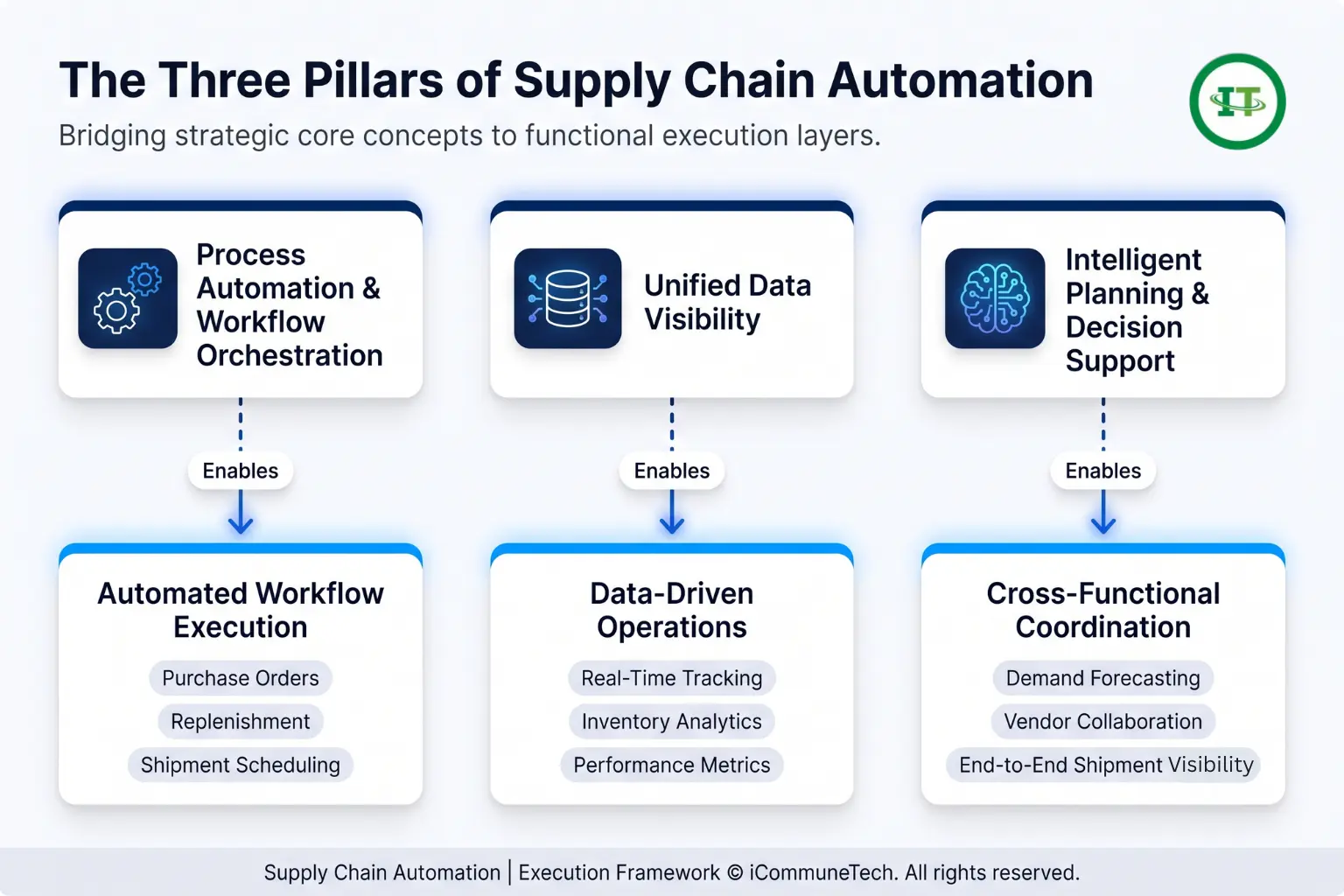
Compared with manual processes that rely on spreadsheets, emails, and repeated data entry, automated workflows improve accuracy, shorten cycle times, and create a stronger foundation for digital supply chain transformation.
How Do Automated Supply Chains Integrate With Existing Operations?
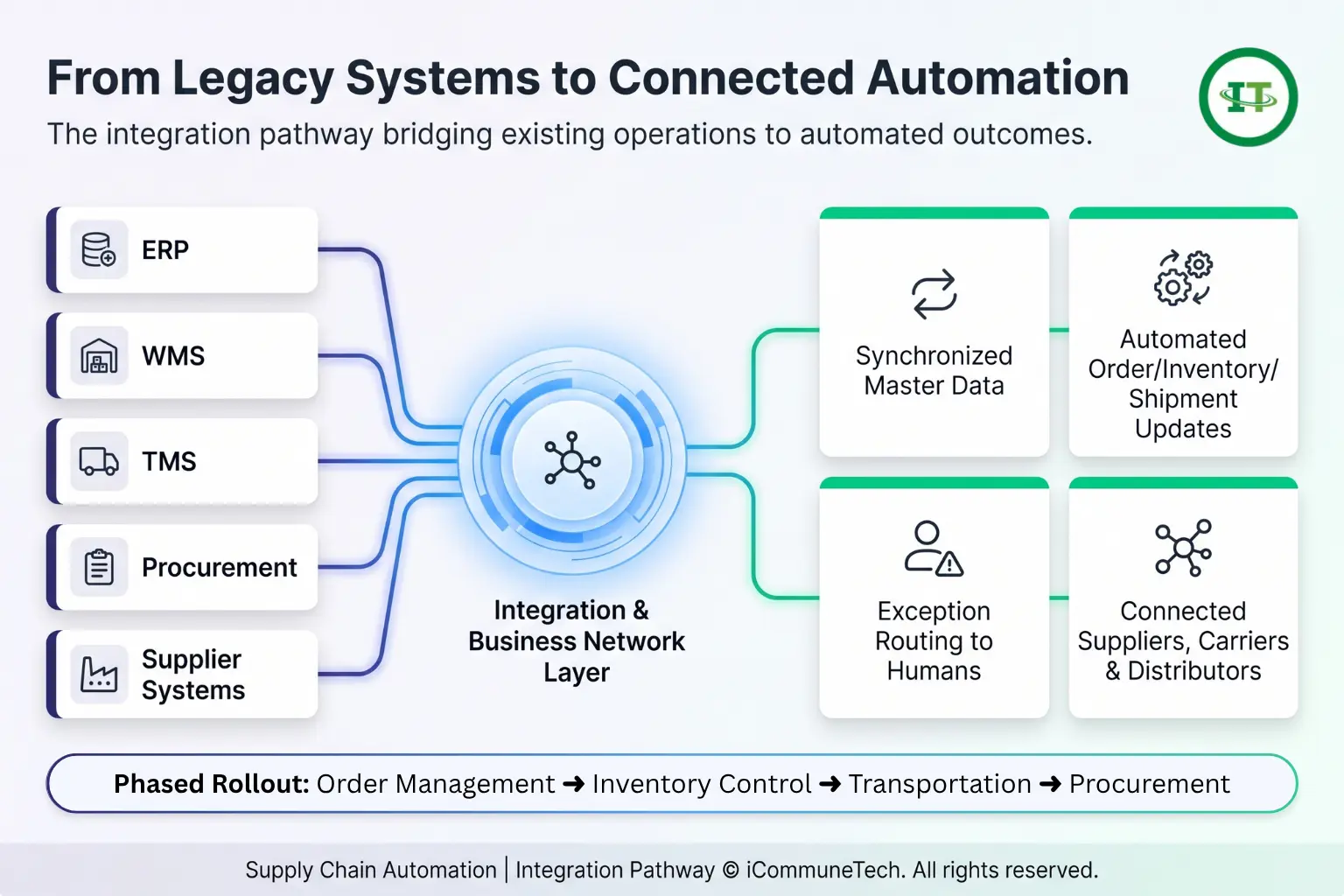
Most supply chain automation initiatives build on existing ERP, WMS, TMS, procurement, and supplier systems rather than replacing them. Integration enables inventory updates, shipment events, planning data, and business transactions to move automatically between applications, reducing duplicate work and improving data consistency.
According to IDC, by 2028, 50% of enterprise-scale supply chains will use business networks to achieve n-tier visibility, enabling organizations to improve disruption response speed by 25% through greater ecosystem-wide collaboration.
Many businesses begin by automating high-volume processes that create operational bottlenecks, including:
- Synchronizing master data across business applications
- Exchanging transactions between legacy and modern systems
- Automating order, inventory, and shipment updates
- Routing exceptions for human review
- Connecting suppliers, carriers, and distribution partners through shared workflows
A phased rollout—typically starting with order management, inventory control, transportation, or procurement—reduces implementation risk while preserving existing technology investments. As automation expands, businesses establish a stronger foundation for supply chain planning.
What Technologies Power Supply Chain Automation?
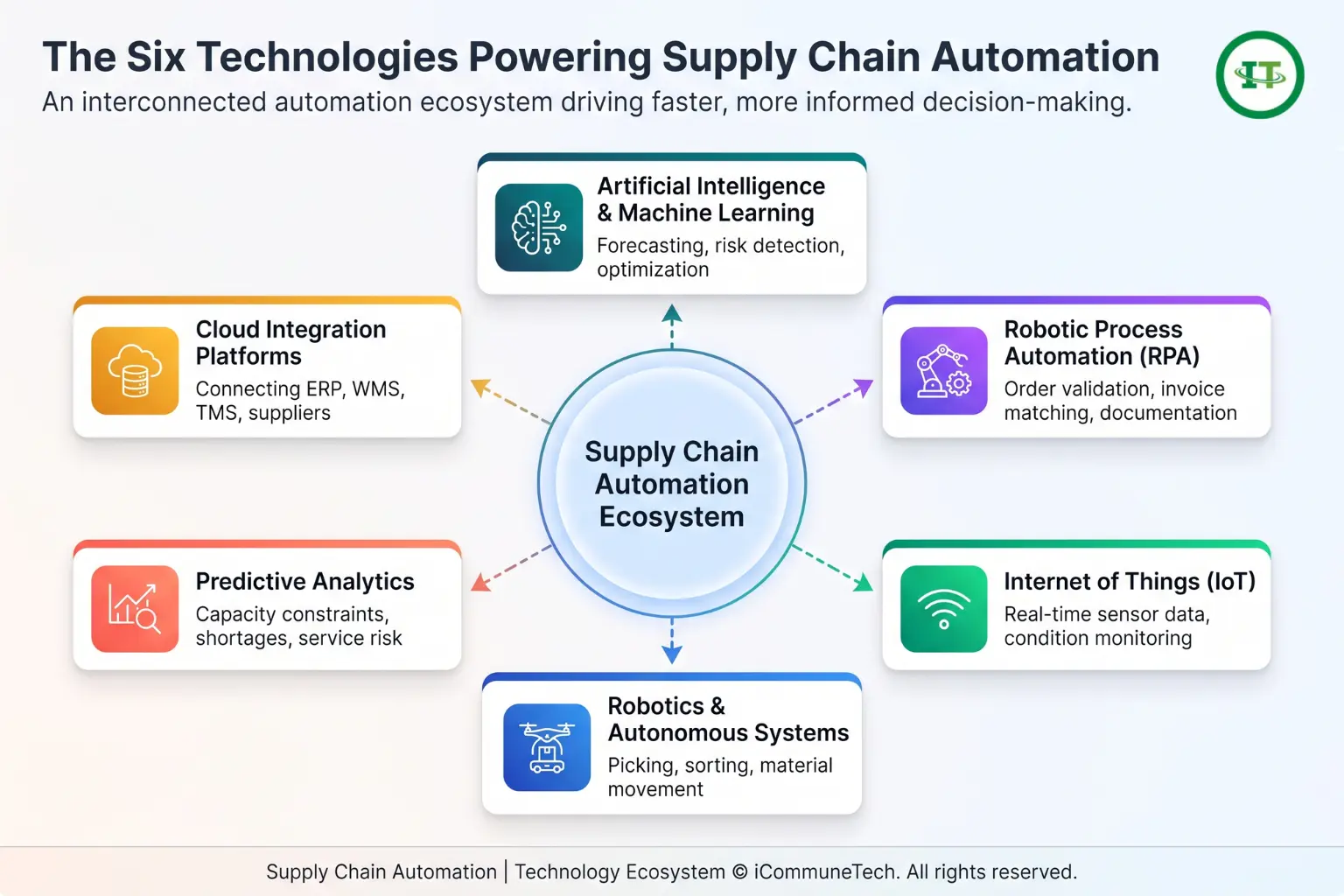
Supply chain automation relies on complementary technologies that automate routine work, improve decision-making, connect business systems, and provide real-time operational insights. Rather than operating independently, these technologies work together to streamline planning, inventory management, warehousing, transportation, and fulfillment.
Core Supply Chain Automation Technologies
Artificial Intelligence (AI) and Machine Learning
Analyze historical and real-time data to forecast demand, identify supply risks, optimize inventory, and recommend operational decisions.
Robotic Process Automation (RPA)
Automates repetitive, rules-based tasks such as order validation, invoice matching, shipment documentation, and master data updates.
Internet of Things (IoT)
Collects real-time data from vehicles, inventory, warehouse equipment, and facilities through connected sensors, enabling continuous monitoring and faster issue detection.
Robotics and Autonomous Systems
Automate warehouse activities including picking, sorting, storage, and internal material movement to improve throughput and reduce manual handling.
Predictive Analytics
Uses operational and historical data to identify capacity constraints, inventory shortages, service risks, and other issues before they affect business performance.
Cloud Integration Platforms
Connect ERP, WMS, TMS, suppliers, carriers, and other business applications so information moves securely between systems.
Each technology addresses a different aspect of supply chain operations, creating an automation ecosystem that supports faster, more informed decision-making.
How Do AI, Machine Learning, and Emerging Technologies Improve Supply Chain Performance?
AI and machine learning convert large volumes of operational data into recommendations that help businesses anticipate demand, optimize inventory, improve transportation planning, and respond to supply disruptions before they escalate.
According to McKinsey’s Supply Chain Risk Survey, only 19% of organizations have deployed AI tools at scale, highlighting significant opportunities to improve forecasting, inventory optimization, risk detection, and operational planning.
Common AI applications include:
- Forecasting seasonal and changing customer demand
- Optimizing inventory levels across locations
- Detecting supplier, transportation, and capacity risks
- Prioritizing orders based on inventory availability and delivery commitments
- Adjusting workflows in response to changing operating conditions
- Simulating supply chain scenarios using digital twins before implementation
When combined with demand planning software, these capabilities help businesses reduce stockouts, minimize excess inventory, improve capacity utilization, and respond more effectively to changing market conditions.
How Do Robotics, IoT, and RPA Automate Physical and Digital Supply Chain Workflows?
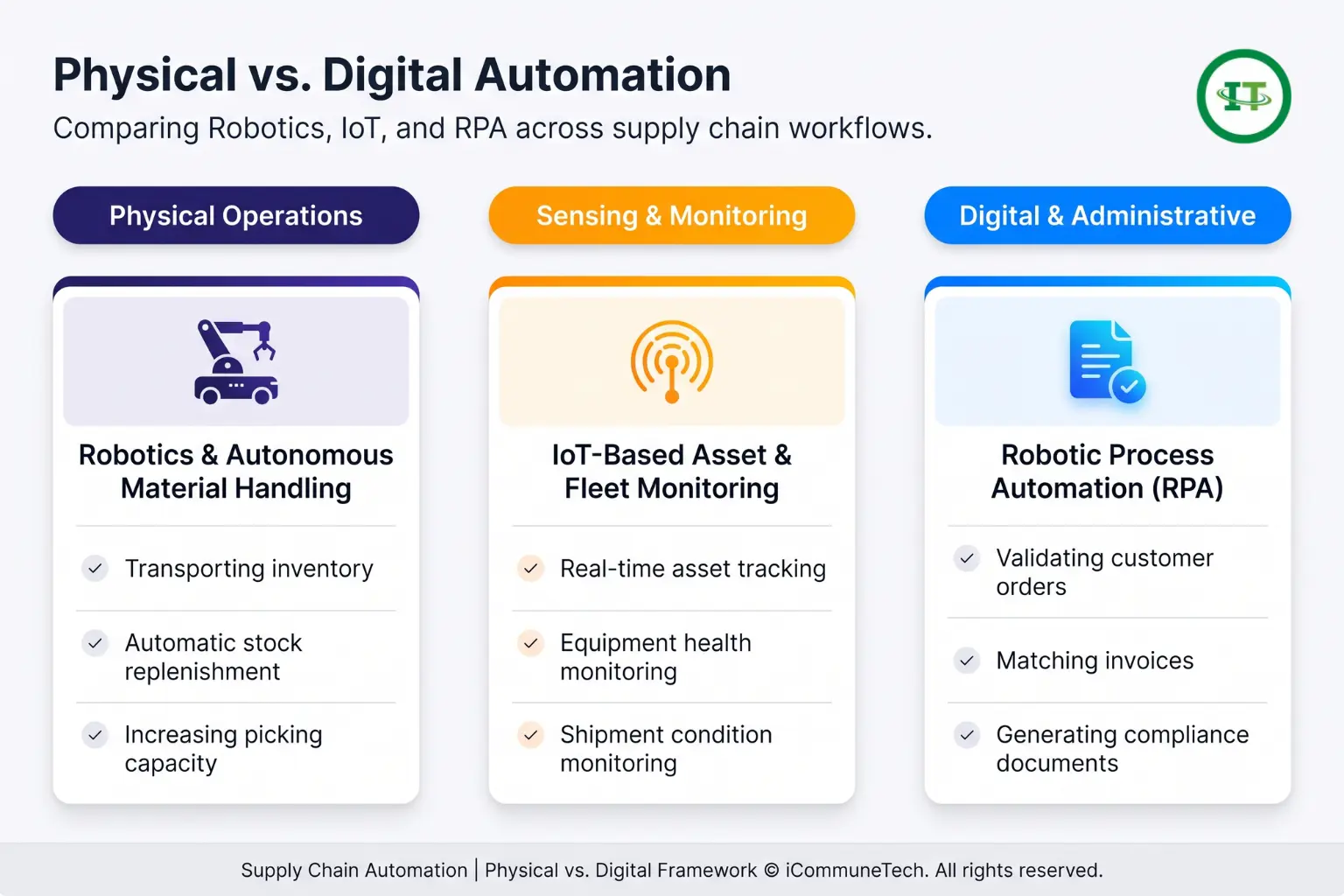
While AI improves planning and decision-making, robotics, IoT, and RPA automate day-to-day warehouse, transportation, and administrative activities. Together, they reduce manual effort while improving speed, consistency, and operational visibility.
Robotics and Autonomous Material Handling
Autonomous Mobile Robots (AMRs), Automated Guided Vehicles (AGVs), and Automated Storage and Retrieval Systems (ASRS) automate inventory movement inside warehouses and distribution centers.
Typical applications include:
- Transporting inventory between storage and picking locations
- Automatically replenishing warehouse stock
- Increasing picking capacity during peak demand
IoT-Based Asset and Fleet Monitoring
IoT sensors continuously monitor the location, condition, and utilization of inventory, vehicles, trailers, and warehouse equipment.
These sensors support:
- Real-time asset tracking
- Equipment health monitoring
- Shipment condition monitoring during transit
Robotic Process Automation (RPA)
RPA handles repetitive administrative processes without manual data entry.
Common use cases include:
- Validating customer orders
- Matching invoices with transactions
- Generating shipping and compliance documentation
As technologies continue to mature, autonomous warehouses, connected fleets, and touchless transaction processing are expanding automation across both physical operations and digital workflows.
How Does Supply Chain Automation Improve Operational Efficiency and Reduce Costs?
Supply chain automation improves productivity by eliminating repetitive manual work, shortening order cycle times, and helping teams use labor, inventory, and transportation assets more efficiently. Instead of relying on manual coordination, businesses automate routine workflows so employees can focus on exception handling and higher-value activities.
IBM reported reducing supply chain costs by USD 160 million through its cognitive supply chain initiative, driven by lower inventory costs, optimized shipping, faster decision-making, and time savings.
When combined with automated inventory systems, automation helps businesses maintain inventory accuracy while reducing carrying costs and replenishment delays.
Key operational improvements include:
- Automating routine transaction processing
- Eliminating repetitive data entry
- Accelerating order-to-fulfillment cycles
- Allocating labor and equipment based on demand
- Reducing inventory carrying costs through accurate replenishment
- Minimizing errors and rework
These improvements enable businesses to increase throughput while maintaining tighter control over operating costs.
How Does Supply Chain Visibility and Data Analytics Improve Decision-Making?
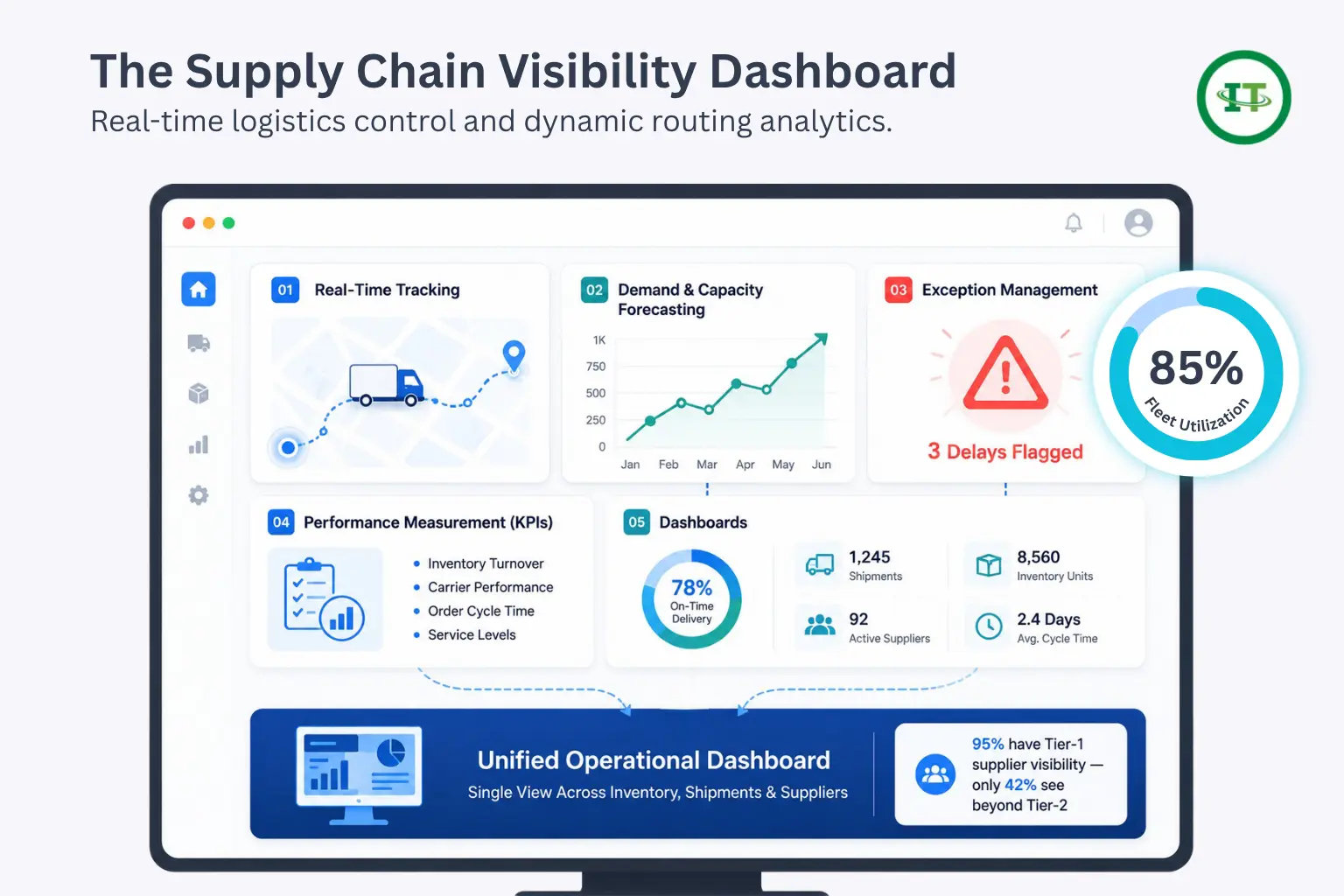
Automation becomes more valuable when businesses can monitor supply chain activity as it happens. Visibility and analytics consolidate inventory, transportation, supplier, and fulfillment data into dashboards that support faster operational decisions.
According to McKinsey, while 95% of companies have visibility into tier-one supplier risks, only 42% have visibility beyond tier two, highlighting the need for broader end-to-end visibility.
Modern analytics platforms help businesses:
Real-Time Tracking
Monitor inventory, shipments, and transportation activity across the supply chain.
Demand and Capacity Forecasting
Forecast inventory requirements and transportation capacity using historical and operational data.
Exception Management
Identify shipment delays, inventory shortages, supplier disruptions, and route deviations before they escalate.
Performance Measurement
Track KPIs such as inventory turnover, carrier performance, order cycle time, and service levels.
Operational Dashboards
Present supply chain metrics in a single view to support planning and resource allocation.
Rather than reacting to disruptions after they occur, businesses can identify issues earlier and make more informed operational decisions.
How Do Automation Platforms Support Supply Chain Management?
Supply chain automation software provides the infrastructure for managing inventory, transportation, procurement, fulfillment, and supplier collaboration. Whether deployed as enterprise software, SaaS, or custom solutions, the platform should align with operational complexity, integration requirements, and long-term business goals.
Deloitte helped a global biopharmaceutical company reduce the time required to convert supply chain data into actionable insights by 75% through data modernization and integrated visibility.
Key platform capabilities include:
Enterprise Integration
Connect ERP, WMS, procurement, supplier, and transportation management software to exchange information across business functions.
Workflow Automation
Standardize approvals, automate transactions, and manage process exceptions through configurable business rules.
Cloud Connectivity
Support secure information exchange between internal systems, suppliers, carriers, customers, and external trading partners.
How Should Organizations Choose Supply Chain Automation Software?
Selecting the right platform depends on business size, transaction volume, network complexity, and future growth plans. Rather than focusing only on features, organizations should evaluate how well the software fits existing operations and long-term digital transformation goals.
Key evaluation criteria include:
Integration
- ERP, WMS, and TMS connectivity
- Supplier and carrier integration
- API and EDI support
Scalability
- Multi-site deployment
- High transaction capacity
- Cloud, hybrid, or on-premises deployment
Governance and Analytics
- Workflow automation
- Reporting and performance dashboards
- Security, audit, and compliance controls
Cloud-Based vs. Custom Supply Chain Automation Platforms
Deployment strategy depends on how standardized or specialized supply chain operations are.
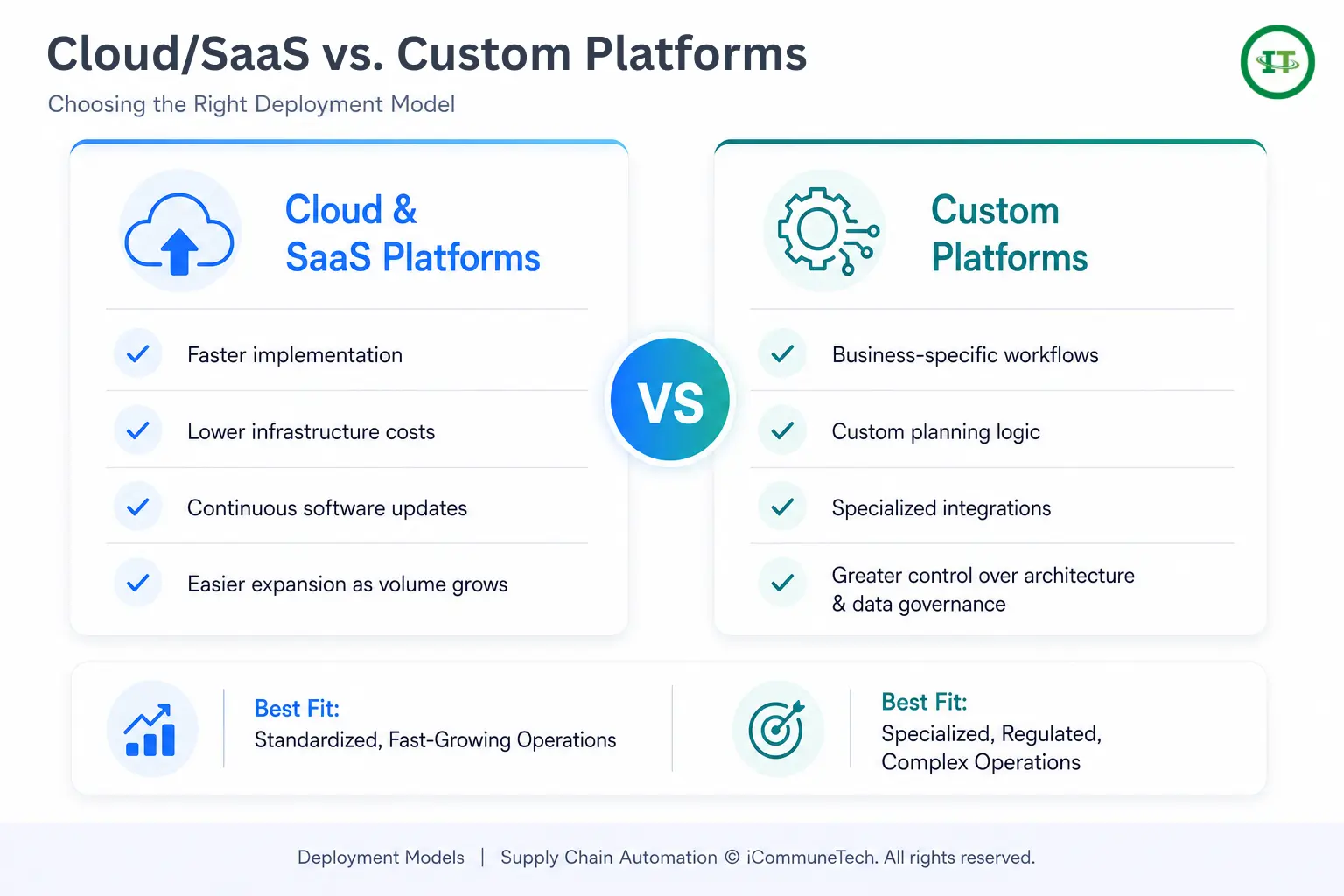
Cloud and SaaS Platforms
Cloud platforms are best suited for organizations seeking faster deployment, standardized processes, and easier scalability.
Typical advantages include:
- Faster implementation
- Lower infrastructure costs
- Continuous software updates
- Easier expansion as transaction volumes grow
Custom Platforms
Custom solutions are better suited to organizations with specialized fulfillment processes, transportation workflows, or regulatory requirements.
Typical advantages include:
- Business-specific workflows
- Custom planning logic
- Specialized integrations
- Greater control over architecture and data governance
Rather than asking which deployment model is better, businesses should select the option that best aligns with their operational requirements and growth strategy.
How Is Supply Chain Automation Applied Across Different Industries?
Although the underlying technologies are similar, automation priorities differ across industries based on operational challenges and service expectations.
| Industry | Primary Challenge | Common Automation Applications | Business Outcome |
|---|---|---|---|
| Retail | Inventory imbalance | Demand-driven replenishment, order orchestration | Higher inventory turnover |
| E-commerce | Peak order volumes | Automated order routing, fulfillment prioritization | Faster fulfillment |
| Manufacturing | Material shortages | Production scheduling, supplier collaboration | Reduced production delays |
| Warehousing & Distribution | Labor shortages | Robotics, ASRS, automated picking | Higher warehouse productivity |
The following sections examine how these approaches are applied in specific industries.
How Does Retail Order Processing Automation Improve Supply Chain Performance?
Retailers manage inventory across stores, warehouses, marketplaces, and e-commerce channels. Automation helps coordinate these fulfillment channels while improving order accuracy and inventory availability.
Order Processing
- Dynamic order routing
- Inventory-based allocation
- Faster order-to-ship processing
Inventory Planning
- Cross-channel inventory synchronization
- Demand-driven replenishment
- Stock optimization
Omnichannel Fulfillment
- Ship-from-store
- Buy Online, Pick Up In Store (BOPIS)
- Delivery partner coordination
These capabilities help retailers improve fill rates, reduce inventory imbalances, and deliver a more consistent omnichannel experience.
How Do Warehouse Automation and Autonomous Vehicles Improve Manufacturing Operations?
Manufacturers use warehouse automation to maintain material flow, reduce manual handling, and keep production running efficiently.
McKinsey reports that a regional grocery chain achieved 20% run-rate savings, a fourfold increase in productivity, and 15–20% faster response times after implementing warehouse automation.
Key applications include:
Automated Material Handling
- Automated picking and packing
- Continuous replenishment
- Reduced manual transport
Automated Storage and Retrieval
- High-density storage
- Faster inventory retrieval
- Improved inventory accuracy
Production Coordination
- Material availability planning
- Reduced production bottlenecks
- Multi-site coordination
When integrated with production scheduling software, warehouse automation helps manufacturers improve throughput while maintaining production continuity.
What Challenges and Integration Considerations Should Organizations Address in Supply Chain Automation?
Implementing supply chain automation involves more than deploying new technology. Businesses must address data quality, legacy systems, process consistency, workforce adoption, and security to ensure automated workflows perform reliably across the supply chain.
Common implementation challenges include:
- Inconsistent master data
- Legacy ERP, WMS, and TMS integration limitations
- Fragmented business processes
- Workforce adoption and change management
- Security and regulatory compliance
- Supplier and partner connectivity
Many of these challenges stem from technology environments that have evolved over time through acquisitions, regional expansion, or independent software deployments. Addressing them early reduces implementation risk and improves long-term scalability.
What Data Challenges and System Integration Obstacles Affect Supply Chain Automation?
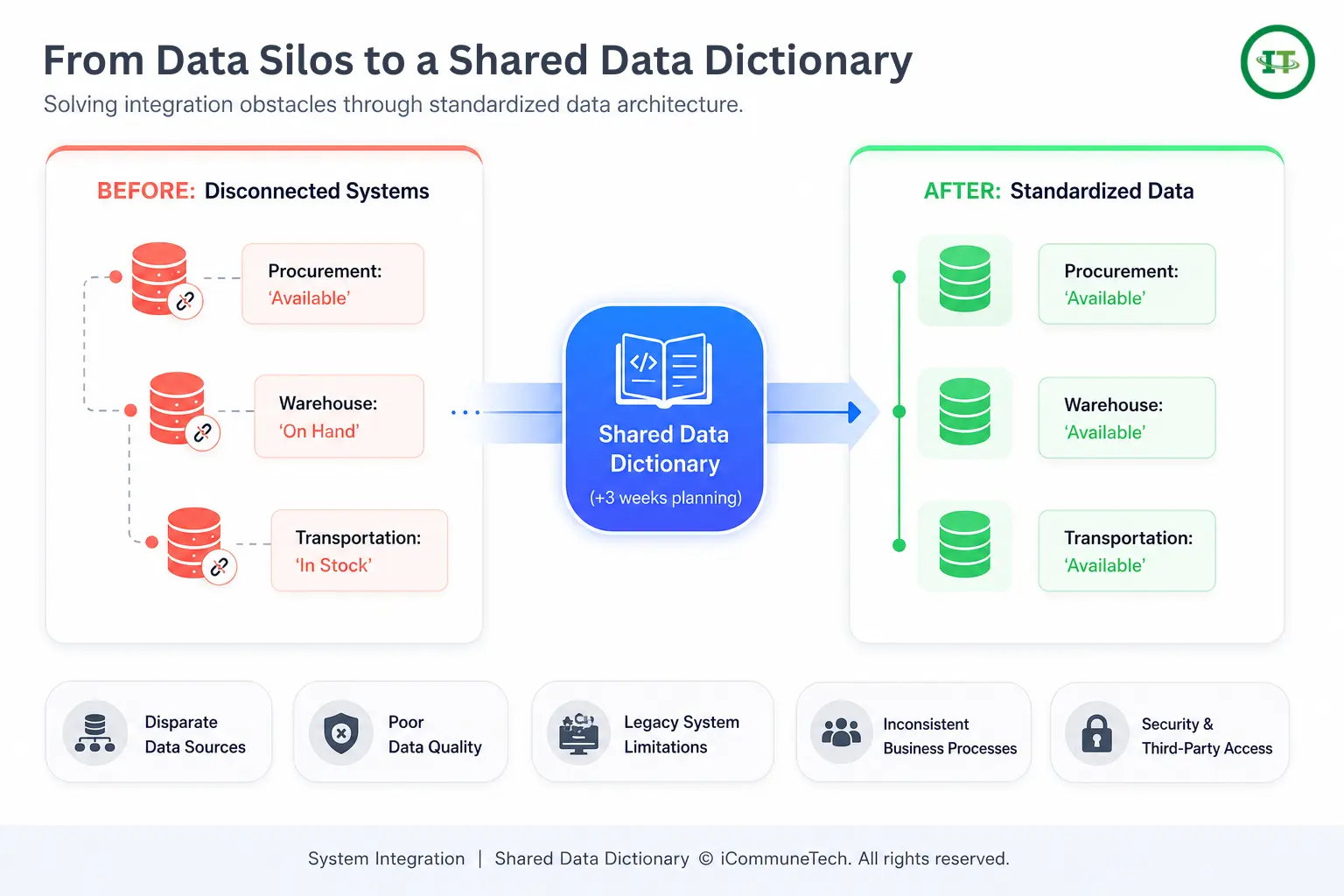
Early in one multi-system integration project, business teams discovered that the same inventory field represented different values across procurement, warehouse, and transportation systems.
Before any integration work began, they created a shared data dictionary that standardized definitions for products, locations, suppliers, and inventory statuses. Although this added three weeks to the planning phase, it reduced testing effort and prevented conflicting transactions after deployment.
This example highlights one of the most common obstacles in supply chain automation: automated workflows are only as reliable as the data they rely on. When systems store inconsistent or incomplete information, integration becomes more complex and automation loses accuracy.
The most common data and integration challenges include:
Disparate Data Sources
ERP, WMS, TMS, procurement, supplier, and customer systems often store information independently, creating data silos that limit end-to-end visibility.
Poor Data Quality
Duplicate records, inaccurate inventory balances, and inconsistent master data increase transaction errors and reduce automation accuracy.
Legacy System Limitations
Older applications may lack APIs, modern integration standards, or real-time data exchange capabilities, making connectivity more complex.
Inconsistent Business Processes
Different operating procedures across locations or departments make it difficult to standardize automated workflows.
Security and Third-Party Access
As more suppliers, carriers, and external partners connect to business systems, protecting data and controlling user access become increasingly important. Implementing supply chain security frameworks helps safeguard information while supporting secure collaboration.
Businesses that establish data standards and consistent integration practices before implementation are better positioned to expand automation without creating additional operational complexity.
How Does Workforce Adaptation and Change Management Affect Supply Chain Automation Success?
Successful automation depends on people as much as technology. Employees need to understand new workflows, develop digital skills, and adapt to changing responsibilities as routine tasks become automated.
Evolving Workforce Roles
Automation shifts employees away from repetitive transaction processing toward activities that require judgment and oversight, including:
- Managing operational exceptions
- Monitoring automated workflows
- Analyzing operational performance
Skills Development
Training helps employees use automation platforms effectively and interpret operational data with confidence.
Key focus areas include:
- Platform and process training
- Data analysis and interpretation
- Digital workflow management
Organizational Alignment
Automation delivers more consistent results when business units, suppliers, and logistics partners follow standardized processes.
This may include:
- Standard operating procedures
- Supplier collaboration through a vendor management system
- Clearly defined governance and change management responsibilities
Preparing employees alongside technology investments accelerates adoption, reduces disruption during implementation, and improves the long-term value of supply chain automation.
What Trends Are Shaping the Future of Supply Chain Automation?
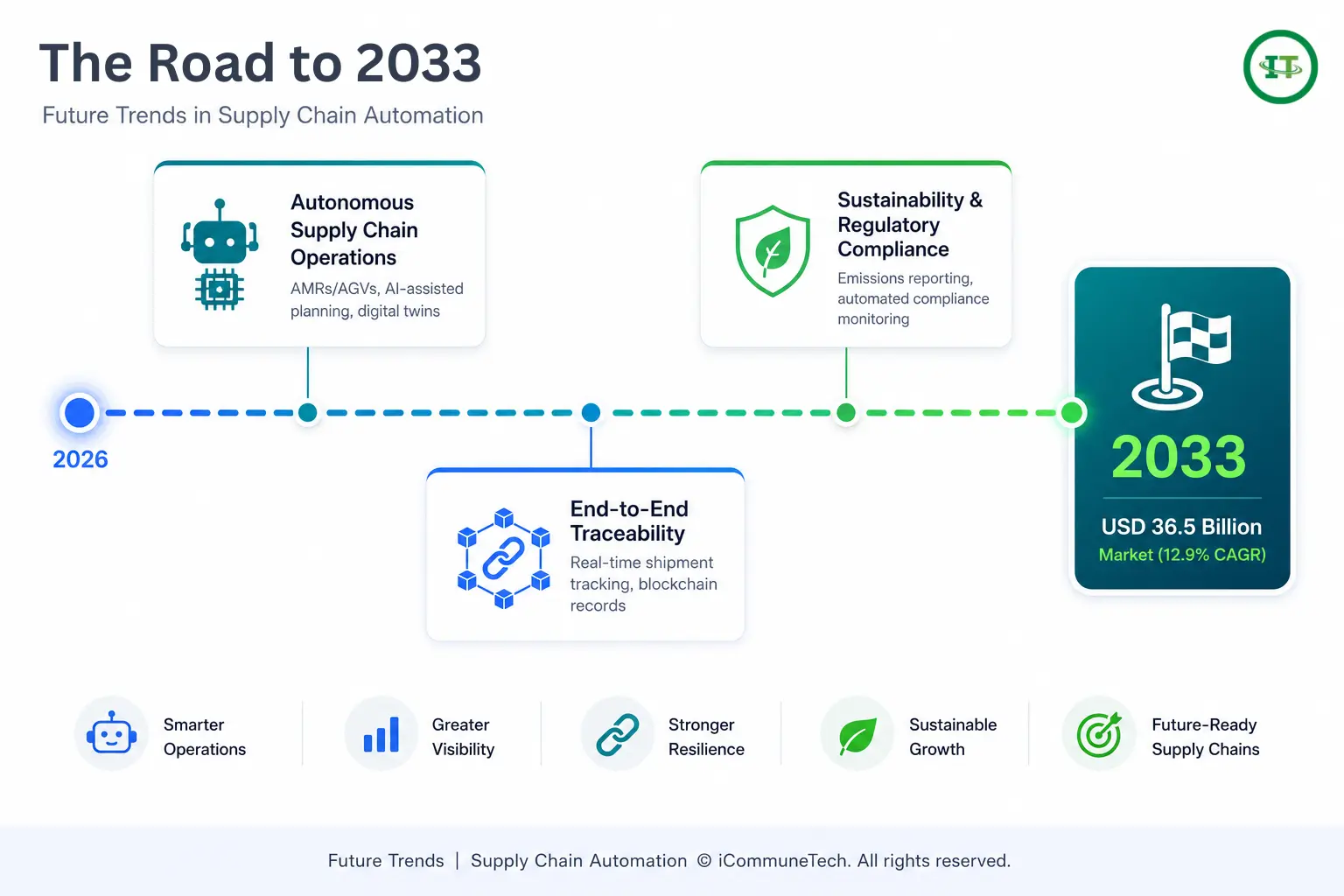
The next phase of supply chain automation focuses on greater autonomy, deeper ecosystem connectivity, and increased regulatory accountability. As AI capabilities mature and connected technologies become more accessible, businesses are shifting from automating individual tasks to orchestrating end-to-end supply chain operations with minimal manual intervention.
According to Future Market Report, the global supply chain automation market is projected to reach USD 36.5 billion by 2033, growing at a 12.9% CAGR from 2026 to 2033, driven by broader adoption of AI, IoT, robotics, and intelligent supply chain solutions.
1. Autonomous Supply Chain Operations
AI, digital twins, and autonomous systems are moving beyond decision support to automate planning and execution across warehouses, transportation, and fulfillment.
Examples include:
- Autonomous Mobile Robots (AMRs) and Automated Guided Vehicles (AGVs)
- AI-assisted operational planning
- Digital twins for scenario modeling and optimization
2. End-to-End Traceability
Businesses are investing in technologies that provide greater visibility into product movement, supplier activity, and logistics events throughout multi-tier supply networks.
Examples include:
- Real-time shipment event tracking
- End-to-end product traceability
- Blockchain supply chain platforms for verifiable transaction records
3. Sustainability and Regulatory Compliance
Automation platforms increasingly capture environmental and operational data to simplify reporting and demonstrate compliance with evolving regulations.
Common applications include:
- Emissions reporting
- Automated compliance monitoring
- Continuous operational risk monitoring
Rather than simply automating individual workflows, these trends are expanding automation into enterprise-wide planning, governance, and decision-making.
How Are Autonomous Vehicles and IoT Creating Smarter Supply Chains?
Autonomous vehicles and IoT are transforming transportation by continuously collecting and sharing operational data from vehicles, equipment, inventory, and logistics infrastructure. This information helps logistics teams improve fleet utilization, optimize routing, and respond more quickly to changing operating conditions.
Working alongside IoT-enabled fleet management systems, these technologies support several emerging capabilities.
Autonomous Transportation
Autonomous and driver-assistance technologies streamline freight movement and yard operations through:
- Autonomous yard management
- Driver-assistance and self-navigation systems
- Reduced vehicle dwell times
Connected Asset Monitoring
IoT sensors continuously monitor assets throughout transportation networks by providing:
- Utilization tracking
- Equipment health monitoring
- Real-time asset status updates
Adaptive Fleet Operations
Live operational data allows businesses to adjust transportation plans as conditions change.
Examples include:
- Dynamic route optimization
- Predictive maintenance scheduling
- Capacity balancing across transportation networks
As these technologies mature, they will improve shipment reliability, increase asset utilization, and support more responsive transportation operations.
How Does Automation Support Supply Chain Sustainability and Transparency?
Automation helps businesses measure, document, and verify supply chain activities by embedding traceability and compliance into everyday operations. Reliable operational data supports environmental reporting, supplier accountability, and regulatory compliance without increasing manual administrative work.
Supported by supply chain compliance practices, automation enables organizations to:
- Reduce excess inventory and material waste
- Optimize transportation to lower fuel consumption
- Generate compliance reports automatically
- Maintain digital audit trails
- Monitor supplier compliance
- Verify sourcing activities through traceable records
By improving transparency and data accuracy, automation helps businesses meet environmental and regulatory requirements while building greater trust across the supply chain.
How Should Organizations Measure Supply Chain Automation ROI and Performance?
The success of supply chain automation should be measured by measurable business outcomes rather than the number of automated processes deployed. Comparing performance before and after implementation helps businesses determine whether automation is improving efficiency, reducing costs, and strengthening service performance.
Performance should be evaluated using KPIs that align with business objectives, including inventory optimization, fulfillment efficiency, and transportation performance.
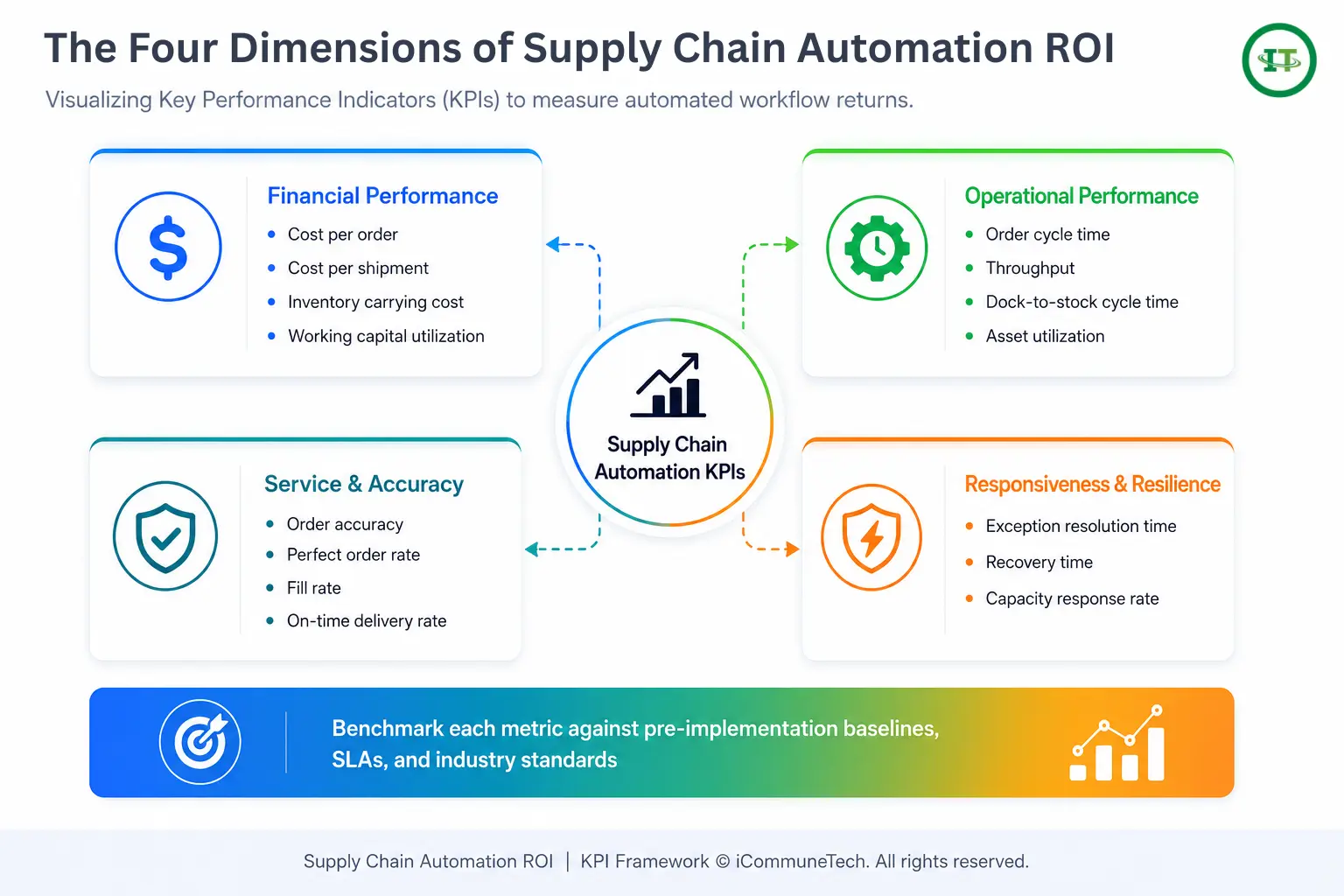
Core Supply Chain Automation Performance Metrics
Financial Performance
Measures the financial impact of automation on operating costs and capital utilization.
- Cost per order
- Cost per shipment
- Inventory carrying cost
- Working capital utilization
Operational Performance
Evaluates how efficiently supply chain activities are completed.
- Order cycle time
- Throughput
- Dock-to-stock cycle time
- Asset utilization
Service and Accuracy
Measures fulfillment quality and customer service performance.
- Order accuracy
- Perfect order rate
- Fill rate
- On-time delivery rate
Responsiveness and Resilience
Assesses how quickly operations adapt to disruptions or demand fluctuations.
- Exception resolution time
- Recovery time
- Capacity response rate
Benchmark Performance Against Business Goals
Track KPI improvements against pre-implementation baselines, service-level agreements (SLAs), and industry benchmarks. Prioritize metrics that demonstrate measurable business value, such as lower operating costs, shorter cycle times, improved inventory efficiency, and higher customer service levels.
Regular performance reviews help identify new automation opportunities while ensuring existing workflows continue to deliver measurable returns.
What Best Practices Improve Supply Chain Automation Implementation Success?
Successful automation programs combine clear business objectives with a phased implementation strategy. Rather than automating every process at once, businesses achieve better results by prioritizing high-impact workflows, validating performance, and expanding automation as measurable value is achieved.
Key implementation practices include:
Prioritize High-Impact Processes
Start with workflows that have the greatest effect on fulfillment, inventory, procurement, or transportation performance.
Deploy Incrementally
Use pilot projects and phased rollouts to validate processes, reduce implementation risk, and encourage user adoption.
Prepare Data and System Integration
Establish data standards, integration requirements, and system architecture before deployment to minimize connectivity issues.
Select the Right Technology Partner
Choose software and implementation partners based on operational fit, scalability, industry experience, and long-term support. Solutions that complement procurement process optimization can further improve sourcing and supplier collaboration.
Establish Governance and KPIs
Define ownership, decision-making responsibilities, and success metrics before implementation begins.
Continuously Optimize
Review performance regularly, refine workflows, and expand automation where measurable business improvements are achieved.
Successful automation is an ongoing improvement initiative rather than a one-time technology project. Continuous measurement and optimization help businesses maximize long-term value from their supply chain investments.
A recent engagement illustrates why custom supply chain software often delivers greater long-term value than isolated automation tools. A regional manufacturing company, a manufacturing organization, needed to connect its ERP, WMS, TMS, and supplier workflows without replacing existing systems.
Rather than introducing another standalone application, we designed integrations that automated information flow between the platforms while preserving established business processes.
The phased rollout prioritized purchase order and inventory synchronization, followed by warehouse fulfillment and transportation planning, allowing operational teams to validate results before expanding automation.
This incremental approach reduced implementation risk while creating a scalable foundation for future AI-driven planning and workflow optimization.
Transform Your Supply Chain with iCommuneTech
Whether you’re automating inventory management, transportation, warehousing, procurement, or end-to-end supply chain operations, iCommuneTech develops tailored supply chain software that aligns with your business goals and existing technology landscape.
Explore a supply chain automation solution designed to improve efficiency, increase visibility, and support long-term growth.
Talk to our team
Irshad Pathan

Web Development Expert
Irshad is a senior technical expert at iCommuneTech. He manages the iCommuneTech's Web Development Team, and has hands-on expertise in web development, Laravel development, Logistics, fleet management, and Supply Chain Management. He mentors the in-house team and enjoys describing his experience in words.
Read More Insights By Irshad →