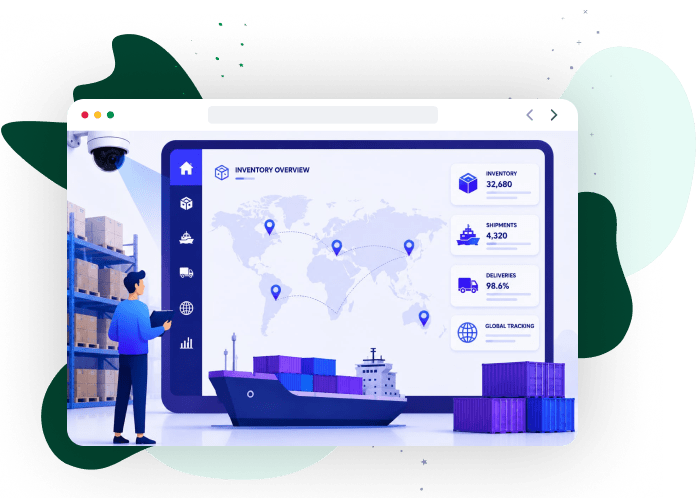
Organizations use analytics to identify risks, improve forecast accuracy, reduce disruptions, and strengthen operational control. This guide explores the key features, analytics types, business benefits, integration requirements, ROI considerations, and use cases that help supply chain leaders improve performance and make informed decisions.

Execute demand planning, inventory control, and logistics optimization with iCommuneTech’s supply chain analytics implementation.
Go for ImplementationWhat Is Supply Chain Analytics?
Supply chain analytics is the process of analyzing supply chain data to improve forecasting, inventory management, logistics planning, sourcing decisions, and overall operational performance.
It helps organizations replace manual planning and disconnected decision-making with data-driven insights that support inventory, production, sourcing, and logistics activities.
The following 3 core operations define how supply chain analytics works:
Data Integration and Standardization
Data pipelines capture transactions from ERP, WMS, and logistics systems and standardize formats to create a consistent dataset for modeling.
Model Execution and Decision Calculation
Forecasting models estimate demand, optimization engines calculate inventory policies, and KPI frameworks measure service levels and cost performance.
Action Triggering and Execution Alignment
Execution engines trigger replenishment orders, production schedules, and transport plans based on model outputs and predefined constraints.
Supply chain management software structures this pipeline by synchronizing transactions, enforcing data consistency, and aligning planning outputs with execution workflows. Poor data synchronization increases forecast error, excess inventory, and delivery delays.
Supply chain analytics replaces reactive decision-making with calculated planning, constraint evaluation, and scenario simulation that control sourcing, production, and distribution outcomes.
What Are the Types of Supply Chain Analytics: 4 vs 5 Models?
Supply chain analytics is commonly categorized into four or five models: descriptive, diagnostic, predictive, prescriptive, and cognitive analytics, with the fifth model adding automated decision-making capabilities.
The key difference between the four-model and five-model framework lies in how decisions are executed.
- 4 models (descriptive to prescriptive) calculate insights and recommended actions for human approval
- Cognitive analytics executes decisions by updating rules based on real-time feedback
The table below defines 5 analytics types by system action, operational role, and decision outcome:
| S. No. | Analytics Type | Core Function | Operational Role | Decision Impact |
|---|---|---|---|---|
| 1 | Descriptive Analytics | Consolidates transactional data into reports | Tracks inventory movement, order status, and transport execution | Establishes baseline performance metrics |
| 2 | Diagnostic Analytics | Analyzes variance and isolates root causes | Detects supplier delays, process bottlenecks, and execution failures | Identifies causes and guides corrective actions |
| 3 | Predictive Analytics | Forecasts demand and variability using statistical models | Projects demand patterns, replenishment cycles, and capacity needs | Improves planning accuracy and risk anticipation |
| 4 | Prescriptive Analytics | Calculates optimal decisions using constraint-based models | Allocates inventory, sequences production, and optimizes distribution | Generates cost- and service-level optimized actions |
| 5 | Cognitive Analytics | Learns from execution data and updates decision rules | Adjusts planning parameters based on real-time outcomes | Automates decisions and improves system adaptability |
Analytical capability advances from performance tracking to automated decision execution as systems integrate data, apply optimization models, and update decision rules dynamically within broader supply chain digital transformation strategies.
Driving Measurable Results Across Industries
From automating manual calculations to modernizing legacy infrastructure, we build software that directly impacts the bottom line. Our custom solutions consistently reduce operational costs and accelerate process efficiency.
View Our Case Studies
What Are the 5 C’s of Supply Chain Analytics?
The 5 C’s of supply chain analytics are Connection, Collaboration, Cyber Awareness, Cognition, and Configuration, which together help organizations improve visibility, coordination, security, decision-making, and adaptability across the supply chain.
Together, these capabilities create a connected analytics environment that improves visibility, execution control, and operational responsiveness.
Connection
Connection integrates ERP, WMS, TMS, and partner platforms into a unified data pipeline. It synchronizes inventory, order, supplier, and logistics data to maintain consistent planning inputs across systems.
Collaboration
Collaboration aligns procurement, inventory, logistics, and supplier activities through shared planning signals and execution data. Coordinated workflows reduce delays, improve replenishment timing, and strengthen operational alignment between internal teams and external partners.
Cyber Awareness
Cyber awareness helps organizations monitor transaction activity, control system access, and strengthen security across supply chain platforms. It protects operational data, reduces unauthorized access risk, and maintains execution continuity.
Cognition
Cognition applies machine learning models to demand signals, operational events, and execution patterns. These models identify anomalies, predict disruptions, and detect shifts in demand, inventory, and logistics conditions before service levels are affected.
Configuration
Configuration adjusts planning parameters, inventory policies, routing rules, and workflow conditions based on operational constraints and execution feedback. This flexibility enables supply chain systems to adapt to changing demand, supply variability, and network conditions.
Integrated supply chain visibility tracks inventory movement, order status, and logistics execution in real time so teams can detect disruptions early and align planning with operational execution.
When Should You Use Each Type of Supply Chain Analytics?
The 5 C’s of supply chain analytics help organizations improve data connectivity, collaboration, security, intelligence, and adaptability across supply chain operations.
When combined with supply chain visibility, these capabilities help organizations improve coordination, strengthen decision-making, and respond more effectively to operational changes.
Connection and Unified Data Flow
Connection brings together ERP, WMS, TMS, and partner systems to create a shared and reliable supply chain data environment.
This shared data foundation helps maintain consistent information across inventory, logistics, procurement, and order management processes.
- ERP, WMS, and TMS synchronization
- Unified inventory and logistics data
- Consistent planning inputs
- Cross-system transaction visibility
Collaboration and Coordinated Execution
Collaboration aligns planning signals and operational workflows between internal teams, suppliers, and logistics partners. Shared execution visibility improves replenishment coordination and reduces operational delays.
Cyber Awareness and Operational Security
Cyber awareness validates transactions, monitors access activity, and enforces security controls across supply chain systems. These controls reduce operational disruption and protect critical supply chain data.
- Transaction validation controls
- Access monitoring and governance
- Operational security enforcement
- Reduced system disruption risk
Cognition and Predictive Intelligence
Cognition applies machine learning models to demand signals, execution events, and operational patterns. These models identify anomalies, forecast disruptions, and detect supply variability early.
Demand signal analysis
Anomaly and disruption detection
Predictive operational insights
Early supply risk identification
Configuration and Adaptive Planning
Configuration adjusts planning parameters, inventory policies, and routing logic based on operational constraints and execution feedback. Adaptive configuration enables faster response to changing network conditions.
What Is Descriptive Analytics in Supply Chain?
Descriptive analytics in supply chain management uses historical and real-time data to measure, monitor, and report operational performance across inventory, orders, warehousing, and logistics activities.
Integrated with inventory database systems, it provides visibility into transaction activity, service levels, and execution status without predicting future outcomes or identifying root causes.
Core Operational Functions
Descriptive analytics structures operational visibility through four primary functions:
- Transaction logging captures inventory, order, and transport activity across supply chain systems
- KPI measurement calculates metrics such as fill rate, inventory turnover, and delivery accuracy
- BI dashboards display warehouse, order, and logistics execution through centralized reporting interfaces
- Period analysis compares operational performance across defined time intervals to identify execution trends
Business and Operational Impact
These capabilities improve operational monitoring, reporting consistency, and execution visibility across supply chain workflows.
- Centralized operational reporting
- Real-time inventory and logistics visibility
- Faster performance monitoring
- Improved service-level tracking
- Better execution transparency
Why Does Diagnostic Analytics Matter for Root Cause Discovery in Supply Chains?
Diagnostic analytics helps organizations identify the root causes of supply chain disruptions by analyzing issues across suppliers, inventory, warehousing, transportation, and order fulfillment processes.
Integrated with supply chain automation systems, it traces delays, bottlenecks, and service disruptions to specific operational causes so organizations can apply targeted corrective actions.
Core Diagnostic Functions
Pattern Detection and Variance Analysis
Diagnostic models compare supplier activity, logistics flows, and demand signals to detect recurring disruptions, execution inconsistencies, and abnormal operational patterns.
- Demand and logistics variance tracking
- Delay and bottleneck identification
- Operational anomaly detection
- Cross-system performance analysis
Root-Cause Isolation
Analysis engines trace deviations to operational causes such as supplier lead-time variability, warehouse processing delays, routing inefficiencies, or inventory imbalance.
- Supplier performance evaluation
- Warehouse delay analysis
- Routing inefficiency detection
- Inventory imbalance identification
Disruption Classification and Impact Measurement
Classification models categorize disruptions as supply, process, capacity, or logistics issues while measuring their impact on service levels and delivery performance.
- Disruption source classification
- Service-level impact analysis
- Delivery-risk assessment
- Operational impact quantification
Operational Outcome
Diagnostic analytics helps organizations respond faster to supply chain issues by identifying recurring failure points and supporting corrective actions such as supplier switching, inventory reallocation, and route reassignment.
What Is Predictive Analytics in Supply Chain Management?
Predictive analytics in supply chain management uses historical and real-time data to forecast future events such as demand spikes, inventory shortages, and shipment delays before they impact operations.
It analyzes historical and real-time data to estimate demand, lead-time variability, and service risk so organizations can plan inventory, production, and logistics more accurately.
Predictive analytics typically relies on four core models to generate forecasts and support planning decisions:
| Model Type | System Action | Operational Outcome |
|---|---|---|
| Demand Forecasting | Analyzes historical sales and external signals to estimate future demand | Produces SKU-level forecasts for replenishment and production planning |
| Lead-Time Estimation | Models supplier and transit variability using historical delivery data | Predicts lead-time ranges to improve scheduling accuracy |
| Inventory Positioning | Simulates demand variability and service targets | Calculates safety stock and reorder levels to prevent stockouts |
| Disruption Prediction | Detects anomalies in supply and transport data | Flags potential delays and network risks before they occur |
Predictive analytics generates performance metrics such as forecast bias, mean absolute percentage error (MAPE), and service-level attainment, helping organizations refine inventory buffers, production schedules, and transportation plans.
Supply chain analytics-driven planning can increase revenue by up to 3–4%, according to McKinsey. It reflects improved demand sensing and execution performance in analytics-enabled supply chains.
Integration with demand planning software enables rolling forecast updates, scenario testing, and alignment between plan releases and execution schedules.
What Is the Impact of Prescriptive and Cognitive Analytics in Supply Chains?
Prescriptive and cognitive analytics help organizations reduce costs, improve service levels, respond faster to disruptions, and automate supply chain decision-making.
Prescriptive analytics identifies the best course of action by evaluating constraints such as cost, capacity, inventory availability, and service-level targets. Cognitive analytics learns from execution data and updates decision rules automatically.
These two advanced analytics models help organizations optimize and automate supply chain decisions:
| Analytics Type | System Action | Operational Application | Business Impact |
|---|---|---|---|
| 1. Prescriptive Analytics | Calculates optimal plans using constraint-based optimization | Allocates inventory, schedules production, and routes shipments based on cost and capacity | Reduces cost and improves service-level performance |
| 2. Cognitive Analytics | Updates decision rules using machine learning and execution feedback | Adjusts routing, replenishment, and allocation based on real-time conditions | Enables autonomous decision-making and continuous improvement |
5–10% cost reduction results from optimization-driven planning and execution in advanced supply chains, as reported by McKinsey.
Prescriptive analytics helps organizations choose the most effective inventory, production, and transportation actions based on current business constraints and objectives.
Cognitive analytics improves decision quality over time by learning from actual outcomes and continuously refining decision rules.
Supply chain AI automation executes these decisions by triggering workflows such as rerouting shipments, adjusting inventory levels, and updating supply plans.
What Are the Key Applications and Use Cases of Supply Chain Analytics?
Supply chain analytics improves planning accuracy, inventory control, logistics execution, and sourcing performance by reducing demand variability, delivery delays, excess inventory, and supplier risk.
Demand Forecasting and Regional Planning
Forecasting models analyze historical sales patterns and external demand signals to align replenishment with regional demand and seasonal consumption trends.
Inventory Rebalancing Across Distribution Networks
Inventory optimization models identify stock imbalances across warehouses and distribution nodes to improve service levels while reducing excess inventory and carrying costs.
Transport Allocation and Route Optimization
Routing engines assign shipments based on cost, capacity, and transit performance through transportation management software to improve logistics efficiency and reduce delivery delays.
Disruption Detection and Response Management
Monitoring systems detect supplier delays, transport disruptions, and execution exceptions to trigger alternate sourcing and route reassignment workflows.
Supplier Performance and Sourcing Optimization
Supplier analytics models evaluate lead-time consistency, delivery accuracy, and sourcing reliability to improve procurement decisions and reduce supply risk.
These analytics capabilities coordinate planning, inventory, logistics, and sourcing decisions across supply chain operations.
Better visibility and data-driven decision-making help organizations improve service levels, respond faster to disruptions, and maintain stronger cost control across supply chain operations.
What Is Demand Forecasting and Planning in Supply Chains?
Demand forecasting and planning estimate future demand, calculate inventory requirements, and align procurement, production, and distribution decisions with expected consumption patterns. These systems use historical transactions, real-time demand signals, and statistical forecasting models to reduce stockouts, excess inventory, and planning inefficiencies.
The following 6 forecasting capabilities define how demand planning systems generate forecasts and execution decisions:
- Baseline demand modeling analyzes historical sales patterns to establish SKU-level demand forecasts
- External signal integration incorporates pricing trends, promotions, seasonality, and market indicators into forecast calculations
- Real-time demand adjustment updates forecasts using recent orders, POS activity, and short-term consumption signals
- Forecast accuracy measurement calculates MAPE, forecast bias, and variance metrics to evaluate planning reliability
- Scenario simulation models demand variability and capacity constraints under different operational conditions
- Forecast-to-execution alignment converts demand forecasts into procurement, production, replenishment, and distribution actions
Analytics-driven demand planning can reduce lost sales by up to 75%, according to McKinsey.
Integrated demand planning solutions synchronize forecast updates, manage plan versions, and connect demand signals with operational execution schedules.
What Is Inventory Optimization and Cost Reduction in Supply Chains?
Inventory optimization and cost reduction in supply chains involve maintaining the right inventory levels, improving replenishment decisions, and reducing inventory-related costs while meeting customer demand and service-level targets.
Integrated with inventory optimization systems, these analytics models improve inventory positioning, replenishment accuracy, and stock utilization across warehouses and distribution nodes.
Echelon-Based Inventory Allocation
Optimization models distribute inventory across upstream and downstream locations using lead-time variability and network demand patterns.
- Multi-node inventory balancing
- Lead-time-based allocation
- Reduced excess inventory
- Improved stock utilization
Service-Level Constrained Buffer Design
Inventory models calculate safety stock using demand variability and target service levels to reduce stockout risk while limiting excess inventory.
- Safety stock optimization
- Service-level alignment
- Reduced stockout exposure
- Lower excess inventory
Replenishment Policy Structuring
Planning engines define reorder points, replenishment frequency, and lot sizes using demand patterns and supply constraints.
- Reorder point calculation
- Replenishment cycle control
- Lot-size optimization
- Controlled inventory flow
Inventory Flow Monitoring
Tracking systems monitor inbound, on-hand, and outbound inventory to maintain supply-demand balance across warehouses and distribution networks.
- Inventory movement visibility
- Multi-location stock tracking
- Supply-demand balancing
- Improved inventory coordination
Carrying Cost Reduction
Cost models evaluate storage, capital, and obsolescence costs to identify opportunities for reducing inventory holding costs without compromising inventory availability.
- Storage cost reduction
- Lower capital lockup
- Obsolescence risk control
- Reduced holding cost
Dead Stock Identification
Analytics models detect slow-moving and non-moving SKUs using turnover and dwell-time analysis to trigger liquidation or inventory reallocation actions.
- Slow-moving SKU detection
- Dead stock visibility
- Inventory liquidation support
- Stock reallocation decisions
According to McKinsey & Company, inventory optimization can reduce inventory levels by 10–20% through improved allocation and planning accuracy. Additional optimization practices can reduce inventory by 10–30%, as per the reports by McKinsey & Company.
What Is Logistics and Route Optimization in Supply Chains?
Logistics and route optimization improve the movement of goods across supply chain networks by optimizing shipment allocation, route planning, dispatch scheduling, and transportation execution.
These systems reduce transport cost, improve delivery speed, and maintain service reliability by aligning routing decisions with operational constraints and real-time execution conditions.
1. Route Optimization
Routing engines calculate delivery routes using distance, capacity, delivery windows, and time constraints to reduce travel distance and fuel consumption.
2. Carrier Selection
Allocation models evaluate carrier rates, delivery performance, and contract terms to assign shipments to the most reliable and cost-effective transportation providers.
3. Dispatch Scheduling
Scheduling systems convert routing plans into dispatch schedules with load sequencing and delivery instructions to improve transportation efficiency.
4. Fleet Performance Monitoring
Tracking systems monitor vehicle utilization, dwell time, delivery status, and route deviations to identify inefficiencies across fleet operations.
5. Dynamic Route Adjustment
Real-time systems update delivery routes based on traffic conditions, delays, and operational disruptions to help maintain delivery schedules.
According to McKinsey & Company, analytics-driven routing and dispatch optimization can reduce transport and warehousing costs by up to 30%. Routing decisions and delivery execution operate through route optimization systems to improve logistics efficiency and service reliability.
What Are the Core Functions of Risk Modeling and Supply Chain Resilience?
Risk modeling and supply chain resilience help organizations identify disruptions, assess their potential impact, and maintain operational continuity through proactive planning and response strategies.
The following 5 functions define how analytics systems manage supply chain risks:
- Risk Identification and Classification: Event-driven models detect risks across suppliers, logistics networks, geopolitical events, and weather disruptions. They classify risks by source to enable targeted response actions.
- Impact Quantification and Probability Modeling: Risk models calculate disruption probability and impact on lead time, capacity, and service levels. They define risk exposure across supply chain operations.
- Scenario Simulation and Contingency Planning: Simulation engines model disruption scenarios such as supplier failure or route blockage. They define contingency actions, including rerouting and alternate sourcing.
- Trigger-Based Risk Response Execution: Execution engines activate predefined actions when risk thresholds are exceeded. They initiate route changes, supplier switching, and capacity adjustments.
- Resilience Structuring and Network Adaptation: Network design models configure multi-sourcing strategies, alternate routes, and buffer capacity. They maintain supply continuity under disruption conditions.
Integrated supply chain security systems monitor risk signals, enforce control mechanisms, and coordinate response actions across supply chain operations.
What Is Supplier Performance Analytics in Supply Chains?
Supplier performance analytics is the process of evaluating supplier reliability, service quality, delivery performance, and sourcing risk to improve procurement decisions and maintain supply continuity.
Integrated with vendor management systems, these analytics models evaluate delivery consistency, SLA compliance, lead-time variability, and supplier risk patterns across supply chain operations.
Supplier Scorecarding and KPI Measurement
KPI models calculate on-time delivery, fill rate, lead-time variance, and defect rate to establish standardized supplier performance benchmarks.
- On-time delivery measurement
- Fill-rate tracking
- Lead-time variance analysis
- Supplier KPI benchmarking
Lead-Time Variability and Reliability Analysis
Reliability models assess delivery consistency and lead-time fluctuations across suppliers to identify unstable sourcing patterns and operational risk.
- Delivery consistency evaluation
- Lead-time reliability analysis
- Supplier stability assessment
- Supply risk identification
Contract Compliance and SLA Monitoring
Monitoring systems verify compliance with delivery schedules, quantity commitments, and quality standards to ensure suppliers meet contractual obligations and procurement requirements.
- SLA compliance validation
- Delivery schedule monitoring
- Quality standard verification
- Procurement rule enforcement
Supplier Risk Profiling and Predictive Assessment
Risk analytics models evaluate historical supplier performance and disruption patterns to identify potential supplier failures and sourcing vulnerabilities.
- Supplier disruption analysis
- Predictive risk evaluation
- Historical performance assessment
- Proactive sourcing support
Sourcing Optimization and Supplier Allocation
Allocation models distribute order volumes based on supplier performance, cost efficiency, and capacity availability to reduce dependency on high-risk suppliers.
- Supplier allocation optimization
- Capacity-based sourcing
- Cost-efficient procurement
- Reduced supplier dependency
According to McKinsey & Company, analytics-driven supply chain transformation can reduce inventory levels by up to 75% through improved planning and sourcing coordination.
What Are the Leading Supply Chain Analytics Platforms and How Does ERP Integration Enable Them?
Supply chain analytics platforms help organizations analyze supply chain data, forecast demand, optimize inventory and logistics operations, and support better sourcing and planning decisions.
ERP integration connects analytics platforms with procurement, inventory, order management, and financial systems so insights can be translated into operational actions.
The AI in the supply chain market is projected to reach USD 50.41 billion by 2032, according to Markets and Markets. This growth highlights increasing adoption of analytics-driven planning and execution systems.
The table below compares 5 leading platforms based on capability, strength, and best-fit scenario:
| S. No. | Platform | Core Capability | Key Strength | Best Fit Scenario |
|---|---|---|---|---|
| 1 | iCommuneTech | Custom analytics implementation and system integration | Configures analytics aligned with ERP workflows and operational processes | Organizations requiring scalable, customized solutions |
| 2 | IBM | Al-driven analytics and decision intelligence | Processes large-scale data for disruption detection and predictive insights | Enterprises managing complex global supply networks |
| 3 | GEP | Procurement and spend analytics | Manages sourcing, contracts, and supplier performance in a unified platform | Organizations focused on procurement optimization |
| 4 | Qlik | Data integration and visualization | Consolidates multi-source data into interactive dashboards | Businesses requiring unified visibility across systems |
| 5 | ToolsGroup | Service-level driven planning and optimization | Applies probabilistic forecasting and inventory optimization models | Supply chains with demand variability and service constraints |
ERP integration creates a unified data layer across procurement, inventory, order management, and finance. It improves KPI accuracy and triggers execution workflows based on analytics outputs.
Analytics platforms operate through ERP-integrated supply chain systems, so planning outputs translate into procurement, production, and distribution actions.
What Is IBM Supply Chain Analytics and Where Does It Fit in Enterprise Deployments?
IBM Supply Chain Analytics helps enterprises analyze large-scale supply chain data, identify disruptions, and support decision-making across global supply chain operations.
The platform combines AI, analytics, and automation capabilities to improve demand planning, inventory management, logistics performance, and supplier visibility across complex enterprise environments.
The following functions define how IBM Supply Chain Analytics operates:
AI-Driven Demand and Risk Modeling
AI models evaluate internal and external data to detect demand shifts and disruption signals. These models generate forecasts and risk indicators for planning decisions.
Control Tower and End-to-End Visibility
Control tower platforms aggregate data from procurement, inventory, logistics, and suppliers. Event monitoring enables exception detection and coordinated response actions.
Scenario Simulation and Decision Support
Simulation engines model supply chain scenarios under capacity and lead-time constraints. Scenario outputs validate decisions before execution.
Automation and Cognitive Decision Execution
Automation engines trigger sourcing, replenishment, and routing actions based on real-time data and predefined rules. Execution workflows update continuously as conditions change.
Enterprise Integration and Scalability
Integration frameworks connect ERP, WMS, and external platforms. System architecture supports multi-region operations and large-scale data processing.
The platform combines AI, analytics, and automation capabilities to improve demand planning, inventory management, logistics performance, and supplier visibility across complex enterprise environments.
How Does iCommuneTech Deliver Custom Analytics Implementation for Supply Chains?
iCommuneTech delivers custom supply chain analytics solutions by designing, integrating, and deploying analytics platforms that align with enterprise processes, operational requirements, and business performance goals.
The following 5 steps define how iCommuneTech delivers end-to-end supply chain analytics implementation:
- Strategy Definition and Use-Case Mapping: iCommuneTech maps business goals to use cases such as demand planning, inventory control, and logistics execution to define measurable outcomes.
- Platform Evaluation and Vendor Alignment: iCommuneTech selects analytics platforms based on data complexity, scalability, and business requirements to ensure the right technology fit.
- Custom Solution Design and Development: iCommuneTech builds data models, analytics pipelines, and decision frameworks tailored to operational workflows.
- ERP and System Integration: iCommuneTech connects analytics solutions with ERP, WMS, TMS, and external systems to synchronize data and execution.
- Deployment, Optimization, and Continuous Support: iCommuneTech deploys solutions, monitors performance, and refines models based on operational feedback.
iCommuneTech operates as an implementation partner that enables flexibility in architecture, ensures data security, and delivers measurable ROI through aligned execution and continuous optimization.
Transform supply chain planning, inventory management, and logistics performance with a custom analytics solution from iCommuneTech.
Implement analytics-driven Supply Chain