Route Optimization System
Development
Route optimization system enables logistics providers, distributors, and courier services to plan efficient routes and manage last-mile deliveries.
iCommuneTech has built custom route planning and dispatch platforms that integrate with TMS, ERP, CRM, and fleet management software. The software aligns routing, dispatch scheduling, and carrier coordination to reduce fuel consumption, travel time, and delivery delays.
What Route Optimization Capabilities Can Your TMS Gain?
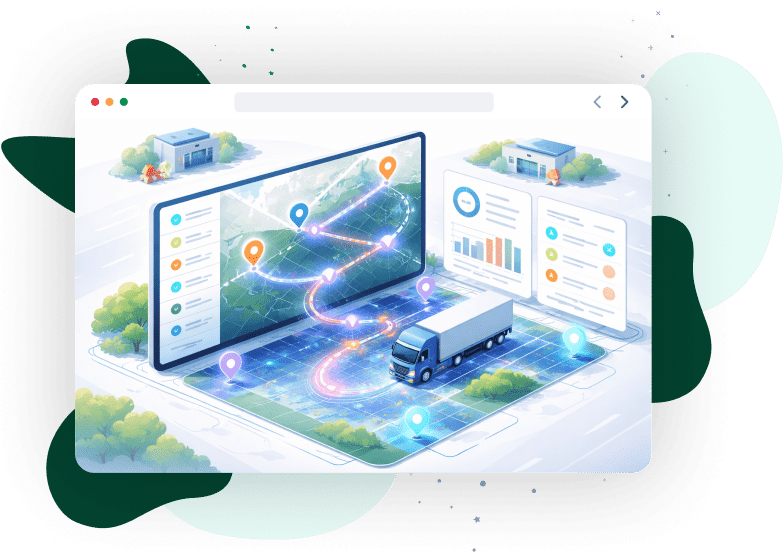
Embedding routing intelligence as a native module creates a full automation pipeline within the TMS:
Performance Gains:
- Improves operational visibility and customer service
- 20–30% trip efficiency
- 20% fuel savings
- 50% less planning effort
Routing Capabilities:
- Multi-stop route optimization
- Constraints-based routing
- Vehicle capacity planning
- Time window routing
- Driver hours compliance
Integrated Intelligence Layer:
- Telematics integration
- Fuel management
- Vehicle maintenance data
- Dynamic recalculation
- Real-time tracking
- Geospatial processing
- Geofencing automation
- Dispatch rules
- Load planning
White-label maps help raise driver satisfaction by 40%.
Explore Our Fleet Management System Demo
View live routing workflows, dispatch screens, and tracking dashboards. Validate routing logic, data flow, and integration behavior.
Why TMS Companies Build a Native Route Optimization System?
A native routing engine gives TMS platforms direct control over routing logic, differentiation, and long-term IP ownership.
Strategic Advantages:
- Model LTL routing rules
- Support regional constraints
- Enable customer-specific workflows
- Control routing logic direction
Custom engine alignment:
- Product strategy fit
- Scalability roadmap
- Built-in dispatch optimization
Limits of SaaS/APIs:
- Weak architecture embedding
- Restricted routing decisions
- Limited constraints handling
- Shallow white-label depth
- No IP ownership
Business Risks:
- Usage-based pricing growth
- Integration overhead
- Engineering workarounds
How iCommuneTech Helps IT Product Companies Deliver New Features Fast Enough?
iCommuneTech helps IT product companies deliver new features faster by extending routing, dispatch, and optimization capabilities through a co-development model that preserves internal architecture and roadmap control.
Architecture-aligned development
Engineering workflow integration
Faster feature rollout
“Working with iCommuneTech has been a game-changer for A&I Fuel Finder. Their team understood our operational challenges from day one and turned our idea into a user-friendly, data-driven platform. Our drivers now save time and money by finding the lowest-priced fuel along optimized routes. The mobile app features, like fuel invoices and card management, made it even more valuable for our clients. We’re pleased with the professionalism, support, and technical expertise iCommuneTech delivered.”

Why to Have Vehicle Routing Module in Your Product Roadmap Is Important?
A vehicle routing module is important because it aligns product strategy with customer expectations and competitive requirements while ensuring routing capabilities scale with business needs.
This alignment reduces uncertainty during development and ensures routing features fit real operational workflows.
Strategic Planning Value:
- Clear requirements definition
- Reduced rework cycles
- Faster deployment timelines
Ensures routing fits business needs with a scalable route planning module
Decision Inputs:
- Customer demand for route optimization
- Competitor capability gaps
- Operational performance impact
- Mobile-first routing
- AI ETA forecasting
- Sales velocity influence
Build vs Buy: Should You Develop a Routing Engine or Integrate a Third-Party API?
You should choose between building a routing engine or integrating an API based on the level of control, IP ownership, scalability, and long-term product differentiation your TMS platform requires.
Custom Build
Full control, full ownership
- Own your routing logic
- Scales with your roadmap
- One-time amortized cost
API / SDK
Fast launch, vendor limits
- Faster to validate
- Vendor-controlled features
- Costs grow with usage
The comparison below outlines how each option affects architecture, cost, ownership, and roadmap control.
| Comparison Attribute | Custom Build | API / SDK Purchase |
|---|---|---|
| Time-to-market | Slower initial build | Faster to test and launch |
| Ownership of routing logic | Full ownership | Vendor-owned |
| Cost over time | Predictable, amortized | Increases with usage |
| Scalability | Platform-controlled | Vendor-dependent |
| Integration complexity | Deep, native integration | Limited to exposed endpoints |
| Data control | Full data ownership | Shared or restricted |
| Customization | Unlimited | Constrained by API |
| Feature roadmap control | Product-driven | Vendor-driven |
Summary
APIs support early validation. Custom engines win long-term for control, scalability, and differentiation.
Route Optimization Engine Development Services for TMS and Logistics Software Platforms
iCommuneTech delivers enterprise-grade route optimization engines through co-development models aligned with TMS product teams.
Platform architecture
Architecture & Technology Stack for Route Optimization Module
The route optimization module uses a modular plug-in architecture that embeds into a TMS without disrupting dispatch workflows. This design supports real-time routing, dynamic recalculation, horizontal scalability, and fault isolation.
Technology Stack
- Backend microservices using Java, .NET, Python via software development services
- Geospatial tools: PostGIS, ElasticSearch, HERE, Google Maps, OpenStreetMap
- Frontend: React, Angular
- CI/CD pipelines
- Cloud: AWS, Azure, GCP via software development servicesDevOps services
Modular Architecture Components
- Route optimization engine using heuristics, AI, and ML prediction
- Dispatch orchestration microservice
- Constraint rules engine
- Real-time routing pipeline
- Geospatial processing layer
- Event-driven execution using Kafka/RabbitMQ
- API gateway with role-based access
- Simulation service
- UI module for route maps
- Admin console
- Constraint rules engine for time windows
- vehicle capacity, driver hours, and service zones
Integration With Your Existing TMS or Logistics Platform
The route optimization module is embedded as a shared intelligence layer within the existing TMS architecture used for logistics management software. This integration enables real-time optimization, native operation, and coordinated decision-making across planning, dispatch, and execution workflows.
Integration Benefits
Native interoperability
Consistent data flow
Faster integration cycles
Scalable connectivity
Key Integration Points
- Order, shipment, load entity integration
- Dispatch and scheduling module connection
- Driver mobile sync
- ELD and telematics integration
- API-first imports/exports
- ERP/CRM connectivity via custom CRM development services
- Role-based access alignment
Routing Engine Customization and Integration Flexibility
The routing engine supports enterprise routing rules, carrier strategies, and regional constraints without changes to the core TMS architecture used for logistics management software. This approach ensures consistent routing performance across customers, geographies, and operating models.
Rule and Constraint Flexibility:
Customization and Scalability Options:
How iCommuneTech offloads and brings innovation in for TMS engineering Teams
iCommuneTech offloads complex logistics engineering while enabling innovation without expanding internal engineering capacity.
We Offload:
- Routing & dispatch engineering
- Integration complexity
- Scalability architecture
We Enable
- Feature delivery acceleration
- Roadmap alignment
- No headcount expansion
The co-development model reduces engineering workload, accelerates feature delivery, and strengthens architectural depth while maintaining alignment with product strategy and roadmap priorities.
iCommuneTech designs modular, production-ready systems with a secure cloud platform by leveraging its expertise across routing, dispatch, and optimization without disrupting roadmaps.