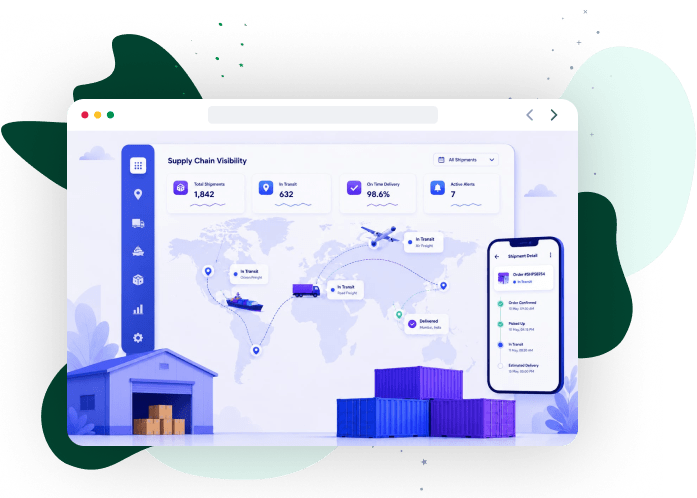
These platforms strengthen planning, inventory accuracy, and risk mitigation through connected operational data and automated exception monitoring. This guide explores how supply chain visibility software enables real-time tracking, supports data-driven decisions, and improves supply chain resilience.
What Is Supply Chain Visibility Software?
Supply chain visibility software is a technology solution that consolidates shipment, inventory, carrier, and order data into a centralized operational view across the supply chain.
By integrating data from ERP, TMS, WMS, and carrier systems, supply chain visibility platforms provide enterprises with a unified view of logistics operations, enabling them to:
- Track shipment flow
- Monitor execution accuracy
- Respond to disruptions in real time
The system connects disconnected logistics operations through shared visibility and workflow control. Key operational functions include:
- Shipment milestone tracking
- Delay detection
- Automated response workflows
- Inventory visibility
- Customer service coordination
This visibility foundation supports predictive analytics, exception management, KPI monitoring, and data-driven decision-making across supply chain planning and execution.
What Are the Key Features and Capabilities of Modern Supply Chain Visibility Platforms?
Modern supply chain visibility platforms combine real-time tracking, predictive analytics, automated alerts, and KPI monitoring to improve logistics execution and disruption response.
The key features and capabilities of modern supply chain visibility platforms include real-time tracking, predictive analytics, automated alerts, KPI monitoring, system integration, and exception management. These capabilities help organizations improve logistics visibility, respond to disruptions faster, and maintain operational control.
These platforms process live shipment data through supply chain analytics and performance insights so enterprises can monitor shipment status, predict delays, and maintain service performance.
Core platform capabilities include:
Event capture and milestone tracking:
Record shipment events and validate movement against planned routes.
ETA forecasting and delay prediction:
Calculate arrival estimates using carrier and transit data.
Exception detection and alert management:
Identify execution failures and route corrective alerts.
KPI monitoring and operational dashboards:
Track on-time delivery, transit variance, and fulfillment performance.
Data orchestration and system connectivity:
Synchronize ERP, TMS, WMS, and carrier data into a unified operational view.
Predictive analytics and AI-driven insights:
Forecast risks and support proactive logistics planning.
These capabilities improve shipment coordination, reduce delays, and strengthen supply chain decision-making.
How Do Real-Time Tracking, Dashboards, and Exception Management Work in Supply Chain Visibility?
Real-time tracking, dashboards, and exception management work together within supply chain visibility platforms to monitor shipment movement, visualize operational performance, and respond to disruptions as they occur.
Integrated with shipment tracking software, these capabilities provide real-time updates, improve shipment visibility, monitor SLA performance, and accelerate disruption response across logistics operations.
Key operational components include:
1. Location tracking and event synchronization
Capture shipment location, transport status, and milestone updates across carrier networks.
2. Custom dashboards and KPI visualization
Display transit variance, dwell time, shipment status, and fulfillment KPIs for planners, suppliers, and logistics teams.
3. Exception detection and automated alerts
Identify delivery delays, route deviations, and milestone failures, then trigger alerts for corrective action.
Together, these capabilities improve shipment coordination, strengthen operational visibility, accelerate disruption response, and support data-driven supply chain management.
Driving Measurable Results Across Industries
From automating manual calculations to modernizing legacy infrastructure, we build software that directly impacts the bottom line. Our custom solutions consistently reduce operational costs and accelerate process efficiency.
View Our Case Studies
How Do Advanced Analytics and Predictive Intelligence Work in Supply Chain Visibility Platforms?
Advanced analytics and predictive intelligence work by analyzing historical and real-time logistics data to forecast delays, identify disruption patterns, evaluate routing alternatives, and support proactive supply chain decision-making.
Integrated with transportation analytics, these capabilities improve ETA forecasting, capacity planning, disruption management, and proactive supply chain response.
Advanced analytics and predictive intelligence operate through 4 functional capabilities:
| S. No. | Capability | System Action | Business Outcome |
|---|---|---|---|
| 1 | Predictive ETA modeling | Analyze carrier, route, and transit history to forecast arrival delays | Improve delivery planning and schedule accuracy |
| 2 | Delay pattern analysis | Identify recurring disruption drivers across routes and logistics nodes | Reduce repeat delays and prioritize intervention |
| 3 | Root-cause analysis | Trace disruption sources across carriers, facilities, and workflows | Improve operational accountability and response speed |
| 4 | What-if scenario simulation | Evaluate routing, scheduling, and carrier alternatives before execution | Strengthen planning decisions and resource allocation |
These capabilities help enterprises predict disruptions, optimize logistics planning, and improve operational responsiveness.
AI-driven analytics and automated exception management continue to expand across supply chain visibility platforms. Gartner predicts that 60% of supply chain disruptions will be resolved without human intervention by 2031, highlighting the growing role of automated risk detection and predictive supply chain intelligence.
How Do KPIs and Dashboards Support Supply Chain Performance Management?
KPIs and dashboards support supply chain performance management by measuring logistics performance, identifying operational bottlenecks, tracking service levels, and enabling continuous improvement across supply chain operations.
Connected with supply chain planning systems, these capabilities help enterprises monitor service reliability, compare performance against operational targets, and improve planning accuracy.
KPI tracking and dashboards operate through 4 functional components:
Measure on-time delivery, fill rate, transit delays, and fulfillment accuracy using live execution data.
Display shipment trends, SLA performance, and route-level exceptions for planners and logistics teams.
Identify delays across carriers, facilities, and transport routes using performance indicators.
Compare operational results against SLA targets and historical performance trends to improve execution planning.
These 4 capabilities improve operational visibility, strengthen KPI governance, and support data-driven supply chain optimization.
How Does End-to-End Visibility Work Across Transport Modes and Supply Chain Nodes?
End-to-end visibility works by connecting transport-mode events and operational node updates into a continuous view of shipment movement from origin dispatch to final delivery.
Integrated with transportation management software, these systems improve logistics transparency, shipment coordination, and disruption response across supply chain operations.
End-to-end visibility combines 2 operational layers:
Transport Mode Visibility
Track shipment status across ocean, air, rail, and truck networks using carrier feeds, telematics, and routing updates.
Node-Level Visibility
Monitor inventory status, processing activity, and shipment handoffs across warehouses, ports, and supplier facilities.
Together, these visibility layers improve shipment traceability, identify operational bottlenecks, and support faster disruption response across the supply chain.
How Does Multimodal Transportation Visibility Work Across Ocean, Air, Rail, and Truck Freight?
Multimodal transportation visibility works by collecting and synchronizing shipment data across ocean, air, rail, and truck networks to provide a continuous view of shipment movement throughout the transportation journey.
Integrated with freight forwarding systems, these platforms improve shipment coordination, reduce transfer delays, and strengthen real-time logistics monitoring across intermodal operations.
Multimodal transportation visibility operates through 4 transport modes:
Ocean freight visibility
Track container booking, vessel loading, port arrival, and customs milestones using carrier EDI updates.
Air freight visibility
Monitor airway bill status, cargo transfers, and flight schedules for time-sensitive shipments.
Rail freight visibility
Track railcar movement, terminal interchange activity, and yard dwell time across rail corridors.
Truck freight visibility
Monitor over-the-road shipment movement using GPS tracking, route deviation alerts, and driver telematics.
Together, these four transport visibility capabilities improve intermodal coordination, reduce shipment delays, and provide continuous visibility across complex freight networks.
How Does Node-Level Visibility Work Across Facilities, Ports, Suppliers, and Inventory?
Node-level visibility works by monitoring inventory movement, processing activity, and shipment handling across warehouses, ports, suppliers, and storage facilities to create a unified view of operations at each supply chain node.
Integrated with warehouse management systems, these visibility capabilities improve inventory accuracy, strengthen inbound and outbound coordination, and increase operational transparency across supply chain nodes.
Node-level visibility operates through 4 operational nodes:
Warehouse Visibility
Track goods receipt, putaway, picking, packing, and dispatch activity to maintain accurate inventory records.
- Goods receipt validation
- Putaway and picking updates
- Dispatch and fulfillment tracking
- Real-time stock visibility
Port Visibility
Monitor container movement, customs clearance, and yard activity across port operations.
- Container gate tracking
- Customs status updates
- Yard handling visibility
- Port transfer coordination
Supplier Visibility
Track production progress, order readiness, and shipment preparation across supplier operations.
- Production status monitoring
- Dispatch readiness tracking
- Supplier fulfillment updates
- Shipment preparation visibility
Inventory Visibility
Monitor stock availability, storage location, and inventory allocation across fulfillment facilities.
- Inventory allocation tracking
- Location-based stock visibility
- Fulfillment inventory monitoring
- Storage coordination updates
Together, these node-level visibility functions improve inventory control, reduce processing delays, strengthen operational transparency, and support coordinated inbound and outbound supply chain operations.
What Are the Top Supply Chain Visibility Platforms and Market Landscape?
The supply chain visibility market includes transport visibility systems, multi-enterprise collaboration networks, and enterprise logistics platforms that process shipment and execution data. Operating within the broader supply chain management software ecosystem, these platforms support real-time tracking, partner collaboration, analytics, and operational coordination across global supply chain operations.
The market includes 3 major platform categories:
- Transport-focused visibility platforms: Manage carrier connectivity, shipment tracking, and transit monitoring across freight networks.
- Network-based collaboration platforms: Connect suppliers, logistics providers, and distribution partners through shared operational data.
- Enterprise-integrated visibility systems: Embed visibility, planning, analytics, and execution functions within enterprise supply chain environments.
These platform categories help organizations evaluate architecture, integration capabilities, scalability, and deployment models before selecting and comparing individual vendors.
Future Market Insights projects the supply chain visibility software market to grow from USD 3.50 billion in 2026 to USD 11.89 billion by 2036 at a 13% CAGR, highlighting growing enterprise investment in real-time logistics visibility and integrated supply chain platforms.
Who Are the Leading Supply Chain Visibility Software Providers?
Leading supply chain visibility software providers include iCommuneTech, FourKites, Project44, SAP IBP, Oracle SCM Cloud, Infor Nexus, Coupa Llamasoft, and Transporeon. These providers deliver real-time tracking, carrier connectivity, analytics, and logistics coordination across global supply chain networks.
Operating within supply chain automation platforms, these providers differ by integration depth, transport coverage, analytics capability, and enterprise scalability.
The vendor landscape includes 8 providers with distinct system focus and industry fit:
| Provider | Market Differentiator | Core Capability | Industry Fit |
|---|---|---|---|
| iCommuneTech | Custom visibility architecture | Builds tailored visibility systems with ERP, TMS, and WMS integration | Enterprises requiring customization and scalable deployment |
| FourKites | Predictive transport visibility | Tracks shipment movement using GPS, carrier integrations, and ETA forecasting | Freight-heavy logistics operations |
| Project44 | Multimodal carrier connectivity | Connects shippers and carriers through API-based freight visibility | Enterprises managing global transport networks |
| SAP IBP | Planning-integrated visibility | Combines planning, execution, and analytics within SAP environments | SAP-based enterprise supply chains |
| Oracle SCM Cloud | Unified SCM execution | Connects order, inventory, and logistics workflows in one platform | Enterprises requiring integrated SCM operations |
| Infor Nexus | Multi-enterprise collaboration | Synchronizes suppliers, logistics providers, and trade partners | Global trade and partner ecosystems |
| Coupa Llamasoft | Network modeling and simulation | Supports supply chain optimization and scenario planning | Enterprises focused on strategic network planning |
| Transporeon | Freight execution and procurement | Manages carrier collaboration and transport procurement workflows | European freight and carrier networks |
How Does Custom Supply Chain Visibility Software Compare With SaaS Platforms?
Custom supply chain visibility software and SaaS platforms differ primarily in deployment flexibility, customization depth, integration capabilities, scalability, and cost structure. Custom platforms provide greater control and adaptability, while SaaS platforms prioritize speed of deployment and standardized functionality.
Integrated with broader digital transformation initiatives, organizations evaluate these models based on operational complexity, infrastructure requirements, and long-term system control.
Custom and SaaS visibility platforms differ across 5 selection factors:
Deployment Model
Custom platforms support cloud, on-premises, and hybrid infrastructure. SaaS platforms operate through vendor-managed cloud environments with subscription-based access.
Workflow Customization
Custom systems align dashboards, workflows, and business rules with enterprise operations. SaaS platforms use standardized workflows and predefined configurations.
System Integration
Custom platforms connect ERP, TMS, WMS, EDI, and proprietary systems using tailored integrations. SaaS platforms depend on packaged APIs and standard connectors.
Scalability and Extensibility
Custom systems expand infrastructure and functionality based on operational requirements. SaaS platforms scale through vendor-supported features and subscription tiers.
Cost Structure
Custom software typically requires a higher upfront investment but provides greater ownership, control, and flexibility. SaaS platforms reduce initial deployment costs through recurring subscription pricing.
Organizations with complex workflows, compliance requirements, or legacy infrastructure dependencies often prioritize custom visibility platforms. Organizations requiring faster deployment and standardized operations commonly adopt SaaS visibility solutions.
How Does Visibility Software Connect With Supply Chain Systems?
Supply chain visibility software connects with ERP, TMS, WMS, carrier, and supplier platforms by exchanging and synchronizing data through APIs, EDI transactions, and integration middleware.
Integrated with vendor management systems, these connections improve data accuracy, reduce manual coordination, and maintain consistent execution across supply chain operations.
Key integration functions include:

API and EDI Connectivity
REST APIs and EDI transactions exchange purchase orders, shipment milestones, ASN records, and inventory updates between connected supply chain systems.
- Purchase order exchange
- Shipment status synchronization
- ASN and inventory updates
- Carrier communication integration

Master Data Standardization
Data mapping engines standardize SKU codes, carrier identifiers, location data, and transaction formats across connected applications.
- SKU and carrier mapping
- Standardized transaction formats
- Location data alignment
- Cross-system data consistency
Workflow Automation
Rule-based orchestration engines trigger approvals, shipment workflows, and escalation tasks based on operational events.
- Automated workflow routing
- Escalation trigger management
- Shipment process coordination
- Event-based task execution
Legacy and Cloud System Connectivity
Integration middleware connects on-premises infrastructure with cloud-based supply chain applications and partner networks.
- Legacy system integration
- Cloud application connectivity
- Partner network coordination
- Hybrid infrastructure support
These integration capabilities improve operational visibility, strengthen process coordination, and support scalable supply chain execution.
How Does Supply Chain Visibility Software Improve Business Performance and Customer Experience?
Supply chain visibility software improves business performance by reducing operational delays, strengthening inventory control, improving fulfillment accuracy, and enabling more informed supply chain decisions through connected operational data.
Integrated with order management systems, these platforms improve order tracking, customer communication, and service reliability across supply chain operations.
Key business and customer experience outcomes include:
Reduced expedited shipping and inventory carrying costs
Higher inventory turnover and warehouse throughput
Strongers order fill rate and OTIF performance
Faster disruption resolution during transport and fulfillment
Accurate order status updates for customers and partners
Lower manual escalation across logistics workflows
Better compliance monitoring and audit visibility
More consistent fulfillment and delivery performance
Organizations measure these outcomes using KPIs such as OTIF rate, order cycle time, dock-to-stock time, inventory turnover ratio, and fulfillment accuracy.
IBM reported a threefold improvement in retail demand forecasting after implementing integrated analytics and supply chain visibility capabilities.
The result highlights how predictive visibility platforms strengthen planning accuracy, inventory coordination, and operational decision-making across supply chains.
Why Choose iCommuneTech for Custom Supply Chain Visibility Software Implementation?
Choose iCommuneTech for custom supply chain visibility software implementation when operational complexity, integration requirements, and workflow customization demand more than a standardized platform can provide.
Leveraging expertise in custom supply chain solutions, iCommuneTech designs and implements visibility platforms aligned with enterprise logistics processes, connecting ERP, TMS, WMS, carrier, and supplier systems into a unified operational environment.
The implementation approach combines custom configuration, governance planning, scalable architecture, and long-term operational support to help organizations improve visibility, coordination, and execution across the supply chain.
Custom Workflow and System Configuration
iCommuneTech configures dashboards, workflows, and business rules based on enterprise logistics requirements, ensuring visibility platforms align with existing operational processes and reporting structures.
- Workflow-specific configuration
- Logistics process alignment
- Custom business-rule mapping
ERP, TMS, and WMS Integration
Integration frameworks connect ERP, TMS, WMS, EDI, and carrier systems into a unified logistics environment.
- API and EDI connectivity
- Cross-system data synchronization
- End-to-end process visibility
Governance and Compliance Management
Security frameworks enforce controlled access, workflow governance, and compliance monitoring across connected systems.
- Role-based access management
- Compliance policy enforcement
- Secure operational data access
Deployment, Testing, and Adoption Support
Deployment teams validate integrations, test workflows, and support phased rollout execution across supply chain operations.
- Phased deployment planning
- Workflow and integration testing
- User onboarding and adoption support

iCommuneTech helps organizations scope, deploy, and scale supply chain visibility platforms based on operational complexity, integration requirements, and long-term business goals.
Go for Implementation