
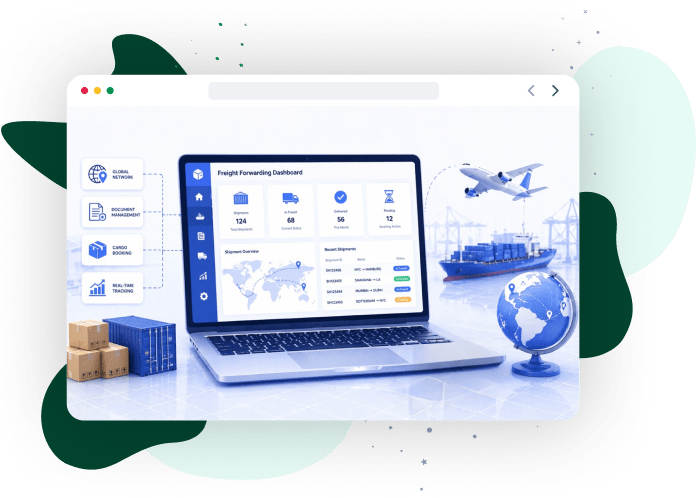
What Is A Freight Forwarding Software?
Freight forwarding software extends transportation management software by embedding execution control for multimodal shipments within a broader logistics system. It is not a standalone application; it functions as a set of interconnected microservices, including rate engines, routing logic, documentation processing, customs handling, and billing.
The system executes freight optimization, rate management, audit and billing workflows, contract enforcement, and invoice reconciliation through a unified data model. TMS platforms achieve end-to-end multimodal visibility, enabling consistent shipment-level decision-making across operations and finance.
Why Should a TMS Platform Add a Freight Forwarding Module? (Business & Growth Drivers)
A TMS platform requires a freight forwarding module to control execution, pricing, and billing across multimodal shipments. Without it, shipment data, rate logic, and financial workflows remain fragmented across external systems, limiting operational control and scalability
The Grand View Research report indicates that the global freight forwarding market is expected to reach USD 285.60 billion by 2030, growing at a CAGR of 4.9% from 2025 to 2030, reinforcing the need for TMS platforms to embed forwarding capabilities rather than rely on external systems.
Key Challenges Without Freight Forwarding
- Loss of enterprise deals: Platforms fail RFP evaluations against CargoWise and Magaya because forwarding capabilities remain outside the core product.
- Limited visibility: Shipment data across air, ocean, and road remains fragmented, preventing unified supply chain visibility across multimodal operations.
- Fragmented tools: Rate management, documentation, and billing operate across disconnected systems, increasing operational latency.
- No financial ownership: Freight rates, contracts, and invoices remain external to the TMS data model, limiting pricing control and margin tracking.
- Restricted analytics: Disconnected datasets prevent accurate margin analysis, forecasting, and performance benchmarking.
- Customer expectations gap: Shippers require execution, pricing, and tracking within a single system, which fragmented platforms fail to deliver.
Business Impact for TMS Product Companies Adding Freight Forwarding
New revenue stream
Freight forwarding introduces a billable module that directly expands ARR through shipment-based monetization.
Competitive positioning
Platforms align with full-suite logistics systems, enabling participation in enterprise RFPs requiring end-to-end capabilities.
Operational unification
Freight, fleet, and warehouse workflows operate within a shared architecture, reducing system fragmentation.
Multi-tenant scalability
Configurable logic allows platforms to serve multiple clients without duplicating infrastructure.
Retention improvement
Integrated execution and financial workflows increase platform dependency and reduce customer churn.
How iCommuneTech Helps IT Product Companies Deliver New Features Fast Enough?
iCommuneTech develops freight forwarding systems by integrating execution modules into existing TMS platforms without disrupting ongoing operations.
Modules for rate management, shipment execution, customs, and billing are added as independent components, enabling faster rollout of new capabilities while maintaining system stability.
Driving Measurable Results Across Industries
From automating manual calculations to modernizing legacy infrastructure, we build software that directly impacts the bottom line. Our custom solutions consistently reduce operational costs and accelerate process efficiency.
View Our Case Studies
What Core Modules Should a Custom Freight Forwarding Software Include?
A custom freight forwarding system is structured around execution, pricing, compliance, and financial validation modules that operate on a unified shipment data model. Each module enforces domain-specific rules while sharing shipment-level data across lifecycle stages.
- The freight optimization module defines routing decisions across air, ocean, road, and rail by evaluating carrier constraints, transit conditions, and cost-performance trade-offs. It applies route optimization across transport lanes using historical performance data and service constraints to generate executable shipment plans.
- The rate management module structures contract rates, tariffs, and spot pricing into normalized data models. It ingests carrier rate sheets, validates pricing conditions, and applies margin rules during quote generation, ensuring pricing consistency across quoting and billing workflows.
- The freight audit and billing module validates shipment charges against contracted rates and executed shipment data. It detects rate mismatches, identifies duplicate invoices, and enforces reconciliation rules before financial posting, maintaining accuracy across payable and receivable processes.
- The contract management module enforces commercial agreements across pricing and execution workflows. It maintains contract lifecycles, applies rate validity constraints, and restricts pricing based on customer-specific and carrier-specific conditions.
All modules interact through shared shipment identifiers and event-driven updates, ensuring that routing decisions, pricing logic, and financial records remain synchronized across workflows. This structure enables controlled execution, pricing accuracy, and audit-ready financial operations.
How Should a TMS Handle Freight Optimization Across Modes?
A TMS handles freight optimization by evaluating routing combinations, carrier performance, and cost-service trade-offs to generate executable shipment plans across air, ocean, road, and rail. It applies constraint-based decision logic to balance transit time, cost efficiency, and service commitments within a single optimization workflow.
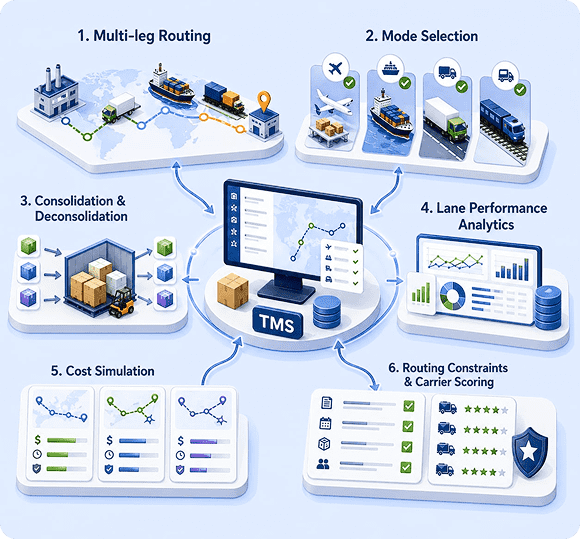
Defines shipment paths across interconnected legs, maintaining continuity between origin, transit hubs, and final delivery points without breaking execution flow.
Assigns transport modes based on shipment priority, cost thresholds, service requirements, and cargo characteristics.
Groups compatible shipments to maximize load utilization and separates them at distribution nodes based on delivery schedules.
Uses historical lane data and carrier metrics through analytics systems to guide routing decisions and improve selection accuracy.
Evaluates multiple routing scenarios by modeling cost, transit time, and service trade-offs before execution.
Applies regulatory limits, capacity availability, and carrier performance scores to refine route selection and ensure feasibility.
Freight optimization enforces consistent decision-making across routing, carrier selection, and cost control, ensuring that shipment execution aligns with operational constraints and service commitments.
How Should Dynamic Rate Management & AI-Assisted Quoting Work?
Dynamic rate management structures, validates, and applies freight pricing through a unified pricing engine that processes contract rates, tariffs, and spot rates within a single decision layer.
AI-assisted quoting analyzes historical shipment data, carrier performance, and market rates to generate optimized quotes automatically. It reduces manual effort and improves pricing accuracy.
It standardizes carrier inputs and enforces pricing rules to ensure consistency between operational cost data and customer-facing quotes, aligning pricing decisions with procurement workflows and financial processes through procurement software and financial workflow automation systems.
Contract, tariff, and spot rate handling
Stores rate data in structured formats and applies it based on shipment type, lane conditions, and contractual constraints.
Rate table ingestion and normalization
Ingests carrier rate sheets, standardizes formats, and maps them to internal pricing models for consistent processing.
AI-assisted quoting engine
Uses historical data, market trends, and margin thresholds to generate optimized quotes and improve pricing accuracy.
Real-time rate validation
Validates pricing against active contracts, surcharges, and currency conditions before finalizing quotes.
Carrier API rate pulls
Retrieves live rates from carrier systems to reflect current market conditions during quote generation.
Cross-currency and surcharge handling
Applies exchange rates, fuel surcharges, and accessorial charges to ensure accurate pricing across regions.
Dynamic rate management enforces pricing consistency, margin control, and quote reliability by aligning rate inputs, validation logic, and quoting workflows within a single pricing framework.
How Should the System Automate Freight Audit & Billing?
A freight forwarding system automates freight audit and billing by applying rule-based validation to shipment charges, comparing executed shipment data with contracted rates before financial posting. It performs invoice verification, exception detection, and financial reconciliation within a unified audit workflow.
Billing data integrates with vendor management systems to align payable and receivable records with validated shipment transactions. The following table outlines how audit and billing functions execute across validation, exception handling, and financial posting.
| Function | System Action | Outcome |
|---|---|---|
| Shipment–invoice reconciliation | Match shipment records with carrier invoices | Verify billed amounts against contracted rates |
| Rate mismatch detection | Compare invoice charges with pricing rules | Flag deviations across lanes and services |
| Duplicate invoice detection | Identify repeated billing entries | Prevent overpayment |
| Dispute generation | Trigger workflows using audit data and shipment records | Resolve billing discrepancies |
| GL coding | Map transactions to financial accounts | Support accurate reporting and compliance |
| ERP/AP/AR sync | Transfer validated billing data to financial systems | Maintain financial consistency |
How Should Contract Management Be Integrated?
Contract management enforces commercial agreements by embedding contract rules directly into pricing, quoting, and shipment execution workflows.
Contract logic integrates with automated order management systems to bind shipment creation, rate application, and billing triggers to contract-specific rules. This ensures that every shipment transaction references active contract conditions before execution.
The following table shows how contract management functions enforce pricing control and compliance across execution workflows.
| Function | System Action | Outcome |
|---|---|---|
| Contract lifecycle management | Track contract creation, activation, renewal, and expiration | Maintain active and valid agreements |
| Contract-specific rates and rules | Apply pricing based on customer, carrier, and lane conditions | Ensure pricing accuracy |
| Automated renewal reminders | Trigger alerts before contract expiry | Prevent service disruption |
| Restriction-based quoting | Enforce constraints during quote generation | Block invalid pricing scenarios |
| Rate validity and compliance | Validate pricing against contract timelines and conditions | Ensure contractual adherence |
How Should a Freight Forwarding Workflow Engine Be Designed?
A freight forwarding workflow engine orchestrates shipment events, document flows, and financial actions through a state-driven execution model. It manages each stage as a controlled sequence with defined transitions, checkpoints, and validation rules.
The engine processes shipment → booking → documentation → customs → invoicing through predefined states, ensuring that each transition follows execution rules and data validation logic. It supports LCL, FCL, MAWB, HAWB, and Bills of Lading by applying format-specific processing at each stage. Multi-leg transitions maintain continuity across carriers and transport modes without data fragmentation.
Exception-based workflows detect disruptions such as document errors or clearance delays and trigger corrective actions within the affected stage. A document engine manages PDFs, digital signatures, EDI exchanges, and API-driven document flows to ensure compliance and traceability across shipment records.
Workflow templates define execution rules per customer and region, enabling configurable shipment handling aligned with operational requirements. These templates integrate with last-mile delivery operations to maintain consistency between upstream shipment processing and final delivery execution.
How Should the Software Support Specialized Freight Modes?
Freight forwarding software handles mode-specific operations, regulatory requirements, and carrier interactions across air, ocean, and cross-border shipments. Each mode introduces distinct document types, communication standards, and scheduling constraints that the system must execute through controlled processing layers.
Air freight enforces airline messaging formats, cargo screening rules, and flight-based scheduling constraints within time-sensitive execution windows. Ocean freight processes container tracking, port operations, and vessel schedules across longer transit cycles with port-level dependencies. Cross-border shipments apply classification, duty validation, and regulatory filing rules through compliance-driven workflows.
The system executes these variations using rule-based processing engines configured by shipment type, trade lane, and carrier requirements. This ensures that operational logic adapts dynamically without disrupting shipment state transitions.
Customer access layers retrieve shipment status, documents, and event updates directly from operational systems, reflecting real-time execution states across all modes. Shipment milestones, delay events, and exception triggers are exposed through synchronized data streams tied to shipment records.
A unified execution model binds mode-specific rules, carrier communication, and customer interaction within the same data framework, maintaining consistency across shipment lifecycle stages and system interfaces.
What Does Air Freight Software Need to Include?
Air freight software must process airway bills, enforce cargo security checks, manage unit load devices, and exchange structured data with airline systems under aviation standards.
Air shipment tracking integrates with shipment tracking software to stream flight events, status updates, and document changes directly from carrier systems, ensuring real-time visibility across air transport legs.
The following table defines how air freight functions execute across documentation, security validation, and airline communication workflows.
| Function | System Action | Outcome |
|---|---|---|
| MAWB/HAWB management | Processes master and house airway bills | Maintains document accuracy |
| Air cargo screening | Validates cargo against security rules | Ensures compliance |
| ULD management | Tracks unit load devices across flights | Controls cargo allocation |
| Airline EDI/API messaging | Exchanges booking and status data with airlines | Maintains data continuity |
| Flight schedule support | Maps shipments to flight schedules | Aligns transit timelines |
| IATA standards compliance | Applies aviation data and messaging standards | Ensures global adherence |
What Does Ocean Freight & Multimodal Shipping Software Require?
Ocean and multimodal shipping software must process container flows, vessel schedules, and port-level cost structures across sea and inland legs. It executes shipment documentation, container tracking, and regulatory validation within international trade workflows.
Regulatory control integrates with supply chain compliance systems for global trade, where shipment data is validated, documentation rules are enforced, and cross-border filings are executed based on jurisdiction-specific requirements.
The following table shows how ocean and multimodal functions execute across documentation, tracking, and compliance workflows.
| Function | System Action | Outcome |
|---|---|---|
| Bills of Lading management | Processes shipping documents for cargo movement | Maintains legal shipment records |
| Container tracking (AIS) | Tracks container location using vessel tracking data | Provides position visibility |
| Sailing schedule management | Maps shipments to vessel departure and arrival schedules | Aligns transit planning |
| Port fees and surcharges | Calculates port charges and accessorial costs | Ensures cost accuracy |
| LCL/FCL logic | Processes consolidation and full container load handling | Controls container utilization |
| NVOCC compliance | Applies regulatory rules for non-vessel operators | Ensures compliance with trade regulations |
Ocean and multimodal execution bind container tracking, vessel scheduling, port cost calculation, and regulatory enforcement within a unified processing layer. It controls shipment progression across sea and inland legs.
How Should Customs Compliance Be Managed for Import & Export?
Customs compliance must validate classification, calculate duties, and submit declarations based on country-specific regulations. The system evaluates shipment data against regulatory frameworks to execute filings, enforce compliance rules, and prevent clearance delays.
The following table defines how customs compliance functions execute across classification, calculation, and submission workflows.
| Function | System Action | Outcome |
|---|---|---|
| HS/HTS classification | Assigns standardized codes to goods based on product attributes | Ensures correct tariff application |
| Duty and tax calculation | Computes duties, taxes, and fees based on classification and jurisdiction | Determines accurate landed cost |
| AES/eManifest submissions | Generates and submits export and import declarations to authorities | Ensures regulatory reporting |
| Broker integrations | Exchanges shipment and compliance data with customs brokers | Supports clearance processing |
| Cross-border rules engine | Applies country-specific trade rules and restrictions | Enforces regulatory compliance |
Customs compliance execution binds classification, duty calculation, declaration filing, and broker communication within a rule-driven processing layer that governs cross-border shipment clearance.
Case Studies: Logistics Software & TMS We’ve Built
iCommuneTech delivers freight, logistics, and TMS platforms with measurable improvements in execution speed, operational efficiency, and shipment-level financial control.
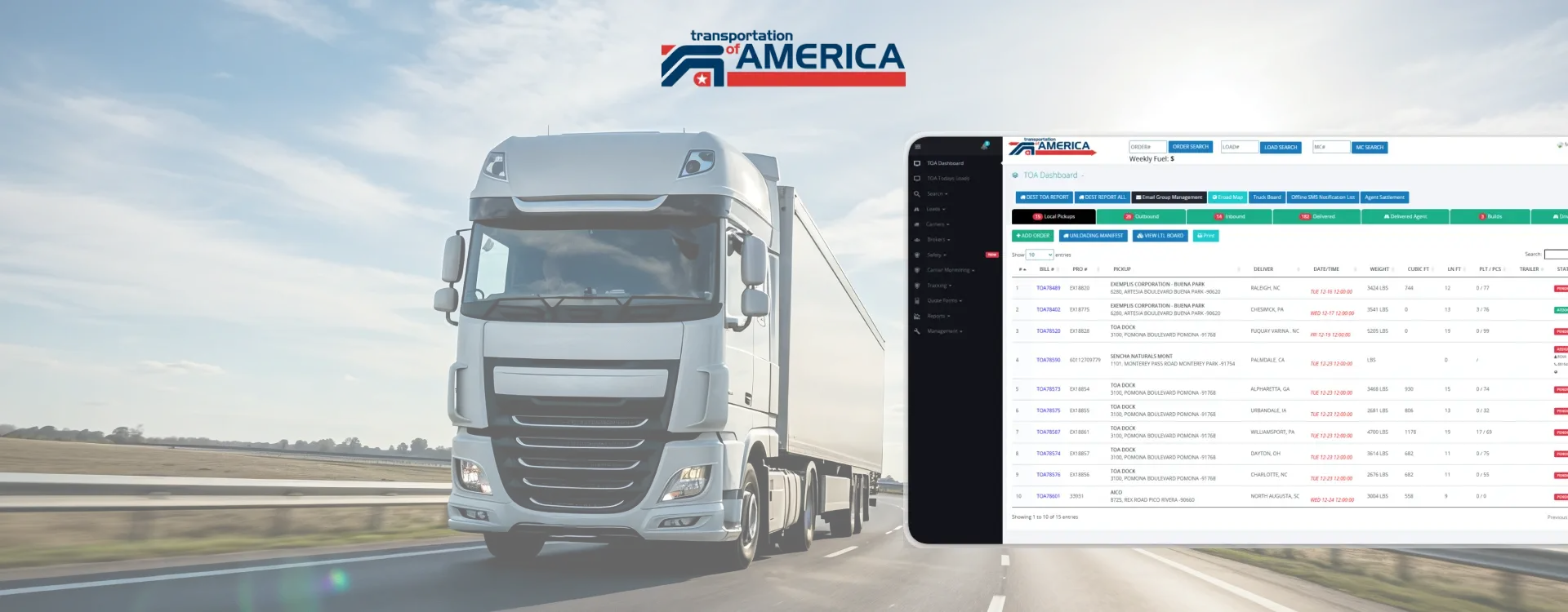 Transportation
1-Minute Dispatch Module for Transportation of America
Reduced dispatch processing time to under one minute by implementing automated workflow orchestration, real-time shipment tracking, and integrated communication across dispatch operations.
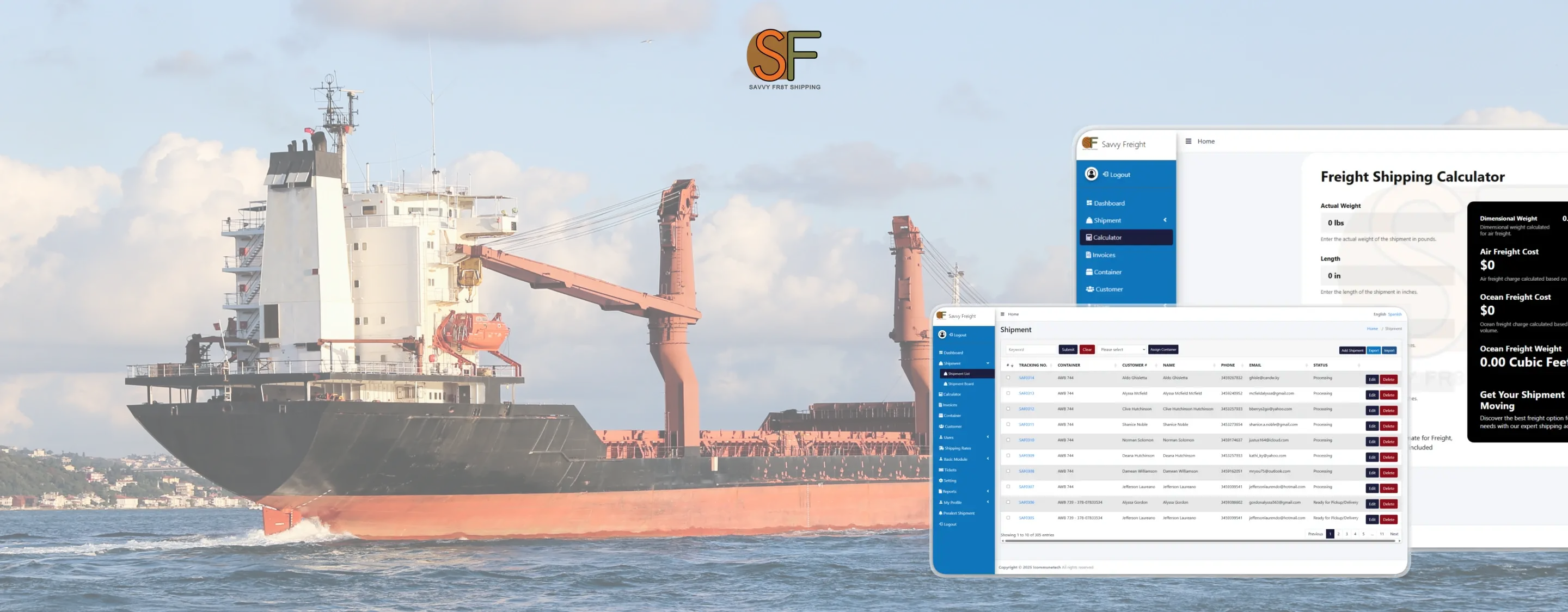 Logistics
60% Faster Shipment Processing with Intelligent Logistics Automation
Increased shipment processing speed by 60% through automated rate calculation, dimensional weight (DIM) logic, and system-driven workflow execution, eliminating 4–6 hours of daily manual effort.
How Should a Custom Freight Forwarding System Integrate with a TMS?
A custom freight forwarding system integrates with a TMS through a unified data model that links jobs, shipments, containers, customers, carriers, and invoices. This model governs how operational events and financial transactions propagate across modules.
What Should the System Architecture Look Like?
A freight forwarding system operates on domain-isolated services that execute shipment processing, compliance validation, and financial transactions across workflow stages.
Domain Service Layer
Core capabilities are partitioned into domain-specific services with strict data ownership and rule enforcement.
- Rate engine processes pricing structures, validates rates, and applies surcharges
- The multimodal shipment engine governs shipment states across transport legs
- Customs engine executes classification, duty calculation, and regulatory filings
- Billing engine validates invoices and posts financial transactions
- Documentation and EDI service exchanges structured documents with external systems
- Container tracking engine ingests and processes shipment status events
Each service enforces its domain boundary, preventing cross-domain data mutation and protecting financial and operational integrity.
Interaction & Data Exchange Model
Service interaction operates through defined contracts and event-driven propagation.
- API-first contracts expose shipment, pricing, documentation, and billing operations
- Event streams transmit state changes such as booking confirmation, clearance status, and invoice approval
Event propagation updates dependent services asynchronously, maintaining execution continuity during service load or failure conditions.
Scalability & Performance Control
Compute resources are allocated based on workload type and execution demand.
- Pricing workloads execute within the rate engine
- Shipment processing runs within the shipment engine
- Tracking ingestion operates within the tracking service
- Booking, quoting, and invoicing follow low-latency execution paths
- Audit and analytics process through a data lake and analytics pipeline
Workload isolation prevents pricing spikes or tracking volume from impacting shipment execution or billing operations.
Deployment & High Availability
Deployment spans cloud infrastructure with regional control and failover capability.
- Infrastructure spans AWS, Azure, and GCP
- Regional routing enforces latency control and regulatory alignment
- Replication, load distribution, and failover mechanisms sustain system availability
Failover mechanisms reroute traffic to active instances without interrupting shipment processing or financial transactions.
Access Control & Multi-Tenant Design
Access control enforces isolation across tenants and operational entities.
- Multi-tenant permission system isolates shipment, contract, and invoice data
- Role-based access governs permissions across operational and financial records
Tenant isolation prevents cross-customer data exposure while aligning with enterprise resource planning systems within supply chain platforms.
How Does Cloud ERP Integration Elevate Freight Forwarding?
Cloud ERP integration binds shipment-level financial events to accounting ledgers at the moment they occur, enabling real-time financial recognition without reconciliation lag.
Posting charges to ERP records, freight costs, accessorials, and revenue entries from shipment events
AP and AR sync maps carrier payables and customer receivables to the same shipment reference
Contract-based accruals register expected cost and revenue before invoice issuance based on rate agreements
Invoice matching compares billed values with shipment data and contract conditions to detect variance
Automated financial workflows trigger approval, posting, and reconciliation based on rule sets
Multi-currency support applies exchange rates during transaction posting for cross-border shipments
Each shipment event—booking, milestone update, or completion—updates ERP records in real time, removing manual reconciliation between operational and accounting systems. Finance teams track margin at the shipment level, while operations access billing status within the same system context.
This integration extends into warehouse management system integration with freight workflows, where inventory movement, shipment execution, and financial posting operate on a shared transaction dataset across locations and functions.
How Does Warehouse Management Software Synchronize With Freight?
Warehouse management software links inventory transactions with shipment execution through shared identifiers and event-driven updates.
- Generates shipment records from confirmed pick and pack data during inventory dispatch
- Records inbound cargo against shipment references during warehouse receiving
- Maps SKU-level data to shipment units for traceability across handling stages
- Routes inbound cargo to outbound staging through cross-docking based on shipment schedules
- Synchronizes status, quantity, and document data across WMS, TMS, and forwarding systems
Warehouse events update shipment records at each stage, linking inventory position with transport execution. Shipment planning, loading, and dispatch operate on validated inventory data, preventing allocation errors and dispatch delays.
Event propagation updates shipment status, document availability, and delivery milestones within customer-facing systems, extending into digital transformation in supply chain customer experience platforms.
How Can Customer Portals Improve Freight Forwarding Experiences?

Customer portals expose shipment data, documents, and service interactions through a system-connected interface linked to operational and financial systems.
The portcent milestones, documentation updates, and billing changes surface automatically as events occur.
Customers track shipments, access documents, submit requests, and communicate with operations teams within a unified interface, reducing manual inquiries and accelerating response handling.
Portal access supports multi-location users and cross-device usage, enabling uninterrupted access to shipment information and service interactions across operational workflows.
What Portal Features Add the Most Customer Value?
Customer portals expose controlled functions that operate on shipment-linked data and event-driven system updates.
- Real-time tracking displays milestone states based on event updates across transport legs
- Document access retrieves shipment-specific files such as bills of lading, invoices, and customs records from the document repository
- Quotation interface captures shipment parameters and returns rate outputs based on pricing rules
- ETA and exception alerts trigger on deviation events such as delay, reroute, or clearance hold
- Context-based messaging links customer queries to shipment identifiers, enabling operations teams to respond within the same transaction context
Each function retrieves data from shipment, document, and pricing systems, enabling direct access to status, documents, and actions without manual coordination.
Portal functions that bind shipment tracking, document access, quotation requests, and message threads to a single shipment record extend into supplier relationship management systems for customer retention and service continuity.
How Does Relationship Management Improve Shipper Retention?
Relationship management binds contractual terms, shipment records, and performance data to each customer account, enabling measurable service evaluation and control.
- SLA tracking compares committed service levels with actual milestone timestamps to identify delay patterns and compliance gaps
- Customer-specific rate visibility applies contract pricing during shipment processing, exposing applicable rates without manual validation
- Shipment history captures executed shipments with associated documents and financial records for audit and reference
- Performance metrics evaluate transit adherence, carrier reliability, and service variance at the customer level
These controls identify service deviations, pricing adherence, and execution patterns at the account level, enabling targeted corrective actions.
How Do Automation & Business Intelligence Enhance Freight Forwarding?
Automation and business intelligence process shipment, pricing, and billing data to drive routing decisions, cost control, and performance optimization.
How Do Custom Freight Forwarding Systems Help TMS Companies Scale Profitably?
Custom freight forwarding systems extend TMS platforms with execution and financial control, enabling new revenue streams and enterprise-level capability expansion.
Add-on module revenue monetizes freight forwarding through shipment processing and billing workflows. Enterprise RFP competitiveness improves as platforms support multimodal execution, contract pricing, and compliance within a unified system. Reduced dependency on SaaS vendors consolidates rate management, documentation, and invoicing within the platform, eliminating reliance on external systems.
Product differentiation strengthens through ownership of shipment execution logic, pricing rules, and financial processing. Customer retention improves as platforms deliver consistent service and maintain account-level control over pricing and execution. Extensible architecture enables the addition of freight, fleet, and warehouse capabilities without system redesign.
This approach extends into fleet management platforms for logistics system development, where transport execution and shipment control operate within the same system environment.
How to Start Building a Custom Freight Forwarding System?
A custom freight forwarding system is built through staged delivery with defined scope, ownership, and timelines.
A prototype or MVP establishes a functional module with core entities such as shipment, rate, and invoice to validate data models and processing logic
A full build roadmap defines module sequencing, integration points, and release phases across execution and financial components
Dedicated team model assigns engineering, architecture, and domain roles with ownership over development, integration, and deployment
Execution follows a fixed timeline:
Discovery and architecture:
3–6 weeks to define system boundaries, service structure, and data relationships
One module MVP:
8–12 weeks to deliver a production-ready component
Full ecosystem build:
6–12 months to implement interconnected modules across the platform
Advanced AI modules:
additional 8–16 weeks to extend analytical and predictive capabilities
Each stage delivers deployable components that integrate into the existing system through defined interfaces, enabling incremental rollout without disrupting ongoing operations.
How iCommuneTech Offloads and Brings Innovation for TMS Engineering Teams
iCommuneTech offloads engineering execution by owning system development, integration, and delivery across logistics platforms, enabling internal teams to focus on product strategy and roadmap execution.
Company Accomplishments
Developed systems across TMS, WMS, fleet management, and custom logistics applications
Implemented custom software, API integrations, cloud infrastructure, and data-driven platforms
Dedicated teams execute module development, system integration, and deployment aligned with the existing product architecture. This approach reduces internal engineering load and enables continuous delivery of new capabilities without disrupting core system development.