
Manufacturing Inventory Management Software: Features, Integrations, ROI, and Implementation
Manufacturing inventory management software improves coordination across procurement, production planning, and warehouse operations by providing accurate, real-time visibility into material availability. Production operations depend on this coordination. When inventory data remains fragmented, planners cannot confirm whether required materials exist across facilities.
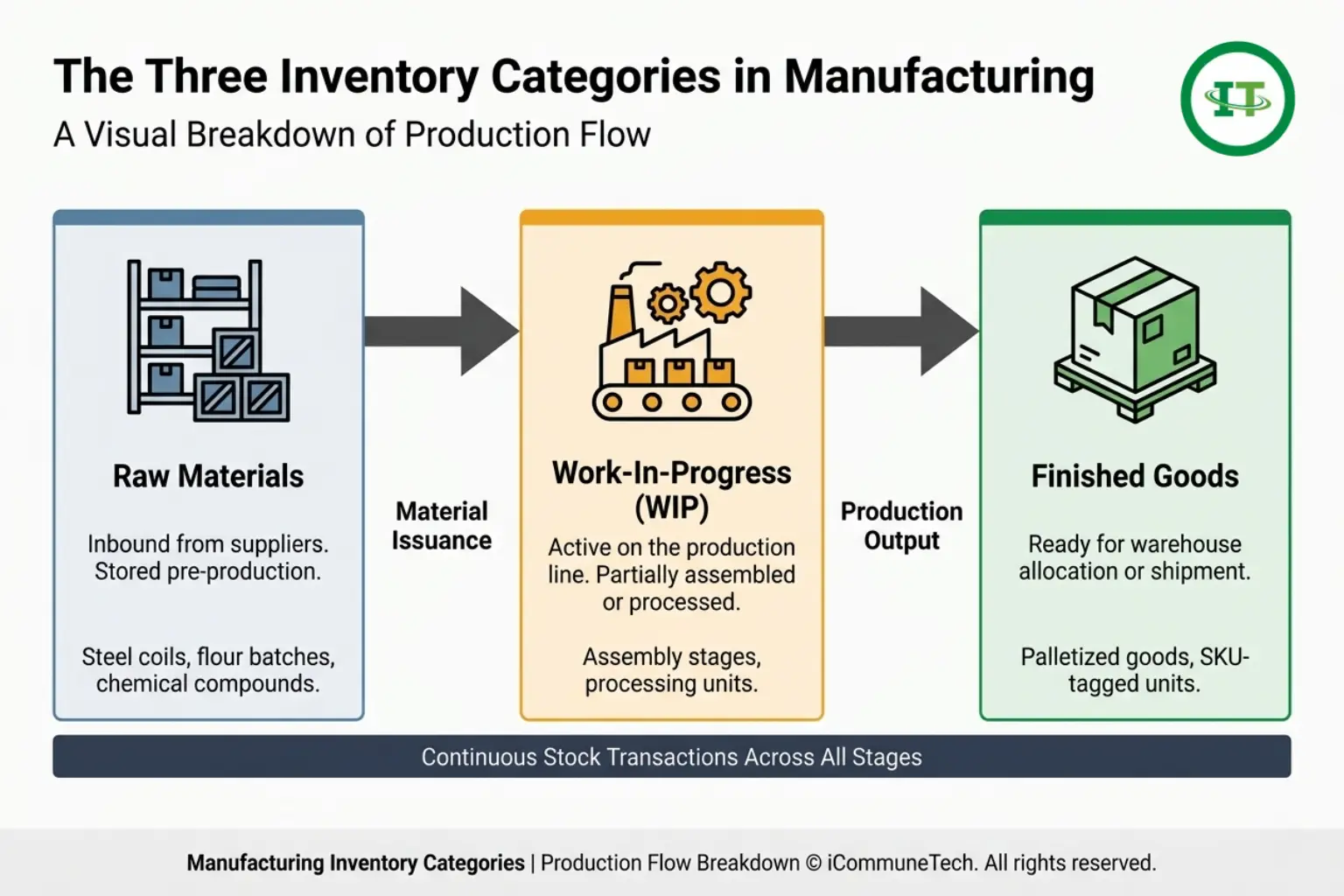
Manufacturers manage three inventory categories: raw materials, work-in-progress (WIP), and finished goods. Each category generates continuous stock transactions across production lines, warehouses, and supplier networks. As SKU counts and transaction volumes increase, tracking these movements becomes more complex.
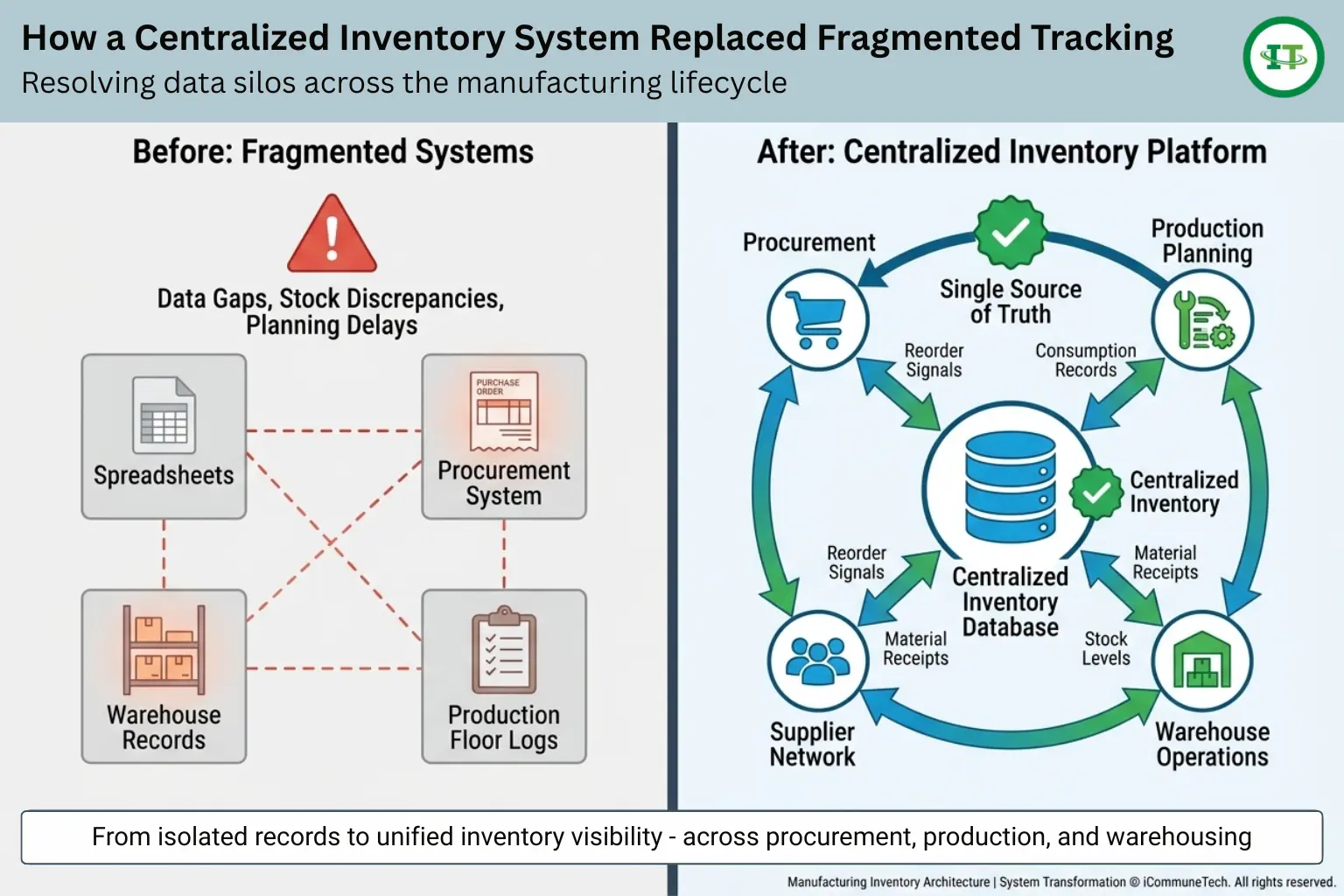
Spreadsheet tracking and disconnected systems fail under this complexity. These systems cannot maintain accurate records at scale, which leads to stock discrepancies, production delays, and inefficient material planning.
Manufacturing inventory management software replaces fragmented tracking with a centralized inventory database. The system records material movements across procurement, production stages, and warehouse locations. Planners access accurate stock levels and confirm component availability before releasing production orders.
Modern inventory platforms extend beyond stock tracking. They enable batch traceability, demand forecasting, and real-time monitoring across multi-location manufacturing operations. These capabilities support production continuity, compliance, and inventory optimization.
Manufacturing leaders evaluate inventory platforms based on the following criteria:
- Ensure inventory visibility across production and warehouse locations
- Integrate with enterprise resource planning (ERP) and production planning systems
- Maintain batch traceability and regulatory compliance
- Improve demand forecasting accuracy
- Optimize implementation cost and platform scalability
This blog explains how manufacturing inventory management software improves operations, integrates with enterprise systems, and delivers measurable ROI across manufacturing environments.
What Is Manufacturing Inventory Management Software?
Manufacturing inventory management software is a system that records, tracks, and controls material movements across procurement, production, and warehouse operations. It maintains structured inventory data for material receipts, production consumption, and finished goods output, ensuring accurate visibility across the entire manufacturing lifecycle.
Manufacturing environments generate continuous inventory transactions across assembly stages, storage locations, and supplier deliveries. As SKU counts and transaction volumes increase, tracking these movements becomes difficult. Spreadsheet tracking and disconnected systems fail at this scale, creating inaccurate records, planning gaps, and production delays.
A centralized inventory management system architecture resolves this fragmentation by consolidating all stock transactions into a unified database. It records material flow from inbound receipt to production usage and finished goods completion, allowing teams to work from a single, consistent source of inventory data.
Production planners rely on this data to confirm component availability before releasing manufacturing orders. Procurement teams use the same records to calculate reorder quantities and align supplier schedules with production demand. This shared visibility removes uncertainty across planning and execution.
Manufacturing inventory systems enable core operational controls:
- Track raw materials issued to production orders
- Monitor work-in-progress (WIP) across manufacturing stages
- Record finished goods output and warehouse allocation
- Capture batch and lot identifiers for traceability
- Maintain accurate inventory counts across warehouse locations
These controls reduce production interruptions caused by material shortages and prevent excess inventory accumulation. They ensure balanced stock levels while improving production continuity and planning accuracy.
Manufacturing inventory management software functions as the central coordination layer across procurement, warehouse operations, and production planning. The following sections examine the capabilities and integration models that strengthen this coordination.
What Are the Core Features of Manufacturing Inventory Management Solutions?
Manufacturing inventory management solutions include five core features: real-time tracking, bill of materials (BOM) management, batch traceability, automated replenishment, and demand forecasting. These features control material movement across production workflows and maintain accurate records of stock levels, component usage, and production output.
Modern platforms use automated inventory systems to capture transactions and update records across production and warehouse environments. These systems support coordinated control in multi-stage manufacturing operations.
A study by Allied Market Research reports the market was valued at $2.3 billion in 2023. It is projected to reach $4.8 billion by 2032, growing at a CAGR of 8.7%. Growth reflects increased adoption of automated platforms for accurate stock tracking and material planning.
Core platform capabilities include:
- Real-time tracking across production and storage locations
- Bill of materials (BOM) structures linking components to manufacturing orders
- Batch and lot traceability for quality control and compliance
- Automated replenishment using defined reorder thresholds
- Demand forecasting models supporting material planning
These capabilities define the functional framework of manufacturing inventory systems. The following sections examine how each capability supports production planning, traceability, and replenishment.
Real-Time Inventory Tracking and Visibility
Real-time inventory tracking improves production planning by providing current inventory data across warehouses and production work centers. Data latency disrupts scheduling because planners cannot confirm component availability.
Real-time inventory tracking improves production planning by providing current inventory data across warehouses and production work centers. Data latency disrupts scheduling because planners cannot confirm component availability.
Manufacturing platforms integrate scanners, sensors, and machine interfaces to capture material movements. These systems record transactions during receiving, production, consumption, and warehouse transfers. Many organizations use supply chain visibility platforms to monitor materials and finished goods.
Inventory tracking platforms support the following operational capabilities:
- Capture material receipts using barcode or radio frequency identification (RFID) scanning
- Synchronize component consumption with production order execution
- Update stock levels across warehouse locations and storage zones
- Generate alerts when stock approaches reorder thresholds
- Display inventory status through operational dashboards
Real-time tracking capabilities improve production visibility and material availability:
- Improve production scheduling reliability
- Detect component shortages earlier
- Reduce manual inventory reconciliation
- Lower inventory carrying costs
- Strengthen coordination between procurement and production planning
Bill of Materials and Batch Management
Bill of materials (BOM) and batch management improve production control by defining product structures and tracking material usage during production. Accurate records ensure each production order consumes the correct materials and maintains traceability.
Bill of materials (BOM) management defines the component hierarchy required to assemble a product. Batch and lot control assign identifiers to materials and finished goods. These identifiers link production output to source materials.
Modern platforms store these relationships within a structured inventory database infrastructure that maintains BOM structures, batch identifiers, and production transaction records.
Inventory platforms support the following functions for BOM control and batch traceability:
- Manage multi-level BOM structures for manufacturing orders
- Record component consumption during production execution
- Assign batch or lot identifiers to incoming materials and finished goods
- Link finished products to source material batches
- Monitor batch status across production and storage locations
These controls support quality management, compliance, and production traceability across regulated and high-volume industries.
| Feature | Operational Benefit |
|---|---|
| Multi-level BOM management | Ensures accurate component allocation during production |
| Batch and lot identification | Enables traceability across manufacturing and distribution |
| Component consumption tracking | Maintains accurate material usage records |
| Finished product batch linkage | Supports quality audits and product recall procedures |
Automated Replenishment and Demand Forecasting
Automated replenishment and demand forecasting improve material planning by aligning inventory availability with production schedules. Procurement teams determine reorder timing and quantities based on expected consumption.
Manufacturing platforms use forecasting models and automated replenishment controls to convert demand signals into procurement actions. Organizations use demand planning software to analyze historical consumption data and generate demand projections.
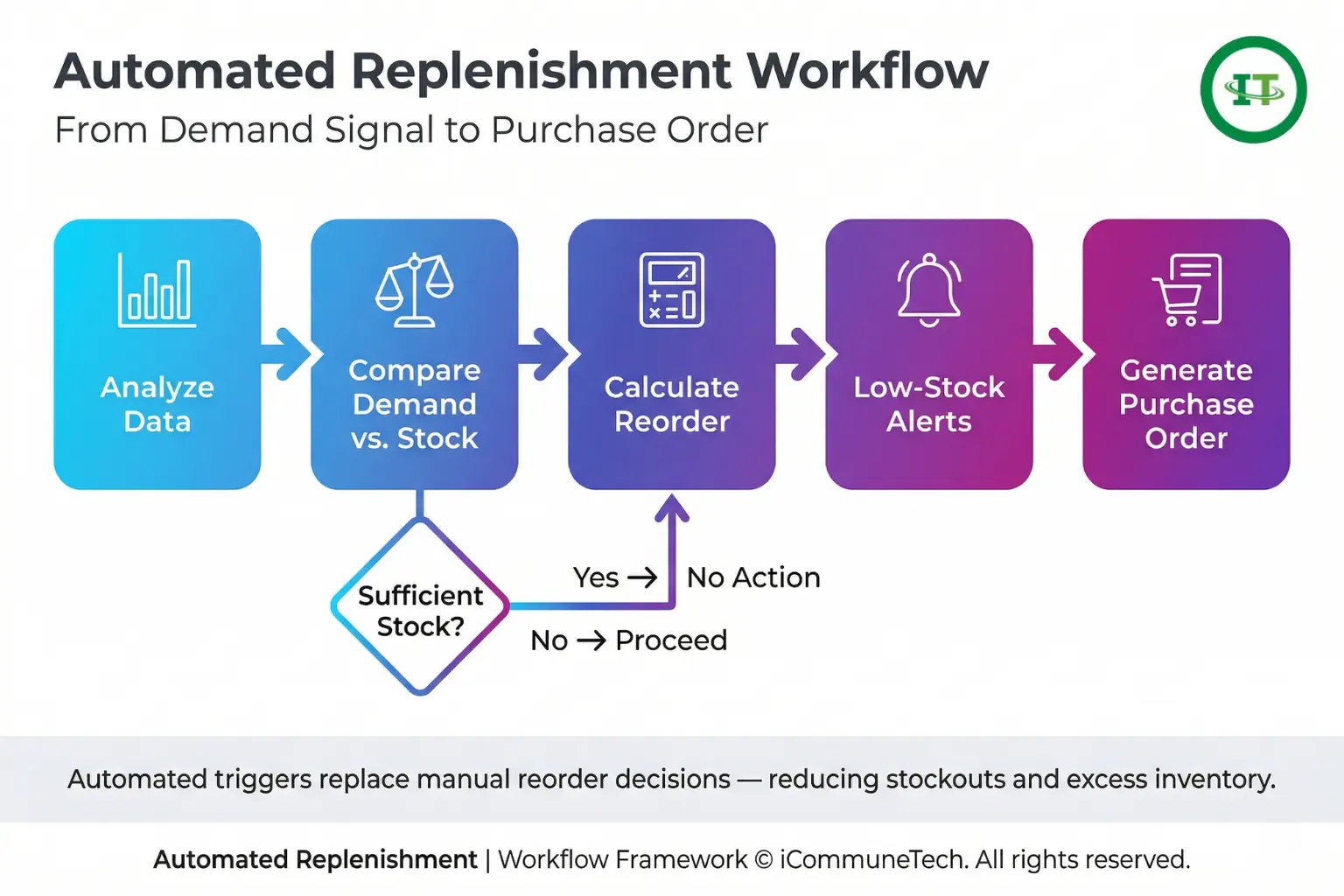
Automated replenishment systems follow this workflow:
- Analyze historical consumption patterns and planned production volumes
- Compare projected demand with available and safety stock levels
- Calculate reorder quantities using forecast demand and supplier lead times
- Trigger low-stock alerts when inventory approaches defined thresholds
- Generate purchase orders to restore required stock levels
Automated replenishment workflows deliver measurable operational outcomes like:
- Reduce production delays caused by material shortages
- Improve procurement planning accuracy
- Lower excess stock from manual reorder decisions
- Increase responsiveness to demand variability
- Strengthen coordination between procurement and production scheduling
How Does Inventory Software Integrate with Manufacturing Systems?
Inventory software integrates with manufacturing systems by exchanging data across enterprise applications used for planning, execution, procurement, and warehouse control. This integration maintains consistent inventory records across all operational systems.
A McKinsey survey found that 90% of supply chain leaders experienced operational disruptions. These disruptions highlight the need for resilient inventory systems and accurate data coordination.
Many organizations implement integrated supply chain management software architectures. These architectures connect inventory platforms with enterprise applications. System interfaces transmit production transactions, procurement updates, and warehouse movements.
| System Type | Integration Purpose |
|---|---|
| Enterprise Resource Planning (ERP) | Aligns inventory records with financial accounting and production planning |
| Manufacturing Execution System (MES) | Records component consumption during production operations |
| Procurement platforms | Generates purchase orders based on material requirements |
| Warehouse Management Systems (WMS) | Coordinates inventory movements within warehouse operations |
These integrations maintain consistent records across manufacturing systems. The following sections examine ERP integration models and industrial Internet of Things (IoT) applications used in inventory environments.
ERP for Inventory Management in Manufacturing
Enterprise resource planning (ERP) platforms manage financial accounting, procurement, and production planning in manufacturing organizations. Inventory platforms exchange transaction data with ERP modules to maintain accurate records of material usage.
Manufacturers connect inventory applications with production scheduling software to align material requirements with production schedules. Integration interfaces transmit production consumption, material receipts, and finished goods updates to ERP modules for reporting.
ERP integration provides the following operational advantages:
- Align material availability with production schedules
- Record material consumption for cost calculations
- Consolidate inventory activity within accounting records
- Support financial reporting for production operations
- Improve visibility into material costs for manufacturing orders
ERP integration introduces the following technical challenges:
- Data structure differences between ERP modules and inventory platforms
- Configuration dependencies across production, procurement, and finance modules
- Processing delays at high transaction volumes
- Connector development requirements for legacy environments
- Monitoring integration interfaces and data exchange pipelines
Utilizing IoT Applications in Manufacturing Inventory Management
Manufacturing facilities deploy connected sensors, radio frequency identification (RFID) readers, and scanning devices to capture inventory events. These devices record material movements across warehouse locations and production operations.
Internet of Things (IoT) integration connects these devices with inventory platforms. Systems receive real-time tracking signals from storage zones and production environments.
Industrial IoT devices transmit data through network gateways into centralized inventory databases. Technologies such as inventory counting with computer vision enable automated stock detection using visual data from warehouse cameras.
IoT-enabled inventory platforms support the following operational use cases:
- Monitor stock quantities across warehouse storage zones
- Detect pallet movement using RFID-based tracking
- Record inventory counts using computer vision systems
- Track manufacturing assets across production facilities
- Generate alerts and notifications when inventory thresholds change
IoT-enabled inventory systems improve inventory control and operational visibility:
- Reduce manual inventory counting activities
- Identify inventory discrepancies faster
- Improve tracking of assets and material locations
- Increase the accuracy of warehouse inventory records
- Enable faster response to inventory level changes
How to Evaluate and Select the Best Manufacturing Inventory Management Software?
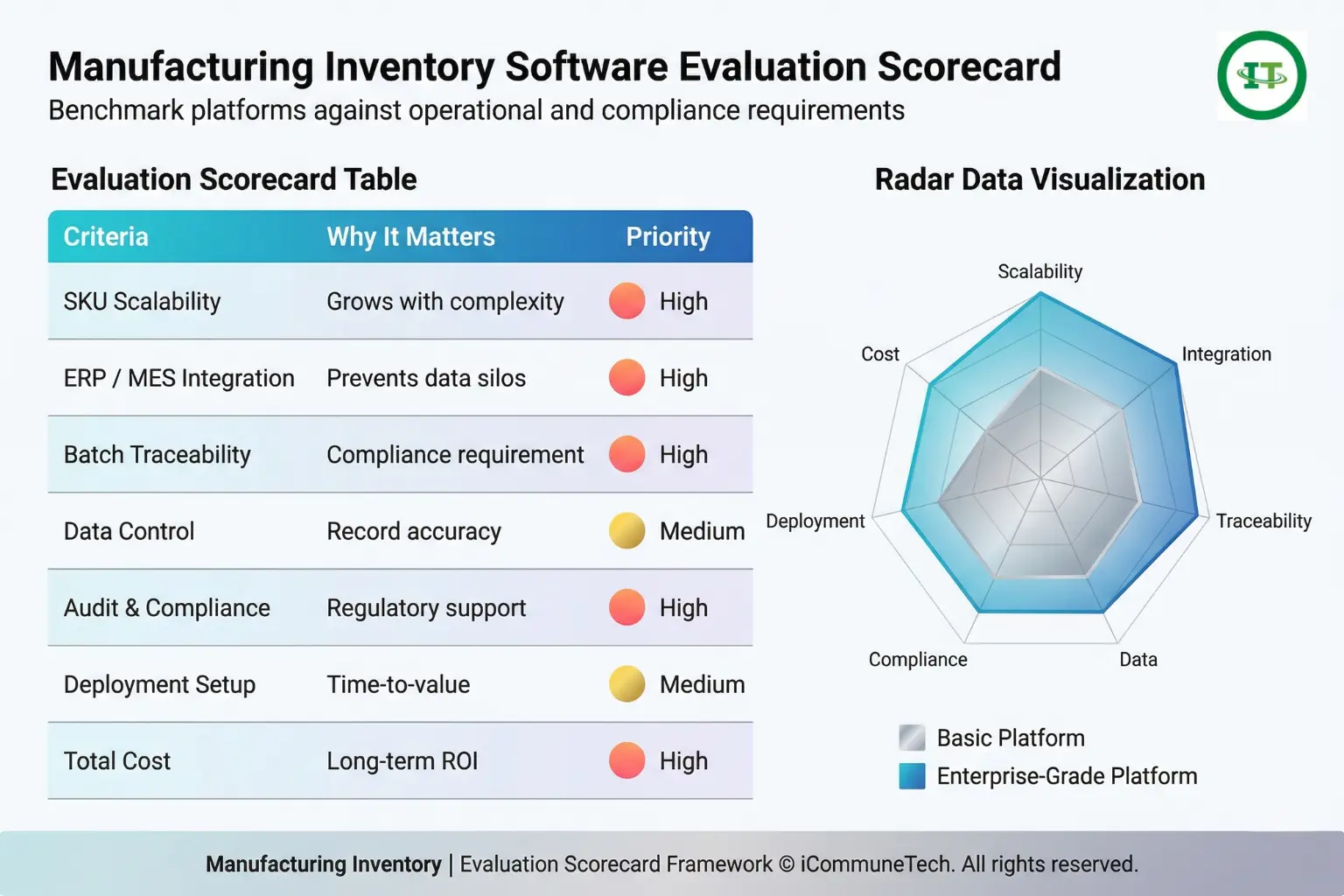
To evaluate and select the best manufacturing inventory management software, organizations assess operational requirements, system compatibility, and implementation cost. Selection teams confirm whether the platform supports production coordination, procurement planning, and warehouse operations.
Inventory platforms operate within supply chain planning software environments. These environments align demand forecasting, procurement schedules, and production plans through shared data inputs. Evaluation focuses on how inventory systems support these planning workflows.
Accurate inventory records stabilize production scheduling and reduce stockouts and excess inventory. An inventory index reading of 45.2, down by 3.7 percentage points from the previous month, indicates contraction across industrial sectors, reflecting demand variability and its impact on inventory levels, according to ISM data reported by Logistics Management.
Manufacturers typically assess inventory platforms using the following criteria:
- Support scalability for increasing stock-keeping unit (SKU) counts, warehouse locations, and transaction volumes
- Ensure integration capability with enterprise resource planning (ERP) and manufacturing execution system (MES) platforms
- Provide traceability through batch tracking, lot tracking, or serial identification
- Maintain data control mechanisms for consistent inventory records
- Support compliance through audit trail and traceability controls
- Minimize deployment complexity during configuration and integration
- Optimize the total cost of ownership across implementation and system maintenance
Evaluation teams confirm the following checklist before selection:
- Support multi-location inventory across manufacturing facilities
- Provide integration interfaces for enterprise systems
- Enable inventory control with required traceability methods
- Deliver inventory reporting for operational and financial analysis
- Align system architecture with existing IT infrastructure
The following subsection examines additional requirements for industries operating under strict regulatory standards.
What Are the Key Criteria for Selecting Inventory Solutions in Regulated Manufacturing?
Inventory solutions in regulated manufacturing must support batch traceability, documentation control, and role-based access control to meet compliance requirements across industries such as pharmaceuticals, food processing, and medical devices.
Organizations implement supply chain compliance systems to record transactions and maintain audit trails. These systems enforce controlled procedures for material handling and production processes. They ensure that material movements, batch records, and distribution data remain verifiable during inspections.
| Compliance Requirement | Purpose |
|---|---|
| Batch and lot traceability | Links finished products to source materials for recall and quality investigations |
| Audit trail recording | Maintains historical records of inventory transactions and system changes |
| Role-based access control | Restricts system actions based on authorized user responsibilities |
| Documentation management | Store regulatory records for inspections and compliance audits |
Regulated manufacturers align inventory systems with the following standards:
- FDA Current Good Manufacturing Practice (cGMP) regulations
- ISO 9001 quality management standards
- ISO 13485 medical device quality systems
- Hazard Analysis and Critical Control Points (HACCP) for food safety
- FDA 21 CFR Part 11 for electronic records and audit requirements
Industry-Specific Inventory Management Software Use Cases
Manufacturing sectors operate under different production methods, material characteristics, and regulatory requirements. Inventory platforms must support these variations to maintain inventory control and production coordination.
Industry requirements vary across the following manufacturing environments:
- Food and beverage manufacturing
- Steel and heavy manufacturing
- Construction material production
- Warehouse and wholesale operations
- Veterinary and healthcare product manufacturing
- Jewelry production and precious material handling
- Automated vending supply chains
Each industry introduces inventory control challenges related to batch tracking, material handling, storage conditions, and compliance requirements. 949.6 billion dollars was the estimated value of U.S. manufacturing inventories in recent data. The figure highlights the capital tied to inventory across industrial supply chains.
The following sections examine how inventory systems support these sector-specific operational requirements.
Food Manufacturing Inventory Management
Food manufacturers must maintain strict control over batch tracking, shelf-life monitoring, and regulatory documentation. Inventory systems record ingredient batches, manage expiration timelines, and maintain traceability across processing and distribution.
Many facilities integrate inventory data with cold chain logistics management systems to maintain temperature-controlled storage and transport conditions to preserve product quality.
The following table outlines operational challenges in food manufacturing and the inventory system capabilities used to address them.
| Operational Challenges | Software Capabilities Addressing the Challenge |
|---|---|
| Managing ingredient batches across multiple processing stages | Assigning lot identifiers to incoming ingredients and finished goods |
| Monitoring expiration dates for perishable materials | Tracking shelf-life status and expiration timelines |
| Maintaining traceability records is required during food safety inspections | Maintaining documentation required for food safety audits |
| Responding rapidly to contamination events or product recalls | Linking finished products to ingredient batches for recall management |
| Controlling material waste caused by expired inventory | Synchronizing inventory records with temperature-controlled storage and transport systems |
Inventory Management Software for Steel and Heavy Industries
Steel and heavy manufacturing operations manage large material volumes, long production cycles, and high-value assets. Inventory systems must track raw materials, semi-finished components, and finished goods across storage yards and processing facilities.
Organizations use inventory optimization platforms to control stock levels and support continuous production. These platforms balance material availability with capital investment using inventory optimization techniques.
The following table outlines operational challenges in steel and heavy manufacturing and the inventory system capabilities used to address them.
| Operational Challenges | Software Capabilities Addressing the Challenge |
|---|---|
| Manage extensive SKU catalogs for raw, semi-finished, and finished materials finished goods | Maintaining structured SKU records for large material catalogs |
| Tracking high-value materials such as steel coils, billets, and fabricated components | Tracking material locations across warehouses, storage yards, and production facilities |
| Monitoring material movement across large storage yards and warehouse facilities | Recording component usage during heavy manufacturing processes |
| Recording material usage during long production cycles | Monitoring material availability for production planning |
| Controlling inventory investment tied to high-value industrial materials | Supporting inventory optimization strategies for high-value industrial materials |
Solutions for Manufacturing SMEs and Niche Verticals
Small and mid-sized manufacturers operate with constrained IT resources and limited system administration capacity. Inventory platforms must support material tracking and transaction recording while remaining easy to configure and maintain.
Organizations use adaptable custom inventory solutions designed for specialized production environments. These solutions support flexible configuration for niche operational requirements.
Manufacturing SMEs and niche sectors require inventory systems that support the following conditions:
- Manage moderate stock-keeping unit (SKU) catalogs within small warehouse environments
- Coordinate inventory across limited production facilities and storage locations
- Integrate inventory records with accounting and procurement systems
- Maintain traceability for specialized materials such as veterinary supplies or precious metals
- Support inventory control without large-scale IT deployment
Flexible inventory platforms provide the following advantages:
- Enable configurable workflows aligned with production processes
- Support lightweight system architecture for smaller environments
- Provide integration with accounting, procurement, and order management systems
- Enable scalable inventory structures for business growth
- Simplify deployment compared to large enterprise platforms
How to Calculate ROI for Manufacturing Inventory Management Software?
To calculate ROI for manufacturing inventory management software, organizations measure financial and operational outcomes such as material costs, production efficiency, and inventory utilization. ROI analysis quantifies how inventory systems impact these performance areas.
Inventory optimization and demand forecasting reduce inventory levels by 10% to 30% while maintaining supply reliability under demand variability.
Many enterprises use supply chain analytics platforms to measure performance and track post-implementation improvements. These platforms provide data analytics and KPI dashboards for inventory reporting.
| Metric | ROI Impact |
|---|---|
| Inventory turnover | Improves capital utilization by reducing excess inventory levels |
| Stockout frequency | Reduces production interruptions caused by material shortages |
| Inventory carrying cost | Lowers storage, handling, and capital costs tied to inventory |
| Order fulfillment accuracy | Improves customer delivery reliability |
| Material waste levels | Reduces financial loss from expired or unused materials |
Manufacturing leaders monitor the following key performance indicators (KPIs):
- Inventory turnover ratio
- Inventory carrying cost percentage
- Stockout frequency across production cycles
- Order fulfillment accuracy rates
- Material waste or scrap levels
- Production downtime caused by material shortages
A PR Newswire report for Hollysys shows inventory turnover of approximately 79–84 days. This metric indicates how manufacturers evaluate supply chain efficiency and working capital performance.
Why Do Manufacturers Trust iCommuneTech for Inventory Management Projects?
Manufacturers trust iCommuneTech because it delivers inventory platforms that support complex production environments and integrate with enterprise systems. These capabilities align with digital supply chain transformation initiatives that improve operational coordination and system integration.
iCommuneTech provides customized inventory platforms for manufacturing operations with specialized configuration requirements. The company focuses on solution architecture, enterprise system integration, and structured deployment support.
The platform differentiates through the following capabilities:
- Configure inventory platforms aligned with production workflows
- Engineer integrations across enterprise systems
- Provide industry-specific configurations for regulated and high-value sectors
- Deploy systems aligned with enterprise IT governance requirements
- Support scalable architecture for multi-site manufacturing operations
Manufacturers rely on iCommuneTech for the following delivery capabilities:
- Design an inventory platform architecture aligned with manufacturing workflows
- Develop integration interfaces across enterprise applications
- Provide structured implementation support for system deployment
- Monitor system performance and optimize operational efficiency
- Support platform scaling and multi-site expansion
Next Steps to Evaluate or Implement Manufacturing Inventory Solutions
Manufacturing organizations planning new inventory systems begin with a structured evaluation of operational needs and system architecture. Many teams start this process through a custom inventory solution demo to review platform capabilities and determine configuration requirements for their production environments.
A typical evaluation and implementation process includes the following steps:
- Document operational workflows related to material handling, production execution, and warehouse activities.
- Analyze the existing system landscape to determine required integration interfaces.
- Assess platform functionality against operational and compliance requirements.
- Define implementation phases, including configuration, integration, development, and deployment milestones.
- Execute validation testing to confirm system performance before organization-wide rollout.
Manufacturing teams should complete the following preparation checklist:
- Compile stock keeping unit (SKU) catalogs and material classification structures
- Identify enterprise systems requiring integration
- Define batch tracking and compliance requirements
- Estimate transaction volumes and inventory data scale
- Establish performance metrics for system evaluation

Irshad Pathan

Web Development Expert
Irshad is a senior technical expert at iCommuneTech. He manages the iCommuneTech's Web Development Team, and has hands-on expertise in web development, Laravel development, Logistics, fleet management, and Supply Chain Management. He mentors the in-house team and enjoys describing his experience in words.
Read More Insights By Irshad →