
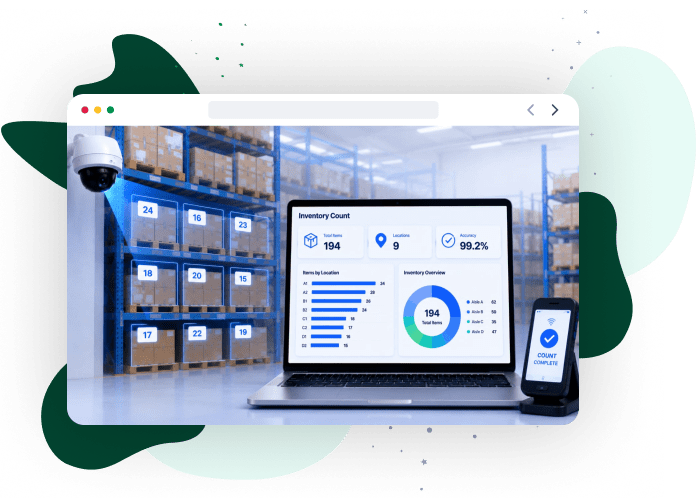
Inventory inaccuracies in warehouse environments result from scan-dependent workflows, delayed reconciliation cycles, and limited visibility across storage locations. These failures reduce order accuracy, disrupt replenishment timing, and weaken stock control in high-throughput warehouses.
Computer vision systems validate inventory through 4 processing layers that convert visual inputs into stock data:
Camera arrays capture inventory conditions across racks, bins, and staging zones, maintaining continuous visual coverage of storage areas
Vision models detect SKUs, extract label data, and estimate quantities, converting images into structured inventory signals
Edge and cloud processing layers validate detected stock states and structure them into transaction-ready data
Integration layers commit validated inventory updates into warehouse and inventory management systems
This model continuously verifies stock, detects discrepancies as they occur, and eliminates manual audit cycles without disrupting warehouse throughput.
Organizations deploy computer vision inventory counting solutions to replace periodic audits with automated validation built into daily operations. This reduces counting effort, compresses audit cycles, and improves control over inventory accuracy across multi-location supply chains.
iCommuneTech designs and deploys computer vision inventory systems built around your warehouse workflows, existing system architecture, and enterprise data requirements. The sections below cover features, system architecture, integration models, and cost—everything needed to evaluate and deploy a computer vision inventory counting system.
What is Computer Vision for Inventory Counting?
Computer vision for inventory counting is an automated system that uses trained vision models to convert warehouse camera feeds into SKU-level stock records without barcode scanning.
It runs inside automated inventory systems, where cameras continuously monitor stock conditions across racks, bins, and shelves. These image streams pass through processing layers that detect items, extract identifiers, and map stock to physical locations.
The system runs inventory through a structured vision pipeline that converts visual inputs into validated stock data:
- Object detection models identify and classify SKUs within captured frames. This gives warehouse teams item-level visibility across all storage locations.
- OCR engines read labels, barcodes, and identifiers. This connects visual data to existing system records.
- Segmentation models separate overlapping or densely packed items. This improves count accuracy in high-density storage zones.
- Tracking logic follows item movement across frames and zones. This preserves inventory position continuity throughout handling events.
This pipeline converts raw image data into transaction-ready inventory records with SKU, quantity, and location attributes.
In warehouse operations, the system matches detected stock against pallet, bin, and rack-level records to identify mismatches during handling events. In retail environments, it monitors shelf conditions to detect stock gaps, empty facings, and incorrect placements. Inventory platforms receive validated updates that trigger exception workflows and keep stock records synchronized. Manual counting cycles are no longer required.
What Are the Market Insights for Computer Vision in Inventory Counting?
The global computer vision market will grow from $22.7 billion in 2022 to $386.3 billion by 2032, at a CAGR of 32.9%, driven by enterprise demand for automated inventory control in warehouse operations.
This growth reflects rising enterprise investment in automation systems that replace manual data capture with continuous visual monitoring across warehouse and retail operations.
Adoption follows supply chain digital transformation initiatives, where inventory tracking shifts from periodic checkpoints to embedded data capture within handling and storage workflows.
Market expansion is driven by execution-level constraints that limit manual inventory control:
SKU proliferation increases the counting workload. This slows audit cycles and reduces count frequency across warehouse operations.
Omnichannel fulfillment requires location-accurate stock data to prevent order routing errors.
Labor constraints restrict manual counting at scale. Large warehouse networks cannot expand audit coverage without automation.
Compliance requirements increase audit frequency. Without automation, this adds significant operational overhead to warehouse teams.
These constraints drive demand for systems that maintain inventory control during live operations:
Continuous stock tracking during handling events reduces dependency on scheduled audits.
Location-bound inventory mapping that supports bin, rack, and shelf-level stock accuracy.
Exception detection isolates mismatches between physical stock and system records in real time.
High-frequency data updates keep inventory records aligned with live operational activity.
Adoption is concentrated in environments where inventory complexity and throughput demand automated control:
- High-throughput distribution centers managing dense storage and rapid inventory movement.
- 3PL operations handle multi-client inventory with strict segregation and traceability requirements.
- Retail environments require shelf-level availability tracking and automated replenishment signals.
- Manufacturing warehouses manage serialized inventory and production-linked stock flows that support assembly line scheduling.
Gartner reports that 50% of warehouse operators will adopt AI-enabled vision systems by 2027, signaling a broad industry transition from manual cycle counting to automated inventory execution across warehouse networks.
Improvements in model accuracy, edge processing, and multi-camera coordination now make computer vision systems stable enough for dynamic warehouse environments with varying layouts and lighting conditions.
Enterprise adoption accelerates when computer vision delivers 3 measurable outcomes: reduced audit effort, faster inventory reconciliation, and improved stock control. Each directly impacts fulfillment reliability and operating cost.
Driving Measurable Results Across Industries
From automating manual calculations to modernizing legacy infrastructure, we build software that directly impacts the bottom line. Our custom solutions consistently reduce operational costs and accelerate process efficiency.
View Our Case Studies
What Are the Key Features of Computer Vision Inventory Management Solutions?
Computer vision inventory management solutions have 8 key features that automate SKU tracking, inventory mapping, and stock updates across warehouse, retail, and multi-site operations.
These features embed visual data capture directly into storage, handling, and replenishment workflows. They connect with inventory management systems to replace scan-dependent processes.
The 8 features below show how computer vision systems capture, process, and update inventory state across warehouse and retail operations:
1. SKU-Level Identification:
Computer vision detects and classifies products within racks, bins, and pallets. It gives warehouse teams item-level inventory visibility during live operations.
2. Quantity Estimation:
The system calculates stock levels directly from visual inputs. This reduces manual counting effort and increases count frequency across storage zones.
3. Location Mapping:
The system links detected inventory to bin, rack, and shelf coordinates. This supports precise stock positioning and faster retrieval during picking operations.
4. Continuous State Tracking:
The system keeps inventory records updated during handling events. Warehouse teams no longer depend on scheduled audit cycles for stock visibility.
5. Discrepancy Detection:
The system flags mismatches between physical stock and system records the moment they occur. Operations teams can investigate and correct errors immediately.
6. Zone Coverage Management:
Monitors storage, staging, and picking areas through coordinated camera inputs, ensuring uninterrupted inventory tracking.
7. Inventory Data Sync:
Commits validated stock data into inventory platforms, keeping system records aligned with physical stock conditions.
8. Multi-Site Control:
Supports deployment across multiple facilities with centralized monitoring, enabling standardized inventory control at scale.
These 8 features give buyers a clear basis to evaluate system fit across warehouse, retail, and multi-location environments. Assess each feature against your coverage requirements, operational priorities, and scalability needs.
How do Computer Vision Systems Enable Real-Time Inventory Tracking and Counting?
Computer vision systems track inventory in real time by capturing stock changes during handling events and committing updates immediately to inventory systems. This removes the delay between physical stock movement and system records.
These systems integrate with real-time inventory visibility by linking inventory updates directly to operational events instead of post-process reconciliation.
Real-time tracking works through event-driven execution mechanisms that capture, validate, and act on inventory changes during warehouse workflows:
Event-Based Capture:
Records stock changes during putaway, picking, replenishment, and dispatch, ensuring inventory updates reflect live operations.
Location-Level Mapping:
Maintains bin, rack, and zone-specific inventory states. This supports precise stock positioning and faster retrieval during picking and putaway.
Movement Alignment:
Matches inbound, internal transfers, and outbound flows with recorded stock data, preventing mismatches during transitions.
Discrepancy Detection:
Flags differences between detected stock and system records at the moment of occurrence, reducing error propagation.
Alert Triggering:
Sends real-time alerts to operations teams when mismatches or stock gaps occur, enabling immediate corrective action.
Zone Monitoring:
Maintains continuous tracking across storage and handling areas through coordinated camera coverage.
Control Tower Sync:
Streams validated inventory updates into dashboards for live monitoring, exception tracking, and decision control.
This execution model maintains synchronized inventory records, reduces manual verification effort, and supports immediate response to stock discrepancies during warehouse operations.
How does Computer Vision Enable Inventory Tracking at the Shelf Edge?
Computer vision tracks shelf-edge inventory by monitoring shelf conditions, detecting stock levels, and enforcing planogram rules directly at the point of sale. This approach replaces scan-based checks with continuous monitoring using barcode scanning in logistics operations, where camera inputs and sensor data identify stock conditions without manual intervention.
Shelf-edge tracking operates through image recognition and sensor-driven control mechanisms that monitor stock presence, compliance, and replenishment signals:
Planogram Enforcement: Compares shelf layout with planogram rules, identifying misplaced items and adjacency violations that affect display compliance
Facing Compliance: Measures facing per SKU, maintaining display standards, and ensuring correct shelf share allocation
Stockout Detection: Detects empty facings and low stock depth, triggering replenishment actions before stockouts impact sales
Price Label Verification: Matches shelf labels with SKU data, preventing pricing errors and incorrect product tagging
Sensor Fusion: Combines camera feeds with weight and infrared sensors to confirm stock presence and detect depletion events with higher accuracy
Backroom Task Triggering: Converts shelf signals into pick, replenish, or transfer tasks within backroom inventory workflows
Last-Mile Fulfillment Alignment: Updates store-level availability for order orchestration, supporting click-and-collect and store-based fulfillment
Together, these mechanisms keep shelves accurate, enforce merchandising rules, and trigger replenishment actions in real time. Retailers gain stronger availability control and more reliable last-mile fulfillment performance.
Case Study: Drone-Based Computer Vision for Inventory Counting Efficiency
Gather AI deployed a drone-based computer vision system at Taylor Logistics that scans warehouse racks, detects SKUs, and calculates case counts and location occupancy without manual access to storage areas.
Before deployment, warehouse teams conducted manual cycle counts that required lifting equipment, extended labor hours, and temporary operational disruption. These constraints reduced counting frequency and increased the risk of mismatches between physical stock and system records.
The system uses autonomous drones to capture rack images and process them through vision models that identify products, read labels, and estimate case quantities across all storage locations. The system also measures location occupancy, allowing operators to track storage utilization and detect empty or underutilized slots.
The Taylor Logistics deployment shows that computer vision systems integrated with autonomous drones can improve inventory counting speed, reduce operational disruption, and support high-throughput warehouse environments at scale.
Explore more implementations across warehouse and 3PL environments:
Check more success storiesClient: Taylor Logistics
Technology: Gather AI Drone-Based Computer Vision Inventory Monitoring System
What is the System Architecture for Computer Vision Inventory Management?
System architecture for computer vision inventory management converts captured images into inventory transactions through coordinated sensing, processing, and integration layers within warehouse operations.
The architecture connects with warehouse management systems by sending validated inventory events. These events update stock records and trigger execution workflows across WMS and ERP platforms.
A production system runs through functional layers that capture, process, and commit inventory data across warehouse environments:
Deployment follows infrastructure-driven models that determine how computer vision integrates into warehouse environments:
Greenfield Deployment:
Designs camera placement, network architecture, and compute infrastructure during new facility setup, enabling optimized system layout.
Brownfield Deployment:
Adds vision components to existing warehouse systems using API-based integration, minimizing disruption to current operations.
This architecture converts visual inputs into structured inventory transactions, maintains system synchronization, and supports controlled data flow across warehouse networks.
How do AI and IoT Integrations Enable Full Automation in Inventory Counting?
AI and IoT integrations automate inventory operations by converting detected stock changes into system-triggered tasks across warehouse and manufacturing workflows.
These integrations connect with supply chain automation systems by linking sensing layers with execution engines that assign and control operational tasks.
Automation works through integrated components that capture signals, process inventory events, and trigger execution across systems:
- Edge Orchestration: Coordinates edge devices to generate and route inventory events with low latency, ensuring faster response to stock changes.
- Sensor Fusion: Combines camera data with RFID, weight, and proximity sensors to confirm stock presence and movement with higher accuracy.
- Digital Twin Synchronization: Maintains a real-time virtual model of storage locations, supporting occupancy tracking and capacity planning.
- Robotics Integration: Triggers AMRs and AGVs to execute replenishment, transfer, and picking tasks based on detected inventory conditions.
- MES Alignment: Links inventory availability with production schedules, ensuring material flow supports manufacturing operations.
- Event Streaming Pipeline: Routes inventory events through data pipelines for processing across warehouse and enterprise systems.
- Workflow Automation Engine: Applies rule-based logic to trigger replenishment, exception handling, and task allocation without manual intervention.
- Centralized Monitoring: Consolidates operational signals into dashboards, allowing teams to track execution status and respond to issues in real time.
These integrations convert inventory signals into automated actions, reducing manual coordination and maintaining consistent execution across warehouse operations.
McKinsey & Company reports that AI-driven operations can automate up to 50% of workforce management tasks and reduce labor costs by 10–15%. For warehouse operators, this means fewer manual touchpoints in task coordination and measurable efficiency gains across inventory-driven workflows.
How do Deployment Models Integrate Computer Vision with Warehouse Management Systems?
Deployment models connect computer vision systems with warehouse platforms through the integration approaches that structure how inventory events are captured, validated, and committed into WMS and ERP workflows.
These models align with transportation management software by linking inventory updates to shipment planning, dispatch sequencing, and yard coordination processes. Integration follows practical deployment approaches that define how vision systems interact with existing warehouse and logistics environments:
These deployment models give warehouse operators a clear path to incremental modernization. Computer vision integrates into existing systems without disrupting operations, and data continuity stays intact throughout every phase of deployment.
What is the Technology Stack for Computer Vision Implementation?
The technology stack for computer vision implementation supports image capture, model processing, and system integration required to convert visual data into operational inventory outputs.
The stack connects with supply chain analytics platforms by feeding structured inventory data into KPI tracking, anomaly detection, and decision workflows. The stack operates as a set of layered components that manage data capture, model execution, and system connectivity across inventory environments:
Capture Devices
Collect image data using cameras, depth sensors, and mobile units, maintaining visual coverage across storage and handling zones
Edge Runtime
Processes image data on local devices, reducing latency and enabling faster inventory event generation
Streaming Layer
Transmits video feeds for real-time processing, supporting continuous data flow across systems
Model Frameworks
Build and train vision models for SKU detection, label extraction, and quantity estimation
Dataset Tooling
Manages annotation and dataset preparation, improving model accuracy and consistency
Training Infrastructure
Runs model training on scalable compute resources, supporting performance optimization
Model Registry
Stores and versions trained models, enabling controlled deployment and rollback
Serving Layer
Deploys models as services for real-time inference within warehouse operations
API Layer
Connects vision outputs with enterprise systems, enabling data exchange across platforms
Data Storage
Stores inventory data, logs, and metadata for analysis and reporting
Monitoring Systems
Tracks model performance, latency, and system health, supporting operational stability
Access Control
Secures data and system access through authentication and authorization mechanisms, protecting inventory information
McKinsey & Company reports that AI-driven systems can reduce administrative overhead by 25–40%, reflecting how automated data processing and reporting reduce manual workload in inventory operations.
This stack supports scalable deployment, structured data processing, and integration with enterprise systems for inventory control and analysis.
What are the Challenges of Computer Vision for Inventory Counting?
Computer vision inventory counting faces 3 operational challenges that affect counting accuracy and system reliability: occlusion in dense storage, lighting variability, and master data misalignment.
These 3 challenges connect to supply chain security challenges, where inventory accuracy, data integrity, and system control require structured mitigation.
| Challenge | Impact | Solution | Outcome |
|---|---|---|---|
| Occlusion in Dense Storage | Blocked visibility in tightly packed racks prevents clear item separation and reduces count accuracy | Multi-Camera Coverage + Depth Sensing: Combines overlapping camera views and depth data to improve item visibility | Higher counting accuracy and improved coverage across dense storage areas |
| Lighting Variability and Image Noise | Changes in lighting, glare, and shadows reduce image clarity and destabilize detection consistency across warehouse zones | Adaptive Image Calibration: Adjusts exposure, brightness, and input conditions to maintain consistent image quality | Stable detection performance across varying warehouse lighting conditions |
| Master Data Misalignment | Differences in SKU definitions, location codes, and units create mismatches between physical and system records | Data Governance Framework: Standardizes data formats, validation rules, and system mappings | Consistent inventory records and improved audit readiness |
These challenges require controlled capture conditions, consistent data structures, and system-level validation to maintain reliable inventory tracking across warehouse operations.
What Are the Costs of Computer Vision Software?
Computer vision software costs depend on infrastructure setup, processing architecture, integration complexity, and ongoing system operations within warehouse environments. The total cost of ownership covers both initial deployment investment and recurring operational expenses. Buyers evaluating computer vision systems should account for both before committing to a deployment model.
The cost structure includes key components that influence capital spend and long-term operating cost:
| Cost Component | What It Involves | Cost Impact |
|---|---|---|
| Camera Density and Coverage Design | Number of cameras required across racks, aisles, and storage zones | Increases hardware and installation costs |
| Compute Architecture Selection | Edge processing or cloud-based inference setup | Impacts infrastructure cost and latency-performance trade-offs |
| Model Training and Data Preparation | Dataset creation, annotation, and model tuning | Adds development and optimization cost |
| System Integration Scope | Connections across WMS, ERP, and analytics platforms | Expands implementation cost due to integration complexity |
| Site Deployment Complexity | Retrofitting, network adjustments, and hardware setup | Raises installation cost in existing facilities |
| Software Licensing and Platform Usage | Vision frameworks, orchestration tools, and runtime environments | Adds recurring platform and licensing cost |
| Operational Support Load | Monitoring, maintenance, incident handling, and model retraining | Increases ongoing operational cost |
| Multi-Site Rollout Scale | Deployment across multiple facilities | Multiplies infrastructure and operational cost |
The deployment strategy determines how the cost is distributed across implementation phases:
| Deployment Model | Cost Behavior |
|---|---|
| Pilot Deployment | Limits initial investment by focusing on selected zones with minimal infrastructure and integration |
| Full Deployment | Requires a higher upfront cost to implement complete system coverage across facilities |
| Phased Expansion | Spreads investment over time by scaling deployment based on operational priorities and performance validation |
Cost control requires optimizing camera placement, compute allocation, and integration depth to balance system performance with budget constraints.
What is the Business Impact, Optimization, and ROI of Computer Vision for Inventory Counting?
The business impact of computer vision for inventory counting includes measurable ROI gains, operational optimization across multiple improvement areas, and stronger inventory control throughout warehouse and multi-site operations.
These outcomes connect with inventory optimization strategies by linking accurate stock data, faster execution, and controlled inventory flow directly to fulfillment performance and operating cost.
ROI is driven by operational improvements that reduce cost, increase throughput, and improve inventory control:
Inventory Accuracy Improvement
Reduces mismatches between physical stock and system records, lowering reconciliation effort and minimizing order errors.
Shrinkage Reduction
Detects untracked stock movement and loss patterns, reducing inventory loss and improving stock accountability.
Cycle Count Acceleration
Replaces manual counting with automated scanning, increasing count frequency and reducing audit time.
Execution Productivity
Reduces manual counting effort, allowing warehouse teams to focus on picking, packing, and throughput-driven tasks.
Replenishment Efficiency
Triggers stock movement based on live availability signals, improving stock flow and reducing stockouts.
Order Fulfillment Reliability
Minimizes pick errors and stock inconsistencies, improving order accuracy and service levels.
Audit Compliance and Traceability
Records inventory events with time and source data, supporting regulatory compliance and audit readiness.
Storage Optimization
Tracks space utilization and slot occupancy, improving warehouse capacity usage.
Network-Level Standardization
Maintains consistent inventory processes across multiple facilities, improving control at scale.
McKinsey & Company reports that AI-driven systems can reduce errors by 20–50%. Automated data capture drives this reduction by improving alignment between physical inventory and system records.
Business impact evolves across deployment stages, where ROI increases as system adoption expands:
Pilot Deployment
Validates system performance and identifies measurable improvements in counting speed and accuracy within selected zones.
Operational Rollout
Integrates automated inventory tracking into daily workflows, reducing manual effort and improving execution consistency.
Network Expansion
Scales standardized inventory control across facilities, increasing overall operational efficiency and cost control.
ROI realization requires aligning deployment scope, data governance, and operational workflows to maximize performance gains and cost efficiency.
What Services Does iCommuneTech Provide for Computer-Vision-Based Inventory Counting?
The services provided for computer-vision-based inventory counting cover 8 implementation phases that design, deploy, and scale inventory counting systems across warehouse and supply chain operations.
These services connect with custom inventory solutions by aligning vision systems with enterprise data models, operational workflows, and compliance requirements. The 8 service phases work across the full implementation lifecycle to reduce deployment risk, accelerate implementation, and ensure consistent system performance:
Use-Case Engineering:
Defines inventory workflows, exception scenarios, and success metrics, ensuring alignment with warehouse operations and business goals.
Rapid Proof of Concept (PoC):
Deploys pilot solutions in controlled environments to validate model accuracy, coverage, and system fit before full-scale rollout.
Model Engineering:
Develops and refines vision models using domain-specific datasets, improving SKU detection accuracy under varying storage conditions.
Integration Architecture:
Connects vision systems with WMS, ERP, and analytics platforms, ensuring consistent data flow and system synchronization.
Deployment Orchestration:
Executes installation and phased rollout across operational zones, minimizing disruption to ongoing warehouse activities.
Governance and Compliance:
Establishes data validation, access control, and audit tracking to maintain regulatory and operational standards.
Performance Management:
Monitors system behavior, manages model updates, and maintains runtime stability for continuous operation.
Multi-Site Scaling:
Expands deployments across facilities using standardized configurations and centralized control frameworks.
iCommuneTech brings 3 core strengths to every computer vision deployment: deep domain expertise in logistics systems, rapid deployment capability, and a structured implementation methodology built for complex warehouse environments. This combination of tailored solution design, fast validation cycles, and controlled scaling gives warehouse operators measurable improvements in inventory accuracy, audit cycle speed, and fulfillment reliability.