Perpetual Inventory System Solutions Features, Integrations, and ROI
Margin pressure increases when inventory records lag behind operational reality across procurement, warehousing, and sales operations. Disconnected systems distort the cost of goods sold, inflate carrying costs, and weaken supply chain management execution. A perpetual inventory system must function as a financial control infrastructure, not merely a stock tracking utility.
iCommuneTech designs enterprise-grade perpetual inventory architectures with direct ERP, POS, and warehouse management system integration. The company implements compliance-ready posting controls and phased deployment models that stabilize reporting and protect working capital.
Is your inventory operating as a real-time control system or as a delayed reconciliation exercise?
This guide examines the core features, cost flow logic, integrations, reporting intelligence, and ROI modeling required for disciplined enterprise adoption.

Initiate a structured perpetual inventory implementation assessment with iCommuneTech to establish long-term control integrity and working capital efficiency.
Go for Implementation →What Is a Perpetual Inventory System
A perpetual inventory system is a real-time inventory tracking method that updates stock balances after every transaction. It preserves continuous quantity and cost accuracy within the inventory ledger. Each purchase, sale, return, or adjustment posts instantly without waiting for period-end inventory counts.
The system integrates with ERP platforms, POS terminals, and warehouse management systems. Barcode scanners or RFID devices capture each SKU movement. A centralized database processes transactions and synchronizes values with the general ledger through predefined posting rules.
Core operational characteristics include:
- Continuous SKU-level quantity tracking
- Real-time cost layer updates
- Automatic COGS recognition at the point of sale
- Immediate synchronization between the inventory subledger and general ledger
Unlike periodic systems, balances update continuously but still require periodic physical validation. Cost of goods sold is recorded at the time of sale. Shrinkage becomes visible as it occurs.
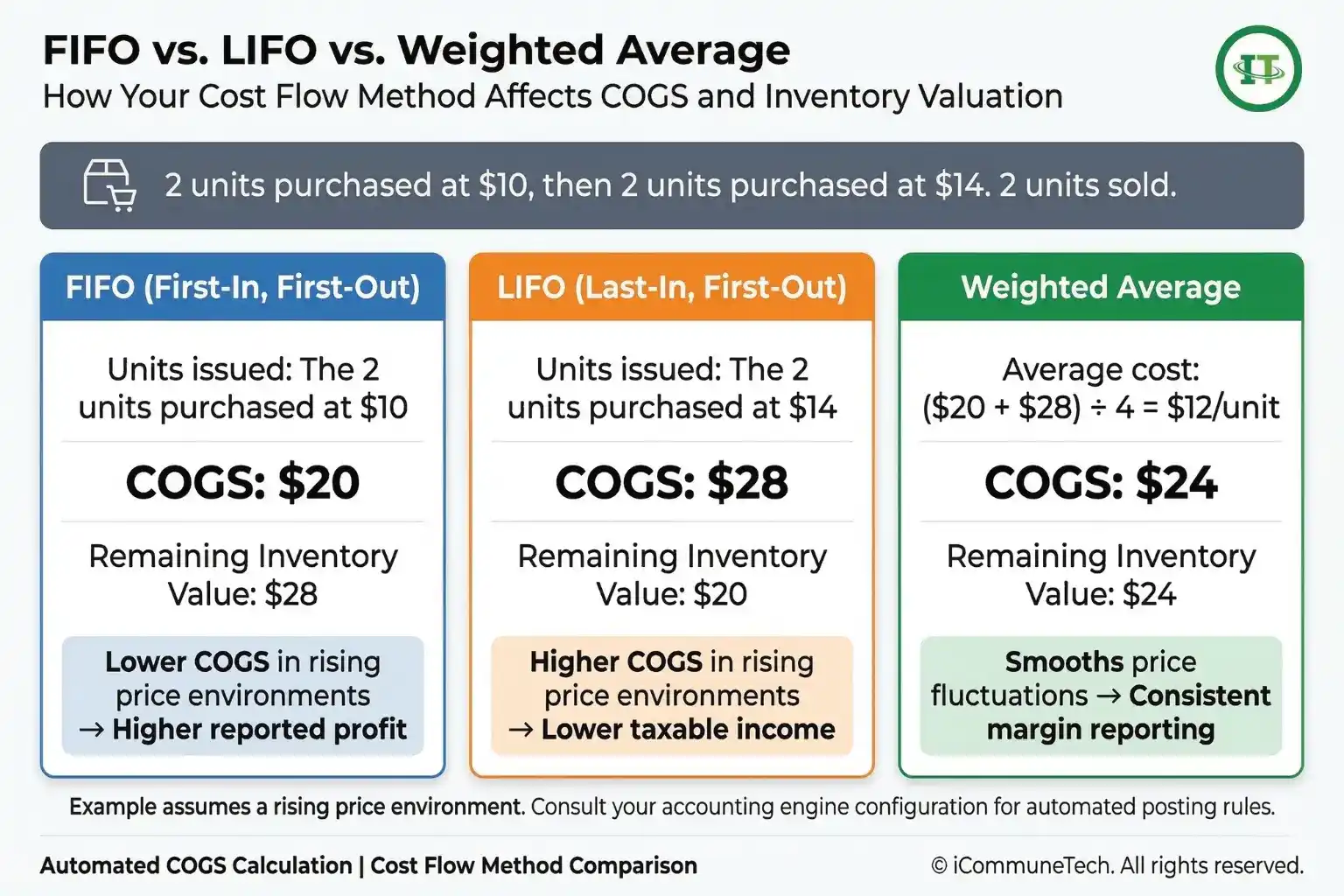
Each transaction creates two effects. Quantity updates appear in the inventory subledger. Insert a worked numerical example under this paragraph demonstrating First-In, First-Out (FIFO) and weighted average issue logic. Inventory system development now prioritizes synchronization integrity, internal controls, and audit-ready reporting.
Core Features of Perpetual Inventory Management Software
Perpetual inventory management software combines transaction-level accuracy with automated accounting synchronization. Enterprise-grade platforms unify operational tracking and financial posting within a single control framework. The system maintains continuous quantity visibility and real-time cost alignment across multiple locations.
Modern digital inventory management software typically includes:
- Real-time inventory updates and multi-location visibility
- Seamless integration with POS, ERP, and warehouse management systems
- Automated COGS calculation using First-In, First-Out (FIFO), Last-In, First-Out (LIFO), or weighted average cost methods
- Instant inventory account updates with structured transaction recording
- Built-in journal entry automation for purchases, sales, returns, and adjustments
These features synchronize transaction posting, cost allocation, and ledger accuracy across operational and financial systems.
Real-Time Inventory Updates and Visibility
A perpetual inventory system updates stock balances immediately after each transaction. Inventory quantities and cost layers adjust in real time across all locations. Every sale, receipt, transfer, or adjustment modifies the SKU record instantly.
Data capture begins at the source. Barcode scanners, RFID devices, and POS terminals record each movement. The ERP or warehouse management system processes the transaction. A centralized database updates the inventory ledger instantly.
Continuous updates align reorder triggers with the current demand signal. Reorder points adjust dynamically as consumption patterns change. Safety stock levels adapt based on live usage patterns. Planning teams rely on current data rather than period-end estimates.
Real-time tracking also strengthens loss detection. Variances surface as they occur, and exception alerts support faster investigation and corrective action.
This transparency enhances supply chain visibility across warehouses, stores, and distribution centers. Demand shifts become visible earlier, allowing operations teams to respond before stockouts or excess carrying costs expand.
Seamless Integration with POS, ERP, and WMS
Perpetual inventory software operates through structured system integration. Accurate inventory control depends on synchronized data across operational and financial platforms. Each transaction must update both quantity and value records without delay.
Key integration components include:
- POS systems that capture sales at the moment of transaction
- ERP systems that post financial entries and update the general ledger
- A warehouse management system that manages receiving, picking, transfers, and cycle counts
- API or middleware layers that enable real-time data synchronization
Integrated architecture ensures:
- Immediate quantity updates across all locations
- Automatic COGS posting at the time of sale
- Purchase receipt valuation adjustments upon goods arrival
- Alignment between the inventory subledger and the general ledger
This interoperability eliminates duplicate data entry, reduces reconciliation gaps, and preserves reporting integrity across complex multi-location environments.
Automated COGS Calculation and Cost Flow Methods
Perpetual inventory systems calculate the cost of goods sold at the moment of sale. COGS recognition occurs automatically using predefined cost flow rules embedded within the accounting engine. Each sales transaction reduces inventory value while recording the associated expense simultaneously.
The system applies one of the approved cost flow methods:
- FIFO, which issues the oldest cost layer first
- LIFO, which issues the most recent cost layer first
- Weighted average cost, which recalculates a moving average after each purchase
When procurement software records a goods receipt, the inventory ledger updates quantity and cost layers instantly. The ERP system then synchronizes these values with the general ledger through automated posting rules.
At the point of sale, two coordinated entries occur. Revenue is recorded in the income statement. COGS posts using the selected cost assumption. Inventory value decreases accordingly.
This automation preserves compliance integrity, maintains audit trails, and ensures financial statements reflect real-time inventory valuation without manual recalculation.
Inventory Account Updates and Transaction Recording
Perpetual systems post inventory changes at the moment each transaction occurs. Every sale, purchase, return, or adjustment updates the inventory account and general ledger instantly. No batch processing delays quantity or valuation updates.
When goods are received, the system records the inventory increase and the corresponding accounts payable liability. Purchase order software initiates the transaction flow from approved procurement documents to goods receipt validation. Quantity and cost layers update once the receipt confirms delivery.
At the time of sale, the system records revenue and reduces inventory simultaneously. Cost of goods sold is posted using the assigned cost flow method. The inventory subledger and general ledger remain synchronized.
Returns follow the same structured logic. Purchase returns decrease inventory and reduce accounts payables. Sales returns restore inventory quantity and reverse cost recognition.
Per-transaction posting strengthens internal controls, reduces reconciliation workload, and improves audit traceability across multi-location operations.
Perpetual Inventory System Journal Entries
Perpetual systems record journal entries for every transaction. Each inventory movement produces synchronized postings in both the inventory subledger and the general ledger. This structure ensures real-time financial accuracy and continuous audit traceability.
The following examples illustrate standard journal entries recorded under a perpetual inventory system.
1. Inventory Purchase (Credit)
| Account | Debit | Credit |
|---|---|---|
| Inventory | 10,000 | — |
| Accounts Payable | — | 10,000 |
Inventory increases at purchase cost while accounts payable records the corresponding liability.
2. Sale of Inventory (Credit Sale)
a. Record Revenue
| Account | Debit | Credit |
|---|---|---|
| Accounts Receivable | 15,000 | — |
| Sales Revenue | — | 15,000 |
b. Record COGS
| Account | Debit | Credit |
|---|---|---|
| Cost of Goods Sold | 9,000 | — |
| Inventory | — | 9,000 |
Revenue recognition and cost recognition occur simultaneously under perpetual inventory accounting.
3. Purchase Return
| Account | Debit | Credit |
|---|---|---|
| Accounts Payable | 2,000 | — |
| Inventory | — | 2,000 |
Inventory decreases at the original purchase cost associated with the returned goods.
4. Inventory Shortage Adjustment
| Account | Debit | Credit |
|---|---|---|
| Inventory Shrinkage Expense | 1,000 | — |
| Inventory | — | 1,000 |
Shrinkage adjustments reflect discrepancies identified during cycle counting or physical inventory verification.
5. Sales Return
a. Reverse Revenue
| Account | Debit | Credit |
|---|---|---|
| Sales Returns | 3,000 | — |
| Accounts Receivable | — | 3,000 |
b. Restore Inventory
| Account | Debit | Credit |
|---|---|---|
| Inventory | 1,800 | — |
| Cost of Goods Sold | — | 1,800 |
These entries maintain synchronization between the inventory subledger and general ledger without requiring period-end adjustments.
How Does a Perpetual Inventory System Work
A perpetual inventory system works by updating inventory records at the exact moment a transaction occurs. The process controls inventory from receipt through sale. Each SKU movement triggers both quantity and cost updates within the inventory ledger.
The workflow follows a structured sequence:
- A purchase order generates an inbound transaction.
- Goods receipt confirms quantity and cost in the system.
- Inventory increases while accounts payable records the corresponding liability.
- Storage, transfers, or picking activities update location-level balances.
- A sale through the POS system reduces inventory and records COGS instantly.
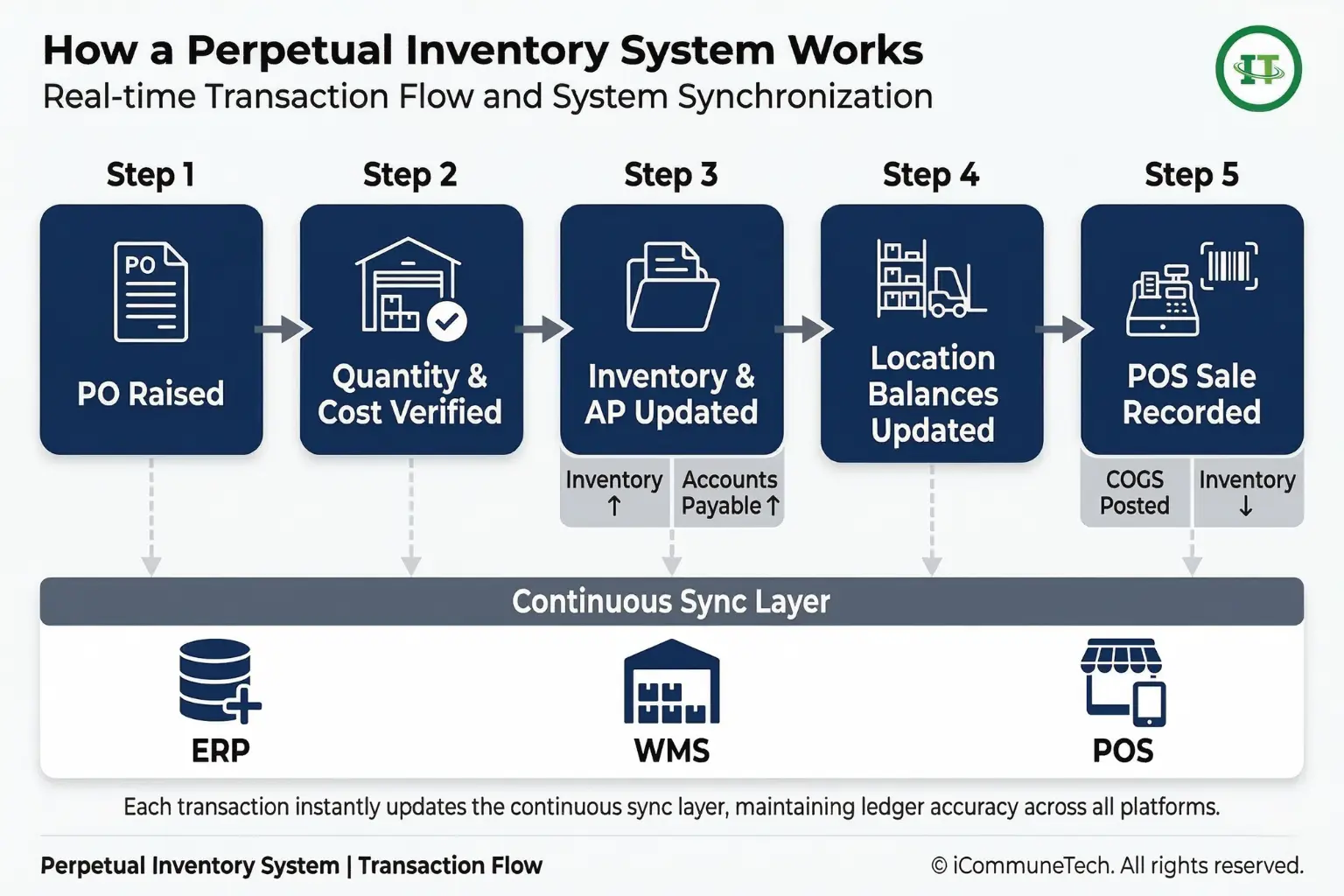
Barcode scanners or RFID devices capture physical movements. The warehouse management system validates quantities and location data. The ERP system processes financial postings. Data synchronization ensures the inventory subledger aligns with the general ledger at all times.
This integrated structure operates as an inventory automation system, eliminating manual stock cards and delayed reconciliation. Each transaction reinforces real-time accuracy, audit trail continuity, and cost flow consistency across the enterprise inventory environment.
When Should a Perpetual Inventory System Be Used
A perpetual inventory system should be used when transaction volume and inventory complexity exceed manual control capacity. Organizations with high sales frequency or multi-location operations require continuous inventory accuracy. Periodic updates cannot support real-time cost recognition or operational responsiveness in these environments.
The system is particularly suitable for:
- Retail chains processing daily POS transactions
- Distribution centers managing large SKU assortments
- Manufacturing operations tracking raw materials and finished goods
- E-commerce businesses with rapid order fulfillment cycles
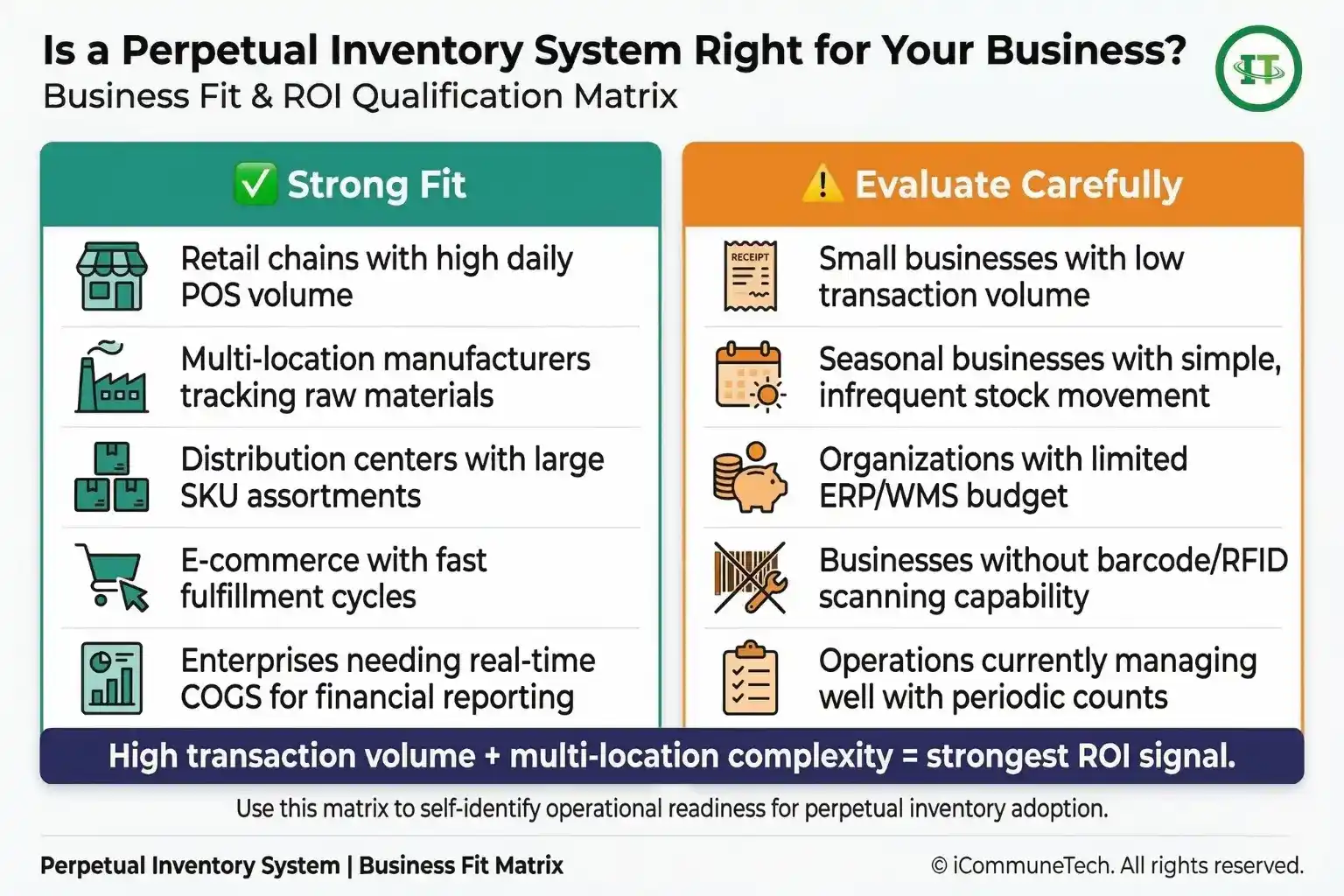
Fast-moving inventory increases exposure to stockouts and shrinkage. Multi-warehouse networks require synchronized visibility across locations. Real-time COGS posting becomes essential for financial reporting stability.
Enterprises that rely on integrated demand planning software depend on accurate inventory data to forecast consumption patterns. Without continuous updates, planning outputs lose reliability.
Businesses seeking tighter internal controls, reduced reconciliation effort, and consistent financial alignment benefit most from adopting a perpetual inventory framework.
Advantages and Benefits of a Perpetual Inventory System
Inventory timing gaps distort valuation and reporting accuracy. Perpetual systems align operational movements with real-time financial impact. Continuous transaction posting reduces reporting adjustments and protects working capital.
Key advantages include:
- Real-time quantity and valuation accuracy across all locations
- Immediate cost of goods sold recognition at the point of sale
- Reduced reconciliation labor and fewer month-end adjustments
- Faster identification of shrinkage and inventory discrepancies
- Improved reorder point calibration and safety stock control
- Lower carrying costs through disciplined inventory optimization
These benefits reduce reconciliation effort and valuation errors. Procurement and planning decisions rely on current stock data rather than delayed counts. Financial statements reflect synchronized balances between the inventory ledger and the general ledger. The system reduces control gaps and reporting volatility.
Potential Drawbacks and Limitations
Perpetual inventory systems introduce operational discipline but require structured implementation. Technology dependence and system complexity can increase initial investment and governance requirements. Organizations must evaluate operational readiness before adoption.
Primary limitations include:
- Higher implementation costs for ERP integration, POS connectivity, and data migration
- Ongoing system maintenance and user training requirements
- Dependence on accurate barcode or RFID scanning at every transaction point
- Exposure to data errors if controls or access permissions are weak
- Continued need for periodic physical counts to validate system accuracy
Even with automation, physical verification remains necessary to detect shrinkage or misposted transactions. Integration gaps between systems can create temporary discrepancies. Weak master data management can distort cost layers or SKU balances.
Enterprises must balance these constraints against the financial and operational stability gained through real-time inventory control. Proper governance, internal controls, and system configuration reduce most of these risks.
Perpetual Inventory System Versus Periodic Inventory System
A perpetual inventory system records inventory changes continuously, while a periodic system updates balances at defined intervals. The distinction centers on transaction timing, cost recognition, and financial visibility. Perpetual methods update the inventory ledger and cost of goods sold at the moment each transaction occurs. Periodic methods defer inventory valuation and COGS calculation until physical counts determine the ending stock.
The operational and accounting differences influence reporting accuracy, reconciliation workload, and working capital control. Enterprises evaluating inventory control software must understand how each method affects ledger synchronization, audit trails, and shrinkage detection.
This comparison establishes a structured foundation for evaluating process flow, accounting treatment, and practical business application across both inventory management approaches.
Difference Between Perpetual Inventory and Physical Inventory
Perpetual inventory and physical inventory serve different control functions within the inventory framework. One provides continuous system-driven tracking. The other validates recorded balances through direct count verification.
| Comparison Area | Perpetual Inventory | Physical Inventory |
|---|---|---|
| Control Method | System-driven transaction updates | Manual or scanned stock counts |
| Timing | Continuous, real-time updates | Conducted periodically or annually |
| Ledger Impact | Updates inventory and COGS immediately | Adjusts balances after reconciliation |
| Technology Use | ERP, POS, and WMS integration | Scanners or inventory counting software |
| Purpose | Ongoing visibility and valuation | Accuracy validation and discrepancy detection |
Perpetual systems maintain real-time records. Physical counts confirm their accuracy and support audit integrity.
Periodic and Perpetual Inventory Examples
Practical scenarios clarify how workflow and reporting differ under each method. The operational impact becomes visible when transaction timing affects financial reporting and stock control. The following examples illustrate typical business environments.
| Business Scenario | Periodic Inventory Workflow | Perpetual Inventory Workflow |
|---|---|---|
| Small retail store | Purchases recorded separately; inventory updated after month-end count | POS updates inventory and COGS at each sale |
| Local wholesaler | Stock levels estimated between counts | Real-time SKU balances across warehouse locations |
| Seasonal business | The cost of goods sold is calculated after the physical inventory | COGS is posted automatically with each transaction |
| Multi-location chain | Central adjustments after periodic reconciliation | Centralized database updates across all stores instantly |
In a periodic environment, management relies on estimated balances between counts. Financial statements reflect delayed cost recognition.
In a perpetual environment, each transaction updates both quantity and valuation. Reporting reflects current inventory levels, cost layers, and profitability metrics without waiting for physical verification.
How Businesses Track Inventory Under a Perpetual System?
Businesses track inventory through structured, transaction-driven processes. Every inventory movement triggers an immediate quantity and valuation update within the system. Tracking begins at the point of data capture and continues through financial synchronization.
The process follows a defined sequence:
- A transaction occurs, such as a receipt, transfer, sale, or return.
- Barcode scanners, RFID devices, or IoT sensors capture the SKU movement.
- The warehouse management system validates location and quantity data.
- The ERP system posts financial entries and updates the general ledger.
- The centralized database refreshes inventory reports instantly.
Advanced environments may incorporate computer vision inventory management to monitor shelf levels or warehouse bins automatically. These systems reduce dependence on manual scanning and enhance real-time visibility.
Perpetual inventory reports display on-hand balances, cost layers, reorder points, and shrinkage alerts. Variances identified during cycle counting generate adjustment entries. Shortage discrepancies post to shrinkage expense accounts, preserving audit trail continuity and ledger alignment.
Perpetual Inventory Control System Technologies
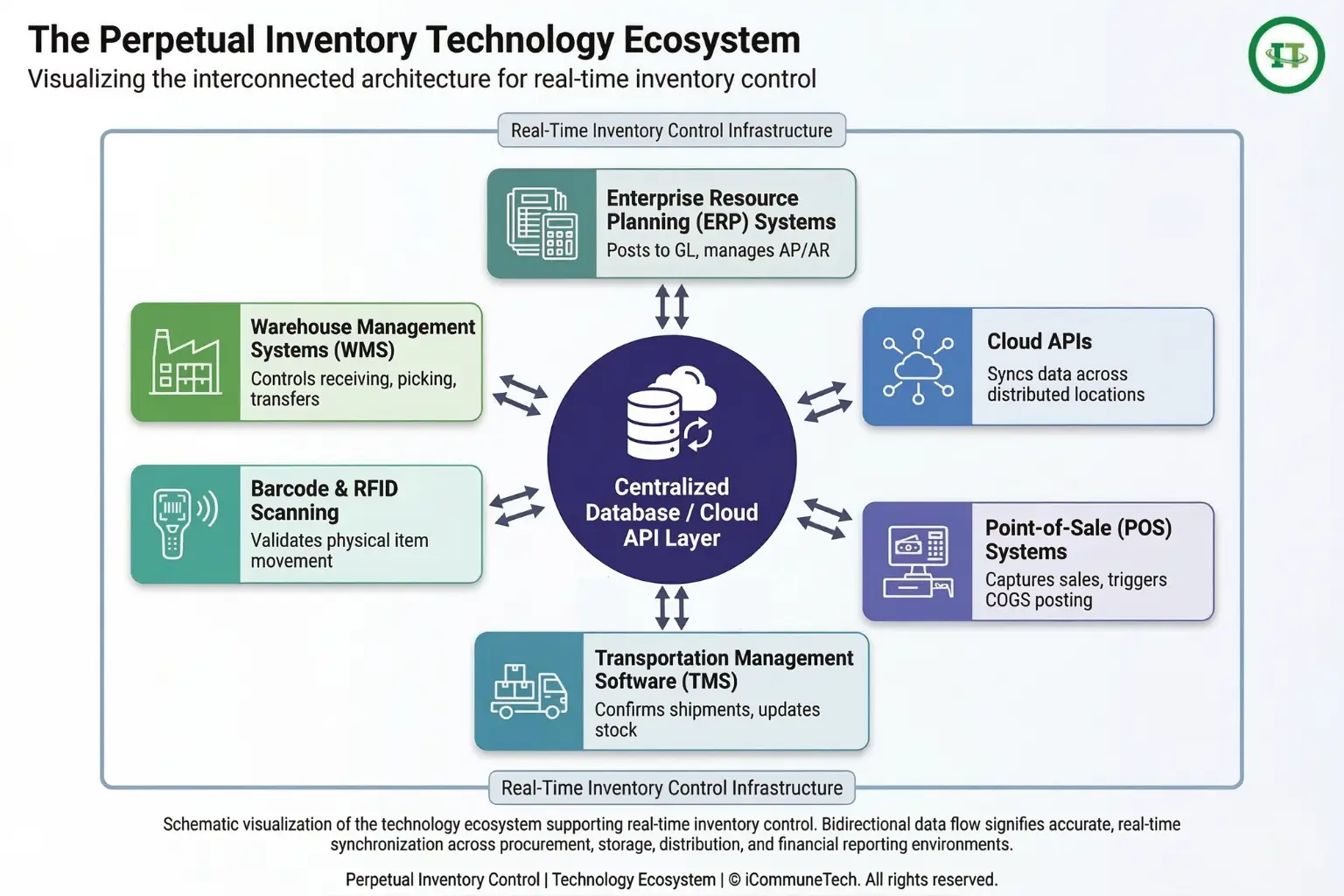
Working capital weakens when inventory data fails to synchronize across systems. Technology architecture determines whether inventory control operates in real time or in delayed fragments. The following technologies form the foundation of a resilient perpetual inventory environment.
- Point-of-Sale (POS) Systems
POS terminals capture sales transactions at the moment of purchase. Each sale reduces SKU quantity and triggers automatic COGS posting. Real-time capture prevents reporting delays and stock distortions. - Enterprise Resource Planning (ERP) Systems
ERP platforms manage financial postings, accounts payable, accounts receivable, and general ledger synchronization. Inventory valuation flows directly into financial statements through structured posting rules. - Warehouse Management Systems (WMS)
WMS platforms control receiving, picking, transfers, and cycle counting. Location-level tracking improves storage accuracy and operational efficiency. - Barcode and RFID Scanning
Scanning technologies validate item movement at each handling point. Automated data capture reduces manual entry errors and strengthens internal controls. - Cloud APIs and Centralized Databases
API integration enables real-time synchronization across distributed systems. Centralized databases maintain consistent inventory records across multiple locations. - Transportation Management Software
Transportation management software aligns outbound shipments with inventory records. Shipment confirmation updates stock balances and improves end-to-end fulfillment visibility.
Together, these technologies create a synchronized control infrastructure that stabilizes inventory accuracy across procurement, storage, distribution, and financial reporting environments.
Inventory Reporting and Analytics in Perpetual Systems
Margin erosion accelerates when inventory reports lag behind operational reality. Real-time reporting converts transaction data into actionable financial and operational intelligence. Perpetual systems generate continuous dashboards for operations, finance, and executive leadership.
Inventory reports include:
- On-hand quantity by SKU and location
- Inventory valuation by the cost flow method
- Cost of goods sold trends
- Reorder point and safety stock status
- Shrinkage and variance analysis
- Inventory turnover and carrying cost metrics
Because transactions post instantly, reports reflect current balances rather than estimated figures. The inventory subledger remains aligned with the general ledger, supporting compliance and audit readiness.
Advanced platforms extend reporting capabilities into predictive modeling. AI-driven forecasting engines analyze consumption patterns and seasonality. Supply chain analytics tools evaluate demand variability, supplier performance, and replenishment efficiency.
Executives gain visibility into working capital exposure and profitability drivers. Finance teams access synchronized valuation data. Operations teams respond to emerging demand signals before stockouts or excess inventory distort performance.
Choosing iCommuneTech for Perpetual Inventory System Implementation
Implementation risk increases when inventory systems lack architectural alignment across operations and finance. Execution quality determines whether a perpetual inventory delivers control or introduces complexity. Enterprises require structured deployment, disciplined integration, and long-term governance.
iCommuneTech approaches implementation as a control architecture initiative rather than a simple software installation. Engagement begins with process mapping across procurement, warehousing, sales, and financial reporting. Integration design ensures ERP, POS, and warehouse management systems synchronize without data fragmentation.
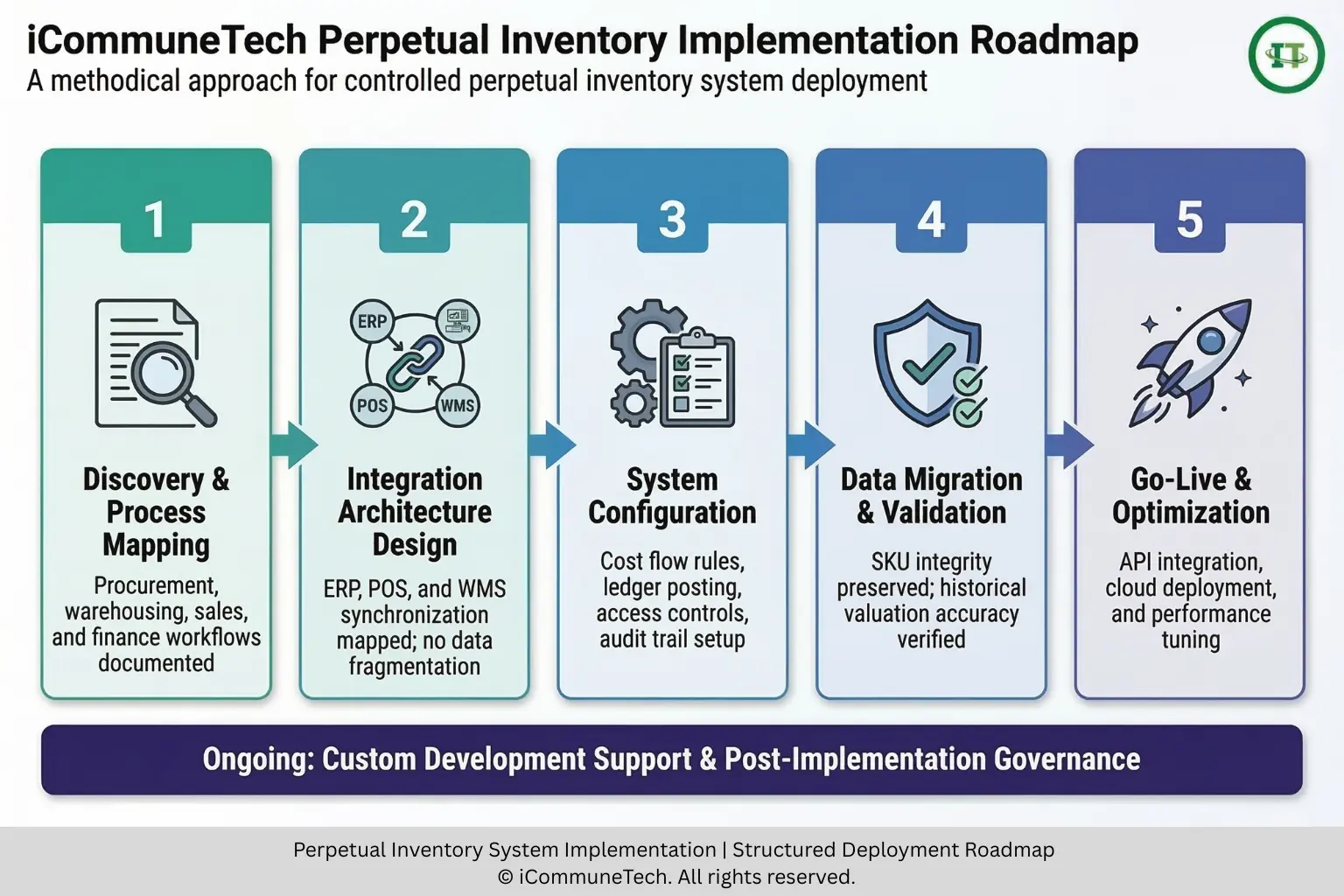
Configuration includes cost flow setup, ledger posting rules, role-based access controls, and audit trail enforcement. Data migration follows structured validation protocols to preserve SKU integrity and historical valuation accuracy.
For enterprises with unique operational models, iCommuneTech engineers custom inventory software aligned with industry-specific workflows and compliance standards. The team also provides API integration, cloud deployment support, and post-implementation performance optimization.
This implementation-first approach reduces reconciliation instability, strengthens financial alignment, and establishes a scalable perpetual inventory control framework designed for enterprise growth.
Estimating ROI and Cost Savings with Perpetual Inventory Systems
Working capital leakage increases when inventory inaccuracies distort valuation and operational planning. ROI evaluation must connect perpetual inventory control to measurable financial outcomes. Investment justification depends on quantifiable cost reductions and capital efficiency gains.
Primary value drivers include:
- Reduced reconciliation labor and fewer manual correction cycles
- Lower shrinkage expense through early discrepancy detection
- Decreased carrying costs through improved reorder precision
- Released working capital through the reduction of excess inventory
- Revenue protection through fewer stockout incidents
- Faster financial close and improved reporting stability
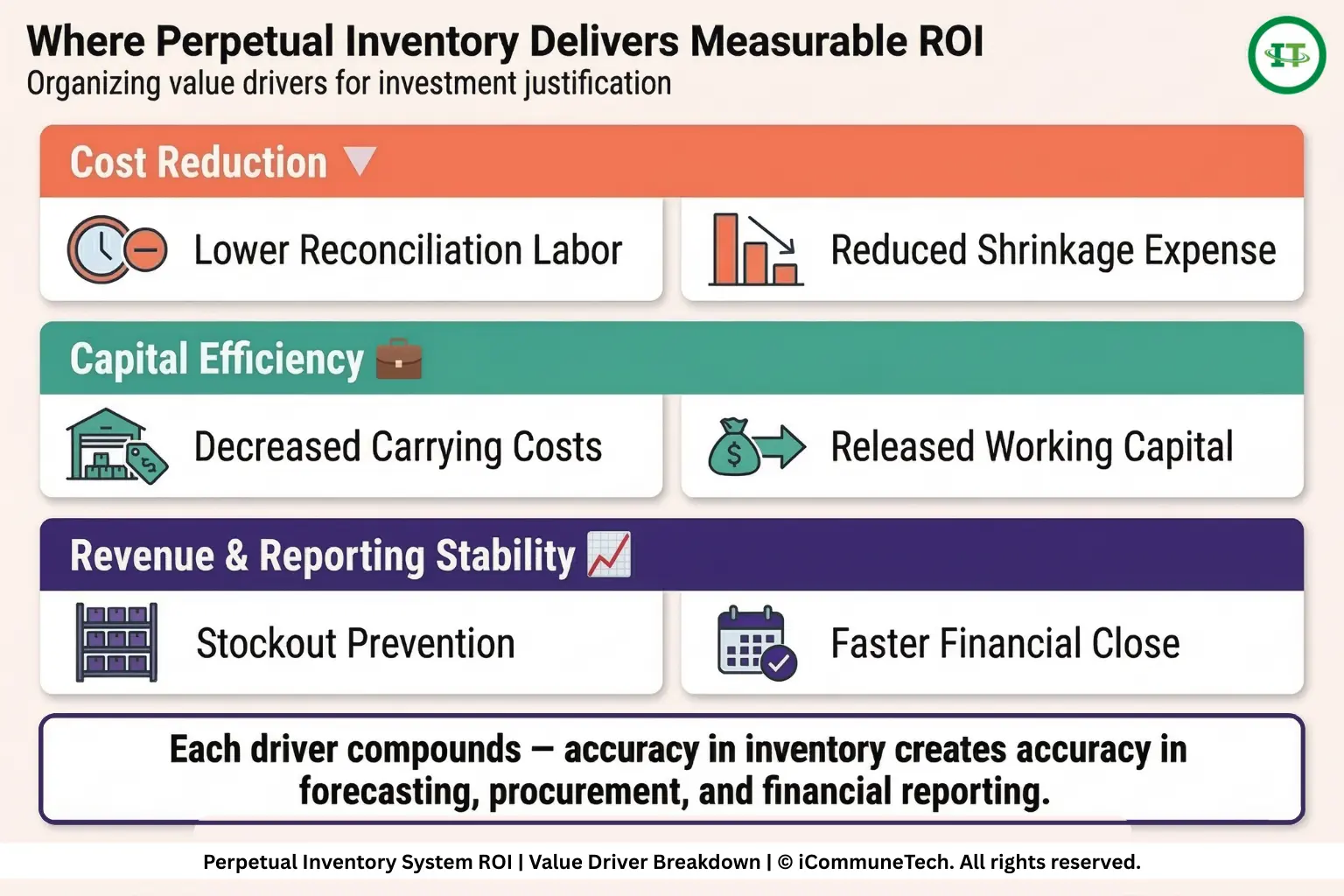
Accurate inventory data improves forecast precision. Procurement decisions align with real consumption patterns. Finance teams gain synchronized visibility across inventory and the general ledger.
Executives often evaluate technology investments with the same discipline applied to fleet management software cost reviews. Inventory modernization requires similar capital scrutiny.
A properly implemented perpetual inventory system reduces operational leakage, stabilizes reporting, and improves long-term capital productivity across the enterprise inventory environment.

Irshad Pathan

Web Development Expert
Irshad is a senior technical expert at iCommuneTech. He manages the iCommuneTech's Web Development Team, and has hands-on expertise in web development, Laravel development, Logistics, fleet management, and Supply Chain Management. He mentors the in-house team and enjoys describing his experience in words.
Read More Insights By Irshad →