What Is E-commerce Inventory Management Software and How Does It Improve Operations, Integrations, and ROI?
E-commerce inventory management software centralizes stock data, synchronizes transactions, and controls fulfillment execution to maintain accuracy, speed, and cost efficiency. As SKU volume and multichannel complexity grow, fragmented systems and manual tracking create stock errors, fulfillment delays, and working capital inefficiencies.
Modern inventory platforms connect inventory with order management, warehouse operations, forecasting, and financial systems to maintain real-time visibility and coordinated execution. This guide covers essential features, integrations, use cases, and ROI strategies that help businesses improve stock accuracy, scale operations, and increase profitability.
What Are the Fundamentals of E-Commerce Inventory Management?
E-commerce inventory management tracks and updates stock across sales channels and fulfillment systems to maintain accurate availability and reliable order execution.
Core inventory management fundamentals include:
- Maintain accurate stock levels across all sales channels
- Track SKU movement across warehouses and fulfillment nodes
- Align inventory availability with real-time demand signals
- Detect and prevent stock discrepancies and shrinkage
- Apply inventory control methods to balance stock levels and costs
These principles require structured inventory systems that synchronize data, support real-time updates, and maintain consistent stock visibility across e-commerce operations.
What Are the Core Attributes of E-commerce Inventory Management?
E-commerce inventory management is defined by five core attributes that determine how stock is tracked, organized, valued, and replenished across digital commerce operations. These attributes provide the structure needed to maintain inventory accuracy, improve fulfillment efficiency, support financial control, and ensure product availability. By aligning with established stock inventory control practices, they help businesses standardize inventory processes and strengthen operational performance. The five core attributes are stock level, item location, SKU management, cost tracking, and sales velocity.
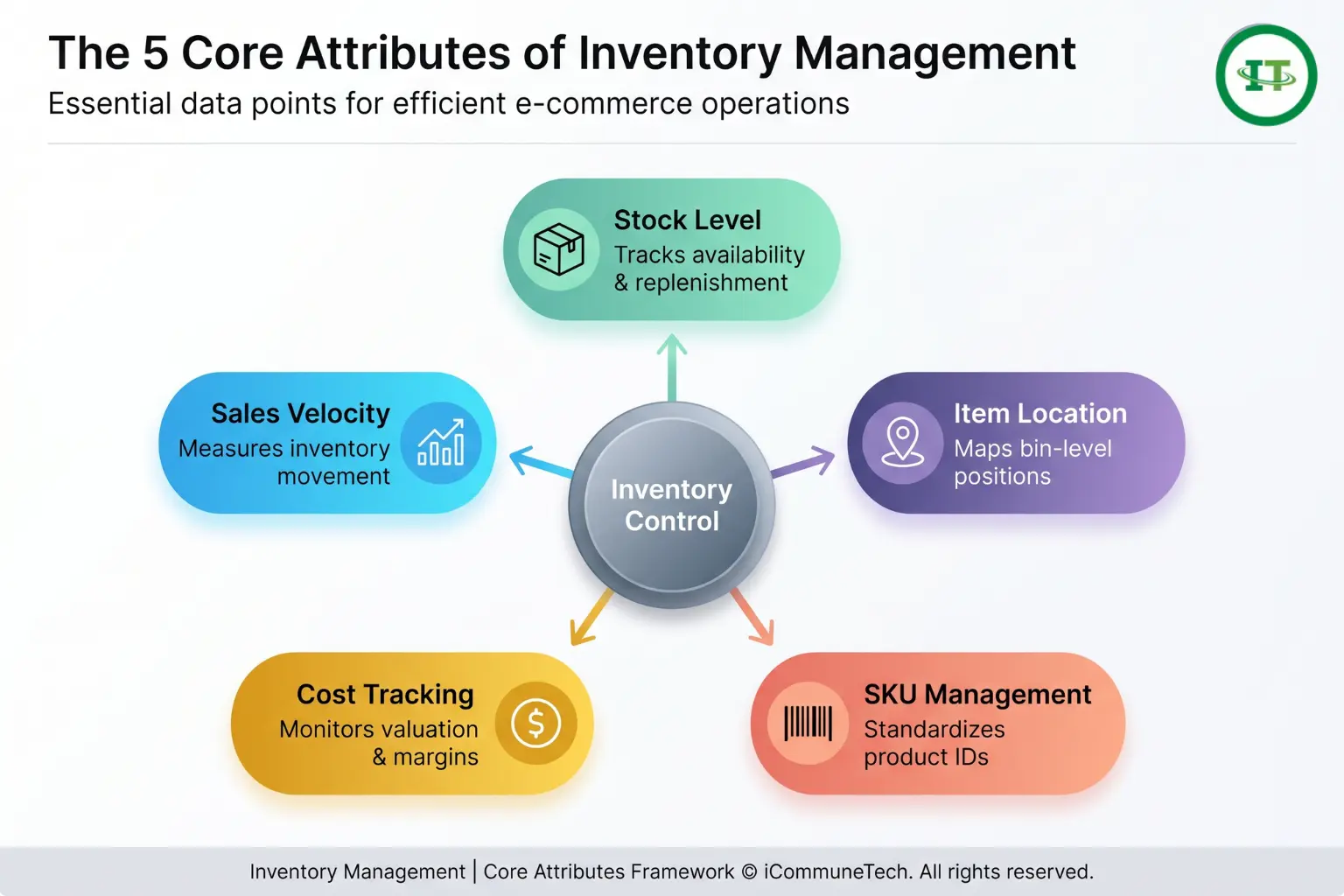
- Stock Level: Tracks available inventory and triggers replenishment to maintain availability, reduce stockouts, and control holding costs.
- Item Location: Maps inventory to precise warehouse locations to improve picking accuracy, allocation speed, and fulfillment efficiency.
- SKU Management: Standardizes product identification and records to maintain consistent inventory data and prevent misallocation.
- Cost Tracking: Monitors inventory valuation and margins to improve financial visibility, cost control, and profitability analysis.
- Sales Velocity: Measures inventory movement trends to improve forecasting accuracy, optimize reorder timing, and reduce overstock risk.
How Does Inventory Management Impact Profit Margin?
Inventory management impacts profit margin by aligning stock levels with demand, improving fulfillment accuracy, and controlling working capital.
Poor control increases excess stock, slows sell-through, and locks capital in unsold inventory, raising carrying costs and write-downs. Optimized control matches stock to demand, improves cash flow, and protects revenue.
According to Market Research Future, companies using advanced inventory systems reduce excess inventory by up to 30%, improving demand alignment and working capital utilization.
The following mechanisms show how inventory management affects profit margin:
- Define EOQ-based purchase quantities to reduce overstock and release working capital
- Set safety stock thresholds to prevent stockouts while limiting holding costs
- Track allocation and picking accuracy to improve fulfillment reliability and repeat sales
- Monitor inventory aging to identify slow-moving stock and trigger liquidation
- Record discrepancies to reduce shrinkage and prevent revenue loss
- Calculate demand forecasts to reduce excess procurement and planning errors
- Maintain valuation records to control write-downs and protect gross margin
Data from McKinsey shows that slow-moving inventory can be reduced by approximately one-third within three months, improving stock turnover and reducing excess holding costs.
Inventory optimization strategies match inventory investment with actual demand, improving cash flow efficiency, reducing operational waste, and strengthening profit margins.
What Is The Step By Step Ecommerce Inventory Management Process?
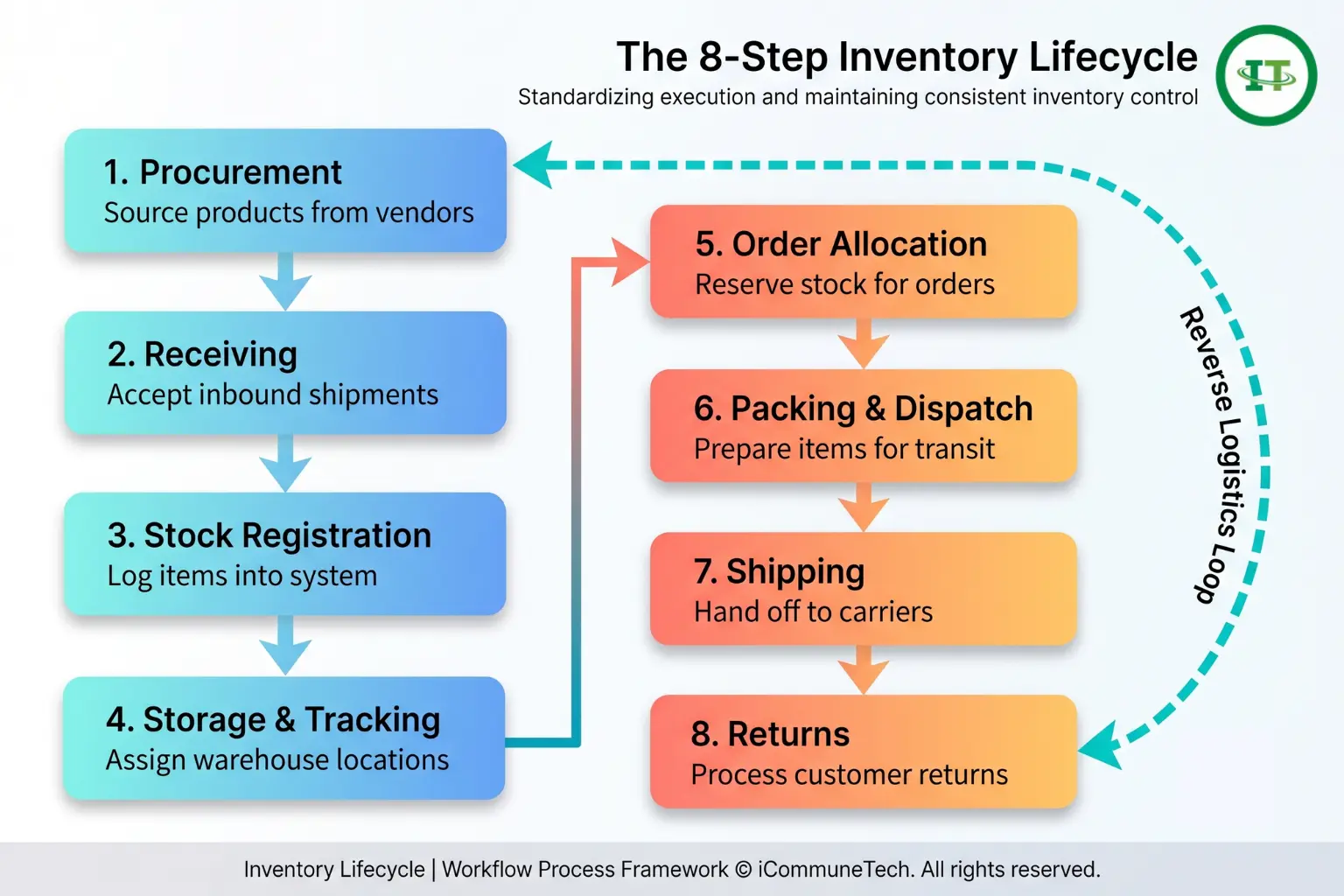
The e-commerce inventory lifecycle manages how stock moves from procurement to fulfillment and returns, ensuring accurate tracking, faster execution, and controlled costs.
The following steps define how each stage operates, including system actions and business outcomes:
- Procurement and order planning: Calculate order quantities using demand forecasts, lead time, and MOQ to prevent excess stock and shortages
- Receiving and validation: Verify incoming goods against purchase orders using barcode scanning to detect discrepancies before system entry
- Stock registration and putaway: Record inventory and assign bin locations using WMS rules to improve storage efficiency and retrieval speed
- Inventory storage and tracking: Monitor stock status (available, reserved, damaged) to maintain real-time visibility and control
- Order allocation and picking: Assign stock using OMS logic based on priority and location to reduce picking time and errors
- Packing and dispatch: Pack, label, and update inventory instantly to maintain accurate outbound records
- Shipping and confirmation: Track delivery status and close transactions to ensure order completion accuracy
- Returns and reverse logistics: Inspect returned items, update stock status, and recover value through resale or disposal
These steps align with supply chain planning workflows to standardize execution and maintain consistent inventory control.
iCommuneTech implements this lifecycle using integrated OMS, WMS, and inventory systems to improve accuracy, reduce operational delays, and scale fulfillment without increasing complexity.
How Do Stock Level Controls Optimize Inventory Replenishment?
Stock level controls adjust replenishment using real-time demand, sales velocity, and lead time to maintain availability and prevent stock imbalances.
- Calculate safety stock using demand variability and lead time to maintain buffer levels
- Recalculate reorder points using sales velocity to keep inventory optimal
- Monitor stock levels continuously to track depletion against demand
- Trigger replenishment at defined thresholds to maintain supply continuity
- Process real-time order data to adjust replenishment timing
- Detect supply delays and demand spikes to prevent imbalances
These mechanisms operate through automated inventory systems that regulate replenishment decisions and improve stock utilization.
How Does Location and SKU Tracking Work Across Warehouses?
Location and SKU tracking assigns each item a unique identifier and maps it to exact warehouse locations, while scanning updates movements in real time to maintain accurate stock data and reliable fulfillment.
The following practices define how tracking maintains inventory accuracy:
- Assign unique SKU codes to each product variant to ensure consistent identification
- Map inventory to bin-level locations to guide precise storage and retrieval
- Capture inventory movements using barcode scanning to update stock records instantly
- Track stock transfers between locations to maintain accurate position data
- Sync real-time inventory updates to reflect current stock availability
- Validate inventory during picking and packing to prevent mismatches
These practices operate within a warehouse management system to maintain alignment between physical inventory and system records, reduce errors, and improve fulfillment accuracy.
Why Is Real-Time Inventory Visibility Important in E-commerce?
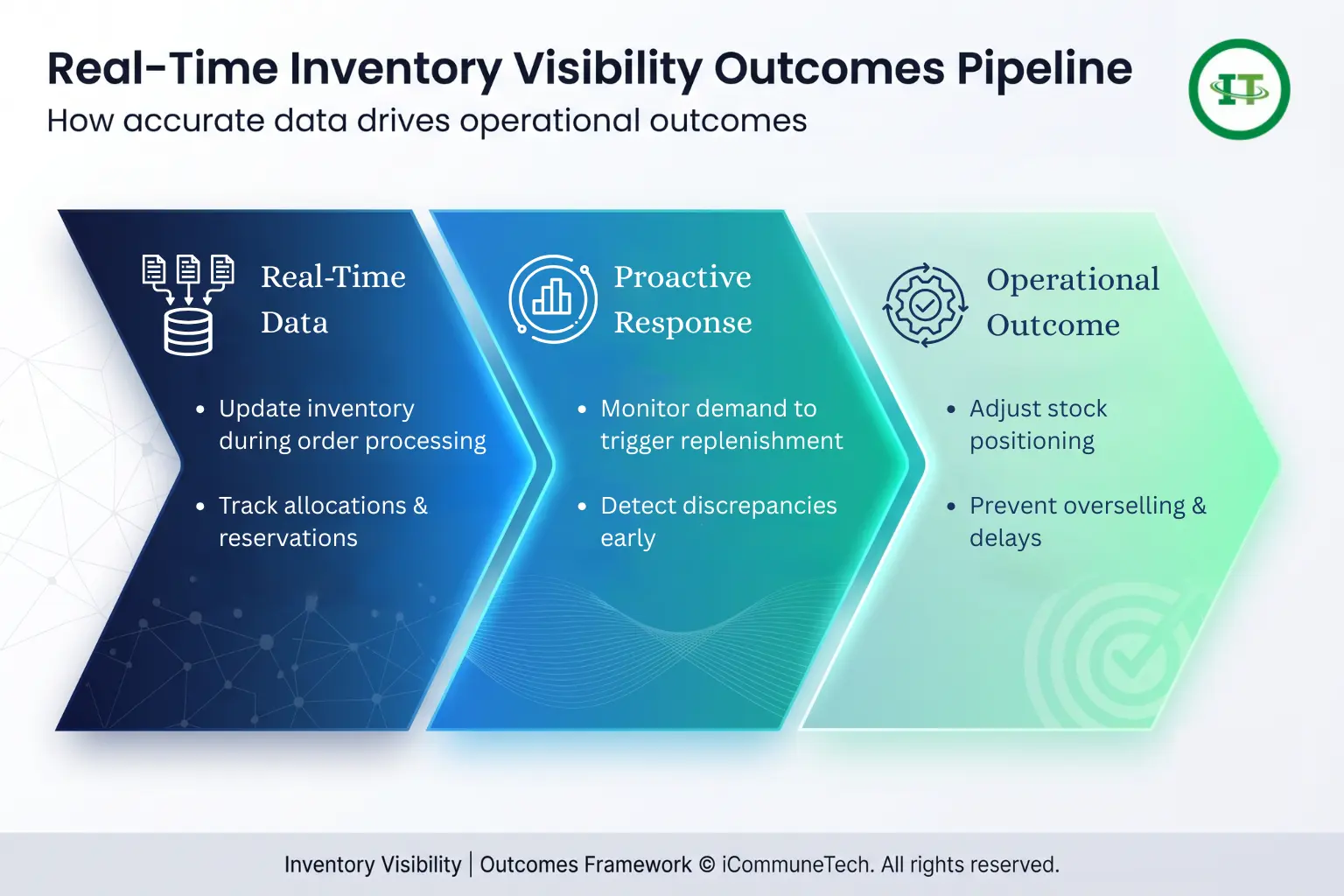
Real-time inventory visibility tracks stock movements instantly to prevent overselling, reduce errors, and maintain accurate fulfillment. Cloud-based supply chain visibility platforms deliver live insights that improve response speed and operational control.
The following outcomes show how real-time visibility improves e-commerce operations:
- Update inventory in real time during order processing to prevent overselling
- Track allocation and reservations to reduce fulfillment errors
- Monitor demand continuously to trigger timely replenishment
- Provide livestock data to support faster decisions
- Detect discrepancies early to prevent delays
- Adjust stock positioning based on demand to improve availability
These capabilities improve order accuracy, support proactive restocking, and strengthen operational efficiency.
How to Select an E-Commerce Inventory Management System
Select an inventory management system capability with operational scale, integration needs, and cost structure. The right system must process transactions reliably, connect with existing platforms, and support growth without increasing complexity.
The e-commerce inventory management software market is projected to grow from 16.16 USD billion in 2025 to 36.67 USD billion by 2035 (CAGR 8.54%), according to Market Research Future. Growth reflects rising investment in scalable, real-time inventory control and system integration.
Use the following criteria to evaluate and compare solutions:
- Verify real-time tracking, automated replenishment, and reporting to maintain stock control and decision accuracy
- Test scalability under higher SKU volume, order load, and multi-location operations
- Evaluate integration with ERP, OMS, WMS, and marketplaces to maintain consistent data flow
- Review UI/UX to improve task efficiency and reduce operational errors
- Calculate TCO, including licensing, implementation, integration, and maintenance, to control long-term cost
- Validate workflow fit to ensure alignment with business processes
These criteria reduce implementation risk and align system selection with business and financial goals. iCommuneTech applies a consultative approach to design architecture and aligns technology with operational outcomes.
What Are the Essential Features of E-commerce Inventory Management Software?
E-commerce inventory management software manages tracking, replenishment, and multi-channel synchronization to maintain accurate stock control and coordinated fulfillment.
These capabilities align with custom inventory software capabilities, allowing systems to adapt to operational requirements and workflow complexity.
01 / Priority Level: Critical
- Real-time inventory tracking maintains accurate stock availability and reduces fulfillment errors through transaction-based updates.
- Automated replenishment generates reorder actions using predefined stock thresholds to maintain inventory continuity.
- Multichannel connectivity synchronizes inventory across sales channels to prevent stock discrepancies and support consistent fulfillment.
02 / Priority Level: High
- SKU management standardizes product identification and tracking to improve inventory accuracy and classification consistency.
- Reporting dashboards deliver inventory metrics and operational insights to support planning and financial control.
03 / Priority Level: Medium
- Mobile access supports inventory execution through handheld devices to improve speed and reduce operational delays.
Which E-Commerce Inventory Management Software Should You Choose?
Choose the platform that matches operational complexity, integration depth, and long-term scalability. Use structured benchmarking from supply chain management software comparison to evaluate solution fit.

iCommuneTech
Platform type → Custom + Integration-led
Strengths → Configures workflows, integrates OMS/WMS/ERP, supports multi-channel control
Limitations → Requires planning and implementation effort
Best fit → Complex, multi-channel ecommerce operations

Zoho Inventory
Platform type → SaaS Platform
Strengths → Quick setup, built-in features, cost-effective
Limitations → Limited customization and scalability
Best fit → Small to mid-sized businesses

TradeGecko (QuickBooks Commerce)
Platform type → SaaS Platform
Strengths → Inventory and order synchronization with easy adoption
Limitations → Vendor dependency and limited flexibility
Best fit → Growing ecommerce brands

NetSuite
Platform type → ERP-Based System
Strengths → Strong financial integration and centralized control
Limitations → High cost and complex deployment
Best fit → Enterprise businesses

SAP
Platform type → ERP-Based System
Strengths → Advanced analytics and compliance-ready architecture
Limitations → Long implementation cycle
Best fit → Large-scale enterprises
Decision Criteria for Selecting the Right Inventory Platform
- Match platform capability with operational complexity
- Prioritize integration depth for multi-channel execution
- Balance customization with deployment speed
- Align scalability with long-term cost structure
iCommuneTech fits businesses that require workflow control and integration flexibility, while SaaS platforms suit standardized operations with lower complexity.
Why Do E-commerce Businesses Use Cloud-Based Inventory Management?
Cloud-based inventory management supports scalable operations, real-time data access, and reduced infrastructure dependency. It provides flexible system access across warehouses and sales channels while maintaining operational continuity.
Cloud adoption aligns with digital inventory systems, supporting deployment across distributed environments.
Cloud-based systems deliver the following operational capabilities:
- Scale resources based on transaction volume
- Access inventory data across locations
- Automate system updates and maintenance
- Reduce infrastructure and hardware costs
- Maintain system availability and uptime
- Secure data through controlled access and encryption
- Enable rapid deployment and system expansion
- Support backup and recovery to prevent data loss
iCommuneTech supports cloud-based inventory systems through scalable infrastructure, system integration, and secure data architecture. The platform supports distributed operations and controlled deployment across complex e-commerce operations.
How Does Real-Time Inventory Management Enable Multi-Channel Synchronization?
E-commerce operations require synchronized inventory updates to maintain accurate stock levels and reliable fulfillment across channels. Without coordination, discrepancies cause overselling, stock gaps, and delayed orders.
Multi-channel synchronization updates inventory in real time as transactions occur, ensuring consistent stock data and aligned order execution through integrated order management systems.
Key outcomes:
- Prevent overselling and stock mismatches
- Centralize inventory allocation across channels
- Adjust stock distribution based on demand and fulfillment priority
- Update inventory instantly after each transaction
- Reduce manual effort through automated allocation
- Maintain consistent revenue by avoiding stock errors
iCommuneTech delivers real-time synchronization through integrated systems that maintain accurate inventory, improve fulfillment speed, and support scalable multichannel operations.
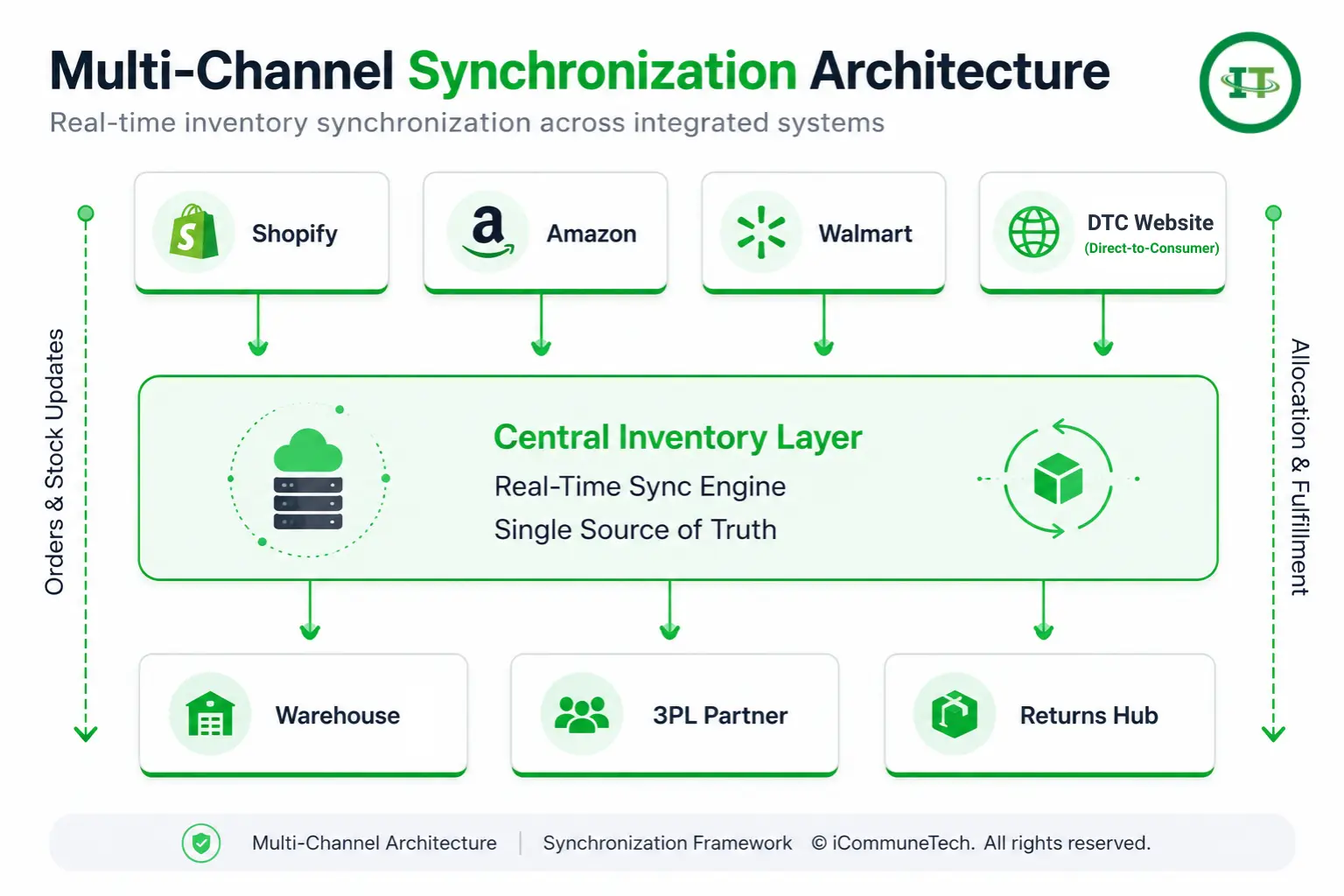
What Are the Key Use Cases for Multi-Channel E-commerce Inventory Management?
Multi-channel inventory management centralizes control to handle different demand patterns, fulfillment rules, and regional constraints without operational fragmentation.
The following scenarios show how e-commerce inventory software manages multi-channel operations through challenge → system action → outcome mapping:
- Marketplace & DTC Balancing: Competing orders for limited stock → allocation rules by channel priority → balanced stock distribution
- Regional Warehouse Distribution: Order-location mismatch → proximity-based routing → faster fulfillment and lower delivery cost
- Catalog Synchronization: SKU mapping errors across platforms → centralized SKU mapping → accurate listings and order processing
- Peak Demand Handling: Demand spikes during sales events → dynamic allocation adjustments → stable order processing
- Cross-Border Allocation: Region-specific demand variation → regional stock assignment → improved product availability
- Reverse Logistics: Mismanaged returned inventory → post-inspection stock updates → faster inventory recovery
- 3PL Coordination: Disconnected partner inventory data → synchronized inventory across 3PL nodes → unified inventory visibility
These use cases show how centralized systems control allocation, synchronize inventory data, and maintain consistent execution across multi-channel ecommerce operations.
How Does Inventory Management Integrate with Major E-Commerce Platforms?
E-commerce operations require integration between inventory systems and sales platforms to maintain accurate stock data and coordinate order processing across channels.
Inventory integration connects platforms such as Shopify, Amazon, and WooCommerce with backend systems to synchronize orders, products, and inventory data across systems.
It uses API-driven inventory databases to maintain consistent data exchange across platforms.
The following table outlines platform-specific integration methods, data exchange scope, and implementation complexity:
| Platform | Integration Type | Data Sync Scope | Complexity |
|---|---|---|---|
| Shopify | REST / GraphQL API | Orders, inventory levels, product data | Moderate |
| BigCommerce | REST API | Orders, catalog, inventory data | Moderate |
| WooCommerce | REST API | Orders, SKU data, stock levels | Moderate |
| Amazon | SP-API (Selling Partner API) | Orders, fulfillment status, and inventory data feeds | High |
| Walmart Marketplace | REST API | Orders, inventory data, and pricing | High |
Inventory integration requires controlled data exchange and validation to maintain accurate, real-time execution.
Key controls:
- Standardize SKU mapping to prevent data conflicts
- Manage API rate limits to avoid sync delays
- Handle failed transactions with retry and logging logic
- Test integrations in staging before deployment
These controls reduce errors and ensure reliable system performance.
iCommuneTech delivers API-driven integration and structured architecture to maintain consistent data flow, stable execution, and scalable operations.
What Are the Best Practices for Shopify Inventory Management Integration?
Shopify inventory integration requires controlled API handling, event flow management, and consistent data processing to maintain accurate order execution and inventory state.
Best practices align with e-commerce order system integration to coordinate Shopify with backend systems.
- Process webhooks with idempotency to prevent duplicate transactions
- Use queue-based requests to manage API limits and traffic spikes
- Standardize SKU formats to avoid mapping conflicts
- Validate incoming data before processing transactions
- Separate event capture from execution to stabilize workflows
- Track workflow states to ensure complete processing
- Log and classify errors for faster issue resolution
- Test integration under peak load to ensure performance
These controls maintain data consistency, prevent errors, and stabilize integration. iCommuneTech implements API-driven, event-based architectures to support scalable and reliable Shopify integration.
How Do Sync Strategies Differ Between BigCommerce, WooCommerce, and Amazon?
Sync strategies differ based on how each platform processes inventory updates, which affects speed, control, and reliability.
| Platform | Sync Method | Key Requirement |
|---|---|---|
| BigCommerce | API-driven | Handle rate limits, retries |
| WooCommerce | Plugin + API | Standardize plugins, validate schema |
| Amazon | Feed + SP-API | Schedule feeds, pre-validate data |
Set up guidance:
Use API pipelines for real-time control, enforce plugin consistency for WooCommerce, and combine feeds with APIs for Amazon to balance load and accuracy. These approaches align with marketplace integration systems that coordinate data flow across platforms.
Commercial insight:
Platform-native setups suit simple operations, while custom integration improves control and scalability for multi-channel environments.
How Does Inventory Automation Improve Process Efficiency and Control?
Inventory automation replaces manual tasks with rule-based execution, reducing manual effort, minimizing errors, and improving operational control. According to McKinsey, spare-parts revenue can increase by about 3% when inventory optimization improves product availability and matches stock with demand patterns. This improvement shows how automated execution maintains consistent stock availability and reduces missed sales.
Automation applies the following mechanisms to streamline workflows:
- Trigger auto-replenishment based on stock thresholds to maintain availability
- Schedule cycle counts to verify inventory and reduce discrepancies
- Classify returns automatically to update stock status and recover value
- Generate alerts for low stock, delays, or anomalies to prompt action
These controls align with supply chain automation workflows, which standardize and automate execution.
iCommuneTech converts manual processes into structured digital workflows that capture transactions, maintain audit trails, and scale reliably with business growth.
How Does AI Improve Inventory Demand Forecasting Accuracy?
AI improves forecasting accuracy by analyzing historical sales, real-time demand signals, and external factors to predict fluctuations, seasonality, and overstock risks. It aligns inventory decisions with expected demand, reducing excess stock and missed sales.
Data from McKinsey shows that advanced analytics applications can improve business performance by 2–10%, demonstrating the impact of data-driven decision-making on operational efficiency and financial outcomes.
AI applies the following techniques to optimize forecasting and inventory control:
- Model demand patterns using time-series models to capture seasonality and trend shifts
- Adjust forecasts using regression models based on pricing, promotions, and external drivers
- Process recent order signals through demand sensing to update short-term forecasts
- Optimize reorder points using forecast outputs and lead time inputs
- Calculate safety stock using probabilistic models to balance availability and holding cost
- Detect anomalies in demand patterns to identify overstock risks and demand deviations
These methods operate within demand planning systems to improve forecast precision, control inventory investment, and stabilize stock availability. iCommuneTech applies advanced data science models and adaptive planning frameworks to deliver accurate, scalable forecasting for high-value inventory operations.
How Does ERP Integration Enable Unified Inventory and Financial Control?
ERP integration maps inventory transactions to financial entries using synchronized posting logic to maintain inventory visibility, cost accuracy, and compliance.
The following integration flows show data flow → system action → business outcome:
Inventory Valuation
Records stock value using configured costing methods.
Sales Orders
Post revenue and receivables from completed sales transactions.
Purchase Orders
Updates procurement records and stock intake during purchasing.
Stock Movements
Logs inventory ledger entries for transfers and stock changes.
Returns & Adjustments
Records refunds, write-offs, and inventory adjustments.
These practices align with procurement software synchronization to coordinate inventory and financial workflows.
iCommuneTech implements ERP integration using rule-driven mapping, validation pipelines, and controlled posting logic to maintain financial traceability and scalable operations.
How Do Reporting Dashboards and KPIs Control Inventory Performance?
Reporting dashboards control inventory performance by tracking key metrics that measure stock movement, availability, and cost. They convert transactional data into actionable insights that guide procurement, allocation, and pricing decisions.
According to McKinsey & Company, inventory optimization can maintain gross margins above 60%, showing that improved turnover can increase profitability without margin loss.
The following KPIs define how performance is measured and controlled:
| KPI | System Action | Outcome |
|---|---|---|
| Sell-Through Rate | Track units sold vs available stock | Identify fast/slow-moving items |
| Stockout Rate | Monitor unavailable SKUs | Prevent lost sales |
| Inventory Holding Cost | Calculate storage and capital cost | Reduce excess inventory spend |
| Aged Inventory | Track stock by aging periods | Trigger liquidation actions |
| Forecast Accuracy | Compare forecast vs actual demand | Improve planning precision |
These metrics are delivered through supply chain analytics dashboards, which process real-time data and present decision-ready insights.
Dashboards highlight deviations and trigger corrective actions such as adjusting reorder points, refining procurement timing, and updating pricing inputs. These actions improve inventory turnover, reduce carrying costs, and drive continuous performance optimization.
How Do Real-Time Inventory Updates Support Bookkeeping and Audit Trails?
Real-time inventory updates post each stock movement as a timestamped financial entry, which keeps inventory balances, COGS, and revenue records aligned for accurate bookkeeping and audit readiness.
The following controls define how real-time updates maintain financial accuracy and audit traceability:
- Record each inventory event with a linked ledger entry to maintain transaction-level accuracy
- Update inventory valuation continuously using defined cost methods to reflect the true financial position
- Log transaction details with timestamps, user IDs, and system actions to create verifiable audit trails
- Track adjustments with reason codes and approvals to control authorized changes
- Reconcile inventory records with financial entries to detect and correct mismatches
- Sync transaction data with accounting systems to maintain consistent financial reporting
These controls operate within a perpetual inventory system to maintain continuous financial integrity.
Real-time tracking creates a complete transaction chain from stock movement to financial entry. Finance teams trace each transaction, validate records during audits, and maintain compliance without reconstructing data.
How Do You Evaluate Cost and ROI for Inventory Management Software?
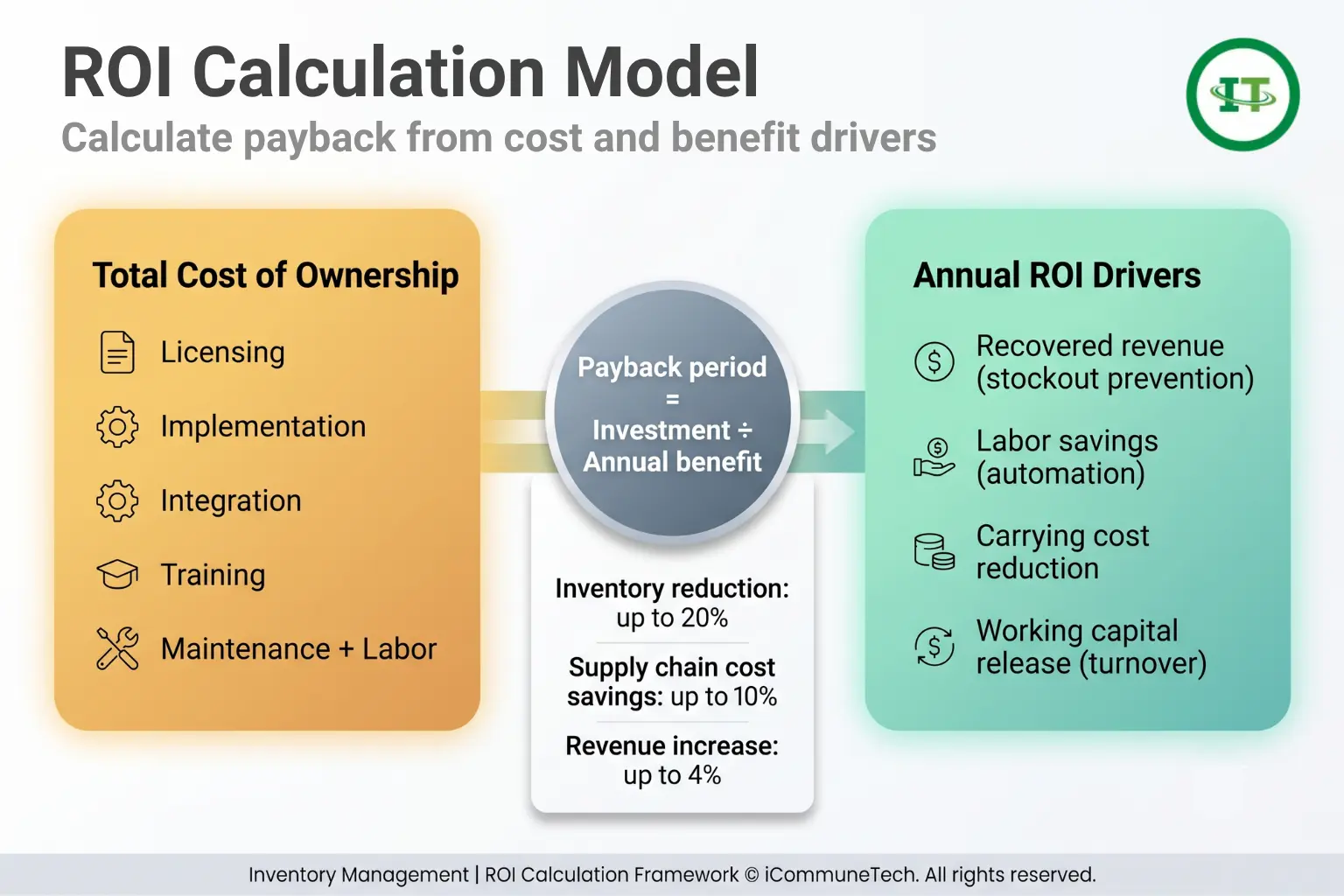
Evaluate ROI by comparing the total cost of ownership (TCO) with measurable financial gains from inventory performance.
TCO components define total investment:
- Calculate licensing, implementation, integration, training, and maintenance to establish the full cost
- Include operational effort to capture baseline labor expense
ROI drivers define financial return:
- Quantify recovered revenue from reduced stockouts
- Measure labor savings from automated workflows
- Calculate the carrying cost reduction from lower inventory levels
- Estimate working capital release from improved turnover
According to McKinsey, autonomous supply chain planning can reduce inventory levels by up to 20%, lower supply chain costs by up to 10%, and increase revenue by up to 4%. These benchmarks provide reference values for estimating financial return during ROI calculation.
Use a simple model to calculate payback:
| Metric | Calculation | Outcome |
|---|---|---|
| Total Investment | Sum of TCO components | Cost baseline |
| Annual Benefit | Revenue recovery + cost savings | Financial gain |
| Payback Period | Investment ÷ Annual Benefit | Time to ROI |
These calculations align with inventory cost optimization to structure cost-to-return analysis.
iCommuneTech applies data-driven cost modeling and performance benchmarks to quantify savings, define payback timelines, and link operational improvements directly to financial outcomes.
When Should You Implement Inventory Management Software?
Implement inventory management software when stock accuracy, fulfillment speed, or cost control declines. Delays, stock errors, and scaling friction signal an immediate need for system control.
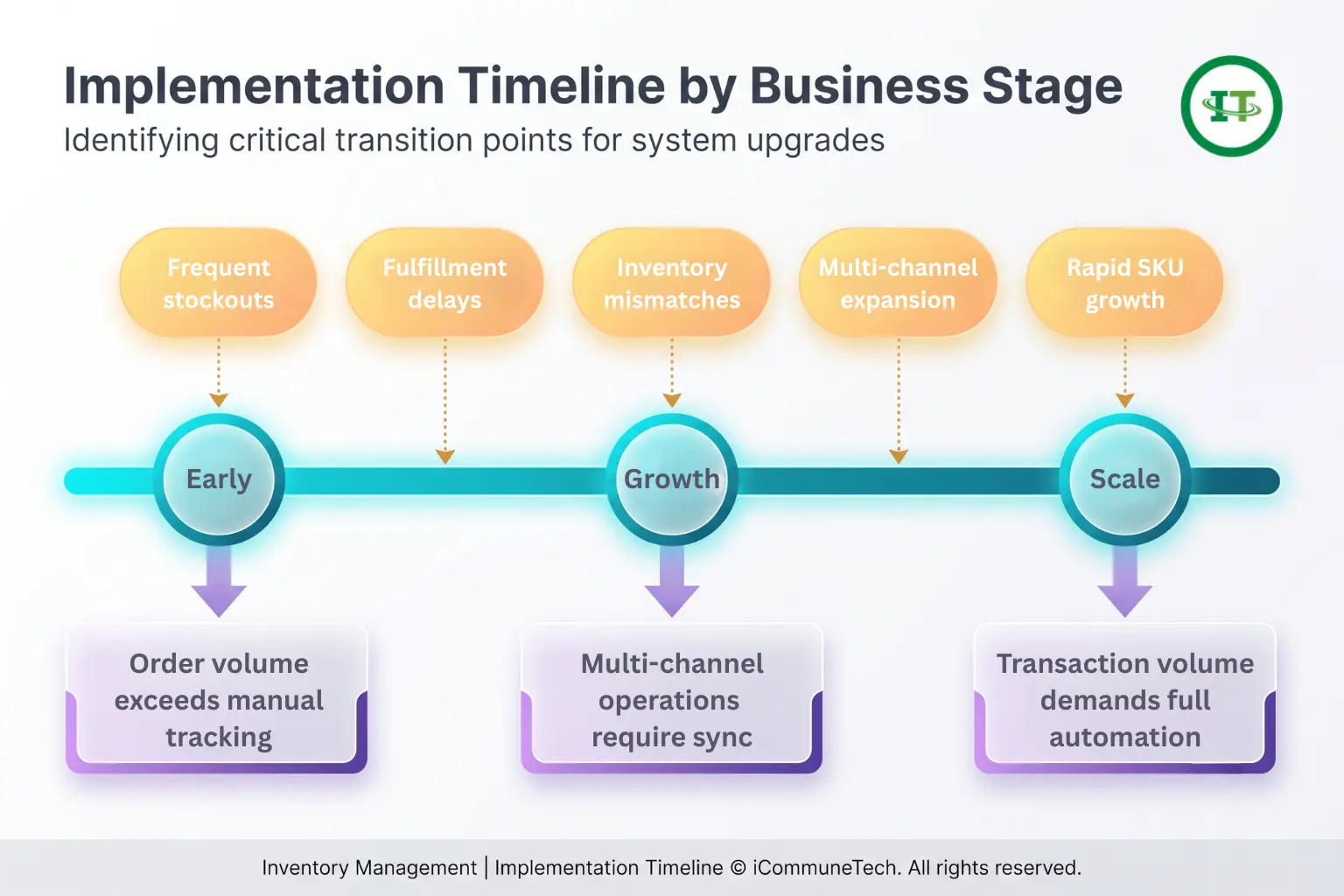
The following signals indicate a transition from manual tracking to system-driven execution:
- Frequent stockouts or overselling reduce revenue and erode customer trust
- Fulfillment delays increase order cycle time and operating cost
- Inventory mismatches create reconciliation gaps and financial risk
- Multi-channel expansion fragments stock visibility and allocation control
- Rapid SKU and order growth overload manual processes
Timing guidance based on business stage:
- Early-stage: Move when order volume exceeds manual tracking capacity
- Growth stage: Move when multi-channel operations require synchronized inventory
- Scale stage: Move when transaction volume demands automation and financial control
These signals align with inventory system transformation, which replaces manual tracking with structured, scalable execution. iCommuneTech identifies these transition points using operational data, then implements systems that restore control, improve fulfillment speed, and support sustainable growth.
How to Create an Effective E-Commerce Inventory Management Strategy?
Create an effective strategy by aligning inventory decisions with demand, operations, and financial goals. Define clear workflows, assign ownership, and connect systems to maintain control as the business scales.
The following steps define how to build or modernize an inventory strategy:
- Align stakeholders across operations, finance, and supply chain to ensure accountable decisions
- Map OMS, WMS, ERP, and marketplaces to establish a unified data flow
- Standardize replenishment, allocation, and fulfillment workflows to control execution
- Maintain accurate SKU, location, and demand data to support reliable planning
- Apply forecasting and reorder models to align inventory with demand
- Define KPIs and monitoring to track performance and trigger corrective action
- Train teams and enforce process adoption to maintain execution consistency
These steps align with the supply chain management software strategy to unify technology and operations.
iCommuneTech applies this framework to convert fragmented processes into controlled, data-driven systems that improve accuracy, reduce cost, and support scalable growth.
What Control Mechanisms Govern E-commerce Inventory Management?
Control mechanisms govern inventory by enforcing rules that maintain stock accuracy, prevent loss, and stabilize fulfillment under growth.
The following checklist shows how each control solves a specific e-commerce pain point:
- Standardize SKU structure to prevent duplication and fulfillment errors
- Assign batch and lot identifiers to manage expiry and compliance
- Classify SKUs using ABC to prioritize high-impact inventory and reduce capital lock-in
- Schedule cycle counts to detect discrepancies early and prevent stock drift
- Audit physical vs system stock to correct mismatches and protect financial accuracy
- Set reorder points using demand and lead time to prevent stockouts
- Maintain safety stock buffers to handle demand variability
- Automate replenishment, allocation, and alerts to reduce manual errors
- Process returns efficiently to recover value and prevent revenue loss
- Monitor exceptions in demand, supply, and stock movement to trigger corrective action
Cycle counting and audits align with inventory counting software to maintain continuous control, reduce errors, and improve inventory performance.
How Does iCommuneTech Implement E-commerce Inventory Management Software?
iCommuneTech implements inventory systems by converting operational rules, data structures, and integrations into controlled, executable workflows.
Implementation aligns with custom inventory deployment to ensure structured rollout and consistent execution.
Delivery model:
- Assess operations: Define SKU structure, flows, and system dependencies
- Design architecture: Set data models and transaction logic
- Configure system: Apply inventory rules and control parameters
- Integrate data: Map entities and establish validated interfaces
- Test scenarios: Verify system behavior under real conditions
- Deploy in phases: Maintain continuity during rollout
- Enable users: Train teams and enforce process adoption
- Stabilize performance: Monitor execution and optimize under load
This approach ensures accurate execution, controlled integration, and scalable inventory operations.
Case Study: AI-Powered Inventory Optimization for Revenue Preservation and Fill Rate Improvement
AI Inventory Optimization Engine Prevents Stockouts and Improves Fill Rates
An AI-driven inventory optimization engine prevented stockouts and improved fill rates by detecting demand risks early and adjusting allocation. Previously, fragmented ERP, warehouse, and logistics systems delayed SKU-level imbalance detection. A unified decision layer now aggregates signals and applies predictive models to act before fulfillment is impacted.
This allowed planning teams to adjust allocation and replenishment timing based on projected demand instead of relying on delayed historical indicators.
Predictive inventory systems protect revenue and improve fulfillment by shifting from reactive fixes to proactive allocation
Check more success storiesClient: Enterprise Shippers and Retail-Focused Supply Chains
Technology: Nauta AI-Powered Inventory Optimization Engine
Measured impact:
How Should Technology Buyers Evaluate and Select E-commerce Inventory Management Software?
Select software by aligning business targets with system capability, integration fit, and delivery timeline. A structured evaluation reduces risk and secures measurable ROI.
The following checklist defines how buyers evaluate, compare, and select solutions:
- Define business targets: Set service level, inventory turnover, and cost goals to anchor evaluation
- Assess requirements: Map SKU volume, order load, channels, and warehouse structure to define system scope
- Identify capability gaps: Pinpoint limits in current tracking, planning, and fulfillment execution
- Compare vendors: Evaluate features, scalability, data handling, and implementation capability
- Validate integration plan: Confirm data exchange with ERP, OMS, WMS, and marketplaces to maintain consistency
- Review system architecture: Check data flow, validation rules, and performance under transaction load
- Analyze cost and ROI: Compare total cost against projected gains in revenue, labor efficiency, and inventory reduction
- Test system fit: Run pilot scenarios to verify workflow alignment and operational performance
These steps align with supply chain planning tools to structure planning and execution.
Expected implementation timeline:
- Small operations: 4–8 weeks
- Mid-scale businesses: 8–16 weeks
- Enterprise deployments: 3–6 months
iCommuneTech applies this framework to align technical design with business objectives, ensure controlled rollout, and deliver scalable inventory operations with measurable business impact.
What Questions Should You Ask E-commerce Inventory Management Vendors Before Selection?
Evaluate vendors by validating pricing, capability, integration, performance, and scalability to reduce risk and ensure long-term fit.
Key vendor questions:
- What costs extend beyond licensing?
- How does pricing scale with volume, SKUs, and users?
- Which core features are native vs add-ons?
- What functional limits exist?
- What workflows can be configured without code?
- What are system constraints?
- Which systems connect directly?
- How are data validation and failures handled?
- How are permissions controlled?
- What audit logs and compliance standards exist?
- What throughput and latency are supported under peak load?
- How are failures managed?
- What limits apply to SKUs, orders, and locations?
- How does performance scale?
- What implementation effort is required?
- How are updates and support handled?
These questions expose system limits, validate vendor claims, and ensure the solution supports scalable operations and controlled execution.
How Will Emerging Technologies Shape the Future of E-commerce Inventory Management?
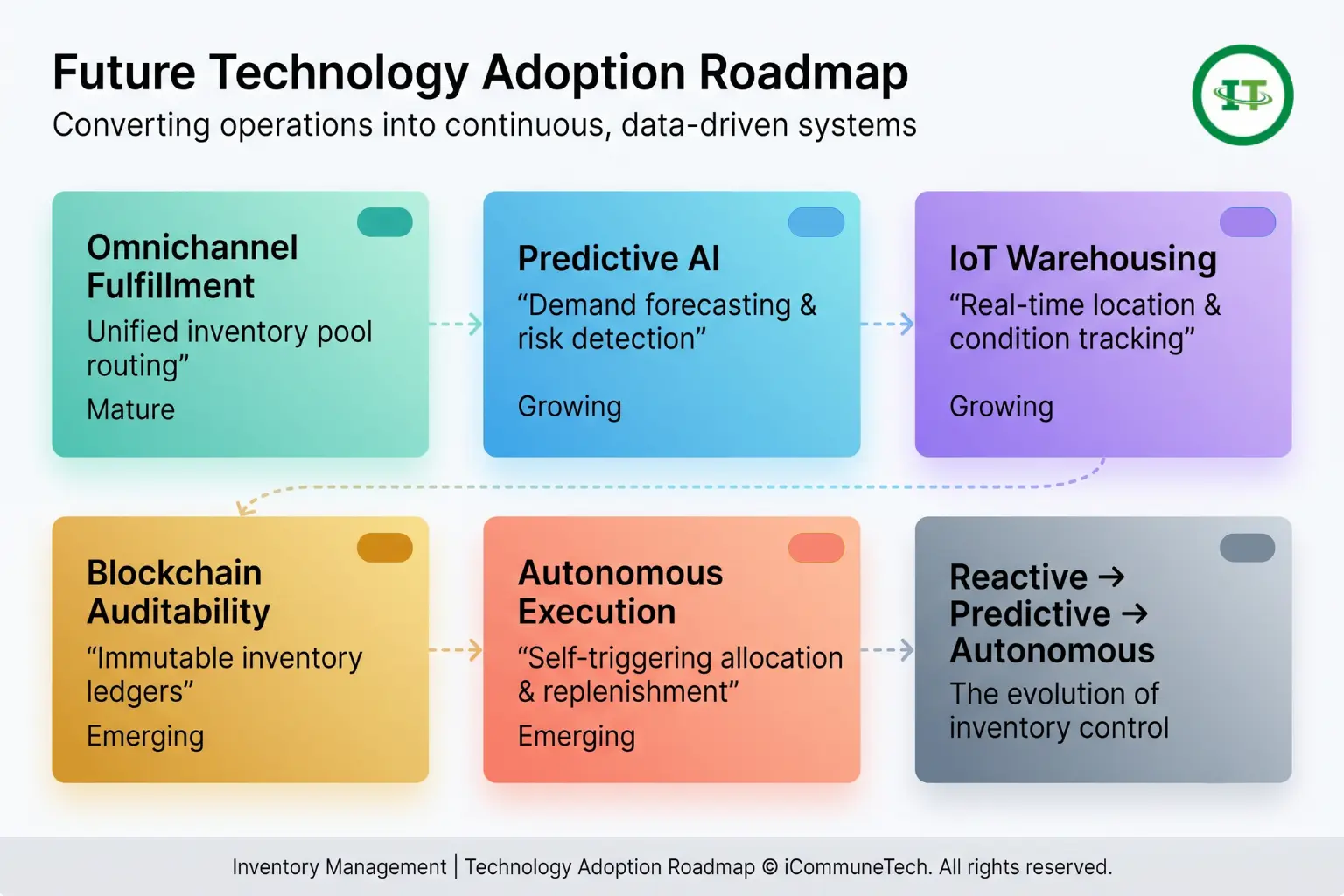
Emerging technologies will shift inventory management from reactive control to predictive, automated execution that improves availability, reduces cost, and strengthens auditability.
The following technologies define how inventory operations will evolve:
- Omnichannel fulfillment: Route orders from a unified inventory pool to increase delivery speed and eliminate stock fragmentation
- Predictive AI: Forecast demand, detect risk, and adjust replenishment to prevent stockouts and excess inventory
- IoT-enabled warehousing: Capture real-time stock location and condition data to improve accuracy and reduce manual handling
- Blockchain auditability: Record inventory transactions in immutable ledgers to ensure traceability and compliance through blockchain supply chain systems
- Autonomous execution systems: Trigger allocation, replenishment, and exception handling without manual intervention
These technologies convert inventory operations into continuous, data-driven systems that respond to demand in real time.
iCommuneTech integrates AI, IoT, and blockchain capabilities into inventory platforms to build scalable, future-ready systems that increase control, improve resilience, and create long-term competitive advantage.
Why Should You Choose iCommuneTech for E-commerce Inventory Management Implementation?
You should choose iCommuneTech when you need reliable execution, scalable systems, and measurable improvements in inventory accuracy and fulfillment performance.
Vendor selection requires evaluation beyond functional capability, focusing on execution reliability, system scalability, and measurable outcomes. Engagement models align with the supply chain digital transformation partner.
iCommuneTech Differentiators
- Global Delivery Capability: Executes multi-region implementations using standardized delivery models.
- Technology Stack Coverage: Supports inventory systems, ERP, OMS, and warehouse platforms within a unified environment.
- Security and Compliance Frameworks: Applies role-based access control, audit logging, and compliance-aligned data governance.
- E-commerce and Supply Chain Expertise: Applies domain-specific knowledge across inventory, fulfillment, and procurement operations.
- Outcome Orientation: Delivers measurable improvements in inventory accuracy, fulfillment efficiency, and cost control.
- Scalable System Enablement: Supports growth in transaction volume, SKU count, and operational scope without requiring structural redesign.
iCommuneTech delivers inventory platforms that sustain execution stability and support operational growth.

Irshad Pathan

Web Development Expert
Irshad is a senior technical expert at iCommuneTech. He manages the iCommuneTech's Web Development Team, and has hands-on expertise in web development, Laravel development, Logistics, fleet management, and Supply Chain Management. He mentors the in-house team and enjoys describing his experience in words.
Read More Insights By Irshad →