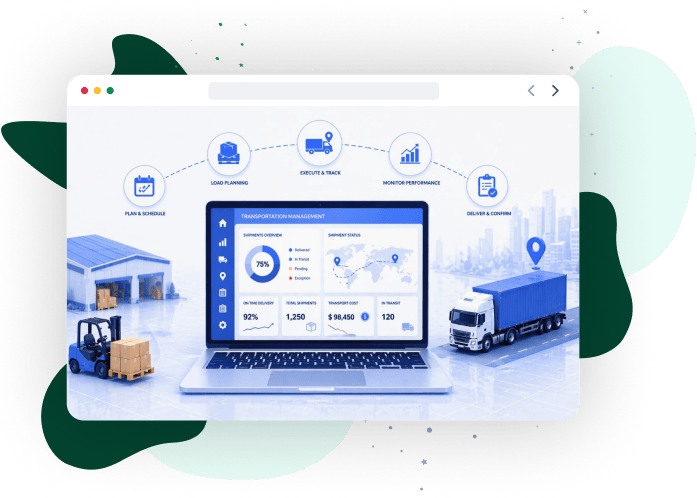
A transportation management system (TMS) manages shipment planning and execution using rule-based logic. Enterprises handling temperature-sensitive goods, hazardous materials, or cross-border shipments must process capacity, delivery, and regulatory constraints within unified workflows.
Custom TMS platforms define execution logic for multi-leg shipments, carrier allocation, and contract-based pricing. They integrate planning, execution, and financial data across ERP, WMS, and telematics systems to ensure accuracy, real-time tracking, and cost validation.
This guide explains custom TMS architecture, core capabilities, integration models, and cost, scalability, and ROI evaluation.
What Is Transportation Management Software in a Custom TMS Context?
Custom transportation management software structures logistics execution through decision logic, data models, and process workflows within system architecture.
The system executes shipment operations using defined rules such as carrier allocation, shipment sequencing, and contract-based pricing based on route, load profile, and service conditions. It supports multi-leg shipments, cross-border compliance workflows, and hybrid fleet operations without relying on fixed templates.
Packaged platforms restrict workflow extensions to predefined modules. A custom transportation management system replaces these limits with extensible logic layers that evaluate capacity, delivery constraints, and regulatory conditions at runtime.
Custom development becomes necessary when logistics networks require coordinated data exchange across ERP, warehouse, and telematics systems. The system synchronizes planning, execution, and financial data under continuous operational inputs.
Supply chains experience disruptions lasting 1–2 months every 3.7 years, according to McKinsey & Company. This instability requires transportation management systems that execute real-time coordination, dynamic routing, and exception handling. Implementation includes order ingestion, planning logic, execution tracking, and financial settlement within a unified data model. The system synchronizes shipment execution, fleet operations, and freight cost allocation without fragmentation.
Custom transportation management software operates through structured logic, unified data models, and constraint-based processing across logistics operations. Embedding this approach within transportation management software solutions aligns operational requirements, integration dependencies, and system scalability.
Driving Measurable Results Across Industries
From automating manual calculations to modernizing legacy infrastructure, we build software that directly impacts the bottom line. Our custom solutions consistently reduce operational costs and accelerate process efficiency.
View Our Case Studies
When Should You Choose Custom TMS vs Off-the-Shelf Transportation Management Systems?
A custom transportation management system fits logistics operations that require rule-driven execution, while off-the-shelf transportation management software suits standardized workflows.
The table compares both approaches across key system and operational dimensions.
| Decision Factor | Off-the-Shelf TMS | Custom TMS | Operational Impact |
|---|---|---|---|
| Execution Logic | Predefined workflows within system limits | Rule-driven execution based on business logic | Determines whether systems adapt to operations or constrain them |
| Routing & Planning | Fixed routing with limited constraint handling | Dynamic constraint evaluation (capacity, time windows, compliance) | Affects routing accuracy and SLA adherence |
| Integration Model | Prebuilt connectors with limited flexibility | Direct integration with ERP, warehouse, and telematics systems | Maintains data consistency across planning, execution, and finance |
| Scalability | Limited by platform modules | Extensible architecture with custom modules | Defines long-term system adaptability |
| Cost Structure | Lower upfront cost with growing constraints | Higher upfront cost with controlled long-term spend | Impacts the total cost of ownership |
| Use Case Fit | Low-variability, standardized operations | Complex, multi-entity, or regulated environments | Determines fit based on operational complexity |
The decision depends on whether logistics operations require constraint-based execution or can operate within predefined workflows. Organizations conducting a logistics system comparison should evaluate execution logic, integration, and scalability against operational requirements.
What Are the Limitations of Pre-Built TMS Platforms?
Pre-built transportation management software platforms restrict logistics execution when workflows require conditional logic and system-level control.
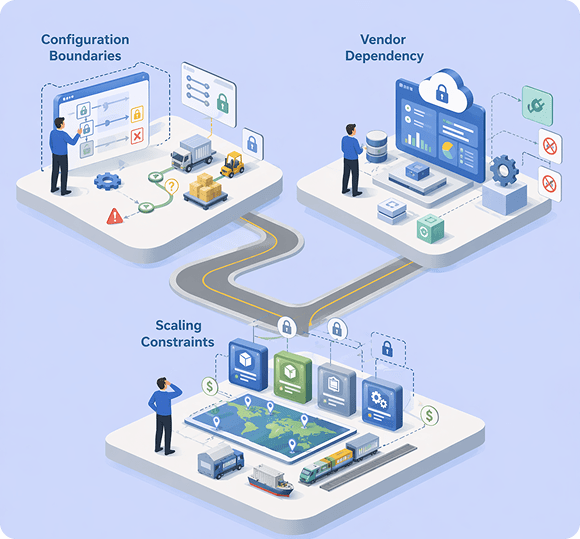
Predefined system parameters restrict multi-condition workflows such as sequence-dependent routing, carrier prioritization, and exception-triggered execution paths.
Vendors control system architecture, data models, and upgrade cycles, limiting core logic modification and integration with external systems.
Expansion across regions, carriers, or service conditions requires additional modules, increasing costs and creating workflow inconsistencies.
Insights from fleet management trends highlight a shift toward modular systems that support independent control over execution logic.
When Is a Custom TMS the Right Strategic Investment?
Data from McKinsey & Company shows that 30% to 50% of a year’s EBITDA can be lost over a decade due to supply chain disruptions. This financial exposure positions TMS as a critical infrastructure for cost control, visibility, and operational resilience.
The checklist below outlines conditions that require a custom TMS approach:
| Evaluation Criteria | Operational Condition | System Requirement | Impact |
|---|---|---|---|
| Routing Complexity | Sequence-dependent routing with interdependent stops | Constraint-based routing with dependency handling | Maintains execution consistency across shipment legs |
| Transport Modes | Multi-leg shipments across transport modes | Mode-specific orchestration within a unified workflow | Preserves continuity across shipment transitions |
| Compliance Requirements | Regulatory validation across regions or shipment types | Embedded compliance checkpoints within execution flow | Enforces regulatory compliance during execution |
| Carrier Strategy | Allocation based on contracts and performance metrics | Contract-driven carrier selection and enforcement logic | Aligns carrier usage with commercial agreements |
| Freight Sensitivity | Shipments requiring controlled handling conditions | Conditional execution rules based on shipment attributes | Preserves handling integrity across movement stages |
| Optimization Needs | Adaptive planning based on operational inputs | Integrated optimization models within execution | Improves decision accuracy under variable conditions |
| System Landscape | Distributed planning and execution systems | Coordinated data orchestration across systems | Maintains consistency across operational processes |
Routing scenarios with interdependent conditions require models that evaluate constraints during execution. These capabilities are delivered through route optimization systems that manage sequence, capacity, and delivery dependencies
What Defines the Core Capabilities of a Custom Transportation Management System?
Core capabilities of a custom transportation management system include shipment planning, routing and optimization, load building, real-time tracking, freight cost management, and performance analytics. These capabilities are implemented across shipment planning, routing and optimization, execution tracking, and financial control functions.
Shipment planning and routing optimize carrier selection, route efficiency, and delivery schedules based on constraints such as capacity, transit time, and cost. Load building consolidates shipments to maximize asset utilization and reduce transport costs.
Real-time tracking provides visibility into shipment status across all legs, while freight cost management validates charges, manages accruals, and ensures invoice accuracy. Performance analytics measure KPIs such as cost per mile, on-time delivery, and carrier performance.
These capabilities operate on integrated data from ERP, WMS, and supply chain management software to maintain execution accuracy and financial alignment across the shipment lifecycle.
How Does Real-Time Visibility, Tracking & Exception Management Work in a Custom TMS?
Real-time visibility operates through continuous signal capture, predictive estimation, and event-driven exception handling across shipment movement. McKinsey reports that inefficient mid- and last-mile handoffs account for 13–19% of logistics costs, reaching up to $95 billion annually in the US. These losses result from fragmented coordination, limited visibility, and manual execution gaps.
Transportation management systems address these gaps through unified tracking, automated event processing, and coordinated execution. The table outlines how visibility, tracking, and exception management functions operate within the custom TMS.
| Capability | System Function | Data Inputs | Operational Impact |
|---|---|---|---|
| Visibility Capture | Capture live shipment and asset signals | GPS, ELD, IoT devices, RFID events | Maintains real-time shipment position and condition |
| Tracking | Track shipment state across transit checkpoints | Location pings, status events, checkpoint scans | Delivers continuous status updates without manual input |
| ETA Prediction | Predict delivery time using historical and real-time data | Position data, route conditions, historical transit records | Improves delivery time accuracy under variable conditions |
| Exception Detection | Detect deviations from planned movement conditions | Delay events, route deviations, missed milestones | Identifies disruptions requiring intervention |
| Alerting | Trigger event-based notifications based on thresholds | Condition breaches, system-triggered events | Enables rapid operational response |
Systems aligned with supply chain visibility software support structured monitoring across shipment movement. Tracking and exception signaling are further enabled through shipment tracking software, which processes event-based updates and triggers operational alerts.
What Is Freight Audit, Settlement & Cost Allocation in a Custom TMS?
Freight audit, settlement, and cost allocation control transportation spend by validating carrier charges, executing settlement workflows, and assigning costs based on shipment execution data.
In enterprise logistics environments, this capability functions as a financial control layer that governs billing accuracy, cost distribution, and performance evaluation through rule-based processing.
Contract Validation & Rate Enforcement
- Validate rates, surcharges, and accessorial charges
- Detect deviations, duplicates, and unauthorized billing
- Enforce contract-based pricing across lanes and carriers
Only contract-compliant invoices are approved.
Invoice Automation & Settlement Execution
- Generate invoices from shipment data
- Route exceptions through approval rules
- Execute settlement across carriers and partners
Settlement is processed without manual reconciliation.
Cost Allocation Across Shipments
- Allocate costs across shipments, routes, and customers
- Distribute shared charges (fuel, detention, handling)
- Track lane and customer profitability
Cost visibility is maintained at the transaction level.
Accrual Management & Financial Alignment
- Record in-transit and unbilled costs
- Align with accounting periods
- Link execution with financial records
Financials stay synchronized with shipment status.
Cost Intelligence & Performance Analytics
- Track cost per shipment, mile, and carrier variance
- Identify inefficiencies and billing discrepancies
Insights are generated using transportation analytics tools. Freight audit and settlement in a custom TMS operates as a financial control system where validation, allocation, and analytics run directly on execution data.
What Are Transportation Analytics, KPIs & Sustainability Metrics?
Transportation analytics, KPIs, and sustainability metrics measure transport performance, cost behavior, and emissions using system-calculated indicators within the TMS execution layer.
In enterprise logistics environments, analytics converts operational and financial data into measurable performance metrics for cost control and service evaluation. These analytics functions include KPI measurement, cost analysis, sustainability tracking, and reporting frameworks.
KPI Structuring & Service Measurement
The system calculates KPIs from shipment and routing data to standardize performance evaluation.
- Measure cost per mile, OTIF, and performance variance
- Standardize service and cost benchmarks
These KPIs establish benchmarks for service reliability and cost efficiency.
Cost Analysis & Network Efficiency
Analytical models evaluate cost behavior across transport operations.
- Identify high-cost lanes and inefficiencies
- Compare planned vs actual costs
- Evaluate carrier performance
Digital transformation reduces logistics costs by 15–20% (Gitnux research).
Sustainability Metrics & Emission Tracking
The system calculates emission metrics from transport activity and fuel consumption.
- Measure CO₂ emissions by shipment and route
- Track fuel consumption
- Support ESG compliance
Analytics & Reporting Framework
Analytics outputs support operational and financial decision-making.
- Consolidate shipment, cost, and performance data
- Enable benchmarking and trend analysis
- Support routing and cost decisions
Delivered through supply chain analytics.
What Is Integration Architecture for Custom Transportation Management Software?
Integration architecture defines how a custom TMS connects execution, planning, and financial systems through structured data exchange.
It operates across three layers: data integration, process synchronization, and visibility/control.
Data Integration Layer
Handles data exchange between systems using APIs, EDI, and event-driven communication.
- Captures inputs from ERP (orders), WMS (inventory), and telematics (GPS, ELD)
- Ensures real-time and batch data synchronization
Process Synchronization Layer
Aligns planning, execution, and financial workflows.
- Updates shipment status across systems during execution
- Synchronizes routing, dispatch, and delivery events
- Maintains consistency between operational and financial records
Visibility & Control Layer
Provides unified visibility and decision support.
- Consolidates shipment, cost, and performance data
- Enables real-time tracking and exception monitoring
- Supports system-wide coordination and control
This architecture ensures continuous data flow across systems, forming the foundation for supply chain visibility systems.
How Do ERP, WMS, Accounting & Telematics Integration Work in a Custom TMS?
Integration across ERP, warehouse, accounting, and telematics systems synchronizes operational inputs with execution and financial records through structured data exchange. The table outlines how core enterprise systems integrate with a custom TMS to synchronize data across planning, execution, and financial processes.
| Integration Area | System Interaction | Data Scope | Outcome |
|---|---|---|---|
| ERP Integration | Synchronizes order and master data with transport workflows | Orders, customer data, routing inputs | Improves load planning and allocation accuracy |
| WMS Integration | Synchronizes warehouse execution with transport readiness | Inventory status, picking, staging, and dispatch signals | Aligns shipment release with warehouse operations |
| Telematics Integration | Captures real-time signals from transport assets | GPS, ELD, device telemetry | Updates shipment movement and execution status |
| Accounting Integration | Maps transport transactions to financial systems | Freight charges, invoices, and accrual entries | Maintains consistency between transport costs and financial records |
Integration Models: API-First vs EDI-Based
The table below compares integration models that govern data exchange methods, system compatibility, and execution responsiveness within a custom TMS environment.
| Integration Type | Data Exchange Method | System Fit | Operational Role |
|---|---|---|---|
| API-First | Real-time, event-driven communication | Modern systems and microservices architectures | Enables immediate data updates and execution responsiveness |
| EDI-Based | Structured, batch-oriented exchange | Legacy and partner systems | Supports standardized communication across external entities |
| Hybrid | Combination of API and EDI | Mixed system environments | Balances real-time execution with external integration constraints |
How iCommuneTech Helps T&L Companies Scale Fast Enough?
Scaling logistics operations requires unified systems, real-time data flow, and execution processes without manual bottlenecks. iCommuneTech delivers this through integrated platforms that synchronize transport, financial, and operational workflows within a unified system architecture.
“The new unified TMS + Fuel Management platform completely changed the way we operate. We now track everything in real-time, invoice faster, and provide better service to our clients.”

How Does API-First & Scalable System Design Work in a Custom TMS?
API-first and scalable system design works by connecting transport functions through APIs, processing real-time data, and scaling modules independently.
It works in the following steps:
1. APIs expose system functions
Transport operations (planning, dispatch, billing) are accessible for integration with external systems.
2. Data is captured in real time
Inputs from ERP, WMS, and telematics (GPS, ELD, IoT) are ingested as event-driven streams.
3. Microservices process operations
Modules handle dispatch, tracking, billing, and carrier management independently.
4. Events trigger workflows
Status updates, delays, and alerts automatically initiate system actions.
5. Cloud infrastructure scales the system
Distributed services ensure scalability, availability, and fault isolation.
System Extensions & External Connectivity
- Integrate carrier portals to manage load updates and execution communication
- Process real-time data streams from telematics and IoT-enabled devices
- Enable coordinated interaction across internal systems and partner platforms
What Are Custom TMS Solutions by Logistics Role?
Custom transportation management system (TMS) solutions structure transport execution workflows based on role-specific responsibilities across shippers, carriers, brokers, and logistics providers. These solutions are structured across shippers, carriers, fleets, freight forwarders, and brokers.
Each role uses distinct decision logic, execution models, and performance metrics, requiring system configurations aligned with planning, execution, and commercial control functions. These role-driven configurations integrate with 3PL software systems to support coordinated operations across multi-party logistics environments.
How Does a Custom TMS Work for Shippers?
A custom TMS for shippers manages inbound procurement, outbound distribution, supplier coordination, and freight spend within a unified system.

Shipment Flow Optimization
Defines how inbound and outbound shipments are planned and sequenced across the network.
- Manage inbound movement from suppliers to warehouses or production nodes
- Plan outbound distribution aligned with order priority and delivery schedules
- Sequence shipments using inventory position and dispatch readiness

Supplier Collaboration
Coordinates supplier interactions to align production, pickup, and shipment execution.
- Align pickup schedules with supplier production timelines
- Share shipment visibility to coordinate execution across supply partners
- Standardize communication across multi-supplier environments

Freight Spend Control & Negotiation
Controls transportation costs and supports carrier selection and rate negotiation.
- Apply lane-based rate structures for carrier selection
- Evaluate carrier performance to support negotiation and allocation decisions
- Monitor cost variance across lanes and shipment types

Compliance Control
Ensures shipments meet regulatory and handling requirements before execution.
- Enforce compliance rules based on product type and regional requirements
- Validate documentation and handling conditions before dispatch
- Ensure adherence to regulatory transport requirements
Integration with demand planning systems connects transport execution with supply and demand planning, improving coordination between planning inputs and shipment execution.
How Does a Custom TMS Work for Carriers, Fleets & Freight Forwarders?
A custom transportation management system (TMS) for carriers, fleets, and freight forwarders manages transport execution across dispatch control, fleet utilization, compliance enforcement, and multi-carrier coordination.
The following capabilities define how a custom TMS manages dispatch, fleet operations, compliance, and carrier coordination for carriers and logistics providers.
Dispatch & Driver Execution
Controls load assignment and driver activity across shipment execution. Dispatch operations assign loads and coordinate driver activity by matching driver availability with trip requirements, managing schedules, and tracking execution across pickup, transit, and delivery stages.
Fleet Utilization & Asset Control
Optimizes fleet capacity and asset allocation across transport operations. Fleet allocation evaluates capacity, route suitability, and availability to assign assets efficiently. Continuous monitoring of fleet usage reduces idle time and improves utilization across shipment volumes.
Safety & Compliance Enforcement
Enforces regulatory and safety requirements across transport operations. The system enforces compliance across drivers, vehicles, and shipments by applying regulatory rules, validating documentation and inspections, and ensuring adherence to transport safety requirements.
Carrier Coordination & Forwarding Operations
Manages load distribution across carriers and forwarding networks. Carrier coordination distributes loads across internal fleets and partner networks using capacity and service conditions. It manages multi-carrier environments and supports multi-leg and cross-border forwarding without execution gaps.
Claim Management
Handles shipment exceptions and claim resolution processes. The system processes claims using shipment events and exception records to track delays, damage, or loss, manage resolution workflows, and maintain records for dispute handling and audit.
Integration with fleet management systems connects dispatch execution with fleet control and real-time operational monitoring.
How Does a Custom TMS Work for Brokers & 3PLs?
A custom transportation management system (TMS) for brokers and 3PLs manages transport execution across load allocation, carrier network operations, and margin control.
The functions below define how a custom TMS supports brokerage and 3PL operations across load allocation, carrier network management, and margin control.
The system matches shipment requirements with available capacity using route constraints, service conditions, and delivery timelines. This ensures accurate load assignment and efficient utilization of carrier networks.
Carrier onboarding standardizes data, validates compliance requirements, and maintains updated records for capacity, service coverage, and performance. This enables consistent network availability and controlled carrier selection.
The system tracks the difference between buy rates and sell rates to maintain margin visibility across lanes, customers, and allocations. This supports profitability monitoring and commercial decision-making.
Integration with freight forwarding systems enables coordinated execution across brokerage and forwarding operations within multi-party logistics networks.
How Does Modernization of TMS Improve Transport Operations?
Legacy platforms operate on outdated codebases with limited extensibility, restricting system upgrades and increasing maintenance overhead. Modern architectures introduce modular components that enable controlled system expansion, faster dispatch and routing decisions, reduced delays, and consistent execution across transport operations.
What Are Advanced Operational Modules in a Custom TMS?
Advanced operational modules extend core transport execution by adding specialized controls for facility operations, access management, and system coordination.
These modules include yard management system capabilities, dock scheduling, access control, and collaboration workflows. Each module manages a specific aspect of execution while maintaining coordination across transport and facility operations.
How Does Yard Management & Dock Scheduling Work in a Custom TMS?
Yard management and dock scheduling in a custom transportation management system control vehicle flow within a facility by regulating entry, positioning, and dock allocation across inbound and outbound movements.
The following functions define how vehicle movement and dock operations are managed within the yard:
Entry Control (Gate Operations)
Gate operations validate incoming vehicles against scheduled appointments and shipment data to control entry sequencing and reduce congestion at access points.
Yard Movement Control
Once inside the yard, the system directs trailer positioning using slot availability and operational priority to optimize placement for loading and unloading.
Dock Scheduling & Throughput
Dock scheduling assigns time slots using shipment priority and dock capacity to maintain controlled loading cycles and reduce turnaround delays.
Integration with the yard management platform synchronizes yard operations with facility workflows and transport execution.
How Do Collaboration, Security & Access Control Work in a Custom TMS?
Collaboration, security, and access control in a custom transportation management system define how users and external partners interact while protecting operational data and execution workflows.
Role-based permissions control user actions, visibility, and execution rights, ensuring each role operates within defined limits. External stakeholders, including carriers and suppliers, interact through dedicated portals to view shipment data, track status updates, and perform assigned tasks without direct access to core system logic.
Supported by supply chain security, data protection, and compliance are enforced through role-based controls, audit tracking, and policy-driven governance that regulate how information is accessed, processed, and transmitted.
Case Study: Transportation Management System Optimization
High-volume logistics operations were streamlined through automated dispatch workflows, real-time driver tracking, and integrated communication systems.
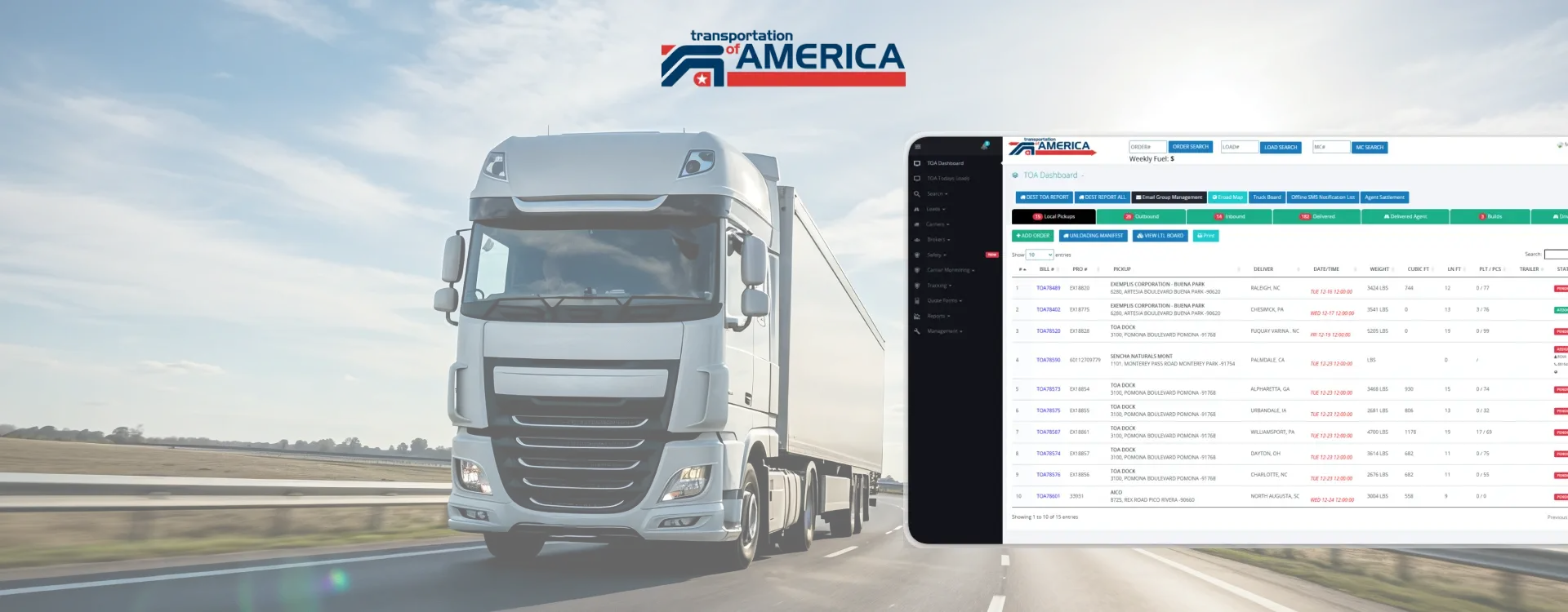
Dispatch time reduced to under 1 minute
Check more success storiesBuild vs Buy: Comparing Custom TMS with Enterprise Platforms
The decision between building a custom transportation management system and adopting an enterprise platform determines how execution logic, integration control, and scalability are implemented across logistics operations.
Enterprise TMS platforms operate within predefined architectures, where workflow configuration, data models, and upgrade cycles follow vendor-defined constraints. In contrast, custom TMS systems align execution logic, integration layers, and operational rules directly with business-specific requirements.
Organizations evaluating enterprise logistics systems must assess whether operational requirements can be supported within standardized platforms or require system-level control through custom development.
What Are the Limitations of Standard TMS Platforms?
Standard TMS platforms struggle to support complex logistics operations where routing, compliance, and carrier allocation require dynamic decision-making beyond predefined workflows.
Configuration Ceilings
Execution logic is restricted to predefined parameters, preventing implementation of conditional workflows such as dependency-based routing, multi-layer validation, or contract-specific allocation beyond supported configurations.
As a result, operations adapt to system constraints instead of embedding business rules into execution processes.
Vendor Lock-In
Platform providers control system architecture, data models, and upgrade cycles. Modifying core logic or integrating external systems requires vendor intervention. This limits system evolution and increases transition complexity when operational requirements change.
Scaling Costs
Scaling is constrained by licensing models and architectural limits. Expanding across regions, carriers, or workflows requires additional modules or full-system upgrades.
This increases cost overhead and creates inconsistencies in execution across expanded operations.
Security and Control Constraints
Security operates within vendor-defined frameworks, limiting control over access policies, data handling, and integration endpoints. As system connectivity expands across partners, exposure risk increases when security configurations cannot be independently enforced.
Organizations requiring stricter control implement safeguards through fleet cybersecurity to manage system-level risks.
How Does Custom TMS Compare with SAP and Oracle-Based TMS?
A custom transportation management system differs from SAP and Oracle-based platforms in how execution logic, cost structure, and system evolution are defined and implemented across logistics operations.
The table below compares both approaches across key system dimensions.
| Comparison Dimension | Custom TMS | SAP / Oracle-Based TMS | Operational Impact |
|---|---|---|---|
| Flexibility vs Standardization | Embeds rule-driven execution logic aligned with business-specific workflows and constraints | Operates within standardized modules with configuration-based workflow control | Determines whether execution adapts to operations or remains constrained by platform structure |
| Total Cost of Ownership | Higher initial development cost with lower long-term cost due to the absence of recurring licensing and maintenance fees | Lower initial configuration cost with increasing long-term expenses from licensing, upgrades, and vendor dependencies | Impacts cost predictability and long-term financial control |
| Innovation Speed | Enables direct implementation of features, integrations, and decision logic without dependency on external release cycles | Follows vendor-defined release cycles, where new capabilities depend on platform updates or complex customizations | Affects responsiveness to operational changes and evolving requirements |
System adaptability to regulatory and operational changes is supported through supply chain compliance systems, which enforce compliance conditions within execution workflows.
How to Develop a Custom Transportation Management System?
Developing a custom transportation management system involves structuring logistics workflows, system architecture, and integrations into a unified execution platform. The development lifecycle organizes process logic, data models, and system modules to ensure consistent design, deployment, and operation of transport workflows.
Organizations implementing custom inventory systems must align development stages with integration scope, system extensibility, and operational scale to maintain consistency across planning and execution.
How Do Discovery, Process Modeling & System Architecture Work in Custom TMS Development?
In custom transportation management system development, discovery, process modeling, and system architecture translate operational requirements into executable system design.
Discovery establishes operational scope by mapping shipment workflows, identifying dependencies, and defining execution constraints such as capacity limits, service commitments, and compliance requirements. This ensures that system requirements reflect actual logistics operations rather than assumed workflows.
Process modeling translates operational flows into structured system processes by defining event sequences, conditional logic, and data relationships across shipment, carrier, and financial entities. This creates a clear execution framework for transport operations.
System architecture organizes components, data models, and integrations to support execution and scalability. It defines module structure, data flow, and integration patterns to maintain consistent processing and alignment with external systems, supported by supply chain planning for coordination with upstream planning inputs.
How Does MVP vs Full-Scale Development Strategy Work in Custom TMS Development?
MVP and full-scale development strategies define how system capabilities are prioritized, implemented, and expanded based on operational requirements and deployment timelines.
Alignment with inventory optimization systems ensures that development priorities reflect demand variability and resource utilization requirements.
The table below compares MVP and full-scale development across scope, deployment, integration, and scalability dimensions.
| Comparison Dimension | MVP Development | Full-Scale Development | Operational Impact |
|---|---|---|---|
| Development Scope | Covers core modules required for shipment planning, execution, and tracking | Covers complete system architecture, including advanced modules, integrations, and analytics | Determines initial system capability coverage |
| Deployment Approach | Uses phased rollout with incremental feature expansion | Uses end-to-end deployment with full functionality from initial release | Impacts time-to-deployment and rollout control |
| Validation Strategy | Test workflows and integration behavior under real operational conditions before expansion | Relies on pre-deployment testing across all modules before system-wide release | Affects risk distribution and issue detection timing |
| Integration Complexity | Integrates critical systems first, with additional integrations added in phases | Integrates all required systems within a unified implementation cycle | Influences the integration risk and implementation effort |
| Scalability Readiness | Expands capabilities progressively based on operational feedback | Establishes full scalability from initial deployment | Impacts how the system handles growth and complexity |
How Do Testing, Deployment, Security & Change Management Work in Custom TMS Development?
In custom transportation management system development, testing, deployment, security, and change management control how solutions are validated, released, secured, and adopted within live operations.
Testing evaluates workflows, integration scenarios, and exception cases against expected outcomes to verify system behavior and data integrity. It identifies defects, checks logic execution, and confirms that outputs align with operational rules.
Deployment provisions production environments, performs data migration, and activates modules through controlled release sequencing. Security enforces policy-driven controls across users, data access, and integration endpoints, aligned with supply chain security systems to maintain governance and compliance
Change management standardizes user onboarding, aligns processes, and manages updates to maintain consistent adoption across operational teams.
How Do You Migrate from a Legacy TMS to a Custom TMS?
Migrating from a legacy system to a custom transportation management system involves transitioning existing logic, data, and integrations into a modern architecture while maintaining operational continuity.
The process starts with assessing legacy system structures, including data models, workflows, and integration dependencies. This step identifies redundant processes, data inconsistencies, and system constraints that must be resolved before transition.
Data migration transfers shipment records, master data, and transactional history into the new system using structured mapping and validation rules. This ensures data accuracy and alignment with the new system architecture.
System transition replaces legacy workflows with updated execution logic while maintaining uninterrupted operations. Integration endpoints are reconfigured to match new interfaces, supported by digital inventory systems for synchronised data handling and interoperability.
What Is the Cost & ROI of Custom TMS Development?
The cost and return on investment (ROI) of a custom transportation management system (TMS) are determined by its impact on execution efficiency, cost control, and operational scalability across logistics networks.
Data from Market Research Intellect indicates that the global Transportation Management Software market is projected to grow from $9.5 billion in 2024 to approximately $20.7 billion by 2033. This growth reflects increasing investment in systems that improve transport execution, cost visibility, and operational control.
Cost Drivers
Cost is determined by system scope, integration depth, data complexity, and architecture design. Implementations involving multi-system connectivity, real-time processing, and advanced execution logic require higher engineering effort, while limited-scope systems involve lower complexity. Ongoing costs include maintenance, infrastructure management, and incremental system enhancements.
Typical Timelines
Development timelines depend on system scope and integration requirements. Core systems with essential planning and execution capabilities follow shorter implementation cycles, while enterprise-scale platforms require extended timelines to accommodate integration, validation, and phased deployment across operational environments.
ROI Benchmarks
ROI is derived from improvements in execution speed, coordination efficiency, and operational control. In a real-world logistics implementation, an integrated system reduced order-to-ship cycle time from multiple days to under two days, accelerating fulfillment throughput and enabling faster response to demand variability.
The same implementation improved real-time visibility and reduced communication delays across operational stakeholders, enabling more consistent execution and faster decision-making.
Long-Term TCO Consideration
Total cost of ownership (TCO) includes initial development, integration, maintenance, and system evolution. Long-term evaluation must account for sustained operational gains, reduced manual intervention, and consistent execution as system complexity and scale increase.
Organizations evaluating supply chain software cost must align investment with system scope, integration requirements, and expected operational outcomes.
Transport Management Software Development Timeline with iCommuneTech
Custom transportation management system development timelines with iCommuneTech depend on project scope, system complexity, and integration requirements, with delivery models aligned to business ROI objectives.
iCommuneTech uses flexible engagement models, including time & materials and dedicated teams, allowing organizations to scale development based on evolving requirements while maintaining control over cost and delivery. This aligns with how enterprises evaluate fleet management software cost when planning transportation systems.
Cost Factors
The cost of custom TMS development is influenced by system depth, data complexity, and scalability requirements:
Number of modules:
Dispatch, routing, fleet tracking, billing, and analytics expand development scope
Integrations:
ERP, EDI, telematics, GPS, and third-party APIs increase system complexity
Data complexity:
Telematics data, video feeds, and CAN bus inputs require advanced processing
Platform scalability:
High transaction volumes and multi-location operations require a robust architecture
UX/UI sophistication:
Role-based dashboards for dispatchers, drivers, and administrators increase development effort
Multi-tenant architecture:
SaaS-based platforms supporting multiple clients add system layers
Analytics and AI models:
Predictive routing, demand forecasting, and optimization engines extend development timelines
Exact costs vary based on algorithm complexity, integration depth, and customization requirements.
Project Delivery Timeline
Custom transportation management system development follows phased implementation aligned with system maturity:
Discovery and architecture:
3–6 weeks for requirements analysis, workflow mapping, and system design
One module MVP:
8–12 weeks for core functionality with limited integrations
Full TMS ecosystem:
6–12 months for end-to-end platform development, including integrations, automation, and analytics
Advanced AI modules:
Additional 8–16 weeks for optimization algorithms, predictive models, and advanced analytics
Each phase ensures controlled rollout, validation, and alignment with operational requirements.
Cost–Timeline Relationship
Development timelines and costs scale with system scope and technical complexity. Projects with fewer modules and limited integrations deploy faster, while enterprise-grade platforms with multi-system integrations, real-time data processing, and AI-driven capabilities require extended timelines for validation, synchronization, and performance optimization.
Want to know the cost of your custom TMS development?
The cost of a custom transportation management system depends on workflow complexity, integration scope, and optimization requirements. Accurately defining these factors is the first step in identifying where the system can reduce operational costs and improve execution performance.
Analyze your transport processes, system gaps, and data flow to define a solution that improves dispatch efficiency, strengthens visibility, and increases fleet utilization.

Get a tailored estimate and see how a custom-built system improves execution with a guided fleet management demo.
See It in Action