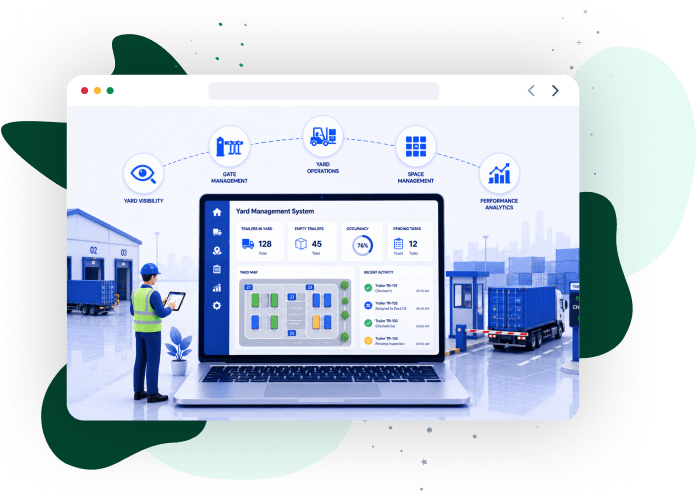

iCommuneTech delivers configurable YMS solutions that map directly to yard workflows, system integrations, and execution constraints, enabling controlled deployment across enterprise environments.
Go for implementationWhat is a Yard Management System?
A yard management system controls the movement, positioning, and status of trailers, containers, and vehicles across yard locations, docks, and gates. It records event-level data at entry, staging, docking, and exit, replacing manual logs with rule-based execution. These yard management system solutions enforce operational rules and maintain accurate yard state.
Transportation Management Systems (TMS) plan loads and carrier movement, while Warehouse Management Systems manage inventory and order processing inside facilities. A yard management system bridges these layers by executing trailer dispatch, dock allocation, and gate validation based on real-time yard conditions. This coordination aligns planned shipments with actual yard availability and dock capacity.
Increasing shipment volume and tighter delivery schedules require continuous visibility into the yard state. System-based tracking, rule-driven task execution, and event timestamping reduce idle trailer time, prevent dock conflicts, and limit costs associated with detention and demurrage.
What Are the Key Yard Management System Features and Functionalities?
The core yard management system functionality includes:
- Gate management: Controls entry, exit, and validation processes
- Dock scheduling: Aligns dock capacity with shipment readiness
- Yard visibility and tracking: Monitors asset positions across yard zones
- Task prioritization and sequencing: Manages trailer movements efficiently
- Exception handling: Resolves delays and operational conflicts in real time
These capabilities are executed through system-defined rules, reducing reliance on manual coordination.
How Does Automating Gate Check-In and Check-Out Improve Yard Operations?
Automated gate systems record entry and exit events using RFID, barcode scanning, and license plate recognition, eliminating manual gate logging. These systems identify vehicles, register timestamps, and update trailer status. Computer vision in logistics operations enables image-based validation of vehicle identity and documentation.
Access control rules validate appointments, verify credentials, and enforce gate permissions before entry. Vehicles proceed only after validation, preventing unauthorized access and eliminating delays caused by manual checks. Each gate transaction generates an event record that updates yard status and triggers subsequent yard processes.
Reduced gate processing time shortens queues, reduces manual labor requirements, and maintains accurate dwell time records through precise entry and exit timestamps.
How Does Intelligent Dock Scheduling and Resource Allocation Improve Yard Throughput?
A yard management system assigns dock slots and resources based on load readiness, dock capacity, and queue position. Scheduling engines sequence arrivals and map trailers to docks using constraint-based logic similar to production scheduling systems.
Dynamic rescheduling adjusts dock assignments when arrival times shift or capacity constraints change. The system reprioritizes queues and reallocates docks to prevent overlap between inbound and outbound movements.
Constraint-based allocation increases dock utilization, reduces staging delays, and enables consistent loading and unloading cycles without reliance on static schedules.
How Does Yard Visibility and Real-Time Tracking Improve Asset Control?
A yard management system tracks trailer positions across yard zones using GPS coordinates, RFID reads, and mobile scans. It provides a map-based view that displays current asset location and status using capabilities similar to supply chain visibility platforms.
Position updates capture trailer movement between staging areas, docks, and exits. Each update captures location change and operational state, eliminating the need for manual search or confirmation. Accurate location data reduces misplaced trailers, shortens retrieval time, and enables faster response to yard changes by maintaining a consistent asset state across operations.
Driving Measurable Results Across Industries
From automating manual calculations to modernizing legacy infrastructure, we build software that directly impacts the bottom line. Our custom solutions consistently reduce operational costs and accelerate process efficiency.
View Our Case Studies
How Does Shunter and Yard Driver Task Optimization Improve Yard Efficiency?
A yard management system automates shunter and yard driver workflows by assigning and sequencing tasks based on trailer priority, real-time location, and dock requirements. Task engines continuously evaluate yard conditions to dispatch the next best move.
The system minimizes empty movements by routing drivers toward the nearest high-priority tasks, reducing unnecessary travel across yard zones. This improves turnaround time and ensures efficient use of yard resources, similar to optimization approaches used in fleet dispatch management systems.
Advanced systems apply data-driven and AI-assisted logic to dynamically adjust task assignments based on congestion patterns, queue buildup, and operational constraints. These models prioritize high-value movements and rebalance workloads in real time.
By automating task allocation and optimizing movement paths, YMS improves labor utilization, reduces idle time, and maintains consistent yard throughput under changing conditions.
How Does Accurate Appointment Management and Dwell Time Tracking Improve Yard Accountability?
A yard management system verifies appointment adherence by matching actual arrival and dock events against scheduled time slots. It records checkpoint timestamps and computes dwell duration per trailer using location-linked status data. These capabilities integrate with transportation analytics insights for performance tracking.
Checkpoint and Time Tracking
- Records check-in, dock-in, dock-out, and exit timestamps
- Associates each timestamp with the yard location and operational state
- Computes dwell duration per trailer based on movement across yard zones
Deviation Detection and Control
- Flags slot variance when actual events differ from scheduled windows
- Identifies delay sources such as early arrival, missed slots, or dock unavailability
- Applies threshold-based rules to detect dwell time exceeding defined limits
Monitoring and Accountability
- Surfaces dwell duration, slot variance, and turnaround metrics in dashboards
- Triggers alerts when dwell thresholds or SLA limits are breached
- Stores traceable records for operational accountability and compliance
What Business Benefits Do Advanced Yard Management Systems Deliver?
Advanced yard management systems increase productivity, reduce costs, and strengthen compliance by applying data-driven processes integrated with supply chain digital transformation.
Productivity and Throughput
- Increases dock throughput by synchronizing trailer flow with handling capacity
- Shortens turnaround time by reducing waiting time between the yard and the dock
- Stabilizes yard flow under variable load conditions
Industry benchmarks from FourKites indicate throughput increases of approximately 20%–40% when trailer flow is synchronized with dock capacity and current yard conditions.
Cost Control and Resource Efficiency
- Reduces labor overhead tied to manual coordination and exception handling
- Limits fuel and equipment usage by eliminating non-productive movements
- Prevents unnecessary costs caused by inefficient yard operations
Compliance and Operational Governance
- Stores structured operational records for audit and traceability
- Enforces SLA adherence through measurable time-based performance indicators
- Ensures regulatory and contractual compliance through consistent data capture
How Does a Yard Management System Reduce Detention and Demurrage Fees?
A yard management system calculates detention and demurrage exposure by capturing checkpoint timestamps such as arrival, dock-in, dock-out, and exit, and comparing them against free-time allowances and contractual limits. These time records integrate with freight forwarding operations that track carrier agreements and charge conditions.
Time Tracking and Fee Calculation
- Computes dwell duration against free-time thresholds defined by carriers or terminals.
- Flags threshold breaches before chargeable time accrues.
- Attributes excess time to specific causes such as queue delays, missed slots, or dock unavailability.
Alerting and Preventive Action
- Triggers alerts as dwell approaches chargeable limits.
- Prioritizes trailers nearing cutoff to accelerate dock assignment or exit processing.
- Enables operational intervention to prevent fee accumulation.
Cost Impact and Justification
- Reduces detention and demurrage expenses by controlling time-based exposure.
- Converts time data into cost visibility for budgeting and carrier negotiations.
- Defines fee reduction as a measurable return on YMS adoption.
An analysis by FourKites highlights potential cost reductions of 40%–80% when delays are identified and resolved before exceeding free-time limits through proactive dwell monitoring.
How Does Boosting Labor Efficiency and Yard Productivity Improve Operational Output?
A yard management system increases workforce output by organizing task assignments, reducing manual intervention, and matching labor activity to yard demand. It increases resource utilization through coordinated task assignment and movement control using capabilities applied in fleet management optimization.
Research published by FourKites indicates that workforce productivity can increase by 25%–30% when yard execution is system-driven, due to reduced manual coordination and optimized task sequencing.
Labor efficiency increases as systems reduce idle time, eliminate redundant movements, and distribute workloads based on operational priority. This produces consistent yard throughput and predictable labor utilization across varying shipment volumes.
How Does Minimizing Emissions Improve Sustainable Yard Operations?
Hidden costs are post-deployment expenses excluded from base pricing.
A yard management system reduces fuel consumption by limiting idle engine time and eliminating unnecessary trailer movements across yard zones. It regulates movement frequency and routing based on task priority and proximity using metrics applied in fuel management systems.
Fuel usage decreases when trailers move only for scheduled dock handling or dispatch, avoiding repeated repositioning and queue delays. Optimized movement patterns reduce engine run time for yard trucks and shunters, lowering emissions per operation cycle.
Lower fuel consumption helps operations meet emission reduction targets and ESG requirements. Controlled yard movements provide measurable tracking of fuel usage and emission impact across operations.
How Does Lowering Costs and Creating a Single Source of Truth Improve Yard Operations?
A yard management system centralizes yard data into a repository that stores asset state, movement logs, and transaction records. This data structure integrates with supply chain analytics platforms that depend on consistent datasets for performance measurement and operational analysis.
Cost Reduction Through Data Integrity
Data integrity eliminates reconciliation errors, prevents asset loss, and removes duplication across systems. Estimates from FourKites indicate that a single yard can achieve annual savings of up to $99,752 by reducing inefficiencies, improving task coordination, and controlling operational costs.
Single Source of Truth for Operations
A unified dataset establishes one reference point for trailer status, dock activity, and movement history. This removes data fragmentation and keeps operational decisions consistent across systems.
Auditability and Decision Support
Structured records store verifiable histories of yard transactions and satisfy compliance requirements and support audit processes. Reliable datasets enable accurate reporting and support data-driven decisions.
How Do Yard Management System Technology and Integrations Enable Scalable Deployment?
A yard management system uses tracking technologies, execution engines, and integration layers to connect yard activity with enterprise systems. It integrates with transportation management software to synchronize yard operations with load planning, carrier coordination, and shipment flow.
Market adoption reflects increasing reliance on scalable architectures. The ABI Research forecasts the YMS market to reach $4.9 billion by 2032 at a 30.5% CAGR.
Core technologies include identification systems such as RFID and license plate recognition, location tracking through GPS, and mobile interfaces for on-ground task management. These components capture asset identity, position, and status, creating the data layer required for controlled yard operations.
Integration frameworks connect the yard management system with warehouse, transportation, and enterprise platforms using API-based exchanges or plug-and-play connectors. Data flows between systems to keep shipment status, dock activity, and asset movement consistent across supply chain systems.
What Are the Core Components of a Yard Management System?
A yard management system includes modules for yard inventory, gate control, dock scheduling, and location tracking, each using structured data models. These components exchange data with warehouse management systems to synchronize trailer handling with inventory processing and order flow.
- Yard inventory tracks trailer identifiers and status states: Maps each asset to a defined operational state across yard locations.
- Gate control records entry and exit transactions: Validates access conditions and captures movement checkpoints.
- Dock scheduling assigns slots based on capacity constraints: Matches trailer positioning with handling availability and processing requirements.
- Location tracking updates positional data across yard zones: Ensures spatial accuracy of trailers and assets within defined yard areas.
- Component interaction creates a shared data layer: Keeps trailer status, dock allocation, and inventory readiness consistent while removing dependency on disconnected records.
How Do YMS, TMS, and WMS Differ in Managing Yard, Transport, and Warehouse Operations?
Yard Management Systems (YMS), Warehouse Management Systems (WMS), and transportation management systems perform different roles across supply chain execution, each focusing on a specific operational function.
| System | Operational Focus | Core Functions | Execution Scope |
|---|---|---|---|
| Yard Management System (YMS) | Yard movement and trailer coordination | Trailer positioning, dock handoffs, gate transitions | Manages trailer flow within yard boundaries |
| Transportation Management System (TMS) | Transportation planning and shipment execution | Load planning, carrier selection, routing | Manages shipment movement across networks |
| Warehouse Management System (WMS) | Inventory and order processing | Stock movement, picking, packing, and storage | Manages internal warehouse operations |
A dedicated YMS handles yard-specific constraints such as dock dependency, trailer sequencing, and space utilization. Embedded yard modules within TMS or WMS lack support for these constraints, reducing operational accuracy at the yard level.
How Do RFID, GPS, and License Plate Recognition Enable Modern Yard Management Systems?
RFID, GPS, and license plate recognition record asset identity, location, and movement events within the yard. These technologies create a data acquisition layer that connects physical assets with system records through IoT in fleet management.
RFID reads tag data at fixed checkpoints, GPS provides location data for in-yard positioning, and license plate recognition extracts vehicle identifiers at gate cameras. These data inputs create verifiable movement records and audit trails.
How Do Yard Management System Vendors and Software Options Compare?
Yard management system vendors differ in product scope, deployment approach, and support model. The market includes standalone YMS products, extensions within larger suites, and offerings integrated with 3PL software platforms that operate across multi-client environments.
Comparison focuses on configuration flexibility, interface coverage, and support for yard-specific scenarios such as trailer sequencing and dock constraints. Analyst reviews evaluate vendors based on extensibility, system interoperability, and readiness for complex deployments.
iCommuneTech delivers an implementation-led model that adapts system configuration to existing operational structures. Its approach prioritizes integration, compatibility, and deployment fit rather than fixed feature delivery.
How Do Leading Yard Management Software Solutions Compare for Enterprise Use in 2026?
Leading yard management platforms are identified through analyst research, such as Gartner, and verified through independent software directories, highlighting enterprise-ready solutions entering 2026.
The table below enables enterprise evaluation based on system fit, architecture compatibility, and deployment scope rather than feature comparison.
| Vendor / Platform | Product Type | Best Fit Scenario | Selection Criteria |
|---|---|---|---|
| iCommuneTech YMS | Custom-built YMS | Integration-driven enterprise environments | Fits operations that need process-level configuration and tight interoperability across existing enterprise systems rather than fixed workflows |
| Manhattan Active YMS | Enterprise suite | High-throughput distribution operations | Works best where yard, warehouse, and transport execution must operate as a single coordinated system |
| Oracle Yard Management | Enterprise suite | Oracle-based system landscapes | Suited for environments already standardized on Oracle, where system consistency outweighs customization depth |
| Kaleris YMS | Specialized YMS | Port and terminal operations | Designed for intermodal yards and complex node coordination where specialized yard execution is required |
| SAP Yard Logistics | Enterprise suite | SAP-centered supply chain environments | Aligns with organizations running SAP, where yard processes must integrate tightly with warehouse and logistics layers |
| Made4net YMS | Supply chain suite | Distributed multi-site operations | Adapts to operations that require scalable deployment across sites with shared execution control |
How Do Dedicated YMS and WMS-Integrated Yard Modules Compare?
Dedicated YMS platforms and yard modules within warehouse inventory systems vary in execution scope, configurability, and control over yard operations.
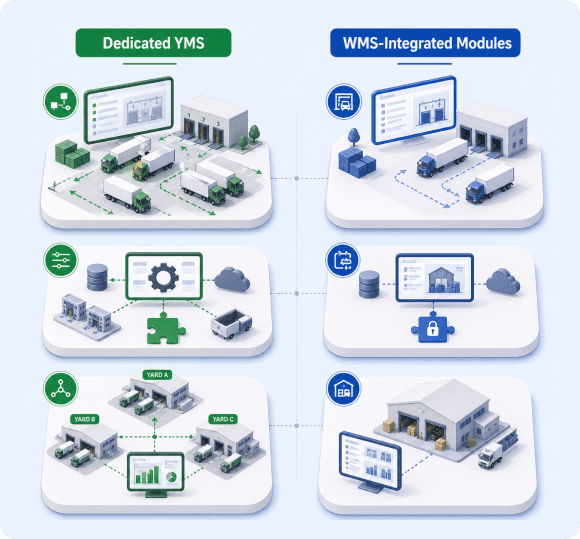
Dedicated YMS delivers yard-specific execution depth
Handles trailer sequencing, dock dependency, and space constraints using configurable logic tailored to yard conditions.
WMS-integrated modules extend warehouse workflows into the yard
Manage basic functions such as dock assignment and trailer tracking within inventory-driven processes.
Dedicated YMS enables flexible configuration and integration control
Adapts to multi-yard environments, variable workflows, and external system dependencies.
WMS modules prioritize warehouse alignment over yard complexity
Limit customization for yard-specific constraints and operational variability.
System selection depends on yard complexity, transaction volume, and integration requirements. Dedicated YMS platforms address environments with high movement density and operational variability, while WMS-integrated modules support controlled warehouse-centric operations.
iCommuneTech delivers a configurable approach that integrates yard operations with existing systems, bridging gaps between dedicated platforms and embedded modules without enforcing fixed product constraints.
How Do Implementation and Best Practices Ensure Successful YMS Projects?
YMS implementation follows a structured approach that defines system configuration, integration architecture, and deployment sequencing required for controlled yard execution.
Implementation Framework
Requirement Definition and Process Mapping
Define yard workflows across gate, dock, and staging operations by identifying inputs, outputs, and dependencies. Translate these workflows into system rules, data structures, and validation logic.
Integration Planning and Data Architecture
Establish integration points with warehouse, transportation, and enterprise systems. Define data models, interface contracts, and message flows to ensure consistent data exchange across platforms.
System Configuration and Rule Setup
Configure operational parameters, including task prioritization rules, dock assignment logic, and access controls. Align system behavior with real-world execution conditions and compliance requirements enforced through supply chain compliance systems.
Deployment and Rollout Strategy
Execute phased deployment across locations or functional areas to reduce operational disruption. Validate system performance under real conditions before full-scale rollout.
Change Management and User Adoption
Define user roles, permissions, and training protocols. Ensure teams understand system workflows and transition from manual processes to system-driven execution.
Continuous Optimization and Performance Monitoring
Track system performance using operational metrics such as dwell time, throughput, and task efficiency. Refine configurations based on real-time data and evolving requirements.
iCommuneTech executes implementation through configuration alignment, integration readiness, and controlled deployment sequencing, ensuring stable system activation and long-term scalability.
How Does Mapping Core Yard Processes and Defining Requirements Improve YMS Outcomes?
Process mapping defines yard workflows as sequence diagrams, identifying inputs, outputs, and handoff points across gate, dock, and staging activities. It specifies entities, attributes, and state transitions required for system configuration using methods applied in procurement process optimization.
Workflow Modeling and State Definition
- Captures workflow sequences across yard touchpoints
- Identifies inputs, outputs, and handoff dependencies
- Specifies entities, attributes, and state transitions
System Requirements and Integration Specification
- Converts workflows into validation rules and data schemas
- Specifies interface endpoints and integration boundaries
- Sets performance limits and system constraints
System Alignment and Implementation Planning
- Reduces design ambiguity and scope deviation
- Keeps system configuration consistent with operational requirements
- Enables accurate system selection and implementation planning
How Do Training, Adoption, and Digital Transformation Improve Yard Operations?
Training defines role-specific procedures, permission levels, and system usage protocols required for controlled yard management system operation. It assigns task responsibilities and enforces correct system interaction using controls applied in supply chain security systems.
Adoption introduces system functions in stages across user groups and operational areas. This approach limits disruption, validates system behavior under real conditions, and enables controlled transition from existing processes.
Digital transformation requires sustained system usage, compliance, and performance tracking. Measurement frameworks evaluate adherence to defined processes and track operational outcomes to maintain consistent execution after deployment.
Contact for custom build