Transportation Analytics: Unleashing Efficiency and Insights for Modern Logistics
Transportation analytics turns raw transport data into clear operational insight. It connects shipments, fleets, routes, and warehouses into one measurable system. With accurate data, teams identify delivery delays during execution, monitor transportation spend, and respond to disruptions earlier. Operational supply chain visibility improves when transportation performance metrics are monitored during execution.
Decisions shift from manual judgment to data-driven choices across planning and execution. These capabilities reduce operational disruptions and support consistent service levels across complex supply networks. The operating model scales growth, reinforces accountability, and improves coordination through decision intelligence across logistics stakeholders.
The transportation analytics market is projected to reach USD 101.58 billion by 2034[1]. This guide outlines the data foundations and analytical technologies used in transportation analytics.
What Are the Foundations of Transportation Data Analytics and Its Core Features?
Effective analytics begins with a clear data foundation and defined core features. This layer establishes how transportation analytics is measured, monitored, and acted on daily. This combination creates a stable analytical baseline that advanced models depend on.
Decisions remain accurate, repeatable, and operationally relevant. These capabilities support measurable improvements across the functions of logistics management, from execution tracking to performance evaluation.
Core features include:
- Reliable data sources that feed analytics dashboards across fleet analytics, route analytics, and warehouse management analytics
- Transportation KPIs that track cost, service, utilization, and safety analytics with consistent definitions
- Reporting systems that standardize outputs for operations, financial management analytics, and compliance reviews
- Data validation processes that ensure accuracy before insights drive inventory optimization, procurement analytics, and order analytics
- Optimization engines that support inventory optimization, pricing controls, and cost modeling tied to financial management analytics
- Alerting systems that flag exceptions affecting service quality, customer analytics, and workforce availability
- Workforce-aligned metrics that connect utilization, safety analytics, and scheduling decisions through workforce analytics
Transportation Data Sources, Sensors, and Surveys
Data sources are the structured raw inputs that supply location, movement, behavior, and system records for transportation data analytics. IoT in transportation enables continuous data capture from vehicles, assets, and infrastructure, forming the foundation for real-time transportation analytics.
| Data Source Category | Raw Input Type | Data Captured | Operational Insight Enabled | Planning / Analytics Use |
|---|---|---|---|---|
| Vehicle & Asset Telemetry | GPS data, telematics data, IoT sensors | Location, speed, idle time, dwell time, and charging needs | Traffic volume, travel patterns, and asset utilization | Fuels transportation data analytics models for routing, grid planning, and capacity decisions |
| Human & Market Inputs | Survey data | Travel behavior, demand signals, demographic insights | Service demand patterns, location preferences | Supports site selection and grid planning with demand context |
| Enterprise Operational Systems | ERP, TMS | Orders, schedules, costs, timestamps, and comprehensive metrics | End-to-end operational performance | Aligns model outputs with execution, reporting, and optimization workflows |
Data Validation and Privacy in Transportation Analytics
Data validation checks whether incoming inputs reflect actual operating conditions before analytics are applied. Errors caught at this stage do not carry into downstream workflows or decisions. Privacy controls define how information is stored and accessed. Data governance frameworks manage how data is shared across systems.
Strong compliance and security practices support regulatory alignment and reduce enterprise risk. Together, these controls build trust in analytics platforms and enable secure SaaS adoption across transportation operations.
Advanced Analytics Technologies in Transportation
Advanced analytics extends transportation analytics beyond reporting into deeper operational intelligence. Descriptive analytics explains what happened, while diagnostic analytics identifies why outcomes occurred. Predictive analytics applies machine learning transportation models to forecast demand, risk, and delays. These models rely on big data drawn from operational systems and external sources.
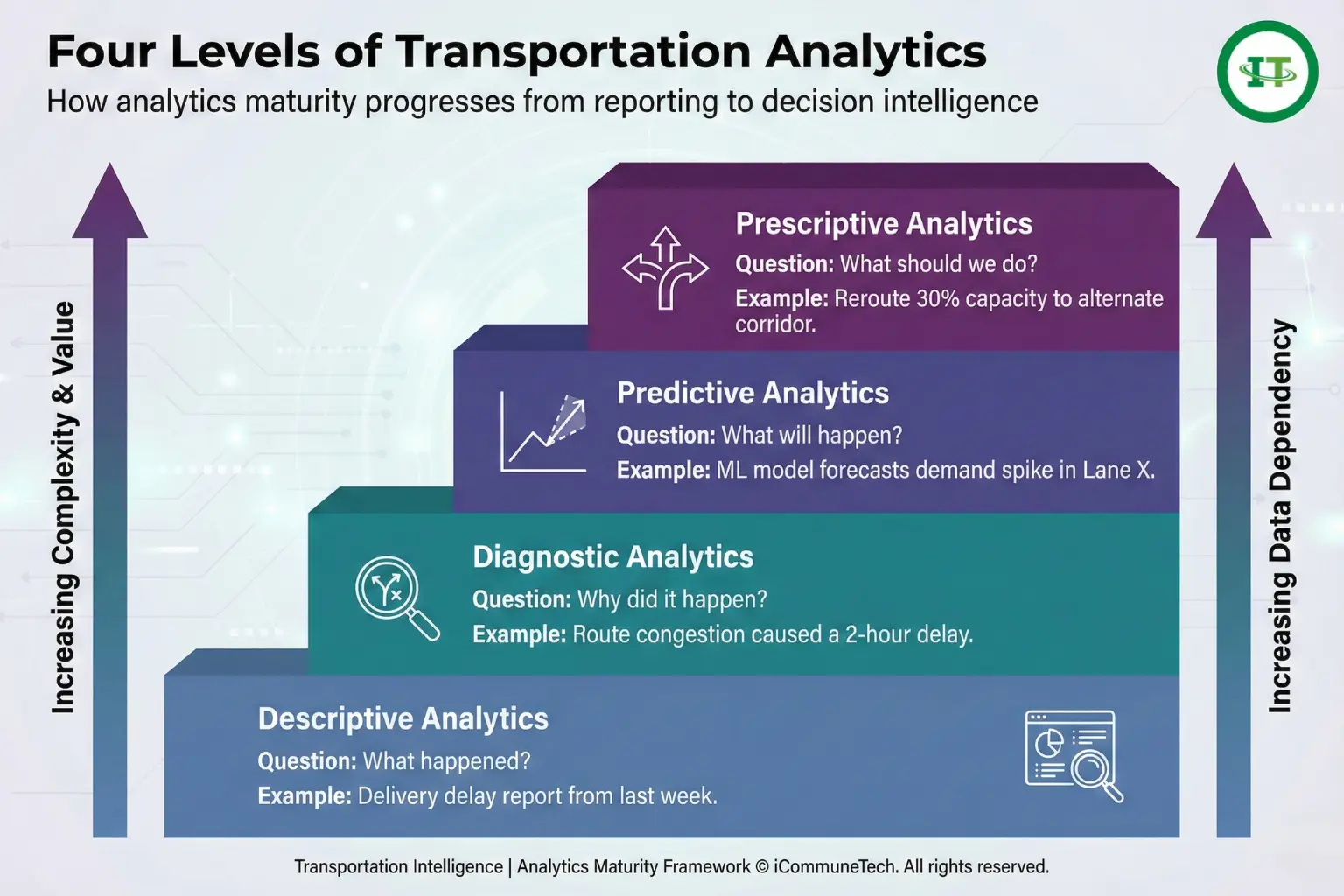
Prescriptive analytics helps teams choose practical actions when cost, time, and capacity trade-offs must be balanced. AI-driven logistics models and digital twins recreate operating conditions so planners can evaluate scenarios before changes reach live operations. This approach enables quicker responses, clearer risk awareness, and more controlled performance improvements across transportation networks.
Predictive Analytics and Machine Learning in Transportation
Predictive analytics applies statistical models and machine learning to anticipate future transportation outcomes. Within transportation analytics, these models rely on historical patterns and real-time signals to reduce uncertainty in planning and execution.
Predictive maintenance reduces breakdowns and unplanned downtime. Organizations implementing predictive maintenance strategies report up to a 25% reduction in maintenance costs[2], as machine learning models detect equipment wear patterns early and enable scheduled servicing before failures disrupt transportation operations.
Key predictive applications include:
- Demand prediction to align capacity with expected shipment volumes. Improves planning accuracy by identifying seasonal shifts, regional demand spikes, and recurring order patterns early.
- ETA forecasting to improve delivery accuracy and customer commitments. Uses real-time traffic, route history, and conditions to continuously refine arrival time estimates.
- Predictive maintenance to reduce breakdowns and unplanned downtime. Detects equipment wear patterns early, enabling scheduled servicing before failures disrupt transportation operations.
- Risk and congestion modeling to anticipate delays and operational disruptions. Analyzes traffic density, weather conditions, and route constraints to forecast potential operational slowdowns.
Big Data Analytics Infrastructure for Transportation
Big data infrastructure provides the scalable backend required to process high-volume transportation data reliably. McKinsey notes that supply chain cost reductions of around 15%[3] can be achieved through operational levers such as dynamic routing and automation.
| Infrastructure Layer | Core Components | Processing Role | Analytics Impact |
|---|---|---|---|
| Data Ingestion | Streaming analytics, message queues | Captures real-time vehicle, sensor, and system data | Supports continuous processing for big data analytics in transportation |
| Data Storage | Data lakes | Stores structured and unstructured transportation data at scale | Enables historical analysis and long-term pattern discovery |
| Compute & Orchestration | Cloud platforms | Scales processing and analytics workloads on demand | Ensures performance, flexibility, and cost-efficient analytics execution |
How Does Transportation Analytics Support Modeling and Planning Decisions?
Transportation analytics delivers value when it directly supports planning and execution decisions across logistics operations. It enables planners and operators to convert data into structured decision-support systems. Transportation modeling represents networks, demand, and constraints in measurable terms to simulate different operating scenarios. Scenario planning allows teams to test alternatives before execution, including trade-offs in capacity and route planning.
Optimization models recommend actions such as route adjustments, capacity allocation, and carrier selection to balance cost, service, and capacity. In practice, these capabilities improve planning accuracy, coordination between planning and execution teams, and response speed during transportation disruptions.
How Do Transportation Modeling and Demand Forecasting Support Planning Decisions?
Planning decisions rely on structured representations of networks, constraints, and operating rules, developed using transportation modeling. Within transportation analytics, demand forecasting estimates shipment volumes, lane demand, and time-based variability using historical trends and current operational signals.
These forecasts guide capacity allocation, fleet sizing, and network design. When modeled scenarios align with forecasted demand, planners can test assumptions, adjust plans early, and reduce execution risk before operations begin.
How Does Route Planning Use Real-Time Traffic Data for Optimization?
- Route planning applies real-time transport analytics to select paths that balance cost, service level, and sustainability goals.
- Live traffic signals, weather data, and road conditions inform route optimization decisions during execution.
- Traffic congestion insights help reroute vehicles to maintain safety, compliance, and delivery commitments.
- Accurate real-time ETA updates improve customer experience and coordination across the supply chain.
- Dynamic routing supports emergency response, maintenance scheduling, inventory coordination, and fuel efficiency while contributing to emissions reduction.
How Are Transportation Analytics Solutions Developed and Implemented?
Developing transportation analytics solutions requires moving from conceptual models to deployable, production-ready systems. Transportation analytics becomes actionable when implemented as deployable platforms that support scalability, reliability, and lifecycle management. It delivers operational value by addressing logistics management challenges related to scale, system integration, and execution consistency.
In SaaS-based transportation analytics environments, solution architecture focuses on integration, performance, and continuous updates. In SaaS logistics environments, development emphasizes usability, security, and operational fit. This execution-focused approach ensures analytics solutions deliver measurable value through improved reliability, usability, and operational adoption in live transportation environments.
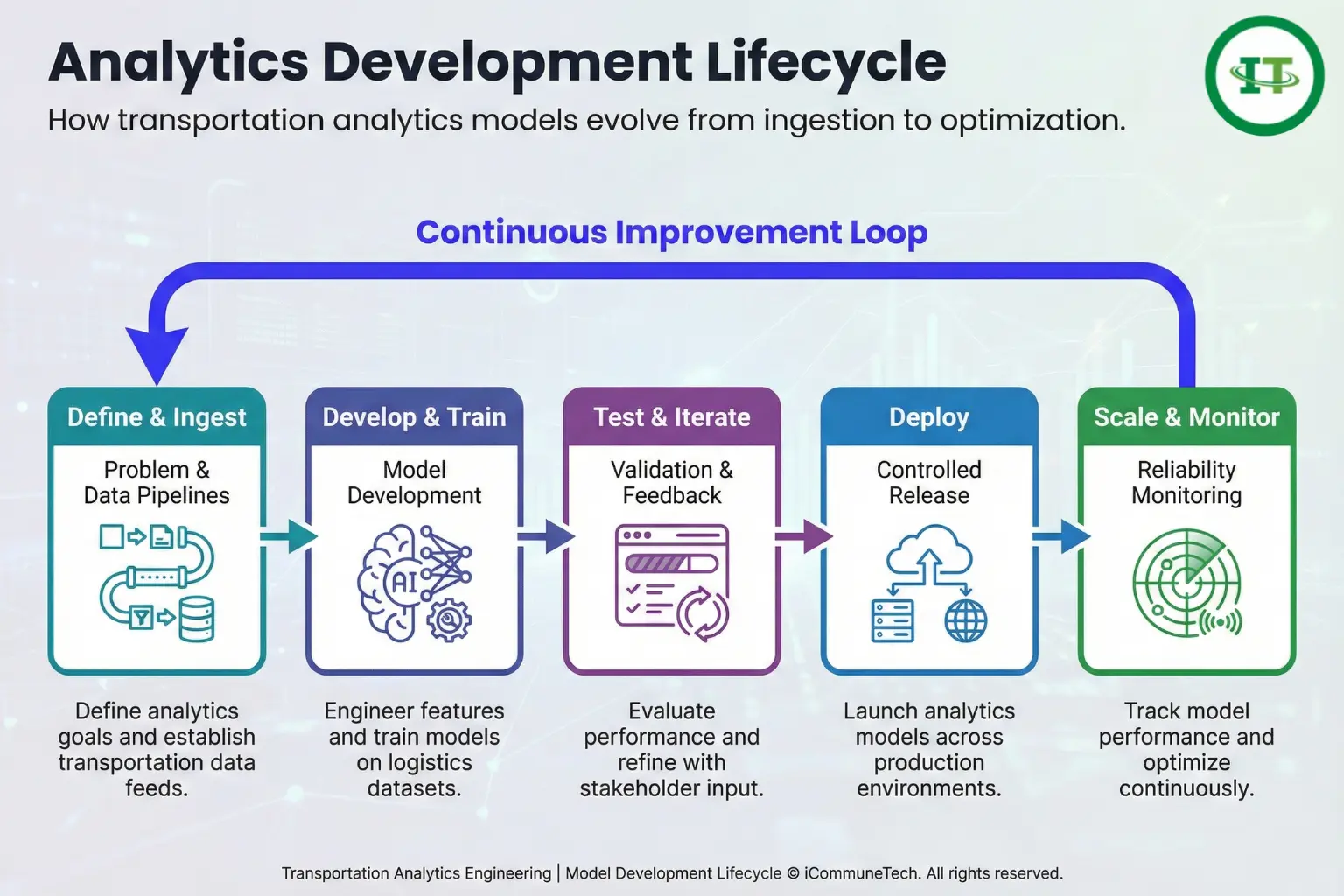
What Is the Analytics Development Lifecycle in Transportation?
- Defining problems and establishing data pipelines for consistent inputs
- Developing feature logic and training models using validated data
- Iterating through testing, performance review, and stakeholder feedback within transportation analytics workflows
- Managing release readiness across controlled deployment environments
- Scaling systems through monitoring, reliability controls, and continuous improvement.
What Are the Best Practices for Implementing and Integrating Transportation Analytics?
Successful adoption depends on how well transportation analytics connects with existing operational systems. Strong analytics integration ensures data flows consistently across planning, execution, and reporting layers without manual intervention. This integration spans across different types of logistics software such as TMS, WMS, and ERP platforms to support consistent data exchange.
Integration best practices include:
- Seamless TMS integration to align routing, dispatch, and fleet management data
- Reliable ERP integration to sync costs, orders, and financial records
- Secure API connectivity to combine proprietary data with external data sources
- Coordinated WMS integration across warehouse operations, inventory management, and order fulfillment systems.
How Does Transportation Analytics Support Strategic Investment and Performance Optimization?
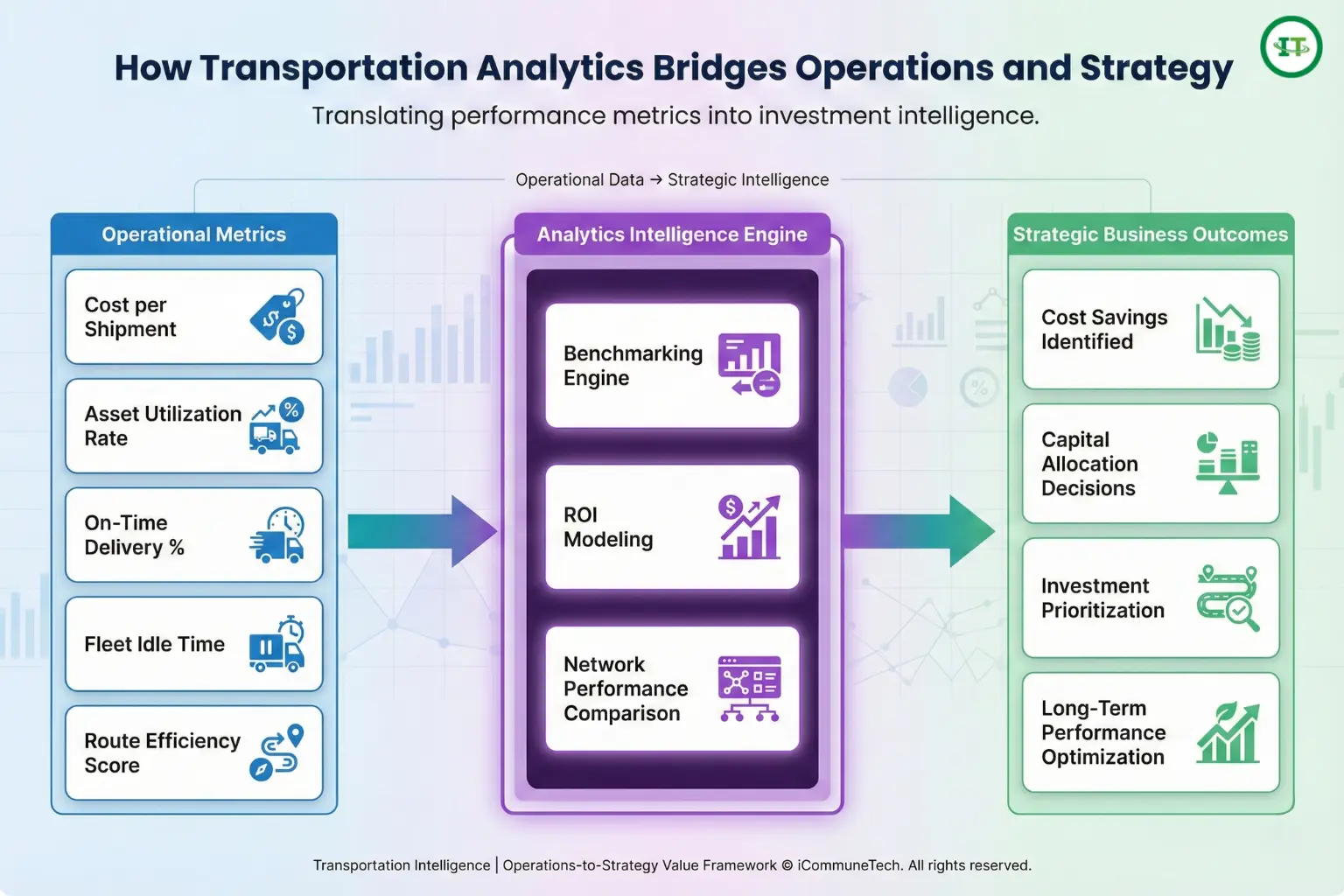
Leadership decisions in transportation require clear links between operational actions and measurable business value. Transportation analytics translates operational performance metrics into financial indicators such as cost savings, asset utilization, and return on investment. These outcomes inform infrastructure planning and investment direction. Consistent ROI measurement shows where analytics investments support cost optimization, service gains, and asset efficiency.
Defined performance benchmarks allow executives to compare results across time and networks. A focused analytics strategy supports informed capital allocation, investment prioritization, and long-term performance optimization without relying on assumptions.
How Does Transportation Analytics Support Investment and Electric Vehicle Infrastructure Planning?
Long-term planning requires clear visibility into cost, demand, and operational impact. Transportation analytics supports infrastructure planning by evaluating fleet usage, route patterns, and energy requirements. These insights guide investments in EV fleets and charging infrastructure while aligning infrastructure planning with sustainability objectives. This approach helps organizations phase capital spending, reduce transition risk, and ensure infrastructure decisions support future transportation demand.
Key analytical considerations include:
- Fleet utilization analysis identifies routes and operations where electric vehicles can replace conventional fleets without disrupting delivery schedules.
- Charging demand forecasting estimates infrastructure requirements by analyzing route distance, dwell time, and vehicle turnaround patterns across different operating zones.
- Energy consumption tracking supports planning by measuring power usage across routes, vehicle types, and operating conditions to ensure charging readiness.
- Cost modeling evaluates long-term investment returns by comparing fuel savings, maintenance reduction, and infrastructure deployment costs across fleet transition phases.
- Route suitability analysis determines which delivery lanes, urban corridors, and regional networks can support electric vehicle adoption with minimal operational disruption.
- Infrastructure location planning identifies optimal sites for charging stations based on route density, vehicle idle time, and operational coverage needs.
- Emission reduction measurement aligns EV investments with sustainability targets, regulatory requirements, and environmental performance benchmarks.
- Scenario planning supports phased transition strategies by testing infrastructure expansion timelines, fleet replacement cycles, and evolving transportation demand patterns.
How Does Transportation Analytics Support Cost Optimization and Profitability in Logistics Operations?
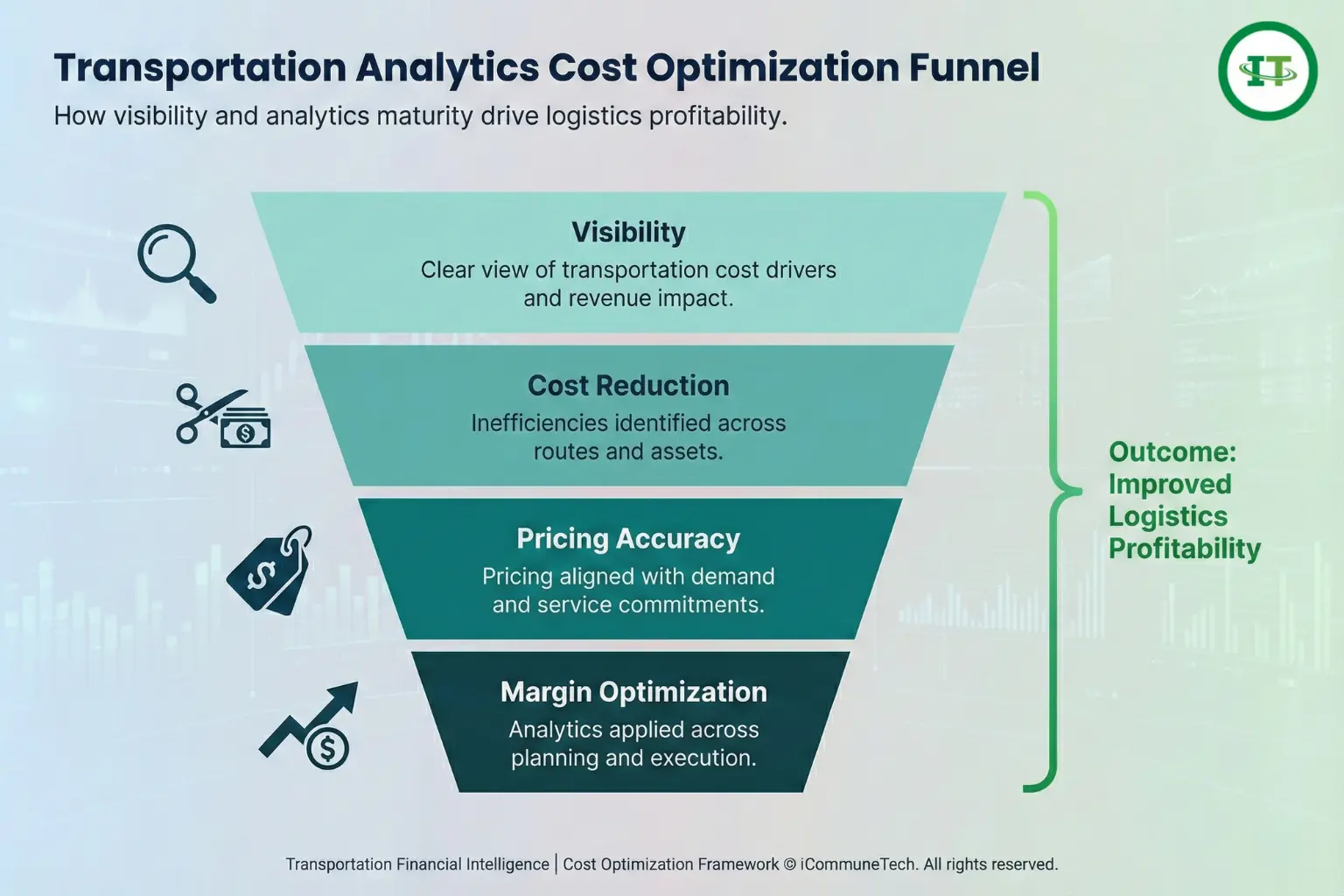
- Improving logistics margins depends on clear visibility into transportation cost drivers and the revenue impact of routing, capacity, and delivery decisions.
- Transportation analytics enables cost reduction by identifying inefficiencies across routes, assets, and operational processes.
- Accurate insights support pricing analytics that reflect service levels, demand patterns, and delivery commitments.
- Consistent application of analytics insights across planning and execution workflows supports margin optimization while maintaining operational efficiency and service performance.
What Use Cases and Specialized Studies Demonstrate the Value of Transportation Analytics?
Practical validation of transportation analytics comes from applied results in live logistics and freight operations. Transportation analytics use cases show how data-driven approaches perform in live operations, including freight analytics across high-volume logistics environments. Industry studies highlight analytics applications across rail visibility, truck visibility, and yard operations.
These industry applications demonstrate measurable improvements in coordination, execution accuracy, and risk mitigation under real operating conditions.
How Do Truck Studies and Freight Analytics Applications Improve Transportation Operations?
Freight analytics evaluates freight-intensive operations by analyzing shipment volumes, route patterns, asset utilization, and dwell time data to identify performance constraints and optimization opportunities.
The following studies illustrate how freight analytics is applied across trucking operations:
| Study Focus | Data Analyzed | Analytics Outcome |
|---|---|---|
| Network and Lane Performance | Shipment volumes, routes, and dwell time | Supports freight optimization across high-density corridors |
| Load Utilization | Trailer capacity, shipment mix | Improves load planning and reduces empty miles |
| Operational Performance | Delivery times, safety events, fuel usage | Tracks trucking KPIs within transportation analytics use cases |
How Does Transportation Analytics Improve Safety and Predictive Risk Mitigation?
Transportation safety outcomes improve when operational risks across fleets, routes, and driver behavior are measured, monitored, and addressed before incidents occur. Transportation analytics extends visibility into driver behavior, asset conditions, and operating environments to support proactive risk mitigation. These insights reduce operational exposure, lower incident frequency, and support insurance cost control while strengthening compliance and workforce safety.
Key safety-focused transportation analytics applications include the following:
- Fleet safety monitoring to identify unsafe driving patterns and high-risk routes
- Risk prediction models that flag potential incidents before they escalate
- Incident prevention through early alerts, corrective actions, and policy enforcement
How Do Traditional and Modern Methods Differ in Transportation Analytics?
Earlier approaches relied on static reports, delayed data, and manual interpretation. Modern transportation analytics replaces legacy, rule-based systems with automated, adaptive models that support real-time decision-making.
The shift from manual to automated analytics enables real-time visibility, faster response, and continuous optimization across transportation operations. Modern methods support timely decisions, reduce human error, and align transportation operations with live conditions rather than historical assumptions.
How Do Modern and Traditional Approaches to Transportation Analytics Compare?
Modern transportation analytics distinguishes SaaS platforms by enabling faster, adaptive, and data-driven transportation decision-making.
The following comparison highlights the operational differences between traditional and modern transportation analytics approaches:
| Approach Type | Traditional Analytics | Modern Analytics |
|---|---|---|
| Processing Model | Static reports and delayed analysis | AI-driven analytics with continuous learning |
| Data Availability | Periodic, historical datasets | Real-time systems using live operational data |
| Competitive Impact | Limited responsiveness | Strong differentiation through speed, accuracy, and scalability in transportation analytics |
What Key Trends Are Shaping the Evolution of Logistics Analytics?
- Transportation analytics is evolving toward faster, adaptive decision-making driven by automation and real-time intelligence.
- AI-driven analytics enables autonomous planning, predictive execution, and reduced reliance on manual intervention.
- Autonomous logistics expands automation across routing, fleet control, and warehouse coordination.
- Real-time intelligence enables continuous visibility, faster response, and system-wide optimization.
- Sustainability and resilience requirements shape analytics roadmaps and long-term logistics strategy decisions.
How Does iCommuneTech Helps You Integrate Transportation Data Analytics?
iCommuneTech enables organizations to deploy real-time transportation analytics as operational decision-support systems. Its approach integrates data, systems, and analytics into usable solutions that support daily transportation decisions and long-term performance goals.
Key transportation analytics integration capabilities provided by iCommuneTech include:
- Delivering real-time insights across planning, execution, and monitoring workflows through integrated transportation analytics platforms.
- Supporting end-to-end analytics implementation aligned with operational needs
- Enabling secure data integration across platforms, partners, and external systems
Conclusion
Transportation operations are shifting from static planning cycles to analytics-driven execution. As shipment volumes increase and route conditions change in real time, performance depends on speed. This execution speed reflects how quickly planners and operators act on validated analytical insights.
Organizations now use transportation analytics as a continuous decision layer. This layer supports routing, capacity planning, and exception handling. Progress depends less on expanding data collection alone and more on building transportation analytics systems that handle operational complexity, regulatory requirements, and sustainability targets within daily workflows. It depends more on building transportation analytics systems that handle operational complexity, regulatory requirements, and sustainability targets within daily workflows.
Ready to turn transportation analytics into measurable operational outcomes?
See how iCommuneTech helps organizations unify transportation data, improve operational visibility, and deploy analytics across logistics networks.
Request a demo today
Irshad Pathan


Web Development Expert
Irshad is a senior technical expert at iCommuneTech. He manages the iCommuneTech's Web Development Team, and has hands-on expertise in web development, Laravel development, Logistics, fleet management, and Supply Chain Management. He mentors the in-house team and enjoys describing his experience in words.
Read More Insights By Irshad →