eProcurement uses digital procurement workflows to manage purchasing, approvals, supplier management, invoice validation, and spend control across the procure-to-pay lifecycle. It replaces manual procurement processes with centralized workflows that improve spend visibility, procurement compliance, policy enforcement, and purchasing efficiency.
For transport, logistics, and supply chain enterprises, eProcurement strengthens supplier management, accelerates purchase approvals, reduces processing costs, and improves coordination between procurement, inventory, finance, and ERP systems. It supports scalable procurement governance through automation, analytics, audit-ready reporting, and real-time transaction visibility.
What Is eProcurement and What Does It Mean in Modern Business?
eProcurement uses digital procurement platforms to manage purchasing, approvals, supplier management, invoice validation, and spend control across the procure-to-pay lifecycle. It replaces fragmented emails, spreadsheets, and manual approvals processes with automated workflows, centralized procurement data, and policy-driven purchase control.
For transport and logistics enterprises, eProcurement improves spend visibility, supplier performance management, approval governance, and procurement cycle efficiency across warehouses, distribution networks, and distributed operations. As part of broader procurement digitization initiatives, it supports workflow automation, compliance management, and scalable purchasing control through standardized procurement workflows, procurement analytics, and real-time transaction tracking.
How Does eProcurement Work in Digital Procurement?
eProcurement replaces manual purchasing coordination with system-driven procurement workflows that manage requisitions, approvals, purchasing transactions, and supplier interactions across the procure-to-pay lifecycle.
It centralizes key procurement activities, including:
- Purchase requisitions
- Approval workflows
- Supplier communication
- Purchase order processing
- Invoice validation
- Payment records
The objective is to standardize procurement operations through automated workflows, purchasing controls, and stronger financial governance.
Comparison: Traditional vs eProcurement
| Traditional Procurement | eProcurement |
|---|---|
| Paper forms and emails | Digital requisition workflows |
| Manual approval follow-ups | Automated approval routing |
| Disconnected supplier coordination | Centralized supplier management |
| Spreadsheet-based tracking | Real-time procurement visibility |
| Limited audit traceability | Structured audit logs |
Traditional procurement depends on manual coordination. eProcurement uses predefined workflows, automated controls, and centralized transaction management.
Digitization improves procurement through three core capabilities:
- Standardization: Requests follow predefined approval structures, purchasing policies, and compliance requirements.
- Automation: Approvals, notifications, purchase orders, and procurement workflows execute automatically with minimal manual intervention.
- Visibility: Procurement transactions remain centralized, traceable, and audit-ready.
What Procurement Challenges Does eProcurement Solve?
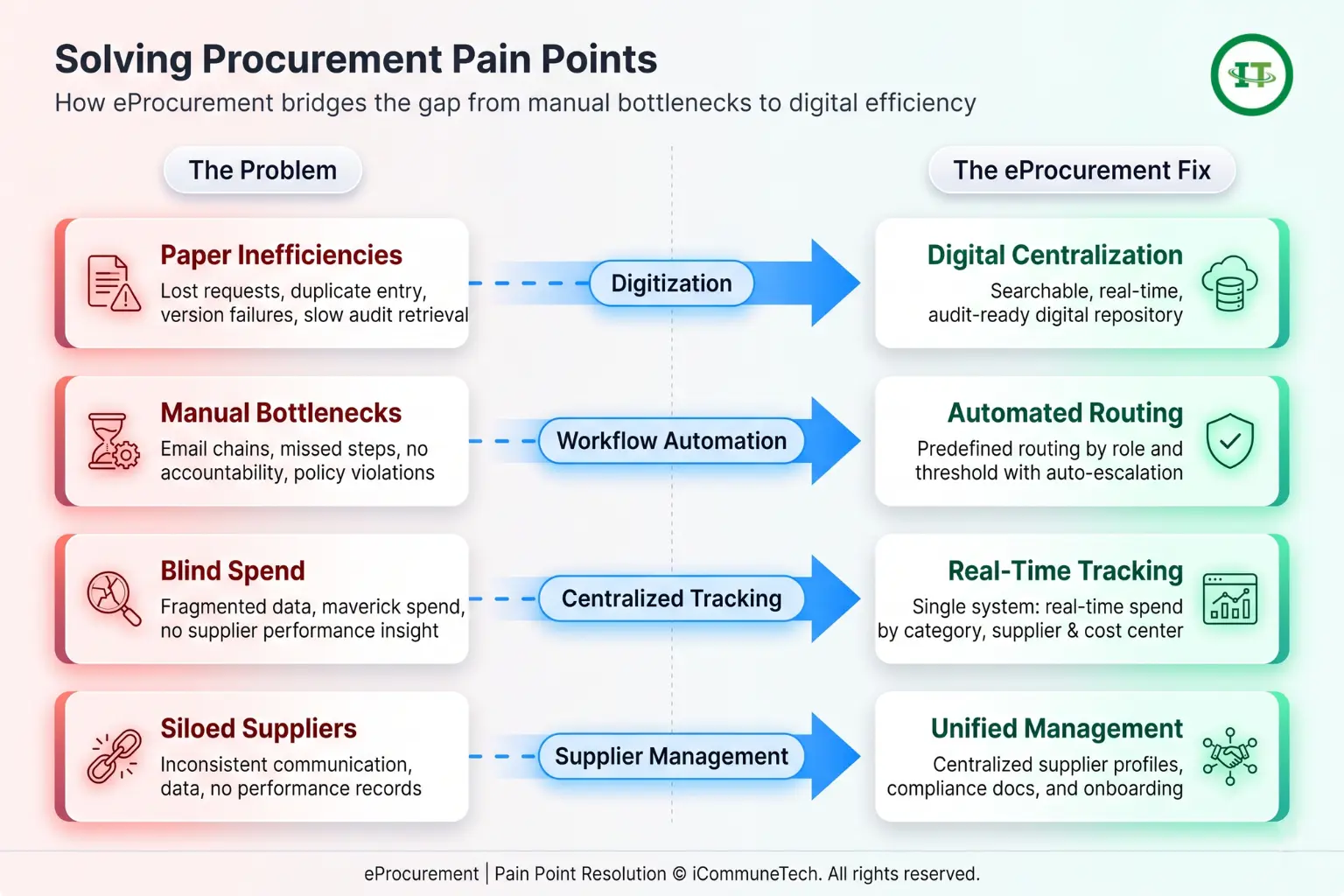
1. Paper-Based Inefficiencies
Manual procurement processes depend on paper forms, emails, spreadsheets, and disconnected approval records.
Common issues include:
- Lost or incomplete purchase requests
- Duplicate data entry across systems
- Version control problems
- Slow document retrieval during audits
eProcurement eliminates physical documentation by digitizing purchase requisitions, purchase orders, invoices, and supporting procurement records. Procurement information is stored in a centralized repository where records can be searched, retrieved, and audited in real time.
2. Manual Approval Bottlenecks
In traditional procurement, approvals often rely on email chains, verbal confirmation, or manual follow-up between departments. This often creates:
- Delayed approval responses
- Missed approval steps
- Procurement Policy violations
- Lack of accountability and approval traceability
eProcurement platforms use predefined approval workflows. Requests are routed automatically based on user role, department, purchasing category, or spend threshold. Escalations, reminders, and notifications are system-driven, reducing dependency on manual follow-up and approval chasing.
3. Lack of Spend Visibility
Without centralized procurement tracking, organizations struggle to understand where money is being spent, which suppliers receive the most spend, and where purchasing inefficiencies exist.
Typical challenges include:
- Fragmented spend data across multiple systems
- Limited spend reporting accuracy
- Difficulty identifying maverick or unauthorized spend
- Inability to analyze supplier performance and purchasing trends
eProcurement consolidates transaction data into a single system that supports structured spend reporting.
How Do Procurement Experts and Industry Standards Define eProcurement?
Procurement bodies, industry analysts, and standards organizations define eProcurement as a technology-driven approach to managing procurement through standardized digital workflows, automated controls, and centralized transaction management.
Organizations such as CIPS, Gartner, and ISO consistently highlight workflow automation, procurement governance, spend visibility, compliance controls, and process standardization as core components of modern eProcurement systems.
What do procurement associations and analysts say?
Leading procurement bodies and analysts define eProcurement as a technology-enabled approach to managing procurement activities across the procure-to-pay lifecycle through standardized digital workflows.
Perspectives from Major Authorities
- CIPS emphasizes procurement automation, process control, and policy alignment.
- Gartner positions eProcurement within broader source-to-pay transformation, focusing on workflow automation, spend visibility, and ERP integration.
- ISO approaches eProcurement from a governance perspective, emphasizing standardization, auditability, and compliance controls.
Common Principles
- Digital procurement workflows
- Automated purchasing coordination
- Financial and compliance governance
Areas of Variation
- The scope between sourcing and purchasing
- ERP and financial system integration depth
- Governance versus efficiency focus
Despite differences in terminology and scope, industry standards consistently position eProcurement as a foundation for procurement control, spend visibility, compliance management, and operational standardization across the procure-to-pay lifecycle.
What common attributes appear across definitions?
Across analyst reports, procurement standards, and industry frameworks, three core attributes consistently define eProcurement systems.
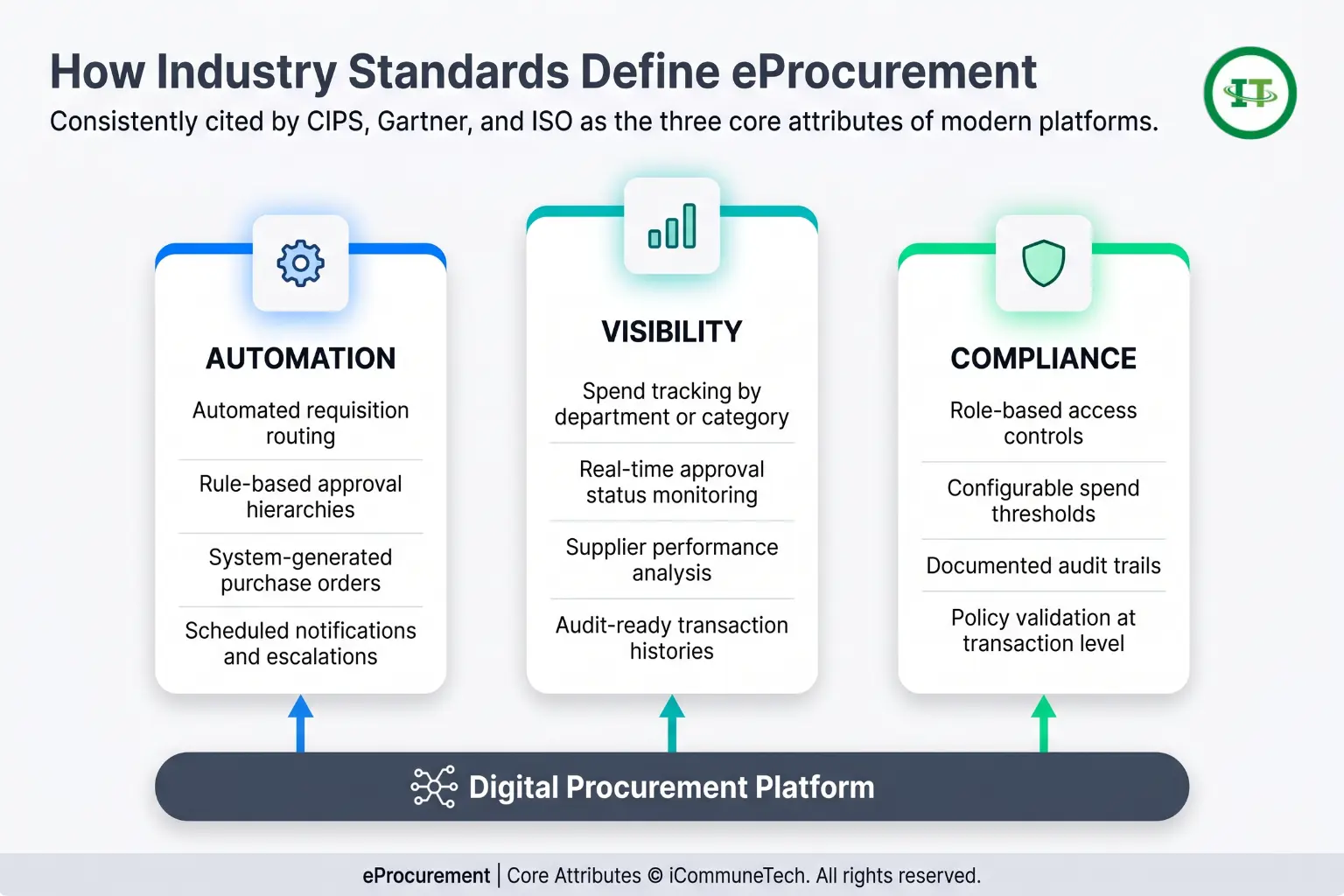
1. Automation
Digital procurement replaces manual coordination with system-driven workflows.
Common automation capabilities include:
- Automated requisition routing
- Rule-based approval hierarchies
- System-generated purchase orders
- Scheduled notifications and escalations
Automation standardizes transaction routing through predefined workflow rules.
2. Visibility
eProcurement platforms centralize transaction data to provide real-time insight into purchasing activity.
This visibility enables:
- Spend tracking by department or category
- Monitoring of approval status
- Supplier performance analysis
- Audit-ready transaction histories
Centralized data consolidates reporting records into a single dataset, enabling accurate spend analysis and financial oversight.
3. Compliance
Industry definitions consistently link eProcurement to governance and policy enforcement.
Compliance mechanisms typically include:
- Role-based access controls
- Configurable approval thresholds
- Documented audit trails
- Policy validation during transaction processing
Embedded compliance rules align transactions with defined internal control frameworks by validating approvals, enforcing spend thresholds, and logging audit trails.
What Are the Major Components of an eProcurement System?
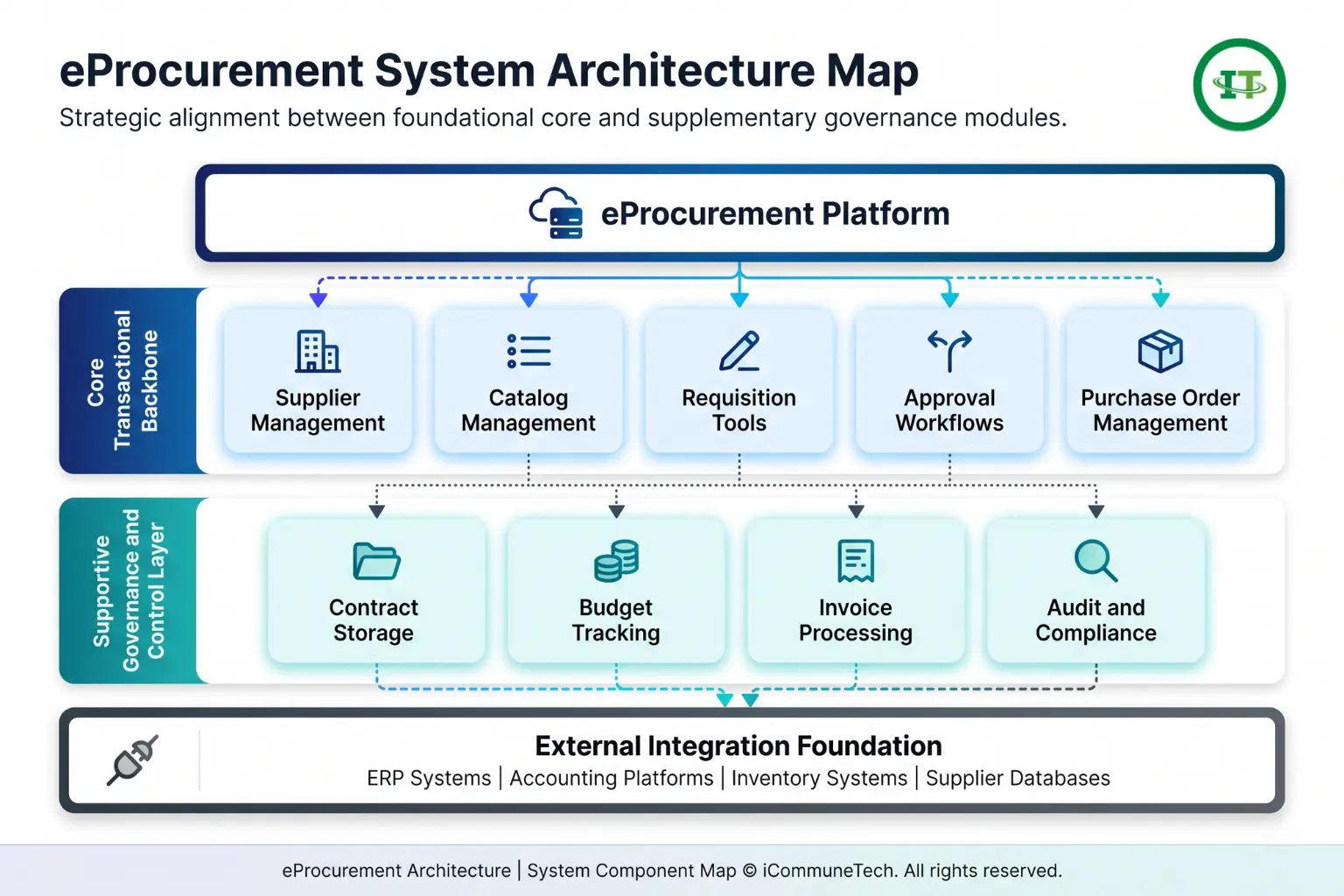
An eProcurement system consists of interconnected modules that manage purchasing activities across the procure-to-pay lifecycle through shared workflows, centralized data management, and automated transaction controls.
Core components include:
- Supplier management
- Digital catalogs
- Requisition management
- Approval workflows
- Purchase order processing
These modules streamline procurement transaction flow from requisition creation to financial recording while reducing duplicate data entry, manual intervention, and process delays. Modern eProcurement platforms also include governance, compliance, budget management, and financial control capabilities that support standardized procurement operations, policy-driven execution, and audit readiness.
Core structural modules
An eProcurement platform is built around foundational modules that manage day-to-day purchasing activities. These modules form the transactional backbone of the procure-to-pay workflow.
1. Supplier Management
Manages supplier profiles and qualification data.
Key capabilities:
- Supplier registration and onboarding
- Storage of compliance documents
- Categorization by product or service type
- Performance tracking references
This module restricts transactions to approved supplier records.
2. Catalog Management
Organizes goods and services into searchable digital catalogs.
Includes:
- Standardized product listings
- Pre-negotiated pricing
- Category-based classification
- Real-time updates to availability or pricing
Digital catalogs reduce off-contract purchasing and improve pricing consistency.
3. Requisition Tools
Enable employees to submit structured purchase requests.
Core functions:
- Online requisition forms
- Line-item detail entry
- Cost center allocation
- Attachment of supporting documents
Requisition tools initiate the formal procurement workflow.
4. Approval Workflows
Route requests through predefined authorization paths.
Capabilities include:
- Role-based approval hierarchies
- Spend threshold rules
- Automated notifications
- Escalation logic
Approval workflows enforce internal policies and financial controls.
5. Purchase Order Management
Generates and tracks purchase orders after approval.
This module supports:
- Automated PO creation from approved requisitions
- Supplier dispatch
- Status tracking
- Record storage for audit purposes
Purchase order management records, supplier commitments, and interfaces with financial systems.
Supportive modules
Beyond core transaction handling, eProcurement platforms include supportive modules that strengthen financial control, governance, and operational oversight. These modules enhance the stability and reliability of the overall system.
1. Contract Storage
Centralizes procurement contracts in a structured repository.
Key functions:
- Secure storage of supplier agreements
- Version control and amendment tracking
- Expiry date alerts
- Role-based access permissions
Centralized contract storage links purchasing records to negotiated agreements.
2. Budget Tracking
Connects procurement activity to financial limits.
This module enables:
- Real-time budget validation during requisition creation
- Cost center monitoring
- Spend threshold alerts
- Department-level reporting
Budget tracking validates transactions against predefined financial limits.
3. Invoice Processing
Manages supplier invoice handling within the procure-to-pay workflow.
Core capabilities include:
- Digital invoice capture
- Matching against purchase orders and receipts
- Discrepancy identification
- Approval routing for payment authorization
4. Audit and Compliance
Provides governance controls and traceability across procurement transactions.
Common controls include:
- Activity logs and transaction history
- Policy validation checks
- Segregation of duties enforcement
- Exportable audit reports
These mechanisms document procurement transactions within defined regulatory and internal frameworks.
What Core Functions and Capabilities Should an eProcurement Platform Provide?
An effective eProcurement platform should support procurement operations, financial control, compliance, and spend governance across the procure-to-pay lifecycle.
Core capabilities include:
- Automated workflows
- Spend analytics and reporting
- Compliance controls
- Supplier performance evaluation
Workflow automation streamlines approvals, purchase order generation, notifications, and procure-to-pay tracking, reducing manual effort and improving traceability.
Spend visibility tools provide real-time dashboards, transaction-level insights, supplier reporting, and maverick spend identification to support budgeting and financial oversight.
Compliance features such as role-based access, spend-threshold approvals, policy validation, segregation of duties, and audit logs strengthen governance and reduce operational risk.
Supplier evaluation tools help monitor supplier performance, pricing, delivery, compliance, and procurement risk to support sourcing decisions and long-term reliability.
How Does the eProcurement Process Work?
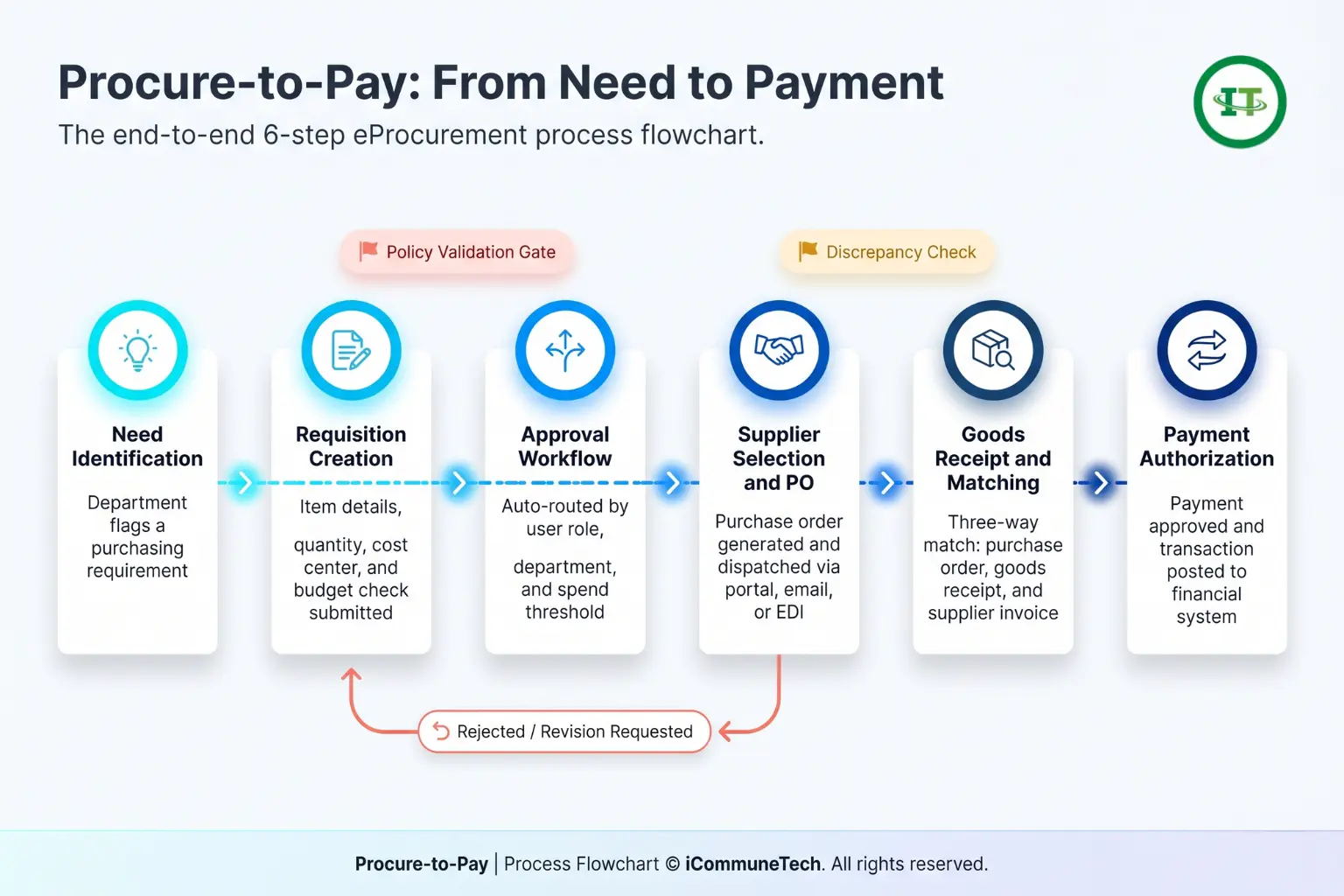
The eProcurement process standardizes purchasing through automated workflows and centralized transaction management.
A typical process includes:
- Requirement identification
- Purchase requisition creation
- Approval workflow execution
- Supplier selection and purchase order issuance
- Goods receipt and invoice matching
- Payment authorization
Need identification and requisition creation
Departments submit digital requisitions containing item details, quantity, cost estimates, supplier references, cost-center allocation, and delivery timelines. The system validates purchasing policies and budget availability before approval routing.
Requisition approval workflow
Automated workflows route requisitions based on department, spend threshold, cost center, purchasing category, or approval hierarchy. Actions include approval, rejection, or modification requests.
Supplier selection and purchase order creation
Organizations evaluate suppliers, pricing, delivery commitments, and commercial terms before generating and dispatching purchase orders through supplier portals, email, or electronic data exchange.
Goods receipt, invoice matching, and payment
After delivery, goods receipts are matched with purchase orders and supplier invoices before payment authorization and transaction recording.
How Do eProcurement Platforms Integrate With ERP and Enterprise Systems?
eProcurement platforms integrate with ERP, accounting, inventory, and supplier management systems to maintain financial accuracy, procurement visibility, and operational consistency.
Integration typically connects:
- ERP systems for financial posting
- Accounting platforms for ledger synchronization
- Inventory systems for stock validation
- Supplier databases for master data management
Data synchronization is enabled through APIs, middleware, or native connectors that exchange supplier records, purchase orders, budget allocations, invoices, payment status, and procurement master data between systems.
Effective integration reduces duplicate entries, improves reconciliation accuracy, maintains master data integrity, and supports real-time procurement operations across finance, procurement, inventory, and supplier management systems.
Types of integrations (API, middleware, native)
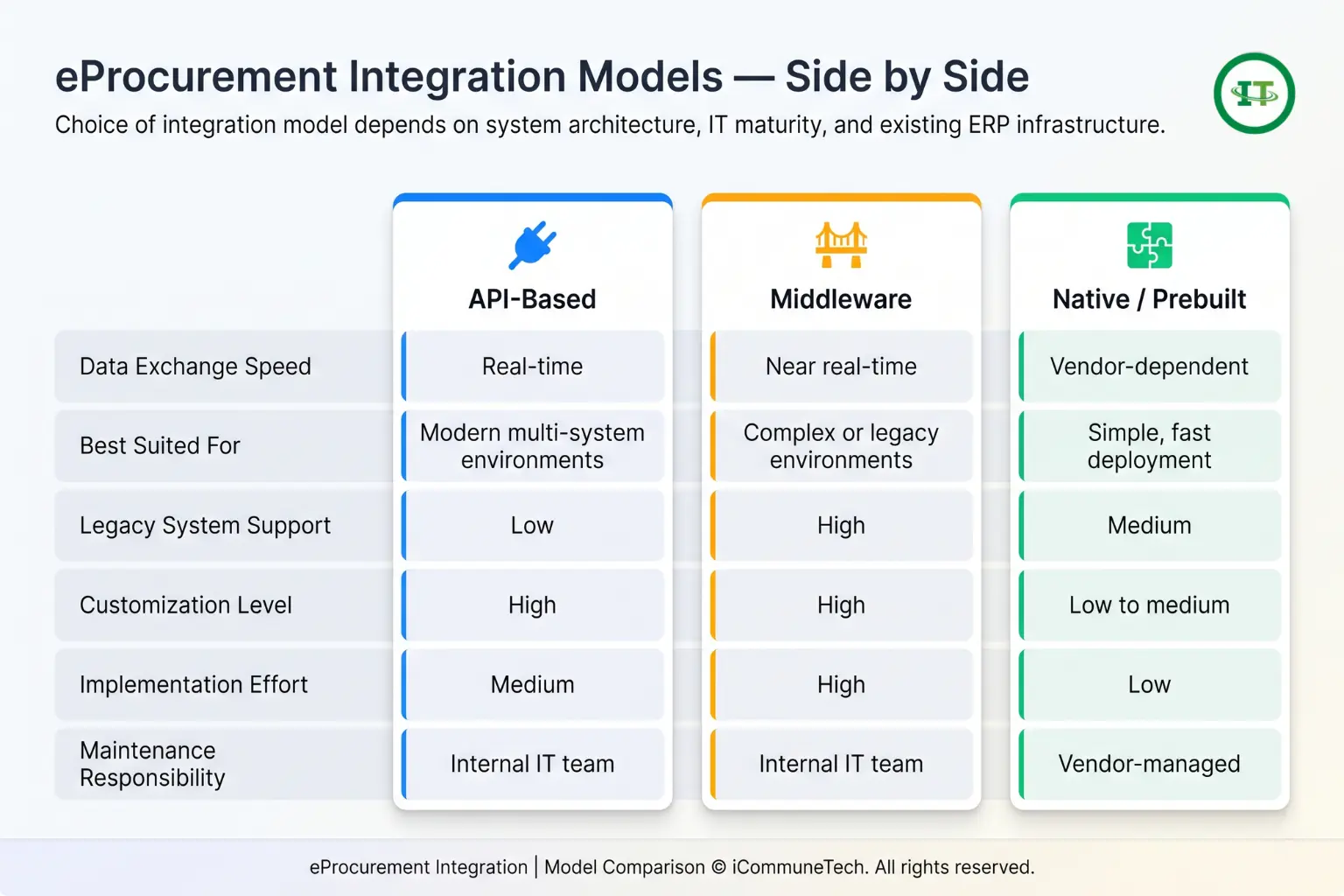
eProcurement platforms connect with ERP and enterprise applications through different integration models. The choice depends on system architecture, scalability needs, and IT maturity.
1. API-Based Integration
Application Programming Interfaces (API) enable direct system-to-system communication between eProcurement platforms and connected enterprise systems.
Typical characteristics:
- Real-time data exchange
- Standardized request and response formats
- Secure authentication mechanisms
- Scalable connectivity for multiple systems
APIs are commonly used to synchronize purchase orders, invoices, supplier records, and payment status between platforms.
2. Middleware Integration
Middleware acts as an intermediary layer between systems.
It is used to:
- Transform data formats
- Route information between multiple applications
- Orchestrate complex integration workflows
- Connect legacy systems that lack modern interfaces
Middleware is often selected when enterprises operate multiple applications, legacy platforms, or complex technology environments that require structured data mediation.
3. Native Integration
Native integration relies on prebuilt connectors provided by software vendors.
Common features include:
- Pre-configured ERP connectors
- Standardized data mapping
- Simplified deployment
- Vendor-supported maintenance
Native integrations reduce implementation effort and deployment complexity but may offer limited customization compared to API-driven approaches.
Each integration type enables data synchronization and master data alignment across systems.
Benefits of integration
Integration connects procurement data with financial and operational systems. Without integration, procurement and finance operate in parallel rather than as a unified process.
Key benefits include:
- Accurate financial posting
- Real-time data synchronization
- Improved reporting consistency
- Faster reconciliation cycles
- Stronger master data integrity
Integration links procurement transactions to financial reporting structures, ensuring that purchase orders and invoices post accurately to the general ledger. From a technical standpoint, it maintains system coherence and supports scalable enterprise operations.
Common integration challenges
Integrating eProcurement tools with ERP and enterprise systems introduces technical and operational complexity. Poor integration design can create data inconsistencies and workflow disruptions.
Common challenges include:
-
Master data misalignment
Supplier records, cost centers, or account codes may differ across systems. -
Data mapping errors
Inconsistent field structures can lead to incorrect financial postings. -
Latency in data synchronization
Delayed updates create reporting discrepancies between procurement and finance. -
Legacy system limitations
Older ERP platforms may lack modern API capabilities. -
Security and access control gaps
Weak authentication mechanisms increase compliance risk.
Successful integration requires defined data governance, coordinated system configuration, clear ownership of master data, and ongoing integration monitoring.
What Types of eProcurement Solutions and Software Options Are Available?
Organizations can choose eProcurement solutions based on operational scale, IT strategy, integration requirements, and procurement complexity. Options range from cloud-based SaaS platforms to fully on-premise procurement systems, depending on governance, security, and customization requirements.
Solutions differ across:
- Deployment model
- Functional scope
- Organization size
- ERP and system integration depth
- Customization and scalability
Some platforms prioritize rapid deployment and standardized workflows, while others provide deeper configuration control, enterprise governance, and industry-specific customization capabilities.
Cloud vs on-premise platforms
| Criteria | Cloud (SaaS) eProcurement | On-Premise eProcurement |
|---|---|---|
| Deployment model | Vendor-hosted cloud platform | Internally hosted infrastructure |
| Implementation speed | Faster deployment | Longer deployment |
| Upgrades and maintenance | Vendor-managed updates | Internal IT-managed updates |
| Scalability | Easily scalable | Requires infrastructure expansion |
| Customization flexibility | Configuration-based customization | Deep customization control |
| Upfront cost | Lower subscription-based cost | Higher infrastructure investment |
| IT dependency | Lower IT dependency | Higher IT dependency |
| Data control | Vendor-managed security | Full internal data control |
Cloud platforms reduce infrastructure management requirements and accelerate deployment, while on-premise solutions provide greater control over infrastructure, customization, and data governance.
Modular vs end-to-end suites
| Criteria | Modular eProcurement Solutions | End-to-End Procurement Suites |
|---|---|---|
| Functional scope | Specific procurement modules | Full procure-to-pay coverage |
| Implementation approach | Phased module rollout | Enterprise-wide deployment |
| Flexibility | Flexible component selection | Standardized procurement workflows |
| Integration complexity | Requires external integration | Built-in suite integration |
| Customization | Module-level customization | Broader system-level customization |
| Cost structure | Lower initial investment | Higher consolidated investment |
| Best suited for | Incremental modernization | Unified enterprise procurement |
Modular solutions allow phased implementation of procurement modules. End-to-end suites consolidate procurement modules within a single platform.
Which eProcurement Tools Are Essential for Modern Procurement Teams?
Modern procurement teams use specialized digital tools to manage sourcing, spend control, contract governance, and supplier risk.
Essential eProcurement tools support:
- eRFQ and eTendering
- Spend analytics
- Contract lifecycle management
- Supplier risk monitoring
These tools strengthen sourcing strategy, procurement visibility, compliance control, and supplier performance management across the procurement lifecycle.
eRFQ and eTendering tools
These tools manage digital quotations and tender workflows, enabling standardized supplier responses, bid comparison, and evaluation-based sourcing decisions.
Spend analytics platforms
Spend analytics platforms consolidate procurement data to track spending patterns, supplier performance, and cost-saving opportunities.
Contract lifecycle management tools
Contract management tools centralize contract creation, approvals, storage, renewals, and procurement-linked agreement tracking.
Supplier risk management systems
Supplier risk platforms monitor vendor performance, compliance exposure, and operational risk across procurement networks.
How Is eProcurement Used in Real-World Industries?
eProcurement improves purchasing control, supplier management, compliance, and spend visibility across industries with complex procurement operations.
Industries such as manufacturing, healthcare, construction, government, and retail use eProcurement to standardize procurement workflows, reduce manual processing, improve supplier governance, and strengthen financial oversight.
Manufacturing
- Manufacturers use eProcurement to manage high-volume purchasing of raw materials and components.
- Automated supplier selection and purchase order workflows improve procurement speed.
- Real-time spend tracking supports material cost control.
Healthcare
- Healthcare procurement requires strict compliance and uninterrupted medical supply coordination.
- eProcurement enforces approval controls and audit-ready documentation.
- Centralized supplier records improve contract and delivery management.
Construction
- Construction firms manage decentralized purchasing across projects and contractors.
- eProcurement connects requisitions with budget and approval controls.
- Digital PO workflows improve supplier and finance coordination.
Government
- Public-sector procurement requires transparency, compliance, and controlled tendering.
- eProcurement supports structured eTendering and evaluation workflows.
- Compliance logs maintain audit traceability.
Retail and eCommerce
- Retail and eCommerce operations require rapid supplier coordination and inventory replenishment.
- eProcurement supports automated purchasing and supplier performance tracking.
- Spend analytics improve category-level procurement visibility.
Why Does eProcurement Matter for Transparency, Savings, and Efficiency?
eProcurement improves procurement governance through centralized transaction visibility, approval controls, and automated workflows.
Digitized procurement operations strengthen spend control, reduce processing errors, improve policy compliance, and accelerate procure-to-pay execution by replacing manual procurement activities with standardized digital workflows.. Structured reporting also enables measurable tracking of spend, supplier performance, approval cycle times, policy adherence, and compliance metrics.
How does transparency improve procurement governance?
Centralized eProcurement platforms record requisitions, approvals, purchase orders, invoices, and payments within a traceable audit framework.
This visibility reduces maverick spend, strengthens policy enforcement, and improves accountability across departments and cost centers.
Where do savings actually come from?
Procurement savings typically come from spend standardization, contract compliance, reduced manual processing, supplier consolidation, and improved purchasing discipline.
Automated workflows minimize duplicate payments, administrative overhead, and uncontrolled purchasing while improving sourcing leverage, supplier negotiations, and cost optimization through spend analytics.
How do digital workflows reduce cycle time?
Digital workflows automate requisition routing, approvals, notifications, purchase order processing, and transaction tracking. Automated escalation rules, workflow notifications, and real-time status tracking reduce approval delays, eliminate manual follow-up, and accelerate the procure-to-pay cycle.
How Does eProcurement Improve Cost Savings and Operational Efficiency?
eProcurement improves procurement performance by reducing manual effort, enforcing spend control, and accelerating the procure-to-pay cycle.
Industry research highlights measurable impact:
- Up to 60% reduction in procurement operational costs through workflow automation and process digitization.
- Up to 50% improvement in operational efficiency through advanced procurement automation adoption.
These gains come from:
- Eliminating manual approval chasing
- Reducing invoice processing errors
- Standardizing supplier and pricing controls
- Accelerating requisition-to-order conversion
Automation applies predefined routing, approval, and validation rules across procurement workflows. As a result, procurement shifts from a transaction-heavy administrative function to a controlled, efficiency-driven business function that supports cost management, governance, and operational efficiency.
Reduction in manual labor and errors
Automation replaces manual approvals, repetitive data entry, and spreadsheet-based reconciliation with system-driven procurement workflows. Structured requisitions, invoice validation, and three-way matching reduce duplicate payments, pricing errors, and administrative workload while improving transaction accuracy.
Better supplier pricing
Centralized spend visibility and structured eRFQ workflows improve supplier negotiations, contract compliance, and volume-based pricing consistency while reducing maverick spend.
Faster approvals and cycle times
Automated approval workflows, notifications, and escalation rules accelerate requisition routing and reduce procure-to-pay cycle time.
How Does eProcurement Improve Transparency, Data Security, and Risk Management?
eProcurement systems improve procurement governance through centralized transaction visibility, role-based access control,compliance monitoring, and audit traceability.
Structured workflows, approval controls, supplier validation processes, and audit logs reduce financial risk, unauthorized purchasing, and compliance exposure while maintaining operational accountability.
Access controls and user permissions
- Role-based permissions restrict procurement actions by user responsibility and spending authority.
- Approval hierarchies enforce policy compliance and spending controls.
- Controlled access reduces unauthorized transactions and internal risk.
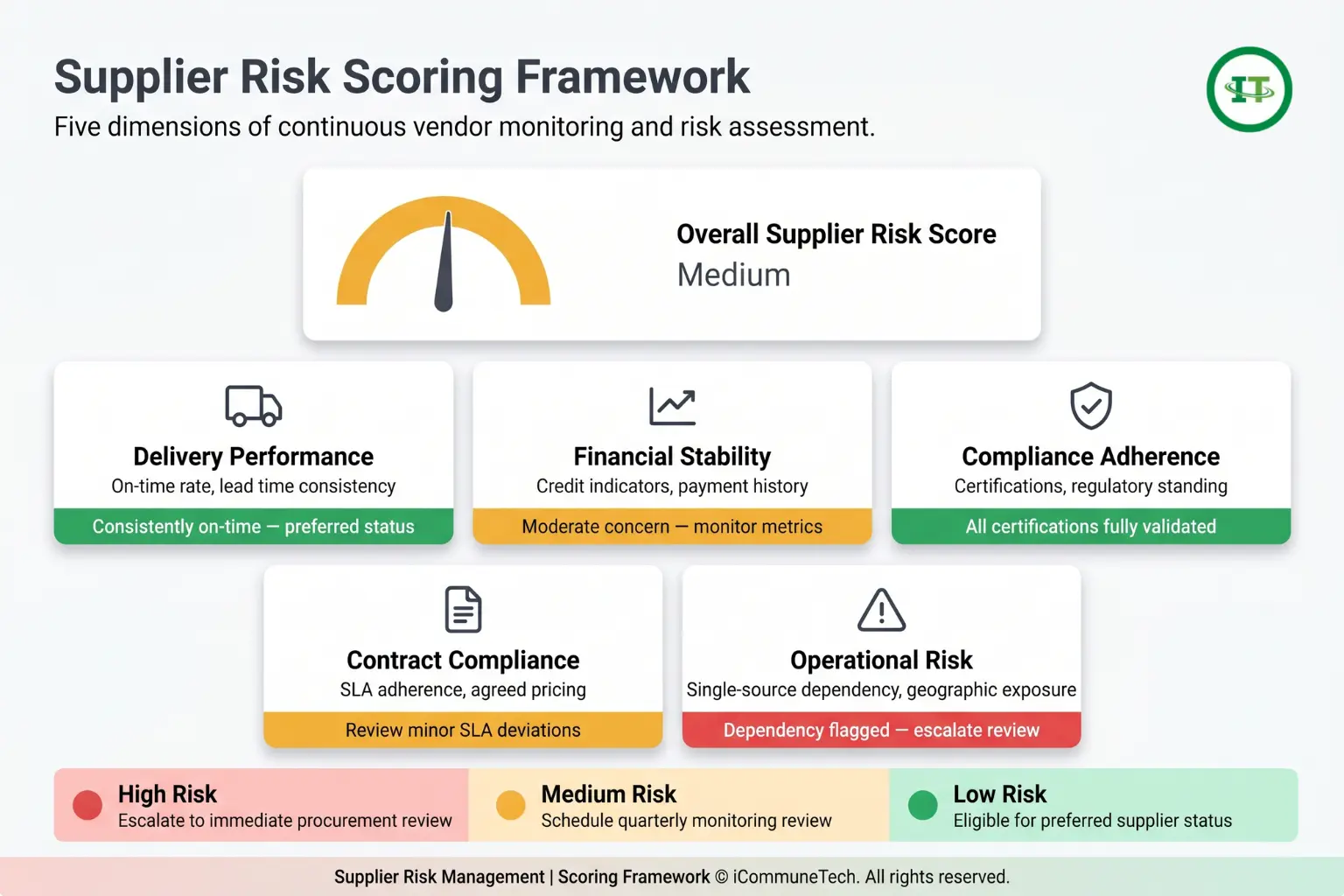
Supplier risk scoring
- Supplier risk scoring evaluates vendor performance, compliance, and operational reliability.
- Historical delivery and contract data support supplier assessment.
- Continuous monitoring identifies financial, compliance, and supply risks.
Fraud detection and audit trails
- Centralized logs record requisitions, approvals, invoices, and payments.
- Automated validation detects duplicate invoices and abnormal spending activity.
- Audit trails support compliance reviews and regulatory inspections.
What Steps Are Required to Successfully Implement eProcurement?
Successful eProcurement implementation requires alignment between procurement processes, system capabilities, governance controls, and organizational objectives before deployment.
A typical implementation includes:
- Assessing procurement workflows and data readiness
- Defining functional and integration requirements
- Selecting a scalable procurement solution
- Configuring workflows, approvals, and user roles
- Migrating supplier and financial master data
- Conducting pilot testing before enterprise rollout
Phased deployment, controlled validation, structured data migration, and stakeholder training reduce implementation risk and improve user adoption.
Pre-implementation assessment
- Step 1: Map current procurement workflows and approval hierarchies.
- Step 2: Identify manual bottlenecks, policy gaps, and compliance risks.
- Step 3: Audit supplier, cost center, and master data quality.
- Step 4: Define measurable success metrics such as cycle time reduction and spend control.
Selecting solutions
- Step 1: Define functional requirements across the procure-to-pay lifecycle.
- Step 2: Evaluate integration capability with ERP and financial systems.
- Step 3: Compare deployment models, scalability, and security standards.
- Step 4: Assess total cost of ownership and long-term platform fit.
Configuration and customization
- Step 1: Configure approval workflows and spend thresholds.
- Step 2: Set up user roles and access permissions.
- Step 3: Align supplier profiles, catalogs, and budget controls.
- Step 4: Customize reporting dashboards and compliance logs.
Testing and pilot rollouts
- Step 1: Perform system validation and workflow testing.
- Step 2: Conduct controlled data migration and integrity checks.
- Step 3: Launch a limited pilot deployment.
- Step 4: Gather feedback, refine configurations, and prepare for full rollout.
How Can Businesses Create an eProcurement Strategy Aligned With Their Goals?
An effective eProcurement strategy aligns procurement workflows, governance controls, technology capabilities, and procurement objectives with measurable business outcomes such as cost reduction, operational efficiency, supplier performance, risk management, and compliance.
Organizations should align procurement strategy with:
- Financial targets
- Risk management priorities
- Cycle-time optimization
- Compliance and governance standards
Performance metrics typically track cost savings, approval efficiency, supplier performance, and policy compliance.
Identifying procurement objectives
Organizations should define procurement goals around cost control, procurement speed, compliance, supplier performance, and risk reduction to align purchasing operations with business priorities.
Procurement objectives should be specific, measurable, and linked to outcomes such as lower procurement costs, faster approvals, improved contract compliance, or reduced supplier risk.
Aligning processes with KPIs
Procurement workflows should map directly to KPIs such as approval cycle time, contract compliance, cost savings, and user adoption.
Governance and internal controls
Role-based approvals, spend thresholds, and audit logs enforce procurement governance, financial discipline, and policy compliance.
How Do You Measure the Effectiveness and ROI of eProcurement?
Measuring eProcurement performance requires tracking operational efficiency, procurement control, user adoption, and financial impact through defined KPIs.
Key metrics include cost savings, compliance rates, procurement cycle time, and user adoption. These indicators measure workflow efficiency, policy adherence, procurement performance, and the overall effectiveness of procurement automation initiatives..
ROI is calculated by comparing implementation and operational costs against savings generated through automation, pricing optimization, reduced processing errors, and improved procurement efficiency.
Key KPIs to track
- Cost savings: Reduction in procurement processing costs and improved supplier pricing.
- Compliance rate: Percentage of purchases aligned with approved suppliers and policies.
- Cycle time: Average time from requisition to purchase order issuance.
- User adoption: Percentage of employees actively using the platform.
Calculating ROI
ROI measures financial return relative to total investment.
When annual savings equal $500,000 and system costs total $200,000, ROI is calculated as follows:
This indicates the system generates 1.5 times its cost in net financial benefit.
How Is eProcurement Used in Government, Supply Chain, and Small Business Contexts?
eProcurement adoption varies based on operational complexity, compliance requirements, and procurement scale. Government organizations prioritize transparency and auditability, supply chain enterprises focus on procurement coordination and inventory control, while SMBs emphasize cost-efficient purchasing automation.
In supply chain management, eProcurement integration with inventory, ERP, and logistics systems improves procurement visibility, supplier coordination, inventory planning, and operational continuity
Government procurement requirements
Government procurement requires controlled tendering, regulatory compliance, and audit traceability. eProcurement platforms support structured bidding, supplier evaluation workflows, compliance documentation, and auditable procurement records.
Centralized audit trails help government agencies demonstrate procurement transparency and compliance during internal and external reviews.
Supply chain optimization
Supply chain organizations use eProcurement to coordinate purchasing across suppliers, warehouses, distribution centres, and logistics operations.. Integration with inventory, ERP, and financial systems improves material planning, supplier performance tracking, and procurement control.
SMB adoption benefits
SMBs use eProcurement to automate approvals, control spending, improve purchasing visibility, and reduce administrative workload through affordable, easy-to-deploy procurement workflows.
What Challenges Do Organizations Face When Adopting eProcurement?
eProcurement adoption involves operational, technical, and organizational challenges that can affect system performance, user adoption, data quality, and long-term ROI.
Common challenges include:
- Employee resistance
- Poor master data quality
- ERP integration complexity
- Budget limitations
Without structured planning, organizations may face workflow disruptions, reporting inconsistencies, low user adoption, and reduced implementation value. Effective change management, data governance, integration planning, stakeholder engagement, and phased deployment improve implementation success and operational outcomes.
Challenge 1: Employee resistance
Employees may resist shifting from manual purchasing to digital procurement workflows. Limited training and unclear process benefits can reduce adoption and slow workflow execution.
Challenge 2: Data quality issues
Inconsistent supplier and financial master data can cause validation failures, reporting errors, and inaccurate procurement records.
Challenge 3: Integration failures
Poor ERP and accounting integration can create synchronization gaps, reconciliation issues, and manual workarounds.
Challenge 4: Budget constraints
Limited implementation budgets may restrict training, integration scope, and system capabilities, reducing long-term ROI.
How Can Companies Overcome Common eProcurement Challenges?
Successful eProcurement adoption requires structured implementation planning, user adoption initiatives, effective governance, and ongoing stakeholder engagement.
Effective approaches include:
- Role-based user training
- Phased deployment
- UX optimization
- Executive governance support
Controlled implementation, workflow validation, and leadership alignment improve adoption, reduce disruption, and strengthen procurement compliance.
1. Training programs
Role-based training helps procurement, finance, and operational teams adopt digital workflows and improve long-term system utilization.
2. Phased deployment
Phased rollout allows organizations to validate workflows, refine configurations, and minimize operational disruption before enterprise-wide deployment.
3. UX personalization
Role-based dashboards, simplified requisitions, and intuitive interfaces improve usability and increase procurement adoption.
4. Better governance and leadership support
Executive oversight, approval governance, and policy alignment reinforce accountability and procurement process compliance.
What Trends Are Shaping the Future of eProcurement?
eProcurement is evolving toward AI-driven, predictive, data-driven, and sustainability-focused procurement operations. Key trends include ESG-based supplier evaluation, predictive analytics, intelligent sourcing automation, and B2B procurement marketplaces.
These technologies improve procurement visibility, supplier intelligence, risk forecasting, sourcing efficiency, and operational resilience while supporting long-term cost control and compliance.
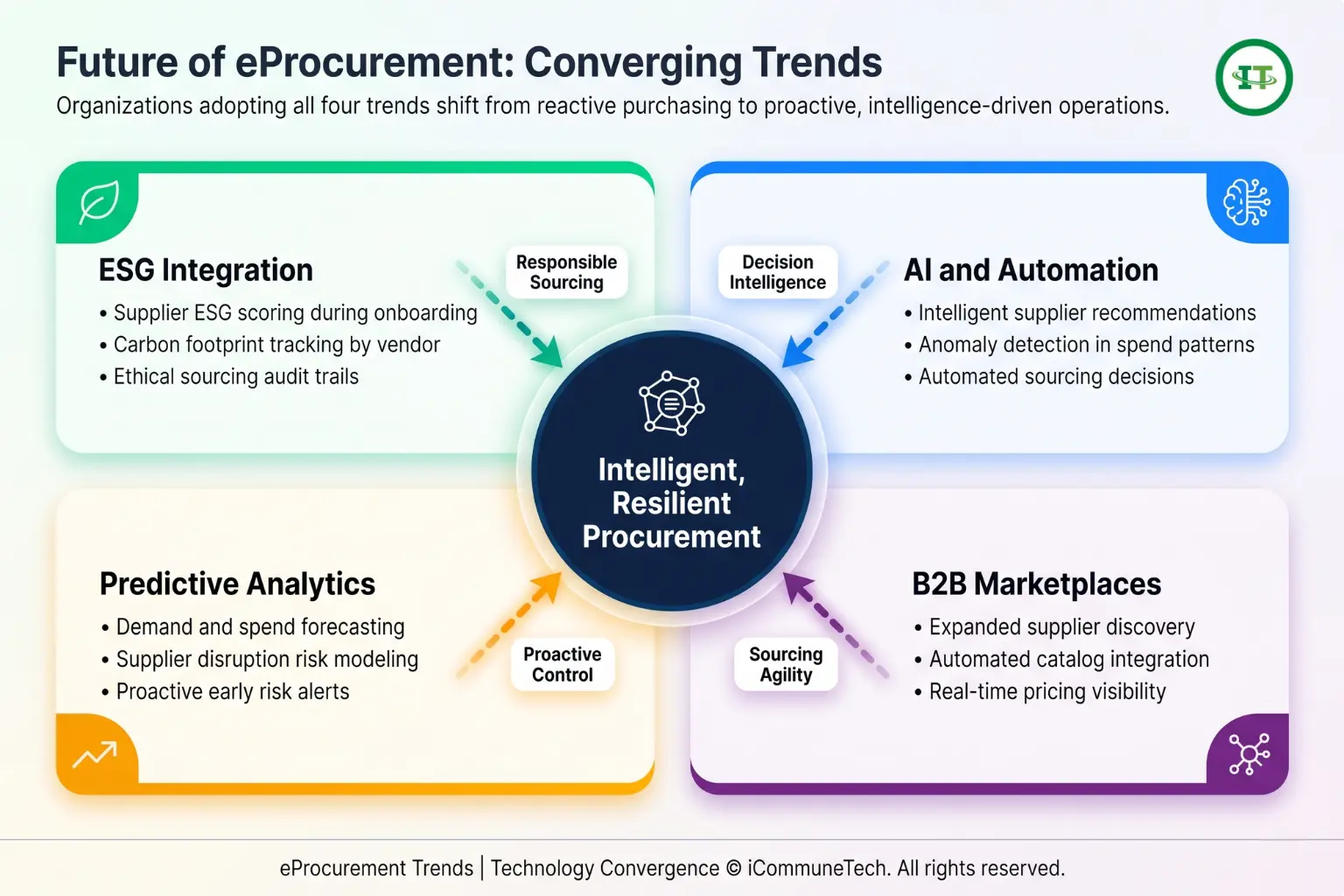
Sustainability and ESG integration
- eProcurement platforms integrate ESG criteria into supplier evaluation and contract management.
- Organizations track sustainability metrics, ethical sourcing, and compliance performance.
- ESG monitoring supports regulatory alignment and corporate sustainability goals.
AI-driven procurement
- AI automates sourcing analysis, approval workflows, and procurement decision support.
- Intelligent systems evaluate supplier performance, pricing trends, and purchasing behavior.
- AI-driven insights improve sourcing efficiency and negotiation strategy.
Predictive procurement tools
- Predictive analytics forecast demand, spend trends, and supply risks.
- Historical procurement data supports proactive planning and supplier management.
- Early risk detection improves procurement continuity and cost control.
B2B marketplaces and automation
- B2B marketplaces expand supplier discovery and sourcing access.
- Automated onboarding and catalog integration accelerate procurement workflows.
- Marketplace automation improves pricing visibility and sourcing speed.
How Does eProcurement Drive Sustainability and Support ESG Goals?
eProcurement embeds ESG criteria into procurement workflows through supplier evaluation, sustainability tracking, compliance monitoring, and responsible sourcing controls..
Data-driven procurement supports:
- ESG-based supplier assessment
- Sustainability KPI tracking
- Carbon-impact monitoring
Centralized reporting improves ESG visibility, regulatory compliance, supplier transparency, and procurement accountability.
ESG supplier criteria
Suppliers are evaluated against environmental, social, and governance standards during onboarding, sourcing, and the supplier qualification process.
Common evaluation criteria may include environmental policies, labour practices, ethical sourcing commitments, regulatory compliance, and sustainability performance.
Carbon footprint tracking
eProcurement platforms track supplier emissions, transportation impact, and procurement-related carbon metrics.
These insights help organizations identify high-impact suppliers and support carbon-reduction initiatives across procurement operations.
Ethical sourcing
Digital procurement workflows enforce supplier compliance with labor, safety, and regulatory standards through centralized documentation and audit traceability.
These insights help organizations identify high-impact suppliers and support carbon-reduction initiatives across procurement operations.
How Do AI and Predictive Analytics Transform eProcurement Efficiency?
AI and predictive analytics improve eProcurement by converting procurement data into predictive insights for demand planning, supplier evaluation, and cost optimization.
AI-driven systems analyze purchasing history, pricing trends, approval patterns, supplier performance, and transaction data to automate sourcing decisions, detect anomalies, and forecast procurement risks.
By combining automation with predictive intelligence, eProcurement shifts from reactive purchasing to proactive procurement management.
Predictive spend forecasting
Predictive analytics uses historical procurement data to forecast demand, spending patterns, and budget requirements for improved planning and cost control.
Supplier risk modeling
AI models analyze supplier performance, compliance history, financial indicators, and disruption risks to support proactive supplier risk management.
Intelligent automation and recommendations
AI-driven workflows automate routine procurement actions, recommend suppliers, identify anomalies, and support faster sourcing decisions.
How Should eProcurement Interfaces Be Designed to Improve User Experience?
User experience directly affects eProcurement adoption, policy compliance, workflow efficiency, and long-term platform utilization. Complex interfaces increase user resistance and informal purchasing activity.
Effective eProcurement UX should prioritize intuitive navigation, simplified workflows, consistent UI structures, and mobile accessibility. Well-designed interfaces reduce training effort, minimize user errors, and accelerate procurement execution across operational teams.
Intuitive navigation
- Clear menu structures and logical workflow paths reduce user confusion.
- Consistent interface layouts help employees complete requisitions and approvals faster.
- Minimal clicks and guided prompts decrease errors and improve overall system adoption.
Mobile-first design
- Mobile-responsive interfaces allow approvals and requisition submissions from any location.
- Simplified layouts improve usability on smaller screens.
- Faster access to tasks reduces approval delays and shortens procurement cycle times.
Personalization and role-based dashboards
- Role-based dashboards display relevant tasks, approvals, and spend insights.
- Personalized views reduce information overload for different user groups.
- Targetening notifications and summary metrics improve productivity and decision speed.
What Change Management Strategies Improve eProcurement Adoption?
Successful eProcurement adoption depends on structured change management, stakeholder alignment, user onboarding, and sustained leadership support.
Organizations improve adoption through:
- Clear communication
- Stakeholder involvement
- Superuser support networks
- Continuous feedback mechanisms
These strategies reduce resistance, improve workflow adoption, and strengthen long-term procurement compliance.
1. Communication plans
Clear communication on process changes, implementation goals, and training schedules improves transparency and user readiness during rollout.
2. Stakeholder engagement
Early involvement of procurement, finance, IT, and operations teams improves alignment, ownership, and cross-functional coordination.
3. Superuser networks
Superusers provide internal guidance, advanced support, and peer-level onboarding to accelerate system adoption.
4. Feedback loops
Continuous feedback and workflow reviews help identify usability gaps and improve long-term procurement performance.
What Are the Best Resources for Learning eProcurement?
Professionals can strengthen eProcurement expertise through industry certifications, online training programs, procurement communities, and continuous learning initiatives aligned with global procurement standards and best practices.
Organizations such as the Chartered Institute of Procurement & Supply (CIPS) provide guidance on procurement governance, compliance, professional development, and digital procurement transformation.
Certifications
Professional certifications validate expertise in procurement governance, compliance, digital procurement workflows, supplier management, and strategic sourcing.
Online courses
Online procurement courses cover eProcurement systems, spend analytics, workflow automation, and procurement reporting.
Communities and mentorship programs
Procurement communities, webinars, and mentorship networks support knowledge sharing, implementation guidance, and continuous professional development.

Irshad Pathan

Web Development Expert
Irshad is a senior technical expert at iCommuneTech. He manages the iCommuneTech's Web Development Team, and has hands-on expertise in web development, Laravel development, Logistics, fleet management, and Supply Chain Management. He mentors the in-house team and enjoys describing his experience in words.
Read More Insights By Irshad →