

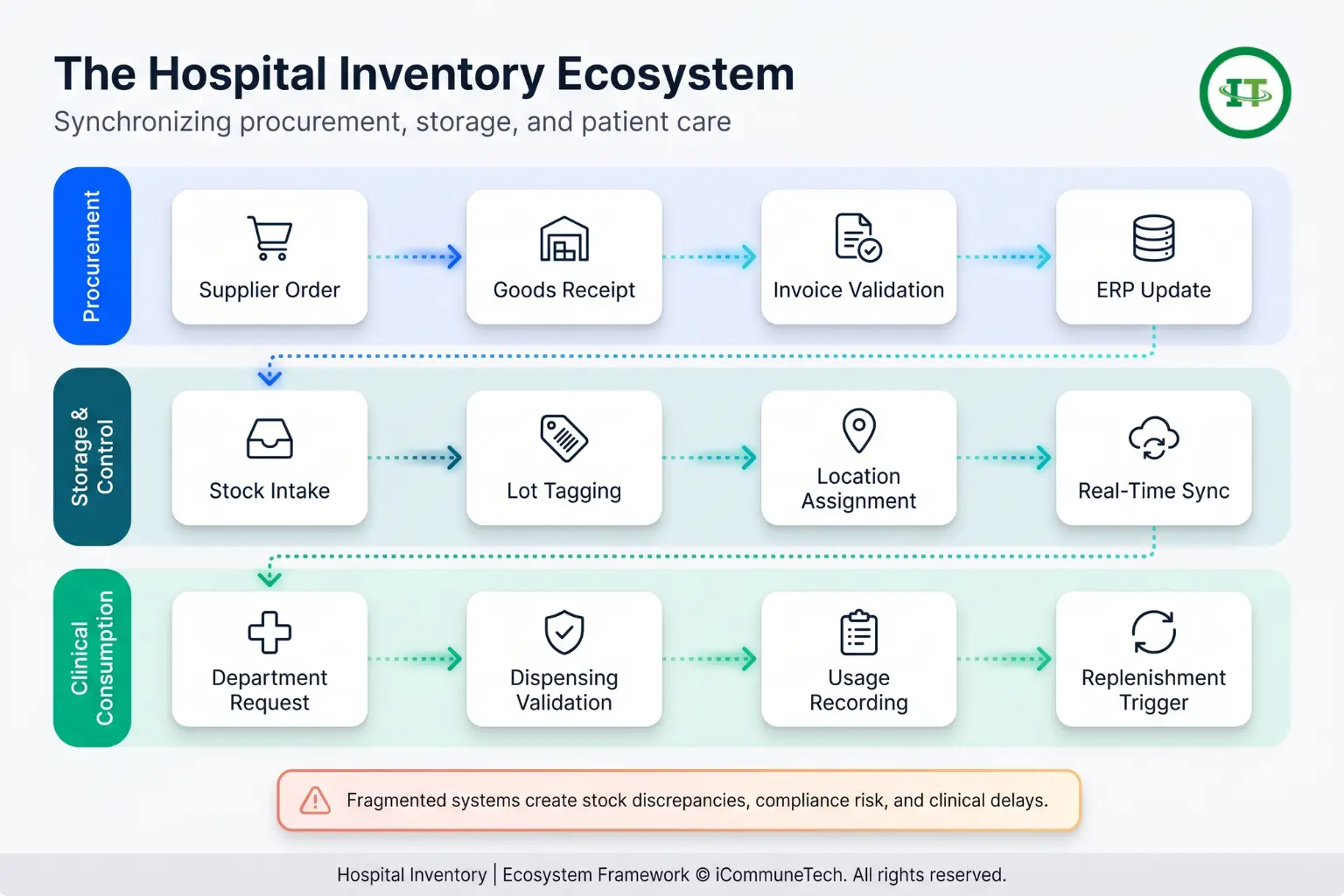
Hospital inventory management software controls stock data across procurement, storage, and clinical consumption points to ensure accurate stock availability, traceability, and usage tracking across operational systems.
Hospitals manage pharmaceuticals, surgical supplies, implants, and equipment across distributed storage locations, where each transaction updates SKU-level availability, lot traceability, and consumption records. When systems are fragmented, stock discrepancies increase, clinical procedures get delayed, and compliance risks rise.
Manual tracking and disconnected databases fail under high transaction volume and across multi-location inventory environments. According to Mckinsey, supply chain functions account for up to 40% of total hospital costs, making inventory control a direct driver of cost efficiency and operational performance.
A centralized healthcare inventory software layer connects inventory databases, warehouse systems, and procurement workflows to synchronized stock movement, validated transactions, and maintains real-time inventory visibility across locations.
Modern hospital inventory systems integrate forecasting engines, barcode and RFID tracking, and ERP platforms to enable demand prediction, automated replenishment, and regulatory traceability across the inventory lifecycle. Implementation fails when data models, integration pipelines, and execution workflows lack clear definitions. Poor system design disrupts synchronization, increases reconciliation effort, and delays adoption.
This guide explains the inventory methods, technologies, and system architectures used in hospital inventory management. It also covers implementation challenges, measurable outcomes, and how iCommuneTech delivers controlled and scalable inventory systems for healthcare environments.
What Is Hospital Inventory Management and Why Does It Matter?
Hospital inventory management is the process of controlling and tracking medical supplies, pharmaceuticals, and equipment across procurement, storage, and clinical consumption points to ensure accurate availability, traceability, and usage visibility. In practice, it keeps the right inventory available at the right time for patient care.
Hospitals operate in regulated and time-critical environments where inventory accuracy directly affects patient safety, cost control, and compliance. Even small inventory errors delay clinical procedures, introduce safety risks, and create stock imbalances. Inaccurate data leads to excess inventory, stockouts, and unplanned procurement cycles.
An integrated inventory management system records inventory transactions and updates stock positions in real time. It maintains batch-level traceability and connects procurement workflows with clinical consumption points to ensure consistent inventory data across departments.
Accurate inventory control reduces operational variance and improves financial performance. According to Mckinsey, high-performing healthcare supply chains can reduce supply spend by up to 10%, which reflects the direct cost impact of synchronized inventory and procurement systems. It keeps supplies available continuously during critical care delivery.
Hospital inventory management systems deliver 6 core capabilities across procurement, storage, and clinical operations:
- Track SKU-level inventory across clinical and storage locations
- Validate lot-controlled inventory during stock movement
- Synchronize inventory records between procurement and consumption points
- Detect stock variance through audit and reconciliation processes
- Drive demand planning using historical consumption data
- Keep traceable records for regulatory compliance
What Inventory Categories Require Distinct Control in Hospital Inventory Management?
Hospitals manage 5 inventory categories with distinct control constraints driven by usage, value, and regulatory requirements. Misaligned control rules increase stock variance and disrupt clinical availability.
A centralized supply chain management system assigns category-level control parameters and enforces rule-based processing across all inventory workflows.
Inventory Categories and Control Requirements
| Inventory Category | Control Requirements | Operational Focus |
|---|---|---|
| Pharmaceuticals | Enforce expiration validation and regulated storage conditions | Maintain compliance and prevent expired stock usage |
| Consumables | Handles high transaction volume and frequent replenishment cycles | Maintain continuous stock availability |
| Medical Devices | Record usage events and maintenance schedules | Maintain asset readiness and lifecycle control |
| Implants | Enable serial-level tracking and patient linkage | Control high-value usage and billing accuracy |
| PPE | Adjust allocation based on demand variability | Stabilize supply during demand fluctuations |
Category-Based Inventory Control Capabilities
Category-level control delivers 6 capabilities across hospital inventory workflows:
- Define control rules based on item classification and operational constraints
- Apply validation logic that meets regulatory and usage requirements
- Keep distinct data attributes across inventory categories
- Match replenishment cycles with consumption patterns
- Detect control gaps that impact stock accuracy
- Coordinate inventory operations across all 5 categories
What Data Attributes Control Healthcare Inventory Items: Expiration, Lot Tracking, or Cost?
Healthcare inventory control depends on structured item attributes that govern validation and financial accuracy at the SKU level. Missing attributes reduce audit reliability and delay recall execution.
A centralized perpetual inventory tracking system enforces attribute validation within transaction logs and maintains consistent records across warehouse systems.
Core Inventory Attributes and Control Functions
| Data Attribute | Control Function | Operational Impact |
|---|---|---|
| Expiration Date | Enforce time-bound eligibility during allocation | Reduce expiry write-offs and maintain compliance |
| Lot Number | Enable batch identification across supply chain stages | Support recall precision and audit verification |
| Unit Cost | Capture SKU-level valuation for financial tracking | Identify cost variance and excess inventory |
| Usage Rate | Measure consumption frequency across departments | Align replenishment cycles with demand patterns |
| Storage Location | Define stock positioning across warehouse systems | Improve retrieval accuracy and movement control |
What Capabilities Do Item-Level Attributes Enable?
Item-level attributes enable 6 inventory control capabilities:
- Enforce validation rules during allocation and stock movement
- Maintain batch-level identification across procurement and usage
- Capture cost data to support financial control
- Process consumption signals to align replenishment cycles
- Map storage locations to improve retrieval accuracy
- Detect data gaps that impact audit reliability
Gaps in any of these attributes reduce transaction accuracy and increase compliance exposure across inventory operations.
Which Inventory Tracking Methods Control Hospital Inventory?
Hospitals use multiple inventory tracking methods, including FIFO, FEFO, JIT, and ABC classification, to control stock movement across varying demand conditions and regulatory requirements.
Each method applies a distinct control logic based on item behavior, usage frequency, and compliance requirements. FIFO and FEFO manage stock rotation and expiry, JIT aligns replenishment with consumption timing, and ABC classification prioritizes inventory based on value and usage.
A single-method approach fails because hospital inventory includes diverse item categories that require different rotation, replenishment, and prioritization strategies. Applying the wrong method leads to excess inventory, stock imbalances, and increased operational risk.
An integrated stock inventory control method framework assigns method-specific rules based on inventory classification and ensures consistent execution across transaction workflows and inventory systems.
Together, these 4 methods maintain stock availability, reduce excess inventory, and ensure controlled stock flow across hospital environments. The following sections examine each method and its application in hospital inventory workflows.
FIFO and FEFO: First-In, First-Out for Expiry Management
FIFO and FEFO are inventory rotation methods that control stock allocation and minimize expiry-related losses in hospital inventory systems.
Hospitals manage pharmaceuticals, biologics, and consumables, where each SKU carries batch identifiers, manufacturing dates, and expiry timestamps that must govern every issue transaction. Failure to enforce these attributes leads to expired stock being issued or valid stock remaining unused.
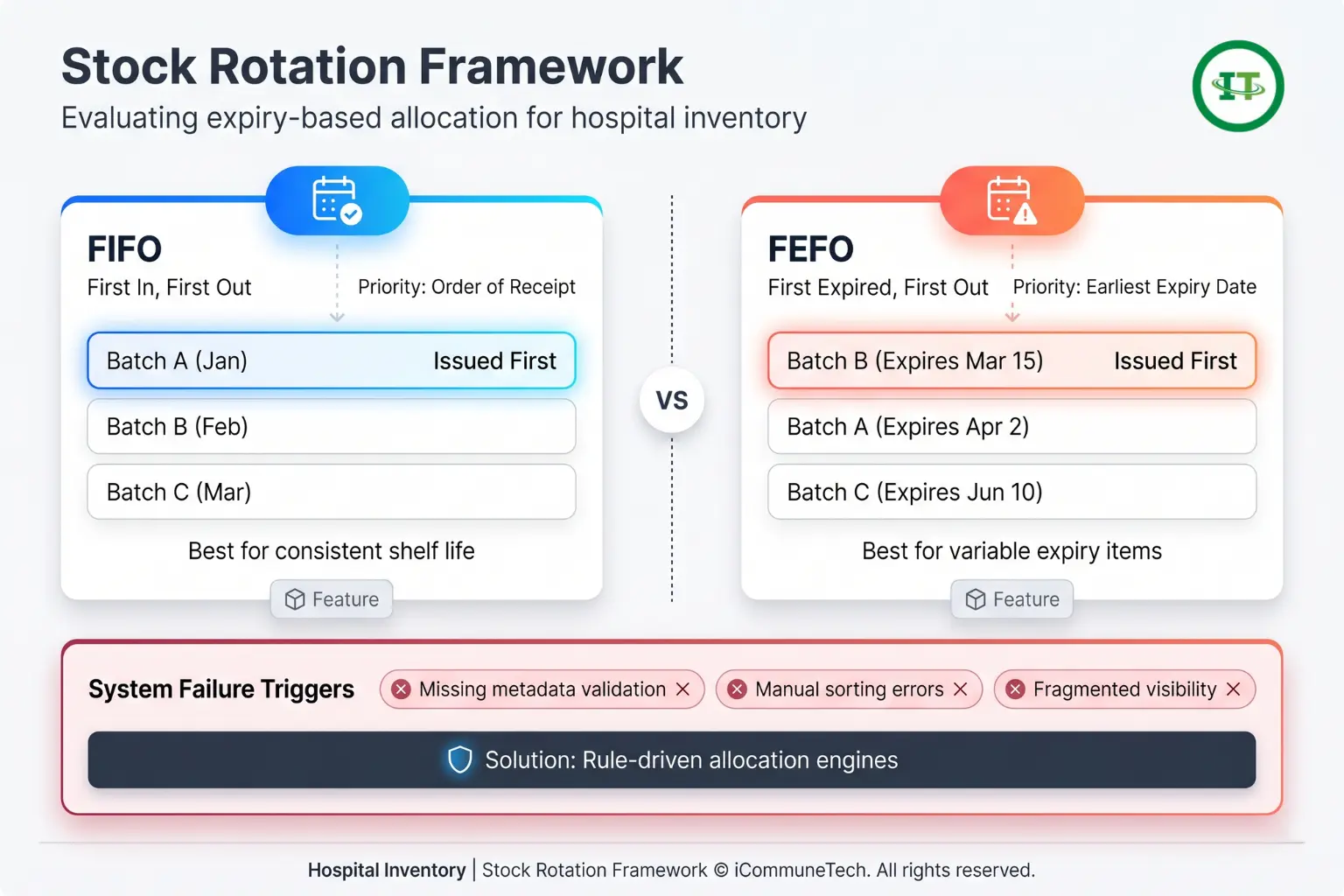
FIFO prioritizes stock movement based on receipt sequence and is suitable for inventory with a consistent shelf life and minimal expiry variation across batches. FEFO prioritizes stock based on the earliest expiry date and requires validated expiry data to ensure correct allocation during dispensing and usage.
Expiry losses increase when batch-level attributes are not enforced during allocation, as stock movement no longer reflects actual shelf-life constraints. Manual and partially automated systems are the most common source of this failure.
Enforcing expiry control at scale requires rule-driven allocation embedded within transaction workflows:
- Validate batch metadata during inward receipt before committing records to the inventory system
- Sort available inventory by expiry timestamp during pick-list generation
- Enforce FEFO logic across issue transactions in pharmacy, stores, and clinical units
- Detect near-expiry inventory using threshold-based monitoring
- Synchronize batch movement across storage locations to maintain allocation accuracy
Manual control fails at scale due to fragmented batch visibility and inconsistent transaction sequencing during high-volume operations. A controlled allocation engine enforces expiry rules within transaction processing, ensuring every issue references validated batch and expiry data.
This approach reduces expiry write-offs, improves stock rotation accuracy, and strengthens recall response through consistent batch traceability.
iCommuneTech implements FEFO-driven allocation by embedding expiry validation within transaction workflows, stabilizing batch-level control across distributed hospital environments.
For advanced inventory optimization strategies, integrating FEFO with demand signals further reduces dead stock and expiry exposure.
Just-In-Time (JIT) Inventory for On-Demand Supplies
Just-In-Time (JIT) inventory controls hospital stock levels by triggering replenishment based on actual consumption rather than predefined stocking cycles, keeping inventory aligned with real-time demand.
Hospitals experience variable demand driven by procedures and patient inflow, where fixed stocking levels fail to match real-time usage at clinical points. This mismatch leads to excess inventory accumulation or sudden stock shortages when replenishment is not aligned with consumption.
JIT shifts replenishment to consumption-driven triggers, where transaction records initiate reorder actions based on actual depletion instead of predefined stocking cycles. This ensures procurement responds directly to usage signals rather than static stocking assumptions.
Controlling stock levels with JIT requires coordinating planning and procurement across 5 execution steps:
- Capture consumption events at dispensing and usage points
- Trigger replenishment using reorder thresholds linked to usage patterns
- Align procurement schedules with supplier lead times and contract terms
- Validate incoming stock against active demand signals before allocation
- Maintain synchronized reorder status across procurement and inventory systems
JIT introduces supply risk because reduced buffer stock increases dependency on supplier reliability and lead-time consistency. Even minor delays can disrupt supply availability in critical hospital units.
A controlled planning layer mitigates this risk by integrating forecasting models with procurement workflows, stabilizing replenishment timing, and aligning supply with demand variability.
iCommuneTech implements JIT by connecting demand signals with procurement execution and supplier coordination, keeping replenishment cycles synchronized under fluctuating clinical demand.
For advanced supply chain planning systems, integrating JIT with predictive demand models further improves replenishment accuracy while maintaining controlled inventory levels.
ABC Analysis for Inventory Prioritization in Healthcare
ABC analysis prioritizes hospital inventory by classifying items into categories based on consumption value, calculated from unit cost and usage frequency, so control efforts are focused on high-impact items.
Hospitals manage diverse SKUs with varying cost impact and usage criticality, requiring differentiated control policies across inventory categories. Applying uniform monitoring across all items reduces oversight effectiveness and misallocates operational effort.
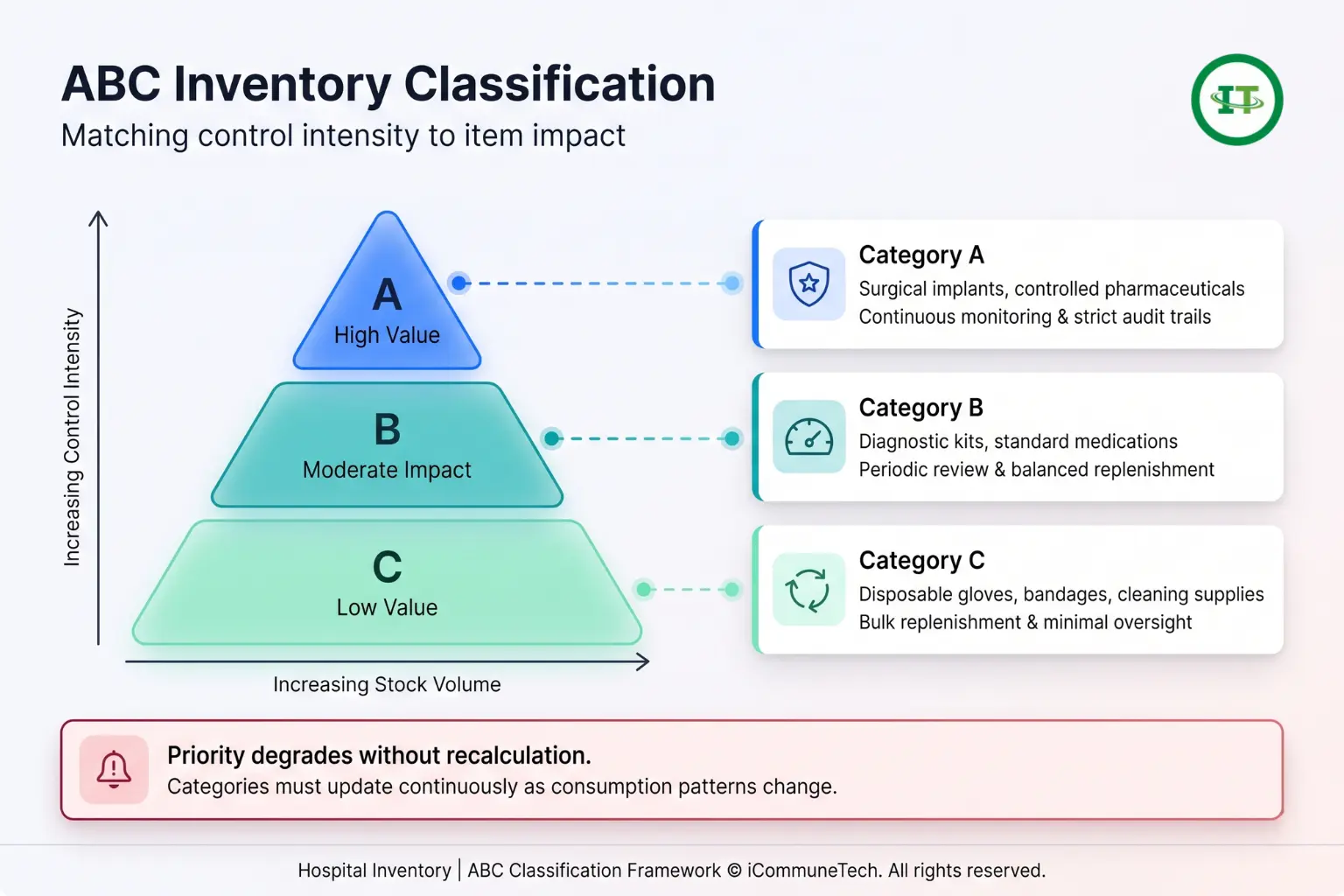
ABC classification segments inventory into 3 categories:
- Category A includes high-value or high-criticality items that require strict control, approval workflows, and continuous monitoring.
- Category B includes moderate-impact items that require balanced control to maintain availability without excessive intervention.
- Category C includes low-value, high-frequency items that require simplified handling to reduce administrative overhead.
Applying ABC prioritization requires enforcing 5 classification-driven control policies across planning and inventory management:
- Rank SKUs based on consumption value derived from cost and usage data
- Assign control rules aligned with category-specific financial and operational impact
- Apply stricter monitoring and approval workflows for Category A items
- Adjust replenishment intervals based on category-level consumption patterns
- Track category performance to identify cost variance and usage deviation
Prioritization accuracy degrades when categories do not update with changing consumption patterns. Item priority shifts over time and requires continuous recalculation based on recent transactions and cost data.
A dynamic classification layer maintains updated ABC segmentation, so prioritization continuously reflects current inventory behavior across hospital operations.
This approach improves financial control and reduces monitoring overhead by focusing effort on high-impact inventory segments. iCommuneTech embeds ABC classification within planning workflows so prioritization continuously adapts to live cost and consumption inputs.
For advanced demand planning software, integrating ABC classification with demand signals further strengthens prioritization accuracy and budget control.
What Technologies Power Modern Hospital Inventory Management?
Modern hospital inventory management is powered by integrated technologies such as barcode and RFID tracking, AI-driven forecasting, and cloud-based ERP systems, which enable accurate tracking, demand planning, and compliant supply chain execution.
Hospitals manage continuous inventory movement across clinical and storage points, where system accuracy depends on synchronized data exchange between transaction capture, planning, and procurement layers. Delays or mismatches in this data flow lead to stock inaccuracies and operational inefficiencies.
These 3 technologies operate across 3 core functional layers:
- Capture inventory events at the source using identification and tracking systems (barcode, RFID)
- Process consumption data to generate demand signals for forecasting and replenishment planning
- Execute procurement, allocation, and financial tracking through integrated ERP workflows
These layers function through connected data pipelines, where transaction data updates inventory state in real time without duplication or delay. Integration accuracy determines system performance, as misaligned data exchange leads to stock imbalances and operational inefficiencies.
iCommuneTech structures these environments by integrating capture, planning, and execution technologies within a unified architecture. For scalable digital inventory systems, this approach ensures consistent inventory visibility, reliable execution, and regulatory compliance.
How Do Barcode and RFID Systems Enable Real-Time Inventory Tracking in Hospitals?
Barcode and RFID systems enable real-time inventory tracking by capturing item identity, batch, and location data during stock movement across hospital operations.
Hospitals manage continuous inventory movement across receiving, internal transfers, and clinical usage, where each transaction must record accurate item-level data to maintain alignment between physical stock and system records. Missing or delayed capture at any point breaks this alignment and leads to inventory inaccuracies.
Barcode systems encode item identity into scannable labels and require manual scanning at each transaction point, capturing validated data during dispensing, transfers, and kit assembly.
RFID systems use tagged items and reader networks to detect inventory movement across defined zones automatically, without manual interaction.
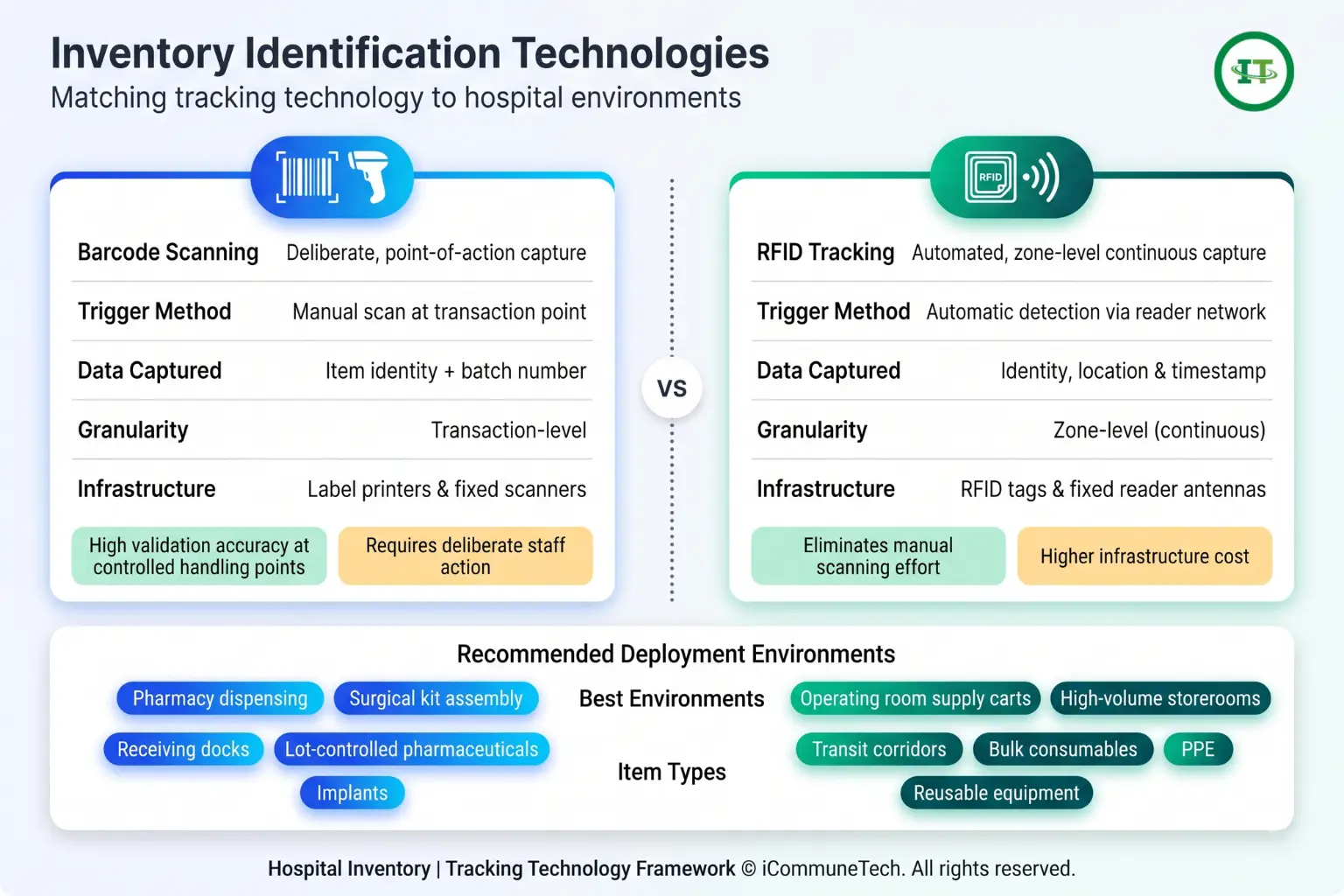
Effective implementation requires embedding identification into 5 operational workflows:
- Encode item identity and batch data during labeling at receipt
- Capture movement events through barcode scans at controlled handling points
- Detect zone-level movement using RFID readers across storage and transit areas
- Record item state changes with identity, batch, and location attributes
- Validate item selection during dispensing to prevent allocation errors
Barcode systems suit environments that require deliberate validation and accuracy at specific transaction points. RFID systems are effective in high-movement environments where continuous, automated tracking reduces manual effort and capture delays.
Tracking accuracy degrades when identification operates outside execution workflows, as recorded events no longer reflect actual stock movement.
iCommuneTech embeds barcode and RFID capture directly into inventory execution workflows so all identification events are recorded as validated transactions without manual reconciliation.
For advanced inventory counting with computer vision, combining visual validation with identification layers improves count accuracy and reduces verification effort.
AI Forecasting to Optimize Hospital Inventory Levels
AI forecasting uses historical consumption data and real-time transaction signals to predict demand and dynamically adjust inventory replenishment in hospital systems.
Hospitals experience demand variability driven by procedures, admissions, and care intensity, where static reorder parameters fail to align with actual consumption patterns, leading to overstock or stockout conditions.
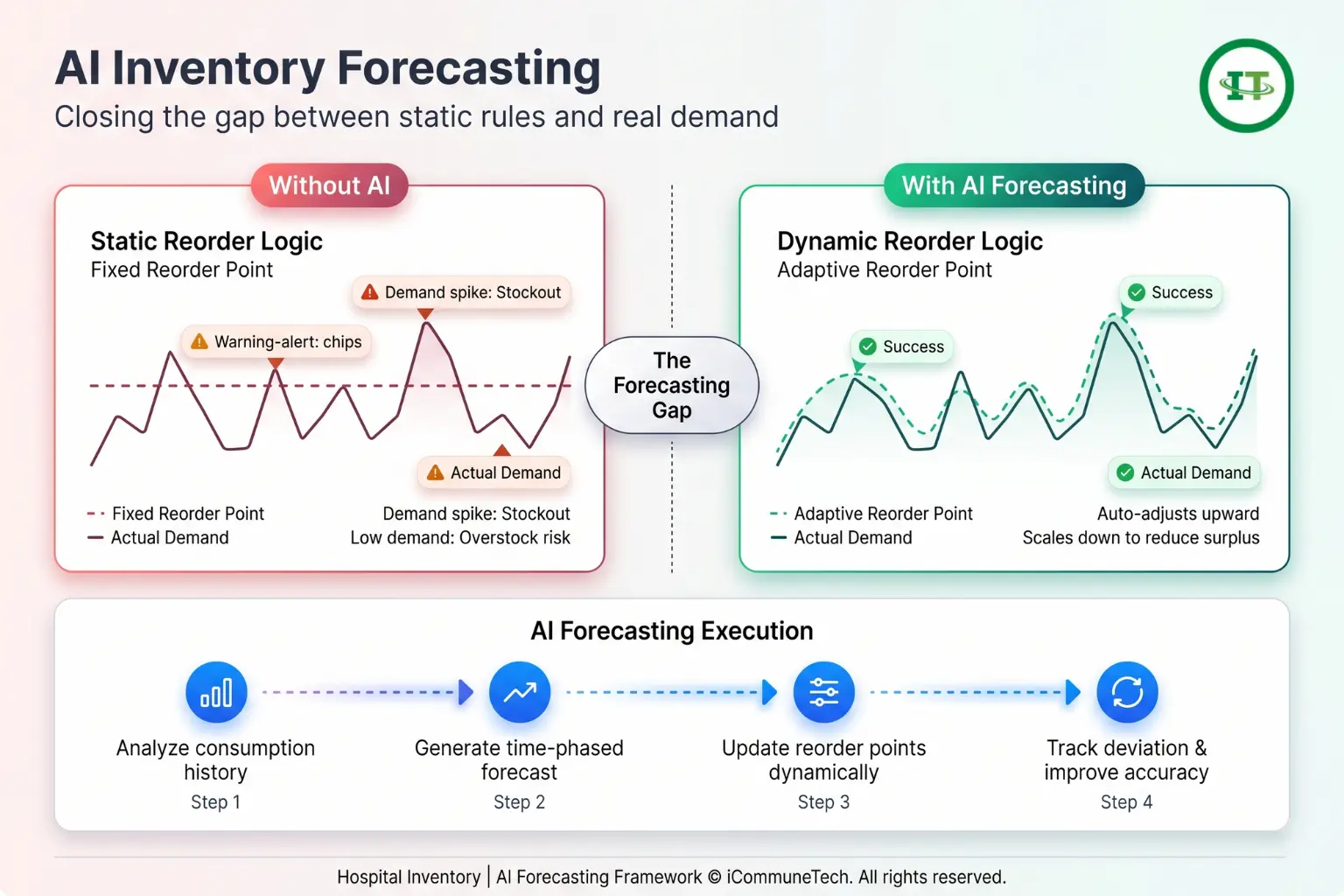
AI models analyze consumption trends and variability at the SKU level to generate time-phased demand forecasts. These forecasts continuously update reorder points and quantities to align procurement cycles with expected usage intervals.
Effective execution requires integrating forecasting outputs across 4 planning workflows:
- Generate demand forecasts at the SKU level using historical consumption and variability signals
- Update reorder points and quantities based on predicted demand intervals
- Align procurement schedules with forecast-driven replenishment cycles
- Track forecast deviation against actual consumption to improve model accuracy
Planning gaps occur when reorder parameters remain static despite demand shifts, causing replenishment decisions to diverge from real usage patterns.
A connected planning layer applies forecast outputs directly to reorder logic so procurement decisions reflect current demand conditions.
This approach stabilizes inventory levels by reducing excess buildup and preventing shortages under variable demand. iCommuneTech embeds forecasting models within planning workflows so demand predictions continuously adjust inventory parameters across hospital environments.
For advanced demand planning software, integrating AI forecasting strengthens planning accuracy and maintains controlled inventory levels.
Cloud ERP for Integrated Supply Chain and Compliance
Cloud ERP systems integrate procurement, inventory, and financial processes into a unified data model, ensuring consistent transaction processing, cost visibility, and regulatory compliance across hospital operations.
Hospitals execute interconnected transactions where purchasing, stock usage, and patient billing must reflect consistent item, quantity, and cost data. When these processes operate in separate systems, financial misalignment occurs, reducing audit accuracy and distorting cost visibility.
Cloud ERP platforms establish a shared data structure where procurement orders, goods receipts, issue transactions, and billing entries are linked to the same item, supplier, and cost attributes. This ensures every transaction updates both operational and financial records within a single system.
Effective execution requires controlled workflows across 5 ERP modules:
- Record procurement commitments with supplier terms and cost structures
- Post goods receipt transactions that update inventory valuation and payable records
- Link issued inventory to patient billing and departmental cost allocation
- Generate compliance logs from transaction-linked audit records
- Reconcile inventory valuation with financial ledgers using shared data references
Financial control degrades when inventory movement and cost records diverge, causing reporting inconsistencies and audit gaps.
A unified ERP layer enforces consistency by linking all transactions to a single data model, ensuring alignment between operational activity and financial impact.
This approach strengthens audit control and cost accuracy by maintaining traceable relationships between inventory, procurement, and financial records. iCommuneTech implements ERP architectures that unify procurement, inventory, and financial workflows, ensuring consistent data integrity across hospital systems.
For advanced procurement software, integrating ERP-driven workflows improves procurement control and maintains compliance across supply chain operations.
What Outcomes Does Effective Hospital Inventory Management Deliver?
Effective hospital inventory management delivers measurable outcomes in cost reduction, regulatory compliance, and supply continuity that directly shape financial performance and patient care delivery.
Hospitals need clear visibility into operational outcomes where inventory performance is tracked through cost efficiency, compliance adherence, and service-level reliability. When inventory systems fail to produce measurable results, inefficiencies persist and weaken return on investment.
An optimized inventory management system links transaction accuracy, demand planning, and execution control to defined performance metrics so hospitals can monitor and improve operational outcomes.
The global hospital asset tracking and inventory management systems market is projected to grow from $26.7 billion in 2022 to $39.4 billion by 2027, reflecting increased investment in inventory visibility and control systems (businesswire).
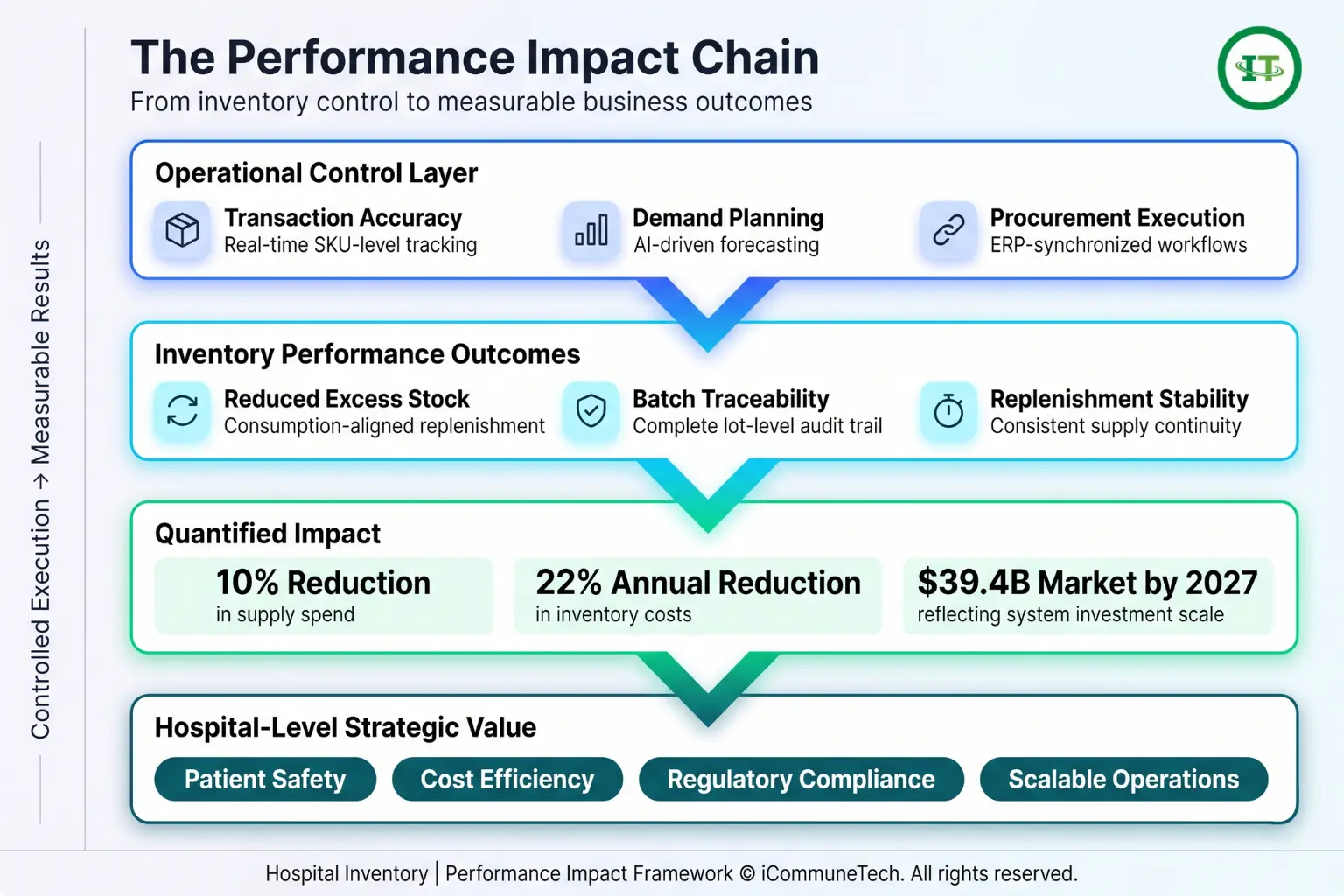
Controlled execution across inventory, procurement, and financial processes drives 4 measurable outcomes:
- Reduce inventory waste through demand-aligned replenishment and controlled allocation
- Improve cost efficiency by aligning stock levels with consumption and financial tracking
- Strengthen compliance through traceable records and audit-ready processes
- Maintain supply continuity by stabilizing replenishment across departments
Analytics layers convert operational data into measurable performance indicators for continuous monitoring and improvement. iCommuneTech connects execution workflows with analytics systems so inventory performance translates into measurable business and clinical outcomes.
For advanced supply chain analytics dashboards, this approach enables continuous monitoring of cost, compliance, and inventory performance.
How Does Hospital Inventory Management Reduce Waste and Improve Cost Efficiency?
Hospital inventory management reduces waste and improves cost efficiency by controlling inventory aging and aligning procurement quantities with actual consumption patterns.
Excess inventory generates cost leakage when stock remains unused or exceeds consumption intervals, resulting in write-offs and working capital lock-in. Hospitals face financial loss when procurement decisions do not align with usage patterns, resulting in surplus accumulation across storage locations.
A structured inventory model enforces consumption-based procurement and prioritizes stock utilization to prevent excess buildup. A hospital study published on Academia.edu found that structured inventory planning reduces inventory costs by over 22.15% annually.
Effective execution requires focused control over inventory aging and procurement behavior across 5 areas:
- Track inventory aging to identify items nearing expiry or non-usable thresholds
- Limit procurement quantities based on actual consumption intervals
- Reallocate surplus stock across departments to prevent localized excess
- Flag non-moving items for corrective action before value loss
- Adjust reorder quantities to prevent surplus accumulation
Cost risk increases when aging inventory goes unmonitored. Delayed intervention converts surplus stock into direct financial loss. A monitoring layer continuously evaluates inventory aging and procurement alignment to trigger timely corrective actions.
This approach improves inventory utilization and reduces financial loss by preventing surplus buildup. iCommuneTech embeds these controls within execution workflows so procurement and inventory levels stay aligned with actual consumption.
For advanced inventory optimization solutions, applying these controls improves cost discipline and minimizes waste across hospital operations.
How Does Hospital Inventory Management Improve Regulatory Compliance and Patient Safety?
Hospital inventory management improves regulatory compliance and patient safety by enforcing batch-level traceability and real-time validation of inventory eligibility during clinical usage.
Regulatory risk increases when batch history and movement records are incomplete. Incomplete records disrupt audit verification and delay recall execution. Clinical risk arises when expired or restricted items bypass validation checks and enter patient care workflows.
An integrated control model maintains batch-linked records and enforces eligibility validation at each transaction point so every item carries a verifiable source, status, and usage history.
Effective execution requires strict governance across 5 traceability and exception handling:
- Capture batch lineage linking source, receipt, storage, and usage records
- Enforce eligibility checks against expiry and restriction rules at issue points
- Maintain movement history across departments for complete audit trails
- Generate alerts for recall events and critical expiry thresholds
- Quarantine affected batches during recall events to prevent clinical use
Risk escalates when exception handling is delayed. Non-compliant inventory remains available for use until teams act. A compliance layer continuously evaluates batch status against regulatory rules and triggers immediate containment actions for affected inventory.
This approach builds audit readiness and protects patient safety through verifiable batch traceability and rapid exception response. iCommuneTech embeds these controls within execution workflows so validation, traceability, and compliance stay consistent across hospital systems.
Integrating these controls within supply chain compliance systems strengthens regulatory enforcement and ensures safe clinical execution across inventory operations.
What Challenges Arise in Hospital Inventory Management Implementation and How Can They Be Overcome?
Hospital inventory management implementation faces 4 challenges across data standardization, system integration, workflow alignment, and adoption that disrupt system performance and delay operational outcomes.
Hospitals operate across heterogeneous systems where item masters, transaction formats, and coding structures differ. These differences prevent consistent data exchange and unified processing.
Adoption challenges arise when system workflows do not align with established clinical and administrative routines. Misalignment creates resistance during implementation. Budget constraints limit rollout when teams do not prioritize implementation scope based on high-impact control areas. Poor prioritization leads to inefficient resource allocation.
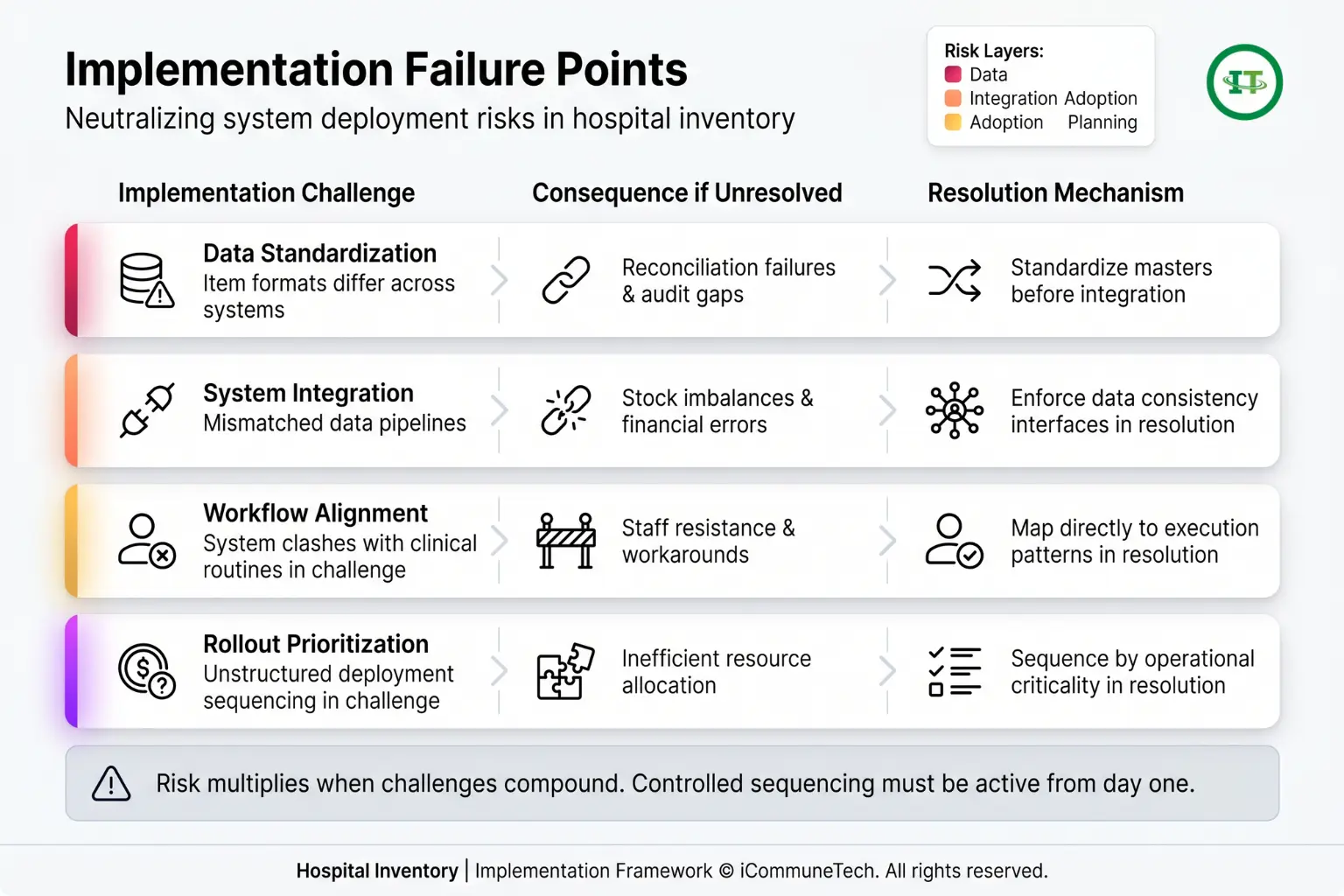
Effective implementation requires structured control across 5 data, integration, and workflow design areas:
- Standardize item masters, coding structures, and transaction formats across systems
- Design integration interfaces that enforce data consistency during exchange
- Align workflows with actual clinical and administrative execution patterns
- Sequence rollout based on operational criticality and dependency mapping
- Establish governance checkpoints to validate system behavior during deployment
Implementation risk increases when deployment lacks controlled sequencing. Misaligned components create instability across environments. A structured implementation model delivers data consistency, controlled integration, and phased rollout for stable system behavior and faster adoption.
iCommuneTech addresses these challenges by aligning data models, integration interfaces, and workflow execution within a controlled implementation framework. Embedding this approach within supply chain digital transformation enables scalable adoption and sustained system performance.
Why Choose iCommuneTech for Your Hospital Inventory Management Solution?
iCommuneTech delivers hospital inventory management solutions through a structured, implementation-first approach that builds system stability, data integrity, and scalable operational performance.
Hospitals need inventory systems that operate reliably under high transaction volumes, regulatory constraints, and distributed environments. Implementation success depends on aligning data models, integration layers, and workflow execution within a controlled architecture.
iCommuneTech designs and deploys inventory systems by integrating data structures, system interfaces, and execution workflows into a unified operational model.
The implementation approach covers disciplined execution across 5 system layers:
- Design data models that enforce consistency across item masters and transaction records
- Build integration interfaces that maintain data integrity across connected systems
- Align workflows with clinical and administrative processes
- Execute phased deployment to stabilize system behavior during rollout
- Establish governance controls to validate system performance post-deployment
Poor implementation leads to system instability, rework, and inconsistent data flow. iCommuneTech mitigates these risks through a structured implementation methodology that delivers reliable system performance and controlled execution.
This approach enables hospitals to achieve accurate inventory control, regulatory compliance, and scalable system expansion. For tailored implementations, explore custom inventory software to build solutions aligned with specific hospital requirements.

Irshad Pathan


Web Development Expert
Irshad is a senior technical expert at iCommuneTech. He manages the iCommuneTech's Web Development Team, and has hands-on expertise in web development, Laravel development, Logistics, fleet management, and Supply Chain Management. He mentors the in-house team and enjoys describing his experience in words.
Read More Insights By Irshad →