
Modernizing Procurement Governance through eSourcing Platforms
Competitive bidding and standardized evaluation introduce measurable cost visibility. eSourcing centralizes supplier communication within a controlled platform. It captures structured data to support auditability and performance analysis.
Sourcing is not an isolated procurement task in logistics technology environments. It affects operational resilience and margin stability. Transportation platforms depend on carrier networks, hardware vendors, telematics providers, and subcontracted service partners. Warehouse systems rely on equipment suppliers and third-party integrations.
As logistics ecosystems expand, manual sourcing methods introduce operational risk, extended cycle times, and inconsistent decision logic. Digital procurement introduces automation, traceability, and structured supplier evaluation.
Competitive pressure increases reliance on structured sourcing controls. Cost volatility, compliance demands, and board-level scrutiny require sourcing decisions that are defensible, repeatable, and performance-oriented. A structured source-to-contract workflow standardizes supplier evaluation. This structure supports scalability as platform complexity increases.
This guide details how eSourcing operates within structured procurement workflows. It outlines differences from traditional sourcing and eProcurement, tools, benefits, advanced techniques, implementation practices, financial integration, and AI-driven supplier risk modeling for data-driven procurement governance.
What Is eSourcing, and How Does It Work?
eSourcing is a structured digital procurement system that manages supplier discovery, competitive bidding, evaluation, and award decisions within a centralized, auditable, source-to-contract workflow.
At its core, eSourcing replaces fragmented manual sourcing practices, email threads, spreadsheet comparisons, disconnected approvals, and undocumented negotiations with a controlled digital sourcing workflow. Every sourcing event becomes a defined entity: an RFI, RFP, or RFQ configured with requirements, timelines, evaluation criteria, and approval logic. Supplier communication occurs within the platform, ensuring traceability and standardized documentation.
How the Digital Sourcing Workflow Operates
A typical eSourcing workflow follows a structured progression:
Requirement Definition
Internal stakeholders define technical, operational, and commercial requirements in a standardized template.
RFx Event Creation
The system generates a sourcing event with preconfigured bid formats, submission deadlines, and compliance checks.
Supplier Invitation & Communication
Approved suppliers receive structured invitations. All clarifications, amendments, and documentation exchanges are logged within the platform.
Bid Submission & Validation
Suppliers submit responses in structured digital formats. The system validates completeness and flags missing data.
Automated Evaluation & Scoring
Bid evaluation tools apply weighted scoring matrices, comparing pricing models, service capabilities, risk indicators, and compliance attributes.
Approval & Award
Digital approval workflows route recommendations through predefined authorization hierarchies before contract award.
This digitized process standardizes documentation, reduces procurement risk and supports performance tracking.
What Problems Does eSourcing Replaces
Manual sourcing environments create systemic inefficiencies:
- Dispersed supplier communication across email and messaging tools
- Inconsistent bid comparison due to unstructured data
- Limited visibility into evaluation logic
- Weak audit trails for compliance and governance
- Slow approval cycles are dependent on manual coordination
Procurement digitization addresses these gaps by centralizing supplier interactions, standardizing bid structures, and embedding automation into evaluation and approval steps.
Data-Rich and Transparent by Design
A defining characteristic of eSourcing is structured data capture. Each supplier response is recorded in comparable formats, enabling:
- Side-by-side bid analysis
- Historical benchmarking across sourcing events
- Supplier performance tracking over time
- Risk assessment based on documented criteria
Structured data enables repeatable, analytics-driven supplier evaluation.
For organizations seeking broader procurement digitization strategies, structured eSourcing capabilities often integrate with enterprise procurement systems such as procurement software platforms that extend visibility into purchasing and supplier lifecycle management.
In practice, eSourcing functions as a governance engine, bringing automation, transparency, and structured evaluation into supplier selection while ensuring sourcing decisions remain traceable, defensible, and performance-aligned.
Driving Measurable Results Across Industries
From automating manual calculations to modernizing legacy infrastructure, we build software that directly impacts the bottom line. Our custom solutions consistently reduce operational costs and accelerate process efficiency.
View Our Case Studies
How Does eSourcing Differ From Traditional Sourcing?
Traditional sourcing relies heavily on manual coordination, email exchanges, spreadsheet comparisons, paper-based RFx documents, and informal evaluation methods. While manageable at a small scale, these approaches introduce compounding inefficiencies, limited transparency, and governance risk as supplier networks expand.
eSourcing introduces a structured digital framework for supplier evaluation. Every RFx event follows predefined workflows, standardized data formats, and documented evaluation logic. This shift modifies the evaluation structure and documentation controls. It alters risk visibility and compliance traceability.
| Dimension | Traditional Sourcing | eSourcing |
|---|---|---|
| Process Structure | Ad hoc workflows managed via email and spreadsheets | Configured digital workflows with defined stages and approvals |
| RFx Management | Paper-based RFx or email attachments | Centralized digital RFx events with standardized templates |
| Supplier Communication | Fragmented email threads and offline clarifications | Platform-based communication with complete interaction logs |
| Bid Evaluation | Manual comparison of inconsistent formats | Structured bid evaluation tools with weighted scoring models |
| Audit Trail | Limited or scattered documentation | Automated audit trails with full traceability |
| Process Repeatability | Varies by team and event | Standardized, repeatable sourcing cycles |
Efficiency Gains
Manual sourcing consumes time through repetitive coordination tasks:
- Consolidating supplier responses from multiple channels
- Reformatting bid data for comparison
- Chasing approvals through email chains
eSourcing automates these steps. Templates enforce consistent data submission. Automated reminders reduce follow-up workload. Approval workflows route decisions without manual tracking. Sourcing cycle times shorten while administrative overhead declines.
Risk Reduction and Compliance
Paper-based RFx and email sourcing create compliance blind spots:
- Missing documentation
- Undocumented negotiation adjustments
- Inconsistent evaluation criteria
Digital sourcing platforms embed governance into the workflow. Evaluation criteria are predefined. Scoring logic is documented. Approval histories are preserved. This strengthens defensibility during audits and directly reduces procurement-related compliance exposure.
Process Repeatability at Scale
As organizations grow, manual sourcing methods become unpredictable. Different teams apply different criteria, formats, and approval standards. eSourcing enforces uniformity across events. Templates, scoring matrices, and audit trails ensure sourcing decisions remain consistent across departments and supplier categories.
eSourcing restructures sourcing workflows around controlled digital stages. This structure supports scalability under expanding supplier networks.
How Does eSourcing Compare to eProcurement?
eSourcing and eProcurement serve distinct but complementary roles within the digital procurement ecosystem. The difference lies in scope and lifecycle ownership.
- eSourcing governs supplier selection within the Source-to-Contract (S2C) phase.
- eProcurement manages purchasing transactions within the Procure-to-Pay (P2P) phase.
Understanding this separation is critical for designing a cohesive procurement architecture.
eSourcing: The Source-to-Contract (S2C) Layer
eSourcing operates upstream in the procurement lifecycle. Its focus is on competitive bidding, supplier evaluation, negotiation, and contract award.
Key responsibilities include:
- Managing RFIs, RFPs, and RFQs
- Structuring supplier bidding events
- Applying weighted evaluation models
- Documenting scoring logic and approvals
- Awarding contracts based on defined criteria
The output of eSourcing is a selected supplier and an agreed commercial framework.
eProcurement: The Procure-to-Pay (P2P) Layer
eProcurement begins after a supplier has been selected. It governs the transactional side of purchasing.
Core functions include:
- Purchase requisitions and approvals
- Purchase order (PO) generation
- Invoice processing
- Goods receipt confirmation
- Payment execution
This layer ensures purchasing transactions align with approved contracts and budget controls.
How do we execute and pay for approved purchases efficiently and compliantly?
Organizations often implement structured web portal procurement systems to manage transactional purchasing at scale and maintain financial governance. These portals centralize requisitions, PO issuance, invoice validation, and payment tracking within a controlled Procure-to-Pay (P2P) workflow.
Structural Comparison
| Dimension | eSourcing (S2C) | eProcurement (P2P) |
|---|---|---|
| Primary Focus | Supplier selection | Purchasing execution |
| Lifecycle Stage | Pre-contract | Post-contract |
| Core Activities | RFx, bidding, evaluation, negotiation | Requisition, PO, invoicing, payment |
| Output | Awarded contract | Completed purchase transaction |
| Strategic Value | Cost optimization, supplier competitiveness | Spend control, financial compliance |
Why Both Matter
Confusing sourcing with purchasing often results in incomplete digitization strategies. Implementing only eProcurement automates transactions but does not improve supplier selection quality. Implementing only eSourcing strengthens competitive bidding but leaves execution workflows manual.
A mature procurement ecosystem connects both layers:
- eSourcing establishes optimal supplier relationships.
- eProcurement ensures compliant, efficient transaction execution.
- Integrated data flows support spend analytics and financial planning.
Together, Source-to-Contract and Procure-to-Pay create a controlled, transparent, and scalable digital procurement environment that supports both operational efficiency and financial governance.
What Are the Key Stages in the eSourcing Process?
The eSourcing process follows a structured RFx lifecycle that transforms internal demand into a formally awarded supplier contract. Unlike manual sourcing, where steps vary by department and documentation is inconsistent, digital sourcing enforces a repeatable, policy-driven sequence of activities.
At a high level, the process moves through three controlled phases:
Stakeholders define business needs, technical specifications, service expectations, budget constraints, and compliance requirements. Clear specification gathering at this stage prevents ambiguity downstream and determines the appropriate sourcing strategy.
Once requirements are validated, a formal sourcing event is initiated. The platform structures the event with defined timelines, supplier invitations, and response formats. All supplier communication and bid submissions are centralized within the system to ensure transparency and data consistency.
Submitted bids are assessed against predefined criteria. The process concludes with formal supplier selection and contract documentation, supported by system-controlled approvals and audit trails.
Throughout these stages, eSourcing ensures:
- Standardized workflows
- Centralized supplier communication
- Structured data capture
- Transparent evaluation processes
- Documented decision logic
The result is a sourcing cycle that is repeatable, auditable, and scalable, providing governance from requirement identification through contract signing.
RFI / RFP / RFQ Stages
Within the RFx lifecycle, RFI, RFP, and RFQ are distinct sourcing instruments. Each serves a different objective and requires a different data structure. Selecting the correct format depends on requirement clarity, market maturity, and evaluation priorities.

RFI (Request for Information)
An RFI is used when requirements are still evolving or when market understanding is limited.
Primary goal:
- Gather market intelligence and assess supplier capabilities
Typical use cases:
- Exploring new service categories
- Identifying qualified vendors
- Understanding available technologies
Data structure characteristics:
- Qualitative capability questionnaires
- Experience summaries
- High-level solution descriptions
- Preliminary compliance disclosures
The RFI phase supports structured specification gathering before moving into competitive evaluation.

RFP (Request for Proposal)
An RFP is issued when requirements are defined but solution approaches may vary.
Primary goal:
- Evaluate how suppliers propose to meet technical, operational, and commercial objectives
Typical use cases:
- Complex services
- Multi-dimensional evaluation criteria
- Strategic partnerships
Data structure characteristics:
- Technical requirement matrices
- Service-level commitments
- Implementation methodologies
- Detailed pricing models
- Risk mitigation plans
RFP responses are evaluated using weighted scoring models that balance qualitative and quantitative criteria.

RFQ (Request for Quotation)
An RFQ is used when specifications are fixed and standardized.
Primary goal:
- Obtain precise pricing under clearly defined requirements
Typical use cases:
- Commodity procurement
- Standardized goods or services
- Short-cycle purchasing
Data structure characteristics:
- Itemized price tables
- Volume-based cost breakdowns
- Delivery timelines
- Commercial term confirmations
Evaluation in RFQs is typically price-focused, with limited qualitative differentiation.
Supplier Selection & Contract Award
After supplier responses are submitted, modern eSourcing platforms execute a structured evaluation and award process built on predefined scoring logic, controlled approvals, and auditable documentation.
What Types of eSourcing Tools Do Organizations Use?
Organizations adopt different categories of eSourcing tools based on scale, complexity, integration needs, and procurement maturity. These tools generally fall into three tiers: enterprise suites, mid-market platforms, and SMB-focused solutions.
Enterprise Suites
Enterprise eSourcing suites are designed for large, multi-entity organizations with complex supplier ecosystems.
Characteristics include:
- Comprehensive source-to-contract capabilities
- Advanced scoring and workflow configuration
- Multi-department access controls
- Global compliance support
- Deep integration APIs for ERP and financial systems
These platforms are typically delivered as SaaS sourcing platforms with modular UI components that integrate into broader procurement ecosystems.
Mid-Market Tools
Mid-market eSourcing tools balance functionality with configurability.
Common features include:
- Standardized RFx templates
- Built-in scoring matrices
- Automated approval workflows
- Core reporting dashboards
- API-based integration with accounting or ERP systems
These solutions often provide configurable UI modules that support structured supplier communication without enterprise-level complexity.
SMB Tools
SMB-focused eSourcing tools prioritize simplicity and cost efficiency.
Typical capabilities include:
- Preconfigured RFx workflows
- Basic supplier invitation and communication tools
- Simplified bid comparison views
- Lightweight reporting
Most are SaaS-based platforms with limited but sufficient integration APIs to connect with accounting or purchasing systems.
Across all categories, modern eSourcing tools emphasize:
- Digital sourcing workflows
- Structured data capture
- Integration capabilities
- User interface modules tailored to sourcing activities
The choice depends on organizational size, supplier network complexity, and required integration depth.
Leading eSourcing Solutions
Below are comparative summaries of widely adopted eSourcing platforms. These descriptions remain neutral and focus on core sourcing capabilities rather than vendor positioning or marketing language.
Coupa
Coupa’s procurement suite includes eSourcing functionality designed to support structured RFx events and supplier engagement.
- Offers configurable RFx templates and scoring models
- Includes built-in compliance controls and approval workflows
- Integrates with broader spend management modules
- Structured data capture supports benchmarking and reporting
Coupa is typically selected where sourcing is part of broader spend and expense governance requirements.
SAP Ariba
SAP Ariba provides a comprehensive digital procurement ecosystem that includes sourcing capabilities.
- Enables creation and execution of RFIs, RFPs, and RFQs
- Supports supplier qualification and risk assessment
- Offers configurable evaluation frameworks
- Data flows into procurement and financial modules for downstream use
Ariba is commonly implemented in organizations needing deep integration with broader procurement and ERP landscapes.
Jaggaer
Jaggaer’s sourcing tools emphasize configurability and supplier collaboration.
- Structured bid events with scorecard-based evaluation
- Supplier portal for centralized communications
- Automated audit logs for governance
- Reporting and analytics for sourcing performance
Jaggaer is positioned for environments with complex supplier communities and multi-criteria evaluation needs.
GEP Smart
GEP Smart combines sourcing with spend intelligence and analytics.
- Source-to-contract workflows with role-based evaluation
- Scorecard and weighted criteria support
- Unified supplier data hub
- Built-in dashboards for real-time sourcing insights
GEP Smart is often used where sourcing insights and supplier performance analytics are priorities.
These platforms vary in deployment scope, integration capabilities, and configurability, but all support core eSourcing functions such as standardized RFx events, supplier evaluation tools, and structured bid comparison. Choice depends on organizational scale, procurement complexity, and integration requirements with existing enterprise systems.
What Are the Benefits of eSourcing?
eSourcing delivers measurable operational and financial improvements by replacing manual sourcing activities with structured digital workflows. The benefits extend beyond efficiency gains and directly impact cost control, governance, and decision quality.
Reduced Cycle Times Through Automation
Manual sourcing often delays procurement due to:
- Email-based clarifications
- Spreadsheet consolidation
- Manual approval routing
Digital sourcing platforms automate RFx distribution, response collection, scoring calculations, and approval workflows. Automated notifications and predefined timelines reduce coordination delays, shortening sourcing cycles without compromising evaluation rigor.
Cost Savings Through Competitive Bidding
Structured supplier bidding increases price transparency and competition. eSourcing enables:
- Side-by-side bid comparison
- Standardized pricing templates
- Weighted evaluation models
- Reverse auction capabilities
By formalizing competition and eliminating informal negotiations, organizations can unlock measurable cost savings and improve commercial outcomes.
Fewer Errors and Greater Transparency
Manual sourcing increases the likelihood of:
- Data inconsistencies
- Missed documentation
- Untracked negotiation adjustments
Digital procurement platforms centralize supplier communication and store all submissions within a controlled environment. Audit trails, version control, and documented evaluation logic strengthen transparency and reduce process errors.
Improved Compliance and Governance
eSourcing enforces policy adherence through:
- Predefined approval hierarchies
- Configured evaluation criteria
- Time-stamped decision records
This ensures sourcing activities align with internal controls and regulatory requirements. Documented audit trails support compliance reviews and external audits.
Data-Driven Procurement Decisions
Each sourcing event generates structured data that supports:
- Historical bid benchmarking
- Supplier performance tracking
- Spend analysis
- Risk assessment modeling
By transforming sourcing activity into analyzable data, eSourcing enables data-driven procurement strategies that replace intuition-based supplier selection with defensible, repeatable decisions.
What Advanced Techniques Are Used in eSourcing?
Modern eSourcing platforms extend beyond standard RFx events by incorporating digital auction mechanisms that increase price transparency and accelerate competitive tension. These techniques are structured, time-bound, and system-controlled to ensure fairness and traceability.
An e-Auction is a real-time, online bidding event where prequalified suppliers submit competitive offers within a defined time window.
Key mechanics include:
- Preconfigured starting price or benchmark
- Defined bidding increments
- Transparent ranking visibility (depending on configuration)
- Automated time extensions if bids are placed near closing
The platform records each bid submission with timestamps, ensuring auditability and compliance.
A reverse auction is a specific type of e-Auction where suppliers compete by progressively lowering their prices.
Unlike traditional auctions, where buyers compete to raise bids, reverse auctions shift competitive pressure to suppliers.
Mechanics typically include:
- A target pricing baseline
- Minimum decrement rules
- Real-time bid visibility (ranked or anonymized)
- Automatic recalculation of the leading position
This format accelerates price discovery and enhances cost savings in standardized or high-volume procurements.
Dynamic bidding refers to automated recalculation and ranking of supplier positions as bids change during an auction event.
System features may include:
- Live leaderboards
- Conditional bid validation
- Real-time price normalization
- Automated event extensions
Dynamic bidding increases competitive responsiveness and prevents last-minute bid suppression strategies.
An Invitation to Tender (ITT) is a formal, structured competitive bidding process often used in regulated or public-sector environments.
Unlike open auctions, ITTs:
- Define strict submission criteria
- Specify compliance documentation requirements
- Include detailed contractual terms
- Enforce sealed or controlled bid submission formats
Digital platforms manage ITTs through structured templates, controlled timelines, and documented evaluation procedures. By integrating e-Auctions, reverse auctions, dynamic bidding, and ITT processes into the sourcing workflow, modern eSourcing systems create structured competitive environments that improve pricing transparency while maintaining governance and audit control.
What Are the Best Practices and Challenges in Implementing eSourcing?
Implementing eSourcing requires more than deploying software. Success depends on structured governance, stakeholder coordination, supplier participation, and disciplined data management. Without these foundations, digital procurement tools fail to deliver expected efficiency and transparency gains.
How Can SMBs Use eSourcing?
Small and mid-sized businesses (SMBs) can adopt eSourcing without enterprise-level complexity by focusing on simplicity, standardization, and cost control. The objective is to introduce structured digital procurement without overengineering workflows.

Use Low-Cost Tools
SMBs typically benefit from SaaS-based eSourcing platforms that offer:
- Subscription-based pricing
- Preconfigured RFx templates
- Basic scoring functionality
- Limited but sufficient reporting
These tools reduce upfront investment while enabling structured supplier bidding and centralized communication.

Leverage Workflow Templates
Predefined workflow templates allow SMBs to standardize sourcing events quickly.
Templates typically include:
- RFQ and RFP formats
- Standard evaluation criteria
- Built-in approval routing
- Basic compliance documentation fields
Using templates minimizes configuration effort and ensures repeatable sourcing processes.

Apply Lean Procurement Principles
SMBs should focus on lean procurement practices that prioritize:
- Clear requirement definition
- Limited but relevant evaluation criteria
- Short approval chains
- Controlled supplier lists
How Does eSourcing Integrate With Financial Planning?
eSourcing generates structured procurement data that directly supports financial planning and analysis (FP&A). By capturing standardized bid inputs, evaluation results, and contract values, digital sourcing platforms create a reliable foundation for budget modeling and spend forecasting.
Alignment With Budget Planning
During requirement definition, sourcing events are typically initiated against predefined budget allocations. Digital workflows link:
- Estimated spend projections
- Approved budget thresholds
- Cost comparison results
- Final contract values
This ensures supplier selection aligns with approved financial constraints before contract award, reducing the risk of unplanned expenditure.
Input for FP&A Models
Structured sourcing data feeds FP&A systems with:
- Historical pricing benchmarks
- Category-level spend data
- Supplier cost trends
- Volume-based pricing scenarios
Finance teams can use this data to model cost impacts, evaluate savings opportunities, and refine financial forecasts based on real sourcing outcomes.
Spend Forecasting and Variance Analysis
Because eSourcing platforms capture comparable pricing data across multiple events, they enable:
- Multi-period spend forecasting
- Supplier performance tracking
- Variance analysis between estimated and awarded costs
- Scenario-based cost projections
This data-driven approach strengthens forecast accuracy and improves long-term cost planning.
How Does AI Enhance eSourcing?
AI enhances eSourcing by automating evaluation tasks, improving decision accuracy, and identifying supplier risks that are invisible through manual review. By leveraging structured procurement data, AI systems reduce manual workload while strengthening analytical depth.
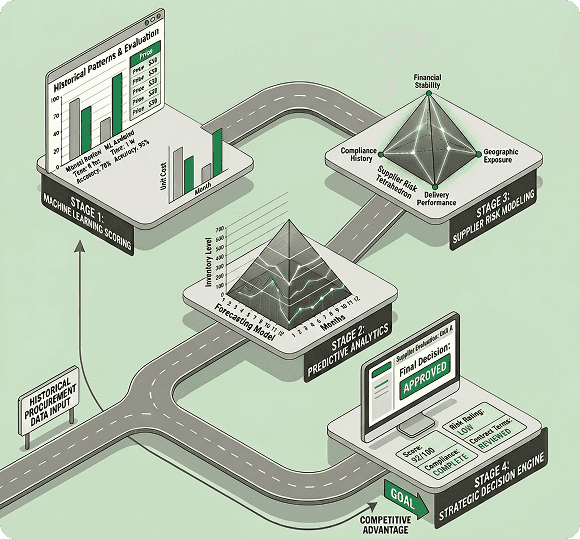
Machine Learning Scoring
Machine learning models analyze historical sourcing outcomes and evaluation patterns to support scoring decisions. Capabilities include:
- Automated bid normalization
- Pattern recognition across pricing and performance data
- Anomaly detection in supplier submissions
- Recommendation support based on past award trends
These models assist evaluators by pre-scoring responses or flagging inconsistencies, reducing manual comparison effort while preserving human oversight.
Predictive Analytics
Predictive analytics uses historical sourcing and supplier performance data to forecast future outcomes. Applications include:
- Price trend forecasting
- Demand-driven sourcing projections
- Savings potential estimation
- Performance probability modeling
This enables procurement teams to anticipate cost movements and supplier behavior before contract award.
Supplier Risk Modeling
AI-driven supplier risk modeling analyzes structured and external data sources to identify potential risk indicators. Risk assessment may include:
- Financial stability signals
- Delivery performance trends
- Compliance history
- Geographic or geopolitical exposure
The system generates risk scores that inform evaluation and approval decisions, strengthening governance and reducing exposure to supplier disruption.