
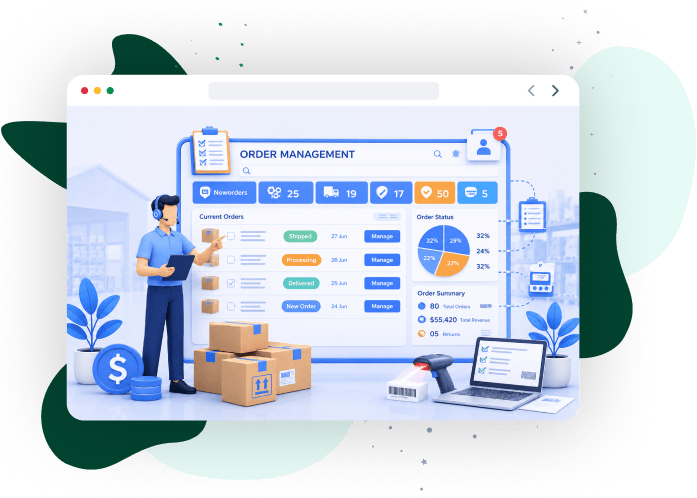
This guide defines system capabilities, integration architecture, measurable business impact, and industry-specific applications. It demonstrates how iCommuneTech’s implementation-first approach delivers controlled deployment, aligns workflows, and scales execution through an order management software platform.
What Is Order Management Software?
Order management software (OMS) controls how orders are validated, allocated, routed, and executed across sales channels and fulfillment networks, ensuring a structured flow from intake to delivery without manual intervention. It processes incoming orders, verifies stock and payment status, assigns optimal fulfillment locations, and tracks execution through closure.
According to Fortune Business Insights, the global OMS market is projected to grow from ~$4.5B in 2026 to over $11B by 2034 at a CAGR of 12%+, reflecting rising demand for scalable, multi-channel order processing systems.
Within enterprise environments, OMS acts as a decision layer that applies predefined rules to allocate inventory, select fulfillment nodes, and trigger downstream processes across warehouse and logistics systems, reducing manual coordination and stabilizing execution at scale.
A structured OMS workflow includes:
- Order ingestion: Receives transactions from commerce platforms and systems
- Validation: Confirms stock, payment, and exceptions
- Fulfillment routing: Assigns orders based on inventory, proximity, and constraints
- Execution: Triggers warehouse, shipment, and carrier processes
- Order closure: Confirms delivery and manages returns
Deployment models include:
- Cloud OMS: Centralized control across distributed networks
- Custom OMS: Tailored workflows for complex operations
- Hybrid OMS: Integrates with existing systems during transformation
OMS operates within a broader supply chain architecture, integrating with ERP, CRM, warehouse, and logistics systems. Integration with supply chain management software maintains consistent data flow and synchronized execution across systems.
What Features Define Modern Order Management Software?
Modern order management software is defined by core capabilities that establish how transactions move across commerce channels, warehouses, and logistics networks without manual intervention.
Within supply chain automation frameworks, OMS acts as the execution layer that enforces consistent order processing across distributed operations.
These capabilities are structured into four operational domains that define how orders are processed end-to-end:
Inventory synchronization across multiple channels
Shipping automation and fulfillment workflows
Order tracking with real-time reporting and exception handling
Purchase order coordination and returns processing
Together, these domains establish consistent processing across multi-node fulfillment environments and eliminate conflicts between systems.
How Does Inventory Synchronization Across Multiple Channels Work in Order Management Systems?
Inventory synchronization updates stock availability in real time based on order events across all channels and fulfillment nodes, eliminating the need for periodic reconciliation.
It must handle high transaction volumes without inconsistencies. A retail OMS deployment increased processing capacity from 2.5 million to over 8 million records per day, ensuring consistent stock alignment, as highlighted in an IBM case study.
When an order is placed, inventory is allocated from a fulfillment node, immediately updating available-to-promise stock across channels. Fulfillment records stock movement, while returns update inventory based on disposition rules such as restock, quarantine, or disposal.
The system consolidates inventory into a unified availability layer accessible across marketplaces, commerce platforms, and internal channels, preventing discrepancies and maintaining accurate visibility.
Integration with an inventory management system aligns allocation, cycle counts, and replenishment with order execution, avoiding conflicting stock states. Real-time synchronization reduces allocation conflicts, stabilizes routing decisions, and maintains accurate inventory across all channels.
How Does Shipping Automation and Fulfillment Workflow Operate in Order Management Systems?
Shipping automation operates by converting validated orders into shipment execution steps through predefined rules that control routing, carrier selection, and dispatch. Each order moves through a structured sequence that defines how it is packed, shipped, and delivered.
At scale, order management systems must process high transaction volumes without delays while maintaining accurate inventory visibility and real-time order routing across fulfillment locations.
According to an IBM case study, a retail OMS implementation processed more than 8 million records per day while supporting real-time order routing across distributed fulfillment networks, highlighting the scalability required to coordinate inventory and fulfillment operations in modern commerce environments.
Once an order is confirmed, the platform allocates a fulfillment location and selects a shipping method based on delivery constraints such as destination zone, service commitment, and package attributes. It then generates shipping labels, books shipments, and schedules dispatch as linked execution steps.
Carrier selection and shipment planning align with logistics constraints through integration with transportation workflows managed by transportation management software. This alignment ensures that shipment execution reflects available capacity, routing logic, and delivery commitments within the transportation layer.
Automated fulfillment reduces manual coordination, stabilizes shipment processing, and prevents routing inconsistencies across distributed operations. Operational improvements reduced downtime by over 80%, as highlighted in IBM’s OMS implementation research.
How Does Advanced Order Tracking and Real-Time Reporting Improve Order Management Systems?
Advanced order tracking and real-time reporting improve order management by making each order state visible, measurable, and actionable across the execution lifecycle, eliminating manual status checks and enabling faster response to delays and exceptions.
Orders progress through defined status transitions recorded as discrete events, creating a traceable path that allows teams to monitor execution and identify breakdowns without manual updates. Exception handling detects deviations, such as delayed dispatch, allocation failures, routing mismatches, or delivery issues, and triggers corrective actions or escalation workflows.
Real-time reporting converts execution data into metrics like order state distribution, processing time variance, exception frequency, and node-level throughput, enabling performance monitoring and bottleneck identification.
Integration with supply chain visibility tools extends insights to network-level monitoring by aligning order data with logistics movement and inventory flow. Together, tracking and reporting enhance execution transparency, reduce response time to disruptions, and improve control across distributed operations.
How Does Purchase Order Management and Returns Handling Work in Order Management Systems?
Purchase order management and returns handling work by controlling inbound supply and reverse logistics through structured transaction flows linked to order demand. These processes ensure that procurement aligns with order fulfillment needs and that returns are processed without disrupting inventory accuracy.
These capabilities operate across two functional areas:
Purchase Order Management
- Creates purchase orders based on demand gaps or replenishment triggers
- Specifies supplier, quantity, delivery schedule, and pricing at creation
- Monitors status across approval, dispatch, and goods receipt stages
- Captures supplier confirmations and inbound shipment updates
- Aligns inbound supply with pending order allocation through integration with purchase order software
Returns Handling
- Validates return requests against original order records
- Routes returns and assigns authorization based on defined policies
- Applies disposition rules such as restock, inspection, or disposal
- Adjusts inventory based on the return outcome
Together, these processes synchronize inbound supply with order demand, preventing inventory discrepancies and maintaining accurate stock positions. For example, when a return is validated and restocked, the OMS updates inventory in real time and makes the item available for reallocation, reducing reconciliation cycles and improving fulfillment continuity across pending orders and supplier planning.
How Should Businesses Choose Order Management Software Based on Size?
Businesses should choose order management software based on operational scale, transaction volume, and fulfillment complexity to support current operations and accommodate future growth. These factors determine configuration depth, integration scope, and the level of control required across order processing.
Small businesses operate with limited channels and simpler fulfillment structures, while mid-market and enterprise organizations manage multi-entity operations, distributed inventory, and interconnected systems that demand higher execution control.
System selection must account for increasing transaction load, additional sales channels, and expanding fulfillment networks. A limited system restricts routing flexibility, creates processing bottlenecks, and reduces visibility as operational complexity grows.
To address these challenges, iCommuneTech delivers scalable order management solutions that adapt to operational size and complexity. This includes configurable workflows for growing businesses, modular architectures for mid-market expansion, and fully customized OMS implementations for enterprise environments with multi-entity operations and distributed fulfillment networks.
The following sections outline how order management software requirements differ between small businesses and mid-market to enterprise environments, and how system capabilities must evolve to support each stage of growth.
Within digital transformation in the supply chain, OMS standardizes order processing, aligns systems, and enables scalable execution across evolving business structures.
How Does Order Management Software Support Small Businesses?
Order management software supports small businesses by simplifying order processing, consolidating sales channels, and reducing system complexity. It is designed for operations with limited transaction volume, fewer sales channels, and centralized fulfillment locations.
Small business OMS deployments focus on the following core capabilities:
Setup requires minimal integration layers and connects directly with commerce platforms. Integration with e-commerce inventory software aligns stock records with order activity across online channels.
The system operates within defined cost constraints without requiring custom development or extended infrastructure. This structure reduces operational overhead, simplifies order handling, and maintains consistent processing for small-scale operations.
How Does Order Management Software Scale for Mid-Market and Enterprise Operations?
Order management software scales by supporting multi-entity structures, distributed fulfillment networks, and high transaction volumes while maintaining strict control over routing, validation, and compliance. It enables coordinated processing across systems, regions, and business units.
Key capabilities include:
- Separation of operations across subsidiaries, regions, and entities
- Role-based access control for operational and administrative functions
- Integration with enterprise systems through structured interfaces
- Rule-based order routing based on location, service, and fulfillment constraints
- Compliance enforcement aligned with tax, audit, and regulatory requirements
Order processing spans interconnected systems, where transactions depend on upstream inputs (inventory, pricing) and downstream execution (fulfillment, logistics). OMS synchronizes these dependencies to prevent inconsistencies and eliminate manual reconciliation.
Integration with enterprise supply chain planning aligns order execution with demand, replenishment, and network configuration, enabling coordinated processing and sustained performance at scale.
iCommuneTech strengthens this integration through a flexible architecture that connects OMS with planning systems using configurable data models and API-driven workflows, allowing organizations to scale deployments without disrupting existing systems or requiring rigid platform dependencies.
How Should Businesses Compare Order Management Software Tools?
Businesses should compare order management software tools by evaluating how well each platform supports workflow customization, complex integrations, and omnichannel order management. These factors help determine whether an OMS can accommodate business-specific processes and coordinate orders across connected sales and fulfillment channels.
A practical evaluation can compare leading OMS categories across these core capabilities:
| Platform Category | Customization | Complex Integrations | Omnichannel Support |
|---|---|---|---|
| Custom OMS (iCommuneTech) | ⭐ | ⭐ | ⭐ |
| Enterprise OMS (IBM Sterling, SAP, Manhattan) | ✅ | ⭐ | ⭐ |
| E-commerce OMS (Shopify, Zoho Inventory, Brightpearl) | ❌ | ❌ | ✅ |
| Modular / Extensible OMS (Odoo, Extensiv) | ⭐ | ✅ | ✅ |
A structured OMS evaluation should examine how each platform performs across these capabilities and how they relate to the business’s operational requirements:
- Workflow customization: Whether the platform can adapt order processes, approval rules, and fulfillment workflows.
- Complex integrations: Whether it can connect with ERP, CRM, WMS, TMS, marketplaces, and other business systems.
- Omnichannel support: Whether it can coordinate orders across websites, marketplaces, stores, and other sales channels.
- Operational alignment: Whether these capabilities match the organization’s existing processes and future requirements.
This approach helps businesses compare OMS platforms based on capability fit rather than feature count. The right solution should provide the required level of customization, integration, and omnichannel support without creating unnecessary operational complexity.
What Are the Strengths and Weaknesses of Leading Order Management Platforms?
Leading order management platforms vary in architecture, configuration flexibility, and integration depth, which directly influence deployment effort, scalability, and operational control. Each platform category offers specific advantages while introducing limitations that affect how effectively it supports complex order processing requirements.
The following comparison highlights how different OMS categories perform across common enterprise use cases:
| Platform Category | Strengths | Weaknesses |
|---|---|---|
| Enterprise OMS (IBM Sterling, SAP, Manhattan) | Supports multi-entity operations, global compliance, and complex order flows | High implementation effort, longer deployment cycles, and rigid configuration |
| E-commerce OMS (Shopify, Zoho Inventory, Brightpearl) | Fast setup, native marketplace integrations, simplified interface | Limited multi-entity support, restricted orchestration capability |
| Modular / Customizable OMS (Odoo, Extensiv) | Configurable workflows, adaptable modules, scalable extensions | Requires technical control and configuration complexity during scaling |
| Retail / Omnichannel OMS (Kibo, Fluent Commerce) | Supports distributed fulfillment and omnichannel execution | Dependency on ecosystem tools, variation in extensibility |
Platform evaluation must assess how well each option aligns with business processes, integration requirements, and long-term scalability. Integration with a vendor management system tracks supplier capability, service performance, and support alignment during this assessment.
iCommuneTech delivers a custom order management system tailored to process requirements, integration architecture, and operational scale. This approach eliminates constraints associated with fixed SaaS-based OMS platforms and supports flexible execution across evolving business environments.
How Do Industry Use Cases Define Order Management Software Requirements?
Industry use cases define order management software requirements by shaping how orders are validated, routed, and fulfilled based on sector-specific workflows and operational constraints. Each industry introduces distinct conditions that influence configuration, integration, and execution logic.
E-commerce and retail require unified order intake and real-time inventory coordination across fragmented channels, while manufacturing and wholesale depend on production-linked processing, contract validation, and bulk order handling. These differences determine how validation rules, routing logic, and integrations are structured.
OMS deployment must align with these conditions to support execution accuracy and prevent process conflicts across systems. Industry use cases also guide how order workflows integrate with broader supply chain solutions across industries for coordinated execution.
How Does Order Management Work for E-Commerce and Omnichannel Retail?
Order management in e-commerce and omnichannel retail consolidates orders from multiple channels, synchronizes inventory, and routes fulfillment based on real-time availability and delivery constraints, ensuring consistent execution across channels.
These environments generate fragmented order streams from marketplaces, direct platforms, and physical stores, disrupting intake, allocation, and fulfillment coordination. OMS centralizes these inputs into a unified processing layer where validation, inventory allocation, and routing are executed consistently, preventing cross-channel conflicts.
Key challenges include:
Channel fragmentation: Multiple order sources require unified control
Inventory conflicts: Stock must be allocated without overlap
Routing complexity: Fulfillment must optimize location and delivery constraints
Inventory accuracy depends on synchronized stock visibility across all channels. Integration with multi-channel inventory control supports real-time updates during validation, preventing overselling.
Fulfillment uses rule-based routing to select optimal dispatch points—warehouses, stores, or logistics partners, supporting split shipments, partial orders, and controlled returns. Order tracking manages state transitions across validation, allocation, dispatch, and delivery, ensuring consistent execution across all order flows.
How Do Order Management Systems Support Manufacturers and Wholesale Distributors?
Order management systems support manufacturers and wholesale distributors by validating complex orders against production constraints, aligning inventory with output, and coordinating fulfillment across multiple stages. This maintains that bulk transactions meet contract terms, pricing conditions, and delivery schedules without manual intervention.
These environments handle high-volume, multi-line orders with variable pricing and strict delivery commitments. Each order is validated against production capacity, material availability, and contractual conditions before release.
OMS enforces rule-based validation, applies contract pricing, and triggers downstream actions across production, inventory, and dispatch, reducing manual effort and preventing data inconsistencies.
Key challenges include:
- Complex order structures: Multi-line orders with variable pricing and terms
- Production-linked validation: Dependence on capacity, materials, and scheduling
- Distributed fulfillment: Multi-stage execution across processing, staging, and dispatch
Inventory alignment requires synchronization between production output and stock availability. Integration with manufacturing inventory software supports accurate updates and allocation decisions.
Fulfillment uses coordinated dispatch planning based on shipment conditions, priority, and logistics availability, supporting batch handling, multi-location dispatch, and shipment scheduling.
Compliance adds control through transaction validation, audit trails, and traceability, ensuring orders meet contractual and regulatory requirements before fulfillment.
How Does a Custom Order Management System Support Complex Operations?
Custom order management systems support complex operations by defining execution logic based on business-specific rules, enabling flexible validation, integration, and coordination across multi-entity environments.
Predefined OMS platforms restrict execution in scenarios that involve variable order logic, partner-dependent workflows, and distributed fulfillment conditions. In contrast, custom implementations configure processing logic to match operational requirements across interconnected systems.
Logistics providers, 3PLs, and organizations with specialized distribution models handle partner networks, contract-driven workflows, and location-based fulfillment constraints. These environments demand configurable validation, adaptable data exchange, and consistent execution control across all participating entities.
A custom OMS supports these requirements through the following capabilities:
Rule-based validation that enforces transaction-specific conditions before processing, reducing manual checks and preventing errors at order intake
Adaptive integration that aligns data exchange with ERP, CRM, and external platforms without structural constraints, minimizing integration delays and enabling faster system expansion
Coordinated multi-entity execution that maintains consistency across partners, facilities, and fulfillment nodes, reducing operational friction and improving order flow across distributed networks
By aligning execution logic with business-specific workflows, tailored automation reduces dependency on manual intervention, eliminates process inconsistencies, and supports rapid scaling across new partners, locations, and fulfillment channels.
This structure enables flexible execution, prevents process conflicts, and maintains consistent order processing across complex operational environments through custom inventory solutions.
How Do Order Management Systems Integrate with ERP, CRM, and Other Core Systems?
Order management systems integrate with ERP, CRM, and other core platforms by synchronizing transaction data, validating orders against financial and customer records, and coordinating execution across interconnected systems. This integration maintains consistent processing without manual reconciliation.
The following integration areas define how data flows, validation logic, and execution control operate across enterprise systems:
| Integration Area | System Interaction | Execution Role | Evaluation Criteria |
|---|---|---|---|
| ERP Integration | Aligns OMS with inventory, pricing, and financial systems | Validates orders against inventory records and financial rules | Accuracy of inventory and financial data across transactions |
| CRM Integration | Aligns OMS with customer data and order history systems | Applies customer-specific data during order validation and tracking | Consistency of customer data across interactions |
| Data Synchronization | Synchronizes transaction updates across connected systems | Maintains consistent order state across OMS, ERP, and CRM | Elimination of data mismatch or duplication |
| API Framework | Structures data exchange between internal and external platforms | Supports system connectivity across multiple applications | Depth and compatibility of API coverage |
| Error Handling | Detects and resolves data exchange inconsistencies | Prevents transaction failures during integration processes | Response accuracy during integration errors |
| Integration Scalability | Expands connectivity across systems and transaction volumes | Sustains performance under increasing operational load | Stability as system connections and data flow grow |
Integration architecture must scale with system expansion and evolving data structures without disrupting existing workflows. OMS maintains execution consistency across connected platforms through ERP and CRM integration in the supply chain.
How Does Order Management Complement ERP and CRM Systems?
Order management complements ERP and CRM systems by controlling order execution while relying on ERP for financial and inventory data and CRM for customer information. This separation supports each system contributes to order processing without overlapping responsibilities.
The following table defines how OMS, ERP, and CRM interact across the order lifecycle:
| System | Core Function | Role in Order Lifecycle | System Contribution |
|---|---|---|---|
| OMS (Order Management System) | Executes order processing logic | Directs order flow across validation, routing, and fulfillment stages | Applies decision rules to control order execution |
| ERP (Enterprise Resource Planning) | Records financial and inventory data | Supplies inventory positions, pricing structures, and financial constraints | Delivers transactional data required for order validation |
| CRM (Customer Relationship Management) | Captures customer data and interaction history | Supplies customer-specific inputs for order handling | Provides context for customer-linked order conditions |
Clear role separation eliminates execution conflicts and prevents data overlap across systems. OMS controls order flow, while ERP and CRM supply structured inputs required for processing. Maintaining this separation through integrated customer relationship and vendor systems supports consistent execution across platforms.
As integrations expand, system responsiveness becomes critical for operational continuity. In a large retail OMS deployment, upgrades and environment provisioning were reduced to hours instead of weeks, demonstrating how optimized integration improves deployment speed and system readiness.
How Does Order Management Integrate With Accounting Systems and Third-Party Applications?
Order management integrates with accounting systems and third-party applications by synchronizing financial data, aligning order states across external platforms, and coordinating transaction updates without manual reconciliation. These integration layers maintain consistency across financial records, shipment status, and marketplace orders across all connected systems.
The following integration areas define how accounting, marketplace, and logistics data flows operate across the connected systems:
| Integration Area | System Interaction | Execution Role | Evaluation Criteria |
|---|---|---|---|
| Accounting Integration | Aligns OMS with financial systems | Records invoices, payments, and reconciliation data linked to each order | Accuracy of financial entries across transactions |
| Marketplace Integration | Aligns OMS with external sales platforms | Captures orders and updates status across channels | Consistency of order data across platforms |
| Logistics Integration | Aligns OMS with shipping and delivery providers | Transmits shipment data and receives delivery status updates | Reliability of shipment tracking and status updates |
| Bi-Directional Data Sync | Synchronizes data flow between OMS and connected systems | Maintains consistent updates across all systems | Elimination of data mismatch or duplication |
| API-Based Integration | Structures data exchange across systems | Supports connectivity with multiple external applications | Compatibility and coverage of API endpoints |
| Integration Monitoring | Detects and tracks data exchange status | Identifies and resolves integration failures or inconsistencies | Control over error detection and resolution |
Integration architecture must scale across additional systems, data formats, and external platforms without disrupting existing workflows. OMS sustains execution continuity through controlled API-driven supply chain integration.
How Are AI and Automation Transforming Order Management Systems?
AI and automation transform order management systems by replacing static rules with data-driven decisions that adapt to real-time conditions. These capabilities improve validation accuracy, accelerate processing, and reduce manual effort in high-volume environments.
Machine learning analyzes historical data, demand signals, and fulfillment outcomes to refine decision logic and detect anomalies such as irregular order patterns, fraud risks, or invalid inputs.
Automation standardizes workflows by controlling validation, allocation, routing, and status transitions without manual intervention, reducing delays and maintaining consistent execution.
Predictive models adjust order handling based on demand variability and supply conditions, aligning fulfillment with inventory availability. This capability is central to AI in supply chain automation, where execution continuously adapts to incoming data.
Emerging technologies such as blockchain enhance control by recording order events in immutable ledgers, enabling traceability and preventing unauthorized data changes across distributed networks.
For organizations adopting these capabilities early, AI-driven order management establishes a foundation for scalable growth by reducing operational friction, improving decision speed, and enabling faster onboarding of new channels, partners, and fulfillment nodes. This future-ready approach supports continuous optimization as transaction volumes increase and supply chain complexity evolves.
KEY CAPABILITIES INCLUDE:
- Predictive validation using historical and real-time data
- Automated workflow execution across processing stages
- Anomaly detection for irregular transactions
- Adaptive fulfillment based on demand and operational conditions
These capabilities improve decision accuracy, reduce risk, and maintain consistent execution across complex supply chain environments.
How Does AI Enable Order Processing and Predictive Analytics in OMS?
How Does Blockchain Enable Secure Automation in Supply Chain Order Processing?
Blockchain enables secure automation in order processing by validating transactions, preventing data tampering, and executing predefined actions across multiple systems without manual reconciliation. In supply chain environments where orders move across suppliers, warehouses, and logistics providers, blockchain ensures that all participants operate on a single, verified version of transaction data.
Each order event, such as creation, approval, dispatch, and delivery, is recorded in a distributed ledger, creating a continuous and verifiable transaction history across all entities. This shared record eliminates discrepancies between systems and reduces delays caused by data mismatches or manual validation.
Transaction authenticity is verified using digital signatures at each stage of the order lifecycle, ensuring that updates such as shipment confirmation or delivery status cannot be altered without authorization. This reduces risks such as incorrect order updates, duplicate invoicing, or disputed transactions.
Immutability prevents unauthorized changes to critical order data, including pricing, quantities, and shipment confirmations, maintaining consistency across financial, inventory, and logistics systems. As a result, reconciliation between systems is minimized, and order processing becomes more reliable.
Smart contracts automate execution within order workflows by triggering actions, such as payment release, shipment approval, or fulfillment authorization, when predefined conditions are met. This removes manual intervention, reduces processing delays, and ensures consistent enforcement of business rules across all participants.
Traceability links each order event to prior records, enabling end-to-end visibility across the order lifecycle. This supports faster issue resolution, audit validation, and compliance tracking across distributed supply chain networks.
How Should Organizations Implement Order Management Software with iCommuneTech?
Implementing an order management system requires structured execution across configuration, integration, and operational adoption. iCommuneTech follows a consultative implementation model that aligns system design with business rules, data architecture, and scalability requirements.
Requirements Definition and Execution Mapping
iCommuneTech defines order orchestration logic, including validation rules, allocation priorities, routing constraints, and exception handling. This phase establishes system behavior based on actual transaction flows, fulfillment models, and partner dependencies.
Solution Configuration and Workflow Orchestration
Configured workflows translate business rules into executable logic using rule engines, dynamic routing conditions, and controlled state transitions. This eliminates dependency on fixed templates and enables precise execution control.
Integration Architecture and Data Alignment
OMS connects with ERP, CRM, warehouse, and logistics systems through API-based integration and structured data models. Data alignment maintains consistency across order states, financial records, and fulfillment updates, eliminating reconciliation gaps.
Change Management and Operational Enablement
Operational teams are aligned with system workflows through controlled onboarding, process validation, and execution readiness planning. This stabilizes adoption across distributed environments and reduces transition risk.
Testing, Deployment, and Controlled Rollout
System behavior is validated through scenario-based testing, including exception handling, routing accuracy, and integration performance. Deployment follows a phased rollout model to stabilize execution under live conditions.
In large-scale OMS implementations, optimized deployment architecture has demonstrated measurable acceleration in go-live timelines. For example, a retail OMS deployment using IBM Sterling reduced deployment time by 75%, increased processing capacity to over 8 million records per day, and cut downtime by more than 80%.
ROI Measurement and Performance Optimization
Post-deployment performance is tracked using operational metrics such as order cycle time, exception rates, fulfillment latency, and system throughput. Continuous optimization refines workflows, improves processing efficiency, and supports scaling without performance degradation.
iCommuneTech Implementation Differentiators
- Consultative delivery model: Aligns system behavior with business execution logic
- Configurable execution layer: Supports rule-based orchestration and multi-entity coordination
- Global delivery capability: Enables deployment across regions and distributed fulfillment networks
- Post-launch optimization: Sustains performance under increasing transaction volume and operational complexity
Organizations adopt this model through order management system implementation, enabling controlled deployment, reduced execution friction, and scalable order processing across complex supply chain environments.