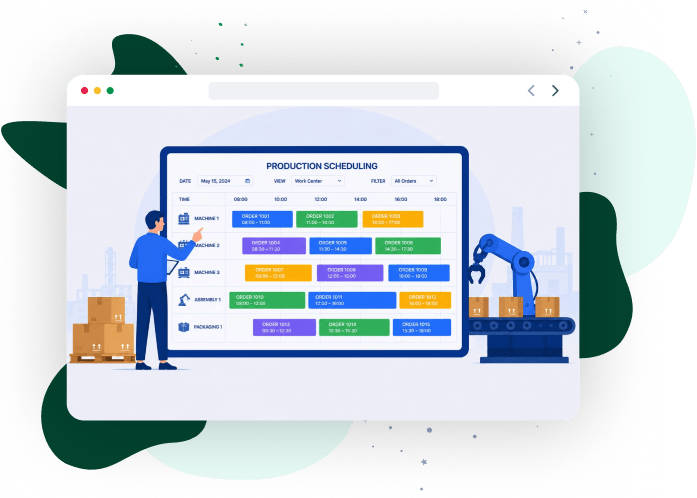

Effective production scheduling depends on balancing capacity constraints, material availability, and production priorities across manufacturing operations. This guide breaks down core features, integration capabilities, and measurable business impact so operations teams can assess solutions based on production complexity and scale.
Go for implementationWhat Are the Core Principles of Production Planning?
Production planning operates through 3 core components that convert demand into executable production schedules:
1. Demand Forecasting
Demand forecasting generates demand signals using order history, pipeline data, and market inputs. It defines what to produce and when demand will occur.
2. Material Requirements Planning (MRP)
MRP calculates component requirements using bill of materials (BOM), lead times, and current inventory. It determines what materials are needed and when they must be available.
3. Master Production Scheduling (MPS)
MPS sequences production orders into time-based schedules based on capacity, priority, and delivery commitments. It aligns production timing with demand and resource constraints.
These components operate within supply chain planning systems that validate constraints before execution.
Planning systems evaluate material availability, machine capacity, and labor allocation before releasing schedules. Recalculation engines adjust schedules when demand or supply conditions change so production avoids shortages, excess inventory, and capacity overload.
What Is the Difference Between Production Planning and Production Scheduling?
Production planning determines what needs to be produced and what resources are required, while production scheduling determines when, where, and in what sequence production tasks should be executed on the shop floor.
Planning uses inputs from demand planning software to calculate production requirements, which scheduling systems convert into time-bound tasks and machine-level assignments.
The table below compares how planning and scheduling differ across decision scope, system function, and operational impact:
| Aspect | Production Planning | Production Scheduling |
|---|---|---|
| Core Role | Defines production and material requirements | Sequences jobs and machine tasks |
| Decision Level | Planning level (monthly/weekly) | Execution level (daily/hourly) |
| Key Focus | Demand, materials, and capacity | Task timing and machine allocation |
| Primary Inputs | Demand, inventory, BOM data | Routing, capacity, and priorities |
| System Function | Creates feasible production plans | Controls execution flow |
| Optimization Goal | Balance demand and capacity | Maximize throughput and schedule adherence |
| Control Mechanism | Capacity and demand validation | Constraint-based sequencing |
| Risk if Misaligned | Unfeasible production plans | Bottlenecks and delays |
| Integrated Outcome | Stable production execution | Better resource and demand alignment |
Driving Measurable Results Across Industries
From automating manual calculations to modernizing legacy infrastructure, we build software that directly impacts the bottom line. Our custom solutions consistently reduce operational costs and accelerate process efficiency.
View Our Case Studies
What Are the Key Features and Capabilities of Modern Production Scheduling Software?
The key features and capabilities of modern production scheduling software include real-time monitoring, intelligent scheduling, automated rescheduling, schedule visualization, and capacity management.
Integrated with supply chain management software, these capabilities connect scheduling decisions with inventory, planning, and shop-floor operations in real time.
Core Capability Layers
Real-Time Monitoring
Tracks machine status, job progress, and production exceptions continuously. The system updates schedules instantly when disruptions, delays, or downtime occur.
Intelligent Scheduling Engine
Sequences operations using routing rules, job priorities, production constraints, and delivery targets to maintain efficient execution flow.
Automated Rescheduling
Automatically recalculates schedules and reallocates resources when demand, orders, or machine capacity change, reducing manual intervention.
Schedule Visualization
Provides visual timelines, machine workloads, and job dependencies to help planners evaluate production impact and make faster decisions.
Capacity and Workload Control
Monitors machine utilization, workforce availability, and workload distribution to reduce bottlenecks, idle time, and resource conflicts.
What Is Real-Time Tracking and Live Production Management?
Real-time tracking and live production management operate through 4 functional layers that capture shop floor data, detect disruptions, and trigger immediate control actions. These capabilities connect execution data across systems through supply chain visibility systems.
The 4 layers below define how real-time systems control production:
Event Capture and Status Synchronization
Production systems collect machine signals, operation timestamps, and downtime codes from PLCs and MES. They update work orders, operation progress, and WIP positions so that system data reflects actual execution.
Exception Detection and Alert Handling
Monitoring logic evaluates cycle time variance, queue buildup, and equipment faults against defined thresholds. It triggers alerts and escalation workflows when deviations occur.
Operational Visibility and KPI Tracking
Dashboards display throughput rate, cycle time, and resource utilization across production lines. Supervisors use this data to identify constraints and track performance trends.
Supervisory Control and Decision Execution
Control systems trigger job resequencing, load balancing, and resource reassignment based on live inputs. These actions maintain production continuity during disruptions.
What Are Workflow Automation and Automatic Scheduling Functions?
Workflow automation and automatic scheduling functions automate routine scheduling tasks, job sequencing, schedule updates, and workflow coordination to reduce manual effort and improve production efficiency.
Core Automation Functions
Automated job release based on material, order, and workflow conditions
Dynamic schedule recalculation when demand or supply conditions change
Standardized workflow execution and automated status updates
Controlled planner overrides with sequencing and constraint validation
Improved production flow, throughput stability, and labor utilization
These capabilities help manufacturers maintain stable scheduling execution and faster operational response.
What Are Visual Planning Tools for Intuitive Production Scheduling?
Visual planning tools are scheduling interfaces that help planners view production timelines, task dependencies, resource workloads, and scheduling constraints in an easy-to-understand visual format.
Integrated with analytics dashboards for operations, these tools help planners evaluate schedules faster, improve coordination, and respond quickly to production changes.
Timeline Structuring and Dependency Mapping
Timeline views provide a clear representation of production activities, task sequences, and operational dependencies across the manufacturing schedule. By visualizing how tasks connect and interact, planners can quickly identify scheduling conflicts, resource constraints, and potential production delays.
This allows planners to identify scheduling conflicts and operational constraints without reviewing complex data tables.
Load Visualization and Capacity Signals
Visual load maps display machine utilization, queue density, and workload distribution across production intervals. Planners can identify bottlenecks, overload conditions, and underutilized resources quickly.
Machine load visibility
Queue and workload monitoring
Capacity imbalance detection
Faster resource adjustment decisions
Scenario Testing Through Visual Manipulation
Interactive scheduling timelines allow planners to reposition operations and modify sequence order directly within the interface. The system recalculates downstream scheduling impact instantly.
- Drag-and-drop schedule adjustments
- Real-time schedule recalculation
- Downstream impact validation
- Faster production response planning
Cross-Team Schedule Alignment
Shared dashboards provide synchronized production timelines across planning, operations, and supervisory teams. This reduces interpretation gaps and improves coordination between departments.
Usability and Cognitive Efficiency
Visual scheduling layouts simplify production planning by presenting dependencies, sequence flow, and resource loads in an intuitive format that is easier to understand.
What Are Capacity Planning and Resource Management Features?
Capacity planning and resource management operate through 5 core functions that calculate capacity, allocate resources, and enforce scheduling constraints.
These features connect with inventory optimization systems to match material availability with production capacity.
The 5 functions below define how systems control capacity and resource allocation:
Finite Capacity Modeling
Systems calculate capacity at machine and work center levels using shift calendars, uptime factors, and maintenance windows. Finite loading checks whether operations fit within available capacity before scheduling.
Resource-Constrained Allocation
Allocation logic assigns operations to machines, labor, and materials based on routing and availability. This prevents double-booking and ensures exclusive resource usage.
Constraint Enforcement and Bottleneck Control
Constraint rules identify bottlenecks and limit job release into constrained work centers. Queue control regulates WIP flow to prevent congestion and cycle time delays.
Utilization Tracking and Variance Analysis
Systems track actual and planned utilization across machines and labor units. Variance analysis identifies underuse, overload, and capacity mismatches.
Material-Capacity Synchronization
Systems link operation start conditions with material availability. This prevents partial execution and reduces waiting time between process steps.
What Does Implementing and Managing the Scheduling Process Involve?
Implementing and managing the scheduling process involves preparing production data, configuring scheduling rules, validating system performance, deploying scheduling workflows, and continuously optimizing operations after go-live.
These phases align with digital transformation in the supply chain to support controlled deployment and reliable scheduling operations.
The process operates across five implementation and governance phases.
Process Baseline and Data Readiness
Defines scheduling scope and prepares routing data, resources, and order structures before deployment.
- Establishes scheduling requirements and operational scope
- Prepares accurate routing, resource, and production master data
- Improves the reliability of schedule generation and execution
Around 90% of organizations plan to overhaul planning systems, highlighting the need for strong data foundations (McKinsey & Company).
System Configuration and Rule Setup
Configures scheduling parameters, sequencing rules, constraints, and production priorities.
Applies scheduling logic and operational constraints
Defines production priorities and sequencing behavior
Controls automated schedule generation processes
Validation Through Controlled Test Cycles
Validates scheduling logic and exception handling using simulated production environments before deployment.
- Test schedules using historical production scenarios
- Validates rule execution and data accuracy
- Confirms exception handling and workflow stability
More than 60% of planning transformations fail or underdeliver, reinforcing the need for structured validation (McKinsey & Company).
Phased Rollout and Operational Stabilization
Deploys scheduling systems gradually across production operations while monitoring execution performance.
Introduces scheduling workflows in controlled phases
Monitors operational gaps and schedule adherence
Stabilizes execution across production environments
Continuous Performance Governance
Maintains scheduling accuracy through ongoing monitoring, rule refinement, and data governance.
Tracks schedule adherence and cycle-time variance
Monitors resource utilization and execution efficiency
Updates rules and corrects operational data issues
These phases help manufacturers deploy production scheduling systems with greater stability, accuracy, and long-term operational control.
What Is Inventory and Supply Chain Integration in Production Scheduling?
Inventory and supply chain integration in production scheduling connects material state changes, supplier confirmations, and logistics events with schedule execution to maintain continuity across production stages. These integrations operate through inventory management systems, so scheduling decisions reflect current supply conditions.
The 6 functions below define how integration controls production scheduling:
Inventory synchronization tracks on-hand, reserved, and in-transit inventory so production schedules reflect actual material availability.
Systems link supplier confirmations, lead times, and delivery schedules with production plans. This allows schedules to adjust based on inbound reliability. Around 45% of companies experience stockouts during peak demand periods, according to Gitnux.
WIP tracking monitors materials and products as they move through production stages, providing real-time visibility into job status, production progress, and material flow. This helps planners identify delays, prevent bottlenecks, and maintain schedule continuity across operations.
WIP tracking monitors materials and products as they move through production stages, helping maintain smooth material flow between operations.
Lot and batch traceability links materials to production orders, helping manufacturers maintain compliance, quality control, and product traceability.
Procurement integration connects purchase order milestones, including dispatch, transit, and receipt events, with production schedules.
What Are Inventory Management and Material Tracking Functions?
Inventory management and material tracking functions help manufacturers monitor inventory levels, track material movement, maintain inventory accuracy, and ensure materials are available when production requires them.
Integrated with the warehouse management system, these functions support real-time inventory visibility and controlled material flow.
Core Inventory and Material Tracking Functions
- Real-time stock ledger updates for receipts, issues, and transfers
- Inventory reservation and material issue tracking for work orders
- WIP inventory recording across production stages
- Batch, lot, and expiry tracking for traceability and compliance
- Goods receipt and quality inspection validation
- Bin-level picking, staging, and warehouse transfers
- Inventory variance detection through cycle counts and audit logs
These capabilities help manufacturers maintain inventory accuracy, traceability, and efficient material execution across production workflows.
What Does Coordinating Supply Chain and Demand Planning in Scheduling Decisions Involve?
Coordinating supply chain and demand planning in scheduling decisions involves aligning production schedules with customer demand, supplier availability, inventory levels, and transportation timelines to support reliable production and delivery performance.
Integrated with transportation management software, these controls help synchronize manufacturing execution with shipment commitments and delivery targets.
Core Coordination Functions
Captures demand updates from forecasting cycles and customer orders to adjust production schedules and job priorities.
Applies supplier limitations such as allocation caps, lead-time variability, and minimum order quantities during production planning.
Aligns production completion with carrier cut-off times, route schedules, and shipment consolidation windows.
Coordinates finished goods availability with dock schedules, delivery slots, and customer appointment windows.
Redirects orders through alternate suppliers, transport routes, or delivery modes during operational disruptions.
Prioritizes orders based on committed delivery dates and SLA requirements to maintain service reliability.
These capabilities help manufacturers improve schedule alignment, protect delivery commitments, and maintain coordinated supply chain execution.
What Are Advanced Scheduling Technologies: AI, Machine Learning, and IIoT?
Advanced scheduling technologies use artificial intelligence (AI), machine learning (ML), and the Industrial Internet of Things (IIoT) to improve production scheduling accuracy, automate decision-making, and help manufacturers respond more effectively to changing production conditions.
These capabilities support supply chain digital transformation by embedding intelligence into scheduling systems.
Modern production scheduling platforms use seven key capabilities to improve planning accuracy, operational responsiveness, and production efficiency:
AI-Based Heuristic Optimization: Systems compute near-optimal schedules using heuristic and constraint-based algorithms under multi-constraint conditions.
Machine Learning Forecast Refinement: Systems train models on historical production data to improve demand variability estimation and cycle time prediction.
IIoT Telemetry Integration: Systems stream machine-level data such as run rate, temperature, and vibration into scheduling inputs.
Predictive Maintenance Scheduling Hooks: Systems integrate failure prediction models to schedule maintenance before breakdowns occur.
Edge-Based Data Processing: Systems process data at the machine or gateway level to reduce latency and support high-frequency data ingestion.
Adaptive Model Calibration: Systems recalibrate model parameters using feedback data to improve prediction accuracy over time.
Anomaly Detection and Exception Classification: Systems detect production anomalies and classify disruptions for targeted response.
What Are AI and Machine Learning Applications in Production Scheduling?
AI and machine learning applications in production scheduling include cycle-time prediction, production sequence optimization, disruption detection, scheduling recommendations, inventory-driven automation, and continuous schedule improvement.
Integrated with automated inventory systems, these technologies connect inventory signals with scheduling actions to improve execution accuracy and responsiveness.
Smarter Cycle Time Prediction
Accurate cycle-time prediction is essential for creating realistic production schedules and maintaining delivery commitments. AI models analyze historical production data, machine performance, and operational variability to estimate how long tasks will take under changing production conditions.
AI models improve timing accuracy by analyzing:
- Historical production performance
- Machine utilization trends
- Real-time operational data
- Production variability patterns
Intelligent Sequence Optimization
Traditional scheduling often relies on fixed estimates for operation duration, which can become inaccurate when production conditions change.
Optimization models help:
- Reduce idle machine time
- Improve production flow
- Minimize changeover delays
- Increase schedule efficiency
Automated Exception Detection and Prioritization
Scheduling disruptions such as shortages, delays, and quality issues can impact production continuity if not identified early.
AI-driven exception models help:
- Detect operational disruptions faster
- Prioritize corrective actions automatically
- Classify production risks by severity
- Improve response coordination across operations
Continuous Model Learning and Adaptation
Machine learning systems continuously retrain using updated production data to maintain prediction accuracy as operational conditions evolve.
Retraining pipeline support:
- Adaptive scheduling behavior
- Improved forecasting accuracy
- Continuous performance optimization
- Better response to operational variability
AI-Based Scheduling Recommendations
Recommendation engines generate ranked scheduling actions based on operational impact and production priorities.
The system can recommend:
- Expedited production orders
- Delayed or resequenced jobs
- Split production execution
- Alternative resource allocation
Inventory-Driven Scheduling Automation
AI scheduling systems respond automatically to inventory events such as shortages, replenishment triggers, and material availability updates.
Inventory-coupled automation supports:
- Dynamic production adjustments
- Faster response to stock shortages
- Improved inventory utilization
- Better synchronization between inventory and production
What Are Scheduling Models and Dispatching Rules for Optimization?
Scheduling models and dispatching rules are methods used to prioritize jobs, sequence production activities, and allocate resources in a way that improves production efficiency, throughput, and delivery performance.
These methods integrate with order management software to convert order attributes into executable scheduling decisions.
The following approaches are commonly used to optimize production schedules and improve resource utilization:
Deterministic Scheduling Formulations:
Systems structure scheduling problems using models such as job shop and flow shop to define job order and machine assignment.
Dispatching Rule Hierarchies:
Systems rank jobs using rules such as earliest due date and shortest processing time based on urgency and workload.
Heuristic Search Strategies:
Systems evaluate multiple scheduling options to generate feasible sequences when exact optimization is not practical.
Objective Function Structuring:
Systems set goals such as reducing delays, minimizing waiting time, and balancing workload across machines.
State-Dependent Rule Switching:
Systems adjust scheduling rules based on real-time conditions such as queue levels and resource utilization.
Constraint Resource Prioritization:
Systems prioritize bottleneck resources to control throughput and prevent production slowdowns.
What Are the Top Production Scheduling Software Solutions for Manufacturers?
The top production scheduling software solutions for manufacturers typically fall into several categories, each designed to support different production environments, operational complexities, and integration requirements.
Operating within supply chain software platforms, these systems connect production planning, execution, inventory, and order management workflows.
APS (Advanced Planning and Scheduling) Suites
APS platforms support complex manufacturing environments through finite scheduling, resource coordination, and constraint-based planning.
These systems typically provide:
- Multi-resource scheduling
- Constraint and bottleneck management
- Advanced sequencing optimization
- High-volume production coordination
APS solutions are commonly used in large and operationally complex manufacturing environments.
ERP-Native Scheduling Modules
ERP-native scheduling systems embed production scheduling directly within ERP platforms to maintain centralized operational control.
Core capabilities include:
- Shared BOM and order data
- Integrated production workflows
- Unified inventory and scheduling visibility
- Consistent operational data management
These systems help organizations streamline production coordination across business functions.
Cloud-Native Scheduling Platforms
Cloud-native scheduling platforms provide centralized scheduling visibility and remote operational access across distributed manufacturing operations.
Key advantages include:
- Multi-site scheduling management
- Centralized cloud access
- Remote operational visibility
- Simplified scalability and updates
These platforms are well-suited for organizations managing distributed production environments.
Industry-Tuned Scheduling Systems
Industry-specific scheduling systems include predefined workflows and production constraints designed for specialized manufacturing sectors.
Typical capabilities include:
- Industry-specific production logic
- Preconfigured operational workflows
- Sector-focused scheduling controls
- Compliance-oriented execution support
These solutions are commonly used in discrete, batch, and process manufacturing operations.
SMB-Oriented Scheduling Tools
SMB scheduling platforms simplify production management for small and mid-sized manufacturers through faster deployment and lower operational complexity.
These tools generally offer:
- Simplified implementation
- User-friendly scheduling interfaces
- Lower infrastructure requirements
- Cost-effective operational management
They are ideal for manufacturers seeking faster adoption with limited operational overhead.
Enterprise Scheduling Frameworks
Enterprise scheduling systems support large-scale manufacturing operations with high transaction volumes and multi-plant coordination requirements.
Enterprise-focused capabilities include:
- Cross-plant production scheduling
- Large-scale operational management
- High-volume transaction processing
- Centralized execution control
These systems are designed for organizations operating complex global manufacturing networks.
Hybrid Deployment Models
Hybrid scheduling platforms combine on-premise execution with cloud-based optimization to balance operational performance and scalability.
Hybrid environments support:
- Local production execution
- Cloud-based planning optimization
- Flexible deployment architecture
- Scalable operational expansion
This approach helps manufacturers maintain performance control while supporting long-term scalability.
What Are the Leading Enterprise Production Scheduling Platforms?
Leading enterprise production scheduling platforms include iCommuneTech, NetSuite, SAP PP, and Infor. These platforms help manufacturers manage multi-site production, automate scheduling workflows, and coordinate production planning through integrated ERP and supply chain systems.
Each platform differs in deployment options, integration capabilities, scalability, and workflow flexibility, making platform selection dependent on operational requirements and business goals.

iCommuneTech Production Scheduling
- Cloud and hybrid deployment support
- Deep ERP and supply chain integration
- Custom workflows and scheduling rules
- High scalability across distributed operations
- Strong fit for complex manufacturing environments
Built for enterprises requiring configurable and implementation-driven scheduling solutions aligned to operational workflows.

NetSuite Production Scheduling
- Cloud-native SaaS deployment
- Unified ERP and scheduling environment
- Centralized business data model
- Supports multi-entity operations
- Best suited for standardized cloud operations
Designed for organizations adopting a cloud-first ERP strategy with centralized operational visibility.

SAP PP (S/4HANA)
- On-premise and hybrid deployment options
- Deep integration with SAP ERP modules
- Strong cross-plant production coordination
- High-volume routing and workflow control
- Ideal for compliance-intensive manufacturing
Focused on large-scale enterprises requiring structured process control and compliance-driven production management.

Infor Production Scheduling (CloudSuite / APS)
- Cloud and hybrid deployment support
- Flexible routing and workflow configuration
- Strong Infor ERP ecosystem integration
- High adaptability for variable production environments
- Suitable for sector-specific manufacturing operations
Supports manufacturers requiring industry-specific scheduling logic and flexible production configuration.
Suitability Summary (When to Choose Each Platform)
| Criteria | Recommended Platform |
|---|---|
| Custom workflow-driven implementation | iCommuneTech |
| Cloud-first ERP strategy | NetSuite |
| Compliance-heavy, standardized operations | SAP PP |
| Industry-specific, flexible scheduling needs | Infor |
What Are Small to Mid-Size Business Scheduling Tools?
Small to mid-size business (SMB) scheduling tools are production scheduling solutions designed to help growing manufacturers manage production planning, inventory coordination, and scheduling activities without the complexity of enterprise-level systems.
Platforms such as MRPeasy, Katana, and Fishbowl help smaller manufacturers replace manual planning while integrating with manufacturing inventory software.
The following comparison table outlines four key evaluation areas that differentiate SMB scheduling tools based on deployment model, core capability, operational focus, and best-fit business use cases:
1. Platform Comparison (Deployment and Core Capability)
| Criteria | iCommuneTech | MRPeasy | Katana |
|---|---|---|---|
| Deployment Model | Cloud / Hybrid | Cloud (SaaS) | Cloud-native |
| Core Capability | Configurable scheduling with inventory and order synchronization | MRP-linked scheduling with BOM control | Real-time inventory allocation with visual planning |
| Operational Focus | Workflow-driven implementation aligned to business processes | Material-driven order execution | SKU-level production visibility |
| Best-Fit Scenario | SMEs requiring scalable, tailored scheduling without ERP complexity | Small manufacturers are formalizing production planning | D2C and batch manufacturers prioritizing usability |
2. Functional Differentiation (How Each Tool Works)
- iCommuneTech: Provides configurable scheduling aligned with business workflows and integrates with inventory, procurement, and order systems.
- MRPeasy: Manages production using BOM-driven logic and connects procurement with order execution.
- Katana: Displays inventory and production visually to support quick scheduling decisions.
- Fishbowl: Links scheduling with inventory transactions and accounting systems for stock control.
Pricing and Adoption Characteristics
SMB production scheduling tools are designed for faster deployment, lower training effort, and simplified operational management. Most platforms focus on usability, subscription-based pricing, and lightweight integrations for growing manufacturing businesses.
Pricing Model
Most SMB scheduling platforms use subscription-based pricing based on users, modules, and feature access.
Implementation Speed
Preconfigured workflows and simplified setup processes support faster implementation and quicker operational adoption.
Training and Usability
User-friendly interfaces reduce training requirements and simplify day-to-day scheduling operations.
Integration Scope
Most tools integrate with inventory, accounting, and basic order management systems to support core operational workflows.
Scalability Limits
SMB-focused platforms may have limitations when managing multi-plant operations or highly complex production environments.
Use-Case Alignment
iCommuneTech
Best suited for organizations requiring configurable scheduling aligned to unique operational workflows and enterprise-scale execution.
MRPeasy
Recommended for manufacturers focused on material-driven production planning and MRP-based scheduling.
Katana
Suitable for businesses prioritizing visual scheduling, ease of use, and rapid implementation.
Fishbowl
Ideal for inventory-focused scheduling operations integrated with accounting and stock management workflows.
What Are Industry-Specific Platforms Like DELMIAworks and Odoo?
Industry-specific scheduling platforms help manufacturers manage batch production, product variation, and line-based operational constraints. Platforms such as DELMIAworks and Odoo integrate scheduling, production control, and material tracking through custom inventory software solutions to improve execution visibility and manufacturing coordination.
The platforms below differ in deployment flexibility, production control capabilities, and industry alignment.
iCommuneTech
- Cloud and hybrid deployment support
- Configurable scheduling and data models
- Cross-industry manufacturing adaptability
- Suitable for tailored production workflows
Designed for manufacturers requiring configurable scheduling workflows and custom operational logic across complex production environments.
DELMIAworks
- On-premise and cloud deployment options
- MES-integrated scheduling and execution
- Machine-level production monitoring
- Strong fit for discrete and packaging industries
- Supports compliance-focused manufacturing operations
Focused on manufacturers requiring machine-level visibility, MES integration, and detailed shop-floor production control.
Odoo Manufacturing
- Cloud and on-premise deployment support
- Integrated ERP and manufacturing modules
- Simplified workflow and inventory coordination
- Suitable for discrete and batch manufacturing
- Ideal for SMB manufacturing operations requiring unified systems
Provides ERP-based scheduling and integrated production workflows for small and mid-sized manufacturers.
Industry-Specific Capabilities (How Systems Control Production)
Platform Differentiation (How Each Platform Operates)
- iCommuneTech: Provides configurable scheduling frameworks aligned with custom workflows and data structures.
- DELMIAworks: Integrates scheduling with MES and machine-level data for real-time production control.
- Odoo: Connects scheduling with ERP modules to manage production, inventory, and procurement in one system.
Customization, Compliance, and Cost Profile
| Factor | iCommuneTech | DELMIAWorks | Odoo |
|---|---|---|---|
| Customization Scope | High (data model and workflow level) | Moderate (template-based extensions) | Modular (app-level customization) |
| Regulatory Coverage | Configurable | Strong (built-in compliance features) | Basic (requires add-ons) |
| Integration Model | API-driven | MES/ERP ecosystem-based | Native within Odoo ecosystem |
| Total Cost of Ownership | Variable | High | Low–Moderate |
Use-Case Alignment (When to Choose Each Platform)
| Requirement | Recommended Platform |
|---|---|
| Custom workflows and flexible data structures | iCommuneTech |
| Shop floor-integrated scheduling with compliance | DELMIAWorks |
| ERP-based scheduling with moderate complexity | Odoo |
What Are the Business Benefits of Production Scheduling Software?
The business benefits of production scheduling software include higher production throughput, shorter lead times, lower operating costs, improved delivery performance, better inventory control, and increased resource utilization.
These improvements support measurable supply chain efficiency improvements across cost, delivery, and utilization.
The 6 performance gains below define how scheduling software improves operations:
Throughput Uplift
Systems increase output by reducing idle time, minimizing changeovers, and controlling job sequencing.
Lead Time Reduction
Systems reduce order cycle time by minimizing waiting intervals and improving sequencing.
Manufacturers can reduce production ramp-up time by up to 50%, according to McKinsey & Company.
Operating Cost Reduction
Systems lower production cost by reducing overtime, minimizing scrap, and improving asset utilization.
Delivery Reliability
Systems align production completion with dispatch schedules to improve on-time delivery performance.
Inventory Compression
Systems reduce excess inventory by synchronizing production release with demand.
Up to 30% of inventory becomes obsolete due to overstocking, according to Gitnux.
Labor Output Efficiency
Systems improve labor productivity by reducing manual coordination and standardizing task execution.
Quantifiable Impact Areas
| Impact Dimension | Business Effect |
|---|---|
| Output Rate | Higher production volume per time interval |
| Lead Time | Shorter order completion cycles |
| Cost per Unit | Lower production and handling cost |
| Service Level | Higher on-time delivery performance |
| Inventory Turns | Faster turnover and lower holding costs |
| Resource Utilization | Improved machine and labor efficiency |
The following strategic benefits define long-term business impact:
Execution Consistency
Systems standardize scheduling decisions to reduce production variability.
Constraint Risk Control
Systems prioritize orders based on capacity limits and delivery commitments.
Scalable Operations
Systems support volume growth and product mix expansion without increasing planning complexity.
Digital Maturity Enablement
Systems connect planning, inventory, and execution layers to support integrated operations.
Production scheduling software helps manufacturers increase output, reduce operational costs, improve delivery reliability, and make better use of available resources. According to McKinsey & Company, top-performing organizations achieve up to four times higher ROI from planning transformations, demonstrating the long-term value of effective production planning and scheduling.
What Are the Operational Efficiency and Cost Reduction Advantages?
The operational efficiency and cost reduction advantages of production scheduling software include improved resource utilization, lower production costs, reduced waste, higher labor productivity, shorter cycle times, and better production throughput.
Key Efficiency and Cost Benefits
Automated job sequencing and dispatching to reduce manual planning
Better material usage alignment to reduce waste and excess consumption
Improved machine utilization and workload balancing
Reduced cycle times and production delays
Controlled WIP levels through inventory cost optimization strategies
Lower expediting effort through stable scheduling execution
Improved labor productivity and task coordination
Reduced quality loss through consistent sequencing and batch control
More stable energy usage and operational cost control
Manufacturing improvements can deliver up to 2× higher capital efficiency, according to McKinsey & Company. These gains align with scheduling systems that maximize machine utilization, balance workloads, and reduce idle capacity across production environments.
What Are the Collaboration Improvements and On-Time Delivery Performance Benefits?
The collaboration and on-time delivery benefits of production scheduling software include better cross-functional coordination, improved schedule visibility, faster communication, more accurate delivery commitments, and stronger on-time delivery performance.
Key Collaboration and Delivery Benefits
- Unified schedule visibility across production and logistics operations
- Production alignment with dispatch through shipment tracking software
- Real-time order status visibility for planning and customer service teams
- Automated production updates and milestone communication
- Coordination between packaging, staging, and shipment readiness
- Supplier synchronization for inbound material planning
- Accurate delivery commitments using live production status
- Alignment of production completion with transport schedules
- Early detection of disruptions and fulfillment risks
- Improved shipment accuracy and schedule adherence
- Integrated execution visibility across external logistics partners
These capabilities help manufacturers improve on-time delivery, strengthen operational coordination, and maintain more reliable fulfillment performance.
Why Choose iCommuneTech for Custom and AI-Driven Production Scheduling Software
Manufacturers choose iCommuneTech when they need production scheduling software that can adapt to complex workflows, plant-specific constraints, compliance requirements, and evolving operational demands.
It connects scheduling logic directly with execution conditions through custom supply chain software development.
The following capabilities highlight how iCommuneTech delivers tailored production scheduling solutions for complex manufacturing environments:
Plant-Specific System Design
Systems configure scheduling logic based on routing structures, resource constraints, and product variability.
AI-Augmented Decision Models
Systems embed optimization algorithms and predictive models to improve sequencing accuracy.
API-Driven Integration Architecture
Systems connect scheduling with ERP, inventory, and logistics platforms using system-agnostic APIs.
Constraint-Centric Configuration
Systems encode machine limits, changeovers, and material conditions into scheduling rules.
Compliance-Ready Frameworks
Systems support traceability, auditability, and regulatory controls through configurable structures.
Capability Differentiation (How iCommuneTech Compares)
| Capability Area | iCommuneTech | Generic Tools |
|---|---|---|
| System Architecture | Configurable, plant-aligned | Template-based |
| Scheduling Logic | Constraint-driven and adaptive | Static rules |
| Optimization Layer | Built-in AI/ML models | Limited or external |
| Integration Model | API-first and system-agnostic | Platform-bound |
| Compliance Handling | Configurable within the system | External or limited |
Unlike generic scheduling platforms, iCommuneTech designs production scheduling systems around actual operational constraints, manufacturing workflows, and enterprise-scale production requirements.
The platform focuses on scheduling precision, scalability, and seamless system integration without relying on generalized software structures.
Core Execution Strengths
Configuration-Led Deployment
Operational parameters are converted directly into scheduling logic during implementation to align systems with real production workflows.
Routing and Constraint Expertise
Scheduling models account for routing dependencies, machine constraints, and shared production resources to improve execution accuracy.
Modular Scalability
The architecture scales across multiple plants, production lines, and operational environments without redesigning the core system.
Controlled System Evolution
Scheduling rules, integrations, and workflows can be updated without disrupting ongoing production operations.
- Constraint-driven scheduling in complex manufacturing environments
- AI-enabled sequencing under changing production conditions
- Deep integration across ERP and enterprise systems
- Compliance-focused and audit-driven production operations
- Multi-site production scaling and operational coordination
Where iCommuneTech Fits Best
Together, these capabilities help manufacturers improve scheduling accuracy, adapt to changing production conditions, support operational growth, and maintain greater control across complex manufacturing environments.
Contact for Custom Build