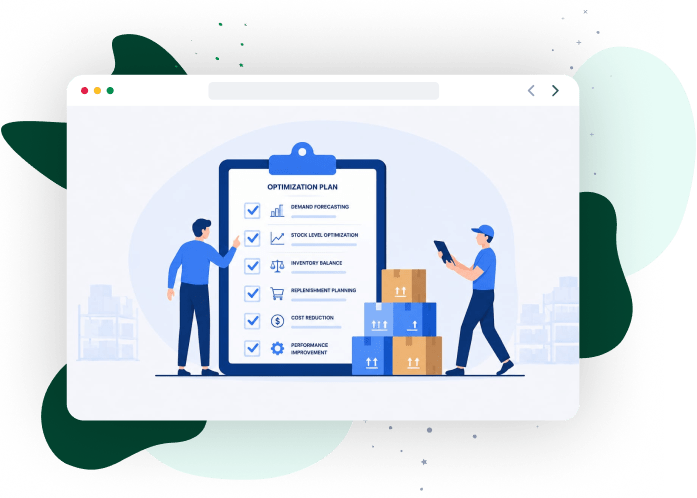
Businesses implementing advanced inventory optimization solutions gain better inventory visibility, automated replenishment, and scalable supply chain control. iCommuneTech delivers logistics-focused inventory optimization systems built for real-time execution, operational scalability, and measurable business performance.
What Is Inventory Optimization?
Inventory optimization helps logistics companies maintain the right stock levels across warehouses and distribution networks to reduce stockouts, lower carrying costs, and improve service levels.
It uses demand patterns, lead times, replenishment cycles, and real-time operational data to determine:
- How much inventory to hold
- Where to position inventory
- When to replenish stock
Unlike basic inventory management, which mainly tracks stock movement, inventory optimization improves forecasting, replenishment planning, and inventory allocation across multi-location supply chains.
For transport and logistics companies, inventory optimization helps balance cost, service performance, and operational agility across complex logistics networks. The system reduces working capital exposure, improves fill rates, and stabilizes network operations.
According to McKinsey & Company, companies reduce inventory levels by up to 30% through optimized planning, freeing working capital and eliminating excess stock.
Effective optimization also depends on a reliable inventory system foundation that provides accurate inventory visibility and real-time supply chain data.
What Should Logistics Leaders Look for in Inventory Optimization Software?
Logistics leaders should choose inventory optimization software that improves inventory accuracy, reduces excess stock, and aligns replenishment with transportation and warehouse operations.
Logistics leaders should evaluate platforms based on scalability, integration depth, forecasting accuracy, and operational flexibility.
The right platform should support:
- Multi-Location Inventory Planning
- Automated Replenishment
- Real-Time Forecasting
- WMS, TMS, and ERP Integration
- Scalable SKU and Order Management
- Real-Time Analytics and Reporting
Unlike basic inventory tools that only track stock, advanced platforms improve inventory flow, forecasting, and allocation across complex logistics networks.
Businesses operating within integrated supply chain management software environments gain better coordination between inventory, transportation, and fulfillment operations.
iCommuneTech develops inventory optimization solutions with real-time integrations, automated planning, and scalable inventory control designed for logistics and transportation companies.
What Are the Essential Features of Logistics Inventory Optimization Software?
Logistics inventory optimization software helps businesses maintain accurate stock levels, automate replenishment, and improve inventory flow across warehouses and transportation networks.
Key features logistics leaders should evaluate include:
Together, these capabilities help transport and logistics companies reduce delays, improve fulfillment accuracy, and maintain service levels across high-volume supply chain operations.
How Should Logistics Teams Choose the Right Inventory Management Software?
Choosing the right inventory management software depends on how well the platform supports operational scale, supply chain visibility, and inventory control across logistics networks.
Before selecting a platform, logistics teams should evaluate:
Operational Fit
- Supports warehouses, fulfillment centers, and multi-node operations
- Handles high SKU volumes and order velocity
- Aligns with transportation and replenishment workflows
Technology & Integration
- Integrates with WMS, TMS, ERP, and OMS platforms
- Provides real-time inventory visibility
- Supports configurable workflows and automation
Performance & Scalability
- Maintains stable performance during high transaction volumes
- Provides inventory analytics, KPI tracking, and operational reporting
- Supports long-term supply chain growth
Vendor Support
- Includes implementation support and long-term system optimization
- Supports configurable custom inventory systems for logistics operations
iCommuneTech develops inventory management solutions with scalable infrastructure, configurable workflows, and real-time integrations built for high-volume logistics environments.
Driving Measurable Results Across Industries
From automating manual calculations to modernizing legacy infrastructure, we build software that directly impacts the bottom line. Our custom solutions consistently reduce operational costs and accelerate process efficiency.
View Our Case Studies
How Does Inventory Optimization Software Integrate with Transportation and Supply Chain Systems?
Inventory optimization software integrates with WMS, TMS, ERP, and telematics systems to improve inventory visibility, automate replenishment, and align inventory decisions with real-time supply chain operations.
Key integration functions include:
WMS Integration:
Synchronizes warehouse inventory, receipts, picks, putaways, and stock movements.
TMS Integration:
Aligns replenishment and inventory allocation with shipment schedules, carrier capacity, and transportation lead times through transportation management software integration.
ERP Integration:
Connects procurement, supplier commitments, purchase orders, and inbound inventory planning.
Telematics & Tracking Integration:
Uses GPS, ETA updates, and shipment tracking data to improve in-transit inventory visibility.
Real-time synchronization helps logistics companies respond faster to:
- Shipment Delays
- Supplier Changes
- Stock Variance
- Warehouse Inventory Updates
Effective integration also requires:
Disconnected systems often create inventory errors, replenishment delays, and visibility gaps across logistics operations.
iCommuneTech develops inventory optimization solutions with real-time integrations connecting warehouse, transportation, procurement, and fulfillment systems across high-volume logistics networks.
How Does Inventory Optimization Work in Transportation Networks?
Inventory optimization in transportation networks helps logistics companies decide where inventory should be positioned and when it should be replenished based on demand, transportation schedules, warehouse capacity, and routing constraints.
The system evaluates:
- Shipment Schedules
- Transportation Lead Times
- Warehouse Capacity
- Demand Fluctuations
- Routing Constraints
to maintain inventory flow across warehouses, cross-docks, and fulfillment nodes.
Key optimization functions include:
Demand-Based Inventory Positioning
Places inventory closer to high-demand regions to improve fulfillment speed and reduce shortages.
Lead-Time & Route Planning
Adjusts replenishment timing using transportation lead times and carrier schedules.
Multi-Location Inventory Allocation
Balances inventory across warehouses and fulfillment nodes to prevent stock imbalance.
Transport & Shipment Alignment
Synchronizes replenishment with dispatch schedules and shipment cycles to reduce delays.
Automated Exception Response
Responds to shipment delays, routing disruptions, and capacity constraints automatically.
Modern systems also use real-time data from supply chain visibility systems to adjust inventory decisions using live shipment and ETA updates.
This helps logistics companies improve fulfillment speed, maintain service levels, and increase transportation efficiency.
A logistics company reduced its order-to-ship cycle time from 7 days to 48 hours after implementing an inventory management solution, according to Business Wire. This shows how inventory optimization improves fulfillment performance across transportation networks.
iCommuneTech develops inventory optimization systems with real-time planning, automated replenishment, and multi-location inventory coordination for logistics and transportation operations.
What Is the Step-By-Step Inventory Optimization Process in Logistics Networks?
Inventory optimization follows a structured process that converts supply chain data into replenishment and inventory allocation decisions across logistics networks.
Step 1: Data Collection
Captures demand, inventory, shipment, supplier, and warehouse data using a centralized inventory database structure.
Step 2: Data Science Application: Validation & Forecasting
Cleans inventory data and uses demand patterns and seasonality trends to forecast inventory requirements.
Step 3: Inventory Planning & Scenario Analysis
Calculates safety stock, reorder points, and inventory allocation while testing disruptions such as supplier delays and demand spikes.
Step 4: Execution & Replenishment
Converts planning outputs into replenishment orders, shipment schedules, and warehouse allocation decisions.
Step 5: Continuous Monitoring
Tracks fill rate, stock variance, and inventory performance to adjust inventory decisions in real time.
This process helps logistics companies reduce inventory imbalance, improve forecasting accuracy, and maintain service levels across multi-location supply chains.
iCommuneTech develops inventory optimization solutions with automated planning workflows, real-time data integration, and continuous monitoring designed for high-volume logistics operations.
How Does Inventory Optimization Software Streamline Demand Forecasting?
Inventory optimization software improves demand forecasting by converting real-time supply chain data into accurate inventory and replenishment decisions.
The system analyzes:
- Order History
- Shipment Activity
- Seasonal Demand Patterns
- Warehouse Movement
- In-Transit Inventory Data
to forecast demand more accurately across warehouses, distribution centers, and fulfillment networks.
Modern platforms continuously adjust forecasts using:
This helps logistics companies reduce overstocking, prevent stockouts, and improve replenishment timing across high-volume operations.
According to McKinsey & Company, AI reduces inventory levels by 20–30% by improving demand forecasting and inventory positioning across distribution networks.
Integration with demand planning software helps businesses connect forecasting directly with replenishment planning and inventory allocation.
iCommuneTech develops inventory optimization solutions with AI-driven forecasting, real-time planning updates, and automated replenishment workflows designed for logistics and transportation operations.
How Can Logistics Networks Reduce Overstock Inventory While Maintaining Service Levels?
Logistics networks reduce overstock by aligning inventory levels with actual demand, transportation lead times, and replenishment cycles across warehouses and fulfillment nodes.
Overstock increases carrying costs, reduces warehouse efficiency, and locks working capital into slow-moving inventory. This often happens due to:
An end-to-end optimization initiative delivered a 40% reduction in excess inventory within six months, according to Medium. This shows how demand-driven inventory planning reduces surplus stock without affecting service levels.
Modern inventory optimization systems reduce overstock through:
- Dynamic Safety Stock Adjustments
- Demand-Based Replenishment
- Multi-Location Inventory Balancing
- SKU Performance Optimization
- Transit-Aware Replenishment Planning
- Real-Time Inventory Monitoring
Execution of stock inventory control methods helps logistics companies reduce excess inventory while maintaining fulfillment performance and operational stability.
Key business benefits include:
- Lower Working Capital Costs
- Better Warehouse Space Utilization
- Higher Inventory Turnover
- Improved Service Levels
iCommuneTech develops inventory optimization solutions that help logistics and transportation companies control excess inventory, improve replenishment accuracy, and maintain efficient inventory flow across multi-location supply chains.
What Are the Key Challenges Facing Logistics Providers in Inventory Optimization?
Logistics providers face demand variability, network complexity, perishability, lead-time uncertainty, regulatory constraints, and delayed data, all of which disrupt inventory accuracy and execution consistency across distributed operations.
The following mapping shows how each challenge affects operations and how optimization systems address them:
Challenge–Response Mapping
| Challenge | Operational Impact | Optimization Response |
|---|---|---|
| Demand Volatility | Irregular order patterns create stock variance and unstable coverage | Incorporates rolling forecasts and variance control to stabilize demand signals |
| Node Interdependence | Imbalance across DCs, hubs, and last-mile nodes affects availability | Coordinates allocation rules across interconnected nodes |
| Shelf-Life Constraints | Expiry exposure increases write-offs for perishable SKUs | Enforces FEFO-based stock rotation and lifecycle prioritization |
| Lane Variability | Transit inconsistency distorts replenishment timing | Models lane-level lead-time distributions for accurate scheduling |
| Regulatory Constraints | Cross-border and handling rules delay movement | Embeds compliance rules into allocation and movement decisions |
| Data Latency | Delayed updates create parameter drift and decision lag | Synchronizes data through event-driven ingestion |
| Capacity Limits | Storage constraints restrict inventory positioning | Applies capacity-aware allocation logic |
| Supplier Variance | Inbound inconsistency affects receipt timing | Adjusts order cycles using supplier reliability patterns |
These challenges require systems that continuously adjust parameters based on real-time inputs, network dependencies, and operational constraints. Addressing supply chain automation challenges delivers stable parameter control, improves allocation accuracy, and maintains service levels under variable network conditions.
iCommuneTech builds inventory optimization systems with constraint-aware models that deliver consistent execution across logistics environments.
What Are the Core Inventory Optimization Techniques Used in Logistics Networks?
Logistics companies use inventory optimization techniques to improve stock accuracy, reduce excess inventory, and maintain stable fulfillment across warehouses, transportation hubs, and distribution networks.
Different techniques solve different inventory challenges within the supply chain:
Inventory Control Techniques
Min-max rules, reorder points, and safety stock thresholds maintain consistent replenishment for stable inventory categories.
AI & Predictive Forecasting
Machine learning models analyze demand changes, shipment activity, and operational trends to improve forecasting accuracy and replenishment timing.
Multi-Echelon Inventory Optimization (MEIO)
MEIO coordinates inventory across warehouses, fulfillment centers, and transportation nodes to reduce stock imbalance across the network.
Constraint-Aware Planning
Optimization models account for transportation capacity, lead times, warehouse limits, and operational restrictions before generating replenishment decisions.
SKU-Based Inventory Strategies
Businesses apply different inventory policies based on SKU demand, value, seasonality, and movement patterns.
Real-Time Inventory Rebalancing
Modern systems automatically redistribute inventory across locations using live operational and shipment data to prevent shortages and overstocking.
Advanced supply chain planning systems combine these techniques to improve inventory visibility, replenishment accuracy, and operational efficiency across logistics networks.
iCommuneTech develops inventory optimization solutions with AI-driven forecasting, automated replenishment, and multi-location inventory coordination designed for logistics and transportation operations.
What Are Rule-Based and Statistical Inventory Optimization Techniques and Where Do They Fit?
Rule-based and statistical inventory optimization techniques define baseline inventory control using fixed thresholds and historical demand patterns. These methods suit stable, low-variance SKUs and controlled operational environments.
Rule-Based Techniques
- Min–Max Policies: Set lower and upper stock limits and trigger replenishment when thresholds are breached
- Reorder Point Triggers: Calculate reorder levels based on lead-time demand and initiate replenishment at defined points
- Static Buffer Levels: Maintain fixed safety stock without dynamic adjustment
These techniques provide deterministic control with low computational overhead and predictable execution.
Statistical Techniques
- ABC Segmentation: Classifies SKUs by value contribution to prioritize control intensity
- Variance Smoothing: Applies moving averages or exponential smoothing to reduce demand variability
- Service-Level Buffers: Calculates safety stock using historical demand and lead-time distributions
These methods incorporate variability but rely on historical patterns to guide decisions.
Fit in Operations
Rule-based and statistical methods support baseline control for stable SKU segments, rapid deployment scenarios, and fallback logic during system exceptions. They align with perpetual inventory system logic to maintain continuous stock tracking and threshold-based replenishment.
Limitations
- Do not respond to real-time demand shifts
- Do not coordinate inventory across multiple nodes
- Maintain rigid parameters that can create excess or shortages
- Depend on historical data without adapting to new patterns
Transition to Advanced Models
Dynamic logistics environments require adaptive models that combine stochastic methods, machine learning, and network coordination to update parameters continuously and synchronize inventory decisions across nodes.
iCommuneTech integrates rule-based and statistical techniques as baseline layers within advanced optimization frameworks to deliver controlled execution and support transition to adaptive inventory strategies.
How Does AI-Powered Inventory Optimization Improve Logistics Performance?
AI-powered inventory optimization improves logistics performance by converting real-time supply chain data into accurate forecasts, adaptive inventory planning, and automated replenishment decisions.
Core AI Capabilities
AI-driven systems improve inventory control through:
Demand Forecasting: Detects demand patterns and improves forecast accuracy across SKU-location networks
Anomaly Detection: Identifies irregularities in orders, inventory movement, and lead times
Dynamic Replenishment: Adjusts order quantities and replenishment timing automatically
Demand Sensing: Uses shipment events, POS data, and operational signals to refine short-term forecasts
Adaptive Safety Stock: Updates buffer levels based on demand variability and operational conditions
Operational Benefits
These capabilities help logistics companies:
- Stabilize inventory for high-variance SKUs
- Respond faster to disruptions and demand shifts
- Improve inbound scheduling accuracy
- Maintain balanced inventory across multiple locations
Unlike static inventory models, AI systems continuously update inventory decisions using real-time operational data.
AI models operate within supply chain analytics platforms that combine forecasting, inventory control, and performance monitoring into a unified system.
Effective deployment requires accurate inventory data, continuous model validation, and integration with warehouse and transportation systems.
iCommuneTech develops AI-driven inventory optimization solutions with scalable ML pipelines, automated replenishment, and real-time inventory coordination for logistics and transportation operations.
How Do Multi-Echelon Inventory Optimization Models Improve Control Across Logistics Networks?
Multi-echelon inventory optimization (MEIO) models improve control by coordinating inventory parameters across all nodes in a network, ensuring stock flows efficiently while maintaining service targets and reducing excess inventory.
Core MEIO Capabilities
MEIO systems use the following capabilities to manage inventory across interconnected nodes:
Echelon-Level Parameter Setting: Calculates safety stock and order quantities across upstream and downstream nodes to maintain balanced coverage.
Node Dependency Modeling: Maps supply relationships between nodes to reflect upstream and downstream impact on inventory decisions.
Lead-Time Propagation: Accounts for cumulative transit and handling time across network tiers to improve replenishment timing.
Demand Pooling: Aggregates demand across nodes to reduce variability and stabilize inventory requirements.
Tiered Inventory Positioning: Allocates stock based on node role and service priority to improve distribution efficiency.
Operational Benefits
These capabilities deliver the following advantages in logistics networks:
- Risk Pooling: Reduces total buffer requirements by aggregating variability across nodes.
- End-to-End Control: Maintains coordinated inventory decisions across all distribution layers.
- Stock De-duplication: Eliminates redundant buffers across multiple nodes.
- Service Stability: Aligns inventory flow with node-level demand requirements.
- Working Capital Efficiency: Reduces excess inventory through coordinated allocation.
Execution Requirements
Effective MEIO implementation requires:
Maintain consistent SKU, inventory, and demand datasets across all nodes
Integrate with warehouse management system coordination to ensure accurate execution
Represent node hierarchy, lanes, and flow dependencies within the system
MEIO models treat the entire network as a single system to deliver coordinated parameter control and efficient inventory distribution across all nodes. iCommuneTech implements MEIO frameworks with node-level synchronization to deliver controlled inventory flow and consistent execution across logistics networks.
How Do Inventory Optimization Analytics Drive Decisions in Logistics Networks?
Inventory optimization analytics convert demand, supply, and transport data into actionable decisions that control replenishment, allocation, and routing across logistics networks. The analytical framework defines how data transforms into decisions:
Analytical Framework
| Layer | Method | Decision Output |
|---|---|---|
| Descriptive | KPI aggregation and time-series views | Identifies stock variance, fill-rate gaps, and turnover inefficiencies |
| Diagnostic | Driver analysis on demand, supply, and lane signals | Determines root causes such as lead-time spikes or node imbalance |
| Predictive | Time-series and ML forecasting models | Generates demand projections and coverage targets |
| Prescriptive | Optimization under constraints (capacity, MOQ, lanes) | Produces order quantities, node allocations, and shipment plans |
These layers move from visibility to action, enabling systems to detect issues, diagnose causes, forecast demand, and execute optimized decisions.
Decision Drivers
Analytics systems translate outputs into the following operational decisions:
Order Sizing & Timing
Sets replenishment quantities using demand forecasts and lead times
Inventory Allocation
Positions stock across warehouses and fulfillment nodes based on demand and capacity
Shipment Coordination
Aligns dispatch planning with carrier schedules and transportation capacity
Exception Management
Detects stock variance, ETA delays, and operational disruptions
KPI Tracking
Key inventory optimization KPIs include:
These metrics help logistics teams monitor inventory performance, fulfillment efficiency, and replenishment accuracy.
Execution Enablement
Dashboards, alerts, and automated workflows convert analytics into real-time operational decisions. Integration with supply chain analytics insights centralizes inventory data, forecasting, and performance monitoring across logistics systems.
iCommuneTech develops analytics-driven inventory optimization solutions with KPI monitoring, automated decision workflows, and real-time supply chain visibility for logistics operations.
What Are the Most Valuable Inventory Optimization KPIs for Logistics Operations?
Key inventory optimization KPIs measure stock movement, service performance, demand coverage, and fulfillment speed to guide replenishment and allocation decisions at the SKU–location level.
The following KPI set defines how logistics teams track and control inventory performance:
KPI Set
| KPI | Definition | Operational Use |
|---|---|---|
| Inventory Turns | Annualized ratio of COGS to average inventory | Identifies slow-moving stock and excess working capital |
| Fill Rate | Share of order lines fulfilled from available stock | Measures service performance at dispatch nodes |
| Days of Supply (DoS) | On-hand inventory expressed in demand days | Controls coverage and limits overstock exposure |
| Backorder Rate | Portion of demand not met at request time | Tracks shortage frequency and service gaps |
| Order Cycle Time | Elapsed time from order release to delivery | Evaluates end-to-end fulfillment speed |
Decision Use
These KPIs drive the following operational decisions:
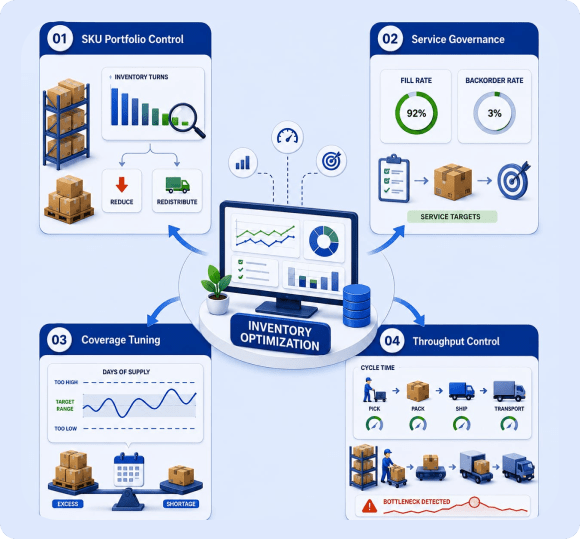
Uses inventory turns to identify low-velocity SKUs for reduction or redistribution.
Uses fill rate and backorder rate to enforce service targets.
Uses days of supply to balance stock levels and prevent shortages or excess.
Uses cycle time to detect bottlenecks across pick, pack, ship, and transport stages.
Measurement Layer
Accurate KPI tracking requires synchronized SKU–location balances, order events, and shipment milestones. Dashboards and alerts within inventory reporting systems highlight threshold breaches and trend shifts to support timely intervention.
iCommuneTech implements KPI-driven optimization frameworks with standardized metrics, alerting, and audit controls to maintain consistent performance across logistics networks.
How Does Scenario Analysis Help Anticipate Disruptions in Logistics Networks?
Scenario analysis helps logistics teams test disruptions, measure operational impact, and define response actions before issues affect inventory flow and fulfillment performance.
Common Scenario Types
Logistics teams typically model:
Scenario Modeling Process
Scenario analysis evaluates how inventory systems respond under changing supply chain conditions through:
- Baseline Inventory Assessment
- Demand or Capacity Disruption Testing
- Impact Measurement on Fill Rate and Inventory Levels
- Response Planning & Policy Evaluation
- Automated Action Playbooks
Operational Outputs
Scenario models help businesses:
- Reallocate inventory across locations
- Prioritize critical shipments
- Adjust replenishment quantities
- Activate alternate transportation routes
- Maintain service continuity during disruptions
Real-time inputs from supply chain risk visibility systems improve scenario accuracy using live ETA updates, capacity alerts, and operational signals.
iCommuneTech develops scenario analysis frameworks with automated response workflows, disruption modeling, and real-time supply chain visibility for logistics and transportation operations.
What Are the Key Industry Use Cases for Inventory Optimization in Logistics?
Inventory optimization helps logistics companies improve inventory flow, reduce operational delays, and maintain service levels across different supply chain models.
Different logistics segments use inventory optimization to solve specific operational challenges:
Freight & Line-Haul Operations
Aligns inventory movement with transportation schedules, lane capacity, and delivery timelines to reduce dwell time and missed cut-offs.
3PL Operations
Improves client-level inventory control, SLA management, and warehouse utilization across shared distribution environments.
Warehousing & Distribution Centers
Optimizes slotting, replenishment, and inventory allocation to reduce congestion and improve fulfillment speed.
Multimodal Logistics
Coordinates inventory movement across road, rail, sea, and air transportation networks to improve transfer efficiency.
E-Commerce Fulfillment
Supports high-order volumes, faster replenishment, returns management, and last-mile fulfillment operations.
Cold Chain Logistics
Controls temperature-sensitive inventory using expiry-based allocation and compliance-focused inventory tracking.
Across these logistics models, inventory optimization helps businesses:
- Reduce Excess Inventory
- Improve Warehouse Efficiency
- Maintain SLA Performance
- Increase Fulfillment Speed
- Improve Transportation Coordination
Integration with 3PL software systems helps logistics providers improve inventory visibility, client-level inventory control, and operational scalability across complex distribution networks.
iCommuneTech develops inventory optimization solutions tailored for freight, warehousing, e-commerce, cold chain, and 3PL operations with real-time planning, inventory coordination, and automated replenishment capabilities.
What Are the Common Pitfalls in Inventory Optimization Projects and How Can They Be Avoided?
Inventory optimization projects often fail because of poor data quality, disconnected systems, weak process governance, and low operational adoption.
These issues can lead to inaccurate inventory decisions, replenishment delays, and inconsistent supply chain performance.
Common challenges include:
Poor Inventory Data
Incorrect SKU, warehouse, or inventory records reduce forecasting and replenishment accuracy.
Disconnected Systems
Weak WMS, TMS, or ERP integration creates delayed inventory updates and visibility gaps.
Static Planning Models
Fixed inventory rules fail to adapt to changing demand and transportation conditions.
Limited Operational Visibility
Missing alerts and monitoring delay responses to shortages, shipment disruptions, and stock imbalance.
Lack of Ownership & Adoption
Poor coordination between operations, planning, and IT teams slows implementation success.
Compliance & Process Gaps
Missing controls increase operational risk and regulatory exposure across logistics networks.
To reduce implementation risk, logistics companies should focus on:
- Real-Time System Integration
- Accurate Inventory Data Management
- Continuous Model Monitoring
- Phased Deployment & Team Training
- Strong Governance & Audit Controls
Managing supply chain compliance risks also helps businesses maintain operational stability and avoid regulatory disruptions.
iCommuneTech develops inventory optimization solutions with governed integrations, real-time data pipelines, and scalable deployment frameworks designed for logistics and transportation operations.
How Can Logistics Providers Achieve ROI With Inventory Optimization?
Logistics providers achieve ROI by reducing excess inventory, improving service performance, lowering fulfillment costs, and increasing operational throughput through optimized policies and automated execution.
A pharmaceutical manufacturing company reduced overhead costs by 32% within one year after implementing an inventory management solution, according to Infinity Research. This result reflects how optimized inventory policies reduce operational costs and improve financial performance.
ROI Drivers
The following drivers convert optimization into measurable financial outcomes:
| Driver | Mechanism | Financial Effect |
|---|---|---|
| Working Capital Release | Depletes excess buffers and slow movers | Improves cash flow and balance sheet efficiency |
| Service Attainment | Increases on-time, in-full fulfillment | Protects revenue and reduces penalties |
| Cost-to-Serve Reduction | Cuts split shipments, expedites, and reworks | Lowers per-order fulfillment cost |
| Throughput Gain | Optimizes pick density, batching, and sequencing | Increases orders processed per labor hour |
| Write-Off Reduction | Controls aging and near-expiry stock | Reduces obsolescence losses |
| Transport Spend Control | Aligns loads with capacity and cut-offs | Reduces premium freight and idle capacity |
Value Levers
These drivers are enabled through the following optimization levers:
- Policy Optimization: Sets order quantities, reorder triggers, and allocation rules based on SKU–location behavior.
- Execution Automation: Automates order release, reallocation, and exception handling across all execution systems.
- Constraint Encoding: Applies MOQ, capacity, cut-offs, and lane limits within decision logic.
- Model Governance: Maintains parameter accuracy through versioning, backtesting, and approval workflows over time.
Measurement
ROI is measured using operational and financial metrics:
- Before/After Delta: Tracks changes in inventory value, turns, fill rate, and backorder rate across optimization cycles.
- Cost-to-Serve: Measures per-order cost across nodes and transport lanes.
- Cycle Time: Evaluates order release to delivery latency at each network stage.
- Exception Rate: Tracks manual interventions per 1,000 orders to quantify automation effectiveness.
Implementation aligned with supply chain cost optimization converts policy improvements into measurable financial outcomes across every logistics network.
Operational Impact
- Releases working capital from excess inventory
- Reduces fulfillment and transport costs
- Increases throughput without proportional cost growth
iCommuneTech delivers ROI through policy optimization, execution automation, and governed models tailored to the constraints of every logistics network.
What Are Sample ROI Outcomes for Logistics Providers Using Inventory Optimization?
Inventory optimization delivers measurable ROI by reducing excess stock, improving service performance, lowering operational costs, and increasing execution efficiency across logistics networks.
Typical outcomes observed across logistics segments include:
Segment-Level ROI Outcomes
Warehousing Operations:
Reduces excess inventory and improves space utilization by eliminating low-velocity stock and aligning inventory levels with actual consumption patterns.
3PL Operations:
Improves client-level allocation accuracy and reduces stock duplication by enforcing SLA-based segmentation across shared facilities.
Freight and Transportation Networks:
Lowers cost-to-serve by reducing dependency on expedited shipments and aligning inventory flow with lane capacity.
E-commerce Fulfillment:
Improves order completion consistency during demand spikes by optimizing allocation logic and replenishment timing.
Measurable Performance Improvements
Inventory optimization impacts key performance areas:
Inventory Reduction
Decreases excess stock and frees working capital tied to slow-moving inventory.
Service Level Improvement
Increases fill rate and order fulfillment reliability across all dispatch nodes.
Cost Efficiency
Reduces fulfillment, storage, and transport costs per order across all nodes.
Throughput Gains
Improves order processing speed and operational flow without proportional cost growth.
Performance tracking relies on continuous measurement of inventory value, service attainment, fulfillment efficiency, and cost-to-serve.
Integration with logistics analytics performance connects operational improvements to financial outcomes through real-time dashboards and KPI monitoring.
iCommuneTech delivers ROI by combining analytics-driven parameter control, execution automation, and network-aligned optimization models that help logistics providers to sustain performance gains and operational stability.
How Should Logistics Teams Calculate Total Cost of Ownership for Inventory Optimization Solutions?
Logistics teams calculate the total cost of ownership (TCO) for inventory optimization solutions by evaluating all upfront and ongoing costs against the system’s ability to reduce operating expenses and improve efficiency over time.
The following components define the full cost structure:
TCO Cost Components
| Cost Category | Cost Elements | Consideration |
|---|---|---|
| Licensing | Subscription tiers, modules, and user seats | Align features with planning scope to avoid over-licensing |
| Integration | API build, data mapping, middleware | Define endpoints, event volumes, and schema requirements |
| Infrastructure | Compute, storage, data transfer | Size workloads based on SKU–location scale and refresh frequency |
| Implementation | Configuration, data onboarding, testing | Estimate effort required for network-specific setup |
| Change Management | Training, SOP updates, rollout support | Ensure adoption across operations and planning teams |
| Run-State Operations | Model maintenance, monitoring, support | Plan for continuous tuning and system upkeep |
These components determine the total investment required to deploy and sustain the system.
Evaluation Criteria
Logistics teams should evaluate TCO based on:
Ability to support SKU growth, warehouse expansion, and higher transaction volumes
Effort required to configure workflows, inventory rules, and operational constraints
Number of systems and interfaces required across the supply chain
Infrastructure, monitoring, and system maintenance requirements
Understanding the full inventory system cost structure helps businesses balance implementation costs with long-term operational efficiency. Scalable platforms reduce manual effort, improve adaptability, and maintain lower long-term operating costs.
iCommuneTech develops inventory optimization solutions with scalable infrastructure, controlled deployment models, and real-time integrations designed for predictable TCO and long-term logistics performance.
Why Choose iCommuneTech for Inventory Optimization System Development?
iCommuneTech develops inventory optimization solutions designed for high-volume logistics and transportation networks.
Our platforms help businesses improve inventory accuracy, automate replenishment, reduce excess stock, and maintain service levels across warehouses, fulfillment centers, and transportation operations.
Why Logistics Companies Choose iCommuneTech
Logistics-Focused Architecture:
Built for multi-location supply chains, transportation constraints, and high SKU volumes.
Configurable Inventory Workflows:
Supports custom replenishment rules, service-level policies, and operational requirements.
Real-Time System Integration:
Connects with WMS, TMS, ERP, and fulfillment systems for synchronized inventory visibility and execution.
Scalable Planning & Automation:
Handles large transaction volumes with automated inventory updates and replenishment planning.
Controlled Deployment Approach:
Uses phased implementation, validation, and monitoring to reduce operational risk.
Continuous Optimization & Support:
Provides ongoing monitoring, workflow optimization, and system scalability support.
Businesses requiring tailored workflows benefit from custom inventory solution development aligned to their logistics network and operational goals.

iCommuneTech delivers inventory optimization systems with real-time planning, scalable infrastructure, and integrated execution designed for modern logistics operations.
Build a Logistics-Focused Inventory Optimization System