
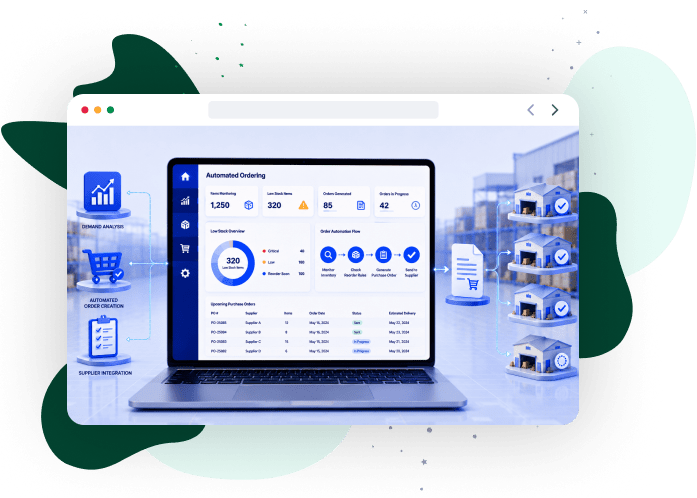
This guide explains how automated ordering systems operate, covering core features, system integrations, and measurable business outcomes such as reduced processing cost, faster order cycles, and improved inventory accuracy. It also outlines how iCommuneTech configures these systems to align with enterprise workflows, integration requirements, and operational constraints.
Go for implementationWhat Is the Role of Automated Ordering Systems in Supply Chain Execution and Resilience?
Automated ordering systems manage order execution by validating inputs, verifying inventory, and routing transactions across connected enterprise systems, reducing manual errors and processing delays. The system processes orders through defined stages where data passes validation rules, triggers inventory checks, and routes based on fulfillment conditions, updating connected systems at each step to maintain consistent records without manual reconciliation.
This structure improves inventory accuracy and transaction consistency by synchronizing order data across procurement, inventory, and financial systems through supply chain automation systems, while maintaining supply chain resilience by controlling order flow based on demand signals and operational constraints.
What Is an Automated Ordering System?
An automated ordering system executes the end-to-end order lifecycle from order capture to fulfillment by applying rule-based validation, inventory checks, and routing logic across connected systems. It replaces manual data entry and disconnected tools with structured processing managed through order management software systems, reducing human error and accelerating order execution.
Legacy order processing relied on spreadsheets, email approvals, and isolated applications, creating delays, data inconsistencies, and gaps between order capture, inventory updates, and fulfillment actions. Automated ordering systems eliminate these gaps by enforcing controlled execution across integrated systems.
What Are the Core Components of Modern Automated Order Management Systems?
Modern automated order management systems use defined processing layers to execute order capture, validation, inventory allocation, fulfillment routing, payment handling, and invoicing across integrated platforms. These components synchronize order and inventory data through inventory and order synchronization, ensuring accurate transaction flow across Enterprise Resource Planning (ERP), warehouse, and financial systems.
The following components define how the system processes and controls each stage of the order lifecycle:
- Order Intake Layer: Receives order inputs from source systems and converts them into structured data for downstream processing.
- Rule Processing Layer: Applies pricing rules, approval logic, and validation checks to determine order eligibility and execution status.
- Inventory Commitment Layer: Allocates available stock based on real-time inventory data and predefined allocation rules.
- Fulfillment Routing Layer: Assigns orders to fulfillment locations based on inventory position, distribution logic, and operational constraints.
- Payment Processing Layer: Records transaction values and triggers payment workflows aligned with financial systems.
- Billing Layer: Generates invoices and links them to completed transactions for financial tracking and reconciliation.
Each component connects through integration points with ERP, Warehouse Management System (WMS), and financial platforms, allowing buyers to evaluate system completeness based on how well these modules support end-to-end order execution.
How Do Automated Ordering Systems Work Across the Supply Chain?
Automated ordering systems work through order processing workflows across the supply chain that execute orders in sequential stages, where each step triggers the next based on predefined execution logic. Workflows move orders from intake to completion by passing validated data between systems, updating inventory positions, and triggering downstream actions based on real-time conditions.
Execution depends on event-based triggers, where each completed action, such as validation or inventory confirmation, automatically initiates the next step in the process. This mechanism ensures that order data updates propagate across connected systems in real time, reducing delays and eliminating the need for manual coordination.
What Technologies Power Automated Ordering Systems and Platform Integration?
Automated ordering systems use a layered technology stack that manages data exchange, system integration, and decision execution across enterprise platforms. This architecture operates through a supply chain digital transformation architecture, where each layer controls a specific function within order processing environments.
The following layers define how the system integrates and processes transactions:
Connects ERP, warehouse, inventory, and financial systems through Application Programming Interface (API) orchestration and structured data mapping, enabling consistent data exchange across platforms.
Validates, transforms, and records transaction data, ensuring accurate and synchronized system updates during order execution.
Applies AI and machine learning models alongside rule engines to detect exceptions, analyze transaction patterns, and drive real-time decision-making within order workflows.
Extends system capability by integrating new sales channels, applications, and workflows without disrupting existing configurations, enabling multi-channel order processing.
The global warehouse automation market is projected to reach $119.86 billion by 2034, according to Fortune Business Insights. This growth reflects the expansion of automated fulfillment environments that require integrated ordering systems to manage high transaction volumes.
iCommuneTech configures these layers by aligning integration frameworks, data models, and execution logic with enterprise system requirements, enabling scalable and resilient order processing across multi-system environments.
How Do AI and Machine Learning Improve Automated Order Processing Systems?
Artificial intelligence and machine learning improve automated order processing by enabling systems to analyze data patterns, predict demand, and automate decision-making across order workflows. These capabilities function through supply chain analytics and intelligence systems, where algorithms process transactional data and operational signals in real time.
Machine learning models analyze demand trends, supplier performance, and order variability to drive forecasting accuracy and inventory allocation decisions. Natural language processing (NLP) converts unstructured inputs such as emails and documents into structured order data, allowing systems to capture orders without manual data entry.
AI-driven exception management detects issues such as pricing errors, quantity mismatches, and incomplete orders, and automatically triggers corrective actions based on predefined rules. Continuous model learning improves detection accuracy over time by adapting to historical transaction patterns.
For example, if a purchase order is raised with a price that differs from the agreed supplier rate, the system flags the deviation instantly, blocks processing, and routes the order for approval, preventing incorrect payments or downstream reconciliation issues.
How Are Automated Ordering Systems Integrated with ERP and EDI Platforms?
Automated ordering systems integrate with ERP and Electronic Data Interchange (EDI) platforms by mapping transaction data, validating formats, and synchronizing records across enterprise systems and external partners, ensuring real-time data exchange and operational visibility. This integration functions through supply chain integration and visibility systems, where standardized communication protocols control how data moves across procurement, inventory, and financial systems.
The following integration layers define how data is processed and exchanged between systems:
| Integration Layer | Function | Technical Mechanism |
|---|---|---|
| ERP Integration | Maps order data to enterprise records | Schema mapping, item master alignment, and ledger synchronization |
| EDI Integration | Transmits structured documents to external partners | ANSI X12 / EDIFACT exchange, protocol-based transmission |
| Data Mapping Layer | Converts system-specific data formats | Field mapping, format transformation, code standardization |
| Validation Layer | Verifies data accuracy before processing | Schema validation, format checks, rule enforcement |
| Exception Handling Layer | Detects and resolves data or transmission errors | Error detection, exception routing, and retry mechanisms |
Integration challenges occur when systems use different data formats and communication standards, leading to data mismatches, processing errors, and limitations with legacy platforms such as SAP or Oracle. iCommuneTech addresses these issues by standardizing data formats, enforcing validation rules, and aligning communication protocols, so information flows consistently across ERP and EDI systems.
How Do Accounting Systems Integrate with Purchase Order Automation?
Accounting systems integrate with procurement workflows by mapping purchase order data to financial records, validating transactions, and automating posting processes, eliminating duplicate data entry and improving financial accuracy. This integration operates through purchase order automation systems, where transaction data flows directly between procurement and accounting systems.
The following layers define how purchase order transactions move through accounting workflows:
| Integration Layer | Function | Technical Mechanism |
|---|---|---|
| PO–Ledger Mapping | Maps purchase order data to accounting structures | Account code mapping, cost center alignment |
| Invoice Matching Layer | Matches invoices with procurement records | Three-way matching (Purchase Order (PO), goods receipt, invoice) |
| Financial Posting Layer | Records validated transactions in accounting systems | General ledger posting, accounts payable updates |
| Reconciliation Layer | Detects and resolves financial discrepancies | Transaction matching, variance detection |
| Approval Control Layer | Enforces financial authorization rules | Approval matrices, audit trail enforcement |
This integration reduces manual reconciliation effort, improves transaction accuracy, and accelerates financial closing cycles by synchronizing procurement and accounting data.
iCommuneTech configures this integration by defining mapping logic, enforcing validation rules, and standardizing financial workflows to maintain consistent and auditable transaction processing.
Driving Measurable Results Across Industries
From automating manual calculations to modernizing legacy infrastructure, we build software that directly impacts the bottom line. Our custom solutions consistently reduce operational costs and accelerate process efficiency.
View Our Case Studies
How Are Automated Ordering Systems Applied Across Different Industries?
Automated ordering systems adapt order processing workflows to industry-specific demand patterns, inventory behavior, and distribution structures, enabling consistent execution across different operational environments. These applications function through supply chain management software solutions, where system logic adjusts based on sector-specific requirements.
The following industries demonstrate how automated ordering systems apply different execution models based on operational needs:
In restaurant operations, automated ordering systems link consumption data with replenishment triggers, enabling frequent procurement cycles, reducing stockouts, and controlling perishable inventory. For example, when ingredient usage spikes during peak hours, the system automatically triggers supplier orders to restock before shortages occur.
In e-commerce environments, automated ordering systems synchronize multi-channel order inputs with inventory and fulfillment systems, preventing stock mismatches and improving order routing across warehouse networks. For example, when a product goes out of stock at one warehouse, the system automatically reroutes orders to the nearest available fulfillment center.
In B2B distribution, automated ordering systems process contract-based orders, manage bulk transactions, and coordinate fulfillment across multiple locations, ensuring compliance with pricing agreements and delivery schedules. For example, when a bulk order is placed under a contract, the system automatically applies negotiated pricing and splits delivery across multiple warehouses.
Each use case reflects how automated ordering systems adapt to industry-specific workflows, preparing the foundation for detailed analysis of restaurant, e-commerce, and B2B implementations in the following sections.
How Are Automated Ordering Systems Used in Restaurants and Food Service?
Automated ordering systems in restaurant operations manage high-frequency, perishable inventory by controlling stock at the ingredient level and aligning procurement with daily consumption patterns. Unlike general order workflows, these systems account for short shelf life, fluctuating demand during peak hours, and strict supplier delivery windows.
These systems operate through inventory control in food supply chains, where stock rotation rules, supplier schedules, and consumption patterns are continuously coordinated to prevent overstocking, spoilage, and last-minute shortages.
The following functional areas define how automated ordering systems manage restaurant operations:
| Function Area | Role in Food Service Operations | Technical Mechanism |
|---|---|---|
| POS Integration | Captures item-level consumption and updates inventory in real time | Point of Sale (POS) data integration, sales-to-stock deduction, SKU-level tracking |
| Replenishment Logic | Generates procurement orders based on consumption thresholds | Reorder point configuration, usage-based triggers |
| Perishable Inventory Tracking | Controls stock rotation and expiry management | Expiry tracking, batch-level visibility |
| Supplier Scheduling | Coordinates order timing with delivery cycles | Order scheduling, supplier lead-time mapping |
| Cost Monitoring | Tracks procurement spend and usage variance | Cost allocation, variance tracking |
Automated ordering systems reduce manual ordering effort, prevent stockouts, and optimize procurement quantities by continuously updating inventory and triggering replenishment based on actual consumption patterns, improving operational efficiency and cost control.
Real-world implementation:
For example, in a quick-service restaurant, every POS transaction deducts ingredient quantities in real time. If daily chicken consumption crosses a predefined threshold by evening, the system automatically generates a replenishment order for the next morning delivery. At the same time, expiry tracking ensures older stock is used first, preventing spoilage and reducing food waste.
How Do E-Commerce Businesses Use Automated Order Processing Systems?
Automated ordering systems in e-commerce environments manage high-volume, multi-channel order flows where inventory is distributed across multiple warehouses and sales platforms. Unlike basic order processing, these systems handle real-time stock visibility across channels, prevent overselling, and dynamically adjust fulfillment decisions based on location, availability, and delivery timelines.
These systems operate through e-commerce inventory management systems, where order inflow, warehouse capacity, and inventory availability are continuously coordinated to maintain accurate stock levels and ensure consistent order execution across all channels.
The following functional areas define how automated order processing operates in e-commerce environments:
| Function Area | Role in E-commerce Operations | Technical Mechanism |
|---|---|---|
| Order Aggregation Layer | Collects and standardizes multi-channel order inputs | API-based channel integration, order normalization |
| Inventory Synchronization Layer | Updates stock levels across channels in real time | Centralized inventory ledger, real-time synchronization |
| Fulfillment Routing Layer | Assigns orders based on inventory availability and location | Location-based routing, capacity-aware allocation |
| Warehouse Execution Layer | Executes picking, packing, and dispatch operations | WMS orchestration, batch processing |
| Customer Communication Layer | Sends order status updates and shipment notifications | Event-driven notifications, shipment tracking integration |
Automated ordering systems eliminate stock mismatches, reduce fulfillment delays, and improve order visibility by synchronizing inventory data, automating routing decisions, and triggering real-time customer communication across channels.
Real-world implementation:
For example, when a customer places an order on an online marketplace, the system instantly checks inventory across multiple warehouses. If the nearest warehouse is out of stock, the system automatically reroutes the order to another location, updates inventory across all channels, and sends real-time delivery updates to the customer—avoiding cancellations and delays.
How Do Automated Order Management Systems Streamline B2B Distribution?
Automated ordering systems in B2B distribution manage complex order workflows where pricing, quantities, and delivery terms vary by contract, customer, and supplier. Unlike standard order processing, these systems handle contract-specific pricing rules, multi-location inventory allocation, and supplier commitments across large-volume and recurring orders.
These systems operate through vendor and supplier management systems, where contract conditions, inventory availability, and supplier execution are continuously coordinated to ensure accurate order processing and compliance across distributed supply networks.
The following functional areas define how automated systems manage complex B2B order workflows:
| Function Area | Role in B2B Distribution | Technical Mechanism |
|---|---|---|
| Contract Enforcement Layer | Matches orders with contractual pricing and terms | Contract rule validation, pricing schema checks |
| Recurring Order Execution Layer | Executes scheduled and repeat orders | Schedule-driven processing, batch execution |
| Network Fulfillment Layer | Allocates orders across multiple fulfillment locations | Multi-node allocation, distribution, and routing |
| Supplier Execution Layer | Coordinates supplier-side order fulfillment | Supplier commitment tracking, order release control |
| Compliance Governance Layer | Applies regulatory and contractual controls | Audit validation, compliance enforcement |
Automated ordering systems improve accuracy, reduce manual contract validation effort, and enable scalable fulfillment across industries such as industrial distribution, wholesale trade, and healthcare supply chains by synchronizing contract data, routing logic, and supplier execution workflows.
Real-world implementation:
For example, in a manufacturing supply chain, when a distributor places a bulk order, the system automatically validates contract pricing, splits the order across multiple warehouses based on availability, and schedules deliveries according to agreed timelines. If quantities exceed contract limits, the system flags the exception for approval before processing, ensuring compliance without manual review.
What Business Impact and ROI Do Automated Order Processing Systems Deliver?
Automated order processing systems deliver measurable ROI by reducing errors, lowering labor effort, increasing processing capacity, and accelerating cash flow across order operations. These outcomes are tracked through supply chain performance and optimization systems, where KPIs measure execution efficiency and financial performance.
ROI impact is measured across the following operational domains:
Order Accuracy Rate
Reduces data defects and exception frequency, stabilizing transaction records and minimizing rework.
Processing Throughput
Increases transaction volume handled per unit time by eliminating manual processing constraints.McKinsey reports that AI-driven procurement improves operational efficiency by 25–40%, reflecting higher processing throughput without additional operational effort.
Cost per Transaction
Reduces operational cost by eliminating manual touchpoints across order handling activities. Procure-to-pay automation can reduce costs by 2–5%, according to McKinsey & Company.
Order-to-Cash Cycle Time
Shortens the time between order confirmation and revenue realization, improving cash flow and receivables turnover.
Scalability Ratio
Increases transaction capacity without proportional resource expansion, supporting volume growth with controlled operating costs.
Automated ordering systems help organizations measure performance and understand cost savings. They provide clear data on how orders are processed, where time is spent, and where costs can be reduced. This makes it easier to evaluate return on investment and plan future improvements, with iCommuneTech aligning system setup to support measurable operational and financial results.
How Do Automated Ordering Systems Reduce Cost and Improve Operational Efficiency?
Automated ordering systems reduce operational costs by replacing manual tasks with system-driven workflows. Orders are automatically validated, checked against inventory, and routed to the correct fulfillment location, reducing manual effort and delays. Built-in validation catches errors early, which reduces rework and exception handling. Faster processing across connected systems increases order throughput and lowers the cost per transaction. These improvements are driven through procurement process optimization systems, where standardized workflows ensure consistent execution.
Cost and efficiency impact is measured across the following domains:
Labor & Staffing Reduction
Decreases staffing effort required per order by shifting data entry, validation, and routing tasks to system-driven execution.
Error and Rework Reduction
Prevents data discrepancies through validation rules, reducing time spent on correction and exception handling.
Lower Cost per Transaction
Lowers processing cost by eliminating manual touchpoints. According toGartner, digital procurement enables 12% cost savings and 21% productivity gains, reflecting reduced operational effort and higher processing capacity.
Processing Throughput
Increases transaction volume handled per unit time by removing manual bottlenecks.
Workforce Optimization
Redirects operational staff from routine processing to exception management and control functions.
These outcomes enable organizations to benchmark cost performance, reduce operational variability, and maintain predictable cost structures across high-volume order environments.
How Do Automated Ordering Systems Improve Accuracy, Compliance, and Risk Control?
Automated ordering systems improve accuracy, compliance, and risk mitigation by validating transaction data, maintaining audit trails, and enforcing access controls across order environments. These controls operate within supply chain compliance systems, where regulatory requirements and audit structures govern transaction processing.
The following controls define how automated ordering systems enforce accuracy, compliance, and risk mitigation across order workflows:
Improved Data Accuracy Across Order Transactions
Schema validation and reference data alignment prevent invalid, duplicate, or inconsistent transaction entries, ensuring that order data remains accurate from input to fulfillment.
Stronger Compliance with Regulatory and Audit Requirements
Rule enforcement aligned with standards such as SOX, HIPAA, and FDA ensures that each transaction follows regulatory requirements. Audit logging records every action, creating traceable transaction histories for verification and reporting.
Enhanced Risk Control Through Anomaly Detection and Access Management
Anomaly detection identifies deviations such as pricing errors, quantity mismatches, and unauthorized changes. Access control policies restrict system actions based on user roles, reducing exposure to fraud and unauthorized transactions.
Advanced analytics in procurement can generate up to 20% cost savings, highlighting how intelligence-driven validation and monitoring improve financial control, as reported by McKinsey & Company.
iCommuneTech configures these control layers by aligning validation schemas, audit frameworks, and role-based access policies with regulatory certifications and enterprise compliance requirements.
How Do Automated Ordering Systems Deliver Speed, Scalability, and Customer Experience Outcomes?
Automated ordering systems deliver speed, scalability, and customer experience outcomes by executing transactions instantly, increasing processing capacity, and maintaining consistent order visibility across operations. These capabilities operate within supply chain scalability and automation systems, where system-driven processing supports high-volume operations and multi-channel demand.
The following capabilities define how automated ordering systems improve execution performance across order workflows:
Faster Order Processing and Reduced Cycle Time
Automated workflows process orders immediately after input validation, reducing order cycle time and eliminating delays caused by manual handoffs between systems.
Scalable Processing for High Transaction Volumes
Processing engines handle increasing transaction volumes without additional manual effort, maintaining stable performance during demand spikes and peak operational cycles.
Improved Customer Experience Through Reliable Fulfillment
Real-time order tracking, consistent fulfillment timelines, and accurate order execution ensure reliable service delivery and improve customer experience across channels.
Automated ordering maintains consistent execution under fluctuating demand conditions, enabling organizations to scale operations without compromising speed or service reliability.
How Does iCommuneTech Execute Automated Ordering System Implementation and Integration?
iCommuneTech executes automated ordering system implementation through a structured lifecycle that defines requirements, integrates enterprise systems, and delivers controlled deployment aligned with business objectives. This approach operates within supply chain implementation and integration services, where execution aligns with system architecture, operational constraints, and measurable time-to-value outcomes.
The following phases define how iCommuneTech manages implementation from scoping to production rollout:
Solution Scoping: iCommuneTech defines order workflows, data models, and integration requirements based on business rules and system dependencies, establishing a clear configuration blueprint for system behavior and architecture.
System Integration: Integration frameworks connect ERP, inventory, warehouse, and financial platforms through API interfaces and data mapping logic, ensuring schema alignment, protocol compatibility, and reliable data exchange.
Configuration and Validation: Business rules, transaction controls, and validation protocols configure system behavior. User acceptance testing (UAT) verifies execution accuracy and confirms alignment with operational requirements.
Deployment and Go-Live: The system transitions to production through controlled rollout strategies, ensuring stable execution, monitored performance, and minimal operational disruption.
Training and Enablement: Structured training programs prepare users to operate within defined workflows, improving adoption and reducing transition risks.
iCommuneTech manages these phases by controlling integration risks, aligning implementation with budget constraints, and accelerating time-to-value through structured execution and scalable system design.
What Is the Deployment Timeline and Key Milestones for Automated Ordering Systems?
Automated ordering system deployment follows a phased timeline that defines system readiness, integration stability, and production rollout across controlled milestones. These phases operate within supply chain system deployment workflows, where each milestone tracks progress from initial assessment to live operations.
The following phases outline the deployment timeline, key milestones, and client involvement points across the implementation lifecycle:
| Phase | Objective | Key Activities |
|---|---|---|
| Discovery | Define system scope and requirements | Workflow assessment, data model definition, integration identification |
| Design | Establish system architecture and configuration logic | Solution design, interface specification, rule definition |
| Integration | Connect systems and enable data exchange | API configuration, data mapping, interface setup |
| User Acceptance Testing (UAT) | Validate system behavior against requirements | Test case execution, defect resolution, and user validation |
| Deployment (Go-Live) | Transition system to production environment | Production rollout, system monitoring, and user onboarding |
Each phase progresses through validation checkpoints that confirm data accuracy, integration stability, and system readiness before moving to the next stage. Typical timelines vary based on system complexity, integration scope, and data readiness, ranging from a few weeks for standard deployments to several months for enterprise-scale implementations.
Client involvement occurs at key milestones, including requirement validation during discovery, design approval, UAT sign-off, and go-live readiness confirmation, ensuring alignment with operational expectations.
iCommuneTech manages these milestones by enforcing validation checkpoints, controlling phase transitions, and maintaining execution control throughout the deployment lifecycle.
How Are Integration and Change Management Challenges Addressed in Automated Ordering System Deployments?
Automated ordering system deployments address integration constraints and change management risks by standardizing data exchange, controlling system transitions, and preparing users for new workflows. These challenges are managed within enterprise supply chain integration systems, where integration governance and transition controls define deployment outcomes.
The following factors define key deployment challenges and how iCommuneTech resolves them:
Integration Constraints
Legacy systems often do not connect easily with newer platforms. This leads to data errors, broken data flow between systems, and delays in processing.
Change Management Constraints
Changes in workflows, roles, and systems make it difficult for teams to adapt quickly. This slows adoption and creates inconsistency in how tasks are executed.
iCommuneTech Approach
iCommuneTech solves these challenges by rolling out the system step by step instead of all at once. This reduces risk, avoids disruption, and allows teams to adapt gradually.
The system is adjusted to match existing processes, so teams do not have to completely change how they work. Training and ongoing support help users adopt the system quickly and use it consistently.
Flexible configuration aligns system behavior with existing processes during transition, minimizing resistance and maintaining workflow continuity. Structured training programs and ongoing client support improve user adoption, ensuring consistent system usage and controlled execution.
What Are Rule-Based and AI-Driven Approaches in Order Automation?
Order automation uses two execution models: rule-based systems and AI-driven systems. The following approaches compare how each model executes order workflows and where each model fits based on business requirements:
Rule-Based Systems
Rule-based systems execute predefined conditions using fixed logic, ensuring consistent outcomes across transactions. This approach fits environments that require strict regulatory compliance, repeatable execution, and low process variability.
AI-Driven Systems
AI-driven systems analyze historical and real-time data to predict outcomes and adjust execution dynamically. This approach fits environments with high variability, large data volumes, and the need for adaptive decision-making at scale.
Method Selection Based on Use Case
- Low-Variability Environments: Rule-based systems maintain consistent execution where processes remain stable, and compliance requirements are strict.
- High-Variability Environments: AI-driven systems adjust execution based on demand patterns, operational changes, and data-driven insights.
- Complex or Scalable Environments: Hybrid models combine rule enforcement with AI-driven decision layers to manage scale, variability, and control requirements simultaneously.
Organizations select the appropriate model based on process complexity, transaction scale, regulatory requirements, and data maturity, ensuring that execution logic aligns with operational demands.
How Does Automated Order Processing Compare to Traditional Methods?
Automated order processing differs from traditional methods by controlling data accuracy, reducing processing time, lowering operational cost, and increasing scalability through system-driven execution. These improvements align with modern supply chain automation systems, where standardized workflows define measurable performance outcomes.
The following table compares automated and traditional order processing across key operational metrics to highlight tangible business impact:
| Evaluation Metric | Traditional Processing | Automated Processing |
|---|---|---|
| Error Rate | Higher defect frequency due to manual entry and fragmented systems | Reduced defect rate through controlled data validation and system checks |
| Order Cycle Time | Longer processing duration with manual handoffs | Shorter cycle time through continuous, system-driven execution |
| Labor Cost | Higher cost per transaction due to manual effort | Lower cost per transaction by eliminating manual intervention |
| Scalability | Limited capacity constrained by workforce availability | High throughput supported by system capacity without additional labor |
| Process Consistency | Variable execution across teams and systems | Standardized execution through predefined workflows and validation rules |
Automated order processing improves performance across these metrics by controlling transaction flow, reducing manual intervention, and maintaining consistent execution, enabling organizations to measure operational gains against traditional processes.

Organizations with complex requirements can engage iCommuneTech to design and implement automated ordering systems aligned with specific operational, integration, and scalability needs.
Contact for Custom Build