

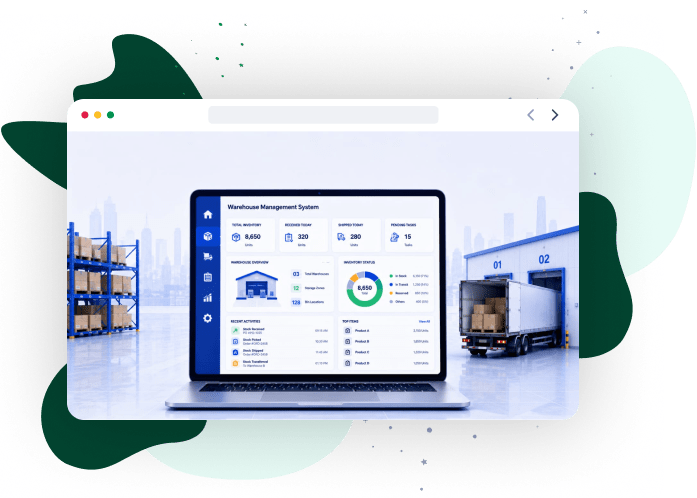
This guide explains the key features of modern WMS platforms, how they integrate with ERP systems, what deployment options are available, how to evaluate vendors, and which technologies are shaping the future of warehouse operations.

Whether you are implementing a new WMS or modernizing an existing warehouse environment, iCommuneTech helps organizations design, integrate, and deploy solutions that align with operational goals and long-term growth plans.
Go for implementation.What Is a Warehouse Management System?
A warehouse management system (WMS) is software that helps organizations manage inventory movement, coordinate warehouse operations, and fulfill orders through real-time tracking and automated workflows. It supports every stage of warehouse operations, including receiving, putaway, picking, replenishment, packing, and dispatch, while helping maintain accurate inventory records.
Driving Measurable Results Across Industries
From automating manual calculations to modernizing legacy infrastructure, we build software that directly impacts the bottom line. Our custom solutions consistently reduce operational costs and accelerate process efficiency.
View Our Case Studies
What Are the Key Features and Capabilities of Modern Warehouse Management Software?
Inventory visibility and control operate through 3 execution layers that maintain inventory accuracy and warehouse responsiveness.
1. Real-Time Inventory Synchronization
Scan-based updates ensure inventory records remain accurate as products move through receiving, picking, replenishment, packing, and dispatch processes.
2. Bin-Level Inventory Control
Bin-level inventory rules help place products in optimal storage locations, improving picking efficiency, reducing travel time, and increasing location accuracy.
3. Inventory Validation and Reconciliation
Cycle counting and exception management workflows help identify inventory discrepancies early, reducing stock inaccuracies and improving audit readiness.
These capabilities operate within an inventory management system that controls allocation and transaction validation in real time.
Accurate inventory positioning improves ATP visibility and fulfillment efficiency.
How Does Inventory Visibility and Control Improve Warehouse Accuracy and Responsiveness?
Inventory visibility and control help organizations maintain accurate stock records by ensuring warehouse transactions are reflected in real time. When integrated with an inventory management system, these capabilities reduce allocation errors, minimize fulfillment delays, and improve overall warehouse execution accuracy.
Real-Time Inventory Synchronization
Scan-based updates maintain accurate inventory visibility during receiving, picking, and dispatch.
- Real-time inventory updates
- SKU and location validation
- Reduced allocation errors
Bin-Level Inventory Control
Bin-level logic improves inventory placement and pick efficiency based on SKU movement patterns.
- Optimized inventory placement
- Reduced travel distance
- Improved pick efficiency
Inventory Reconciliation and Replenishment
Cycle counting and replenishment workflows maintain inventory accuracy across warehouse operations.
- Variance reconciliation
- Audit-ready inventory tracking
- Replenishment management
How Does Real-Time Tracking and Data Synchronization Improve Warehouse Execution?
Real-time tracking and data synchronization give organizations visibility into inventory, orders, and shipments as warehouse activities occur.
When integrated with real-time shipment tracking software, these capabilities help warehouse and logistics teams work from the same data, reducing delays, improving coordination, and supporting faster order fulfillment.
Core synchronization capabilities include:
Event-driven updates during picking, packing, and dispatch
Barcode, RFID, and IoT-based transaction validation
Real-time data exchange between WMS, ERP, OMS, and TMS
High-volume transaction processing with low latency
Order, dock, and shipment status synchronization
Reduced status mismatches and fulfillment delays
How Do Slotting and Space Optimization Improve Warehouse Throughput and Storage Efficiency?
Slotting and space optimization help warehouses move more inventory with fewer resources by reducing picker travel time, improving storage utilization, and increasing overall throughput.
Core optimization capabilities include:
Demand-driven slotting using inventory optimization strategies
ABC-based SKU positioning
Dynamic inventory re-slotting
Bin and pallet space optimization
Zone-based SKU allocation
Consumption-driven replenishment
Slotting and space optimization help warehouses move more inventory with fewer resources by reducing picker travel time, improving storage utilization, and increasing overall throughput.
How Do Labor Management and Productivity Tools Improve Workforce Efficiency in Warehouses?
Labor management systems improve warehouse productivity through workforce allocation, task sequencing, and performance tracking. Integrated with warehouse analytics and performance tracking, these systems improve labor efficiency and throughput control.
Core labor management functions include:
Engineered Labor Standards (ELS)
Defines execution benchmarks for warehouse tasks.
Task Dispatch and Interleaving
Sequence tasks to reduce travel time and improve utilization.
KPI and Productivity Tracking
Tracks throughput, pick rate, and workforce performance.
Exception Monitoring
Detects delays and idle intervals.
Mobile Workforce Execution
Supports real-time task execution through mobile devices.
According to Gitnux, 59% of warehouse automation initiatives are impacted by skilled labor shortages.
How Do Advanced Reporting and Analytics Improve Warehouse Decision-Making and Cost Control?
Advanced reporting and analytics convert warehouse data into operational insights that improve execution visibility, inventory performance, and cost control. Integrated with supply chain analytics platforms, these systems support faster warehouse decision-making.
Core Warehouse Analytics Functions
How Does Barcode and RFID Scanning Integration Improve Data Accuracy and Warehouse Control?
Barcode and RFID integration improve warehouse accuracy through real-time transaction validation and inventory synchronization. Integrated with barcode scanning in logistics operations, these technologies strengthen inventory traceability and warehouse control.
Core Barcode and RFID Functions
Transaction Validation
Captures SKU, quantity, and location data during warehouse transactions.
Barcode-Based Data Capture
Uses handheld and camera-based scanners for inventory processing.
RFID Inventory Identification
Enables bulk and non-line-of-sight inventory scanning.
Cycle Count Automation
Supports scan-based inventory reconciliation and audit validation.
Real-Time WMS Synchronization
Updates inventory records instantly through connected scanning systems.
Inventory Traceability
Tracks inventory movement and handling status across operations.
According to Gitnux, RFID adoption has improved inventory visibility by up to 40%.
How Does a Warehouse Management System Work?
- A warehouse management system (WMS) automates inventory movement, storage, picking, packing, and dispatch operations.
- It uses real-time data processing to improve warehouse accuracy and fulfillment speed.
- WMS platforms integrate with ERP, OMS, and transportation systems through APIs, barcode scanners, RFID, and IoT devices.
- Integration with supply chain visibility systems keeps inventory, order, and warehouse data synchronized across operations.
- Real-time synchronization helps teams make faster and more accurate fulfillment decisions.
What Is the Core Purpose of a WMS in Supply Chain Operations?
The core purpose of a warehouse management system (WMS) is to manage warehouse execution, maintain inventory accuracy, and streamline order fulfillment through real-time inventory tracking and automated warehouse workflows.
A WMS helps organizations control inventory movement, optimize storage and picking operations, reduce fulfillment errors, and improve warehouse efficiency across inbound, storage, and outbound processes.
How Does a Warehouse Management System Differ from an ERP System?
A warehouse management system (WMS) is designed to manage day-to-day warehouse operations, while an ERP system focuses on enterprise-wide functions such as procurement, planning, finance, and resource management.
| Comparison Area | WMS | ERP |
|---|---|---|
| System Role | Executes warehouse operations | Manages enterprise planning and finance |
| Process Scope | Controls picking, storage, and fulfillment | Handles procurement, planning, and accounting |
| Data Granularity | Tracks bin-level inventory and movement | Maintains aggregated inventory and financial data |
| Execution Capability | Supports real-time warehouse execution | Limited warehouse control |
| Integration Function | Processes fulfillment transactions | Generates operational demand signals |
| Operational Limitation | Requires ERP integration for finance visibility | Limited real-time warehouse execution |
| Deployment Fit | High-volume warehouse operations | Enterprise-wide business management |
| System Dependency | Operates as a warehouse execution layer | Operates as a central enterprise platform |
Within procurement and inventory integration systems, WMS and ERP integration synchronize planning, inventory, and fulfillment data across supply chain operations.
A warehouse management system (WMS) is designed to manage day-to-day warehouse operations, while an ERP system focuses on enterprise-wide functions such as procurement, planning, finance, and resource management.
What Are the Different Types of Warehouse Management Systems?
Warehouse management systems are available in several deployment models, each offering different levels of scalability, integration flexibility, automation support, and operational control.
| WMS Type | Architecture Model | Key Characteristics | Best Fit Scenario |
|---|---|---|---|
| Cloud-Based WMS | SaaS / Cloud | API integration, remote access, rapid deployment | Multi-site operations |
| Standalone WMS | Independent system | High configurability, external integration | Complex warehouse workflows |
| ERP-Integrated WMS | ERP-embedded | Unified enterprise data and workflows | Centralized operations |
| Warehouse Execution System (WES) | Execution + automation | Real-time orchestration and robotics control | Automated warehouses |
| On-Premise WMS | Local deployment | Internal hosting and infrastructure control | Regulated environments |
Each WMS type differs in scalability, integration complexity, and execution depth. Selection should align with warehouse volume, automation requirements, and operational complexity.
How Do Cloud-Based Warehouse Management Systems Support Scalable and Flexible Operations?
Cloud-based warehouse management systems improve scalability through elastic infrastructure, centralized data management, and API-driven integration. Within cloud-based inventory systems, these platforms support multi-location operations, rapid deployment, and remote warehouse access.
Core cloud WMS capabilities include:
- Elastic scaling for variable transaction volumes
- API integration with ERP, OMS, and TMS
- Centralized multi-site data management
- Continuous system updates without downtime
- Subscription-based infrastructure model
- Security, audit logging, and failover support
- Browser and mobile-based operational access
How Do Standalone WMS Platforms Support Specialized Warehouse Operations?
Standalone WMS platforms support complex warehouse operations through configurable workflows, modular architecture, and independent execution control.
Core Capability Layers
Rule-Based Execution Controls putaway, picking, replenishment, and routing through configurable warehouse rules.
Modular Architecture Separates receiving, storage, fulfillment, and shipping functions for flexible process expansion.
Workflow Flexibility Supports complex SKU handling and warehouse-specific operational requirements.
System Integration Connects with ERP, OMS, and logistics systems through APIs and middleware.
Upgrade Governance Validates custom configurations during updates to maintain operational stability.
iCommuneTech designs standalone WMS architectures aligned with warehouse workflows and integration requirements.
How Do ERP-Integrated WMS Solutions Support Unified Supply Chain Operations?
ERP-integrated WMS solutions support unified supply chain operations by connecting warehouse activities, inventory management, procurement, and financial processes within a single system.
Through enterprise resource planning integration, warehouse transactions synchronize directly with planning, procurement, and business operations, helping organizations maintain consistent data and reduce reconciliation efforts across departments.
Unified Data and Transaction Control
ERP-integrated WMS platforms use a shared data environment, allowing warehouse, inventory, and financial transactions to update within the same system.
This reduces duplicate records, improves data consistency, and minimizes reconciliation efforts.
Shared enterprise data model
Direct inventory and financial posting
Reduced synchronization gaps
Centralized transaction control
ERP-Based Workflow Configuration
Warehouse workflows operate through ERP configuration frameworks and extension layers without requiring separate execution systems.
Operational Constraints in High-Volume Environments
While ERP-integrated WMS solutions offer strong data consistency, they may be less suitable for highly automated or high-volume warehouse environments that require advanced orchestration capabilities.
- Limited advanced warehouse automation
- Reduced orchestration flexibility
- Performance constraints under heavy load
- Lower scalability in distributed operations
How Do Warehouse Execution Systems (WES) Differ from WMS in Automation and Control?
Warehouse Execution Systems (WES) control real-time material flow and warehouse automation, while warehouse management systems (WMS) manage inventory and order execution.
The following comparison outlines how WES and WMS differ across execution control and automation handling:
| Comparison Area | WMS | WES |
|---|---|---|
| Control Scope | Manages inventory and order execution | Controls material flow and automation |
| Execution Logic | Rule-based task sequencing | Dynamic flow orchestration |
| System Interaction | Integrates with ERP and OMS | Integrates with PLCs, WCS, and robotics |
| Processing Focus | Transaction and fulfillment processing | Routing and load balancing |
| Automation Handling | Limited automation integration | Direct automation control |
| Performance Role | Supports warehouse execution | Maintains automated flow stability |
| Deployment Fit | Manual and semi-automated warehouses | High-density automated facilities |
| Architecture Role | Inventory execution layer | Automation orchestration layer |
Within warehouse execution and automation systems, WES complements WMS by coordinating automation flow while WMS maintains inventory and fulfillment control.
iCommuneTech helps organizations design WMS and WES architectures that support warehouse automation, material flow coordination, and scalable fulfillment operations.
How Do On-Premise WMS Deployments Provide Control and Customization?
On-premise warehouse management systems provide organizations with direct control over infrastructure, data, security, and warehouse processes. They are often selected by businesses that require extensive customization, strict compliance controls, or integration with legacy systems.
Within secure supply chain systems, on-premise WMS deployments support compliance-driven and enterprise-controlled warehouse operations.
Core On-Premise WMS Capabilities
- Internal infrastructure and data control
- Role-based security and compliance management
- Workflow and rule-engine customization
- Legacy system and hardware integration
- Internal monitoring and access governance
Operational Considerations
- Higher infrastructure and maintenance overhead
- Internal upgrade and scaling responsibility
On-premise WMS deployments suit regulated and legacy-heavy warehouse environments.
What Are the Top Warehouse Management System Vendors and Software Options for Enterprise Evaluation?
Warehouse management system (WMS) platforms vary in functionality, integration capabilities, scalability, and implementation requirements.
The following comparison highlights commonly evaluated WMS solutions for enterprise warehouse operations and digital transformation initiatives.
| Vendor / Platform | Core Strength | Integration Capability | Scalability Fit | Key Consideration |
|---|---|---|---|---|
| iCommuneTech | Custom WMS and integration engineering | ERP, WMS, TMS, automation integration | Enterprise and multi-site operations | Tailored implementation approach |
| SAP EWM | Advanced warehouse control | Native SAP integration | Large enterprises | High implementation cost |
| Oracle WMS | Cloud-based execution | ERP and API integration | Global distribution | Configuration complexity |
| Manhattan WMS | AI-driven fulfillment | Multi-system integration | High-volume operations | Higher implementation effort |
| Blue Yonder WMS | Supply chain optimization | End-to-end integration | Omnichannel enterprises | Longer deployment cycles |
| Körber / HighJump | Configurable workflows | Flexible integration | Mid-large enterprises | Customization overhead |
| Infor WMS | Manufacturing alignment | Enterprise integration | Manufacturing and distribution | Structured implementation |
| Softeon WMS | Automation and 3PL support | ERP and TMS integration | Complex warehouse operations | Longer rollout timelines |
| Logiwa / Fishbowl / Zoho | Lightweight cloud platforms | Prebuilt integrations | SMB and eCommerce | Limited execution depth |
How Does SAP Extended Warehouse Management (EWM) Support Large-Scale Warehouse Operations?
SAP Extended Warehouse Management (EWM) supports large-scale warehouse operations by providing advanced inventory management, warehouse process control, and native integration with SAP business applications across multiple facilities.
Integrated with enterprise warehouse integration systems, SAP EWM synchronizes warehouse, inventory, and logistics transactions within a unified data model.
Core SAP EWM Capabilities
- Yard and cross-docking management
- Native SAP ERP and S/4HANA integration
- Configurable workflow extensions
- Batch tracking and compliance control
- Embedded and decentralized deployment
Operational Considerations
- High implementation complexity
- Enterprise and regulated-environment focus
iCommuneTech configures SAP EWM environments aligned with enterprise workflows and operational scale.
How Does Oracle Warehouse Management Cloud Support Scalable and Integrated Warehouse Operations?
Oracle Warehouse Management Cloud supports scalable fulfillment, multi-channel processing, and API-driven warehouse integration across distributed operations.
Integrated with cloud warehouse management platforms, the platform synchronizes inventory, fulfillment, and logistics workflows within a cloud-based environment.
Core Oracle WMS Cloud Capabilities
- Multi-channel fulfillment and order processing
- Dynamic order allocation
- API-driven ERP and logistics integration
- Embedded analytics and performance monitoring
- Elastic cloud scalability
- Continuous cloud updates
When Should Organizations Consider Oracle WMS Cloud?
Oracle WMS Cloud is often a strong option for organizations that require scalable cloud infrastructure, operate across multiple fulfillment channels, and need close integration with Oracle business applications and supply chain systems.
iCommuneTech helps organizations implement Oracle WMS Cloud solutions that align with warehouse processes, integration requirements, and long-term growth objectives.
How Do Manhattan Associates WMS Solutions Support High-Volume and Omnichannel Warehouse Operations?
Manhattan Associates WMS supports high-volume and omnichannel warehouse operations by helping organizations process large order volumes efficiently while coordinating fulfillment activities across multiple sales channels.
Integrated with high-volume warehouse optimization systems, the platform manages retail, e-commerce, and wholesale fulfillment within a unified workflow environment.
Core Manhattan WMS Capabilities
- Waveless order processing
- Adaptive task sequencing
- Omnichannel order orchestration
- Predictive workload analysis
- AS/RS, robotics, and sortation integration
How Does Softeon Warehouse Management Platform Support 3PL and Execution-Driven Operations?
Softeon WMS is designed for third-party logistics (3PL) providers that manage multiple clients, service-level agreements, and warehouse workflows within a single platform.
Integrated with third-party logistics software solutions, the platform manages client-specific warehouse operations with controlled execution and billing accuracy.
Core Softeon WMS Capabilities
How Do Epicor and Zoho Inventory Compare for Mid-Market Warehouse Operations?
Epicor and Zoho Inventory serve different operational needs. Epicor is commonly used by manufacturers and distributors that require ERP-driven inventory management, while Zoho Inventory is designed for businesses that need cloud-based inventory and order management across multiple sales channels.
Within e-commerce inventory systems, both platforms support inventory synchronization, order processing, and multi-channel operations for mid-market businesses.
The following comparison outlines their key differences:
| Comparison Area | Epicor | Zoho Inventory |
|---|---|---|
| Architecture Model | ERP-integrated platform | SaaS-based platform |
| Core Strength | MRP and inventory control | Multi-channel order management |
| Integration Model | ERP modules and SDKs | APIs and prebuilt connectors |
| Usability | Structured ERP configuration | Simple and fast setup |
| Deployment Speed | Longer implementation | Rapid deployment |
| Best Fit Scenario | Manufacturing and distribution | e-commerce and SMB operations |
How Do Emerging WMS Solutions Like Fishbowl Support Small and Niche Warehouse Operations?
Emerging WMS platforms such as ShipHero and Fishbowl support SMB and niche warehouse operations through rapid deployment, prebuilt integrations, and cost-efficient inventory control.
E-commerce Fulfillment
ShipHero streamlines multi-channel fulfillment through marketplace, carrier, and shipment integrations.
Inventory and Production Control
Fishbowl supports inventory tracking, BOM management, and accounting integration for SMB operations.
Rapid Deployment and Cost Efficient
Prebuilt integrations and simplified setup reduce deployment effort, operational overhead, and infrastructure dependency.
These platforms suit startups and e-commerce operations requiring affordability, flexibility, and rapid deployment.
What Should Organizations Consider for Warehouse Management System Implementation and Selection?
Organizations should evaluate warehouse management systems based on warehouse complexity, transaction volume, integration requirements, scalability, and total cost of ownership. Effective WMS selection requires alignment with warehouse workflows, inventory management processes, fulfillment requirements, and long-term business objectives.
Successful implementation depends on careful planning, system configuration, integration testing, phased deployment, performance validation, and user adoption.
What Are the Key Cost Factors in Warehouse Management Software Implementation?
Warehouse management system (WMS) costs are influenced by factors such as licensing, system integration, infrastructure, customization, and future scalability requirements.
Within the warehouse management system cost analysis, the total cost of ownership varies based on deployment model, warehouse complexity, and transaction volume.
Core Cost Factors
Pricing depends on users, modules, transaction volume, and SaaS or perpetual licensing structure.
Implementation includes workflow configuration, API development, middleware integration, and ERP connectivity.
Costs include cloud hosting, servers, RF devices, barcode scanners, and RFID infrastructure.
Ongoing costs include SLA support, maintenance, workforce training, and rollout management.
Operational growth increases infrastructure and integration costs, while ROI is measured through fulfillment speed, inventory accuracy, and labor efficiency.
According to Gitnux, 43% of organizations cite upfront cost as a major barrier to WMS adoption.
What Are the Key Deployment Challenges and Integration Complexities in WMS Implementation?
WMS implementation challenges include legacy integration, data migration errors, interface latency, and user adoption issues that affect operational continuity and go-live stability. Within supply chain integration challenges, these risks often emerge from inconsistent data models and tightly coupled system dependencies.
According to Gitnux, 67% of warehouse transformation initiatives face delays due to legacy integration complexity.
Legacy Integration and Data Alignment
Legacy platforms and inconsistent schemas increase interface complexity and create inventory synchronization risks during deployment.
- Custom middleware and adapters
- ERP–WMS data mapping conflicts
- Inconsistent inventory records
- Delayed transaction synchronization
Data Migration and Validation Risks
Incorrect SKU masters, location structures, and incomplete validation disrupt warehouse execution during go-live.
- Invalid inventory and location data
- Allocation and transaction errors
- Limited testing coverage
- Go-live execution instability
Interface and Performance Constraints
API latency and message queue congestion reduce real-time synchronization across warehouse and enterprise systems.
API and interface delays
Message queue bottlenecks
Synchronization gaps
Reduced execution responsiveness
User Adoption and Configuration Gaps
Inconsistent workflow adoption and parameter misalignment reduce execution accuracy and operational stability.
- Weak scan-process compliance
- Manual execution overrides
- Misconfigured workflow parameters
- Inconsistent operational behavior
How Do You Evaluate WMS Scalability for Growing Warehouses?
Evaluate WMS scalability by testing whether the system sustains transaction growth, multi-site operations, and automation integration under increasing warehouse demand.
Integrated with scalable supply chain systems, scalability evaluation measures architecture stability, processing capacity, and operational adaptability.
Core WMS Scalability Criteria
- High-volume transaction processing
- Multi-warehouse coordination
- SKU expansion handling
- WCS and robotics integration
- Concurrent workflow execution
- Cost-efficient scaling
- Stable ERP and OMS synchronization
What Are the Steps to Successful Warehouse Management System Implementation?
Successful WMS implementation depends on structured configuration, integration validation, controlled deployment, and workflow alignment to maintain stable warehouse execution. Integrated with automated order processing systems, implementation success requires synchronization between system logic, data structures, and operational workflows.
Planning and System Configuration
Teams define warehouse workflows, configure inventory structures, validate transaction logic, and standardize data before migration.
Integration and Deployment Validation
APIs, event triggers, and transaction flows are tested to maintain synchronization accuracy, stability, and controlled deployment execution.
Training and Post-Go-Live Stabilization
Warehouse teams are trained on operational workflows, while post-go-live monitoring helps resolve defects, stabilize transactions, and optimize execution.
What Is iCommuneTech’s Approach to Custom WMS Development?
iCommuneTech’s approach to custom WMS development focuses on designing warehouse management solutions that align with an organization’s workflows, integration requirements, and long-term operational goals.
Within custom warehouse management solutions, this approach helps businesses improve inventory control, fulfillment efficiency, and system connectivity.
Workflow and System Configuration
Defines inventory structures, transaction logic, configurable workflows, and execution controls aligned with warehouse operations.
Integration and Deployment Validation
Integrates ERP, WMS, WCS, and logistics platforms while validating data flows, workflows, and transaction accuracy before deployment.
Continuous Optimization and Scalability
Uses operational data and performance insights to improve warehouse processes, support business growth, and ensure the WMS continues to meet changing operational requirements.
How Do WMS Features Vary Across Industry-Specific Use Cases?
WMS features vary across industries because different warehouse environments have unique fulfillment, inventory, compliance, and operational requirements. As a result, organizations often need industry-specific workflows, inventory controls, and system integrations to support their operations effectively.
Core Industry-Specific WMS Functions
- Multi-client tenancy and contract billing for 3PL operations
- High-frequency picking and returns processing for eCommerce fulfillment
- BOM-driven inventory control for manufacturing operations
- Wave planning and pick optimization for distribution environments
- Marketplace, ERP, and production system integration
- Serialized, batch, lot, and expiry-based inventory tracking
- Compliance controls for regulated and defense logistics operations
- Temperature-controlled and traceability-based inventory execution
These capabilities allow WMS platforms to adapt execution logic, inventory control, and workflow configuration to industry-specific operational requirements.
What Are the WMS Requirements for 3PL and Third-Party Logistics Operations?
WMS features vary across industries because different warehouse environments have unique fulfillment, inventory, compliance, and operational requirements. As a result, organizations often need industry-specific workflows, inventory controls, and system integrations to support their operations effectively. Within third-party logistics management software, these capabilities support parallel warehouse execution across multiple clients without operational overlap.
Core 3PL WMS Requirements
Tenant-specific workflows for receiving, picking, labeling, and compliance
Event-based billing for storage, pallet movement, kitting, and returns
Client dashboards for inventory, order status, and SLA visibility
Multi-client order orchestration and resource allocation
API and EDI integration across customer systems
Tracking of value-added services, such as bundling and relabeling
Template-driven onboarding for faster client deployment
These capabilities help 3PL providers maintain billing accuracy, meet service-level agreements, and manage multiple client operations efficiently within the same warehouse network.
What Are the WMS Requirements for E-commerce Fulfillment Operations?
WMS platforms for eCommerce fulfillment must support fast order processing, multi-channel inventory management, marketplace integrations, reverse logistics, and the ability to scale during peak demand periods.
When integrated with e-commerce order management systems, these capabilities help businesses maintain accurate inventory, process orders across multiple sales channels, and improve fulfillment speed.
The following capabilities define eCommerce WMS operations:
Wave and cluster picking
Distributed order allocation
Marketplace integration
Short-cycle fulfillment
Reverse logistics management
Real-time inventory visibility
Carrier integration and labeling
Peak-demand scalability
What Are the WMS Requirements for Food and Beverage Distribution?
WMS platforms for food and beverage distribution must support batch traceability, FEFO inventory allocation, temperature monitoring, and recall management to maintain product quality and regulatory compliance.
Integrated with cold chain logistics systems, these capabilities maintain product quality and compliance across perishable inventory operations.
The following capabilities define food and beverage WMS operations:
- Batch traceability
- FEFO inventory allocation
- Temperature-controlled storage
- Cold-chain event logging
- Quality and hold control
- Compliance tracking
- Recall management
- Handling constraints
What Are the WMS Requirements for Manufacturing Warehouse Optimization?
WMS requirements for manufacturing include BOM-driven inventory control, WIP tracking, production synchronization, and line-side replenishment. Integrated with manufacturing inventory software, these capabilities maintain material flow and inventory accuracy across production operations.
What Are the WMS Requirements for Defense and High-Security Logistics Applications?
WMS requirements for defense logistics include clearance-based access control, serialized asset tracking, audit logging, and mission-driven dispatch workflows.
Integrated with supply chain security systems, these capabilities maintain secure asset control across high-security logistics environments.
How Do Innovative Technologies Enhance Warehouse Management Systems?
Innovative technologies enhance WMS through automated data capture, real-time monitoring, predictive decision-making, and intelligent workflow execution. Integrated with barcode, RFID, AI, IoT, blockchain, and AR/VR technologies, modern WMS platforms improve inventory accuracy, operational responsiveness, and warehouse scalability.
These technologies support dynamic slotting, automated validation, sensor-driven monitoring, secure traceability, and guided warehouse execution across high-volume operations.
How Do AI and Machine Learning Enhance Warehouse Optimization Software?
AI and machine learning enhance warehouse optimization by analyzing operational data, predicting demand patterns, and dynamically adjusting execution workflows. Integrated with AI in supply chain analytics, these technologies improve warehouse responsiveness, inventory accuracy, and fulfillment efficiency.
Core AI and ML Optimization Functions
Demand Forecasting
Predicts SKU demand patterns to improve replenishment, allocation, and inventory planning.
Adaptive Slotting
Optimizes bin locations based on SKU velocity and order behavior.
Anomaly Detection
Identifies shrinkage, inventory variance, and abnormal transaction activity.
Labor Optimization
Allocates workforce based on workload forecasts and operational priorities.
Route Optimization
Calculates efficient pick paths to reduce travel time and improve throughput.
Predictive Replenishment
Triggers replenishment using demand-driven inventory signals.
Exception Prediction
Detects stockout, congestion, and fulfillment risk conditions early.
Continuous Model Learning
Refines models using live warehouse transaction data.
How Does IoT Enable Real-Time Warehouse Management?
IoT enables real-time warehouse management by providing continuous visibility into inventory, assets, equipment, and warehouse conditions, allowing organizations to make faster and more accurate operational decisions.
Integrated with IoT in logistics operations, IoT-driven WMS platforms improve inventory visibility, operational responsiveness, and automated execution across warehouse environments.
IoT-enabled warehouses can save approximately $1.2 million annually per 500,000 sq. ft. facility through improved tracking and operational efficiency, according to Gitnux.
Real-Time Event Processing
IoT systems capture and process live warehouse events through connected sensors, readers, and gateways.
IoT event processing helps:
- Trigger inventory updates
- Automate warehouse alerts
- Reduce manual intervention
- Improve execution responsiveness
Automated Location and Condition Monitoring
IoT devices continuously monitor asset location and environmental conditions across warehouse operations.
Monitoring systems help:
- Track inventory movement
- Enforce temperature conditions
- Detect operational exceptions
- Improve inventory accuracy
Scalable and Secure Device Integration
IoT platforms connect warehouse devices through scalable event pipelines and secure communication frameworks.
IoT integration supports:
- High-volume device connectivity
- Real-time WMS synchronization
- Encrypted device communication
- Stable warehouse execution
How Does Blockchain Enhance Traceability and Control in Warehouse and Supply Chain Operations?
Blockchain enhances traceability and control in warehouse and supply chain operations by providing a secure, transparent, and verifiable record of inventory movements, transactions, and asset ownership across the supply chain.
Integrated with blockchain in the supply chain, blockchain platforms strengthen auditability, transaction security, and cross-network coordination.
Tamper-Proof Transaction Control
Blockchain validates and records transactions through distributed verification and cryptographic security.
Blockchain controls help:
- Prevent unauthorized changes
- Maintain data integrity
- Reduce reconciliation disputes
- Improve audit traceability
End-to-End Asset Traceability
Blockchain tracks inventory movement and custody changes across supply chain participants.
Traceability capabilities help:
- Monitor asset handoffs
- Maintain custody records
- Improve shipment visibility
- Support compliance tracking
Secure Multi-Party Synchronization
Blockchain synchronizes transaction data across suppliers, carriers, and warehouses through shared ledgers.
Blockchain synchronization supports:
- Real-time data sharing
- Smart contract automation
- Secure role-based access
- Reliable system coordination
Blockchain enhances traceability and control in warehouse and supply chain operations by providing a secure, transparent, and verifiable record of inventory movements, transactions, and asset ownership across the supply chain.
How Do Augmented and Virtual Reality Improve Warehouse Execution?
Augmented reality (AR) and virtual reality (VR) improve warehouse operations by increasing picking accuracy, reducing training time, improving workforce productivity, and enhancing operational safety.
Integrated with digital warehouse transformation tools, AR/VR systems improve picking accuracy, workforce productivity, and operational safety.
Pick-by-Vision and Hands-Free Execution
AR interfaces provide visual picking guidance, task confirmations, and hands-free interaction through voice and gesture controls.
Validation, Training, and Simulation
Computer vision validation, VR-based training, and virtual layout simulation improve accuracy, onboarding, and operational planning.
WMS Integration and Performance Tracking
AR/VR systems synchronize with WMS task queues for real-time execution, monitoring, and productivity tracking.
Augmented reality (AR) and virtual reality (VR) improve warehouse operations by increasing picking accuracy, reducing training time, improving workforce productivity, and enhancing operational safety.
How Do You Select the Best Warehouse Management System? A Practical Comparison Checklist
Select the best WMS by evaluating execution capability, integration, scalability, security, cost, and vendor support against operational and growth requirements.
Use the following checklist to compare WMS platforms across workflows, transaction volume, and integration complexity:
| Evaluation Area | What to Assess | Key Question |
|---|---|---|
| Functional Coverage | Receiving, picking, packing, returns | Does it support the required workflows? |
| Data Model | SKU, lot/serial, inventory states | Can it maintain inventory accuracy? |
| Integration Architecture | APIs, ERP/WMS/WCS connectivity | Does it support stable integration? |
| Throughput Capacity | Transaction speed and load handling | Can it sustain peak demand? |
| Workflow Configuration | Allocation, slotting, and replenishment rules | Can workflows adapt without coding? |
| Automation Integration | Robotics, conveyors, IoT connectivity | Does it support automation control? |
| Security Controls | RBAC, audit logs, encryption | Does it enforce secure access? |
| Operational Visibility | Dashboards and KPI reporting | Can teams monitor performance? |
| Cost Structure | Licensing, integration, support | Is scaling cost-effective? |
| Implementation Model | Deployment and testing approach | Is rollout structured and stable? |
| Vendor Support | SLA, upgrades, and issue resolution | Is vendor support reliable? |
| Extensibility | APIs and modular expansion | Can the platform scale safely? |
| Data Migration | Validation and reconciliation | Can migration maintain data integrity? |
| Industry Fit | Domain capability and scale alignment | Does it fit operational complexity? |
Incorrect WMS selection leads to integration gaps, scalability limits, and operational inefficiencies.
iCommuneTech helps organizations evaluate, select, and implement WMS solutions by aligning platform capabilities with operational requirements, integration needs, and long-term business objectives.
Contact for Custom Build