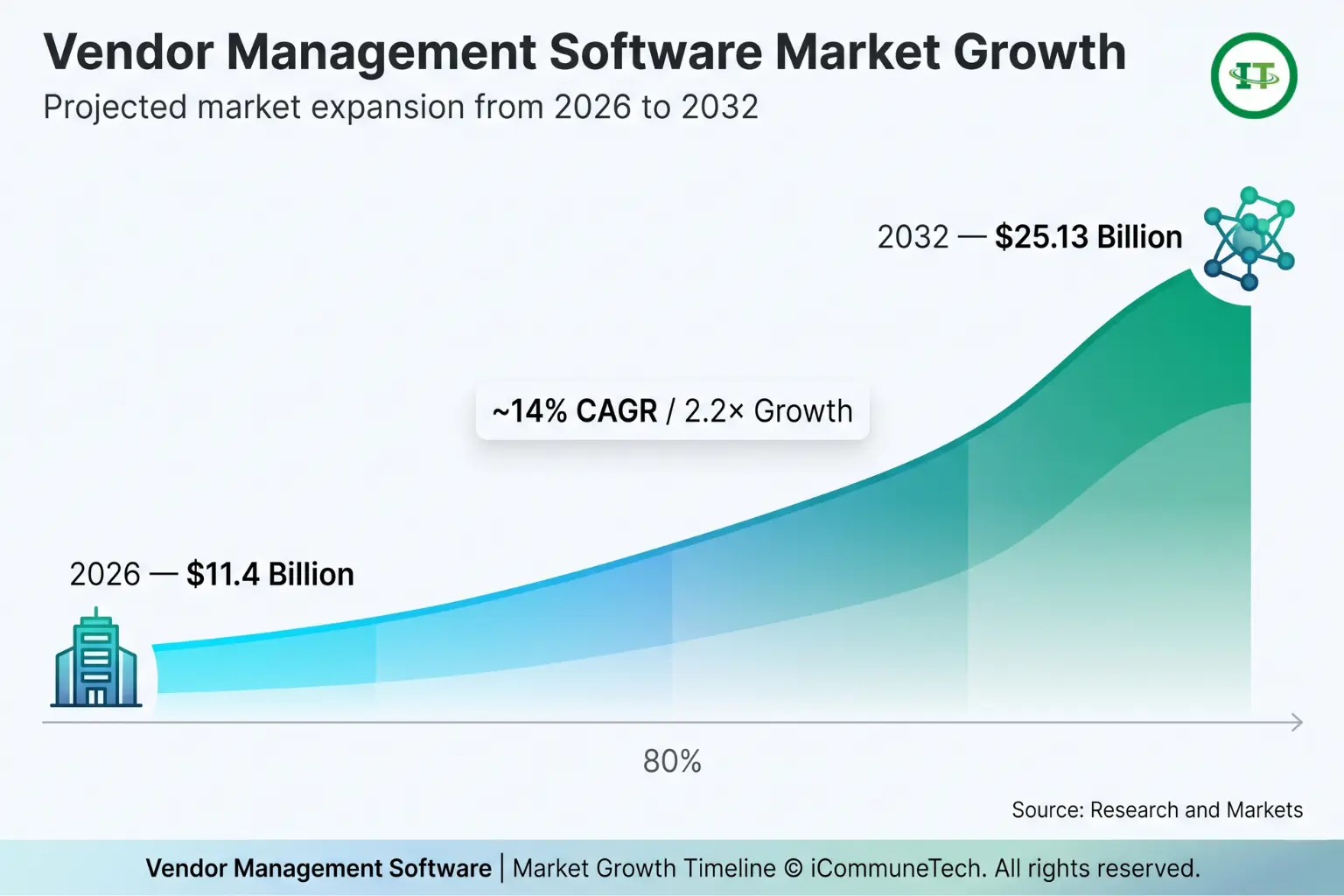
The vendor management software market is expected to grow from $11.4 billion in 2026 to $25.13 billion by 2032. With many VMS tools offering different capabilities, choosing the right solution becomes difficult. Businesses need clear evaluation criteria and a structured way to compare options.
In this guide, we’ll break down how vendor management software works, the key features to look for, and the criteria you should use to evaluate different options. We’ll also cover common risks to watch out for and how to choose the right solution based on your business needs, so you can confidently pick the best vendor management software for your organization.
Top Vendor Management Tools and Platforms for Enterprise and SMBs
Large organizations operate complex supplier networks spanning procurement, outsourcing, logistics, and technology vendors. These environments require platforms managing vendor lifecycles, compliance monitoring, contract governance, and supplier performance tracking. Enterprise platforms emphasize scalability, deep system integrations, and centralized vendor oversight.
SMB vendor management platforms prioritize simplified deployment and lower implementation complexity. Cloud-based vendor management tools support vendor onboarding automation, vendor contract management, and performance dashboards without extensive infrastructure. Integration with ERP and procurement systems synchronizes supplier data, purchase orders, and financial records.
Platforms combining procurement automation tools, analytics, and vendor risk management tools dominate the market because they support end-to-end vendor lifecycle coordination.
Procurement leaders evaluate solutions highlighted in iCommuneTech’s overview of vendor management tools when comparing vendor governance platforms.
| Platform | Primary Focus | Deployment Model | Ideal Business Size |
|---|---|---|---|
| iCommuneTech | Vendor lifecycle automation and procurement integration | Cloud / Custom | Enterprises and mid-market organizations |
| SAP Ariba | Procurement and supplier collaboration | Cloud | Large enterprises |
| Coupa | Spend management and vendor performance | Cloud | Mid-to-large enterprises |
| Oracle Procurement Cloud | Procurement governance and supplier lifecycle | Cloud | Enterprises using Oracle ERP |
Vendor Management Process Stages
Vendor management stages organize how enterprises discover suppliers, evaluate capabilities, manage procurement transactions, and monitor vendor performance. Selecting the right vendor management tool requires understanding how vendor relationships evolve across different lifecycle stages. Each stage, from supplier discovery to performance monitoring, maps to specific platform capabilities, helping organizations evaluate which tools support their operational requirements at each point in the vendor lifecycle.
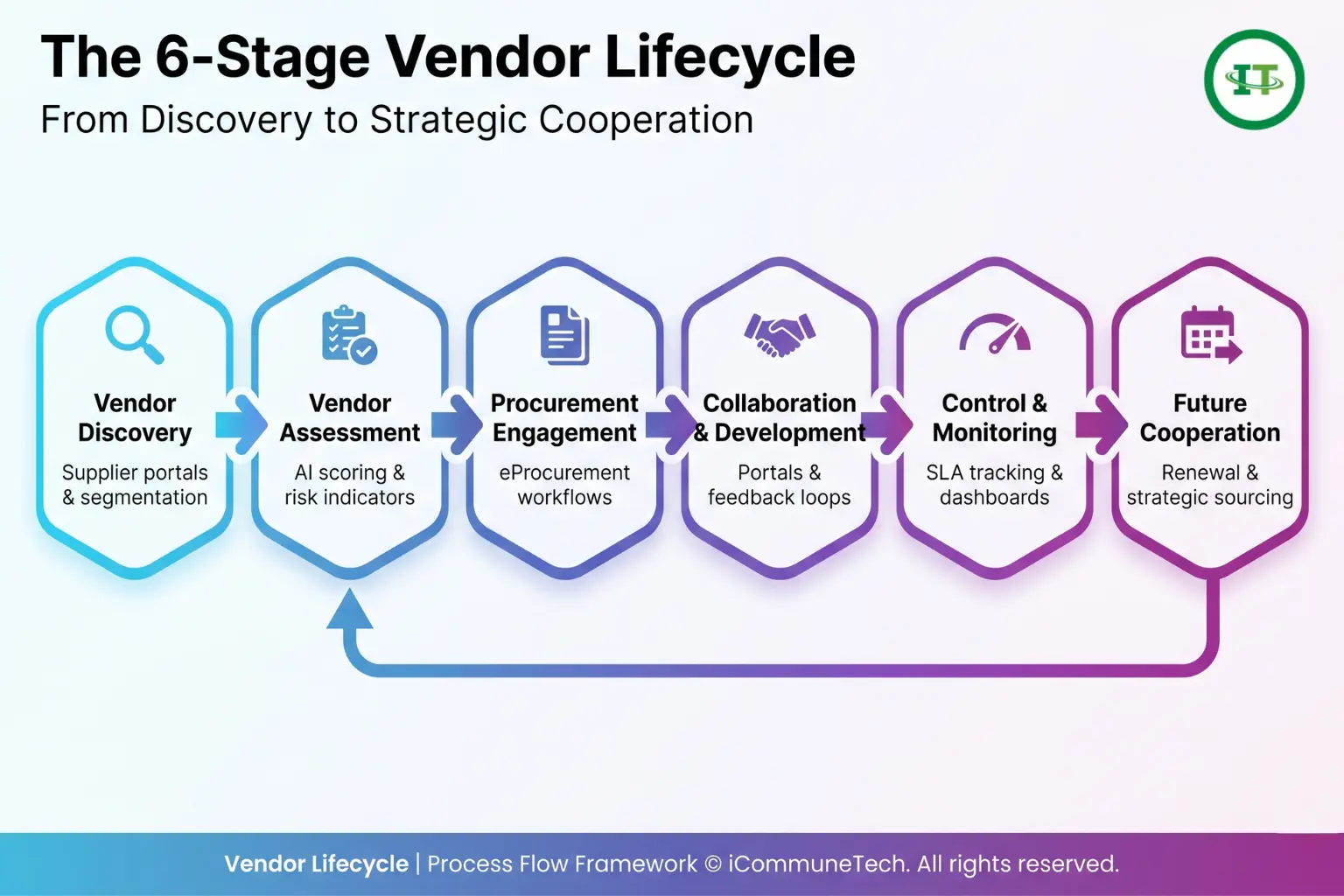
Enterprises manage vendor relationships through six operational lifecycle stages:
- Vendor discovery: Supplier portals aggregate vendor profiles, certifications, and capability data to create a searchable vendor pool. Advanced platforms also support supplier segmentation and filtering based on category, geography, and compliance status.
- Vendor assessment: Analytics tools and AI-based scoring models evaluate supplier qualifications, financial stability, and risk indicators. These insights help procurement teams shortlist vendors based on predefined performance and compliance criteria.
- Procurement engagement: eProcurement platforms manage sourcing events, vendor bidding, and purchasing transactions through automated workflows. Integration with approval systems ensures controlled procurement execution and audit-ready transaction tracking.
- Vendor collaboration and development: Vendor portals and collaboration tools enable structured communication, document sharing, and performance feedback. These capabilities support continuous improvement and long-term supplier relationship development.
- Control and monitoring: Monitoring systems track delivery timelines, SLA adherence, and compliance metrics in real time. Performance dashboards provide visibility into vendor reliability and help identify underperforming suppliers.
- Future cooperation planning: Procurement teams use historical performance data and risk assessments to evaluate long-term vendor viability. These insights guide contract renewals, strategic sourcing decisions, and supplier consolidation strategies.
Enterprise Vendor Management Platforms and Capabilities
Enterprise vendor management platforms extend beyond basic supplier coordination by integrating procurement automation, supplier lifecycle management, and analytics within centralized systems. These platforms are designed to handle complex vendor ecosystems, where managing contracts, compliance, and performance requires unified control across multiple business functions.
Unlike general vendor management tools, enterprise-grade solutions emphasize deep integration with ERP, finance, and sourcing systems. They consolidate vendor records, contract obligations, and performance data into a single system of record, enabling consistent governance across distributed operations.
The following platforms represent widely adopted enterprise vendor management solutions, evaluated based on their core capabilities, integration depth, and ability to support large-scale vendor lifecycle management.
| Platform | Core Strength | Key Capabilities | Supported Industries |
|---|---|---|---|
| iCommuneTech | Vendor lifecycle automation and procurement integration | Vendor onboarding automation, procurement workflows, and vendor performance tracking | Manufacturing, logistics, enterprise supply chains |
| SAP Ariba | Global supplier collaboration | Supplier onboarding, sourcing, contract management, procurement automation | Manufacturing, retail, healthcare |
| Coupa | Spend and supplier performance management | Spend analytics, supplier risk monitoring, and procurement workflows | Retail, technology, and financial services |
| Oracle Procurement Cloud | Procurement governance and supplier lifecycle management | Vendor onboarding automation, contract governance, ERP integration | Manufacturing, logistics, enterprise IT |
These vendor management software platforms differentiate themselves through cloud deployment models, automation features, and multi-entity support. Enterprise procurement teams evaluate them based on integration depth, supplier lifecycle coverage, and vendor risk management tools that support large-scale vendor governance programs.
Best VMS Tools for Small Business Vendor Management
SMB vendor management tools prioritize ease of deployment, affordability, and minimal configuration. These platforms are designed for lean procurement teams that require quick implementation and simplified workflows without extensive IT involvement.
The following vendor management tools are well-suited for small business environments, offering streamlined functionality, accounting integrations, and scalable procurement support.
| Platform | Core Focus | Key Capabilities | Integration Strength |
|---|---|---|---|
| Precoro | Procurement automation for SMBs | Vendor onboarding, purchase approvals, and invoice tracking | QuickBooks Online, accounting systems |
| Kissflow Procurement Cloud | Workflow-driven procurement management | Vendor onboarding automation, approval workflows | ERP and finance integrations |
| Tradogram | Purchasing and supplier coordination | Purchase order automation, vendor records, and spend reporting | QuickBooks, accounting platforms |
| Gatekeeper | Vendor contract and lifecycle management | Contract tracking, supplier compliance monitoring | CRM and finance integrations |
Organizations requiring deeper customization evaluate platforms such as iCommuneTech’s vendor management system when scaling vendor governance and procurement automation across growing supplier networks.
Core Features and Capabilities of Modern Vendor Management Systems
Modern vendor management platforms differentiate through capabilities that enforce structured supplier governance, standardize procurement workflows, and deliver continuous visibility into vendor performance and risk.
Core functions include vendor onboarding workflows, contract lifecycle control, compliance verification, and performance analytics. These capabilities maintain data consistency, enforce policy adherence, and support audit-ready operations across procurement and finance environments.
Workflow automation coordinates supplier registration, approval routing, invoice validation, and contract execution with minimal manual intervention. Integration with ERP, finance, and sourcing systems ensures synchronized vendor records, transaction data, and compliance documentation across enterprise operations.
Advanced capabilities such as vendor portals, real-time performance dashboards, and risk monitoring frameworks provide operational transparency into supplier activity. These features enable proactive issue detection, strengthen compliance oversight, and support performance-driven vendor management.
The following sections detail critical capabilities required to evaluate enterprise-grade vendor management platforms.
Key Features to Seek in Vendor Management Tools
Enterprise buyers evaluate tools based on how effectively they support governance, automation depth, and integration flexibility across procurement and compliance workflows. The following capabilities represent key differentiators when comparing vendor management platforms.
Configurable Workflow Automation
Platforms vary in how flexibly they support approval routing, exception handling, and multi-level procurement workflows. Tools that allow configurable workflows adapt more effectively to complex organizational structures and policy requirements.
Granular Vendor Risk Scoring and Monitoring
Advanced systems provide dynamic risk scoring models that evaluate vendors based on compliance status, financial stability, and operational performance. Continuous monitoring capabilities enable early detection of risk across supplier networks.
Customizable Vendor Data Models
Enterprise environments require tools that support configurable vendor profiles, custom fields, and multi-entity data structures. This flexibility ensures alignment with internal governance frameworks and regulatory requirements.
Advanced Analytics and Decision Intelligence
Beyond standard dashboards, leading platforms offer predictive analytics, spend optimization insights, and performance benchmarking. These capabilities support data-driven vendor selection and continuous improvement.
Multi-Entity and Global Support
Organizations operating across regions require tools that handle multiple business units, currencies, and regulatory environments. Platforms with strong multi-entity support enable consistent governance across global vendor networks.
Integration Architecture and API Flexibility
The depth and flexibility of integrations differentiate platforms significantly. Tools with robust APIs and pre-built connectors integrate seamlessly with ERP, finance, and procurement ecosystems, reducing implementation complexity.
Auditability and Compliance Enforcement
Enterprise-grade solutions provide audit trails, compliance checkpoints, and automated policy enforcement. These features ensure traceability across vendor lifecycle activities and support regulatory audits.
These differentiating capabilities enable procurement and IT leaders to evaluate vendor management platforms beyond basic functionality, ensuring alignment with operational complexity, compliance requirements, and long-term scalability.
Benefits of AI Integration and Automation in Vendor Lifecycle Management
AI-driven platforms improve vendor oversight by analyzing supplier data, contract activity, and procurement transactions in real time. Intelligent systems evaluate patterns in vendor behavior and operational performance that traditional monitoring processes miss. Vendor lifecycle management requires continuous evaluation of supplier contracts, compliance documentation, performance metrics, and procurement transactions.
Manual vendor record reviews delay early risk detection and supplier performance monitoring. As vendor ecosystems expand, studies show that organizations spend over 143 hours per month on manual supplier management tasks, highlighting the operational burden of non-automated processes, according to ResearchGate.
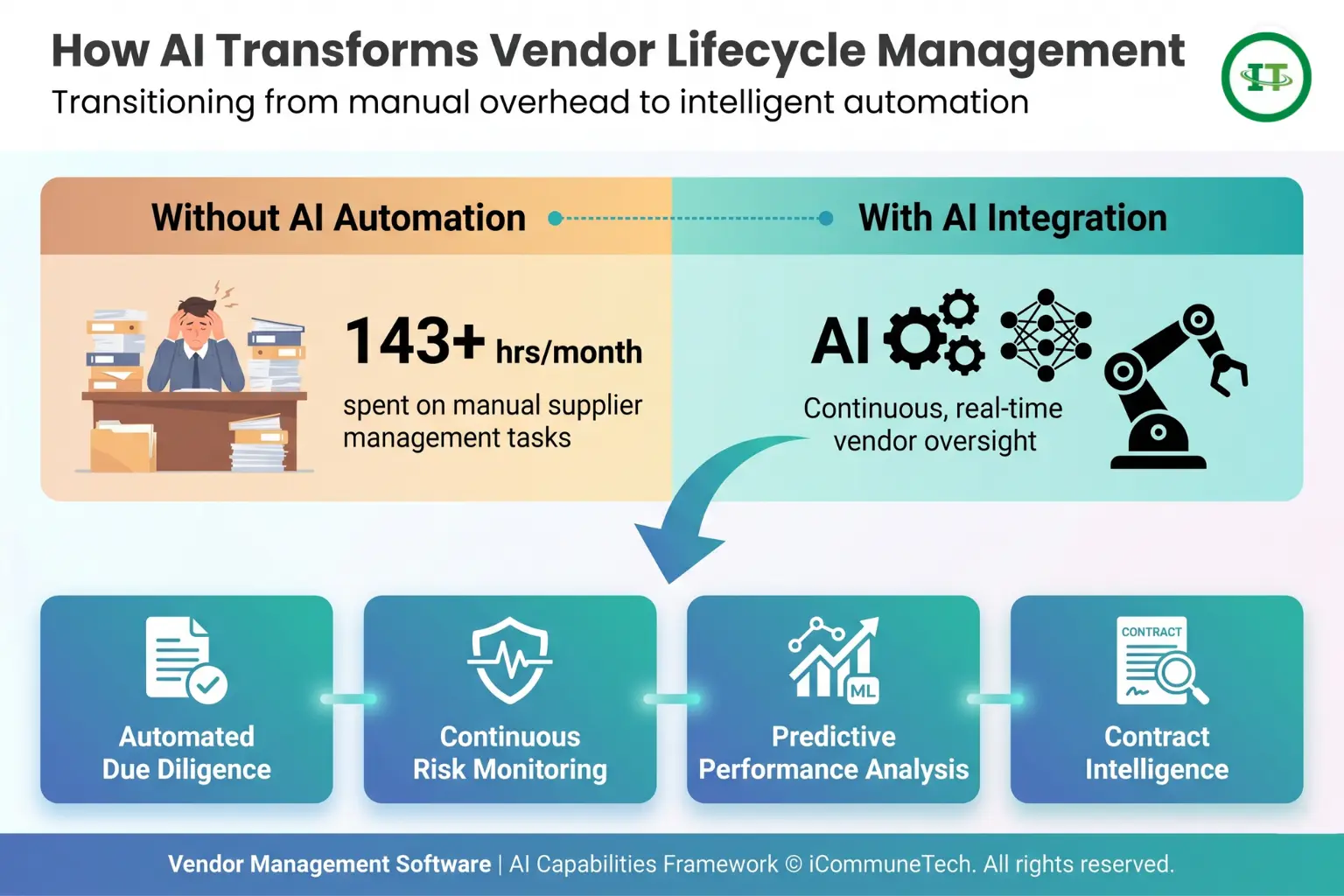
AI integration introduces several operational capabilities across vendor governance:
- Automated vendor due diligence: AI systems analyze supplier documentation, certifications, and risk indicators during vendor onboarding and qualification.
- Continuous vendor risk monitoring: Predictive models detect compliance gaps, contract deviations, and operational risks across supplier networks.
- Predictive supplier performance analysis: Machine learning evaluates delivery reliability, SLA compliance, and vendor responsiveness across procurement operations.
- Contract intelligence and obligation tracking: AI-driven contract analysis identifies renewal timelines, risk clauses, and performance obligations within vendor agreements.
Vendor Portals and Self-Service Communities
Vendor collaboration slows when suppliers rely on email communication, manual document exchange, and disconnected procurement systems. Managing onboarding records, compliance documents, and supplier communication across multiple channels increases administrative effort and delays coordination.
Vendor portals address these inefficiencies by providing suppliers with controlled digital access to procurement environments. These platforms centralize onboarding, document management, and communication workflows, reducing manual coordination while improving supplier engagement.
Modern vendor management platforms typically provide the following portal capabilities:
- Digital vendor onboarding interfaces: Suppliers submit company profiles, certifications, and tax documentation during onboarding through guided workflows.
- Document submission and compliance tracking: Vendors upload compliance records, contracts, and regulatory documents directly within the portal environment.
- Operational communication channels: Secure messaging tools enable direct communication between procurement teams and suppliers.
- Supplier collaboration and knowledge sharing: Vendor communities support updates, announcements, and shared resources that improve supplier coordination.
Vendor Risk and Compliance Management in Third-Party Relationships
Vendor governance platforms monitor operational, financial, compliance, and cybersecurity risks through integrated compliance and risk management workflows. Supplier access to enterprise systems, sensitive data, and operational processes increases the impact of compliance failures or service disruptions.
These platforms reduce this exposure by embedding risk monitoring and regulatory oversight within procurement workflows. It centralizes vendor records, certifications, and contractual obligations across procurement and compliance systems. Integration with enterprise supply chain compliance frameworks aligns vendor governance with regulatory and internal policy requirements.
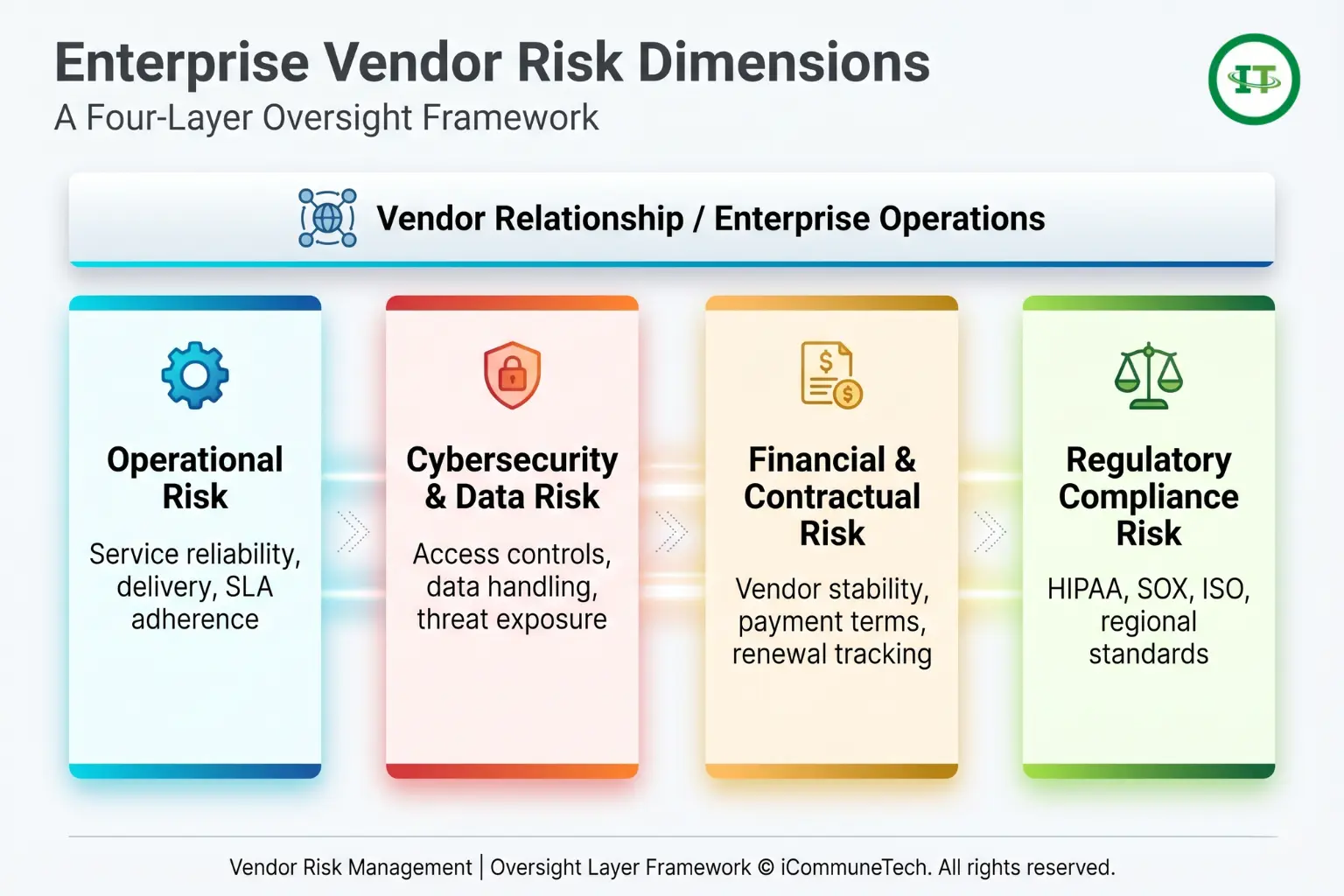
Procurement teams typically monitor vendor governance across several risk dimensions:
- Operational risk oversight: Evaluates vendor service reliability, delivery consistency, and SLA adherence across supplier engagements to ensure continuity in supply chain operations.
- Cybersecurity and data protection risk: Assesses vendor access controls, data handling practices, and exposure to external threats to prevent security breaches and unauthorized system access.
- Financial and contractual risk: Tracks vendor financial stability, payment dependencies, contract obligations, and renewal timelines to minimize financial exposure and contractual non-compliance.
- Regulatory compliance exposure: Monitors adherence to industry regulations, certifications, and internal compliance policies to ensure vendors meet legal and operational standards across regions.
Structured oversight improves vendor risk monitoring across distributed supplier networks. Continuous monitoring improves procurement transparency while reducing exposure to compliance violations and third-party operational disruptions.
Vendor Risk Management and Security Management Tools
Supplier ecosystems expose enterprise systems to cybersecurity threats, operational disruption, and data governance risks. Third-party vendors often access internal systems, shared infrastructure, and sensitive operational data, increasing exposure across distributed environments.
Vendor risk management tools provide structured frameworks to monitor supplier security posture and operational reliability. These systems evaluate vendor activity, compliance history, and cybersecurity practices across the supplier lifecycle.
Automated monitoring enables continuous risk detection, allowing organizations to identify compliance gaps, security vulnerabilities, and operational risks early.
Vendor risk management platforms use the following capabilities to manage supplier risk:
| Capability | Operational Function | Governance Value |
|---|---|---|
| Vendor risk scoring | Assesses vendors using compliance records, cybersecurity posture, and operational performance metrics | Supports risk-based vendor selection and prioritization |
| Threat intelligence integration | Tracks external threat signals and vendor-related vulnerabilities in real time | Enables early identification of cybersecurity risks |
| Automated security questionnaires | Captures vendor security policies, certifications, and risk disclosures through standardized workflows | Improves consistency in vendor due diligence |
| Incident monitoring and response workflows | Detects and tracks security incidents, breaches, and service disruptions | Accelerates incident response and risk mitigation |
Compliance Management Capabilities in Vendor Platforms
Compliance management requires continuous verification of supplier certifications, contractual obligations, and regulatory documentation across the vendor lifecycle. Procurement teams maintain audit trails for approvals, policy enforcement, and compliance status across distributed environments.
Enterprise vendor platforms enforce compliance through structured monitoring and control mechanisms that validate certification status, contractual obligations, and regulatory adherence.
Vendor platforms use the following capabilities to manage compliance:
| Compliance Capability | Operational Function | Governance Outcome |
|---|---|---|
| Compliance dashboards | Track certification status and policy adherence | Continuous compliance visibility |
| Document repositories | Store contracts and regulatory records | Centralized audit documentation |
| Certification alerts | Trigger alerts before certifications or approvals expire. | Reduced compliance gaps |
| Approval workflows | Enforce policy checks during onboarding | Controlled vendor engagement |
Integration with procurement process optimization initiatives standardizes compliance checks within procurement workflows. These capabilities support consistent compliance enforcement across supplier lifecycle activities.
These capabilities enable organizations to:
- Maintain audit-ready vendor records across procurement and compliance functions
- Reduce regulatory exposure through continuous compliance monitoring
- Enforce adherence to standards such as HIPAA, SOX, and ISO across supplier networks
Performance Tracking, Reporting, and Spend Analytics in Vendor Management
Vendor management platforms apply analytics to consolidate procurement transactions, supplier performance data, and contract activity within a unified reporting environment. Industry research shows that procurement teams achieve 3–8% cost savings through advanced analytics, improving sourcing decisions and pricing strategies, as highlighted in research from McKinsey.
Integration with enterprise supply chain analytics platforms enables continuous monitoring of supplier performance metrics across procurement operations. These platforms provide real-time insight into vendor activity, enabling continuous monitoring of performance, spend, and contractual compliance.
Vendor management analytics platforms support the following capabilities:
- Performance analytics dashboards: Track supplier reliability, service delivery, and contract compliance in real time
- Spend analytics: Identify cost patterns, category-level spending, and vendor concentration across procurement operations
- Custom reporting frameworks: Consolidate supplier lifecycle data, financial records, and contract activity into unified dashboards
- KPI tracking systems: Measure vendor performance against defined service levels, benchmarks, and operational targets
Vendor Performance Management and Balanced Scorecards
Vendor performance management modules use scorecards to measure delivery reliability, quality standards, and contract compliance. These modules standardize supplier evaluation across procurement activities. 25% higher performance improvement is achieved by organizations that formalize supplier performance measurement. This improvement reflects stronger SLA adherence and quality consistency, based on findings from Aberdeen Group.
Scorecards define benchmarks that compare vendor outcomes against predefined performance targets. They enable consistent evaluation across supplier categories and procurement functions.
Balanced scorecards structure vendor evaluation across key operational dimensions:
| Performance Dimension | Operational Metric | Governance Insight |
|---|---|---|
| Delivery performance | On-time delivery and order accuracy | Supplier reliability tracking |
| Quality compliance | Defect rates and service quality | Product and service consistency |
| Contract adherence | SLA fulfillment and contractual obligations | Vendor accountability |
| Relationship health | Communication, responsiveness, and issue resolution | Supplier collaboration monitoring |
Scorecards track SLA compliance, corrective actions, and supplier performance trends. Continuous monitoring improves supplier accountability and supports long-term vendor relationships.
Reporting and Spend Analytics Tools for Procurement Insights
Enterprise procurement teams require reporting systems to evaluate supplier spending, contract utilization, and sourcing efficiency. Fragmented purchasing data prevents accurate identification of cost patterns and performance trends.
Analytics-enabled vendor platforms convert procurement data into actionable insights. These systems centralize transaction records, supplier metrics, and contract data within a unified reporting environment.
Analytics-enabled vendor platforms convert procurement activity into operational insights:
- Customizable dashboards consolidate supplier key performance indicators (KPIs) and spend data.
- Real-time spend analysis identifies cost trends across sourcing categories.
- Contract utilization reports track agreement usage and renewal timelines.
- Exportable reports support cross-functional procurement analysis.
These capabilities improve procurement visibility and support data-driven decision-making. They enable consistent evaluation of supplier performance and spending patterns across procurement operations.
Onboarding, Contract Management, and Procurement Workflows in Vendor Tools
Effective vendor governance requires structured onboarding, controlled contract administration, and coordinated procurement workflows.
Modern platforms automate vendor lifecycle activities through centralized workflows for registration, documentation, and contract approvals. Integration with enterprise procurement process optimization initiatives ensures vendor engagement follows standardized procurement policies.
Automation reduces manual coordination and maintains consistent supplier records across procurement systems. It also improves traceability across onboarding, contracting, and transaction workflows.
According to research published in the International Journal of Leading Research Publication, procurement automation reduces manual errors by up to 80% in order processing and invoice matching, improving data accuracy and operational efficiency.
Vendor Onboarding and Lifecycle Automation
Vendor onboarding systems verify supplier credentials, compliance documents, and operational eligibility before engagement. Manual onboarding delays approvals and creates inconsistent supplier records across procurement systems.
Automated onboarding workflows standardize registration, due diligence, and approval processes. These workflows improve data consistency and reduce delays during supplier onboarding.
Organizations implementing ERP-based vendor management systems report up to 37.2% efficiency improvement when managing large vendor networks, demonstrating how integrated platforms streamline procurement workflows and improve vendor coordination (ResearchGate).
Automation within vendor tools automates supplier onboarding through digital workflow coordination.
| Onboarding Capability | Operational Function | Procurement Impact |
|---|---|---|
| Digital registration workflows | Capture supplier profiles, certifications, and compliance documents | Faster supplier registration |
| Automated due diligence checks | Validate certifications and eligibility records | Reduced compliance risk |
| Risk flagging mechanisms | Detect incomplete documentation and policy violations | Early issue detection |
| Lifecycle tracking systems | Maintain supplier records across onboarding and engagement | Consistent data management |
Contract Management and Procurement Automation in Vendor Management Platforms
Enterprise procurement teams manage large volumes of supplier agreements, purchase orders, and financial transactions. Manual contract tracking and procurement coordination create approval delays and inconsistent audit records.
Vendor management platforms automate contract governance through structured workflows. These workflows standardize contract creation, approval routing, and obligation tracking.
The table outlines how automation improves contract control and approval efficiency across procurement operations.
| Automation Capability | Operational Function | Governance Outcome |
|---|---|---|
| Digital contract creation | Standardizes vendor agreement templates and documentation | Consistent contract governance |
| E-approval workflows | Routes contracts through procurement, legal, and finance approvals | Faster approval cycles |
| Milestone reminders | Tracks contract obligations and delivery milestones | Improved contract compliance |
| Renewal alerts | Flags expiring vendor agreements before deadlines | Reduced contract risk |
Automation also manages procurement transactions such as purchase ordering, invoice validation, and payment workflows. These processes reduce administrative errors and improve financial traceability.
Industry-Specific and Global Vendor Management Solutions
Vendor governance requirements vary across industries and global operations. Vendor management platforms support these variations through configurable governance models. These models align supplier oversight with industry regulations and operational requirements.
Key capabilities that support industry-specific and global vendor management include:
- Sector-specific compliance monitoring aligns supplier oversight with regulatory requirements.
- Configurable workflows support procurement policies across different operating models.
- Multi-region supplier coordination enables management across entities and geographies.
- Centralized data management ensures consistent supplier records across business units.
Integration with enterprise supply chain management software environments allows organizations to manage specialized vendor ecosystems while maintaining standardized governance across global operations.
IT Vendor Management and Cloud-Based Platforms
Enterprise IT operations rely on external vendors for SaaS applications, infrastructure, and cybersecurity. Managing these vendors requires control over licensing, access, and service performance across distributed systems.
IT vendor management platforms centralize governance across licensing, security, and service operations, providing unified visibility into vendor activity in cloud environments.
Key IT vendor management capabilities include:
| IT Governance Area | Operational Focus | Platform Capability |
|---|---|---|
| SaaS license management | Monitor subscription usage and renewal cycles | Tracks licenses and usage analytics |
| Cybersecurity oversight | Evaluate vendor security posture and access controls | Enforces security compliance monitoring |
| IT service coordination | Manage vendor incidents and service requests | Integrates with IT service management (ITSM) systems |
| Cloud deployment governance | Manage vendor operations across cloud infrastructure | Supports secure cloud-based administration |
Global Vendor Management: Multi-Entity Support and SAP Fieldglass Solutions
Global vendor management platforms support multi-entity coordination and cross-border procurement control. These platforms standardize supplier data, transactions, and compliance processes across regions.
Global vendor management platforms provide several operational capabilities:
| Capability | Operational Function | Enterprise Benefit |
|---|---|---|
| Multi-entity vendor administration | Manage suppliers across subsidiaries and regions | Ensures centralized vendor oversight |
| Multi-currency transaction support | Handle payments and contracts across currencies | Maintains financial consistency |
| Regional compliance monitoring | Align vendor operations with local regulations | Reduces compliance risk |
| Centralized reporting | Consolidate vendor performance across entities | Provides global procurement visibility |
Platforms such as SAP Fieldglass support contingent workforce management and cross-border vendor operations. These platforms enable centralized control across global supplier networks.
Selection Guide: How to Select an Ideal IT Vendor Management Tool
Selecting an IT vendor management tool requires a structured evaluation of governance capabilities, integration requirements, and scalability. The selected platform must align with enterprise systems, security policies, and operational requirements.
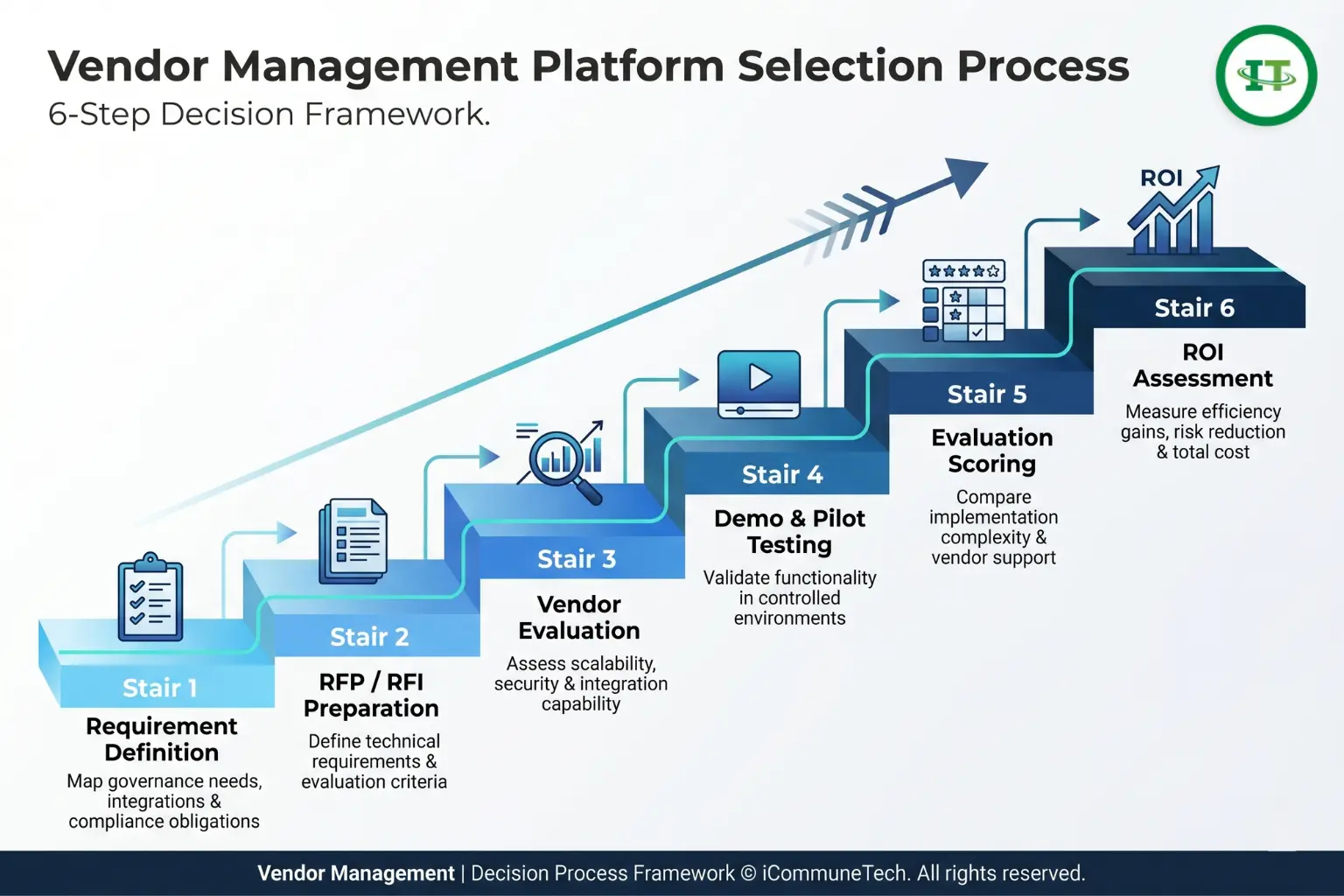
A structured selection process typically includes the following steps:
- Requirement definition: Identify vendor governance needs, integration requirements, and compliance obligations across IT operations
- Request for proposal (RFP) or request for information (RFI) preparation: Define technical requirements, vendor capabilities, and evaluation criteria
- Vendor evaluation: Assess platforms based on scalability, security architecture, and integration capability
- Demonstrations and pilot testing: Validate system functionality through controlled testing environments
- Evaluation scoring: Compare platforms based on implementation complexity, vendor support, and operational fit
- Return on investment (ROI) assessment: Evaluate efficiency gains, governance improvements, and overall cost impact
Organizations often align vendor management platform selection with broader digital supply chain transformation initiatives to ensure the solution integrates with procurement, analytics, and operational systems across the enterprise.
Frequently Asked Questions About Vendor Management Tools
Enterprise teams evaluating vendor management tools often raise practical questions about deployment models, integration complexity, and operational benefits. The following answers address common concerns from IT, procurement, and compliance leaders.
What deployment models are available for vendor management tools?
Vendor management platforms are available as cloud-based software-as-a-service (SaaS) solutions or on-premise integrated systems. Cloud deployment enables faster implementation and supports scalable vendor management across distributed operations.
How do vendor management tools integrate with enterprise systems?
Vendor management platforms integrate with enterprise resource planning (ERP), procurement, finance, and analytics systems through application programming interfaces (APIs). These integrations synchronize supplier records, contracts, and procurement transactions across systems.
What cost factors influence vendor management platform adoption?
Adoption costs depend on licensing models, integration complexity, supplier network size, and customization requirements. Organizations assess return on investment (ROI) based on efficiency improvements and risk reduction.
What operational benefits do vendor management tools provide?
Vendor management platforms centralize supplier data and procurement processes. This centralization improves visibility, strengthens compliance monitoring, and supports performance tracking across supplier networks.

Irshad Pathan

Web Development Expert
Irshad is a senior technical expert at iCommuneTech. He manages the iCommuneTech's Web Development Team, and has hands-on expertise in web development, Laravel development, Logistics, fleet management, and Supply Chain Management. He mentors the in-house team and enjoys describing his experience in words.
Read More Insights By Irshad →