Fleet Management Software
Development
Fleet management system supports vehicle tracking, dispatch coordination, telematics monitoring, and task execution for transportation operators, including freight carriers and last-mile delivery fleets.
iCommuneTech develops fleet management software that integrates with Transportation Management Systems (TMS), ERP platforms, and logistics product environments. The platform embeds routing logic, driver task assignment, and asset monitoring into dispatch workflows across active fleet environments.
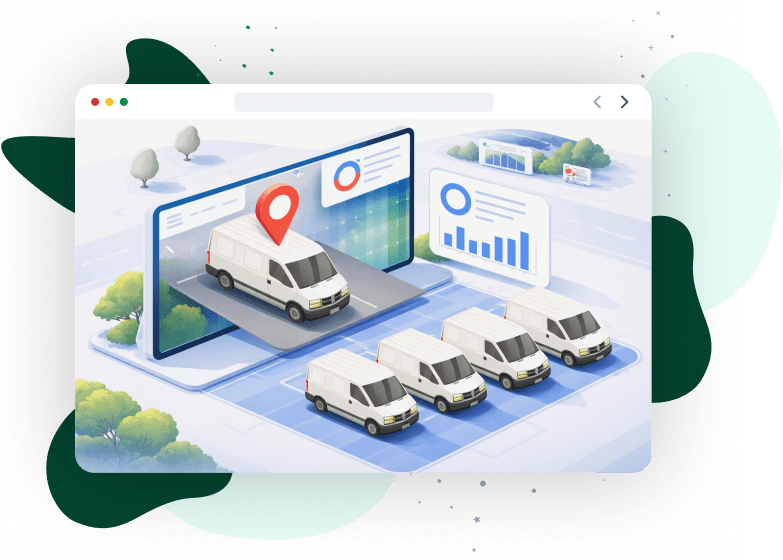
iCommuneTech’s Fleet Management Software for Dispatch and Visibility Constraints
Transportation and logistics ecosystems include fleet owners, logistics service providers, and IT product companies facing operational pressure, rising costs, and system limitations. Gaps in execution, coordination, and operational visibility reduce performance and scalability.
Custom fleet management software embeds control, real-time visibility, and dispatch coordination into transportation operations and product platforms.
Fleet Owners
Fleet owners across trucking, air, rail, water, and multi-modal transport manage vehicles, drivers, and delivery schedules across distributed fleet environments. Disconnected tracking tools and manual dispatch workflows limit route visibility, driver monitoring, and asset utilization across active fleet operations. These gaps reduce coordination, increase idle time, and weaken service reliability. As fleets scale, fragmented systems amplify inefficiencies and execution delays.
Key Operational Challenges
- Limited visibility into vehicle movement, driver activity, and route execution
- Increasing fuel, maintenance, and idle costs across fleet operations
- Dispatch gaps affecting delivery schedules and route coordination
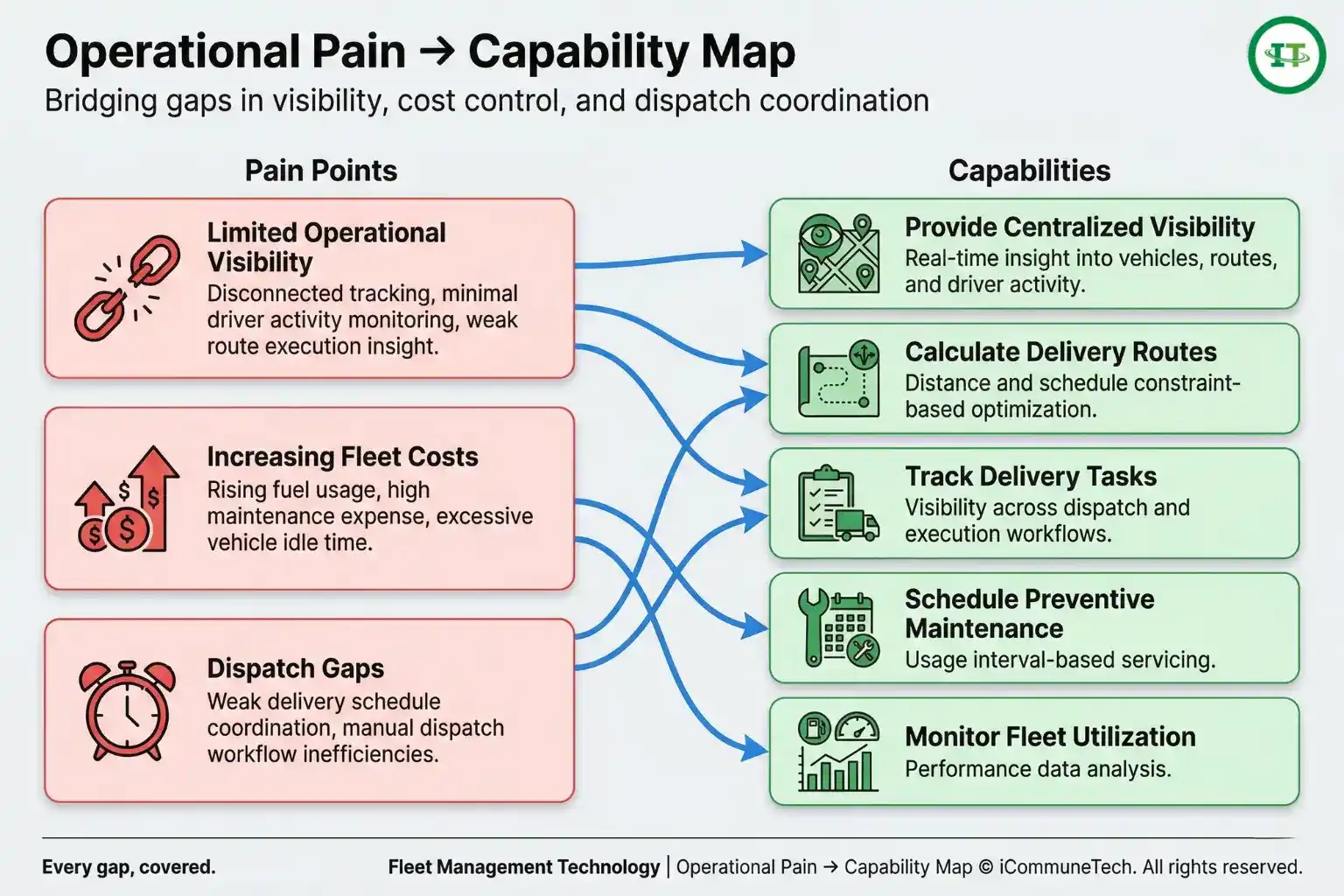
Embedded Fleet Capabilities
- Provide centralized visibility into vehicles, routes, and driver activity
- Calculate delivery routes based on distance and schedule constraints
- Track delivery tasks across dispatch and execution workflows
- Schedule preventive maintenance based on usage intervals
- Monitor fleet utilization through operational performance data
Fleet Management Service Providers
Fleet management service providers, including logistics service providers, freight forwarders, and third-party operators, coordinate client fleets, shipment routing, and dispatch workflows across partner networks. Disconnected tracking systems and customer-specific dispatch tools limit execution visibility, workflow standardization, and operational control across multi-client fleet environments.
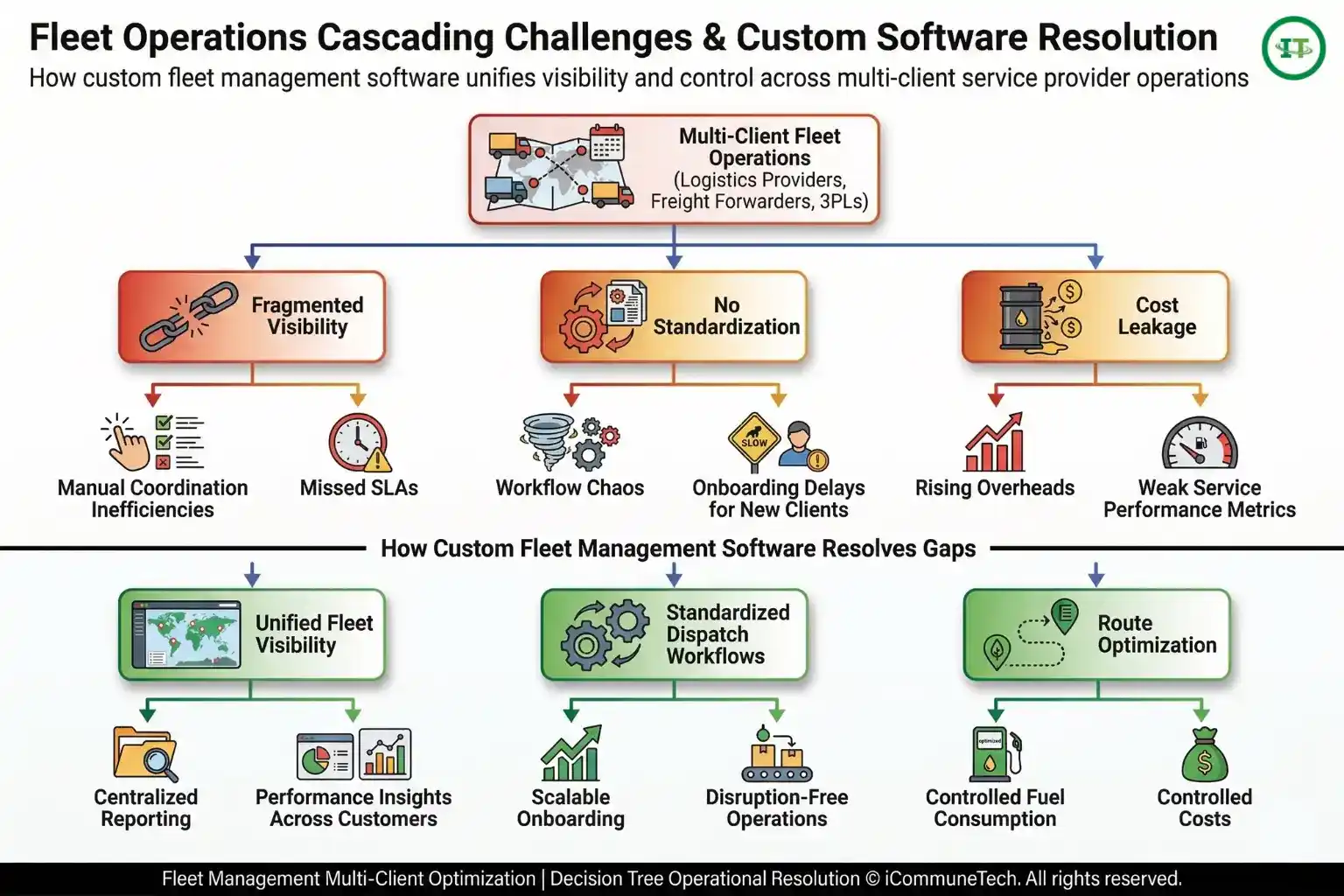
Key operational challenges affecting service provider performance include:
- Fragmented visibility across client fleets, shipments, and routes managed through disconnected tools and manual coordination
- Difficulty standardizing dispatch, tracking, and reporting processes across multiple customers and operating models
- Limited control over cost drivers such as fuel usage, asset utilization, and service performance metrics
Desired outcomes that custom fleet management software can support:
- Unified fleet visibility across vehicles, routes, shipments, and driver activity for multiple client operations
- Standardized dispatch workflows that improve coordination, scheduling accuracy, and service execution
- Route optimization that supports better asset utilization and controlled fuel consumption
- Centralized reporting that provides performance insights across customers, regions, and service lines
- Scalable system architecture that supports onboarding new clients without disrupting existing operations
IT Product Companies
IT product companies building software for transportation and logistics platforms face pressure to deliver complete systems with fleet intelligence. Missing native fleet capabilities creates product gaps, limits platform competitiveness, slows roadmap execution, and reduces product differentiation in complex logistics environments.
Key development challenges affecting platform expansion include:
- Dependence on external fleet tools that restrict customization, integration depth, and control over core product capabilities
- Gaps in real-time tracking, dispatch visibility, and telematics data integration within the existing platform architecture
- Delays in feature delivery caused by limited domain expertise and complex system integration requirements
Desired outcomes that custom fleet management software can support:
- Native fleet modules that strengthen product capability across tracking, dispatch, and telematics intelligence
- Deeper integration with TMS, ERP, and workflow systems for consistent data flow and execution alignment
- Faster roadmap expansion through reusable fleet components and prebuilt operational logic
- Ownership of fleet intelligence IP that supports long-term differentiation and platform control
- Scalable architecture that supports multi-tenant deployment across diverse logistics use cases
What Fleet Management Capabilities Can Your TMS Platform Gain?
TMS platforms gain asset tracking, dispatch coordination, telematics ingestion, and maintenance monitoring capabilities across commercial vehicles, trailers, containers, aviation equipment, ships, and rail assets. These capabilities embed route execution, vehicle location tracking, and asset lifecycle monitoring into transportation workflows across distributed fleet environments.
Fleet management capabilities that a TMS platform can gain:
TMS Platform Gap Visualizer
How Our Modern Fleet Management System Can Remove The Growth Bottleneck of Your T&L Business
Our modern fleet management system removes growth bottlenecks by integrating dispatch coordination, route execution, vehicle tracking, safety monitoring, and maintenance scheduling into a unified operational layer. The system connects vehicles, drivers, routes, loads, and assets through shared execution workflows across transportation platforms.
The platform uses an API-first, modular architecture to integrate routing, tracking, and analytics modules into existing TMS environments. Each module operates independently while sharing telematics inputs, route data, and asset status signals across fleet operations.
Explore Our Fleet Management System Demo
Our fleet management system demo provides access to dispatch coordination, route planning, vehicle tracking, safety monitoring, and analytics modules within a unified platform environment. The demo environment presents execution workflows across vehicles, drivers, routes, and fleet assets.
The demo illustrates how routing aligns with dispatch workflows, how telematics inputs feed analytics modules, and how compliance and safety systems interact with operational data across transportation platforms.
Real-time data flow
Feature coverage
UI alignment
Why Modern TMS Companies Build Native Fleet Management Ecosystems?
Modern TMS platforms build native fleet management ecosystems to overcome integration constraints across external tracking, routing, and maintenance tools. Disconnected modules create fragmented data sources, limit UI ownership, restrict multi-tenant platform behavior, and reduce execution visibility across fleet operations.
Custom native modules create differentiation by connecting routing, tracking, and maintenance into a shared data layer supporting unified visibility across operations. In one platform modernization initiative, client satisfaction improved by 60% as faster turnaround, transparent workflows increased dispatch accuracy, reduced support tickets, and improved communication. NPS rose from 7.2 to 9.1, strengthening customer trust and reinforcing long-term retention through consistent, integrated operational experiences.
Common product engineering pain points include:
- Limited flexibility when integrating external fleet tools
- Misalignment across multi-tenant platform features
- Vendor lock-in reduces customization control
- Rising licensing costs with platform scale
- Disconnected data across the outing and tracking modules
- Fragmented insights are delaying roadmap execution
- Get this verified from the subject matter expert
How iCommuneTech Helps IT Product Companies Deliver Fleet Management Software Features Fast Enough?
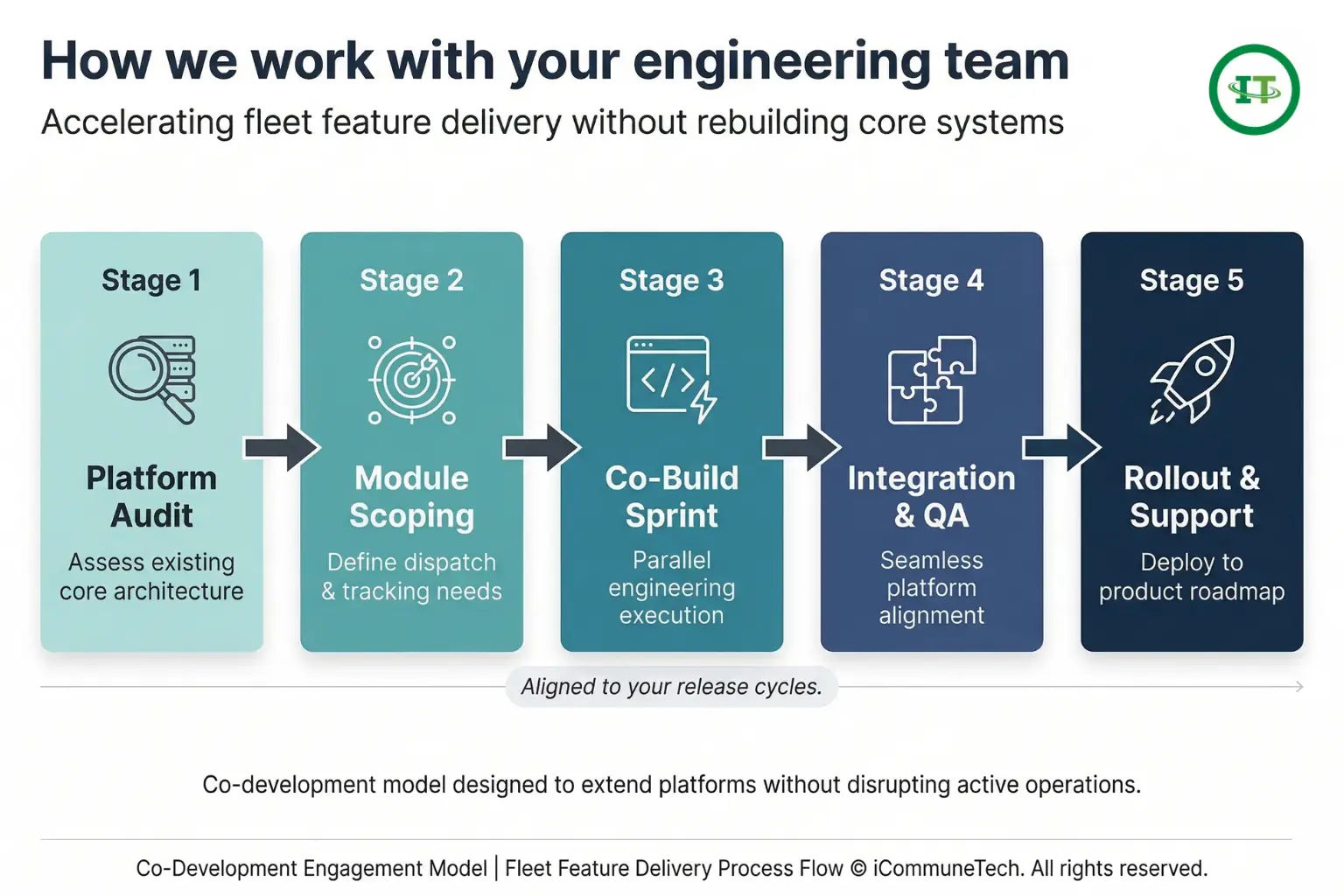
iCommuneTech helps IT product companies accelerate fleet feature delivery by extending dispatch, tracking, and telematics modules into existing transportation platforms without rebuilding core systems. The co-development model aligns engineering execution with product roadmaps, release cycles, and platform integration requirements.
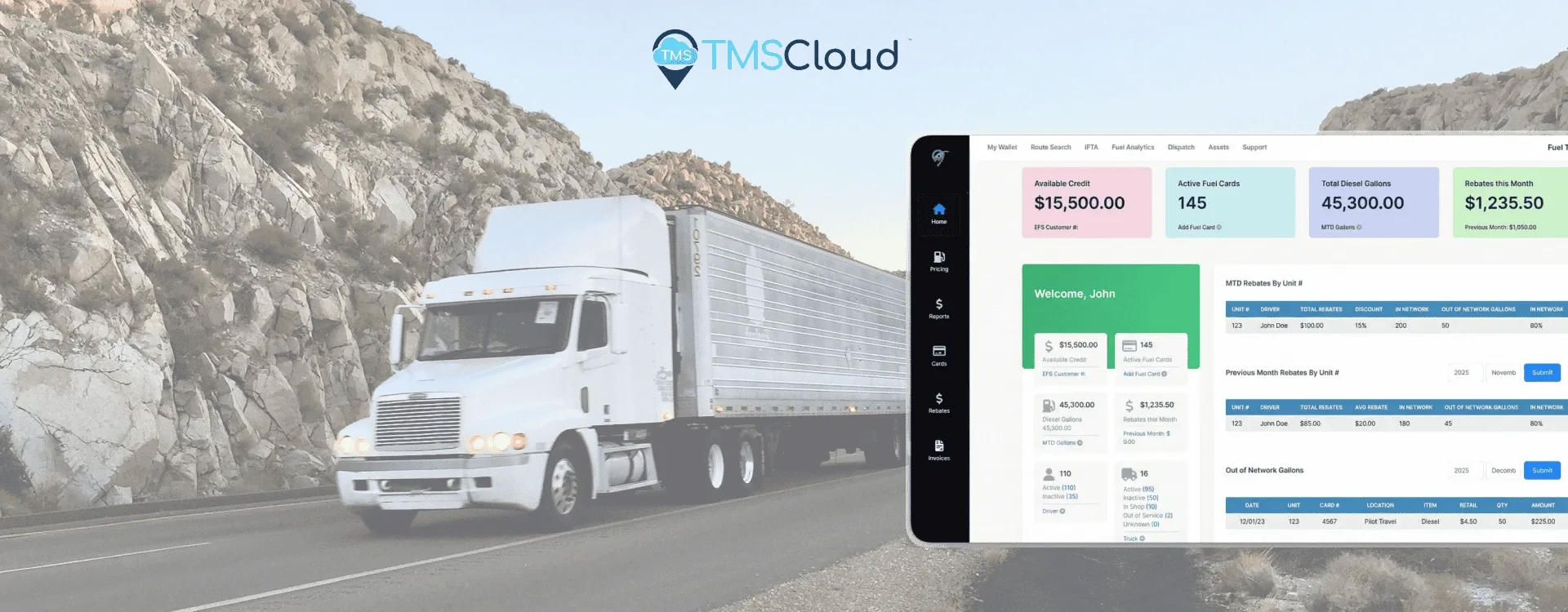
“Working with iCommuneTech has been a game-changer for A&I Fuel Finder. Their team understood our operational challenges from day one and turned our idea into a user-friendly, data-driven platform. Our drivers now save time and money by finding the lowest-priced fuel along optimized routes. The mobile app features, like fuel invoices and card management, made it even more valuable for our clients. We’re pleased with the professionalism, support, and technical expertise iCommuneTech delivered.”

How a Custom Fleet Management System Strengthens Your TMS
A custom fleet management system strengthens TMS platforms by embedding routing, tracking, safety, fuel monitoring, and maintenance modules into a unified operational environment. Native fleet capabilities reduce reliance on external APIs, improve execution visibility, and expand platform control across vehicles, drivers, and assets.
Rule and Constraint Flexibility
Build vs Buy: Should You Develop a Fleet Management Suite or Integrate Vendor APIs?
TMS vendors evaluating fleet expansion must compare long-term platform control against short-term integration speed. Vendor APIs enable faster entry but restrict flexibility, data ownership, and cross-module intelligence. Custom development supports deeper platform alignment, stronger data control, and sustained product differentiation.
Custom Development vs Third-Party Safety Vendor Integration
| Comparison Attribute | Custom Development | Third-Party Safety Vendor Integration |
|---|---|---|
| Data ownership | Full control over telematics, driver, and operational data pipelines | Vendor controls access, storage, and data structure |
| Multi-tenant needs | Designed to support platform tenancy models and customer isolation | Limited support for tenant-specific configurations |
| Cost scalability | Predictable cost growth as platform adoption increases | Licensing costs increase with vehicles, users, and usage |
| UI/UX control | Seamless integration aligned with product interface standards | Restricted customization and inconsistent user experience |
| Telematics data access | Direct access to raw data streams for analytics and intelligence building | Filtered or limited access based on vendor APIs |
| Cross-module intelligence | Unified insights across routing, dispatch, fuel, maintenance, and safety modules | Fragmented insights across disconnected systems |
| Roadmap flexibility | Independent feature evolution aligned with product strategy | Dependent on vendor priorities and update cycles |
Summary
Custom development remains the ideal path for TMS vendors aiming to expand platform capabilities, strengthen data ownership, enable unified intelligence layers, and support long-term product differentiation.
Fleet Management System Development Services for Logistics Software Platforms
Enterprise TMS platforms require structured engineering support to expand fleet capabilities without disrupting existing architecture and release cycles. Projects demand alignment across product vision, data models, integrations, and operational workflows. Full-cycle fleet management system development supports seamless delivery from ideation through rollout and long-term evolution.
iCommuneTech works as a co-build partner with TMS product teams to deliver fleet modules aligned with platform architecture. The engagement model supports execution continuity, integration stability, and delivery predictability across development phases.
Core services include:
Architecture And Technology Stack for Fleet Management System
A fleet management system uses a modular architecture to support independent evolution of dispatch, tracking, routing, safety, and analytics components while maintaining shared operational data flow. The architecture supports interoperability, real-time processing, and tenant isolation across distributed fleet environments.
The platform uses microservices architecture to manage domain-specific logic through an event-driven backbone. Telematics ingestion pipelines capture data from GPS devices, CAN bus inputs, and vehicle sensors to feed a centralized tracking engine for location visibility and driver activity monitoring.
Data management and control layers support long-term scalability:
- Data lake storing historical telemetry, operational events, and performance analytics
- Operational database supporting real-time transactions, dispatch execution, and tracking updates
- Real-time alerts and event bus coordinating system-wide notifications, workflow triggers
- Multi-tenant admin layer isolating customer environments within shared infrastructure
- Role-based access control governing user permissions across drivers, dispatchers, and administrators
Core architectural components include:
- Modular microservices coordinating dispatch, routing, fuel analytics, maintenance scheduling, and load optimization as unified operational intelligence
- Telematics ingestion layer processing real-time GPS, telemetry, and vehicle sensor data streams
- Tracking engine maintains live vehicle location, movement history, and driver activity data
- Dispatch logic layer aligning orders, routes, drivers, and task execution workflows
- Routing logic engine supporting dynamic route calculations, constraint-based optimization
- Fuel analytics service evaluating consumption patterns, idle behaviour, and efficiency metrics
- Maintenance scheduler managing preventive service intervals, work orders, and asset lifecycle data
- Load optimization engine coordinating weight distribution, space utilization, and loading sequence logic
- Incident and accident event pipeline capturing safety triggers, video inputs, and telemetry-based alerts
A system diagram in production documentation should represent microservices connected through an event bus, feeding data pipelines into tracking, dispatch, analytics, and storage layers, with multi-tenant access controls applied at the platform level.
Integration With Your Existing TMS or Logistics Platform
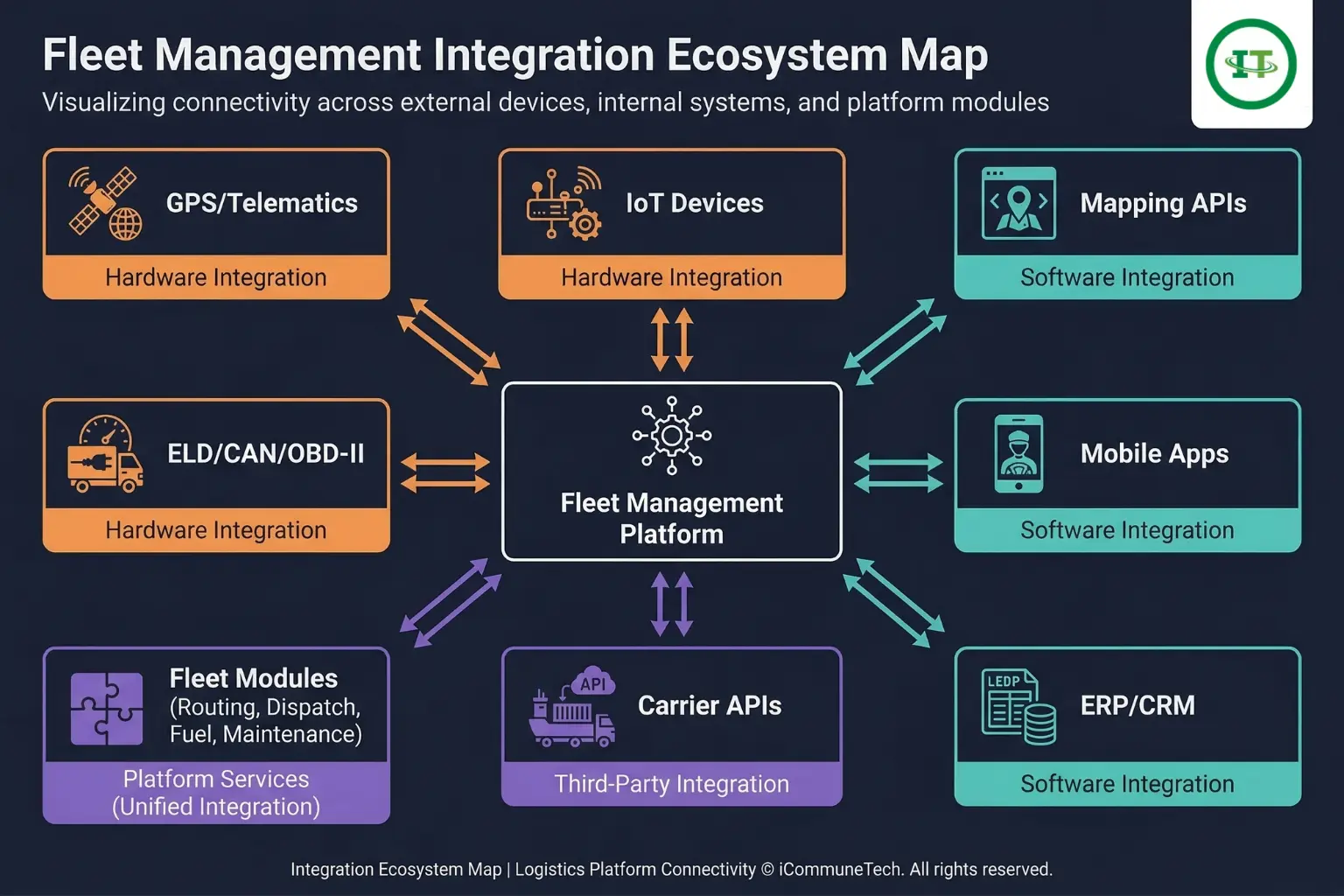
A fleet management system integrates operational inputs, execution workflows, and analytics into a unified TMS platform layer. Integration enables TMS vendors to manage vehicle, driver, and asset data across logistics management software environments while maintaining consistent execution visibility.
The integration layer connects external devices, internal systems, and platform modules through shared APIs and synchronized data models. The structure supports interoperability across routing, dispatch, tracking, fuel monitoring, and maintenance workflows.
This connected integration framework supports unified execution control, strengthens platform ownership, and enables consistent operational visibility across logistics operations.
Key Integration Points
- GPS and telematics vendors supplying real-time location, movement, and vehicle telemetry data
- IoT devices capturing engine metrics, asset conditions, and environmental signals
- ELD, CAN bus, OBD-II readers feeding compliance, performance data streams
- Mapping APIs supporting geospatial intelligence, route calculations, and location context
- Mobile applications enabling driver communication, task execution, and inspection reporting
- ERP systems and CRM development services synchronize orders, customers, billing, and operational records
- Carrier and shipper APIs connecting shipment data, delivery updates, and partner workflows
- Routing, dispatch, fuel, and maintenance modules operating as interoperable services across the platform
Fleet Management Software Customization and Integration Flexibility
Fleet management software customization at the platform level focuses on embedding operational intelligence inside TMS products rather than building standalone fleet software. The platform integrates maintenance data, tracking inputs, and operational signals directly into core TMS workflows. This customization approach strengthens platform control by aligning system capabilities with product architecture and execution logic.
The platform development model supports deep integration, modular expansion, and long-term evolution across connected operational domains. Each component functions as an embedded capability within the TMS ecosystem, preserving workflow continuity and system stability.
Platform-level development services include:
How iCommuneTech Offloads and Brings Innovation in for TMS Engineering Teams
With more than ten years of logistics engineering experience, iCommuneTech supports multiple TMS products across planning, optimization, and execution domains. This experience enables predictable delivery while preserving internal platform ownership.
Custom Fleet Management Software Cost and Development Timeline
Custom fleet management software pricing aligns with project scope, functional depth, and business ROI goals rather than fixed packages. Engagement models may include full process outsourcing (managed services) or focused consulting that depends on delivery ownership, internal team maturity, and long-term platform strategy. Exact costs depend on algorithm complexity, data processing depth, and the number of required integrations across the fleet ecosystem.
An interactive cost calculator provides a directional investment range for building custom fleet management capabilities within a TMS platform. The calculator evaluates selected modules, integration scope, telematics, sensor data complexity, UX/UI depth, multi-tenant scalability needs, and analytics or AI extensions. It estimates engineering effort, architecture depth, infrastructure load, and delivery timelines based on fleet size, data volume, and deployment model.
Fleet Management System Calculator
Cost Factors:
Number of modules across tracking, dispatch, maintenance, fuel, and safety
Integration needs across TMS, ERP, CRM, telematics, and third-party services
Data complexity from telematics, video streams, and CAN bus signals
Platform scalability requirements for fleet size and growth targets
UX/UI sophistication across web and mobile interfaces
Multi-tenant architecture requirements for client-level environments
Analytics and AI model depth for forecasting, optimization, and automation
Project Delivery Timeline
3–6 weeks
8-12 weeks
6–12 months
+8–16 weeks
When Should Transport And Logistics and Software Companies Build Their Own Fleet Management System?
Building a native fleet management system becomes relevant when integrated fleet operations evolve into a core product expectation and external tools restrict platform control. The following questions help evaluate urgency and strategic alignment for native system development. If the answer is yes to three or more, custom fleet development aligns with product expansion and long-term revenue goals.
Fleet Management System Implementation Impact on ROI
A custom fleet management system increases ROI by converting operational intelligence into a long-term platform asset across fleet owners, service providers, and IT product companies. Owned fleet data compounds value through cost optimization, compliance visibility, and cross-module intelligence that strengthens operational decision-making. Expanded capabilities improve efficiency, unlock new revenue streams, and strengthen competitive positioning.
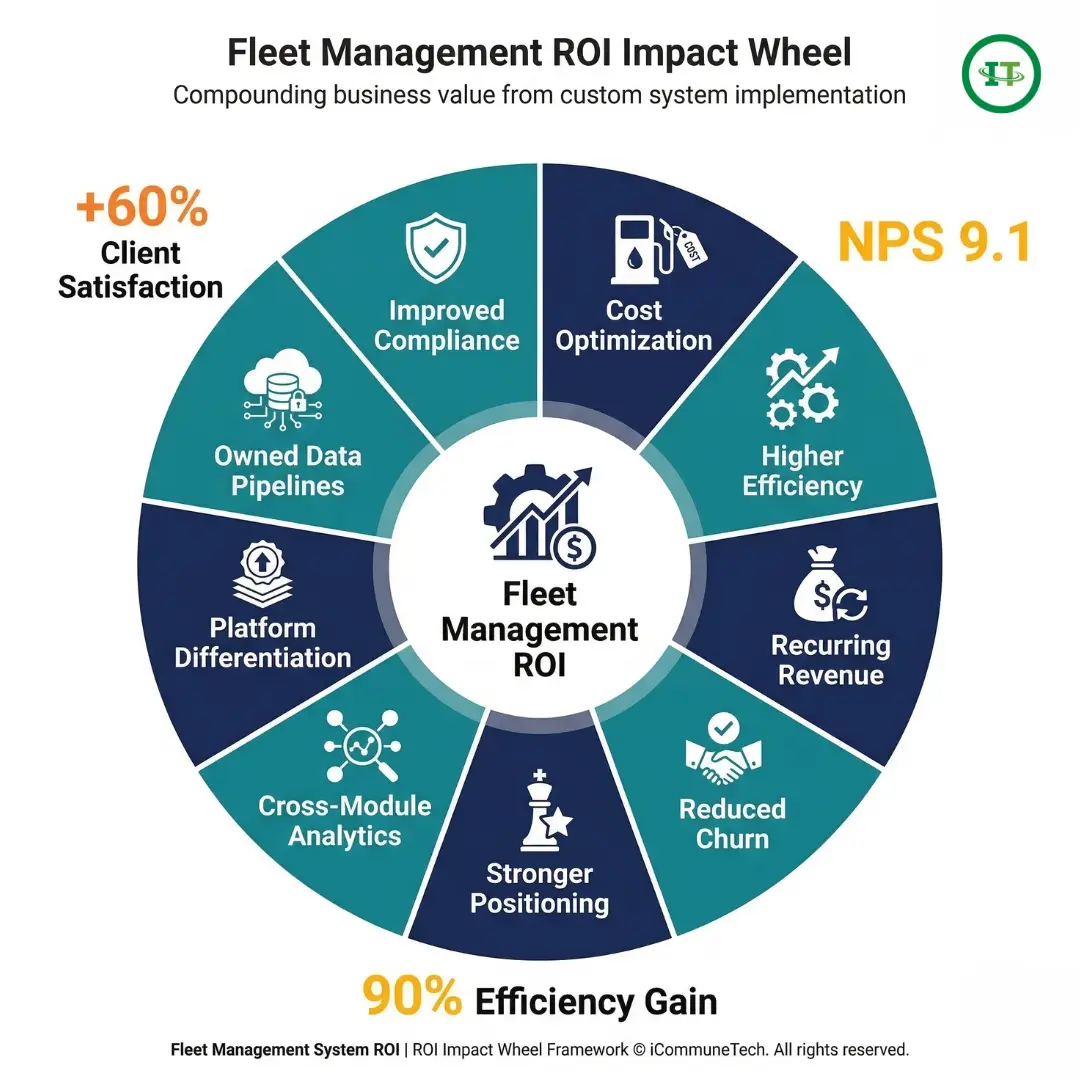
ROI Impact Across Transport and Logistics and Software Platforms:
- Improved compliance visibility through integrated tracking, inspection, and regulatory monitoring workflows
- Cost optimization through fuel insights, maintenance planning, and utilization control
- Higher operational efficiency across dispatch, routing, and execution coordination
- New recurring revenue streams through premium fleet modules, add-on platform capabilities
- Reduced customer churn by expanding platform value and operational coverage
- Stronger competitive positioning through full operational visibility, integrated intelligence
- Cross-module analytics converting routing, driver, maintenance, and fuel data into a unified intelligence layer
- Platform differentiation through embedded capabilities aligned with industry-specific workflows
- Ownership of critical fleet data pipelines is strengthening control and long-term product value
- Higher net revenue retention through deeper platform adoption, expanded feature usage
Case Studies: Relevant Logistics, Telematics & Fleet Systems We’ve Built
The following case studies demonstrate operational outcomes delivered through fleet, routing, and dispatch systems built for logistics platforms. Each case study reflects operational impact across transportation workflows, proving adaptability across fleet operations and TMS environments.
Efficient Modernisation of 20-Year-Old TMS SaaS
Improved platform efficiency by 90% and increased customer satisfaction by 60% through infrastructure modernization and unified operational data integration.
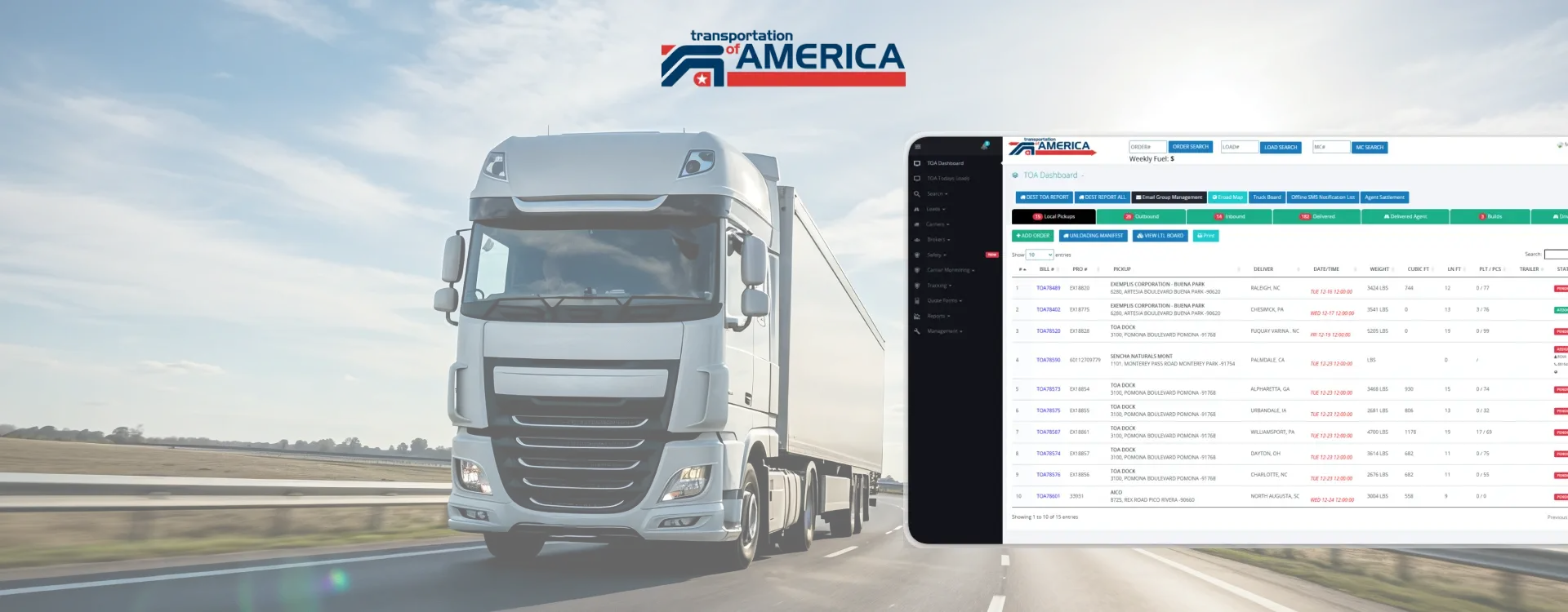
1-Minute Dispatch System Through Automation and Real-Time Tracking
Reduced dispatch execution time to under one minute using real-time tracking, automated assignment, and workflow optimization.
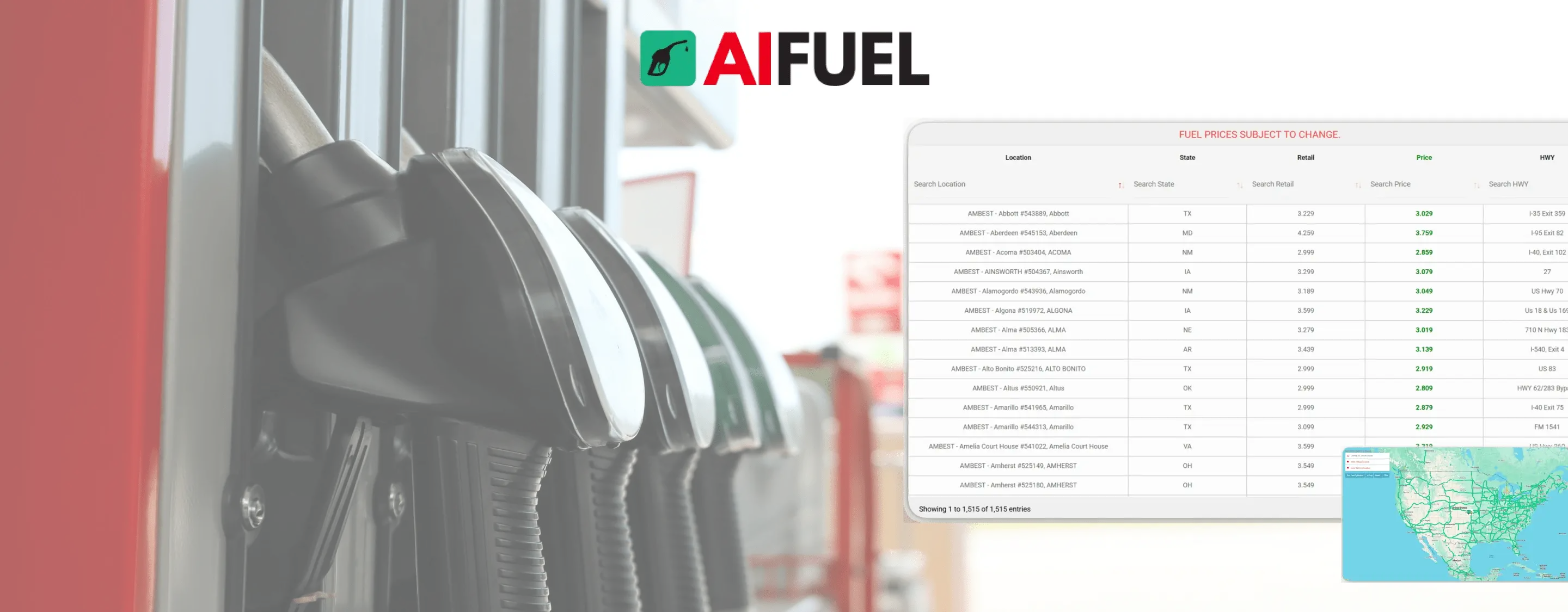
Route and Fuel Management Platform Development
Enabled optimized routing and fuel intelligence, improving operational visibility and cost control across fleet operations.
Discuss Your Fleet Management System Needs
Custom fleet management modules integrate with existing TMS platforms to strengthen dispatch visibility, operational coordination, and asset monitoring across fleet environments.