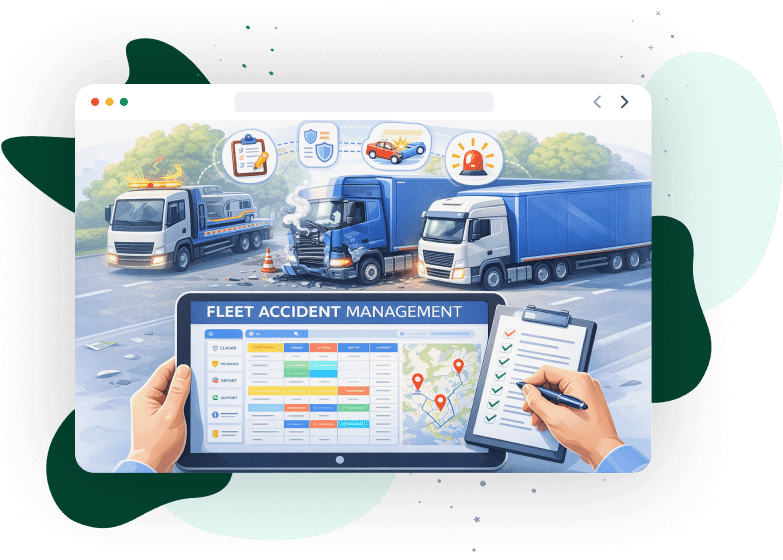
Fleet Accident Management System
A fleet accident management system centralizes incident tracking, safety monitoring, and event recording for transportation companies, such as freight carriers and last-mile delivery providers.
iCommuneTech develops accident reporting and driver safety management software that integrates with systems such as TMS, ERP, CRM, and fleet management software. The software aligns incident reporting with dispatch events and telematics timelines to improve response coordination, reduce risk exposure, and maintain safety compliance.
What Accident & Safety Management Capabilities Can Your TMS Platform Gain?
Your TMS platform gains safety intelligence and operational control when accident management becomes a native capability. Embedded modules convert accident data and safety events into real-time visibility, automation, and forensic insight inside the core platform.
Native accident workflows replace fragmented tools and disconnected records. Incident data remains linked with routes, tasks, vehicles, drivers, and telematics timelines.
Accident and safety management functions as modular product intelligence, not manual paperwork. Capabilities follow a structured flow: detection → investigation → corrective action → compliance reporting.
Modular accident and safety management capabilities:
Explore Our Fleet Management System Demo
Review fleet operations across dispatch, routing, accident records, and safety analytics.
Evaluate incident workflows, telematics context, trip replay, and reporting as embedded TMS capabilities.
Why TMS Companies Build a Native Accident Management Module?
TMS companies build a native accident management module to control safety intelligence, eliminate fragmented workflows, and retain ownership of accident data inside the platform.
When accident management operates externally, investigation timelines disconnect from dispatch, routing, telematics, and driver performance analytics. Embedding accident intelligence inside the TMS restores event continuity and strengthens product differentiation.
Try to reframe the content with this perspective. especially when writing the opening line for the heading.
Platforms that unified operational workflows achieved 60% faster processing, demonstrating that aligned event timelines accelerate investigation and resolution. Native accident modules preserve data ownership, UX consistency, and long-term scalable architecture.
Recurring Constraints With Internal-Only Or External Safety Tools Include:
- Disconnected UX in multi-tenant TMS platforms
- Weak linkage with dispatch events and route context
- Limited access to raw telematics feeds
- No unified view across safety and operational timelines
- Restricted white-labeling for SaaS consistency
- Rising licensing costs at scale
- Safety scoring algorithms outside product control
- Accidents disconnected from route deviations
- Fuel waste impact is hidden without a unified correlation
- Driver performance analytics weakened without native safety data
External engineering partnerships resolve these constraints without diverting core product teams from strategic releases.
Building native dispatch shifts control back to the TMS platform, strengthens differentiation, and protects long-term scalability.
How iCommuneTech Helps IT Product Companies Deliver New Features Fast Enough?
iCommuneTech accelerates feature delivery by embedding with product teams and building complex accident intelligence modules without disrupting release schedules. Our team aligns with existing TMS architecture, understands dispatch and telematics dependencies, and delivers safety modules within defined roadmap timelines while preserving internal engineering capacity.
“Working with iCommuneTech transformed our product execution. The team understood our operational challenges from day one and converted our concept into a scalable, data-driven platform. Our drivers now save time and money through optimized routing and integrated mobile workflows. The professionalism, support, and technical expertise strengthened our product delivery.”

Why Is Having a Fleet Accident Management Module in Your Product Roadmap Important?
Having a fleet accident management module in your product roadmap ensures control over safety data, investigation workflows, and compliance logic as customer expectations evolve. Enterprise buyers expect embedded safety intelligence within their TMS rather than relying on external tools. Without integrated accident management, platforms risk fragmented workflows, limited differentiation, and slower enterprise adoption. Accident intelligence transforms a transaction-driven TMS into a fleet operations control system by linking incidents, telematics timelines, routing events, and driver performance analytics into a unified operational context.
Strategic value drivers:
Early roadmap inclusion ensures safety capabilities scale with platform growth and evolving enterprise expectations.
Build vs Buy: Should You Develop a Fleet Accident Management System or Integrate a Vendor?
You should develop a fleet accident management system when long term data ownership, scoring control, cost predictability, and product differentiation outweigh short term integration speed. Vendor integrations offer faster initial deployment. Custom development provides architectural control, unified safety intelligence, and scalable economics as customer volume grows.
Comparison Overview
| Comparison Attribute | Custom Development | Third-Party Safety Vendor Integration |
|---|---|---|
| Data ownership | Full ownership of accident and telematics data | Vendor controls data storage and access |
| Accident detection logic customization | Rules and models tailored to product needs | Fixed logic with limited configuration |
| Telematics compatibility | Supports diverse ELD, CAN bus, and video feeds | Limited to supported devices |
| UI/UX consistency | Native UI aligned with TMS experience | External UI or embedded widgets |
| Event refresh frequency | Real-time event processing | API polling or delayed updates |
| Integration depth | Deep integration with dispatch, routing, and tasks | Shallow API-level integration |
| Multi-tenant support | Designed for SaaS tenancy and isolation | Often constrained or unavailable |
| Long-term cost scalability | Predictable costs as customers scale | Rising licensing and usage fees |
| Control over scoring algorithms | Full control over safety and risk scoring | Vendor-defined scoring logic |
| Compliance workflows | Configurable to regional and customer needs | Standardized workflows with limits |
Summary
Custom modules deliver stronger differentiation, algorithm control, and extensibility at enterprise scale.
Fleet Accident Management Module Development Services for TMS and Logistics Software Platforms
iCommuneTech develops fleet accident management modules through structured enterprise co-development rather than task-based outsourcing. The engagement model integrates with internal architecture, data structures, and release sequencing to reduce delivery risk and preserve platform integrity.
With more than 12 years of product engineering experience across fleet and logistics platforms, our team of highly professional individuals delivers sustained execution capability for safety intelligence systems.
Service Scope (Object–Action):
This co-development model preserves product ownership, accelerates delivery, and ensures accident management ships as a core TMS module.
Architecture & Technology Stack for Accident Management System
The accident management module uses a cloud native, IoT-enabled microservices architecture embedded within TMS platforms. It supports continuous event ingestion, sub-second alerting, and horizontal scalability for enterprise fleet environments.
Production deployments process millions of telematics events daily with real-time incident detection and performance isolation across services.
Technology Stack:
- Backend microservices built using .NET, Java, Node.js, or Go through scalable software development services
- Containerization via Docker and Kubernetes
- Databases: PostgreSQL with PostGIS and TimescaleDB
- Event streaming through Kafka and MQTT
- AI/video analytics using TensorFlow or PyTorch
- Frontend built with React or Angular
Modular Architecture Components:
- Event ingestion pipeline for telematics, GPS, CAN bus, and video
- Accident detection engine using rule-based and ML models
- Time-series database storing speed, braking, and G-force data
- Geospatial mapping system for route-aware visualization
- Trip replay engine reconstructing incidents
- Safety scoring microservice calculating risk
- Driver and vehicle risk analytics engine
- Event correlation service merging dispatch and routing data
- Notification service managing alerts and workflows
- Admin and user portals for configuration
- API gateway with RBAC enforcing secure access
This architecture delivers scalable, real-time accident intelligence with predictable performance and extensibility.
Integration With Your Existing TMS or Logistics Platform
The accident management module integrates directly with TMS, ERP, and CRM systems within
your logistics
management software environment. Orders, vehicles, drivers, routes, and compliance records synchronize
in real time, eliminating duplicate data entry and fragmented safety records.
Incident data enters the TMS, connects with dispatch and vehicle context, flows through compliance validation
and investigation workflows, and consolidates into a unified operational timeline.
This integration model ensures accident management functions as a core platform capability, not an external
add-on.
Integration attributes:
- Native sync with user, order, fleet, vehicle, task entities
- Configurable adapters for TMS, ERP, or CRM development requirements
- Event-driven updates for real-time alerts and safety triggers
- Data consolidation for reporting, audits, and analytics
- Process automation across detection, investigation, and compliance
Key benefits:
Unified operations without duplicate entry
Faster investigations via automated data correlation
Consistent UX across safety and dispatch
Actionable analytics from consolidated operational data
Accident Management System Customization and Integration Flexibility
Accident management systems must support live telematics ingestion, heterogeneous device environments, and evolving safety policies. The module embeds natively within existing TMS architecture while remaining configurable at the tenant, region, and compliance level. Customization ensures accident intelligence aligns with fleet behavior models, risk governance rules, and operational workflows across SaaS environments.
Detection and Risk Configuration
Platform and Tenant Control
Data Governance and Rollout Control
This flexibility ensures accident management aligns with your TMS while supporting differentiated safety strategies at SaaS scale.
How iCommuneTech Offloads and Brings Innovation in for TMS Engineering Teams?
iCommuneTech increases delivery velocity by building complex platform modules such as accident intelligence and safety systems while internal teams retain architectural control and roadmap ownership. The collaboration model integrates directly with product teams to accelerate releases without increasing headcount or disrupting core development cycles
Accident Management System Cost and Development Timeline
The cost and timeline of an accident management system depend on detection logic complexity, telematics and video integrations, analytics depth, and multi-tenant scalability requirements. Projects range from focused MVP builds to full enterprise safety intelligence platforms.
An interactive cost calculator provides a directional investment estimate for building accident management capabilities within a TMS platform. It evaluates detection models, telematics, and video integrations, reporting scope, storage needs, and tenant scale to estimate engineering effort and delivery duration.
Fleet Management System Calculator
Cost factors include:
Accident detection logic complexity
Telematics and video integrations
Event timeline UI and UX depth
Analytics and reporting scope
Multi-tenant architecture support
Storage and retention needs, especially video
Roadmap co-creation with product teams
Exact costs depend on detection algorithms and required integrations.
High-level delivery timeline:
2–4 weeks
8–12 weeks
4–6 months
+2–4 months
This approach sets clear expectations while keeping investment aligned with business outcomes.
When Should TMS Companies Build Their Own Accident Management System?
TMS companies should build their own native accident management system when product control, data ownership, and competitive differentiation become more valuable than short-term integration speed. Native development becomes justified when safety intelligence directly impacts revenue, retention, or platform positioning. If three or more of the following conditions apply, internal development becomes strategically aligned:
Affirmative answers signal readiness for native development. A built-in accident module restores data control, unlocks differentiation, and strengthens long-term platform value.
Accident Management System Implementation Impact on Your TMS Product ROI
A custom accident management system delivers measurable ROI across the logistics lifecycle. As a native safety suite, it drives revenue expansion, improves retention, and deepens operational intelligence.
Accident management functions as a high-value upsell module, increasing platform stickiness while reducing reliance on external safety vendors. Unified accident, telematics, and dispatch timelines strengthen compliance reporting and support safety-focused RFPs.
Native integration expands intelligence across dispatch, routing, fuel usage, and driver risk analytics.
Native accident management converts safety intelligence into sustained TMS ROI and competitive leverage.
Measured impact from integrated TMS platforms:
- 60% faster processing through unified workflows
- 50% reduction in planning time from consolidated real-time data
- <1 minute response times via embedded real-time modules
- 40–90% efficiency gains from automation and consolidation
- Lower operational costs by removing fragmented third-party tools
Case Studies: Fleet Safety & Telematics Performance Impact
Teletrac Navman Report Highlights Driver Exoneration and Insurance Impact Through Safety Technology
Client: Multiple Fleet Operators (Industry-Wide Study)
Technology: Teletrac Navman Video Telematics & Fleet Safety Platform
Fleet operators faced rising insurance premiums, accident-related disputes, and limited visibility into driver behavior during incidents. Safety technology deployments were driven by the need to strengthen accident defense, improve claims handling efficiency, and reduce operational risk exposure.
The Teletrac Navman safety technology deployment study evaluated how fleets use integrated video telematics, GPS tracking, and driver monitoring tools to improve accident management outcomes and financial protection.
The findings demonstrate how embedded telematics and video safety systems strengthen accident defense, reduce financial exposure, and accelerate claims resolution across commercial fleet environments.
Check more success storiesMeasured impact:
Discuss Your Accident Management Software Needs
Map accident workflows to your TMS architecture and identify where a native safety module can reduce investigation time, eliminate third-party dependencies, and strengthen compliance positioning. Define scope, integration depth, and scalability requirements through a focused technical discussion.