Fleet Maintenance System
Fleet maintenance system supports preventive maintenance scheduling, work order tracking, and asset servicing for transportation operators. iCommuneTech develops fleet maintenance software integrated with TMS, ERP, CRM, and fleet management platforms, aligning maintenance planning with dispatch schedules to control repair costs and maintain vehicle availability.

What Fleet Maintenance Capabilities Can Your TMS Platform Gain?
A Transportation Management System (TMS) gains operational control when fleet maintenance becomes a native product capability.
Native maintenance replaces fragmented tools and disconnected service records. Maintenance data links directly with routes, tasks, vehicles, drivers, and telematics timelines. Embedded modules convert asset data into uptime protection, automation, and compliance control.
Capabilities follow a lifecycle: monitoring, prevention, repair, cost control, and compliance. Identify missed services, recurring failures, and cost anomalies across assets.
Modular Fleet Maintenance Capabilities Include:
Explore Our Fleet Management System Demo
Use the demo to review fleet maintenance workflows across assets, preventive schedules, service history, and repair orders. Evaluate maintenance automation, telematics-driven meter updates, cost tracking, and issue resolution as native TMS capabilities.
Capacity utilization
Constraint handling
Load sequencing
Why TMS Companies Build a Native Fleet Maintenance Management System
A native fleet maintenance management system aligns with TMS architecture, protects workflow control, and strengthens enterprise scalability.
Native integration links fault detection, dispatch context, and technician assignment to protect uptime and reduce downtime. Maintenance events convert into actionable workflows that preserve SLA commitments.
When maintenance is built natively, detected faults automatically assign technicians using telematics and dispatch data.
Deliver 60% faster processing with maintenance-led workflows across event-driven systems.
Dispatch execution time dropped to <1 minute after linking maintenance faults directly with routing and technician workflows.
Build fleet maintenance natively to preserve workflow control, response speed, and long-term product scalability.
Engineering and Business Pain Points Addressed
- No control over maintenance workflow design inside the TMS
- Inability to embed maintenance UI within the native product experience
- OEM fault codes and telematics data lack a one-to-one mapping
- No custom preventive maintenance rules across clients
- Lack of multi-tenant control for fleets and customer separation
- License fees increase with every added asset
- Limited transparency into raw maintenance and telematics data
- No cross-module insight linking maintenance, routing, and tracking
How iCommuneTech Helps IT Product Companies Deliver New Features Fast Enough?
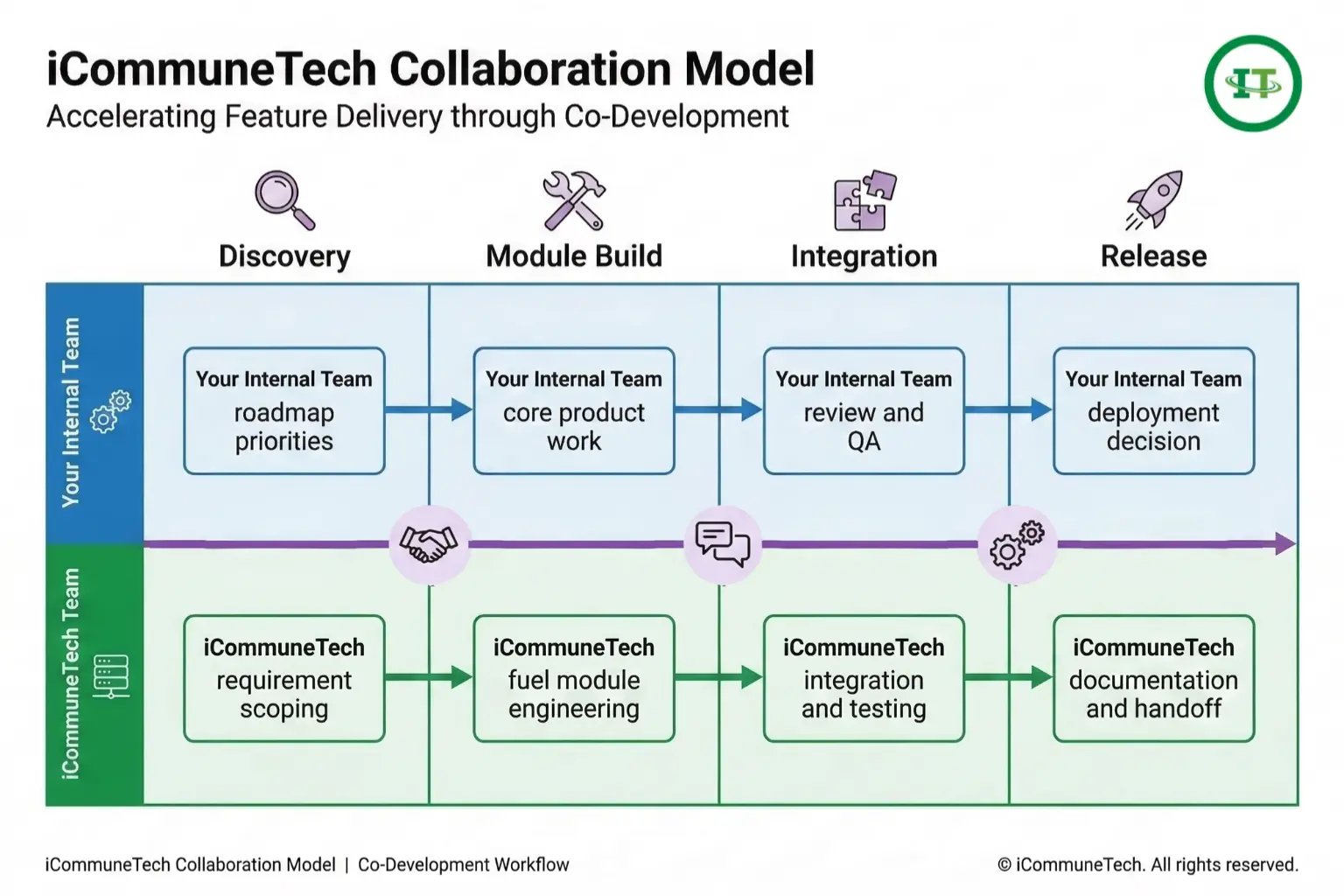
Delivery speed increases when partners understand TMS internals, data dependencies, and release constraints. iCommuneTech works alongside product teams to build native TMS features without disrupting roadmap velocity.
“The new portal transformed our operations – faster processing, automated rates, ticket management, and now seamless invoice payments. The flexibility for clients and admins to manage payments has been a game-changer.”

Importance of Fleet Maintenance Management Program in Your Product Roadmap
Modern TMS buyers expect embedded fleet maintenance inside the platform—not external tools. Native maintenance increases platform stickiness, lifetime value, and renewal confidence. It creates a monetizable add-on without fragmenting user experience or data ownership. Unlike Samsara, Fleetio, and Geotab, native maintenance gives TMS platforms full control over data models, workflow orchestration, and UI architecture. This strengthens enterprise evaluations with deeper system integration, extensibility, and long-term architectural ownership.
Strategic outcomes delivered by a roadmap-ready maintenance program:
Roadmap alignment turns maintenance into a durable growth lever across product strategy, revenue expansion, and retention performance.
Build vs Buy: Should You Develop a Fleet Maintenance System or Integrate a Vendor?
TMS product teams choose between long-term platform control and short-term integration speed. This decision impacts cost scalability, roadmap ownership, and cross-module intelligence.
Comparison Overview
| Criteria | Custom Development | Third-Party Vendor Integration |
|---|---|---|
| Workflow control | Full control | Limited control |
| Data ownership | Full ownership | Vendor-controlled |
| Telematics sync | Custom rules and mappings | Basic data mapping |
| UI/UX integration | Fully aligned with TMS | Embedded iframe or API |
| Multi-tenant support | Native multi-tenant design | Limited tenant control |
| Cost scalability | Scales with platform growth | Cost increases per asset |
| Roadmap flexibility | Complete roadmap ownership | Vendor-dependent roadmap |
| Cross-module intelligence | Unified intelligence | Fragmented insights |
Summary
Custom development delivers stronger differentiation, data ownership, and extensibility at scale. Third-party integration deploys faster with lower upfront planning and development effort.
Fleet Maintenance Module Development Services for TMS and Logistics Software Platforms
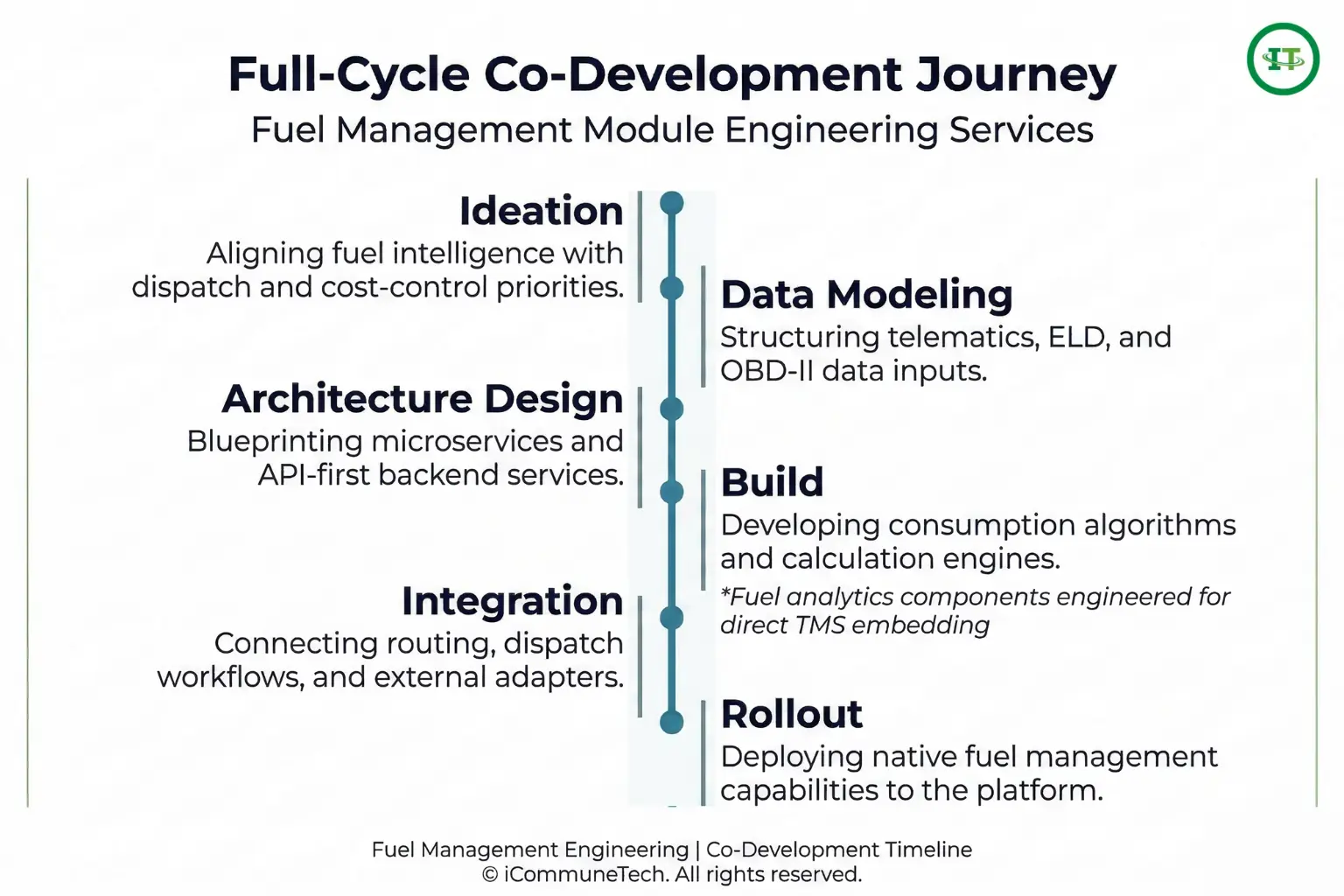
iCommuneTech delivers fleet maintenance module development as co-development with enterprise product teams. Full-cycle delivery—from ideation through rollout—aligns architecture design, data models, and release cadence while reducing risk.
With 12+ years of experience in fleet management software development since 2015, production modules delivered through this model achieved measurable ROI in under 5 months of rollout.
Service Scope (Object–Action):
Architecture & Technology Stack for Fleet Maintenance System
The module uses a cloud-based, event-driven microservices architecture embedded inside TMS platforms. Design supports high-volume telematics ingestion, low-latency processing, and horizontal scalability.
Architecture ensures predictable execution of maintenance workflows without blocking dispatch or routing operations. Continuous asset signals process while preserving data integrity and response reliability.
Architecture delivers scalable fleet maintenance operations, controlled performance, and long-term extensibility for enterprise TMS platforms.
Click layers to hold function descriptions
Technology Stack:
- Backend microservices using .NET, Java, Node.js, and Go via scalable software development services
- PostgreSQL and TimescaleDB for transactional and time-series workloads
- Cloud infrastructure across AWS, GCP, Azure
- Frontend applications using React or Angular
- Kafka and MQTT for IoT event streaming
Modular Architecture Components:
- Telematics ingestion pipeline for fault codes, odometer, and engine hours
- Maintenance rules engine managing PM intervals, triggers, alerts
- Work order microservice for repair creation and approvals
- Parts inventory microservice handling stock and purchasing workflows
- Vendor management microservice coordinating service providers
- Maintenance cost engine tracking labor, parts, vendor expenses
- Geospatial integration linking maintenance events with route context
- Event-driven messaging layer for alerts and escalations
- Time-series database storing high-frequency meter readings
- Maintenance dashboard UI for reporting and visibility
Integration With Your Existing TMS or Logistics Platform
The fleet maintenance module embeds directly within your TMS to create a closed-loop fleet health ecosystem. Integrated systems eliminate data silos by synchronizing assets, routes, maintenance events, and dispatch decisions inside centralized logistics management software. Shared data models connect tracking, routing, dispatch, and service operations. Every module reacts to vehicle health signals in real time.
Telematics data enters the TMS, connects with routes and dispatch context, is enriched with driver-reported issues, and flows into service workflows for faster resolution.
Native integration ensures fleet maintenance operates as a core platform capability, not an external dependency.
Integration Attributes
- Native synchronization with fleet, vehicle, route, task, and user entities
- Configurable adapters for TMS, ERP, and CRM development
- Event-driven updates for maintenance alerts and approval workflows
- Unified data storage for reporting, audits, analytics
- End-to-end process automation across maintenance and dispatch
Key benefits of Fleet Maintenance Integration with TMS:
Unified fleet visibility across operations
Faster issue resolution through automated data flow
Dispatch decisions based on vehicle health
Consistent user experience across modules
Actionable operational insights from combined data
Fleet Maintenance Management Software System Customization and Integration Flexibility
Fleet maintenance software must adapt to diverse fleet types, operating rules, and customer-specific maintenance strategies. iCommuneTech builds modules that ingest live asset data and embed directly within existing TMS architectures. Customization aligns maintenance intelligence with fleet behavior and operational policies. Integration flexibility supports multi-tenant scale, customer isolation, and compliance governance.
Maintenance Configuration and Control
- Custom preventive maintenance templates per customer and asset type
- Auto-scheduled PM driven by mileage, engine hours, and time intervals
- Automated reminders and overdue alerts aligned with compliance rules
- Custom work order line items matching maintenance workflows
Platform and Tenant Management
- Multi-tenant administration with isolated configurations
- Custom approval workflows based on organizational roles
- Configurable cost categories for parts, labor, and vendors
- Configurable parts catalogs aligned with supplier models
Advanced Maintenance Intelligence
- Predictive maintenance using historical repair data
- Machine learning failure detection for pattern recognition
- Trend analysis across service logs and fault codes
- Condition-based maintenance using combined telematics inputs
Data Governance and Rollout Control
- Feature flags for phased rollout
- API versioning for backward compatibility and controlled upgrades
Flexible system ensures fleet maintenance aligns with your TMS platform while supporting scalable, differentiated strategies.
How iCommuneTech Offloads and Brings Innovation in for TMS Engineering Teams
TMS engineering teams extend delivery capacity by offloading complex module development without losing architectural control. iCommuneTech operates as an embedded product partner, accelerating feature delivery while protecting core roadmap ownership.
Custom Maintenance Module Cost and Development Timeline
Pricing aligns with module scope, telemetry depth, and expected operational ROI across fleet maintenance workflows. Engagements typically follow time-and-material or dedicated team delivery models, selected based on roadmap pace, ownership goals, and integration complexity.
Development cost is shaped by telematics ingestion volume, preventive maintenance logic depth, workflow coverage across PM and repairs, parts inventory controls, and the breadth of integrations with TMS, ERP, CRM, and telematics engines.
An interactive cost calculator provides a directional investment range for building fleet maintenance capabilities within a TMS platform. The calculator evaluates selected maintenance modules, preventive maintenance rule complexity, telematics data ingestion scale, technician mobile feature depth, and integration scope across enterprise systems. It estimates engineering effort, architecture depth, infrastructure load, and delivery timelines based on fleet size, service workflows, and deployment model.
Fleet Management System Calculator
Key Cost Factors:
Indicative delivery timeline
When Should TMS Companies Build Their Own Maintenance System?
Not every TMS platform requires a native module. If three or more answers below are “yes,” custom fleet maintenance development becomes a strategic product decision
Multiple affirmative responses indicate readiness for internal development.
Fleet Maintenance Program Implementation Impact on Your TMS Product ROI
A native fleet maintenance program drives measurable ROI across uptime, cost control, and platform growth. Embedded maintenance converts asset health data into action before failures disrupt service.
Maintenance operates as a revenue-generating add-on within the TMS. It increases platform stickiness, expands lifetime value, and strengthens RFP competitiveness with end-to-end fleet lifecycle intelligence.
Native fleet maintenance drives revenue expansion, retention growth, and long-term product differentiation.
Business Impact
- 60% faster processing through unified operational workflows
- <1 minute response cycles via embedded event-driven modules
- 20–30% efficiency gains from consolidated routing and asset data
- 20% fuel cost reduction via maintenance-aware routing
- 40–90% operational efficiency after platform consolidation
Case Studies: Fleet Telematics & Operational Cost Savings Success
AO Delivers Multi-Million Pound Savings Across its Fleet Operations with Samsara
AO, the UK’s leading electrical retailer with a 1,000+ commercial vehicle delivery fleet, faced rising operational costs, manual and fragmented maintenance processes, limited real-time visibility into driver behaviour, and inefficiencies in safety and performance monitoring.
To modernize its fleet operations, AO deployed the Samsara Connected Operations® Platform, integrating advanced telematics, AI-powered dash cams, digital driver walkarounds, and real-time analytics to unify fleet performance, safety, maintenance, and cost control in one system.
The deployment replaced paper-based inspections with digital workflows, introduced AI-powered in-cab coaching, and centralized fleet performance data. This led to safer driving, fewer collisions, lower repair costs, and improved operational predictability.
Check more success storiesMeasured impact
Discuss Your Fleet Maintenance System Needs
Align fleet maintenance workflows with your TMS product architecture and delivery goals. Identify where custom maintenance software can reduce costs, improve uptime, and strengthen service reliability.