

Strategic Integration and Performance of Demand Planning Software
Modern demand planning platforms integrate forecasting engines with ERP execution systems. This integration allows forecasts to translate directly into operational decisions.
These platforms support capabilities such as:
- Machine learning–based forecast recalibration
- Probabilistic demand modeling
- Real-time demand signal ingestion
- Hierarchical forecast reconciliation
- S&OP process orchestration
Forecast accuracy alone does not guarantee improved financial outcomes when forecasting systems remain disconnected from execution workflows. Planning platforms must synchronize with ERP and warehouse management systems, enforce governance, and scale across large SKU portfolios. Operational stability depends on consistent integration between ERP, inventory, and forecasting data models supported by clear governance policies.
Demand planning software delivers measurable operational outcomes such as:
- Stockout reduction
- Excess inventory reduction
- Replenishment stabilization
- Inventory turnover improvement
- Working capital control
Organizations pursuing structured adoption often require implementation and integration expertise. iCommuneTech provides this expertise for demand planning platforms. The firm supports platform evaluation, integration engineering, and deployment across enterprise planning environments.
The following sections examine key aspects of modern demand planning software. These include AI-powered forecasting, platform architecture, vendor ecosystems, integration frameworks, collaborative planning models, SME scalability, and ROI considerations.
AI-Powered Demand Planning Software: The Future of Demand Forecasting
Demand planning software is shifting from fixed statistical forecasting models to adaptive AI-driven forecasting systems. Traditional forecasting models rely on scheduled recalibration cycles. AI-driven demand planning platforms embed machine learning forecasting models within data pipelines to trigger automated recalculation.
The architectural shift includes:
- Segment-based model selection
- Forecast error–driven model retraining
- Model comparison and performance monitoring
- Predictive analytics embedded within planning workflows
These capabilities rely on advanced supply chain analytics frameworks. Demand volatility accelerates the adoption of AI-driven forecasting platforms. Short product lifecycles and fragmented channel signals strain traditional forecasting methods. AI forecasting tools reduce planning latency by updating forecasts continuously as new data enters the system. These systems also support broader supply chain automation by enabling faster decision cycles and automated planning adjustments.
Improved forecast precision strengthens service levels, optimizes inventory positioning, and reduces working capital exposure. Competitive agility improves when recalibration cycles shorten, and manual overrides decline.
Platform evaluation must assess compute scalability, governance controls, ERP and WMS integration stability, and the maturity of supporting data pipelines. Model sophistication alone does not guarantee operational performance. Long-term performance depends on stable system integration and scalable compute capacity.
The following sections explain machine learning forecasting architectures and real-time demand sensing frameworks.
How AI and Machine Learning Improve Forecast Accuracy
AI-driven planning systems embed machine learning models within the forecasting engine to improve prediction accuracy. These models analyze transaction history, pricing patterns, promotions, channel mix, and external demand drivers at the SKU-location level. Machine learning models detect nonlinear demand patterns that traditional statistical methods often miss.
The forecasting workflow includes:
Data segmentation based on demand behavior
Feature engineering using time, price, and promotion variables
Cross-validated model training
Benchmark comparison against statistical baselines
Automated model selection and deployment
Demand analytics platforms retrain models using forecast error feedback from prior prediction cycles. Override actions remain governed and logged, while algorithm-driven recalibration becomes the primary adjustment mechanism.
Higher forecast accuracy stabilizes operational supply chain metrics. Lower forecast error stabilizes replenishment plans, refines safety stock calculations, and improves inventory turnover. Service levels improve when forecasts reflect granular demand behavior instead of aggregated averages.
Constraints must be addressed. Sparse historical data, inconsistent master data, and high SKU churn reduce model reliability. Frequent model retraining increases compute load. AI forecasting tools deliver sustained precision when integrated directly with ERP data pipelines instead of operating as standalone systems.
Probabilistic Demand Modeling and Real-Time Forecast Adjustments with Demand Sensing
Probabilistic demand modeling and demand sensing enable demand planning systems to adjust forecasts using quantified uncertainty and live demand signals.
Probabilistic demand modeling replaces single-value forecasts with demand distributions across time buckets. AI demand planning software generates multiple forecast scenarios and assigns probability weights to each outcome. Planners evaluate service-level exposure using confidence intervals instead of fixed averages.
This approach embeds uncertainty into forecasting logic. Safety stock and replenishment parameters adjust according to forecast variance instead of relying on static buffers.
Predictive demand analytics integrates probability bands directly into inventory policy calculations. Service targets map to defined confidence thresholds. Higher demand variability increases buffer levels, while stable demand reduces excess stock.
The forecasting engine passes risk-adjusted outputs to ERP and supply planning systems through governed integration workflows.
Demand sensing introduces short-term forecast recalibration using high-frequency signals such as POS feeds, distributor inventory updates, and digital channel activity. API pipelines deliver incremental updates directly into the forecasting engine.
Models detect variance against baseline projections and trigger controlled adjustments within daily or weekly planning buckets.
High-frequency signals increase data noise and computational load. Overreaction to short-term fluctuations can disrupt monthly S&OP cycles. Governance frameworks define adjustment thresholds, lock periods, and override controls.
Structured planning architectures govern how probabilistic modeling and demand sensing integrate within enterprise forecasting workflows.
Driving Measurable Results Across Industries
From automating manual calculations to modernizing legacy infrastructure, we build software that directly impacts the bottom line. Our custom solutions consistently reduce operational costs and accelerate process efficiency.
View Our Case Studies
Core Features and Capabilities of Modern Demand Planning Software
Modern demand planning software operates as a governed planning platform that integrates forecasting with enterprise operational and transactional data. These capabilities function as structural components embedded within the forecasting engine and the ERP integration layer.
Core capabilities determine whether demand planning software functions as a stable enterprise planning system.
A demand forecasting system must support the following capabilities:
Multi-method forecasting architecture
Integration of enterprise and external data
Hierarchical forecast reconciliation
Exception detection and alert monitoring
Scenario simulation within governed workflows
These capabilities require structured data governance that controls master data, hierarchies, and planning cycles. Master data alignment, time-bucket consistency, and SKU hierarchy integrity support forecast stability. Lack of structured reconciliation logic creates latency between forecast generation and downstream supply chain execution.
Modern demand planning tools also require configurable workflows aligned with S&OP cadence, role-based access control, and override traceability. Platform evaluation should assess scalability constraints, integration complexity, and infrastructure requirements. The following sections examine advanced forecasting methods, external signal integration, and proactive exception management as key capability pillars.
Advanced Forecasting Methods: Passive vs. Active Approaches
Advanced forecasting methods manage recalibration cycles and signal weighting to balance forecast stability and responsiveness. Passive and active forecasting models address different demand volatility profiles and governance requirements.
| Dimension | Passive Forecasting | Active Forecasting |
|---|---|---|
| Core Logic | Historical pattern–based statistical forecasting models | Adaptive machine learning forecasting models |
| Data Dependency | Primarily internal historical sales data | Historical, real-time, and external signals |
| Recalibration Cycle | Scheduled, periodic parameter updates | Continuous or event-driven retraining |
| Volatility Handling | Suitable for stable, mature demand | Designed for volatile or rapidly shifting demand |
| Compute Requirements | Low to moderate | Moderate to high, depending on model complexity |
| Explainability | High transparency in model logic | Variable; lower with complex ML models |
| Governance Complexity | Easier to audit and validate | Requires model monitoring and drift controls |
| Infrastructure Needs | Standard batch processing | Scalable, API-driven, or streaming architecture |
Demand planning platforms allow controlled switching between passive and active approaches at the SKU or segment level. Model governance frameworks compare forecast error across product clusters and assign forecasting methods accordingly. Stability-focused segments may rely on passive models, while high-variability categories benefit from active models.
Deployment depends on hierarchy alignment and ERP integration. Performance monitoring ensures model stability within planning workflows.
Balancing Internal Business Forecasting with External Macro Trends
Balancing internal forecasts with macro trends requires a demand planning platform capable of governing multiple data sources. Internal data captures operational execution. External indicators provide market-level context. Effective demand planning requires calibrated weighting between internal operational data and external market signals.
Internal forecasting inputs include:
These inputs anchor the demand forecasting system to transactional data and commercial strategy.
External macro trend inputs include:
Demand planning software integrates external data through structured data ingestion pipelines. External variables are treated as weighted features rather than direct demand drivers. This approach prevents overfitting and preserves forecast stability.
The forecast engine applies reconciliation logic to balance internal and external influences. Internal data dominates short-horizon planning. Macro trends exert a stronger influence over mid- and long-range horizons.
Constraints must be managed. External data quality varies because of inconsistent reporting standards, delayed updates, and incomplete regional coverage. Signal latency and regional relevance affect reliability. Governance controls define approved sources, refresh cadence, and weighting limits.
Integrating internal operational data with external market signals improves strategic visibility and stabilizes demand forecasts.
Exception Management and Forecasting Alerts for Proactive Planning
Exception management identifies forecast deviations before they disrupt supply chain execution workflows. These systems protect forecast integrity by isolating material deviations before they affect downstream execution workflows.
Demand planning platforms such as SAP IBP and Anaplan embed monitoring controls to detect forecast variance and bias drift. Instead of requiring planners to review every SKU manually, the system evaluates forecast variance, bias shifts, and demand anomalies against predefined thresholds.
Core exception triggers include:- Forecast error exceeding tolerance thresholds
- Sudden demand spikes or demand collapse
- Bias drift across product hierarchies
- Promotion uplift deviations from baseline assumptions
- Data ingestion failures or missing signals
These triggers initiate alerts routed through role-based workflows. Alert severity levels map to defined impact thresholds. High-risk deviations escalate to planners or supply managers, while over-tier alerts route to analyst review queues.
Structured alerts reduce manual review and focus attention on material deviations. Rapid anomaly detection stabilizes replenishment cycles and limits margin erosion from excess inventory and stockouts.
Planning teams must manage threshold constraints:
Effective exception management depends on calibrated thresholds and ERP feedback loops. Override logging must remain governed within demand planning workflow
Top Demand Planning Software Vendors and Solutions
Demand planning software vendors differ in architecture, scalability, integration depth, and deployment models. Platform selection requires evaluation beyond feature breadth, focusing on alignment with enterprise supply chain planning architecture. Enterprise buyers must assess forecast architecture, data modeling, reconciliation logic, and ERP integration.
Buyers should prioritize architectural fit and integration scalability over feature comparisons.
Demand planning software providers generally fall into three structural categories:
Platform architecture determines implementation complexity and long-term system maintainability. Some platforms emphasize tightly coupled ERP integration. Others emphasize modeling flexibility or collaborative planning layers.
Evaluation criteria should include:
Demand planning platforms support different enterprise operating models. Complex global networks require hierarchy control and governed ERP integration. Mid-sized or innovation-driven organizations may prioritize configurability and faster deployment.
iCommuneTech does not operate as a demand planning software vendor but as an implementation and integration partner. Its role centers on platform selection advisory, ERP and WMS integration, legacy system modernization, and architecture alignment across evaluated platforms.
The following sections compare enterprise platforms, emerging vendors, and cloud-based adaptive planning ecosystems within these structural dimensions.
Enterprise-Level Platforms: Anaplan, SAP, and Infor Demand Forecasting
Enterprise demand planning platforms differ in architecture, integration depth, and scalability across global supply chain environments.
| Dimension | Anaplan | SAP (APO / IBP) | Infor Demand Planning |
|---|---|---|---|
| Architecture Model | Cloud-native connected planning platform | Tightly coupled to SAP ERP | Integrated supply chain planning suite |
| Scalability | High-dimensional modeling across large SKU hierarchies | Designed for multinational, high-volume environments | Scalable across diversified portfolios |
| Multinational Capabilities | Multi-entity modeling, flexible hierarchies | Strong cross-border governance and localization | Industry-driven global templates |
| ERP Integration | API-based architecture supporting multi-ERP environments | Deep native SAP ERP integration | Prebuilt connectors; depth varies by ERP |
| Forecast & Supply Coupling | Flexible scenario modeling with limited supply constraint depth | Strong supply-constrained planning integration | Statistical forecasting integrated with supply planning |
| Customization Complexity | High configurability; governance burden increases with model scale | Configuration-intensive; structural rigidity limits rapid redesign | Template-driven; deep customization increases effort |
| Implementation Overhead | Dependent on model design, requires structured governance | High in large SAP estates; long stabilization cycles | Moderate to high, depending on integration scope |
| Primary Limitations | Model governance complexity at scale | Implementation rigidity and high transformation effort | Custom integration may increase maintenance complexity |
- SAP environments benefit from tight transactional integration and strong supply-constrained planning capabilities, particularly in multi-echelon and multinational operations.
- Anaplan suits organizations requiring cross-functional modeling flexibility across finance, sales, and supply chain planning layers. Governance controls become critical as model complexity increases.
- Infor aligns well with industry-specific enterprises seeking structured statistical forecasting within broader supply planning environments.
Selection depends on hierarchy complexity, ERP landscape maturity, supply constraint requirements, and long-term configuration governance rather than brand positioning.
Emerging and Niche Vendors: Blue Ridge, Board, Wrike, and Atlas
Emerging demand planning vendors differentiate themselves through specialization rather than enterprise standardization. These platforms focus on usability, AI-driven demand insights, or collaboration-centric planning workflows. They typically appeal to mid-sized and large organizations seeking faster deployment.
| Dimension | Blue Ridge | Board | Wrike | Atlas |
|---|---|---|---|---|
| Core Focus | Retail replenishment and inventory optimization | Integrated business planning and analytics | Collaborative work management with planning extensions | AI-driven planning and analytics acceleration |
| Architecture Model | Cloud-based retail-oriented planning engine | Unified planning platform combining BI and forecasting | SaaS collaboration layer with integrations | Cloud-native predictive analytics platform |
| Forecasting Depth | Statistical and inventory-driven forecasting | Statistical models with financial integration | Limited native forecasting capability; relies on external integrations | AI-focused modeling capabilities |
| Collaboration Strength | Moderate; operational planning focus | Strong cross-functional alignment | Strong workflow and task collaboration | Analytics-driven collaboration dashboards |
| ERP connectivity | Prebuilt retail ERP connectors | API-based integration; multi-system capable | Integrates via APIs; lacks native ERP integration | API-based integration; varies by deployment |
| Scalability | Optimized for retail SKU volumes | Scales across finance and operations | Scales for team collaboration, but not for complex supply chain environments | Scalable analytics; dependent on data governance |
| Primary Limitations | Retail-centric scope | May require configuration for deep supply constraints | Not a full supply chain planning engine | Integration and governance maturity may vary |
These vendors address less traditional demand planning requirements. Blue Ridge targets retail replenishment environments. The board integrates financial and operational planning capabilities. Wrike provides collaboration workflows but depends on external forecasting engines. Atlas emphasizes AI-driven analytics and requires mature data governance frameworks.
Niche solutions shorten implementation timelines and simplify configuration. Constraints include limited supply chain depth and reliance on external ERP systems for execution. Platform selection should consider data maturity, integration requirements, and supply network complexity.
Cloud-Based and Adaptive Planning: Workday and Add-On Ecosystems
Cloud-based planning platforms prioritize deployment speed and elasticity over deep supply constraint modeling. These systems target organizations seeking scalable planning capabilities without dedicated infrastructure ownership.
| Dimension | Workday Adaptive Planning | Add-On Ecosystems (Planning Extensions & Connectors) |
|---|---|---|
| Architecture Model | Multi-tenant SaaS, cloud-native | API extensions integrated with ERP or analytics platforms |
| Deployment Speed | Accelerated implementation timelines | Dependent on the integration scope |
| Scalability | Elastic compute capacity and user scaling | Scales with underlying cloud infrastructure |
| Workforce Enablement | Browser-based, role-driven collaboration | Integrates with collaboration platforms and BI tools |
| Integration Model | API and connector-based ERP integration | Forecasting, BI, or AI module integration with core enterprise systems |
| Forecasting Depth | Strong financial and operational planning | Varies by add-on specialization |
| Primary Limitations | Limited deep supply chain constraint logic | Risk of system fragmentation if governance controls are weak |
Workday Adaptive Planning emphasizes financial and operational planning alignment across distributed teams. Its SaaS architecture centralizes access and version control across global planning teams. Add-on ecosystems extend existing ERP or analytics environments with forecasting modules, AI capabilities, or scenario modeling engines.
Constraints include dependency on integration maturity. System fragmentation increases when extensions operate without unified data governance frameworks. These platforms suit organizations prioritizing deployment agility over deep supply network optimization.
Integration and Implementation: Connecting Demand Planning with Enterprise Systems
Integration determines whether planning software operates independently or as part of the enterprise architecture. Demand forecasts must flow into ERP, WMS, procurement, and analytics platforms without latency, duplication, or hierarchy distortion.
ERP connectivity ensures forecasts translate directly into supply planning and replenishment decisions.
Enterprise connectivity includes:
API-based synchronization with ERP transaction layers
Inventory and fulfillment feedback from WMS platforms
Financial reconciliation with accounting systems
Master data alignment across product, location, and customer hierarchies
Common Integration Challenges
Without proper governance, legacy environments create data mapping overhead and reconciliation instability. Inconsistent schemas and undocumented integrations increase data duplication.
- Hierarchy normalization across ERP and planning layers
- Phased rollout with parallel validation cycles
- API monitoring and latency governance
- Structured override and audit logging mechanisms
Best Practice Controls
Integration maturity directly affects forecast accuracy, replenishment stability, and reporting consistency.
iCommuneTech supports demand planning initiatives through implementation and ERP connectivity services. Its role centers on ERP and WMS connectivity, legacy system modernization, hierarchy alignment, and governance stabilization across complex multi-system enterprise environments.
The following sections examine ERP and WMS connectivity, multidimensional modeling, and vendor-specific implementation timelines.
Implementation Speed and Time-to-Value Across Major Vendors
Implementation speed for demand planning software depends on the deployment model, integration complexity, data maturity, and governance readiness. Cloud-native AI platforms typically deploy faster than ERP-centric enterprise planning suites.
| Vendor / Approach | Typical Implementation Timeline | Deployment Context |
|---|---|---|
| iCommuneTech (Implementation Accelerator Model) | Timeline varies by ERP/WMS complexity | Vendor-neutral implementation partner focusing on integration engineering and rollout sequencing |
| Cloud-Based AI Demand Planning Platforms | 8–16 weeks | Typical go-live timeframe for cloud AI demand planning platforms |
| SAP IBP (Minimum Scope) | ~3 months | Limited-scope IBP deployments |
| SAP IBP (Enterprise Programs) | 3–18 months | Multi-module, enterprise-scale IBP implementation |
| SAP IBP (Community Guidance) | Multi-month programs, depending on the scope | SAP community guidance on project duration variability |
Factors Influencing Time-to-Value
- Cloud deployment model: Reduces infrastructure provisioning and environment setup.
- Prebuilt connectors: Accelerate ERP and WMS integration mapping.
- Master data maturity: Clean hierarchies reduce configuration and reconciliation delays.
- Scope control: Defined rollout phases prevent customization drift.
- Vendor-led vs partner-led implementation: Vendor templates accelerate standardized deployments, while experienced integration partners support heterogeneous enterprise environments.
Vendor-led implementations follow structured templates suited for standardized environments, while partner-led programs introduce flexibility for heterogeneous ERP landscapes but require disciplined governance to maintain implementation speed.
ERP-centric platforms require longer stabilization periods because of transactional coupling, cross-module dependencies, and complex hierarchy governance. Cloud-native AI tools compress deployment cycles when integration boundaries are controlled and data foundations are properly prepared.
Implementation accelerators such as iCommuneTech focus on canonical data modeling, ERP/WMS integration frameworks, and phased rollout sequencing to reduce stabilization risk while preserving architectural integrity.
Time-to-value ultimately depends on disciplined integration practices and governance maturity.
Collaborative and Cross-Functional Demand Planning Approaches
Collaborative demand planning aligns forecasting across sales, marketing, finance, and supply chain teams within demand planning software environments. Demand planning software must support structured input consolidation, controlled overrides, and role-based access controls to ensure effective cross-functional coordination.
This approach ensures forecasts reflect shared enterprise assumptions rather than isolated departmental projections.
Modern demand planning platforms embed collaboration within the forecast workflow as part of broader digital transformation initiatives instead of treating it as an external meeting process. Forecast adjustments, promotional inputs, financial targets, and supply constraints are captured within shared demand planning modeling environments. This reduces spreadsheet dependency and manual reconciliation between departments.
Enterprise alignment requires:
- A unified data model across commercial and operational hierarchies
- Role-based permissions and audit logging
- Structured workflow approvals aligned with S&OP cadence
- Version control to preserve a single validated forecast baseline
Without embedded collaboration controls, forecast baselines diverge across departments, creating service instability and inefficient working capital allocation.
The following sections examine demand collaboration hubs with S&OP alignment and scenario-based modeling capabilities that strengthen enterprise consensus and strategic responsiveness.
Demand Collaboration Hubs and S&OP Process Alignment
Demand collaboration hubs to create a single version of truth across sales, marketing, finance, and supply chain teams within a unified modeling environment. Instead of distributing spreadsheets across departments, the forecasting platform captures structured inputs directly within the forecast workflow.
These hubs create a single validated forecast baseline aligned with the S&OP planning process.
A collaboration hub includes the following capabilities:
- Role-based forecast adjustment interfaces
- Controlled override logging and audit trails
- Workflow approvals aligned with monthly S&OP cycles
- Integrated commentary and change tracking
Sales teams contribute market intelligence, customer feedback, and pipeline signals. Marketing teams input promotional plans and campaign timing. Finance validates revenue alignment and margin targets. Supply chain teams evaluate feasibility against capacity and inventory constraints. All inputs reconcile within a common data model and shared hierarchies.
S&OP alignment requires structured cadence management. Baseline forecasts move through defined stages: statistical generation, commercial adjustment, supply validation, executive review, and final approval. Version control mechanisms preserve historical forecast states and prevent uncontrolled forecast revisions.
Collaborative planning environments must address several operational constraints. Excessive manual overrides distort statistical baselines. Poorly defined roles create approval bottlenecks. Misaligned data dimensions across systems undermine forecast consistency.
When implemented within governed planning workflows, collaboration hubs reduce forecast fragmentation and improve accountability across enterprise forecast cycles.
Optimizing Inventory and Supply Chain Performance With Demand Planning
Optimizing inventory optimization and supply chain performance requires that demand planning operate as a control layer between forecast generation and execution systems. Forecast accuracy improves operational outcomes when replenishment and safety stock levels adjust dynamically to demand changes.
This control layer converts demand forecasts into measurable improvements in inventory performance and service levels.
The forecasting platform directly influences the following operational areas:
Inventory target calculations across SKU-location nodes
Replenishment timing and order quantities
Capacity utilization across production and distribution networks
Working capital exposure from excess or insufficient inventory
The system must reconcile demand projections with supply constraints through governed ERP and WMS connectivity. Dimensional alignment ensures that local demand signals aggregate accurately into regional and global supply chain strategies.
Operational stability depends on disciplined data pipelines and synchronized planning-to-execution workflows. Without structured ERP connectivity, forecast improvements remain analytical instead of operational.
The following sections examine how accurate planning reduces stockouts and overstock, and how balancing short-term and long-term projections stabilizes enterprise supply chain performance.
Stockout Prevention and Overstock Reduction Through Accurate Planning
Accurate demand planning stabilizes inventory positioning by aligning forecast outputs with replenishment and safety stock logic within ERP and WMS systems. The forecasting platform reduces demand variability distortion by recalibrating forecasts at SKU-location granularity and propagating adjustments through dimensional reconciliation rules.
This approach reduces both stockouts and excess inventory by synchronizing demand forecasts with inventory control parameters.
Practical mechanisms include the following controls:
Reduced forecast bias lowers the need for excess buffer inventory. More stable demand projections improve fill rates and reduce emergency procurement costs. Working capital exposure declines when excess inventory is minimized without increasing stockout risk.
Improved order fulfillment consistency, fewer expedited shipments, and more stable production schedules result from accurate demand planning. Supply chain agility increases when inventory targets adjust automatically in response to forecast updates.
Several operational constraints affect demand-driven inventory optimization. Poor master data, delayed ERP feedback, or excessive manual overrides can reintroduce imbalance. Sustainable inventory optimization depends on disciplined model governance and synchronized execution controls.
Short-Term and Long-Term Projections for Balanced Planning
Balanced demand planning requires distinct forecasting horizons aligned with operational and strategic decision layers.
This approach separates short-term operational forecasts from long-term strategic projections while maintaining reconciliation between the two horizons.
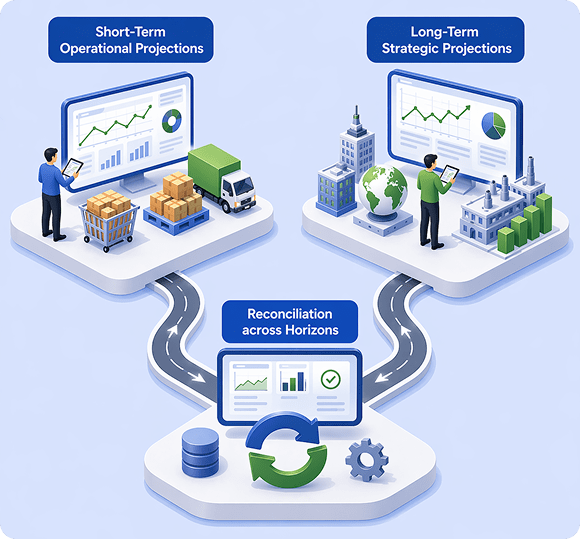
Short-term forecasts typically operate within daily or weekly time buckets. They drive replenishment orders, production scheduling, and distribution planning. These models prioritize responsiveness and low forecast bias to stabilize operational execution workflows.
Inputs include current sales trends, open orders, promotions, and near-term inventory positions. Rapid recalibration is essential to prevent stockouts or excess inventory accumulation. ERP and WMS connectivity ensures forecast updates translate into execution adjustments.
Long-term forecasts extend across quarterly or annual planning horizons. They inform capacity planning, sourcing strategies, network design, and financial budgeting. These models emphasize structural demand trends rather than short-cycle fluctuations.
Inputs include macroeconomic indicators, product lifecycle assumptions, market expansion plans, and portfolio shifts. Statistical smoothing and scenario modeling support investment planning and resource allocation decisions. Forecast stability depends on disciplined time-bucket management, version control, and integration with enterprise financial systems.
The forecasting platform must synchronize both horizons through dimensional and time-based reconciliation logic. Short-term deviations should inform strategic outlook adjustments without destabilizing the approved forecast baseline.
Forecast stability depends on disciplined time-bucket management, version control, and integration with enterprise financial systems.
Seasonality, Promotions, and New Product Introductions in Forecasts
Seasonality, promotions, and new product introductions introduce structural variability into demand patterns. The forecasting platform must isolate recurring signals, quantify promotional uplift, and model limited historical data without distorting the forecast baseline.
Demand forecasting systems treat seasonality, promotional uplift, and new product launches as structured forecasting components.
Seasonality Modeling
Seasonality is identified through time-series decomposition across defined time buckets. Statistical engines extract recurring demand patterns at the SKU, category, or regional levels. These patterns are stored as reusable seasonal indices within the forecasting engine.
Configuration controls include the following:
- Time-bucket granularity selection
- Seasonal profile inheritance across product levels
- Cross-location demand pattern normalization
Proper seasonality modeling prevents overreaction to short-term demand noise while preserving predictable cyclical demand patterns.
Promotional Uplift Configuration
Promotional modeling separates baseline demand from incremental promotional uplift. Marketing calendars are integrated into the forecasting layer, and uplift coefficients are applied based on historical promotion performance.
Key controls include the following:
- Event tagging and classification
- Elasticity modeling by discount depth
- Post-event demand decay logic
ERP and trade system promotion connectivity ensures uplift assumptions reflect actual execution.
New Product Introduction (NPI) Forecasting
>New product forecasting requires proxy modeling techniques because historical demand data is limited. Systems may use the following methods:
- Analog product mapping
- Attribute-based clustering
- Top-down allocation from category growth targets
Limited historical data requires governance policies that restrict manual overrides and enforce model recalibration.
Constraints include sparse data availability, promotional cannibalization effects, and cross-channel demand variability. Stable implementation depends on structured data tagging, dimensional alignment, and disciplined model review cycles.
Demand Planning Software for Small Businesses and E-commerce
Demand planning software for small businesses and e-commerce operations must balance implementation simplicity with long-term scalability. Smaller enterprises often lack complex multi-echelon networks, yet they face high demand volatility, shorter product life cycles, and rapid channel shifts.
SME-focused platforms prioritize usability, affordability, and scalable cloud architecture without compromising forecasting accuracy.
Unlike large enterprise planning suites, SME-oriented platforms emphasize the following characteristics:
- Cloud-native deployment with minimal infrastructure overhead
- Preconfigured forecasting templates
- Simplified SKU and location hierarchies
- API extensibility with e-commerce platforms and accounting systems
SME operational requirements differ from large enterprise environments due to smaller planning structures and faster demand cycles. E-commerce retailers require high-frequency demand updates, promotion modeling, and rapid inventory recalibration supported by scalable e-commerce inventory software platforms. Implementation timelines are shorter, but data discipline remains critical.
Several architectural trade-offs influence SME platform selection. Reduced configuration complexity limits deep supply constraint modeling. Custom integration options may be narrower than enterprise platforms. Modern SaaS planning platforms allow incremental expansion as transaction volumes and SKU portfolios increase.
The following section outlines scalable forecasting platforms suitable for SMEs and digital commerce organizations, including considerations for integration and long-term scalability.
Scalable Demand Planning Software Options for SMEs
Small and mid-sized enterprises require demand planning software that combines usability, affordability, and scalable architecture. Cloud-native platforms with simplified configuration and API-driven integrations align with e-commerce and growth-stage environments.
Scalable SME demand planning platforms combine cloud deployment, flexible integrations, and growth-ready system architecture.
Commonly evaluated solutions include:
- Netstock: Cloud-based demand and inventory planning platform focused on stock optimization and forecasting.
- Inventory Planner: E-commerce forecasting and replenishment platform with native commerce integrations.
- StockTrim and StockIQ: AI-driven forecasting platforms focused on inventory health and demand variability.
- Intuendi: Cloud AI forecasting platform for high-growth companies.
- Ganacos / APEX: Lightweight planning platforms combining forecasting and inventory management.
Selection Considerations for SMEs
Implementation simplicity
Minimal infrastructure setup and intuitive onboarding
Integration compatibility
API connectivity to e-commerce platforms, accounting systems, and ERP tools
SKU scalability
Ability to support growth in product count and channel complexity
Feature extensibility
Support for future scenario modeling and collaborative planning
SME-focused tools limit deep supply constraint modeling to maintain fast deployment and simplified configuration. When supported by disciplined data structures and integration alignment, these platforms improve forecasting accuracy and inventory visibility compared with spreadsheet-based planning while supporting future scalability.
Why Choose iCommuneTech for Demand Planning Software Consulting and Implementation
Selecting demand planning software is a strategic decision that affects forecasting accuracy, ERP synchronization, and long-term supply chain stability. Software capabilities alone do not determine success in enterprise supply chain automation initiatives. Architecture alignment, disciplined ERP connectivity, and governed implementation execution define sustainable performance.
iCommuneTech operates as an implementation-focused technology partner that aligns demand planning platforms with enterprise architecture and legacy ecosystems.
iCommuneTech supports organizations across the full demand planning lifecycle through the following services:
Demand planning systems must synchronize with ERP, WMS, finance, and analytics platforms. iCommuneTech emphasizes API architecture design, data mapping discipline, and latency governance to prevent forecast-to-execution gaps.
Implementation teams combine technical connectivity expertise with supply chain domain knowledge. This combination enables configuration of statistical models, collaboration workflows, and reconciliation logic within structured enterprise controls.
Projects may follow phased rollout, hybrid coexistence, or full transformation pathways depending on enterprise readiness. Delivery approaches adapt to data maturity, system complexity, and change management capacity.
Many enterprises operate legacy forecasting tools or customized ERP modules. iCommuneTech focuses on canonical data modeling, controlled migration sequencing, and system coupling validation to reduce disruption during system transition.
The objective is not rapid deployment alone but sustained planning system performance. The forecasting platform must operate as a governed control layer across sales, operations, finance, and supply chain functions.