Fleet Tracking System Development
Fleet tracking system enables GPS tracking, route monitoring, dispatch coordination, and telematics analytics for transportation, logistics, and delivery companies.
iCommuneTech develops robust fleet tracking and dispatch management software integrated with TMS, ERP, CRM, and fleet management system environments. The software aligns vehicle location tracking, trip monitoring, and telematics data to improve route adherence, detect delays, and strengthen operational control.

What Fleet Tracking Telematics Capabilities Can Your TMS Platform Gain?
Embedded fleet tracking telematics transform live GPS signals into dispatch intelligence, routing insights, and fuel analytics across workflows.
Real-time visibility improves execution accuracy and reduces operational risk. In one modernization initiative, operational efficiency improved from 40% to 90% after integrating real-time tracking data.
These features turn tracking into a native TMS capability that strengthens fleet visibility, telematics intelligence, and cost control.
Capabilities Your TMS Can Offer Customers
Explore Our Fleet Management System Demo
Experience fleet tracking embedded into dispatch, routing, and visibility workflows inside a TMS interface.
Real-time data flow
Feature coverage
UI alignment
Why TMS Companies Build a Native Fleet Tracking System
Third-party tools limit control, restrict integrations, and weaken product differentiation, and TMS vendors risk losing deals where live tracking is a baseline expectation. Native tracking engines and abilities provide data ownership, integration depth, and platform scalability.
Not just this, native tracking preserves:
Engineering and Business Pain Points Addressed:
How iCommuneTech Helps IT Product Companies Deliver New Features Fast Enough?
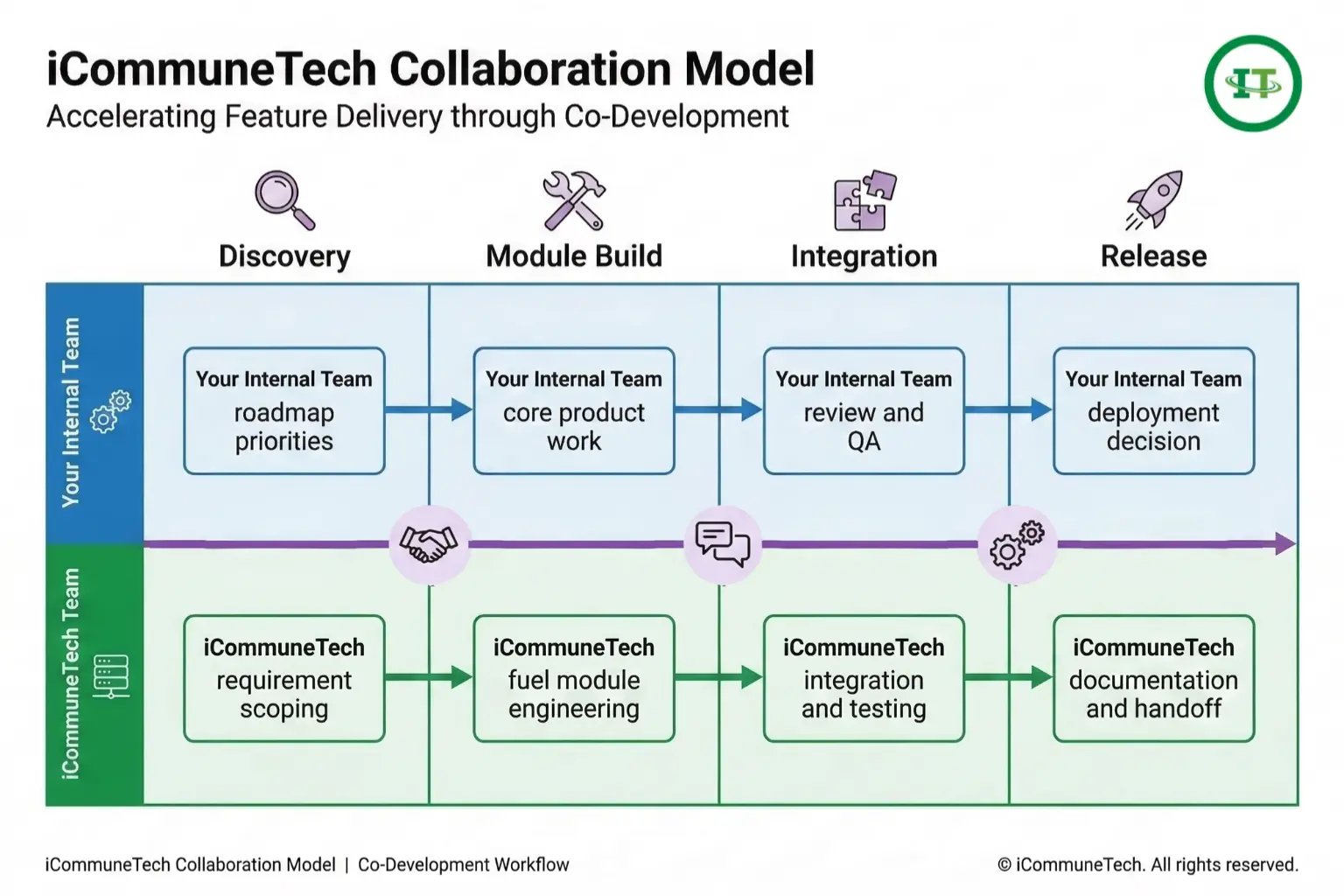
We believe feature delivery accelerates when tracking modules extend existing platforms without rebuilding core systems. We also utilize co-development models that align with product roadmaps and release cycles.
“Working with iCommuneTech has been a game-changer for A&I Fuel Finder. Their team understood our operational challenges from day one and turned our idea into a user-friendly, data-driven platform. Our drivers now save time and money by finding the lowest-priced fuel along optimized routes. The mobile app features, like fuel invoices and card management, made it even more valuable for our clients. We’re pleased with the professionalism, support, and technical expertise IcommuneTech delivered.”

Why Having a Fleet Tracking Telematics Module in Your Product Roadmap Is Important?
Fleet tracking turns a TMS into an operational control tower with real-time vehicle data, execution visibility, and decision intelligence. Tracking supports product differentiation, retention, and long-term platform growth.
Product-Level Outcomes
Fleet tracking strengthens intelligence across dispatch, routing, and analytics layers.
Build vs Buy: Should You Develop a Fleet Tracking System or Integrate a Third-Party Provider?
TMS companies must choose between building a native tracking engine or integrating external tools, a decision that directly affects product control, scalability, cost structure, and long-term platform differentiation. TMS companies building long-term platforms choose custom tracking engines for control, differentiation, and scalable growth. Let’s compare custom building a software solution to implementing a ready-made one.
Comparison Overview
| Comparison Attribute | Custom Build | Third-Party Tracking SaaS / API Integration |
|---|---|---|
| IP ownership | Full ownership of tracking logic and data | No ownership, vendor-controlled IP |
| Data refresh frequency | Tuned to dispatch and routing needs | Fixed or vendor-limited refresh rates |
| Geospatial flexibility | Custom geofencing and map logic | Predefined geospatial constraints |
| Cost scalability | Predictable costs aligned with growth | Costs rise with vehicles and usage |
| Data model alignment | Designed to match the TMS schema | Requires data transformation layers |
| Device compatibility control | Flexible device and protocol support | Limited to supported vendor devices |
| UI/UX integration | Fully embedded within the TMS interface | External maps or frame-based views |
| Multi-tenant structure | Built for SaaS tenancy models | Limited or costly tenant separation |
| Roadmap dependency | Internal roadmap control | Vendor-driven roadmap priorities |
Fleet Tracking System Development Services for TMS and Logistics Software Platforms
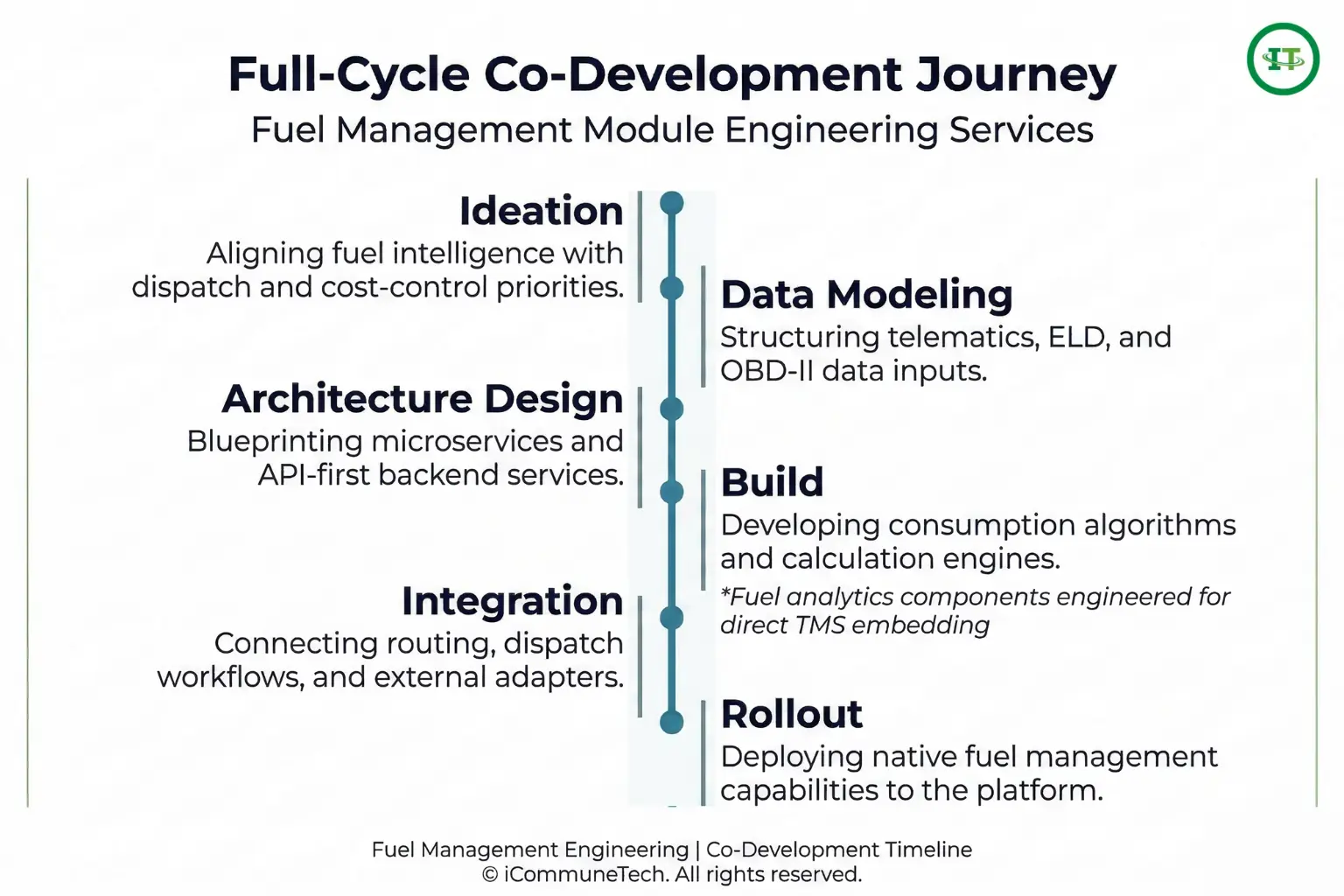
We follow a full-cycle development process covering ideation, architecture, integration, and rollout for embedded fleet tracking in TMS products. Delivered through a co-development model aligned with product roadmaps to launch tracking as a native capability, not an external dependency.
Engineering and Product Services
Architecture & Technology Stack for Fleet Tracking System
A modular plug-in architecture enables scalable real-time ingestion and dispatch intelligence, with production environments achieving over30% acceleration in fuel and operational data processing. Our module is designed as a plug-in engine that integrates cleanly into existing TMS platforms and supports scalable operations.
Click layers to view component descriptions
Modular Architecture Components:
- Real-time GPS ingestion pipelines via MQTT, WebSockets, REST, TCP
- Telematics processors for speed, RPM, fuel, and engine events
- Time-series storage using TimescaleDB, InfluxDB
- Geospatial indexing using PostGIS and ElasticSearch geo
- Mapping engines using Google Maps, Mapbox, HERE
- Event-driven microservices via Kafka, RabbitMQ
- Data normalization layers
- Driver scoring services
- Tracking frontend modules with React/Angular
- Admin consoles for provisioning
Technology Stack:
- Backend via iCommuneTech’s enterprise development services
- Backend: Go, Java, .NET, Node.js
- Frontend: React, Angular
- Cloud: AWS Kinesis, AWS IoT Core, Azure IoT Hub
Integration With Your Existing TMS Architecture
Our fleet tracking module embeds as a shared intelligence layer across dispatch, routing, fuel, and reporting modules, without disrupting core workflows or data ownership.
Integration Benefits
Improves dispatch accuracy
Ensures reporting consistency
Strengthens customer visibility
Maintains customer visibility without external tracking dependencies
Key Integration Points
- Sync with the dispatch management system
- Sync with route optimization using executed route data
- Sync with the fuel management system
- Driver and vehicle master data sync
- Multi-tenant client support
- Reporting and analytics integration
- Unified customer visibility dashboards
Fleet Tracking System Customization and Integration Flexibilit
Our fleet tracking system applies tracking logic to platform rules, customer needs, and operational scale, and aligns telematics data with each TMS product architecture without forcing platform changes.
Rule and Configuration Flexibility:
Device Ecosystem Support:
How iCommuneTech Offloads and Brings Innovation for TMS Engineering Teams
TMS engineering teams ship faster because:
- Core workloads handled externally
- Integration complexity reduced
- Platform control remains internal
Telematics intelligence is integrated into the roadmap through co-development with internal teams.
Company Accomplishments
- Built hundreds of custom software solutions
- Enabled digital transformation for global brands
- Delivered performance-focused integrations
- Sustained long-term enterprise partnerships
Cost & Timeline of Building a Custom Fuel Management System
Custom fleet tracking pricing aligns with project scope, integration depth, and long-term platform ROI through flexible delivery models designed for TMS products.
Projects follow time-and-material or dedicated team structures based on delivery speed, telemetry complexity, and long-term ownership expectations.
The exact costs depend on device scale, data ingestion frequency, analytics depth, mapping UI requirements, and integrations across dispatch, routing, and fuel systems.
Estimate the development investment for building a fleet tracking module inside your TMS using our interactive cost calculator, which provides a directional cost range based on telematics scale, integrations, system complexity, and feature scope.
The calculator estimates fleet tracking development cost by evaluating the number of vehicles, telemetry ingestion needs, integrations, analytics requirements, and deployment model. Each input adjusts engineering effort, architecture depth, and delivery timelines, and the combined scope is then translated into a realistic directional investment range.
Fleet Management System Calculator
Key Cost Factors
Project Development Timeline
When Should TMS Companies Build Their Own Fleet Tracking System?
Use these questions to evaluate urgency, product impact, revenue risk, and platform control signals to identify recurring integration constraints. If yes to three or more, native tracking becomes a roadmap priority.
Impact of Fleet Tracking System Implementation on Your TMS Product ROI
New revenue from tracking add-on modules
Unlock new monetization channels by offering native, real-time fleet tracking as a premium tier or standalone module to your existing customer base.
Competitive advantage
Stand out in a crowded market with a fully integrated, white-labeled telematics solution that easily outpaces fragmented, disjointed third-party integrations.
Increased ARPU from bundled analytics
Boost your Average Revenue Per User by packaging advanced route history, fuel analytics, and driver performance data natively within your platform.
Higher retention from unified visibility
Reduce churn by embedding mission-critical tracking directly into daily dispatch workflows, making your TMS an indispensable, sticky tool for operations.
Reduced dependency on external vendors
Eliminate escalating per-asset licensing fees and unpredictable third-party feature roadmaps by taking complete ownership of your tracking architecture.
Stronger cross-module intelligence
Seamlessly share real-time location and telemetry data with your native routing, billing, and dispatch engines to automatically trigger complex workflows.
Differentiated connected fleet platform
Evolve far beyond traditional TMS capabilities into a holistic, connected ecosystem that solves end-to-end logistics challenges natively for your users.
Case Studies: Fleet Tracking & Telematics Operational Efficiency Success
Milk & More Achieves £2M+ Annual Savings Through Telematics-Driven Fleet Optimization
Technology: Geotab GO Device & MyGeotab Fleet Telematics Platform
Milk & More, a large UK-based doorstep delivery company operating a national fleet, sought to improve fuel efficiency, enhance driver safety, and support its transition toward electric vehicles.
The organization required real-time fleet tracking, driver behavior monitoring, and telematics analytics to optimize route performance and reduce operational waste. By deploying Geotab’s GPS fleet tracking and telematics platform, Milk & More unified live vehicle data, fuel usage insights, and driver performance analytics into a centralized operational intelligence system.
The engagement demonstrates how real-time fleet tracking, telematics analytics, and driver performance monitoring can translate into measurable fuel savings, safety improvements, sustainability gains, and long-term operational cost control across large-scale delivery fleets.
Check more success storiesMeasured impact:
Discuss Adding Fleet Tracking Capabilities to Your TMS
Explore the tracking capabilities your product needs to strengthen routing, dispatch, and visibility. Plan a custom fleet tracking engine that fits your TMS architecture and roadmap priorities to align tracking intelligence with product goals, integration needs, and long-term platform value.