
Architectural Foundations of Supply Chain Planning Software
Scaling logistics platforms requires a governed architecture that integrates forecasting, supply balancing, production scheduling, and inventory optimization within a unified planning environment. Production scheduling and financial planning must operate on a shared data model to maintain synchronized planning decisions across the network.
Supply chain planning software (SCP) replaces spreadsheets and siloed planning tools with constraint-governed planning systems. These platforms convert demand signals into validated supply, production, and distribution decisions across the network.
Modern SCP platforms consolidate ERP, warehouse, transportation, and supplier data into synchronized planning models. Embedded analytics and scenario simulation allow planners to evaluate alternative supply responses before execution. AI-driven recalibration updates forecasting models and planning parameters across multi-echelon supply networks.
This discussion analyzes supply chain planning software from operational, architectural, and governance perspectives, covering:
- Planning architecture and data model foundations
- Demand, supply, production, and inventory modules
- Integrated business planning governance
- AI-driven optimization engines and decision logic
- Cloud scalability and distributed visibility
- Resilience modeling and disruption simulation
- Sustainability controls and compliance automation
- Workforce governance and change management architecture
The evaluation also considers key architectural and operational criteria:
- Alignment with existing enterprise systems
- Horizontal scalability across distributed planning nodes
- Integration boundaries between planning and execution layers
- AI automation depth and model governance maturity
- Organizational readiness for platform adoption
Planning theory must translate into system capabilities, measurable checkpoints, and practical implementation controls across distributed logistics platforms.
iCommuneTech supports SCP modernization through system redesign, API-governed integration, AI model deployment, and governance frameworks across multi-echelon supply networks. The following sections examine these dimensions for structured architecture evaluation.
Driving Measurable Results Across Industries
From automating manual calculations to modernizing legacy infrastructure, we build software that directly impacts the bottom line. Our custom solutions consistently reduce operational costs and accelerate process efficiency.
View Our Case Studies
Collect demand data from multiple sources through integrated planning pipelines.
Convert demand forecasts into supply requirements based on planning constraints.
Check supplier capacity, production resources, and logistics availability.
Release approved plans to execution systems such as ERP and production platforms.
Track planning results and adjust forecasting and planning parameters.
This closed-loop architecture links operational supply plans with revenue forecasts and working capital exposure metrics. Version contro govern cross-functional plan changes.
Spreadsheet-based models fail at the multi-echelon scale. They lack concurrency control, version governance, distributed computation, and transactional durability under regional workloads. Enterprise planning platforms must support multi-tenant cloud-native deployment. Horizontal scaling isolates tenant workloads and adjusts compute capacity as planning workloads fluctuate.
Understanding The Basics Of The Supply Chain Planning Process
- The supply chain planning process establishes coordinated control by integrating demand, supply, production, and inventory decisions within a unified planning system.
- The process starts with structured data collection. Sales history, inventory levels, supplier lead times, and capacity parameters feed a unified model. Clean data supports demand forecasting and scenario evaluation. Gartner projects that 70% of large organizations will adopt AI-based supply chain forecasting by 2030, reinforcing the shift toward data-driven demand planning.
- Forecasts convert into supply, production, and distribution plans. Constraint checks validate material availability, manufacturing, and logistics capacity before execution.
- Approved plans integrate with ERP and operational systems. Variance monitoring recalibrates planning assumptions and improves forecast accuracy.
Effective planning depends on synchronized data models and controlled execution workflows.
Enterprise platforms must support the following operational capabilities:
- Network-wide supply chain visibility
- Adaptability to disruption
- Scalable planning across multi-site planning
- Risk-based scenario modeling
For example, a distributed supply network can reallocate inventory across nodes using event-driven supply recalculation. The system can shift stock and adjust replenishment to limit excess capital exposure.
Planning objectives must balance service levels against capital and disruption risk.
Core Components And Types Of Supply Chain Planning
Isolated planning tools create misalignment. Forecasts drift from capacity assumptions. Inventory targets conflict with production limits. Supply chain planning software resolves this fragmentation by structuring decisions within a governed planning system.
Within that structure, planning is carried out through coordinated modules. Each module addresses a distinct operational question while drawing from the same synchronized data foundation.
| Planning Component | Primary Inputs | Key Focus Area | Operational Output |
|---|---|---|---|
| Demand Planning | Historical sales, market indicators, and statistical models | Forecast accuracy, demand volatility, revenue exposure | Baseline demand forecast |
| Supply Planning | Supplier capacity, lead times, sourcing policies, logistics constraints | Feasible replenishment and allocation decisions | Network supply plan |
| Production Planning | Bills of materials, labor availability, machine capacity, and sequencing rules | Throughput limits and manufacturing trade-offs | Validated production schedule |
| Inventory Optimization | Service-level targets, variability metrics, replenishment policies | Safety stock and multi-echelon positioning | Inventory targets and reorder logic |
Continuous operation requires an event-driven architecture. Forecast updates trigger downstream recalculations through message brokers. This approach eliminates manual or scheduled batch reprocessing. A forecast revision affects supply requirements. Supply changes alter production schedules. Production adjustments reshape inventory buffers.
These modules operate as independently deployable services within a shared orchestration layer. The following sections examine each component in operational depth.
Demand Planning And Forecasting In The Supply Chain
Forecast inaccuracy leads to stockouts, excess inventory, and reactive operational adjustments. Demand planning stabilizes supply decisions through governed forecasting.
Supply chain planning software consolidates historical sales, seasonality, promotions, pricing shifts, and external market signals into a unified data model. Statistical algorithms generate baseline forecasts. Machine learning models detect patterns across products, regions, and channels. Scenario simulation evaluates demand variability before forecasts enter operational planning workflows.
Common forecasting constraints and system responses include:
| Planning Challenge | Operational Impac | AI-Driven Response | System Outcome |
|---|---|---|---|
| Incomplete historical data | Weak baseline forecasts | Pattern recognition across sparse datasets | Improved statistical reliability |
| Promotional distortion | Artificial demand spikes | Real-time signal ingestion and correction logic | Stabilized forecast accuracy |
| Demand volatility | Frequent manual overrides | Automated forecast error tracking | Reduced bias and faster recalibration |
| New product introduction uncertainty | Limited historical reference | Predictive modeling using analog products | Better launch planning accuracy |
| Siloed sales and operations inputs | Conflicting forecast assumptions | Exception-based review workflows | Cross-functional alignment |
Legacy forecasting tools rely on periodic recalculation and manual spreadsheet adjustments. These approaches cannot ingest external signals or retrain models when volatility increases. Planners compensate by increasing inventory buffers or applying manual overrides.
iCommuneTech engineers build API-first, scalable planning infrastructures by refactoring legacy monoliths into modular, integration-ready systems that support AI-driven demand sensing and governed orchestration.
Continuous signal ingestion from ERP, CRM, warehouse, and external market feeds enables near real-time forecast recalibration. Override actions trigger audit logs and financial impact validation.
Automated supply scheduling improves responsiveness through:
Constraint-based optimization engines
Real-time inventory synchronization
Lead time simulation
Exception-based alerts
Recalibration trigger parameter updates after forecast or supply variance.
Production Planning And Control For Scalable Operations
Uncoordinated shop-floor decisions create bottlenecks, idle capacity, and missed delivery targets. Production planning validate sequencing and resource allocation before release to prevent bottlenecks, idle capacity, and infeasible schedules.
Production planning within supply chain planning integrates:
Supply chain planning software connects with manufacturing execution systems to synchronize:
Production orders
Real-time shop-floor status
Operational boundaries include:
Constraint-based logic enforces resource and sequencing rules, ensuring operational feasibility and capacity balance.
These controls link sequencing, capacity evaluation, and execution feedback within one framework.
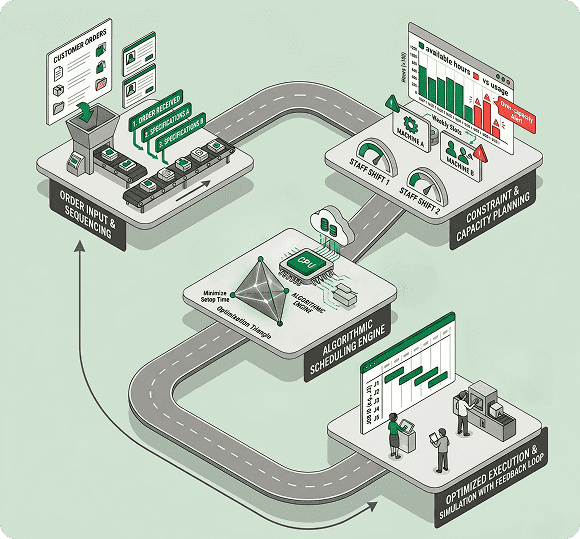
SCP software sequences production orders based on due dates, setup dependencies, and throughput targets. Finite capacity planning prevents overload and identifies conflicts early.
Production schedules adjust when demand or supply conditions change. Scenario simulation tests alternative lot sizes, resource allocations, and sequencing rules without disrupting active operations.
Manufacturing sequencing must optimize three core factors: setup time efficiency, throughput stability, and shared resource allocation. Algorithmic scheduling frameworks replace heuristic manual coordination to maintain consistency. Similar to aircraft sequencing on a runway, manufacturing schedules coordinate resource access, capacity, and timing. Structured sequencing reduces waiting time and avoids conflict. Comparable logic can reduce changeover time and improve output stability.
Optimizing Inventory: Inventory Optimization Strategies
Excess inventory locks capital. Insufficient stock reduces service levels. Inventory optimization establishes a controlled balance across the supply chain network.
Inventory optimization strategies within supply chain planning software apply statistical models, service targets, and variability metrics to determine optimal stock positioning. Each strategy addresses distinct risk and capital trade-offs.
Core strategies include:
Safety Stock Calculation
Uses demand variability and lead-time deviation to define buffer levels. Reduces stockout probability under forecast uncertainty.
ABC Analysis
Classifies items by revenue impact or consumption value. Applies differentiated control policies across A, B, and C categories.
Multi-Echelon Inventory Optimization
Models inventory dependencies across plants, distribution centers, and regional warehouses. Balances stock positioning to reduce duplication and transfer costs.
Multi-site inventory models prevent duplication across distribution nodes to reduce excess safety stock and avoid unnecessary capital allocation. Capital allocation shifts toward structured, data-informed decisions.
Advanced planning systems enhance inventory control through:
- Automated replenishment triggers
- Exception-based inventory alerts
- Dynamic reorder point recalibration
Inventory recalibration is executed through automated parameter updates across planning cycles.
Integrated Business Planning And Cross-Functional Coordination
Disconnected planning processes create revenue gaps and margin pressure across siloed functions. Integrated planning reconciles financial targets with validated supply capacity within a unified governance cycle.
To maintain alignment, the financial plan must translate into capacity-constrained operational schedules.
- 1. Shared planning calendars
- 2. Unified data models
- 3. Scenario evaluation workflows
- 4. Consensus checkpoints
Barriers include:
Modern supply chain planning platforms support synchronized workflows and audit trails across planning cycles. iCommuneTech supports integrated business planning initiatives through structured process design and scalable planning platform architecture.
Sales And Operations Planning (S&OP) And The Integrated Business Planning Process
Sales and operations planning (S&OP) establishes a recurring governance cycle that reconciles demand forecasts, supply capabilities, and financial plans. Integrated business planning extends this model by embedding profit targets, capital constraints, and scenario analysis within the same framework.
Gartner research highlights that a medical equipment manufacturer improved forecast value added by 22% year over year after strengthening S&OP process management. This improvement demonstrates the measurable performance impact of structured planning governance.
S&OP and integrated business planning frameworks align cross-departmental plans with financial targets.
S&OP cycles include demand review, supply review, financial reconciliation, and executive sign-off. Shared data models replace fragmented spreadsheets and informal coordination.
Automation and advanced analytics strengthen S&OP execution through:
Best practices include defined planning cadences, controlled data ownership, and executive sponsorship. Common pitfalls include siloed metrics, manual overrides, and limited scenario discipline.
Large and complex organizations require coordinated orchestration between planning processes and digital platforms. iCommuneTech supports S&OP and integrated business planning adoption by aligning governance processes with scalable planning system architecture.
Cross-Functional Coordination For Holistic Business Planning
Departmental isolation fragments demand forecasts, financial budgets, and operational commitments. Cross-functional coordination restores alignment within digital supply chain planning environments.
Holistic business planning requires synchronized data flows across sales, finance, procurement, manufacturing, and logistics. Integrated supply chain planning platforms consolidate inputs into shared data models and governed workflows.
Effective coordination establishes accountability and synchronized planning cycles.
Barriers include:
Modern supply chain planning (SCP) solutions mitigate these constraints through:
Structured workflows clarify ownership of forecasts, supply commitments, and financial targets. Variance analysis exposes planning deviations before execution risk escalates.
Digital transformation initiatives depend on alignment between process design and platform architecture. iCommuneTech supports cross-functional coordination initiatives by integrating data pipelines, governance frameworks, and scalable planning systems.
AI-Powered And Intelligent Planning Capabilities
Volatile demand and margin pressure expose weaknesses in disconnected supply chain planning models. Traditional statistical forecasting methods struggle to adapt to real-time disruptions and sudden demand shifts.
AI-powered planning introduces adaptive decision intelligence within supply chain planning software. Machine learning models process large datasets, detect non-linear patterns, and recalibrate forecasts as conditions change.
AI-driven capabilities improve planning speed and forecast accuracy across complex supply networks.
Intelligent planning engines support:
- Data-driven demand sensing
- Scenario-based decision evaluation
- Constraint-aware network optimization
- Dynamic resource allocation
These capabilities extend beyond traditional workflow automation. They embed predictive logic directly within planning workflows. Intelligent planning systems, updating forecasts and supply projections as new data signals arrive.
Evaluating AI-powered supply chain planning requires three assessments: model governance standards, data quality controls, and integration depth within enterprise architecture. Structured implementation enables resilient and scalable planning environments capable of adapting to increasing operational complexity.
These systems support constraint-aware planning across distributed supply chain networks.
Key Capabilities Include:
Available-To-Promise (ATP)
Confirms order fulfillment based on current inventory and planned receipts. Improves order commitment speed and customer service reliability.
Capable-To-Promise (CTP)
Evaluates production capacity and material availability before accepting orders. Reduces overcommitment risk and rescheduling costs.
Scenario Modeling
Simulates demand shifts, supply disruptions, or policy changes. Supports risk-informed planning and contingency evaluation.
Resource Allocation Engines
Optimize the distribution of inventory and capacity across regions. These engines improve global inventory balancing and working capital efficiency.
iCommuneTech builds and integrates intelligent decision layers within complex SCP environments, enabling scalable optimization across multi-echelon supply chains.
Cloud-Based Platforms And End-To-End Visibility
Legacy infrastructure restricts scalability and fragments regional data access. Cloud platforms centralize planning environments through an elastic and synchronized architecture.
Cloud deployment supports continuous data alignment across global supply networks.
End-to-end visibility depends on integrated data flows from:
Cloud-native supply chain planning software consolidates ERP, warehouse management systems, and external partner data into governed planning models.
Potential operational outcomes include:
- Real-time plan updates
- Faster disruption response
- Reduced manual reconciliation
- Unified performance dashboards
Cloud deployment lowers infrastructure overhead while supporting access control, security policies, and compliance requirements.
Platform evaluation should assess architecture scalability, integration depth, and visibility across execution layers. Structured cloud transformation supports transparent, resilient planning environments.
Cloud-Based Supply Chain Planning Platforms For Modern Enterprises
Legacy on-premise systems restrict scalability and delay upgrades. Infrastructure maintenance absorbs IT resources.
Cloud-based supply chain planning platforms deliver SCP capabilities through elastic hosted environments that replace rigid infrastructure with scalable, centrally governed architectures.
Cloud platforms eliminate hardware provisioning cycles and accelerate environment setup, configuration, and deployment across enterprise supply chain planning environments.
Elastic infrastructure expands compute and storage capacity on demand. It supports increasing data volumes and analytics workloads.
Cloud-based infrastructure can reduce IT infrastructure costs by 35.8% compared to traditional systems, lowering management overhead and shifting maintenance to managed services.
Cloud platforms provide unified regional access and synchronize planning activities across geographically distributed operations in real time.
Security and compliance considerations include:
- Role-based access control
- Data encryption in transit and at rest
- Audit trails and monitoring
- Regulatory standards alignment
iCommuneTech supports cloud-based platform migration and optimization through structured architecture assessment, integration redesign, and controlled performance tuning across complex supply environments.
Achieving End-To-End Visibility Across The Supply Chain
Fragmented data prevents accurate risk assessment and delays response to supply chain disruptions. End-to-end visibility connects supply chain nodes within a unified and governed data environment. Industry research shows that 62% of companies have limited supply chain visibility, and only 15% report visibility into production data. This highlights transparency gaps that delay disruption response and weaken risk management across supply networks.
Modern supply chain planning solutions integrate suppliers, production sites, distribution centers, carriers, and last-mile delivery data streams. Unified planning data models consolidate ERP, warehouse management systems, transportation systems, and external partner data.
End-to-end visibility depends on synchronized data flows across operational nodes.
Improved operational visibility enables outcomes such as:
- Proactive risk detection through variance monitoring
- Real-time exception management across facilities
- Early identification of capacity or inventory gaps
- Improved stakeholder trust through shared reporting
Supply chain control towers and dashboard analytics expose operational deviations before service impact escalates. Automated alerts identify disruptions in supplier lead times or transit performance.
Practical implementation involves data pipeline design, standardized integration layers, and governed access controls. iCommuneTech builds data-driven transparency by orchestrating multi-system integration, real-time synchronization, and scalable visibility frameworks across complex supply ecosystems.
Integration With ERP And Warehouse Management Systems
Building Resilient And Responsive Supply Chains
Volatile demand, supplier concentration, and geopolitical instability increase disruption risk. Static planning models cannot absorb rapid change.
Resilience depends on predictive risk visibility, early disruption detection, scenario-based impact assessment, and structured mitigation workflows embedded within adaptive operating models. Responsive operating models enable rapid re-planning, dynamic capacity adjustments, and inventory reallocation across network nodes.
Modern SCP solutions integrate forecasting, supply balancing, inventory policy, and financial targets within one synchronized framework. Unified data flows shorten decision cycles and reduce response lag.
Resilient and responsive supply chains anticipate constraints rather than react to failure. Structured SCP implementation reduces exposure under operational uncertainty.
Supply Chain Resilience Through Proactive Risk Management
Unanticipated disruptions expose fragile supply networks. Reactive planning increases recovery time and costs.
Supply chain resilience through proactive risk management embeds risk identification and mitigation within supply chain planning software. Modern SCP platforms monitor supplier performance, lead time variability, capacity constraints, and logistics reliability.
Resilience depends on embedded risk analytics and structured scenario testing.
Planning systems support resilience through:
- Automated disruption alerts based on variance thresholds
- Risk scoring models across suppliers and lanes
- Scenario simulations for demand spikes or supply loss
- Predefined mitigation playbooks within workflows
Industry-relevant risk scenarios include supplier insolvency, port congestion, raw material shortages, regulatory shifts, and regional demand surges. Scenario testing evaluates service impact, inventory risk, and financial consequences before execution.
Embedded analytics quantify the probability and severity of disruptions across multi-echelon networks. Early detection enables controlled response rather than emergency correction.
iCommuneTech supports resilience consulting by aligning risk governance frameworks with scalable planning architecture, integrating predictive analytics, and embedding automated mitigation triggers within complex supply environments.
Responsive Planning Models For Dynamic Business Needs
Demand spikes, supply interruptions, and macro volatility destabilize fixed planning cycles. Periodic reviews cannot absorb rapid changes.
Responsive planning models for dynamic business needs embed continuous recalibration within supply chain planning software. Modern SCP tools enable real-time re-planning when forecasts, capacity, or supply constraints change.
These models depend on automated re-planning and resource reallocation.
Mature supply chain functions deploy capabilities such as:
Event-driven workflows trigger plan revisions when thresholds exceed defined limits. Scenario comparison engines evaluate alternative sourcing, production, and distribution strategies before commitment.
Evaluation cues for planning software include data synchronization latency, scalability of optimization engines, and governance of automated overrides.
iCommuneTech supports responsive operating models through architecture design, event-driven integration layers, and intelligent reallocation logic tailored to complex multi-echelon supply networks.
The Future Of Supply Chain Planning: Digital Transformation And Innovation
Legacy planning models rely on periodic recalculation and manual intervention. Network complexity and volatility require adaptive systems.
The future of supply chain planning centers on digital transformation and innovation embedded within intelligent platforms. Advanced analytics and automation support a shift toward predictive planning coordination.
Digital transformation positions planning as a continuous optimization process.
Next-generation supply chain planning software integrates structured data pipelines, scalable cloud infrastructure, and embedded intelligence. Planning cycles compress as systems ingest real-time signals and recalibrate automatically.
Manual spreadsheet-based workflows decline in relevance. Optimization engines evaluate constraints and simulate governed planning scenarios. Human-machine collaboration evolves toward supervised autonomy. Decision-makers focus on policy setting and exception governance instead of routine recalculation.
Evaluating emerging supply chain planning platforms requires assessing automation depth, AI integration maturity, and adaptability to evolving business models. Continuous innovation influences competitiveness across digital supply networks.
Digital Transformation In Supply Chain Planning
Manual planning cycles and siloed systems limit responsiveness and data accuracy. Digital transformation restructures planning workflows around automation and data integration.
Digital transformation in supply chain planning integrates workflow automation, IoT connectivity, and advanced analytics into core planning processes. Automated data capture reduces manual entry errors. IoT-enabled signals improve inventory accuracy and asset tracking across supply nodes.
Digital transformation in supply chain planning improves planning speed, scalability, and data fidelity across complex networks.
Advanced analytics engines process high-volume datasets and generate near real-time insights. Cloud infrastructure supports scalable compute capacity during demand peaks.
Value drivers include:
- Faster planning cycles
- Scalable resource utilization
- Improved master data accuracy
- Support for digital-first business models
New operating models emerge when planning systems connect directly with execution layers. Automated feedback loops reduce lag between decisions and outcome measurement.
iCommuneTech enables large-scale digital planning transitions through structured architecture redesign, integration modernization, and embedded analytics deployment across enterprise supply ecosystems.
Next-Gen Platforms: Digital Brain Systems And Natural Conversations
Fragmented dashboards and complex interfaces slow decision cycles. Legacy interfaces require technical expertise and manual navigation across modules.
Next-generation platforms introduce digital brain systems that centralize forecasting, optimization, and execution logic within a single decision layer. These systems aggregate structured and unstructured data from ERP, warehouse, transportation, and external feeds.
Digital brain platforms centralize access to forecasting and optimization logic.
Core Capabilities Include
Natural conversations enable users to request forecasts, simulate scenarios, or review risk exposure through guided dialogue. Planning inputs shift from form-based navigation to semantic interactions.
Compared with legacy interfaces, digital brain platforms reduce navigation complexity, shorten analysis time, and expand accessibility across roles.
iCommuneTech advances enterprise AI solutions through innovation programs focused on conversational planning layers, integrated data fabrics, and scalable digital brain architectures for complex supply networks.
Sustainability And Ethical Supply Chain Planning
Cost-focused planning models overlook environmental exposure and regulatory risks. Stakeholders demand measurable accountability across sourcing and operations.
Sustainability and ethical supply chain planning integrate environmental and social governance criteria into structured supply chain planning workflows. Advanced SCP software embeds impact metrics within demand, supply, and distribution decisions.
This approach aligns operational performance with environmental and compliance objectives. Planning systems integrate emissions metrics, supplier governance controls, and compliance thresholds into cost and service decision models. Unified data models provide visibility into environmental impact across procurement, manufacturing, and logistics layers.
Scenario-based evaluation supports trade-off analysis between cost efficiency and sustainability goals. Automated compliance monitoring reduces manual reporting requirements and audit gaps.

Embedding sustainability criteria within planning architecture shifts ESG oversight from periodic reporting to operational execution. Evaluating SCP platforms requires assessing environmental data integration, compliance automation maturity, and transparency across supplier networks.
Carbon Footprint Tracking And Reduction In Planning Processes
Procurement and logistics decisions influence emissions exposure. Traditional planning models often ignore carbon impact.
Carbon footprint tracking and reduction in planning processes embed emissions metrics within supply chain planning software. SCP platforms associate carbon factors with suppliers, transport modes, production assets, and warehouse operations.
This approach requires integrating emissions modeling into core planning logic.
During procurement planning, systems estimate supplier-level emissions based on sourcing region and material type. In manufacturing, energy intensity and resource consumption parameters inform production scenarios. In logistics planning, transport mode selection and routing distance determine carbon output.
Scenario analysis supports lower-carbon routing or alternative supplier selection. Planners compare cost, service impact, and emission levels before commitment.
Predictive analytics forecast emission exposure under demand growth or network changes. Optimization engines model trade-offs between efficiency and sustainability thresholds. Embedding carbon metrics within planning workflows enables structured trade-off analysis instead of post-hoc reporting.
Supply Chain Resilience And Risk Mitigation Planning
Global supply networks face geopolitical instability, climate events, and supplier concentration risks. Reactive controls fail under rapid disruption.
Supply chain resilience and risk mitigation planning extend traditional risk management through predictive monitoring and structured response modeling. Advanced planning platforms embed risk indicators within forecasting and sourcing decisions.
Resilience planning requires proactive risk visibility and disruption modeling.
Supply Chain Resilience and Risk Management in Supply Chain Planning Software
Modern SCP platforms integrate internal performance metrics with external data signals. Risk exposure becomes measurable across suppliers, lanes, and facilities before service impact occurs.
Resilience modeling incorporates scenario evaluation and threshold-based alerting within planning workflows. Controlled escalation paths reduce decision latency during disruption by defining authority levels and response timelines.
Risk mitigation planning aligns contingency sourcing, safety stock policies, and capacity buffers with measurable risk exposure levels. Governance frameworks ensure mitigation actions integrate with financial and operational targets.
Evaluating resilience capabilities requires reviewing three areas: real-time signal ingestion, scenario modeling control, and automated response triggers embedded in the planning architecture. Structured implementation supports operational stability under uncertainty.
Real-Time Risk Monitoring And Disruption Simulation
Delayed disruption detection increases service impact and recovery costs. Static risk registers cannot absorb live external shocks.
Delayed disruption detection increases service impact and recovery costs. Static risk registers cannot absorb live external shocks.
Real-time risk monitoring and disruption simulation embed continuous signal ingestion within supply chain planning software. Planning platforms integrate geopolitical feeds, weather alerts, supplier performance data, and transportation status updates into governed risk models.
These capabilities depend on live data ingestion and predictive scoring.
Technical foundations include:
- Event-driven data pipelines
- API-based integration with external risk feeds
- Stream processing engines for anomaly detection
- Machine learning risk scoring models
Smart alerting mechanisms trigger when thresholds exceed predefined tolerance levels. Alerts route to designated roles with contextual impact analysis.
Disruption simulation models evaluate supplier failure, route closure, or capacity loss before operational exposure escalates. Scenario engines quantify service, inventory, and financial impact. These capabilities shorten response latency and reduce reactive decision-making. iCommuneTech supports crisis-ready architectures through event-driven integration layers, predictive risk models, and automated escalation workflows across complex supply networks.
Scenario Planning For Demand And Supply Shocks
Unanticipated demand surges and supplier shutdowns expose rigid planning structures. Static forecasts cannot evaluate extreme volatility.
Scenario planning for demand and supply shocks embeds controlled experimentation within supply chain planning software. Advanced SCP platforms support structured what-if models that simulate demand spikes, raw material shortages, logistics disruptions, or regional shutdowns.
Scenario planning for demand and supply shocks relies on governed what-if modeling, integrated risk scoring, and automated response playbooks.
What-if models adjust demand inputs, capacity limits, sourcing rules, or inventory buffers. The system recalculates service impact, cost variance, and working capital exposure.
Integrated risk scoring quantifies probability and severity across scenarios. Planning teams compare alternative mitigation paths using measurable metrics instead of intuition.
Automated response playbooks predefine sourcing shifts, inventory reallocation, and capacity adjustments when thresholds are triggered.
Structured scenario environments reduce decision latency during crisis conditions. iCommuneTech applies scenario planning toolkits that combine optimization engines, risk analytics, and scalable architecture design across complex multi-echelon supply networks.
Workforce And Change Management In Supply Chain Planning Transitions
Effective workforce and change management determine whether supply chain planning technology investments translate into measurable operational performance. Successful SCP implementation requires coordinated process redesign alongside system configuration.
Technology deployment fails when organizational readiness lags. Successful implementation requires coordinated process redesign alongside system configuration.
Leadership & Governance
Leadership sponsorship establishes decision authority and accountability across business functions. Defined communication channels reduce uncertainty during supply chain planning platform migration.
Framework & Alignment
Change management frameworks align incentives, redefine planning roles, and formalize governance structures. Adoption readiness includes clear data ownership clarity, process standardization, and cross-functional accountability.
Strategic Rollout
Implementation success depends on synchronized technical rollout and workforce enablement. Structured transition planning reduces productivity dips and disruption risk.
SCP Readiness Evaluation
Evaluating SCP readiness requires assessing organizational maturity, workforce skills, and alignment between planning policies and system architecture. Effective workforce planning and change management support durable adoption beyond initial deployment.
User Adoption And Training Programs For Planning Platforms
New planning systems underperform when users lack proficiency. Informal training creates inconsistent process execution.
User adoption and training programs embed structured learning and support within supply chain planning transitions. Effective onboarding aligns user roles with system responsibilities and planning workflows.
User adoption and training programs for planning platforms sustain long-term system performance and governance discipline.
Structured enablement models include:
- Role-based training aligned to functional responsibilities
- Scenario-driven workshops using real planning cases
- Microlearning modules for continuous reinforcement
- Knowledge repositories integrated within the platform
Adoption metrics track login frequency, workflow completion rates, forecast override patterns, and exception resolution times. These indicators reveal user capability gaps before system performance declines.
Ongoing education reinforces policy compliance and system updates. Performance reviews incorporate accountability for the supply chain planning system usage.
iCommuneTech develops training and support models aligned with organizational maturity to improve user proficiency during supply chain planning transitions.