
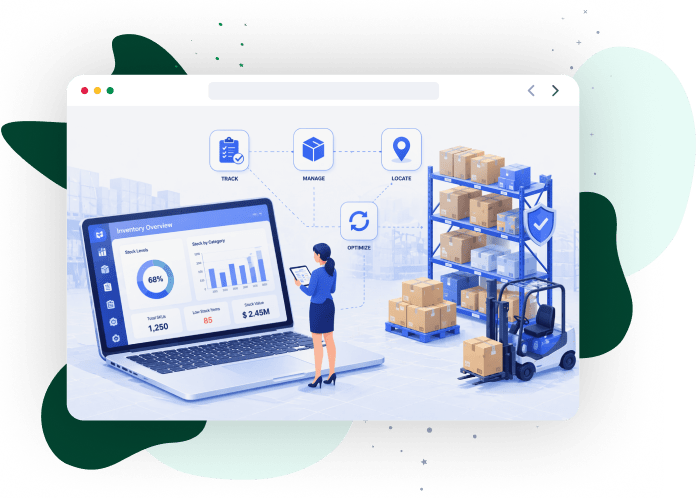
The discussion focuses on the levers that determine execution control, eliminate data fragmentation, shape capital allocation, and define measurable return. iCommuneTech engineers scalable inventory infrastructure for complex and high-volume supply networks.
A disciplined execution model shifts inventory management from reactive correction to proactive capital control.
Ready to move from fragmented visibility to structured, real-time inventory execution across your supply network?
Convert inventory from a balance-sheet burden to controlled financial leverage through scalable, integrated infrastructure. Partner with iCommuneTech to build inventory infrastructure that delivers measurable cash flow, service stability, and margin protection
What Is an Inventory Management System
Inventory system development is a capital allocation decision, not a software enhancement. In supply-intensive operations, it establishes control over how inventory is received, allocated, moved, reconciled, and financially valued across the supply network. The objective is not record-keeping. The objective is disciplined working capital control, stable service levels, and protection of margin under volatility.
An inventory system synchronizes inventory decisions in real time across the enterprise. It aligns physical stock movement with financial reporting, order demand, transportation planning, and procurement execution. In multi-location supply networks, this means coordinating inventory across owned and partner facilities without conflicting data or delayed updates.
Effective inventory infrastructure must enable the following capabilities:
-
Accurate, real-time stock visibility at SKU and batch levels to prevent misallocation
-
Dynamic allocation across channels and regions to protect service levels
-
Automated replenishment aligned with real demand behavior, not static thresholds
-
Synchronization with financial, transportation, warehouse, sales, and production systems
-
Automated detection of shrinkage, delays, and stock imbalances before margin impact
Operations, finance, and technology leaders rely on inventory infrastructure to maintain accuracy, speed, and capital discipline. Each function depends on it to stabilize fulfillment, compress lead times, and optimize balance-sheet exposure.
Modernization is typically driven by financial and operational pressure:
-
Stockouts disrupting revenue continuity
-
Excess inventory inflates carrying costs and cash lock-up
-
Fragmented visibility distorting allocation decisions
-
Manual reconciliation increases labor dependency
-
Legacy platforms restricting scalable growth
In distributed networks, spreadsheet-based controls create delays between physical movement and recorded inventory positions. These delays distort forecasting, inflate safety stock, increase expedited freight, and lock up working capital.
A properly engineered inventory system reduces stock volatility, protects data accuracy, and delivers end-to-end visibility across the supply network. Real-time synchronization between operations and financial records reduces service failures and operating cost leakage. Leadership moves from crisis correction to structured execution control.
The cost of inaction compounds. Inaccurate inventory positions distort demand planning and procurement timing. Overstock ties up capital that could be redeployed for growth. Understock directly erodes revenue and customer retention. Fragmented systems increase manual dependency and the risk of errors. An integrated inventory platform becomes core infrastructure for scalable growth, disciplined capital management, and operational resilience.
Types of Inventory Management Systems
System selection determines how inventory risk, working capital exposure, and scalability are controlled across the enterprise. Inventory models are designed for varying levels of operational complexity and growth pressure. Selecting the wrong model increases integration friction, distorts visibility, and inflates working capital requirements.
Organizations managing production, warehousing, fleets, and distributed inventory must evaluate systems based on control depth, scalability, automation capability, and data reliability. System architecture must align with transaction intensity, geographic expansion plans, and long-term growth strategy.
Inventory System Architecture Models in Inventory Management Software Development
Inventory systems generally fall into four strategic models:
- Warehouse-centric execution platforms focused on facility throughput
- Cloud-based multi-site platforms built for distributed scalability
- Sensor-enabled tracking systems that automate physical validation
- Advanced systems leveraging predictive analytics and distributed ledger validation
Each model addresses a different form of operational and capital constraint. Some concentrate on maximizing facility-level throughput and accuracy. Others prioritize network-wide visibility, automated validation, or predictive decision accuracy. These distinctions materially affect financial outcomes. They influence the total cost of ownership, integration burden, upgrade flexibility, and long-term operational resilience.
Selecting the appropriate model determines integration viability, scalability limits, and long-term return on invested capital.
Warehouse Inventory Management Systems
Warehouse-centric systems determine throughput velocity, accuracy, and cost discipline within distribution centres. In high-volume logistics operations, the warehouse is the core revenue-enabling hub. Any breakdown in inventory accuracy disrupts fulfillment, distorts transportation planning, and inflates working capital requirements.
These systems concentrate on facility-level precision, where margin leakage typically originates.
Core capabilities include the following functions:
-
Real-time inventory tracking at bin, rack, pallet, and SKU levels
-
Automated replenishment triggers based on demand signals
-
Integrated demand forecasting for slotting and safety stock alignment
-
Directed put-away and optimized picking paths
-
Cycle counting automation with variance analytics
-
Integration with transportation management systems (TMS) for dock coordination
Real-time tracking removes delays between physical movement and recorded inventory positions. Instant allocation prevents artificial shortages and unnecessary replenishment that locks up capital. Accurate bin-level visibility increases picking velocity and reduces shipment errors.
Automated restocking reduces manual intervention and labor dependency. Demand-linked replenishment protects service levels while preventing excess buffer stock accumulation. This reduces carrying costs and accelerates capital turnover.
Synchronizing inventory with transportation planning stabilizes dock operations and shipment sequencing. Aligned inventory availability reduces dwell time, detention fees, and expedited freight exposure. This coordination protects service-level commitments without increasing safety stock.
For distribution-intensive operations, measurable financial impacts includes:
Warehouse systems must sustain high transaction intensity and continuous synchronization across connected platforms. Failure to design for scale creates reconciliation overhead, throughput bottlenecks, and operational margin erosion.
A properly structured warehouse system anchors supply chain performance at the facility level. It converts warehouse operations into measurable financial control and capital discipline.
Cloud, SaaS, and Web-Based Inventory Systems
Distributed logistics networks require centralized control without expanding fixed infrastructure. Cloud-based inventory systems remove the link between operational scale and physical infrastructure investment. The model converts upfront capital expenditure into variable operating costs aligned with growth.
For multi-site operations, this architectural choice directly affects expansion velocity, integration agility, and long-term cost control.
| Evaluation Dimension | Cloud / SaaS Inventory System | Operational Impact | Financial Lever | Risk Consideration |
|---|---|---|---|---|
| Deployment Model | Subscription-based delivery aligned with operational scale | Accelerated multi-site expansion | Reduced upfront infrastructure cost | Vendor dependency |
| Scalability | Elastic compute and storage scaling | Handles seasonal spikes without re-architecture | Avoids idle infrastructure investment | Usage-based cost variability |
| Accessibility | Browser-based and mobile access | Enables remote warehouse and field coordination | Faster decision cycles | Requires secure access governance |
| Upgrade Cycle | Centralized automatic updates | Eliminates version fragmentation | Reduces upgrade project costs | Limited control over release timing |
| Integration | API-first connectivity | Accelerates ERP, TMS, and e-commerce integration | Faster partner onboarding | API governance complexity |
| Infrastructure Ownership | Vendor-managed hosting | Low internal IT maintenance burden | Lower hardware and data center spend | Data residency and compliance review required |
Scalability is the primary financial advantage. As order volumes grow or new facilities are added, capacity expands without incremental capital investment. This supports acquisition-led growth and rapid geographic expansion.
Remote access protects operational continuity across distributed teams. Regional teams and logistics partners operate from a unified real-time inventory dataset. This reduces coordination delays and execution friction across the network.
Centralized upgrades protect long-term system relevance. Security, compliance, and performance improvements are deployed without large-scale migration disruptions. This prevents the stagnation often seen in legacy on-premise environments.
Architectural governance remains critical. Cybersecurity, identity controls, data residency compliance, and API governance must be tightly managed. In high-transaction environments, network reliability must sustain continuous real-time synchronization.
When properly governed, cloud inventory systems deliver scalable operational agility. It enables faster scaling, reduces fixed infrastructure burden, and improves capital efficiency while supporting integrated supply networks.
Barcode, RFID, QR, and IoT Inventory Systems
Inventory losses typically originate at the point of physical movement. When receiving, picking, transferring, or dispatching events are not captured instantly, system data diverges from physical reality. Barcode, RFID, QR, and IoT systems reduce this exposure by automating validation at the source and preventing errors from compounding into financial loss.
Barcode Systems
Barcode systems establish baseline validation control, reducing shrinkage and preventing small movement errors from compounding into margin erosion.
Operational and Financial Impact:
- Real-time SKU-level updates during receipt and dispatch
- Reduced manual entry errors
- Faster cycle counting and reconciliation
Financial lever: Lower shrinkage, reduced labor per transaction, improved stock accuracy. Barcode systems deliver high return on minimal capital investment, forming the foundational layer of inventory loss prevention.
RFID Systems
RFID enables bulk, non-line-of-sight tracking. Multiple tagged items can be detected simultaneously without manual scanning.
Operational impact:
- Accelerated dock validation
- Faster cross-docking throughput
- Improved pallet and asset tracking
Financial lever: Reduced dwell time, lower labor intensity, tighter loss control. RFID is most valuable in high-velocity environments where throughput delays translate directly into margin erosion and service penalties.
QR Code Systems
QR-based systems expand data capture beyond basic SKU identification. They can store batch details, expiration dates, and supplier information.
Operational impact:
- Enhanced traceability
- Improved returns and reverse logistics processing
- Faster exception investigation
Financial lever: Reduced compliance risk, improved recall management, and lower write-offs. QR workflows are effective in regulated industries requiring detailed audit trails.
IoT-Enabled Inventory Systems
IoT systems introduce sensor-based intelligence into inventory monitoring.
Typical capabilities:
- Temperature and humidity tracking for cold chain environments
- Location tracking across facilities and fleets
- Shock and vibration detection during transit
- Tamper alerts for high-value goods
Financial lever: Reduced spoilage, lower insurance exposure, improved compliance posture.
IoT integration transforms static tracking into continuous monitoring. Implementation requires device lifecycle management, reliable connectivity, and structured integration governance.
When deployed strategically, these technologies convert physical inventory events into accurate, real-time data streams. The result is tighter control, reduced variance, and stronger operational resilience across complex supply networks
AI, Blockchain, and Advanced Inventory System Innovations
When demand volatility and supplier variability increase, static planning models inflate safety stock, destabilize service levels, and quietly erode margins. Advanced inventory capabilities reduce working capital volatility, detect disruptions earlier, and prevent planning errors from converting into excess stock or lost revenue.
These technologies do not replace foundational systems. They enhance decision precision, risk detection, and cross-network transparency.
Artificial Intelligence in Inventory Planning
AI-driven inventory systems use machine learning models to analyze historical demand, seasonality, supplier performance, lead-time variability, and external signals
Operational impact:
- Lower excess inventory without increasing service risk
- Reduced revenue leakage from stockouts
- Faster response to demand shifts without manual escalation
- Early anomaly detection
Financial lever: Reduced excess inventory, improved stock rotation, and fewer stockouts.
AI reduces reliance on static reorder thresholds. It enables adaptive planning aligned with real demand behavior rather than fixed assumptions. Without disciplined data governance, predictive systems amplify noise and increase planning volatility instead of reducing it.
Blockchain for Supply Chain Transparency
In multi-party supply networks, a lack of transaction trust increases dispute costs, fraud exposure, and audit complexity. Distributed validation reduces that exposure. Each inventory movement, ownership transfer, or compliance checkpoint is time-stamped and tamper-resistant.
Operational impact:
- End-to-end traceability across suppliers and logistics partners
- Faster recall management
- Improved dispute resolution
- Enhanced compliance documentation
Financial lever: Reduced fraud exposure, lower audit costs, stronger regulatory posture.
In regulated and cross-border environments, trusted transaction validation reduces regulatory exposure and protects brand equity.
Advanced Predictive and Automation Capabilities
Beyond AI and blockchain, advanced systems integrate the following capabilities:
- Predictive maintenance insights linked to spare parts inventory
- Automated exception routing
- Scenario simulation for supply disruption planning
- Digital twin modeling of inventory networks
These capabilities reduce disruption cost, compress working capital, and stabilize service levels without inflating buffer stock.
Financial lever: Working capital compression, disruption cost avoidance, and service-level stabilization without inventory inflation.
Decision speed and precision reduce the capital required to maintain service stability under volatility. Organizations using advanced inventory system innovations operate with tighter working capital discipline, stronger resilience to disruptions, and improved service-level stability.
Deploying advanced systems without operational discipline increases complexity and erodes return on investment. Without clean data architecture and integration discipline, advanced technologies amplify noise instead of reducing risk. When implemented correctly, they transform inventory control into a strategic performance engine rather than a transactional record system.
Key Features of Logistics-Focused Inventory Systems
In logistics-intensive environments, feature selection directly determines margin stability and working capital exposure. Inventory systems must support high transaction velocity, distributed assets, and strict service-level commitments. Missing capabilities create fulfillment delays, visibility blind spots, and distort working capital.
Logistics-focused inventory management software is evaluated against three structural pillars: execution accuracy, network-wide visibility, and planning intelligence. Each pillar directly influences cost control, SLA compliance, and scalability across warehouses, fleets, and cross-docking operations.
Core feature categories include the following:
-
Real-time monitoring of inventory movement
-
Unified visibility across facilities and in-transit assets
-
Advanced planning and optimization capabilities
These capabilities are not incremental enhancements. They define whether the system can operate as a logistics infrastructure or merely as a record-keeping tool.
When assessing inventory systems, leadership must identify capability gaps that affect throughput stability, data reliability, and disruption resilience. The right feature architecture protects margins, strengthens operational transparency, and enables controlled expansion in high-velocity supply networks.
Real-Time Inventory Tracking and Monitoring
In high-velocity logistics environments, timing gaps create cost gaps. When system records trail physical movement, allocation errors increase, safety buffers expand, and SLA performance becomes unstable. Real-time inventory tracking establishes synchronization between warehouse activity and digital control systems.
Effective real-time inventory management software requires the following capabilities:
Event-driven architecture capable of handling high transaction volumes
Scan or sensor-based capture at every movement point
Low-latency data synchronization across facilities
Exception alert engines tied to defined thresholds
Continuous integration with ERP, TMS, and production systems
Up-to-the-minute location data ensures accurate SKU, batch, and pallet positioning across receiving, storage, picking, and dispatch zones. This reduces phantom inventory, duplicate commitments, and shipment rescheduling.
Exception management is equally critical. Automated alerts for stock deviations, transfer delays, environmental variance, or shrinkage prevent minor discrepancies from escalating into operational disruptions. Early detection reduces recovery costs and protects delivery timelines.
Inventory flow metrics such as throughput velocity, dwell time, order cycle duration, and pick accuracy provide measurable insight into warehouse performance. These metrics support labor optimization and capacity planning without expanding the facility footprint.
For production and supply operators managing high-velocity goods, SLA compliance depends on synchronized data. Real-time tracking aligns available stock with confirmed demand, stabilizing fulfillment performance and reducing reliance on expedited transportation.
The outcome is tighter inventory control, improved service reliability, reduced error correction effort, and stronger working capital discipline. In distributed logistics networks, real-time visibility functions as operational infrastructure rather than an optional enhancement.
Inventory Visibility Across Warehouses and Vehicles
Distributed logistics networks lose control when inventory data is fragmented. Warehouse stock may be accurate locally, but disconnected from in-transit goods or fleet status. This disconnect drives buffer inventory, reactive transfers, and planning distortion. Comprehensive visibility corrects this structural weakness.
Inventory visibility across warehouses and vehicles depends on three coordinated layers.
A centralized dashboard consolidates the following data:
- Stock positions across all warehouses
- In-transit inventory by route and vehicle
- Transfer status between facilities
- Order allocation versus available inventory
This prevents duplicate commitments and enables controlled inter-warehouse rebalancing. Decision-makers operate from a single source of truth rather than reconciling data across multiple systems.
Modern inventory management software extends visibility beyond centralized control rooms.
Mobile-enabled capabilities allow the following actions:
- On-site validation of stock discrepancies
- Real-time transfer approvals
- Immediate confirmation of dispatch and receipt events
- Exception resolution without workflow delays
Operational responsiveness improves without increasing administrative overhead.
Vehicle location and shipment status must synchronize with inventory management systems.
Telematics integration enables the following capabilities:
- Real-time vehicle tracking linked to shipment records
- Accurate estimated arrival times
- Cross-docking coordination
- Reduced uncertainty in just-in-time supply models
Inventory in motion becomes as visible as inventory in storage.
The outcome is structured transparency across the network. Stock fragmentation declines, emergency transfers are reduced, and coordination between warehousing and transportation stabilizes.
In multi-node supply chains, visibility is not merely reporting. It functions as execution control across both fixed and moving assets.
Advanced Inventory Planning, Optimization, and Forecasting
Most inventory volatility originates from planning misalignment rather than warehouse execution. Static reorder logic cannot absorb demand volatility, supplier variability, or multi-channel complexity. Advanced inventory planning systems introduce algorithmic precision to stabilize supply without inflating stock levels.
Algorithmic Inventory Optimization
Optimization engines continuously evaluate demand variability, lead-time fluctuations, and service-level targets. Inventory positions are recalibrated dynamically rather than adjusted periodically. The objective is disciplined stock alignment that reduces excess while protecting fulfillment reliability.
Predictive Demand Forecasting
AI-powered forecasting models analyze historical consumption, seasonality, channel behavior, and external demand drivers. As data quality improves, forecast accuracy increases. This reduces both revenue loss from stockouts and capital lockup from overstocking.
Automated Replenishment Logic
Advanced inventory management software triggers procurement and internal transfers based on predefined optimization rules. Manual planner intervention decreases. Response times to demand shifts shorten. Multi-location balance improves.
Scenario Modeling and Risk Anticipation
Demand shocks and supplier delays create immediate revenue risk and working capital distortion. Scenario modeling quantifies that exposure before it materializes. This prevents emergency procurement, expedited freight, and excess safety stock that inflate operating costs during disruptions.
The result is faster capital rotation, fewer emergency expenditures, and reduced volatility in working capital deployment. Planning shifts from cost absorption after disruptions to cost avoidance before it occurs.
Seamless Integrations With Existing Systems
Inventory systems do not operate in isolation. In production and logistics environments, inventory data continuously interacts with transportation scheduling, financial accounting, sales transactions, warehouse execution, and external partner networks. Without disciplined integration, inventory mismatches inflate safety stock, delay revenue recognition, and increase reconciliation labor.
Structured integration converts inventory data into a unified control layer that protects margins and financial accuracy. It ensures stock movements, order flows, shipment events, and financial postings remain synchronized across systems. This alignment reduces manual intervention and prevents discrepancies between operational and financial records.
Common integration domains include the following systems:
-
Transportation management platforms (TMS)
-
Enterprise resource planning ERP and financial systems
-
Point-of-sale POS and e-commerce channels
-
Warehouse execution systems
-
Fleet management tools
-
IoT ecosystems and third-party logistics (3PL) networks
Without disciplined integration governance, system mismatches reintroduce manual reconciliation and financial exposure. Integration architecture becomes a discipline that supports scalability and long-term system resilience.
When integration is engineered correctly, organizations gain a unified operational view, faster decision cycles, and improved coordination across supply chain nodes. When integration is neglected, system silos generate inventory mismatches, delayed billing, and operational inefficiencies that compound as the network grows.
Integration With Transportation Management Systems (TMS)
Transportation cost volatility rarely begins in routing. It often begins with inventory inaccuracy.
When loads are planned against unavailable stock, the consequences compound quickly: carrier rescheduling, partial shipments, detention penalties, and expedited freight. Each correction erodes the margins. Each misalignment increases working capital pressure and destabilizes service commitments.
Tight integration between inventory and transportation systems stabilizes the cost structure at the source.
When shipment planning is anchored to confirmed inventory availability, shipping becomes demand-driven rather than assumption-based. Loads are built on committed stock. Allocation decisions reflect real-time availability. The frequency of last-minute changes declines significantly.
Real-time synchronization between inventory and TMS platforms also enables dynamic route optimization. As shipment status updates and inventory positions change, routing logic adjusts accordingly. This reduces unnecessary mileage, minimizes re-routing, and improves on-time delivery performance without expanding fleet capacity.
The financial impact is structural:
-
Lower expedited freight as a percentage of revenue
-
Reduced detention and rescheduling penalties
-
Improved route efficiency and fuel utilization
-
Higher dock and fleet productivity without additional assets
Delivery execution becomes more predictable. Customer commitments align with physical availability. Service reliability improves without inflating safety stock or increasing transportation spend.
Without disciplined integration, errors scale with transaction volume. What appears as a minor misalignment in a single warehouse becomes systemic cost leakage across a growing network.
When engineered correctly, TMS and inventory integration create a unified execution layer where transportation costs, inventory position, and delivery performance move in sync. The result is stabilized operating expenses, protected margins, and measurable improvements in customer service performance under demand volatility.
Integration With ERP, POS, and Sales Channels
Revenue leakage often begins where sales velocity outpaces inventory accuracy. Orders are captured in one system, stock is recorded in another, and financial postings occur elsewhere. Without integration, overselling increases cancellations, revenue recognition becomes distorted, and audit exposure grows.
Connecting inventory management software with ERP, POS, and digital sales channels creates a unified control structure across demand capture, stock allocation, and financial reconciliation.
Financial Integrity of Inventory Valuation
ERP integration aligns inventory quantities with financial valuation, cost of goods sold, and procurement records. Stock movements update accounting entries automatically. This eliminates manual journal adjustments and reduces audit exposure.
Revenue Protection Across Channels
POS systems and ecommerce platforms must reflect real-time inventory availability. When online marketplaces and retail terminals pull from synchronized stock data, overselling declines and fulfillment delays are minimized. Allocation logic can prioritize channels based on margin or service-level commitments.
Margin-Optimized Allocation
Distributed sales channels require coordinated inventory orchestration. Integration enables centralized allocation rules, inter-store transfers, and direct-to-customer fulfillment across multiple nodes. Inventory visibility remains consistent whether the sale originates in-store, online, or through marketplace partners.
Capital Planning Accuracy
Sales velocity data feeds directly back into inventory planning models. Procurement decisions reflect real demand patterns rather than historical assumptions. Financial reporting mirrors operational reality, reducing end-of-period reconciliation effort.
Weak integration design introduces data latency and mismatches that undermine revenue accuracy and fulfillment reliability.
When ERP, POS, and sales channels operate in sync with inventory systems, organizations achieve stronger revenue-to-inventory conversion, lower working capital distortion, and reduced audit exposure across all channels.
Interoperability With IoT, APIs, and Third-Party Logistics (3PL) Services
As inventory moves into partner facilities and contracted networks, financial control becomes dependent on data synchronization. Without it, working capital visibility fragments and service risk compounds. Inventory often resides in external warehouses, in transit with contracted carriers, or under environmental monitoring systems. Without structured connectivity, visibility fragments and execution risk increase.
Modern inventory management software must operate as an integration hub, not a closed system.
API-Driven Connectivity
API-driven interoperability prevents partner-induced blind spots. As networks scale, disciplined integration protects margins by eliminating reconciliation labor, reducing allocation errors, and accelerating partner onboarding without operational disruption.
API-based interoperability supports the following capabilities:
- Event-driven synchronization
- Faster partner onboarding
- Standardized data mapping
- Reduced manual reconciliation
This architecture prevents information silos as supply networks scale.
IoT and Sensor Network Integration
Condition-based visibility protects high-value inventory from spoilage, damage, and compliance failures. In temperature-sensitive or regulated environments, this reduces insurance claims, recall costs, and revenue loss from unsellable inventory.
This integration supports:
- Cold chain compliance
- High-value asset protection
- Condition-based inventory validation
- Proactive risk mitigation
Inventory data evolves from static quantity records into condition-aware intelligence.
3PL System Interoperability
When third-party facilities operate outside the core system, inventory visibility fragments and customer commitments become less reliable. Structured 3PL interoperability protects revenue accuracy, reduces buffer inventory, and maintains performance accountability across partner networks.
This alignment enables the following capabilities:
- Real-time stock visibility across partner facilities
- Accurate customer commitments
- Coordinated replenishment decisions
- Transparent performance measurement
Without disciplined governance, external integrations introduce latency, duplicate records, and reconciliation costs that scale with transaction volumes.
Inventory Management System Design and Technology Stack
Design decisions determine whether the inventory function supports growth without inflating working capital and operating costs or becomes a structural constraint. Architecture, platform selection, and the technology stack influence performance under load, integration flexibility, upgrade pathways, and risk exposure. Poor design choices increase technical debt and limit expansion.
Inventory system architecture defines whether growth compounds efficiency or cost.
When transaction volume increases, poorly structured systems introduce reconciliation overhead, performance degradation, and integration friction. Scalability cannot be retrofitted without operational disruption and capital reallocation.
Design decisions must anticipate the following factors:
-
Projected revenue growth and transaction intensity
-
Multi-location expansion
-
Regulatory exposure
-
Integration depth across ERP, TMS, and partner ecosystems
-
Long-term capital efficiency
Architecture is not merely a technical preference. It is a growth enabler, or a structural constraint. When engineered correctly, the system absorbs scale without inflating working capital or operational overhead.
User Experience and Interface Considerations
In high-velocity environments, usability directly influences labor costs per transaction and data accuracy.
Complex interfaces slow throughput. Error-prone workflows increase shrinkage, rework, and reconciliation labor. Adoption friction delays productivity ramp-up during expansion.
Interface design must reduce operational variance by:
- Shortening onboarding time for new facilities and seasonal labor
- Preventing duplicate or incorrect entries at point of capture
- Surfacing exceptions immediately to decision-makers
- Enabling mobile execution across warehouse floors and field operations
User experience is not cosmetic. It determines how efficiently the system capability converts into consistent execution. Poor usability inflates labor cost and error correction effort at scale.
Choosing the Right Inventory Management System Technology
Technology selection determines the capital structure of the inventory function. Cloud-native models align cost with growth and enable rapid geographic expansion, but introduce vendor dependency and subscription volatility. Hybrid models balance control and flexibility but increase architectural complexity. On-premise deployments offer tighter internal control but require higher fixed capital investment and dedicated upgrade resources.
The decision must align with the following considerations:
- Capital expenditure tolerance versus operating expense preference
- Growth trajectory and transaction volatility
- Regulatory and data sovereignty exposure
- Vendor concentration risk
- Multi-year total cost of ownership
Once deployed, system reversal is expensive.
The chosen framework sets the scalability ceiling and cost structure for the inventory ecosystem. Strategic alignment at the selection stage prevents future constraints.
Security, Compliance, and Regulatory Considerations
Inventory systems govern financially sensitive data that directly affects valuation, revenue commitments, and contractual exposure. Weak security architecture introduces audit risk, fraud exposure, and potential balance-sheet distortion. Security controls must ensure that inventory data cannot be altered, intercepted, or manipulated across internal systems and partner networks.
Secure data flows require encryption both in transit and at rest, controlled API gateways, and network segmentation across warehouses and external integrations. Role-based access controls must restrict transaction authority based on operational responsibility. Privilege escalation without governance introduces audit and fraud risk.
Every inventory movement must remain traceable to preserve financial defensibility and audit integrity. Every inventory adjustment, transfer, and allocation decision should be time-stamped and attributable. This strengthens dispute resolution and regulatory defensibility.
Compliance alignment protects against regulatory penalties and strengthens defensibility in cross-border and regulated environments. For industries handling sensitive cargo, pharmaceuticals, or cross-border shipments, regulatory readiness is non-negotiable. Security discipline protects operational continuity and preserves contractual trust.
Steps in Inventory System Development With iCommuneTech
Implementation must align system architecture with growth plans, integration complexity, and working capital exposure from day one.
Engagement begins by identifying where inventory volatility erodes margin and constraining scalability. Transaction volumes, integration dependencies, regulatory exposure, and scalability targets are documented. Functional gaps, data inconsistencies, and infrastructure constraints are identified early to prevent downstream redesign.
Architecture decisions prevent future scalability constraints and avoid expensive retrofits under growth. Data models, API structures, and workflow logic are defined. Interactive prototypes validate usability and operational fit before full-scale development.
Development ensures synchronization across financial, transportation, and sales systems to eliminate reconciliation overhead. Event-driven synchronization enables real-time data alignment across platforms.
Validation focuses on performance at scale, financial accuracy, and resilience under operational stress. Post-deployment monitoring, performance optimization, and structured support ensure long-term operational stability and scalability.
Case Study: Logistics Inventory Acceleration
Inventory Management Solution Reduced Order-to-Ship Time from 7 Days to 48 Hours
Client: Canadian Logistics Company
Technology: Integrated Inventory Management System
The client operated across multiple warehousing and distribution sites with fragmented communication between staff, drivers, and distribution centers. This fragmentation created logistical inefficiencies and prolonged fulfillment cycles. The lack of real-time visibility and structured workflows limited responsiveness to market variability and customer expectations.
The solution eliminated visibility gaps and synchronized execution across facilities, stabilizing fulfillment operations.
The outcome included faster revenue realization and improved asset productivity without expanding physical infrastructure.
By converting fragmented operational data into synchronized execution signals, the organization improved responsiveness and operational throughput.
Check more success storiesMeasured impact:
Benefits of Inventory Management System Development
Inventory system modernization directly influences margin stability, working capital velocity, and service reliability. When engineered correctly, the system functions as operational infrastructure rather than administrative software.

Lower Inventory Carrying Costs
Analyst forecasts suggest that optimized inventory applications can reduce inventory carrying costs by up to 18% as organizations adopt advanced planning and replenishment capabilities, freeing cash for strategic investments.

Improved Inventory Accuracy
Integrated automation platforms that combine inventory intelligence with real-time location tracking can deliver near-continuous visibility and support inventory accuracy approaching 99% , reducing mismatches between physical stock and system records.

Faster Order Fulfillment Cycles
AI-driven inventory solutions have helped manufacturers achieve up to a 32% improvement in order-to-fulfillment speed by eliminating spreadsheet-based workflows and consolidating processes across procurement, inventory, and sales.

Reduced Operational Errors
Automation and structured validation workflows reduce manual errors in receiving, picking, and shipping. This decreases rework and return handling costs while improving fulfillment quality.

Stronger Working Capital Efficiency
Aligning inventory levels with real demand reduces capital tied up in excess stock while maintaining reliable product availability.

Enhanced Customer Experience
Accurate stock visibility and faster fulfillment cycles improve delivery reliability and consistency, increasing customer satisfaction and repeat business.

Data-Driven Decision Making
Structured inventory metrics such as turnover rates, aging indicators, and flow performance provide leadership with actionable insights. This reduces reactive planning and enables more informed allocation of capital and labor.
The cumulative impact strengthens competitive positioning by reducing operational volatility while improving capital efficiency. A well-designed inventory system improves resilience and stabilizes fulfillment performance in high-velocity supply environments.
Inventory Management for Specialized Sectors
Industry-specific constraints determine whether inventory becomes a growth enabler or a structural liability. Transaction velocity, regulatory oversight, demand variability, and asset configuration shape how inventory systems must be designed. Generic configurations introduce compliance exposure and margin instability in sector-specific environments.
Logistics networks prioritize cross-node coordination and in-transit visibility. Manufacturing environments require tight synchronization between procurement, production schedules, and warehouse operations. Retail and e-commerce models require real-time stock accuracy across distributed sales channels. Regulated and perishable sectors introduce strict compliance and condition-based monitoring requirements.
Sector-aligned inventory management software must address the following factors:
-
Distinct workflow patterns and transaction density
-
Industry-specific compliance and traceability mandates
-
Integration with production, fulfillment, or distribution ecosystems
-
Environmental and lifecycle constraints tied to the goods type
System architecture must adapt to these variables without compromising scalability or integration integrity. Systems that ignore industry-specific requirements generate operational friction, compliance exposure, and margin instability.
A sector-focused approach ensures inventory systems function as operational infrastructure aligned with real-world execution demands rather than generic tracking tools.
Manufacturing and Industrial Inventory Management
In manufacturing, inventory accuracy directly determines production uptime and margin stability. A single inventory error can stop a production line, delay shipments, and increase idle labor costs. Inventory systems in manufacturing must integrate directly with production control, not operate as isolated warehouse tools.
High Transaction Density
Manufacturing networks process continuous inventory movements across:
- Raw materials
- Work-in-progress inventory
- Finished goods
- Spare parts and MRO supplies
Any delay in inventory updates increases the risk of production line stoppages, emergency procurement, and idle labor costs.
Production-Synchronized Inventory
Material availability must align with:
- Bill of materials structures
- Production schedules
- Shift-level consumption patterns
- Just-in-time delivery commitments
Real-time synchronization protects against unplanned downtime, expedited sourcing costs, and production margin erosion.
Vendor and Procurement Alignment
Inventory systems must coordinate vendor-managed inventory, lead-time variability, and automated replenishment triggers tied to production forecasts.
Traceability and Compliance
Batch, lot, and serial-level tracking are essential in regulated industrial sectors. Traceability must be embedded into system workflows rather than added after deployment.
A manufacturing-aligned inventory system stabilizes throughput, compresses excess component inventory, and protects capital tied to production buffers.
Retail and eCommerce Fulfillment Inventory Software
In retail and e-commerce, inventory accuracy directly influences revenue capture and customer retention. It also influences customer trust, order completion rates, and fulfillment cost control.
Inventory must update instantly across:
- Physical stores
- E-commerce platforms
- Marketplaces
- Regional fulfillment centers
Inventory latency leads to overselling, order cancellations, refund costs, and reduced customer lifetime value.
Systems must support:
- Barcode-validated picking
- Rapid packing validation
- Automated dispatch sequencing
- Seasonal throughput scaling
Fulfillment efficiency determines whether volume growth expands margin contribution or increases fulfillment cost per order.
Returns processing must include:
- Inspection workflows
- Restock eligibility logic
- Refurbishment routing
- Resale allocation
Efficient reverse logistics protects margin recovery and reduces write-offs.
Integrated analytics provide visibility into:
- SKU turnover by channel
- Stock aging patterns
- Promotion-driven demand shifts
- Store-to-warehouse rebalancing needs
Retail inventory systems must synchronize channels to prevent capital fragmentation and protect revenue-to-inventory conversion. Precision, speed, and coordination determine scalability and customer experience consistency.
Grocery and Food Inventory Monitoring
In grocery and food operations, inventory loses value daily, directly compressing gross margins. Inventory value declines rapidly. Temperature breaches and rotation failures quickly convert into write-offs, recall exposure, and brand risk. Inventory systems in this sector must continuously monitor condition, age, and movement.
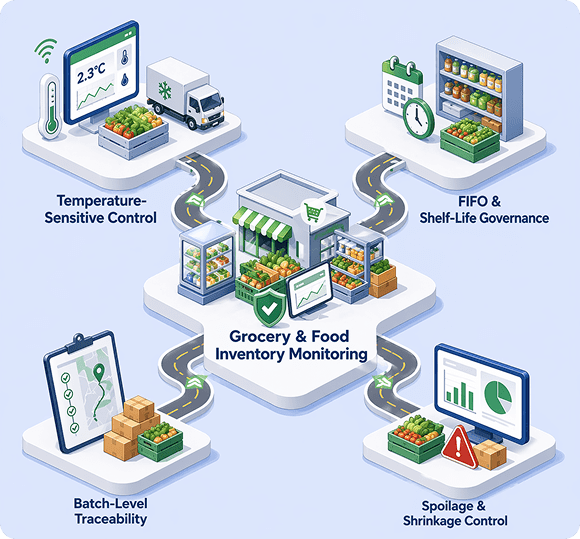
Cold chain integrity requires real-time monitoring of the following factors:
- Temperature and humidity levels
- Storage zone compliance
- In-transit environmental conditions
Integration with IoT sensors ensures deviations trigger alerts before spoilage occurs. Environmental data must be attached to batch-level inventory records.
First-in-first-out logic is non-negotiable for perishable goods. Inventory systems must enforce:
- Automated lot sequencing
- Expiration-based picking rules
- Aging inventory alerts
- Shelf-life visibility by location
Failure to rotate inventory correctly increases write-offs and food waste.
Grocery operations require rapid product recall capability. Inventory management software must support the following capabilities:
- Lot and supplier trace mapping
- Time-stamped movement history
- Downstream distribution tracking
Traceability protects consumer safety and regulatory compliance.
Advanced monitoring systems identify:
- Aging stock concentration
- Temperature breach impact
- Expiring SKU clustering
These insights enable proactive discounting, redistribution, or disposal planning.
Grocery inventory systems must protect revenue by preventing spoilage, enabling rapid recalls, and preserving regulatory defensibility. Condition tracking, expiration control, and traceability are not optional enhancements. They are operational safeguards that protect revenue, brand trust, and regulatory standing.
Inventory Management System Costs and ROI
Inventory system investment determines how efficiently working capital converts into revenue. System investment must be evaluated against measurable operational and financial outcomes. Cost structures vary based on architectural depth, integration scope, and regulatory exposure. Returns depend on execution quality and organizational adoption.
Investment categories typically include:
-
Core software development or licensing
-
Integration with ERP, TMS, POS, and partner systems
-
Infrastructure and deployment architecture
-
Data migration and configuration
-
Security, compliance, and audit readiness
-
Ongoing maintenance and performance optimization
Total cost of ownership must be assessed over a multi-year horizon rather than initial deployment alone. Underestimating integration complexity or post-deployment governance leads to budget overruns and delayed value realization.
Returns materialize through working capital compression, labor productivity gains, shrinkage reduction, and improved service stability. Labor savings, shrinkage control, faster fulfillment cycles, and improved stock rotation collectively influence profitability and working capital efficiency.
Without disciplined ROI modeling, inventory system investments risk becoming digital overhead instead of margin expansion drivers.
Key Cost Drivers in Inventory System Projects
Budget overruns in inventory projects typically stem from underestimated integration complexity and architectural misalignment. Budget overruns often occur when complexity is underestimated during the design stage. Understanding cost drivers early prevents structural rework and deployment delays.
Transaction volume, SKU count, warehouse count, and geographic spread influence infrastructure and development requirements. Multi-location environments require advanced synchronization logic and performance tuning.
Each integration with ERP, TMS, POS, WMS, ecommerce platforms, or 3PL systems adds development effort, API governance, testing cycles, and long-term maintenance overhead. Integration complexity is the primary cost driver in enterprise inventory initiatives.
Cloud-native, hybrid, and on-premise frameworks carry different infrastructure, licensing, and scaling implications. Advanced capabilities such as AI-driven forecasting or IoT integration increase development and data governance requirements.
Mobile-enabled workflows, handheld device compatibility, and role-based dashboards increase UI/UX design and testing effort compared to desktop-only deployments.
Industries with strict compliance standards require audit trails, encryption controls, access governance, and certification alignment. These controls extend both implementation timelines and validation requirements.
Post-deployment monitoring, upgrades, performance tuning, and integration updates contribute to the total cost of ownership. Sustainable budgeting must account for long-term system evolution.
Cost discipline requires aligning system capability with measurable financial impact instead of unnecessary feature expansion.
Calculating ROI for an Inventory Management System
Inventory system ROI must demonstrate measurable improvements in working capital velocity, margin protection, and cost stability. Financial impact compounds across multiple levers: capital compression, labor productivity, shrinkage reduction, and service stabilization. The financial return reflects the cumulative effect of efficiency gains, capital reduction, and risk mitigation.
Measure working capital improvement through stock inventory compression. This represents capital released from excess inventory and redeployed into growth or debt reduction.
Higher turnover accelerates cash conversion and reduces exposure to obsolescence and rising holding costs.
Measure improvements in the following metrics:
- Order cycle time
- Pick accuracy rate
- On-time shipment percentage
Fulfillment efficiency reduces labor cost per order and minimizes premium freight spending, directly improving contribution margin.
Improved tracking reduces shrinkage, write-offs, and audit exposure.
Automation reduces reconciliation overhead that increases as transaction volume scales.
Real-time reporting reduces reactive procurement and emergency sourcing. Avoiding disruption costs and improving demand alignment often represent the largest unmodeled contributors to margin stability.
Without baseline benchmarking and post-implementation KPI governance, financial impact cannot be credibly validated. Without disciplined measurement, inventory modernization risks being perceived as cost center expansion rather than capital efficiency improvement.
Why Choose iCommuneTech as Your Inventory System Development Partner
iCommuneTech approaches inventory system development as a capital efficiency initiative rather than a software implementation project. With more than 500 clients served and over 550 projects delivered across industries, the firm combines deep technical execution with domain expertise in logistics, supply chain operations, and enterprise software architecture.

Custom Approach With Operational Alignment
Unlike template-driven platforms, iCommuneTech structures systems around real transaction flows, integration complexity, and organizational growth trajectory. Engagement begins by identifying margin leakage points and integration risks before architecture decisions are finalized.

Breadth of Technical Offerings
End-to-end capabilities reduce vendor fragmentation and accelerate time-to-value during periods of growth.
This approach reduces dependency on multiple vendors and accelerates implementation timelines.

Integration Expertise
iCommuneTech has demonstrated expertise in building custom integrations for ERP, TMS, POS, ecommerce, and sensor/telematics systems. Its engineering discipline ensures robust API governance, event-driven synchronization, and low-latency data flows required for distributed, multi-site inventory networks.

Compliance and Reliability
Structured governance and validation processes ensure financial integrity and operational stability beyond deployment. Continuous support and performance optimization maintain stability beyond initial deployment.

Contrast With Competitors
Compared to template-based or generic providers, iCommuneTech emphasizes the following principles:
- Tailored architecture over one-size-fits-all products
- Rapid iterative delivery rather than long static build cycles
- Deep operational focus on logistics and supply chain workflows
- Ongoing support and optimization, not handoff upon delivery
The result is inventory infrastructure that scales with transaction growth, preserves margin under volatility, and strengthens capital discipline across the supply network.