Dispatch Management System Development
A dispatch management system enables task assignment, route planning, order-to-task sequencing, and dispatch coordination for transportation, logistics, and delivery companies.
iCommuneTech develops robust dispatch management software integrated with TMS, ERP, CRM, and fleet management system environments. The software aligns task allocation, driver scheduling, and order dispatch workflows to reduce delays, improve coordination, and maintain delivery timelines.
What Dispatch Management Capabilities Can Your TMS Gain?
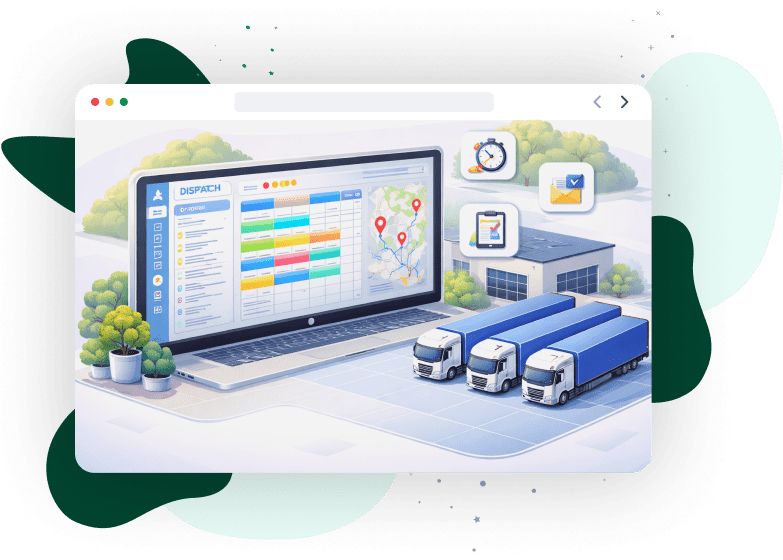
A TMS gains execution control, operational visibility, and automated workflow coordination when dispatch management becomes a native capability. Embedded modules convert orders, vehicles, drivers, and routes into coordinated execution across scheduling, assignment, live tracking, and performance reporting.
Modernizing and embedding dispatch coordination into core workflows resulted in 30% faster order and invoice processing through automated dispatch orchestration and workflow digitization.
Improved visibility strengthens SLA adherence, customer responsiveness, and end-to-end execution reliability.
Dispatch execution follows a structured control sequence:
Modular dispatch management capabilities:
Explore Our Dispatch Management System Demo
See how dispatch execution runs inside your TMS across scheduling, assignment rules, routing, and live tracking.
Evaluate real-time vehicle updates, task coordination, and reporting within a unified control environment.
Why TMS Companies Build Native Dispatch Software?
TMS companies build native dispatch software to control execution logic, protect IP, and preserve long-term product margins.
Custom dispatch modules align directly with existing data models, routing engines, and billing workflows. Control over assignment rules, routing constraints, and execution sequencing remains inside the platform rather than dependent on external vendors.
Internal constraints
- Limited engineering bandwidth delays complex dispatch builds
- In-house teams’ slow roadmap velocity when handling routing logic internally
- Specialized dispatch algorithms require domain expertise, not always available internally
External dependency risks
- Third-party tools fail in multi-tenant SaaS environments
- External systems restrict workflow customization and data ownership
- Licensing costs reduce margins as customer volume scales
- Vendor roadmaps limit feature control and differentiation
- UI constraints disrupt product consistency
External engineering partnerships resolve these constraints without diverting core product teams from strategic releases.
Building native dispatch shifts control back to the TMS platform, strengthens differentiation, and protects long-term scalability.
How iCommuneTech Helps IT Product Companies Deliver New Features Fast Enough?
iCommuneTech helps IT product companies deliver new features faster by co-developing native dispatch modules within existing TMS architecture and aligning execution with internal release cycles. The team works alongside internal engineering units to build complex dispatch capabilities without delaying core product launches or increasing headcount pressure.
“The new portal transformed our operations with faster processing, automated rates, ticket management, and seamless invoice payments. The flexibility for clients and admins to manage payments changed how we operate.”

Why is having a Dispatch Management Module in Your Product Roadmap Important?
Having a dispatch management module in your product roadmap ensures architectural alignment, execution control, and long-term scalability before operational complexity increases. Early requirement definition prevents integration gaps, protects data consistency across TMS, ERP, and CRM systems, and reduces rework during later release cycles. Clear scoping improves data modeling accuracy, integration planning, and capacity forecasting.
Business analysis checklist:
This checklist ensures dispatch capabilities deliver immediate value while remaining adaptable for platform growth.
Build Custom Dispatch Software vs Use Off-the-Shelf APIs/SDKs
Choosing between custom dispatch software and off-the-shelf APIs/SDKs defines long-term product control, scalability, margin protection, and roadmap flexibility. TMS platforms operate within multi-tenant SaaS environments that require deep workflow integration, controlled data models, and adaptable routing logic. Dispatch capabilities that sit outside the core architecture introduce structural dependency and long-term constraints.
Comparison Overview
| Comparison Attribute | Custom Dispatch Software | Off-the-Shelf Dispatch APIs / SDKs |
|---|---|---|
| Time-to-market | Planned releases aligned with the product roadmap | Fast start with limited depth |
| Integration depth | Native integration with TMS data models and services | Partial integration through external APIs |
| Workflow flexibility | Configurable logic for complex logistics workflows | Rigid workflows limit customer customization |
| Roadmap control | Full control over features and core logic | No control over vendor roadmap |
| Scalability and margins | Predictable costs as customers scale | Licensing limits scalability and margins |
| IP ownership | Full ownership of the dispatch IP | Vendor retains IP |
| Customization over time | Adapts as businesses and regions expand | Costly customization is required later |
| Multi-tenant SaaS fit | Built for multi-tenant SaaS environments | Often constrained by shared limits |
Summary
Custom dispatch software involves a higher upfront investment but delivers stronger lifecycle ROI, deeper workflow integration, and sustained IP ownership. As TMS platforms scale, native dispatch evolves with operational demands, while external tools introduce API constraints, rising costs, and long-term architectural friction.
Dispatch Module Development Services for TMS and Logistics Software Platforms
iCommuneTech delivers dispatch module development through co-development with enterprise product teams, not task-based outsourcing. Full-cycle delivery from ideation to rollout aligns architecture, data models, and release cadence while reducing handoffs and delivery risk.
With 12+ years of product engineering experience, the team brings sustained execution capability to TMS and logistics software platforms.
Service Scope (Object–Action):
This co-development model preserves product ownership, accelerates delivery, and ensures dispatch launches as a first-class platform module.
Architecture & Technology Stack for Dispatch Software System
The dispatch management module uses a modular plug-in architecture embedded into TMS platforms. It enables real-time dispatch execution, routing, and live tracking without disrupting planning or billing workflows.
Designed for scale, this architecture processes 10,000+ dispatches daily using independent services, event-driven communication, performance isolation, and automated CI/CD pipelines.
Technology Stack:
- Backend microservices built using .NET, Java, or Node.js through scalable software development services
- Databases: PostgreSQL or MongoDB
- Event streaming via Webhooks and event queues
- Cloud deployment on AWS, Azure, or GCP
- Integrations using REST APIs, WebSockets, and MQTT
Modular Architecture Components:
- Dispatching microservices manages order intake and execution control.
- The assignment engine allocates trucks, trailers, and drivers using defined constraints.
- Route optimization services calculate and update delivery paths dynamically.
- The tracking layer synchronizes live vehicle telemetry and status updates.
- The event processing layer propagates dispatch events across services
- Integration services connecting dispatch, routing, billing, and reporting
- API gateway enforcing authentication and throttling
- SDKs enabling controlled extensions
- Multi-tenant compatible data models
- Admin console for configuration and operational control
- White-label UI modules for dashboards and maps
This architecture ensures resilient, high-volume dispatch with predictable performance and extensibility.
Integration With Your Existing TMS or Logistics Platform
The dispatch module integrates directly with TMS, ERP, and CRM systems within your logistics management software to synchronize orders, fleets, drivers, tasks, and billing data across platforms.
Shared entities remain consistent across systems, ensuring a single operational source of truth without duplicate entry or manual reconciliation.
Integration attributes:
- Native sync with user, order, fleet, and task entities across TMS, ERP, and CRM development environments.
- Configurable adapters for TMS/ERP/CRM mappings
- Event-driven updates for ETAs and exceptions
- Data consolidation for reporting and SLA tracking
- Process automation across order intake and invoicing
Key benefits:
Unified operations without duplicate entry
Faster execution via automated handoffs
Improved scheduling and billing accuracy
Actionable analytics from consolidated data
Orders created via CRM development flow into dispatch for scheduling and routing, update in real time during execution, and sync with ERP for automated invoicing and reporting.
Job Creation & Client Profile
Scheduling & Route Optimization
Real-Time Asset Visibility
Automated Invoicing
Status Propagation
Dispatch Software Customization and Integration Flexibility
Enterprise TMS platforms require adaptable dispatch systems that evolve without rewrites. Custom dispatch modules adjust to operational change, regional expansion, and customer demands while maintaining uptime New delivery zones can be added within two days without downtime, preserving service continuity.
Customization and flexibility capabilities:
This flexibility enables platform growth without disrupting live dispatch operations.
How iCommuneTech Offloads and Brings Innovation in for TMS Engineering Teams
iCommuneTech offloads complex dispatch development and advanced platform engineering while preserving roadmap control and code ownership.
Through structured co-development, product teams accelerate feature delivery, gain specialized dispatch expertise, and avoid expanding internal headcount. Embedded collaboration ensures new modules ship without disrupting core releases and maintains architectural consistency at scale.
What Does Custom Dispatch Software Cost and How Long Does Development Take?
Custom dispatch software development cost depends on module scope, routing complexity, integration depth, and scalability requirements, while development timelines range from weeks to months based on architectural and deployment needs.
An interactive cost calculator provides a directional investment range for building custom dispatch capabilities within a TMS platform. The calculator evaluates selected dispatch modules, routing, and rules engine complexity, real-time tracking requirements, platform targets across web and mobile, and integration scope with enterprise systems. It estimates engineering effort, architecture depth, scalability planning, and delivery timelines based on tenant scale, user load, and deployment model.
Fleet Management System Calculator
Cost factors include:
Typical module scope covering dispatching, routing, tracking, and reporting
Feature and integration complexity across rules engines, optimization, and real-time updates
Platform targets for web, mobile, or combined delivery
Integration approach using API-based connections versus embedded modules
White-label UI options for branding and tenant-level customization
Scalability requirements for multi-tenant growth and peak volumes
Roadmap co-creation with product teams clarifies priorities early, reduces rework, and keeps investment aligned with release goals.
High-level delivery timeline:
1–2 weeks
1–2 months
3–6 months
When Should TMS Companies Build Their Own Dispatch Management Module?
TMS companies should build their own dispatch management module when product control, workflow flexibility, and long-term margin protection become strategic priorities. The decision becomes time sensitive when external APIs restrict routing logic, limit data ownership, increase licensing costs, or weaken differentiation against competitors offering native dispatch capabilities.
If three or more answers are yes, building a native dispatch module becomes strategically justified and operationally urgent.
Dispatch Management System Implementation Impact on Your TMS Product ROI
Native dispatch management delivers measurable ROI by embedding execution inside the TMS core. Integrated modules increase product stickiness, unlock upsell revenue, and strengthen margin control without third-party dependency.
Built-in dispatch restores roadmap ownership and converts proprietary logic into long-term IP assets. Reduced reliance on external tools lowers licensing costs as customer volume scales.
Embedding fuel insights into daily operational workflows supports customer retention and recurring value realization.
ROI follows a structured rollout:
Business impact appears as:
- Faster time-to-market
- Larger average deal sizes
- Improved retention
- Sustained competitive differentiation
Case Studies: Enterprise Success with Custom Dispatch Software
Dispatch Module Modernization for a Transportation Management System
This section demonstrates the success story of how enterprise TMS and logistics platforms have improved execution speed, operational visibility, and dispatch scalability through custom dispatch modernization.
Each case highlights measurable outcomes from modernized workflows and real-time execution.
Our team modernized an existing dispatch module to support real-time execution, automated notifications, and live operational visibility. Manual coordination was replaced with a scalable and event-driven dispatch system built for enterprise logistics providers.
Check more success storiesMeasured Impact:
Discuss Your Custom Dispatch Software Needs
Let’s map your dispatch workflows and identify where custom software can reduce costs, remove bottlenecks, and improve service performance. Align dispatch capabilities with your product roadmap and integration needs through a focused, technical discussion.