
Load Optimization System
Development
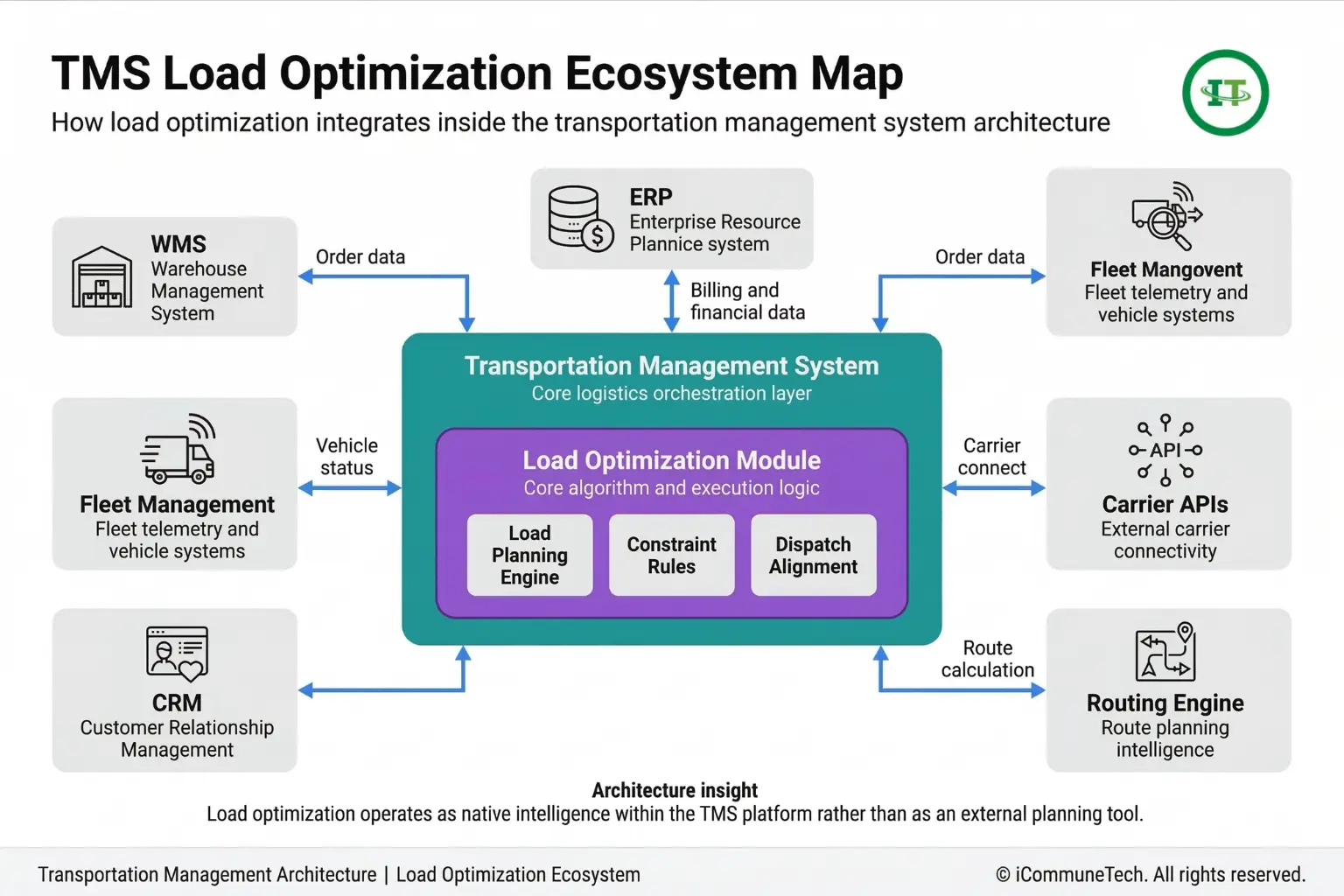
Load optimization software enables transportation companies to manage shipment consolidation, freight planning, and vehicle capacity utilization. The system integrates with TMS and fleet management platforms to ensure efficient load planning and dispatch operations.
iCommuneTech develops scalable load optimization solutions that function as a native module within logistics platforms. It supports dispatch workflows, freight analytics, truck load optimization, and operational scalability.

What Load Optimization Capabilities Can Your TMS Platform Gain?
A load optimization system is a native product module that plans, consolidates, and sequences freight across orders, vehicles, and routes. Load optimization capabilities enable TMS platforms to plan, consolidate, and execute freight loads efficiently across orders, vehicles, trailers, and routes using algorithm-driven optimization logic. These capabilities function as native platform intelligence rather than external planning tools.
In one infrastructure modernization initiative, operational efficiency improved from 40% to 90% after integrating real-time planning data. Execution data integration strengthened utilization, planning accuracy, and dispatch coordination across TMS workflows, improving operational decision-making outcomes.
iCommuneTech embeds shipment optimization, transportation analytics, predictive planning, dispatch optimization, and route optimization directly into TMS workflows, enabling consistent execution and scalable load management across logistics networks.
Capabilities Your TMS Can Offer Customers
Explore Our Fleet Management System Demo
Review load planning, consolidation rules, and dispatch alignment using embedded truck load optimization software within a TMS workflow.
Capacity utilization
Constraint handling
Load sequencing
Why TMS Companies Build a Native Load Optimization System
Native load planning engines align with product data models and customer workflows across LTL consolidation, shipment optimization, capacity utilization, and complex cartonization scenarios.
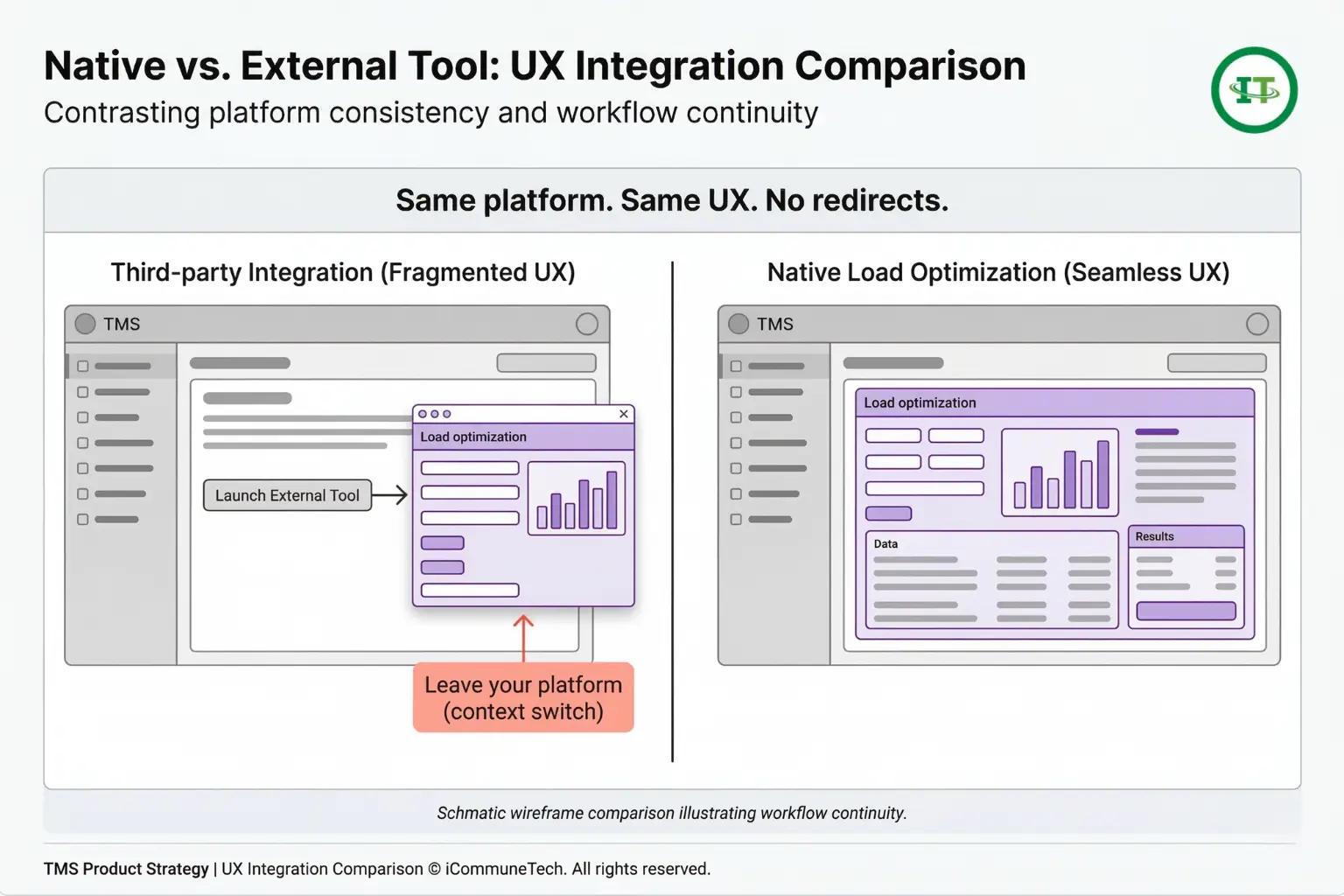
Handles customer-specific load planning rules, sequence logic, shipment constraints, and route optimization logic that external tools cannot embed inside a TMS.
Preserves
- Platform UX consistency
- Optimization control
Engineering and Business Pain Points Addressed
- SaaS tools cannot embed custom load planning logic, shipment optimization rules, and capacity constraints inside your TMS.
- Load planning APIs remain limited, costly at scale, and restrict route optimization and capacity utilization logic.
- Industry-specific shipment rules, cartonization logic, and load optimization constraints require custom optimization engines.
- Platform-aligned UI and UX demand native components.
- Algorithm control supports evolving load planning workflows, shipment logic, and route optimization rules.
- IP ownership drives long-term product differentiation.
- SaaS licensing costs rise with shipment volume, load planning complexity, and optimization usage.
How iCommuneTech Helps IT Product Companies Deliver New Features Fast Enough?
Feature delivery accelerates when load optimization modules extend existing TMS platforms without rebuilding
core systems.
Co-development models align engineering execution with product roadmaps, release cycles, and integration
constraints.
Extend Existing TMS Platforms
Deploy load optimization modules without rewriting core systems.
Roadmap-Aligned Engineering
Co-development aligned with release cycles and integration constraints.
Faster Feature Deployment
Reduce time-to-market with modular optimization architecture.
“Working with iCommuneTech has been a game-changer for A&I Fuel Finder. Their team understood our operational challenges from day one and turned our idea into a user-friendly, data-driven platform. Our drivers now save time and money by finding the lowest-priced fuel along optimized routes. The mobile app features, like fuel invoices and card management, made it even more valuable for our clients. We’re pleased with the professionalism, support, and technical expertise iCommuneTech delivered.”

Why Having a Load Optimization Module in Your Product Roadmap Is Important?
A load optimization module strengthens platform differentiation as customers expect automated load planning, shipment consolidation, freight optimization, and capacity utilization within modern TMS products.
Core TMS functions such as routing, carrier selection, dispatch planning, billing accuracy, and freight cost
control rely on accurate load planning and shipment optimization logic.
A native load optimization
module supports platform expansion, reduces carrier costs, improves truck utilization, and drives measurable
outcomes that improve customer retention.
Product-Level Reasons
- Load planning ranks among the most requested TMS features
- Routing, carrier selection, dispatch, and billing gain higher accuracy
- Customers expect freight optimization without manual intervention
- Advanced modules like rate optimization and network planning depend on it
- Premium load planning modules create upsell paths
- Lower carrier costs improve customer retention
- The platform evolves into a visibility and planning suite
Business Value
- Increased ARPU across enterprise customers
- Lower churn driven by embedded optimization
- Higher customer lifetime value
- Clear competitive differentiation in crowded TMS markets
Load Optimization Module Development Services for TMS and Logistics Software Platforms
Full-cycle engineering services cover the design, development, and rollout of load optimization modules for enterprise TMS products. The scope includes load planning, shipment consolidation, route optimization, and capacity utilization as native platform capabilities
Development builds on logistics platform experience and long-term product partnerships. Services include load planning engines, shipment optimization logic, cartonization rules, and optimization algorithms designed for production-scale use.
Product teams retain architecture control, data model alignment, and IP ownership while accelerating feature delivery across load planning, dispatch planning, and route optimization without third-party dependency.
Engineering and Product Services
Architecture & Technology Stack for Load Optimization Systems
A modular plug-in architecture embeds load optimization capabilities into TMS platforms without disrupting routing, dispatch, or existing load planning workflows. This design supports real-time shipment planning, route optimization, and capacity utilization as native platform functions.
Independent modules allow scalable deployment, targeted performance tuning, and controlled system evolution across load planning and shipment optimization workflows.
Balanced loads help:
- Reduce turnaround time
- Improve dispatch throughput at scale
Technology Stack
- Backend services via software development services
- Optimization frameworks: OR-Tools, Gurobi, CPLEX
- React / Angular frontend
- Cloud deployment via DevOps services
Modular Architecture Components
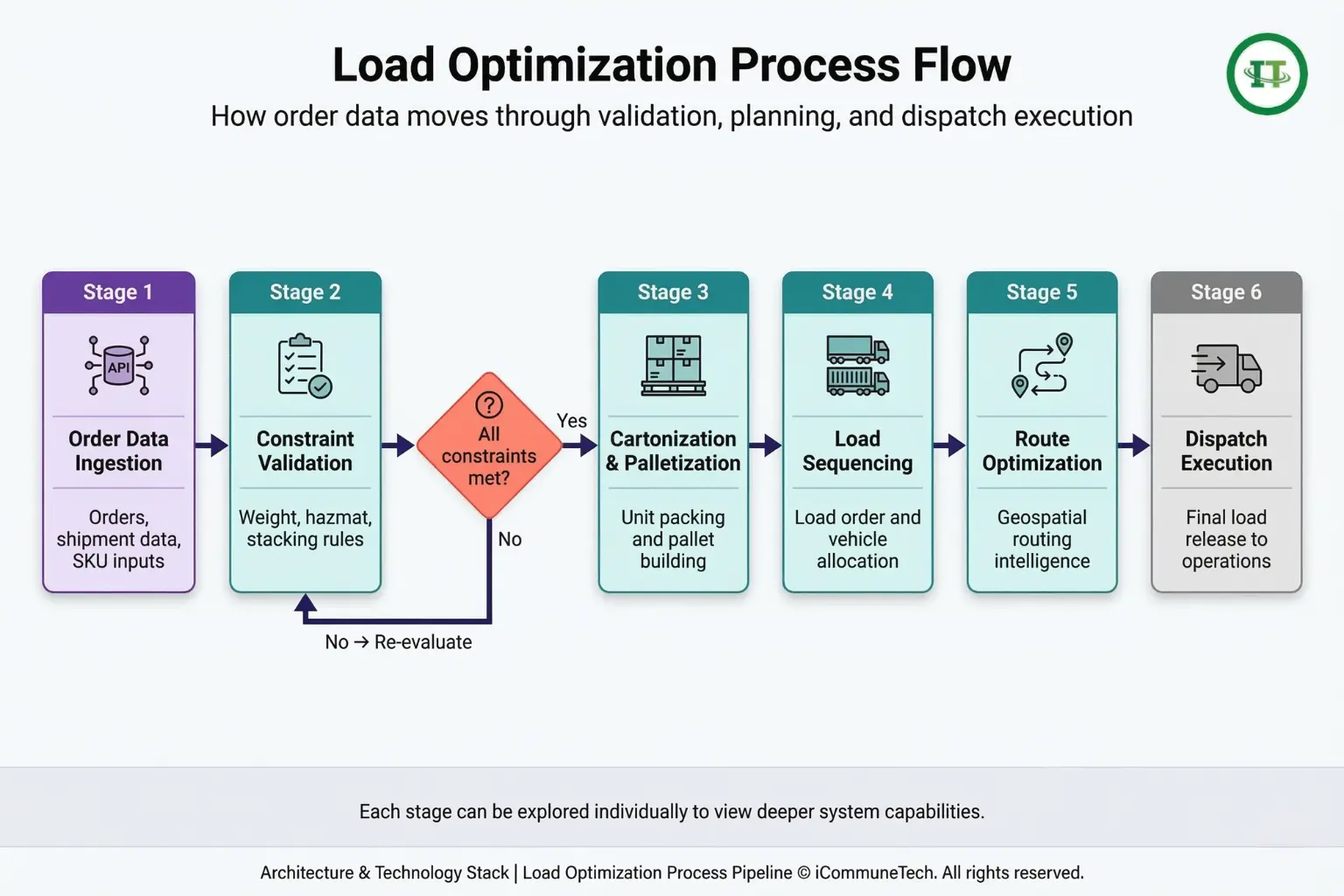
- Load optimization engine using mathematical models and heuristics
- Constraint rules engine for weight, balance, stacking, and hazmat
- Cartonization subsystem for unit-level packing logic
- 3D load builder microservice for spatial planning
- Order data ingestion pipeline for real-time updates
- Geospatial and routing integration layer
- Weight and dimension validation component
- Event-driven execution using Kafka or RabbitMQ
- UI module for load visualization
- Admin console for rule configuration
Integration With Your Existing TMS Architecture
The load optimization system is embedded as a shared intelligence layer across load planning, shipment planning, dispatch, routing, and execution workflows within an existing TMS architecture. This approach preserves platform structure while extending optimization capabilities.
The integration enables coordinated decision-making and real-time load optimization across planning, dispatch planning, route optimization, and shipment execution without dependency on external tools.
- Fuel Management
- Dispatch Management
Key Integration Points
- Order, load, shipment entities
- Routing engine integration
- Dispatch module connectivity
- Scheduling engine alignment
- Fuel and capacity data synchronization
- WMS integration for carton and pallet details
- Carrier management linkage
- Customer-specific rule configurations
- Rate shopping integration
Integration Benefits
Single connected intelligence layer across the TMS
Consistent optimization decisions across planning and execution
Faster response to capacity, routing, and demand changes
Load Optimization System Customization and Integration Flexibility
The load optimization system supports customer-specific and industry-specific load planning rules without changes to the core TMS architecture. This design allows customization while preserving platform stability and upgrade paths.
Configuration layers adapt load optimization logic across vehicle limits, load constraints, capacity utilization, and delivery patterns to match different industries and operating models.
Rule and Constraint Flexibility
Customization and Scalability Options
How iCommuneTech Offloads and Brings Innovation in for TMS Engineering Teams
With more than ten years of logistics engineering experience, iCommuneTech supports multiple TMS products across planning, optimization, and execution domains. This experience enables predictable delivery while preserving internal platform ownership.
Teams ship faster because:
Delivery pressure is reduced through proven modules
Shared ownership improves execution speed
Predictable release cycles reduce rework
Engineering capacity shifts:
From maintenance to innovation
While core platform control remains internal
Cost & Development Timeline for a Custom Load Optimization System
Pricing aligns with project scope and ROI targets through delivery models designed for enterprise TMS platforms. Engagements typically follow time-and-material or dedicated team models, selected based on delivery speed requirements and long-term ownership goals.
Development cost depends on optimization algorithm complexity, constraint depth, and the number of integrations required across planning, routing, and execution systems.
An interactive cost calculator provides a directional investment range for building load optimization capabilities inside a TMS platform. The calculator evaluates selected modules, optimization complexity, integrations, user scale, and deployment model to estimate engineering effort and delivery timelines.
Fleet Management System Calculator
[master_cost_calculator type=”fleet”]Key Cost Factors
2D versus 3D load planning and space utilization requirements
LTL, FTL, or parcel-specific load planning logic
UI visualization scope for load planning and shipment visibility
Data model complexity across orders, loads, and shipment entities
Operational constraints across weight, stacking, and routing rules
Integrations with TMS, WMS, routing engines, and carrier APIs
Project Development Timeline
3–4 weeks
3–4 months
6–9 months
9–12 months
When Should TMS Companies Build Their Own Load Optimization System?
Building a native load optimization system becomes relevant when load planning evolves into a core product differentiator and third-party tools limit platform control, data model alignment, and route planning flexibility.
The checklist below helps assess urgency, product fit, and revenue impact. If three or more conditions apply, custom load optimization development aligns with product strategy, IP ownership goals, and long-term margin control.
Build vs Buy: Should You Develop Load Optimization or Integrate a Third-Party Tool?
A clear TMS optimization cost comparison helps product teams evaluate long-term tradeoffs between custom development and third-party tools. The decision impacts platform scalability, IP ownership, integration depth, recurring operating costs, architecture control, and roadmap flexibility.
| Comparison Attribute | Custom Build | Third-Party Load Planning Tool |
|---|---|---|
| IP ownership | Full ownership of algorithms and logic | Vendor retains core IP |
| Data refresh frequency | Real-time, platform-controlled updates | Limited by external API cycles |
| Geospatial flexibility | Fully adaptable to routing models | Restricted to vendor capabilities |
| Cost scalability | Predictable at scale | Costs increase with shipment volume |
| Data model alignment | Native fit with TMS entities | Requires mapping and translation |
| Device compatibility control | Full control across devices | Dependent on vendor support |
| UI/UX integration | Seamless, platform-consistent UI | Embedded or redirected experiences |
| Multi-tenant structure | Designed for platform tenancy | Generic tenancy constraints |
| Roadmap dependency | Independent feature evolution | Dependent on the vendor roadmap |
Summary
Custom load optimization modules match platform architecture, support shipment optimization and route planning, scale predictably, protect IP ownership, and strengthen long-term product differentiation.
Load Optimization System Implementation Impact on your TMS Product ROI
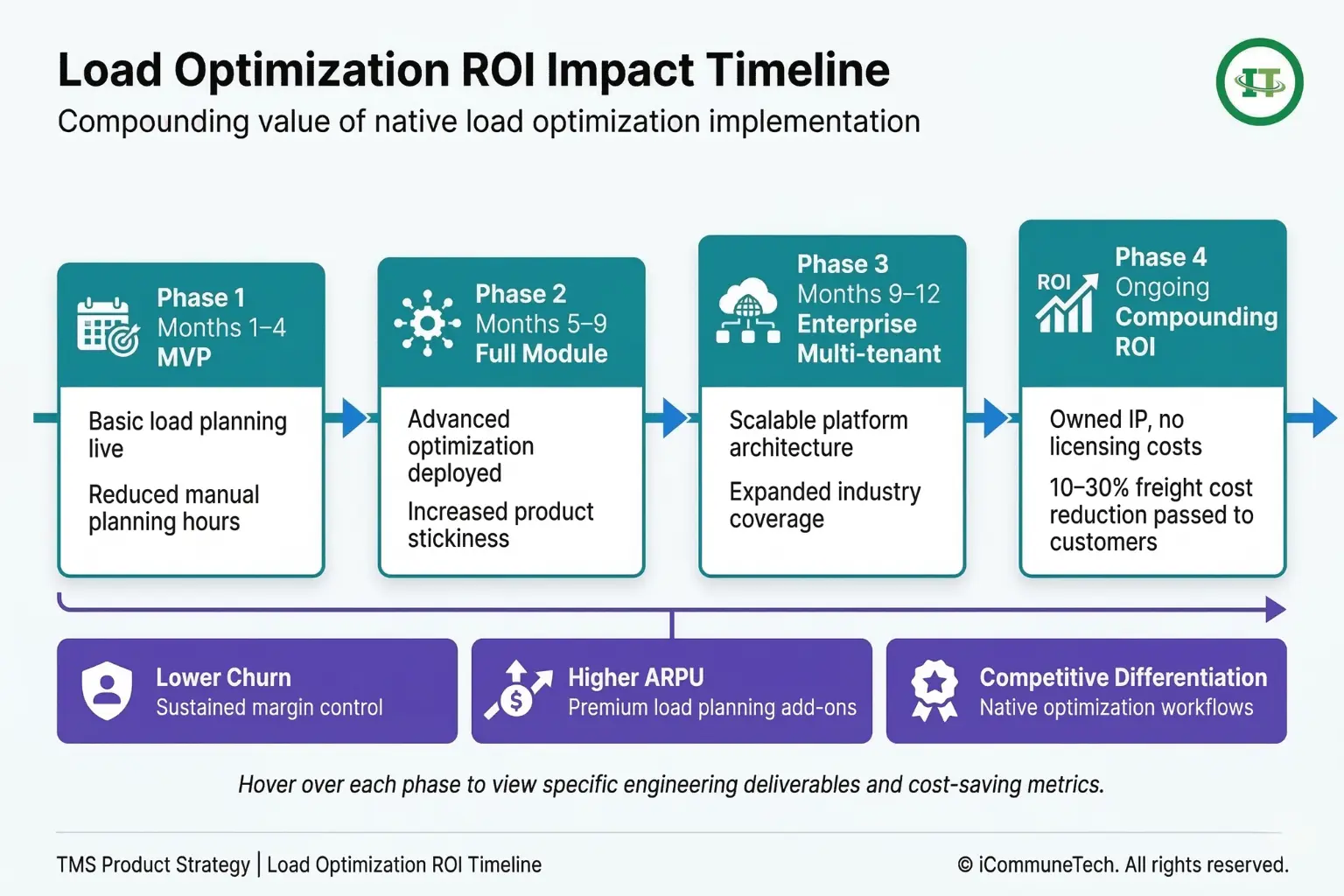
A custom load optimization system improves ROI by converting planning intelligence into a long-term product asset within a TMS platform. Native optimization capabilities support differentiation, reuse across releases, and sustained margin control.
Owned optimization IP compounds value over time by reducing external dependencies and enabling consistent product evolution aligned with platform architecture.
Industry benchmarks indicate that customers achieve 10–30% freight cost reduction, which increases perceived product value and supports wider adoption.
ROI Impact for TMS Products
10-30% Freight Savings- Higher ARPU through premium load planning add-ons
- Increased product stickiness through native optimization workflows
- Competitive advantage
- Expanded industry coverage
- Reduced customer churn
- Stronger perceived value
Case Studies: Load Optimization and Transportation Efficiency Transformation Success
Shipwell Customers Realize 20-40% Savings with Integrated Load Optimization
Shipwell introduced a proprietary load optimization feature built directly into its Transportation Management System (TMS) to automate manual load planning and route consolidation processes.
Before this enhancement, shippers often spent hours manually consolidating orders and planning routes using spreadsheets or third-party tools outside their core TMS. The new feature evaluates order size, weight, pickup and delivery windows, and combines them into the most cost-efficient shipments automatically — reducing planning time, cost, and emissions.
Measured Impact:
- 20–40% reduction in shipping costs through optimized load consolidation and routing plans across full truckload and less-than-truckload freight
- 4–5 hours saved per week in manual planning effort for logistics teams
- 10,000+ pounds of carbon emissions reduced by cutting more than 2,700 miles of unnecessary travel for one shipment cohort
- Enhanced routing options uncovered operational efficiencies that manual planning had overlooked, improving decision speed and carrier utilization
This case demonstrates how embedded load optimization within a unified TMS platform can deliver measurable cost savings, operational efficiency, and sustainability outcomes for shippers experiencing complex planning challenges.
Multiple Shipwell Beta Customers
Shipwell Load Optimization Feature (Integrated in TMS)
Discuss Adding Load Optimization Capabilities to Your TMS
Evaluate how native load planning and routing intelligence can integrate with your existing TMS product architecture and workflows. Define a custom optimization engine aligned with data models, workflows, and long-term roadmap goals.