IoT Fleet Management: Unlocking Real-Time Efficiency for Modern Transport Management System (TMS) Platforms
Distributed logistics networks fragment vehicle data, delaying dispatch decisions and increasing fuel and compliance costs. Disconnected vehicles and assets delay dispatch actions by limiting real-time visibility within transportation platforms.
IoT fleet management is the use of connected devices to collect vehicle, driver, and sensor data centrally. It links field activity with TMS and SaaS platforms for planning and execution. IoT fleet management solutions establish a consistent architecture connecting devices, applications, and workflows. Integrated telemetry feeds live vehicle statuses into dispatch systems, enabling faster exception detection and response.
Integrated telemetry enables real-time monitoring, strengthening dispatch control, exception handling, and service reliability. Usage and fault data identify fuel waste and maintenance risks, reducing breakdowns and unscheduled service events. Speeding and harsh braking data trigger alerts and policy enforcement that reduce unsafe driving behaviors.
Security governance enforces device authentication, access controls, and encrypted data transmission. Advanced use cases support small and mid-sized business SMB enablement, compliance automation, and sustainability impact across logistics networks. Amazon Web Services (AWS) IoT Fleet Management manages device authentication and data ingestion for large-scale fleet telemetry. Custom IoT solutions adapt data models and APIs to business needs.
The sections that follow examine architecture, execution, analytics, and governance required for scalable fleet performance.
What Components and Architecture Power IoT Fleet Management Systems?
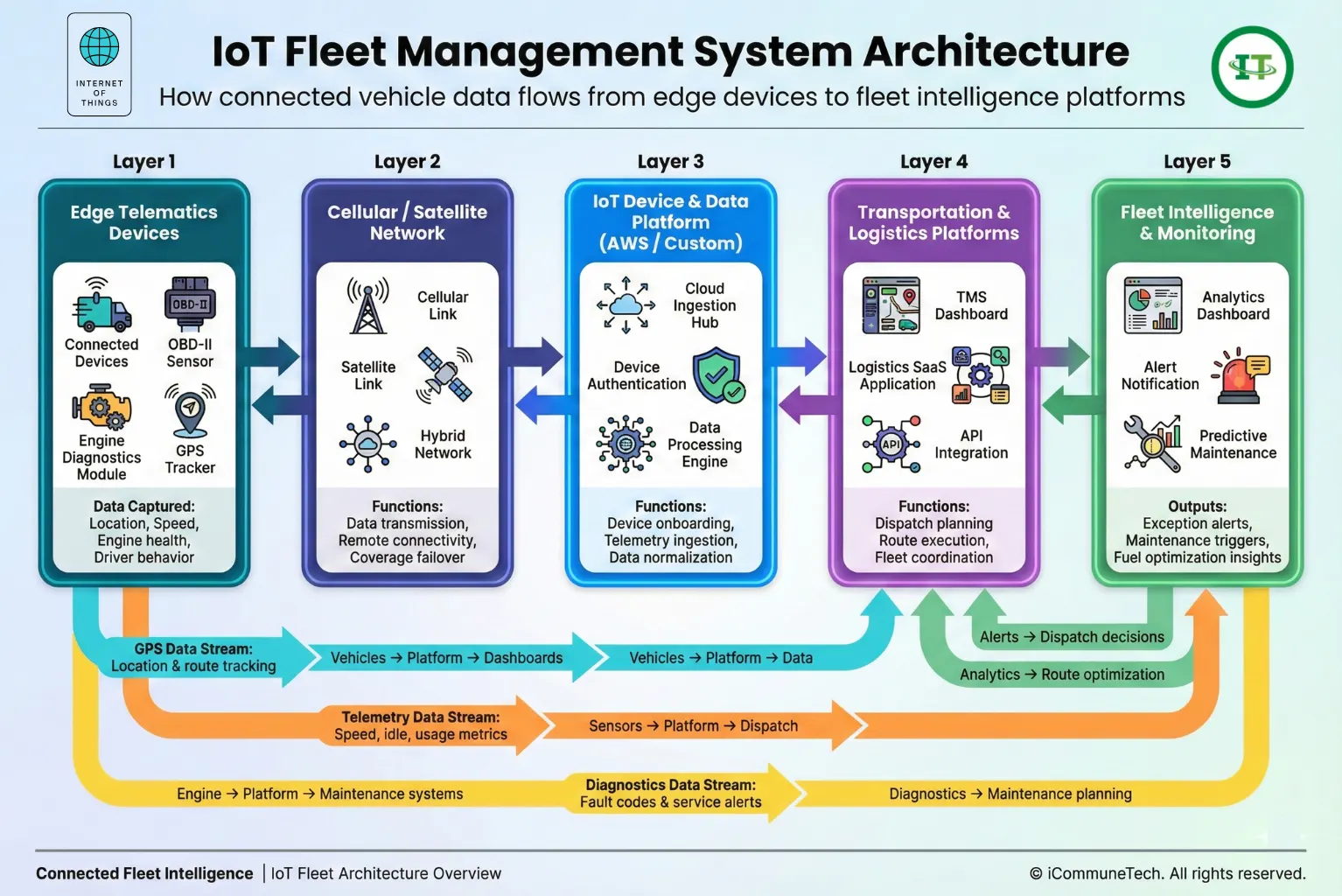
Effective design starts with fleet hardware that captures data through edge devices, which are onboard units that collect vehicle sensor data. Network connectivity transports this data across cellular, satellite, or hybrid layers based on coverage needs.
IoT fleet management structures data ingestion through telemetry, which transmits vehicle sensor data to central platforms. Normalized telemetry, which standardizes data formats across devices and systems, enables interoperability across TMS and logistics applications.
Modular architecture allows device, carrier, and application changes without reengineering the telemetry pipeline. AWS IoT fleet management strengthens data ingestion and device orchestration, which controls device onboarding, connectivity, and lifecycle management. Device orchestration secures registered devices, manages connections, and routes telemetry at scale. Custom IoT fleet management solutions align architecture with operational scale and integration goals.
Fleet Management System Essentials: Hardware, Software, and IoT Sensors
A modern fleet management system depends on tightly integrated hardware, software, and sensor layers to capture reliable operational telemetry.
Fleet Hardware and Sensor Essentials
| Component / Sensor | Function | Operational Benefit |
|---|---|---|
| GPS Trackers | Provide continuous location and movement data across vehicles | Enable real-time tracking, routing accuracy, and asset visibility |
| Engine Diagnostics (OBD-II, CAN Bus) | Expose engine health, fault codes, and usage signals | Support preventive maintenance and reduce unplanned downtime |
| Temperature Sensors | Monitor shipment and cargo conditions | Maintain product integrity in cold chain logistics |
| Fuel Sensors | Measure consumption and detect anomalies | Improve fuel accountability and identify inefficiencies |
| Motion Sensors | Detect movement, vibration, and handling | Enhance security and ensure shipment stability |
These components generate governed telemetry with validated, secured, access-controlled data. This data supports maintenance planning, uptime decisions, and compliance workflows.
Fleet management software capabilities include:
- Dashboards that convert sensor feeds into real-time operational controls
- Centralized visibility for planning, dispatch, and execution monitoring
- Actionable insights that define the performance standard of the best fleet management software
Accurate sensors sustain trust across planning, safety, and regulatory processes. These foundations support AWS-integrated IoT fleet management with flexible architecture aligned to execution requirements.
Building Connected Vehicles With Telemetry and Network Integration
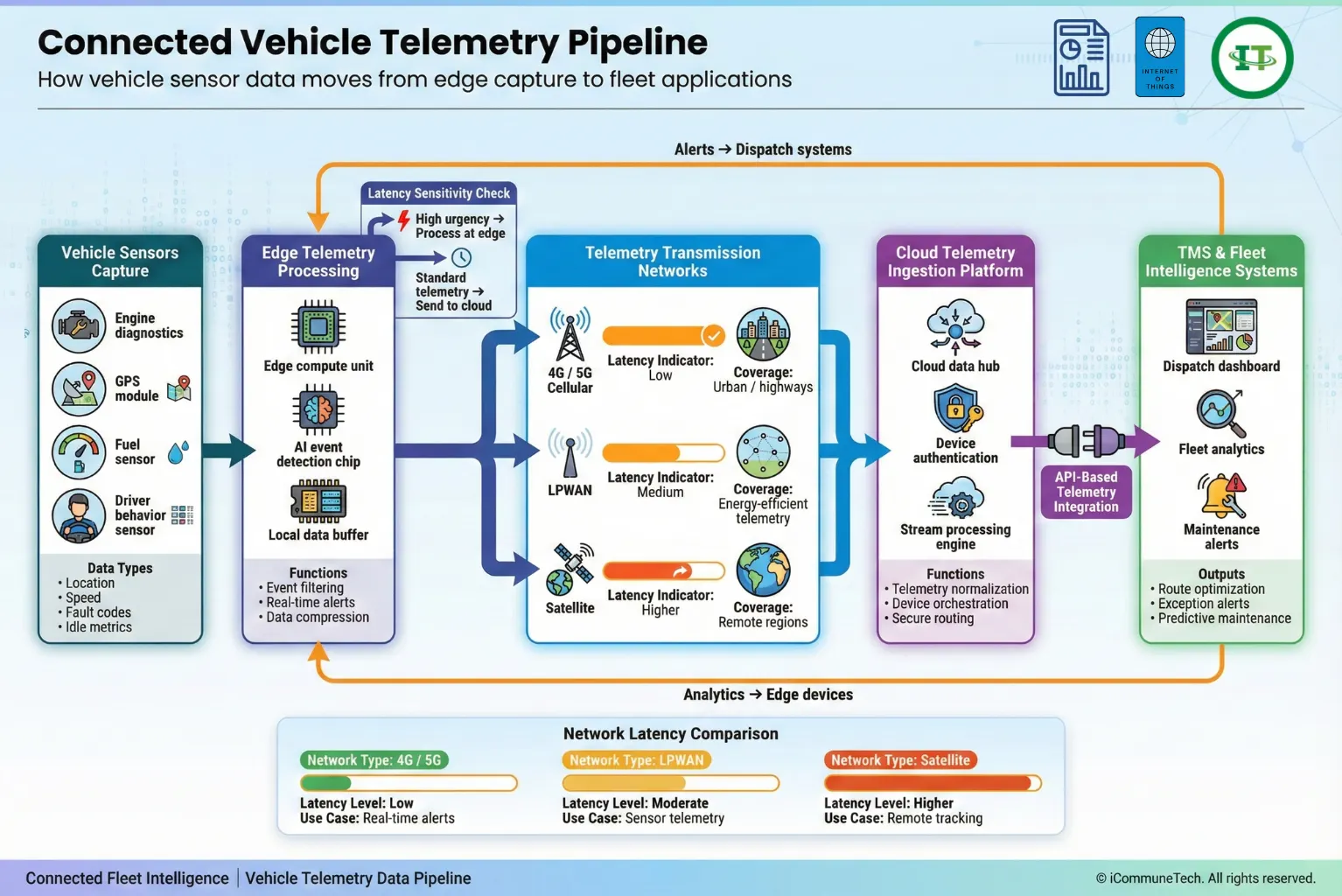
Connected vehicles use staged telemetry pipelines, which move vehicle sensor data from onboard devices to cloud fleet management and TMS platforms. This staged design forms the foundation of a resilient telemetry architecture. It supports latency-sensitive monitoring, where delays impact real-time alerts and controls, and downstream analytics.
IoT fleet management uses edge capture, where data is collected and processed on the vehicle before transmission to cloud fleet platforms and TMS systems. Network layers transmit data through cellular, LPWAN, or satellite connections, based on coverage and cost.
Operational latency requirements dictate whether alerts and controls are processed at the edge or in the cloud. In latency-sensitive scenarios, edge AI for fleet monitoring enables real-time event detection on vehicles before data reaches the cloud.
Cellular 4G/5G suits low-latency urban use, while LPWAN enables low-power telemetry. Satellite connectivity supports remote and cross-border routes. API-based integrations automatically send normalized telemetry into TMS applications.
AWS IoT fleet management supports secure routing and device orchestration at scale. This design supports resilient execution across regions and operating conditions.
Real-Time Monitoring and Tracking Capabilities in IoT Fleet Management
Logistics execution requires continuous visibility across vehicles, assets, and routes during live operations. IoT fleet management enables real-time monitoring that accelerates decisions within active transportation workflows.
Real-Time Monitoring Capabilities
| Capability | Function / Description | Operational Benefit |
|---|---|---|
| Live Dashboards | Display current vehicle locations, ETAs, and operating states at fleet and asset levels | Improve situational awareness and speed up decision-making |
| Event-Driven Alerts | Trigger automatic notifications for delays, route deviations, and threshold breaches | Reduce response time and improve operational reliability |
| TMS Data Linkage | Connects live execution data with Transportation Management Systems (TMS) for dispatch, rerouting, and escalation | Enhances coordination between tracking systems and dispatch teams |
| Asset-Level Visibility | Provides shipment condition, dwell time, and custody status in real time | Strengthens accountability and ensures shipment integrity |
| Fleet-Level Insights | Monitors capacity utilization, network flow, and systemic performance constraints | Optimizes route efficiency and fleet productivity |
AWS IoT Fleet Management provides scalable streaming, enabling continuous ingestion of high-volume vehicle and asset data and rule-based alerts. It enables connected analytics that align tracking precision with execution speed and reliability. Real-time asset tracking removes delivery uncertainty by streaming live GPS signals from vehicles and mobile assets. AI-powered telematics systems can reduce accident rates by up to 40% by combining real-time monitoring with predictive analytics
Fleet and asset tracking
- Consolidate location, condition, and timestamp data into accurate arrival expectations
- Apply geofencing to flag early or late entries at yards, customers, and depots
- Measure asset utilization through dwell time, turns, and idle exposure
- Prioritize exceptions involving delays, deviations, or condition breaches
- Feed alerts into TMS workflows for dispatch updates and customer notifications
Using Data Analytics for Predictive and Historical Geolocation Insights
Geolocation analytics adds intelligence layers above raw tracking streams collected during operations, shifting execution from reactive updates to forward planning.
Geolocation analytics capabilities include:
- Route history analysis to identify recurring congestion and inefficient lane choices
- Dwell time analysis highlighting delays at facilities, yards, and customer locations
- Predictive ETA modeling that anticipates disruptions before service impact
- Trend identification to identify emerging risks ahead of service degradation
AI in fleet management applies machine learning to route history and dwell patterns to improve schedule reliability.
How Does IoT Fleet Management Reduce Operating Costs Across Fleet Operations?
Fleet efficiency measures fuel usage, idle time, and asset utilization across the active route. According to GlobeNewswire, the IoT fleet management market is projected to grow from USD 11.2 billion in 2025 to USD 36.3 billion by 2034. Fleet economics are driven by fuel spend, idle exposure, and underused assets across routes.
IoT fleet management improves cost control through:
- Measure cost per mile by route and driver to identify inefficient operating patterns.
- Asset utilization tracking that exposes idle vehicles and low-yield assignments, such as short-haul trips with poor load utilization.
- Idle time monitoring across dwell, queuing, and off-route conditions
- Operational benchmarking across lanes, vehicles, and driver shifts
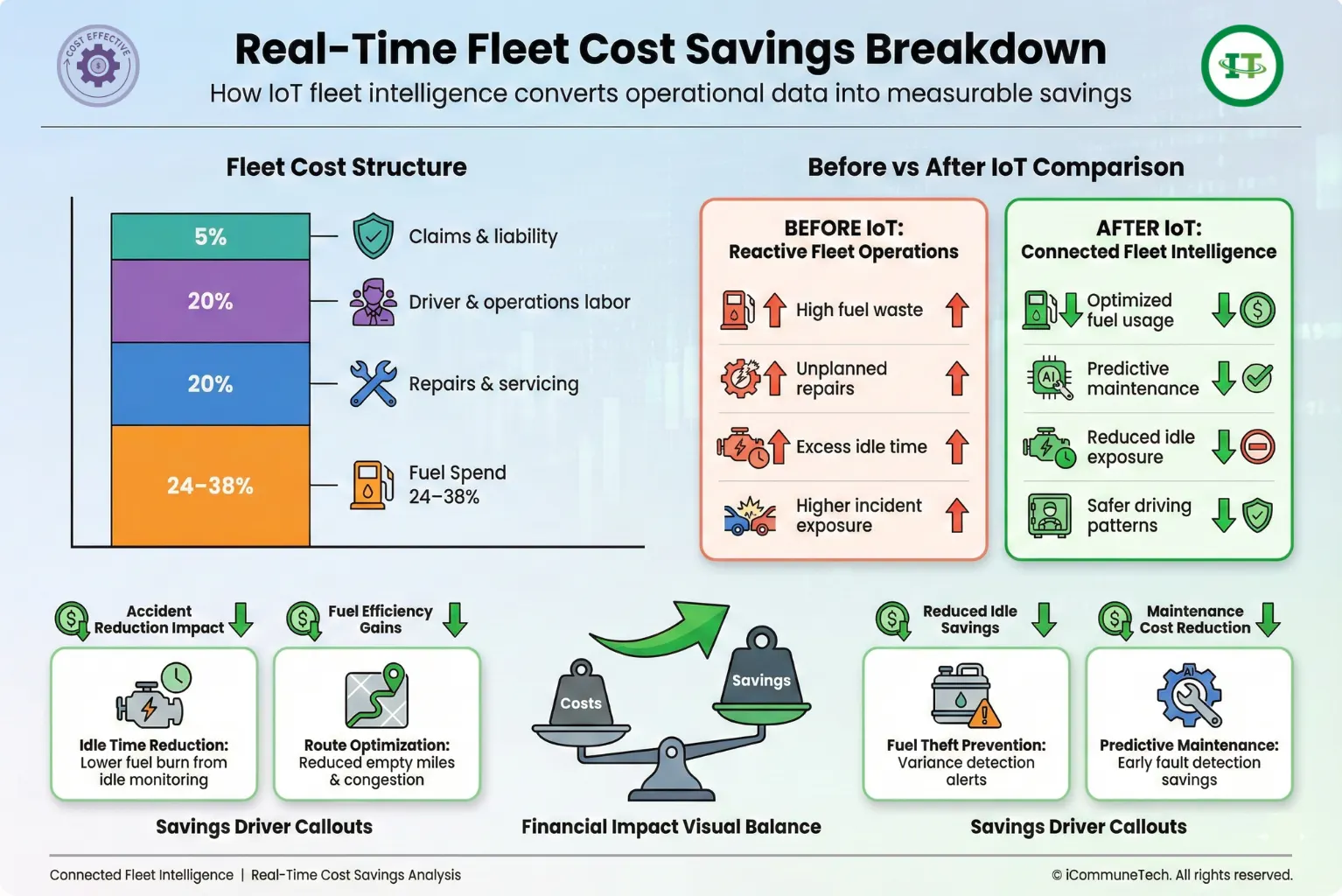
Deloitte reported that logistics firms using IoT-based fleet management systems achieved up to 15% fuel savings while improving delivery accuracy through better visibility and route optimization. These insights forecast fuel waste, route delays, and maintenance risks before service disruption. Alerts and thresholds trigger route changes that reduce idle time and missed delivery windows.
Reducing idle time improves fuel efficiency, and data-led route optimization cuts empty miles and congestion delays. IoT fleet management solutions translate performance metrics into measurable savings aligned with execution goals.
How Does IoT Fleet Management Reduce Fuel Costs and Waste?
Fuel remains one of the largest operating expenses in fleet management. Uncontrolled fuel consumption stems from excessive idling, inefficient routing, route deviations, and unauthorized vehicle usage. Without real-time visibility, these inefficiencies accumulate and directly impact overall operating costs.
Savings result from live traffic inputs, maintenance alerts, and fuel usage thresholds. IoT fleet management captures sensor-level fuel consumption and idle detection data to isolate inefficiencies.
Fuel optimization capabilities include:
- Fuel consumption tracking by vehicle, route, and driver
- Idle detection identifies excess engine runtime
- Behavioral analysis linking acceleration, speed, and routing choices to fuel burn
- Unauthorized usage detection through off-hours movement and route deviations
Fuel theft prevention relies on variance alerts between expected and actual tank levels. AWS IoT Fleet Management ingests fuel telemetry and triggers alerts when consumption deviates from expected patterns.
How Does IoT Fleet Management Optimize Routes During Live Operations?
Static routing models fail when traffic conditions, loads, or delivery windows change during execution. IoT fleet management enables continuous route optimization using live operational inputs.
Dynamic routing capabilities include:
- Real-time traffic inputs that adjust routes during congestion
- Load constraint awareness across vehicle capacity and cargo type
- Delivery window enforcement across multi-stop routes
- Continuous recalculation through TMS engine integration
Live traffic, load, and delivery data trigger route recalculation before congestion delays occur. Telemetry feeds support synchronized routing updates during delays, reducing empty miles and missed windows. AWS IoT fleet management streams live conditions that enable coordinated routing decisions across distributed fleets.
Predictive Maintenance and Vehicle Health Monitoring
Unplanned breakdowns increase downtime, disrupt schedules, and raise repair costs across fleets. IoT fleet management systems capture telemetry from engines and critical components to detect early faults.
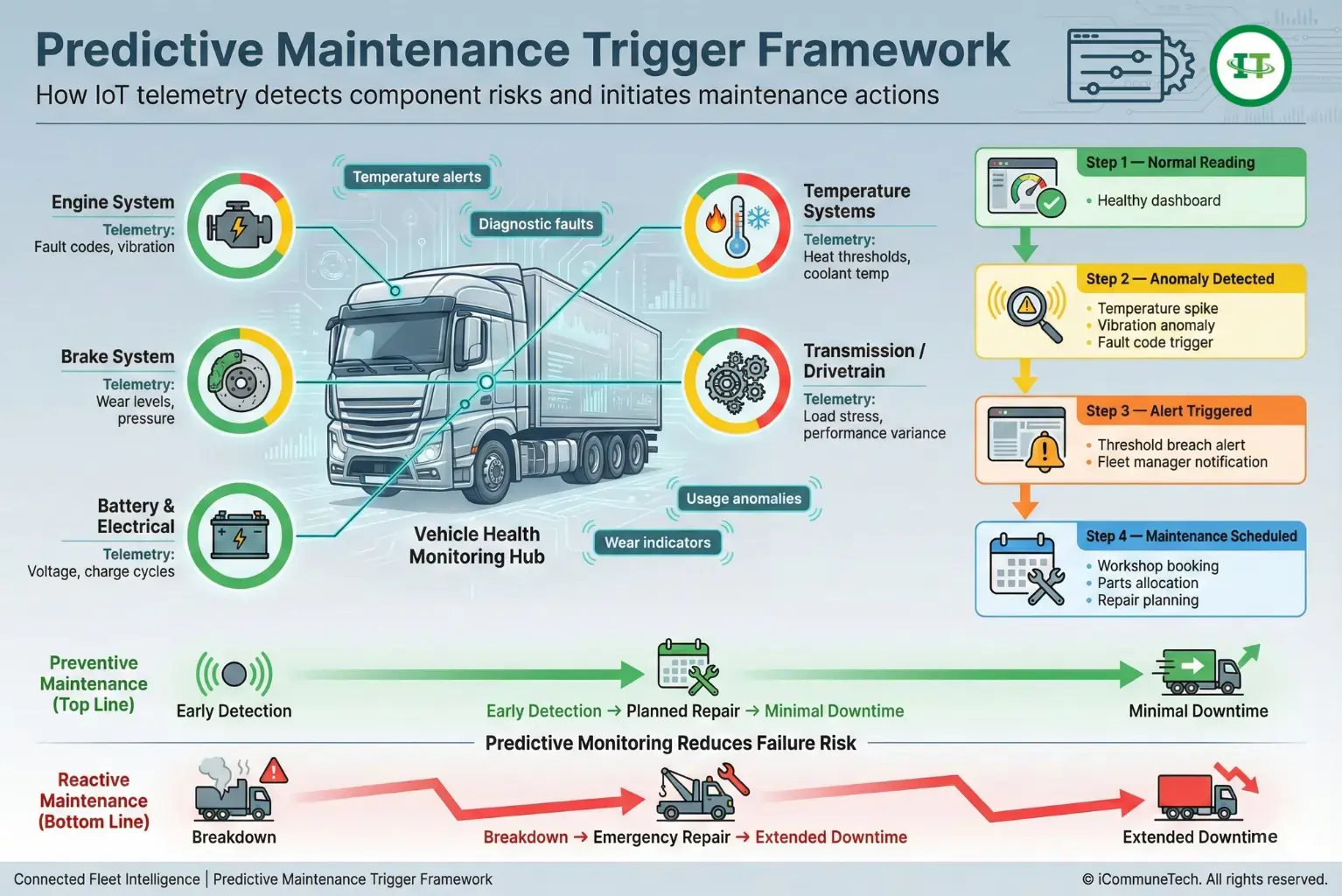
Temperature, vibration, and diagnostic anomalies trigger condition-based maintenance scheduling. Edge AI for fleet monitoring identifies abnormal patterns locally. This reduces response time and minimizes data transmission overhead.
This approach enables predictive maintenance by identifying failure patterns before roadside breakdowns. Early intervention reduces downtime hours and stabilizes service commitments. Temperature, vibration, and fault code anomalies signal failures days before roadside breakdowns.
Planned repairs extend asset lifespan and improve maintenance budget control. AWS IoT fleet management supports secure data processing that scales health insights across mixed vehicle fleets.
Predictive Maintenance Strategies for Fleets
Traditional preventive schedules service vehicles on time, not based on condition. IoT fleet management enables a maintenance strategy built on usage patterns and live telemetry. Maintenance triggers activate when alert thresholds detect anomalies across components.
Predictive Maintenance Approaches
| Strategy Type | Core Mechanism | Operational Benefit |
|---|---|---|
| Usage-Based Servicing | Aligns repairs with actual wear instead of fixed time intervals | Extends component lifespan and reduces unnecessary maintenance costs |
| Condition-Based Maintenance | Uses live telemetry and alert thresholds to identify performance anomalies | Detects issues early and prevents costly breakdowns |
| Historical Fault Pattern Analysis | Leverages fault history to train predictive models for early failure detection | Anticipates component failures and schedules timely interventions |
| IoT-Enabled Maintenance Optimization | Integrates sensor data and machine learning for proactive planning | Shifts operations from reactive repairs to planned interventions, improving maintenance accuracy |
IoT fleet management solutions reduce breakdown risk while improving maintenance planning accuracy and operational reliability.
Using Telemetry to Monitor Engine and Vehicle Health
Telemetry streams engine diagnostics and component signals into analytics pipelines. Algorithms analyze trends across temperature, pressure, and vibration. Fault codes trigger real-time alerts when thresholds break.
Battery and brake monitoring exposes degradation before failures. Vehicle uptime metrics quantify availability by asset. Early alerts enable planned repairs that reduce component wear and unexpected vehicle downtime. Operators act on alerts to prevent roadside events.
Enhancing Driver Safety, Behavior, and Compliance With IoT
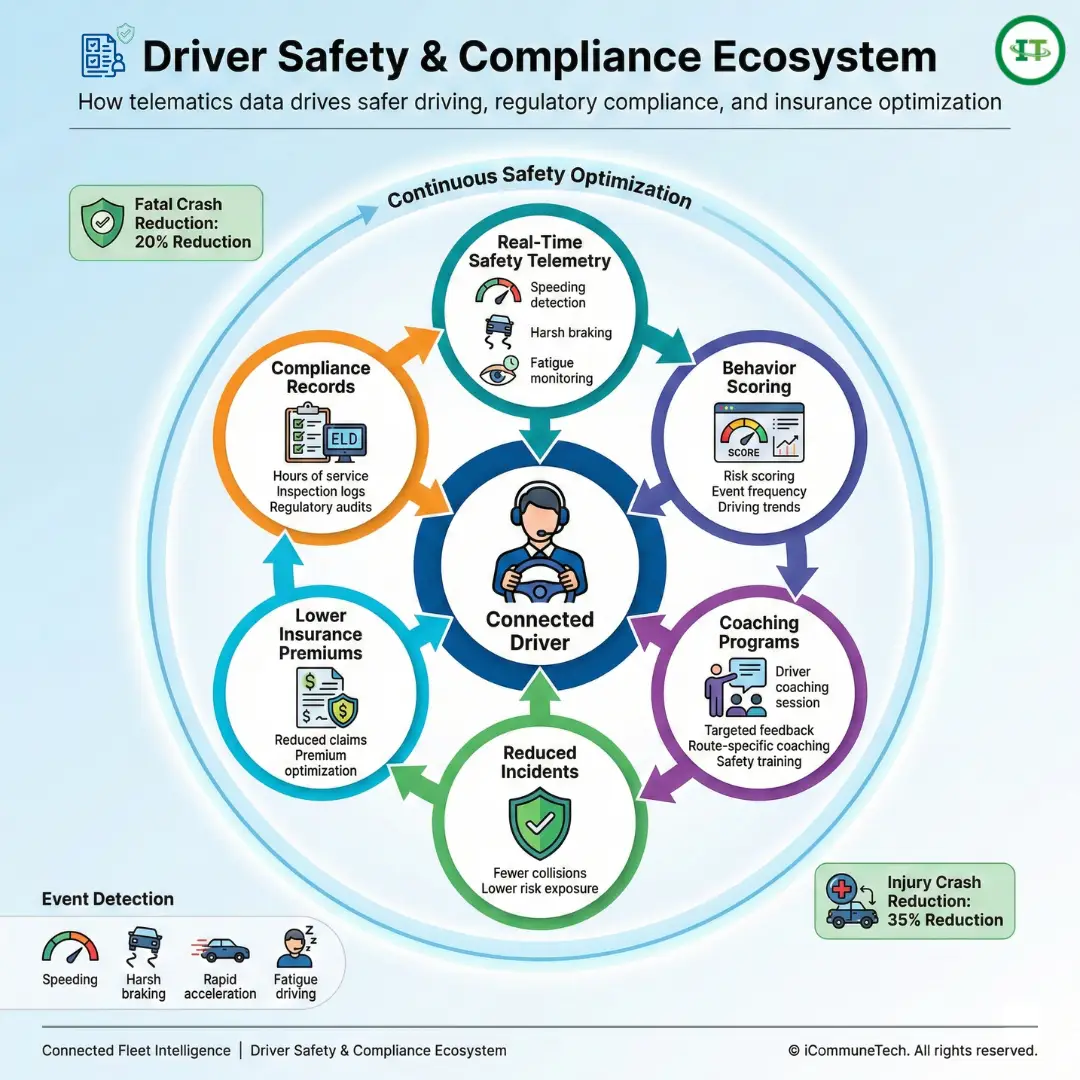
Modern fleets position drivers as data-enabled partners within safety programs. Driver safety improves when objective telemetry replaces manual observation. Video telematics within IoT fleet management reduces fatal crashes by 20% and injury crashes by 35%.
IoT fleet management captures safety metrics such as speeding, harsh braking, and fatigue indicators. Behavior scoring converts events into consistent performance baselines across routes.
IoT compliance tracking validates hours, inspections, and operating limits digitally, eliminating paper logs. Insights support targeted coaching aligned with measurable outcomes. This approach reduces incidents, stabilizes insurance exposure, and maintains regulatory alignment.
Driver Safety Programs Powered by Telematics
Effective safety programs use behavioral data to guide coaching, not enforcement. IoT fleet management captures harsh braking, acceleration, and speeding events during trips. Safety scorecards translate events into consistent performance baselines.
Coaching focuses on repeat patterns tied to routes and schedules. Reduced risk lowers incident frequency and claims exposure. Clear metrics support insurance reviews and liability reduction across fleets.
Maintaining Compliance and Leveraging Insurance Telematics
Effective compliance management relies on automated data capture instead of manual reporting. IoT fleet management records ELD compliance and hours-of-service tracking from vehicle telemetry.
This automation reduces log errors and audit exposure. Telematics data supplies insurance risk scoring models with verified driving and usage patterns. Accurate records support fair premium assessments and claims review. Compliance signals strengthen insurer confidence and lower liability across fleet operations.
How Should Fleets Secure, Govern, and Implement IoT Fleet Management Systems?
Fleets should secure IoT fleet management systems by defining clear ownership and documenting controls for device access and data handling. Programs must establish data ownership across devices, platforms, and integrations to prevent ambiguity and risk.
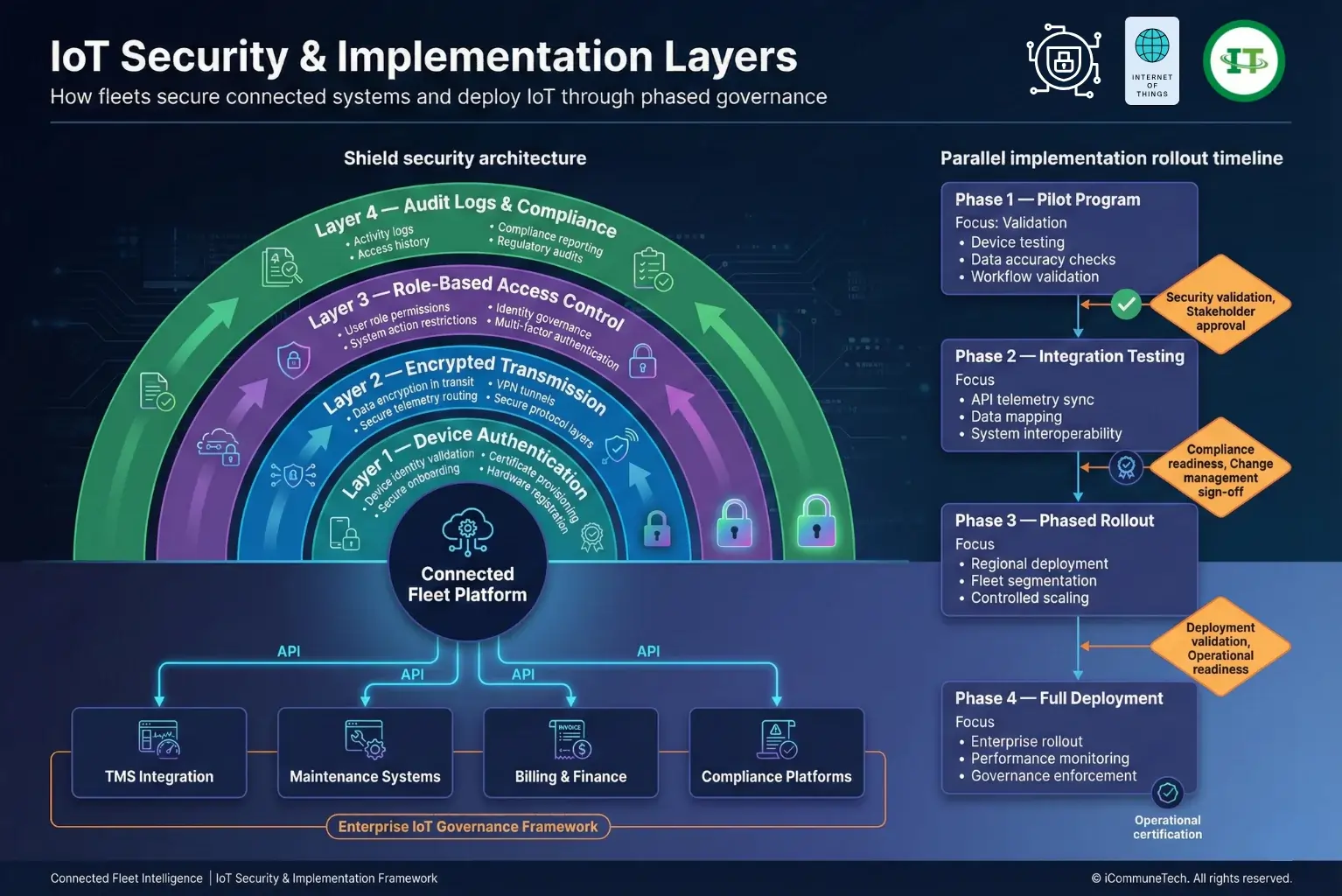
To govern operations, fleets should define access roles, audit logs, and device lifecycle controls. Layered security should enforce identity checks, encrypt data, and monitor traffic across devices and networks.
Implementation should follow a disciplined rollout that phases deployment, validates controls, and aligns stakeholders. This approach reduces data breach risk, audit failures, and unauthorized system access.
How Does IoT Security Protect Devices, Networks, and Access Controls?
Effective IoT security applies layered protection across physical devices and digital systems. The system authenticates each device before allowing any data exchange. Encryption safeguards telemetry as it transmits and during storage.
Role-based access control limits system actions by function and responsibility. Access controls reduce unauthorized device access and data interception risks. Layered safeguards maintain operational integrity across distributed fleet environments.
How Should IoT Be Implemented Across Existing Fleet Operations?
IoT should be implemented across existing fleet operations using a phased rollout that reduces deployment risk while delivering measurable cost and uptime improvements. Fleets should start with pilot programs to validate devices, data quality, and workflows in live environments.
Implementation should integrate telemetry through APIs with existing TMS, maintenance, and billing systems to preserve operational continuity. Historical data should be migrated to support reporting, audits, and continuity.
Successful rollout requires structured change management to prepare teams for new processes, roles, and accountability. Governance checkpoints should confirm readiness before broader deployment to avoid disrupting daily dispatch, compliance, or service commitment.
Advanced Use Cases and Emerging Trends in IoT Fleet Management
Advanced analytics extend fleet data beyond tracking into automation and predictive operational controls. IoT fleet management automates rule-based responses across complex logistics workflows. Automation enables event-based responses without manual intervention during execution.
AI-driven insights analyze patterns across routes, assets, and behaviors to identify operational advantages. AI adoption is accelerating rapidly, with 28% of organizations reporting current usage and another 54% planning implementation within five years, bringing total adoption to 82% by 2029.
Industry-specific scenarios extend value beyond general transport models. Cold chain operations rely on continuous condition monitoring to protect temperature-sensitive shipments.
These trends improve service reliability, reduce risk, and strengthen competitive positioning. Fleets adopting advanced capabilities respond faster to market demands and regulatory change.
Asset Tracking in Cold Chain Logistics and Temperature-Sensitive Shipments
Cold chain logistics require continuous monitoring to protect product integrity during transport. IoT fleet management uses temperature sensors to track conditions across vehicles and containers. Alert thresholds trigger notifications when readings drift outside approved ranges.
These signals enable corrective action before spoilage risk increases. Captured data forms audit trails supporting regulatory compliance and quality verification. Continuous visibility reduces product loss, strengthens accountability, and maintains shipment integrity across temperature-sensitive supply chains.
How Do OTA Updates Support Fleet Software and Autonomous Readiness?
Over-the-air (OTA) management enables remote control of vehicle software without physical access. OTA firmware updates deploy patches, performance improvements, and configuration changes across fleets. Vehicle software management ensures consistent versions and reduces manual service events.
Centralized update control limits operational risk during rollout windows. These capabilities support autonomous readiness by maintaining validated software states. Remote management prepares fleets for evolving mobility models without speculative dependency on full autonomy.
Scalable and Modular Deployment Approaches in IoT Fleet Management
- Modern IoT fleet management frameworks must scale across enterprise and small and mid-sized business (SMB) environments.
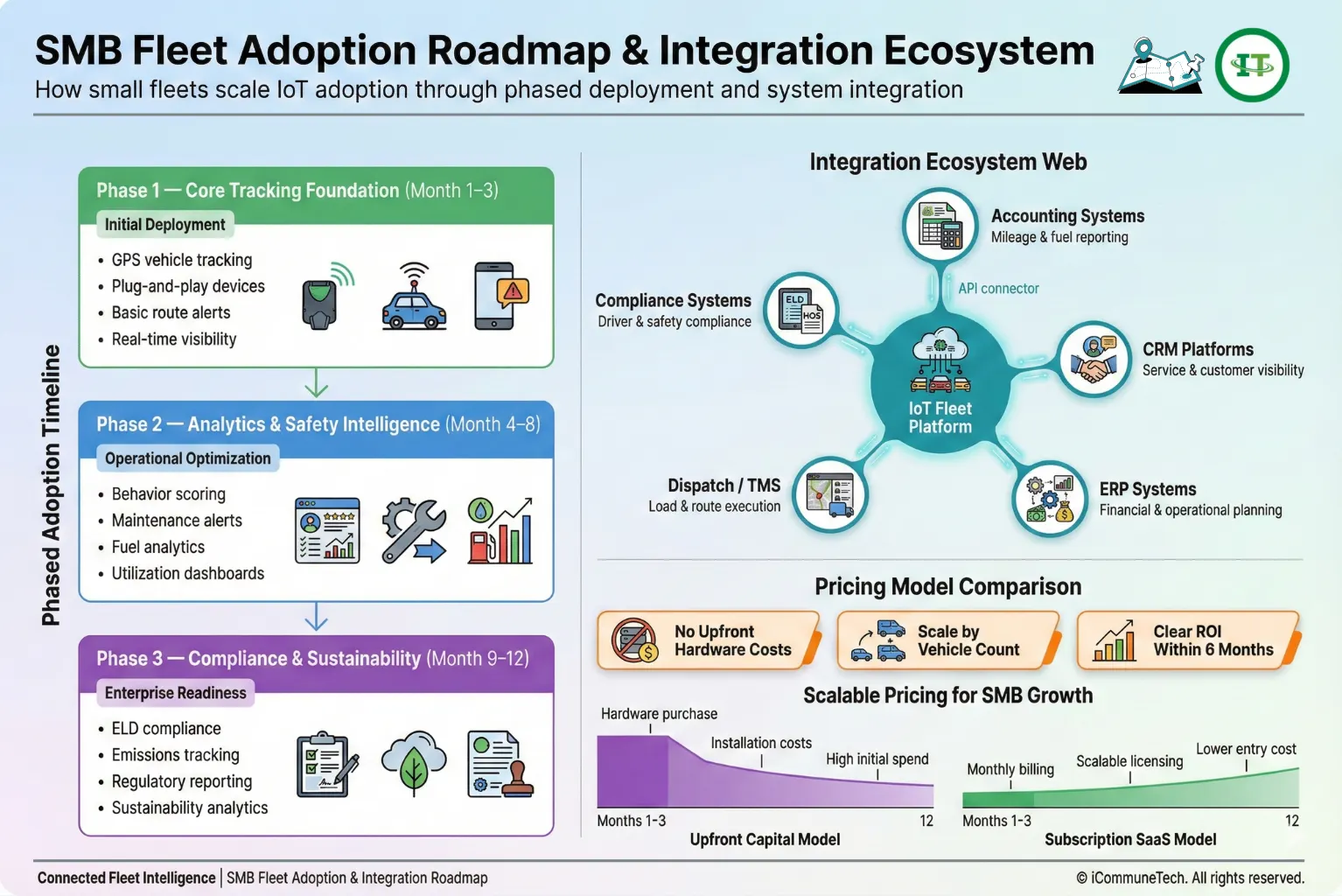
- Modular deployment allows organizations to expand in phases, starting with core tracking and adding analytics, safety, and sustainability.
- This model controls costs while maintaining consistent architecture, governance, and interoperability across fleet sizes.
Affordable IoT Fleet Management Options for Small and Mid-Sized Businesses
Smaller fleets face budget limits and limited technical capacity during technology adoption. IoT fleet management supports SMB enablement through modular features and phased onboarding. Flexible pricing models align costs with vehicle counts and active usage.
Streamlined installation reduces setup time and avoids operational disruption. Cloud-based services lower upfront investment and maintenance overhead. Measured outcomes demonstrate cost efficiency through fuel savings and reduced downtime.
Small and mid-sized fleets benefit from real-time driver tracking that prevents unsafe and unauthorized behaviors. APIs and prebuilt connectors or ready-made system integrations allow scalable integration with accounting, dispatch, and compliance tools. Clear ROI emerges from faster visibility, controlled spend, and predictable expansion paths.
Low-Cost Entry Points for Fleet Tracking and Management
Entry-level fleet deployments prioritize cost accessibility through minimal configurations and plug-and-play devices. Subscription pricing spreads costs across operating months instead of upfront capital investment. CommuteLogix offers publicly documented subscription plans that scale by fleet size, while iCommuneTech provides fleet and logistics software with customized pricing available on request. Core features deliver tracking, alerts, and reporting, with clear upgrade paths to analytics, maintenance, and compliance.
Ensuring Scalability and Simple Integration With Popular SMB Tools
Sustainable growth depends on scalable integration across existing business systems. Modern platforms connect fleet data with popular SMB accounting tools such as QuickBooks and Xero. They also integrate with HubSpot CRM for customer and service workflows and NetSuite ERP for financial and operational management.
Modern platforms connect fleet data with customer relationship management (CRM) and enterprise resource planning (ERP) systems. Accounting tools receive automated mileage, fuel, and cost records for accurate reporting.
Workflow automation reduces manual updates between dispatch, billing, and compliance tasks. This ecosystem compatibility supports expansion as fleet size, routes, and operational complexity increase.
Improving Driver Behavior With IoT-Based Analytics and Coaching
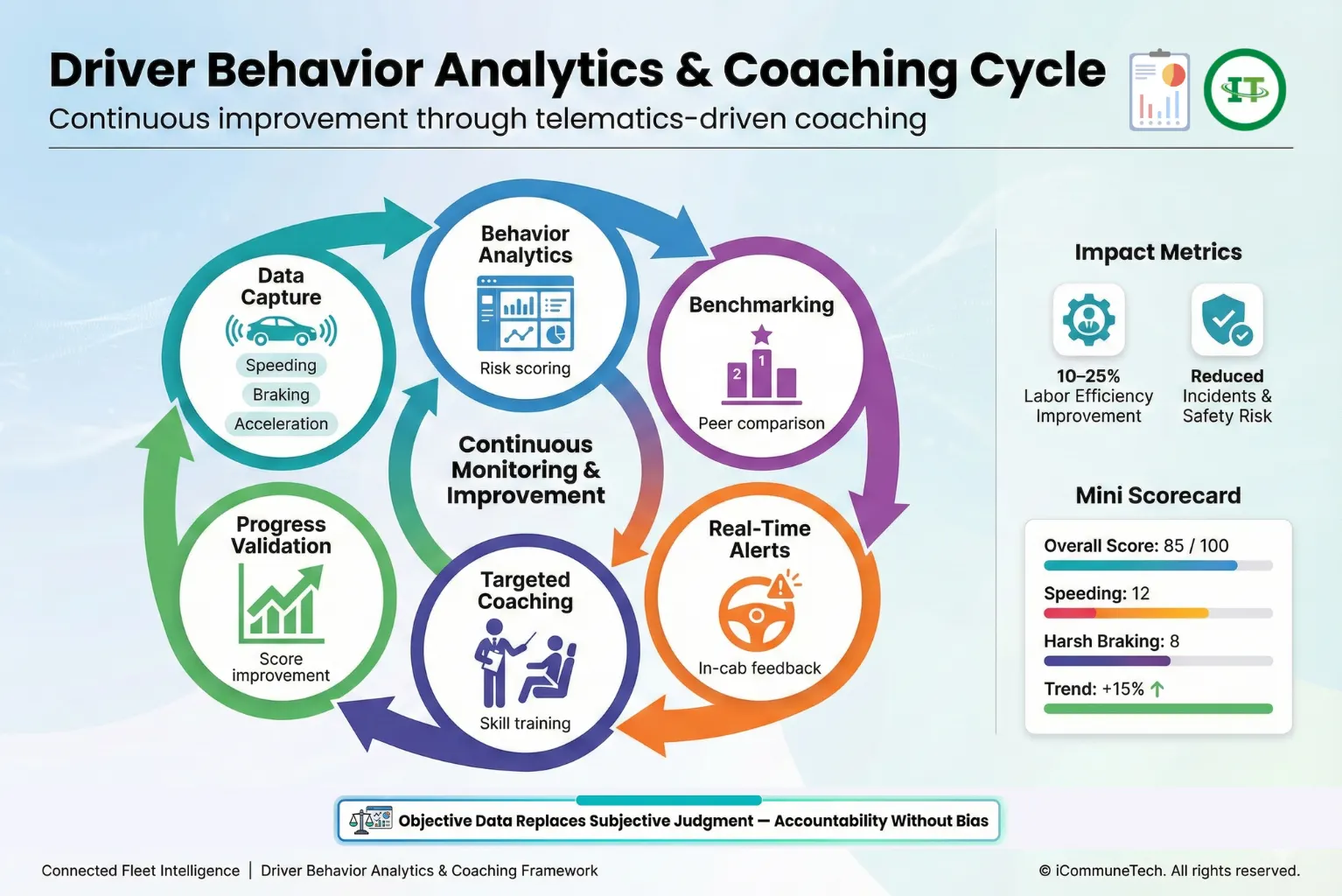
Safer operations depend on continuous improvement cycles grounded in objective data. IoT fleet management enables behavior analytics by capturing driving patterns across routes and conditions. These insights trigger structured coaching workflows focused on specific risk behaviors.
According to McKinsey, data-driven staffing optimization enabled by telematics can reduce overtime costs and increase field-force productivity by 10% or more. Driver feedback delivered through scorecards and alerts reinforces corrective actions during daily operations. Performance benchmarking compares individuals against peer and route baselines.
These benchmarks are powered by connected fleet analytics that unify driver, vehicle, and route data into consistent performance insights. Clear benchmarks establish accountability without subjective judgment. This feedback-driven model improves consistency, reduces incidents, and supports long-term safety outcomes across fleets.
Providing Real-Time Feedback and In-Cab Driver Alerts
In-cab alerts deliver timely driver feedback without distracting attention from the road. Audio and visual alerts activate through event-based triggers such as speeding or harsh braking. These safety nudges reinforce corrective actions while driving.
Design prioritizes clarity, short duration, and minimal cognitive load. Immediate signals prevent repeated behaviors across trips and routes. Event-driven feedback supports safer habits while maintaining focus and situational awareness.
Benchmarking Performance and Tailoring Driver Training
Comparative analytics evaluate driving outcomes across peers, routes, and operating conditions. Performance benchmarking uses driver score comparisons to distinguish consistent behaviors, such as repeated speeding or harsh braking, from isolated one-time events.
Performance tracking measures trends over time using standardized metrics. Training recommendations target specific gaps revealed by comparisons, not generic courses. Focused programs align instruction with risk profiles and role demands. Managers validate progress through repeat scoring and outcome reviews.
Sustainability and Emissions Reduction Through IoT Fleet Optimization
Operational efficiency and environmental performance now intersect across modern logistics networks. IoT fleet management connects execution data with measurable sustainability outcomes. Fuel consumption, idle exposure, and routing efficiency influence carbon output.
Accurate emissions reporting relies on verified telemetry rather than estimates or manual logs. This data supports regulatory alignment across regional and industry standards. Eco-driving insights link acceleration, speed control, and idle behavior to reduced emissions.
Measured improvements demonstrate sustainability impact without sacrificing service performance. Integrated reporting consolidates fuel, distance, and emissions data, strengthening accountability and guiding continuous environmental improvement across fleets.
Accurately Measuring and Reporting Fleet Carbon Emissions
Fleet emissions measurement uses telemetry data captured from fuel use and distance traveled. IoT fleet management applies fuel-based emissions models using verified consumption data. This approach supports emissions reporting aligned with recognized reporting standards.
Automated systems calculate emissions instead of relying on manual record estimates. Consistent data improves comparability across vehicles, routes, and operating periods. Structured reports strengthen audit readiness during regulatory reviews. Reliable emissions data enables accountability across logistics operations while supporting disclosure and compliance requirements.
Eco-Driving and Idle Reduction With IoT Telemetry
Driving behavior influences fuel burn and tailpipe output across daily routes. IoT fleet management captures throttle, braking, speed, and idle signals from vehicle telemetry. These inputs quantify idle time reduction and smooth driving metrics by trip and driver.
Coaching links eco-driving behaviors to measurable emissions savings over time. Targeted feedback reduces unnecessary idling and aggressive maneuvers. Repeat measurements validate improvements and track ongoing progress. Sustained behavior change lowers fuel use while delivering consistent emissions savings across fleets.
Conclusion
Future fleet platforms will reward organizations that design for change, not static efficiency. IoT fleet management will increasingly function as a decision backbone across logistics ecosystems. Scalable data foundations will determine how quickly operations adapt to market pressure.
Teams should assess integration depth, governance maturity, and execution readiness. IoT fleet management solutions will shift toward modular adoption and continuous optimization. Cloud-native approaches like AWS IoT fleet management will support controlled scale and resilience.
Purpose-built custom IoT fleet management solutions will align technology with operational intent. Progress depends on disciplined architecture choices and measurable execution outcomes.
Ready to Operationalize Connected Fleet Intelligence?
iCommunetech helps unify vehicle, driver, and operational data into a single execution layer. Integration preserves existing TMS workflows and operational continuity. Teams gain governed visibility that supports informed decisions across fleet operations.
For structured fleet integration and execution-ready insights, contact us to discuss next steps.

Irshad Pathan

Web Development Expert
Irshad is a senior technical expert at iCommuneTech. He manages the iCommuneTech's Web Development Team, and has hands-on expertise in web development, Laravel development, Logistics, fleet management, and Supply Chain Management. He mentors the in-house team and enjoys describing his experience in words.
Read More Insights By Irshad →