Fleet Telematics: Modern Tracking, Intelligence, and Efficiency for Fleet Management
When fleets lose visibility, costs rise, service slips, and operational control breaks down. Fleet telematics holds strategic importance by collecting real-time vehicle, driver, and asset data for operational decision-making. This data collection helps teams identify delivery issues and fuel cost increases sooner.
Real-time telematics data keeps vehicle status visible during active fleet operations. By centralizing vehicle data, telematics strengthens core fleet management capabilities across routing, maintenance, and monitoring. Telematics replaces manual updates with live insights into routing, service scheduling, and asset utilization.
Fleet managers track route status and vehicle condition without delays. Continuous vehicle data reveals idle time and service risks earlier during daily operations. Telematics improves driver safety through driving event analysis and real-time alerts. These alerts support corrective action before incidents occur.
Fleet operations rely on platforms that differ in features, integrations, and analytics depth. This creates the need for careful vendor comparison. Telematics adoption varies across transportation, construction, utilities, and service fleets.
Industry-specific requirements shape how telematics systems support routing, compliance, and maintenance operations. Modern platforms introduce advanced intelligence through analytics that turn operational data into insights. Strong data governance determines how fleet data remains controlled and protected.
The sections ahead explore telematics systems, providers, features, and data considerations shaping modern fleet operations. Without shared vehicle data, expanding fleets face higher costs, service delays, and reduced operational control.
What Is Fleet Telematics and Why Does It Matter for Modern Fleet Management
Fleet operations struggle when vehicle data stays fragmented across drivers, spreadsheets, and disconnected tools. This pressure drives the adoption of fleet telematics as a centralized system for collecting daily vehicle data. The system combines vehicle sensors, connectivity, and fleet management software into a single operational environment. According to Expert Market[1], telematics is now the most widely used fleet technology, with 83% of fleets employing it.
At its core, telematics fleet management captures location, usage, and condition during vehicle operation. That data supports maintenance, routing, compliance, and cost decisions using real vehicle activity. Manual reports arrive after trips, while system-recorded events provide visibility during routes as conditions change.
Location-only GPS tools leave vehicle condition and driving events unrecorded during active routes. Fleet telematics captures these signals and supports telematics vehicle tracking without constant driver interaction. Managers view movement, idle behavior, and stop duration across the entire fleet.
Maintenance teams receive fault codes before breakdowns disrupt schedules. Fleet management telematics links vehicle behavior to operational decisions across dispatch, service, and asset planning. Linking vehicle behavior to preset conditions reduces downtime, fuel waste, and maintenance reporting gaps.
Modern fleets operate across larger territories with tighter service expectations. Without shared data, scale increases risk rather than profitability. With the right telematics structure, fleet operations gain consistency, accountability, and measurable control.
How Telematics Devices Collect and Transmit Critical Vehicle Data
Modern fleets rely on continuous data capture to maintain operational awareness. This need positions fleet telematics as the technical link between vehicles and management systems. This connection depends on the telematics hardware installed within each vehicle.
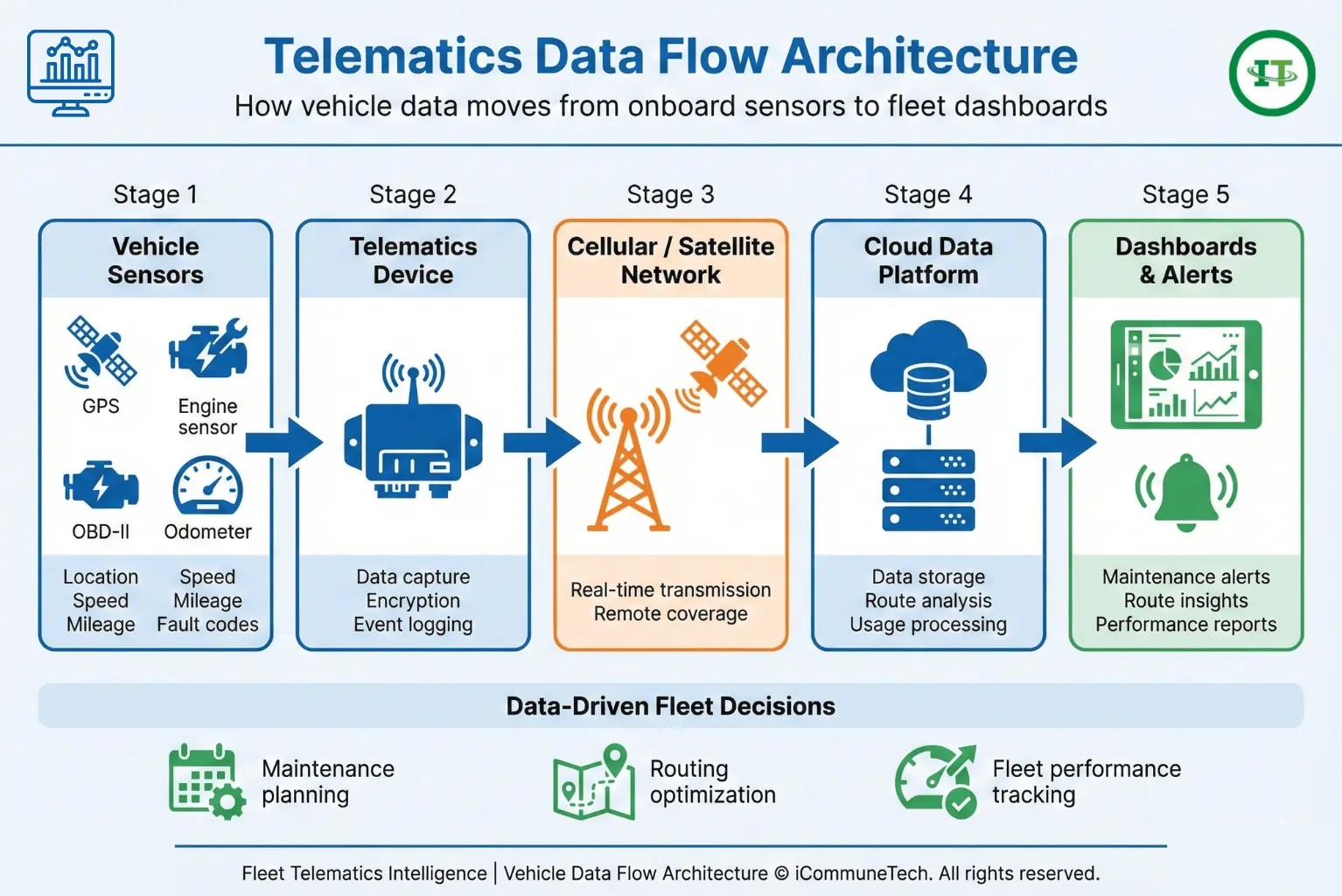
These devices connect to onboard systems that monitor vehicle activity during operation. Core inputs include engine sensors, odometers, GPS modules, and diagnostic interfaces. These sources feed fleet systems with speed, mileage, fault codes, and usage patterns.
Data capture occurs without driver interaction or manual logging. Once captured, information moves through secure transmission channels. Fleet telematics systems rely on cellular networks across standard service areas. Remote routes use satellite connections to maintain data continuity.
Transmission frequency adjusts based on movement, events, and reporting rules. Incoming data flows into cloud platforms built for processing and storage. Telematics tracking converts location signals into route history and dwell analysis. Dashboards convert vehicle data into alerts that trigger maintenance actions and shorten operational response times.
This process generates insights that guide routing, maintenance planning, and fleet performance decisions. Signal quality, update frequency, and device configuration affect data consistency. Effective fleet systems balance data volume with accuracy and response speed. This end-to-end flow turns vehicle activity into actionable inputs for routing, maintenance planning, and fleet performance decisions.
Key Hardware: GPS Devices, Black Boxes, and Vehicle Modems
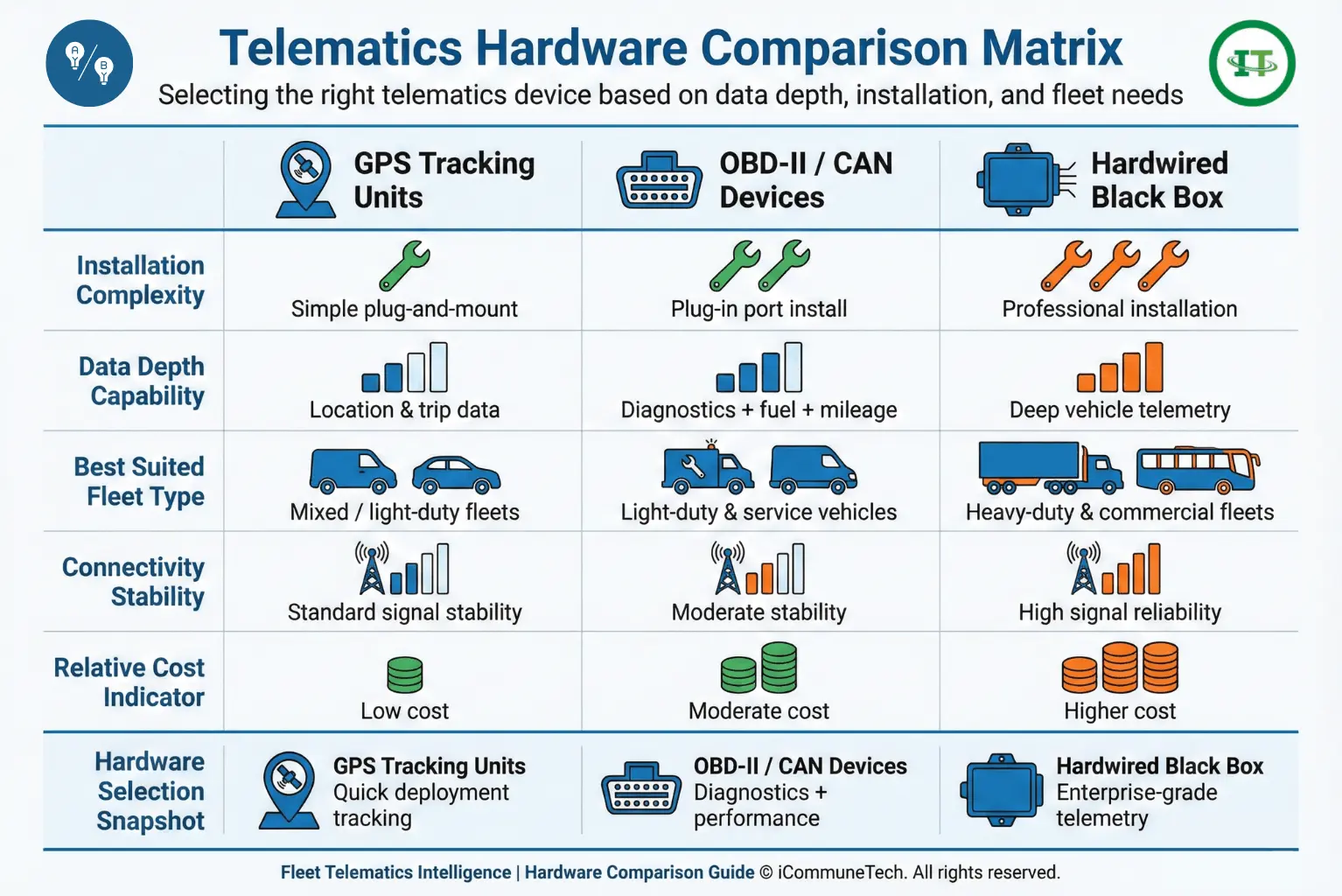
Vehicle hardware forms the data capture layer within fleet telematics deployments. Each device type serves a distinct role based on vehicle type and operational needs. Hardware selection shapes data depth, reliability, and long-term scalability.
GPS tracking units provide location, speed, heading, and trip history. These units support telematics fleet management by recording movement across service routes. Most are installed through dashboards or windshields with external or embedded antennas.
OBD-II and CAN bus devices access vehicle diagnostics and engine data. They connect through factory ports, supporting fast installation across light-duty fleets. Fleet telematics solutions use these devices for fault codes, fuel metrics, and mileage tracking.
Hardwired black box units deliver deeper data access and improved signal stability. Installers connect them to the vehicle’s power and control systems. This approach suits heavy-duty vehicles requiring consistent telematics vehicle tracking and diagnostics.
Vehicle modems transmit data from onboard devices to cloud platforms. They manage connectivity across cellular and satellite networks. Within fleet management telematics, modems ensure data reaches dashboards without interruption.
What Data Telematics Systems Capture and Why It Matters
Operational decisions improve when data reflects real vehicle behavior. This shift places fleet telematics at the center of performance measurement. Systems collect structured data tied to cost, risk, and asset health. Driver behavior metrics quantify speeding, idling, and harsh events to support safety benchmarking and performance improvement.
Location and trip records show route adherence, stop duration, and asset utilization by revealing how often vehicles are active versus idle during service hours. Within telematics fleet management, this data guides dispatch planning and service coverage.
Route history supports proof of service and workload balancing.
Speeding, idling, and harsh events expose driving patterns that affect safety and fuel use. Fleet telematics solutions highlight these events through thresholds and alerts. Supervisors address risk through coaching rather than incident response.
Fuel consumption data links driving behavior and route design to operating cost. This insight supports budget control and emissions tracking. Telematics vehicle tracking adds context by tying fuel use to terrain and traffic.
Engine diagnostics and fault codes signal maintenance needs before breakdowns occur. Planners schedule service based on conditions instead of fixed intervals. Across fleets, fleet management telematics turns raw signals into decisions that protect uptime and control costs.
Industry-Specific Fleet Operations: Telematics for Construction, Utilities, and Public Transit
Operational demands vary by industry, yet data requirements remain consistent across fleet operations. This reality positions fleet telematics as adaptable infrastructure rather than fixed tooling. Platforms adjust to equipment type, operating environment, and regulatory pressure.
Construction fleets rely on mixed assets operating across changing job sites. Equipment tracking confirms location, usage hours, and unauthorized movement risks. Within fleet systems, asset protection supports utilization planning and theft prevention across heavy equipment. Harsh environments require durable devices and stable connectivity.
Utility fleets operate under service restoration requirements and safety mandates. Crews respond during outages, storms, and remote access conditions. Fleet telematics solutions support dispatch visibility, response timing, and compliance documentation. Reliable location data improves crew coordination and public accountability.
Public transit fleets face strict regulatory oversight and fixed service schedules. Vehicle availability and route adherence affect rider trust and funding outcomes. Systems capture mileage, fault codes, and service adherence for reporting requirements.
Across sectors, fleet management telematics aligns technology with industry constraints. This cross-industry use supports consistent data practices across diverse operating models. Telematics integrations align with compliance processes and reduce overlap across existing systems.
Fleet Telematics in Construction: Equipment Tracking and Job Site Asset Protection
Construction sites lose productivity when equipment location and usage remain unclear. This challenge makes fleet telematics valuable beyond on-road vehicles. Systems extend visibility to heavy equipment, trailers, and mobile assets.
Heavy equipment tracking records location, movement, and operating hours. Within telematics fleet management, managers confirm asset presence across multiple job sites. Unauthorized movement outside defined work zones or schedules triggers alerts.
Idle time analysis reveals underused or misallocated equipment. Extended idle increases wear while adding no productive value. Fleet telematics solutions highlight machines running without active work. Using idle time insights, teams rebalance assets to reduce rental costs and ownership overhead.
Job site visibility improves coordination between crews and equipment availability. Supervisors plan work based on verified asset readiness rather than assumptions. Accurate usage data supports project scheduling and cost allocation.
Asset recovery depends on timely location data during theft or misuse. Recovery teams act faster when the last known location and movement history remain available. Across construction fleets, fleet management telematics protects assets, improves utilization, and limits financial loss.
Telematics Applications for Agriculture Equipment, Marine, Aviation, and Public Transportation
Specialized industries demand data beyond standard vehicle movement. These environments position fleet telematics as a configurable system supporting equipment-specific monitoring.
Sensors adapt to terrain, climate, and regulatory exposure.
Agriculture equipment relies on location, engine load, and operating hours. Within telematics fleet management, data tracks field coverage, idle time, and seasonal utilization. Environmental inputs measure temperature, humidity, and soil-related operating conditions.
Marine operations depend on route tracking, engine status, and fuel burn. Salt exposure and signal variability require resilient hardware. Fleet telematics solutions integrate vessel position with weather and engine performance data.
Aviation applications prioritize flight hours, maintenance cycles, and regulatory reporting. Systems record usage metrics tied to safety inspections and service intervals. Specialized compliance data supports audits and operational readiness.
Public transportation fleets track schedule adherence and service reliability. Electric fleet segments are expanding, increasing the need for battery monitoring and vehicle condition visibility. The global automotive IoT market, which includes connected vehicles and telematics systems, is projected to reach around US$274.7 billion in 2025[2]. Environmental monitoring supports emissions reporting and vehicle condition oversight.
Operational dashboards are built by combining vehicle, compliance, and service data from multiple fleet systems. Platform flexibility helps teams manage oversight needs while maintaining continuity as operating conditions change.
Top Fleet Telematics Companies and Platform Comparisons for 2026
Platform comparison evaluates fleet telematics providers based on operational fit, scale support, and industry requirements. Geographic reach affects provider suitability by determining service availability, compliance support, and data coverage across regions. This analysis compares telematics platforms to help fleets select providers aligned with operational scale and service complexity.
| Company | Market positioning | Fleet size suitability | Industry focus | Geographic coverage |
|---|---|---|---|---|
| iCommuneTech | Operations-focused platform designed for visibility, control, and service performance | Small to mid-sized fleets seeking structured operational oversight | Logistics, field services, utilities, and commercial operations | North America with regional scalability |
| Verizon Connect | Enterprise platform with strong compliance, reporting, and administrative depth | Large fleets with complex operational and regulatory requirements | Transportation, utilities, service fleets, and regulated sectors | National and international coverage |
| Trimble | Integrated transportation and vehicle data ecosystem | Large and enterprise fleets | Long-haul trucking, construction, agriculture, and logistics | Global presence across multiple regions |
| Geotab | Data-centric platform emphasizing analytics and third-party integrations | Small to large fleets requiring scalable architecture | Delivery, government, utilities, and mixed fleets | Global with partner-driven expansion |
| Samsara | Cloud-based platform focused on safety, visibility, and operational reporting | Mid-sized to large fleets | Transportation, construction, field services, and warehousing | Primarily North America, with expanding markets |
| Fleet Complete | Flexible platform supporting mixed asset and vehicle environments | Small to mid-sized fleets | Service fleets, the public sector, and construction | Regional and international markets |
Leading Fleet Telematics Providers: Samsara, Geotab, Verizon Connect, and More
Fleet telematics platforms differ in how much vehicle data they collect, scale deployments, and connect with operational systems. This comparison maps providers to specific fleet operating scenarios to support informed platform selection.
| Provider | Core features | Target customers | Known differentiators | Ecosystem or marketplace support |
|---|---|---|---|---|
| iCommuneTech | Vehicle tracking, diagnostics, alerts, and reporting | Small to mid-sized operational fleets | Operations-first design with strong service visibility | Integrates with operational and reporting tools |
| Samsara | Location tracking, cameras, safety alerts, dashboards | Mid-sized and large fleets | Unified safety and operations visibility | Closed but expanding integration ecosystem |
| Geotab | Vehicle data capture, diagnostics, analytics | Public sector, mixed fleets, global operators | Open data access and flexible analytics | Large third-party marketplace |
| Verizon Connect | Dispatch tools, compliance reporting, asset tracking | Large and enterprise fleets | Strong compliance and nationwide coverage | Limited marketplace with enterprise integrations |
| Fleet Complete | Vehicle and asset tracking, reporting tools | Small to mid-sized fleets | Mixed asset support and regional flexibility | Partner-driven integrations |
Samsara vs Geotab vs Verizon Connect: Platform Integration, Data Analytics, and Video Capabilities
Platform differences appear when comparing integrations, analytics sophistication, and the maturity of video telematics capabilities. This table shows how providers support integrations, analytics, and video needs across different fleet sizes.
| Provider | Integration capabilities | Analytics depth | Video telematics support | Scalability and customization |
|---|---|---|---|---|
| iCommuneTech | Integrates vehicle data with operational and reporting systems | Focuses on actionable operational metrics and performance tracking | Supports video data through compatible hardware and platform workflows | Configurable for small to mid-sized fleets with evolving requirements |
| Samsara | Native integrations across sensors, cameras, and dashboards | Event-based analytics tied to safety and utilization | Built-in video capture with event review and alerting | Scales across large fleets with standardized configurations |
| Geotab | Open APIs and a broad third-party marketplace | Advanced analytics with customizable reports and datasets | Video supported through partner hardware integrations | High flexibility for global fleets and complex data models |
| Verizon Connect | Structured integrations with enterprise and compliance systems | Strong reporting for compliance, dispatch, and asset usage | Video available through approved camera solutions | Designed for large fleets with centralized governance |
Fleet Telematics vs GPS Tracking, ELD Systems, and Asset Tracking
| Capability | Fleet telematics | GPS-only tracking | ELD-focused systems | Standalone asset tracking |
|---|---|---|---|---|
| Primary purpose | End-to-end operational oversight | Location visibility only | Regulatory compliance | Asset location and recovery |
| Location tracking | Real-time and historical with context | Real-time and basic history | Included for compliance logs | Real-time, limited context |
| Vehicle diagnostics | Engine data, fault codes, mileage | Not available | Limited or unavailable | Not available |
| Driver behavior data | Speeding, idling, and harsh events | Not available | Limited to driving time | Not available |
| Maintenance support | Condition-based and predictive | Not supported | Not supported | Not supported |
| Fuel and cost insights | Consumption, idling efficiency | Not supported | Not supported | Not supported |
| Compliance coverage | Safety, inspections, reporting support | Not supported | HOS and mandate-focused | Not supported |
| Asset visibility | Vehicles and connected equipment | Vehicles only | Vehicles only | Equipment and trailers |
| Operational decision support | Dispatch, planning, performance control | Minimal | Compliance-driven | Theft and utilization checks |
| Best suited for | Fleets managing vehicles, drivers, and service outcomes | Fleets needing basic visibility | Regulated fleets meeting mandates | Fleets protecting non-powered assets |
Core Features of Fleet Telematics Systems: Tracking, Maintenance, and Fuel Management
Operational value depends on converting vehicle data into cost control, uptime improvement, and service reliability gains. These capabilities align with core fleet management system features used for daily operational control. These features support cost governance and service reliability by reducing manual oversight and unplanned operational disruptions.
Real-time tracking forms the foundation of telematics by showing vehicle location, status, and utilization. Live views improve dispatch accuracy by confirming real-time vehicle positions. They also highlight service exceptions such as late arrivals, missed stops, and unexpected service delays. Real-time visibility reduces missed stops and delays by alerting teams to route deviations. These deviations may result from traffic congestion, weather conditions, vehicle issues, or forced re-routing.
Predictive maintenance uses vehicle data to schedule service before breakdowns, replacing reactive repair cycles. Sensors capture fault codes, mileage, and engine trends to inform service scheduling and maintenance prioritization. Fleet telematics schedules service early, reducing roadside breakdowns, emergency labor costs, and vehicle downtime. Uptime improves because planned maintenance prevents breakdowns that trigger emergency repairs and roadside incidents.
Fuel optimization targets fuel spend, one of the highest variable costs in fleet operations. Systems measure consumption and driving behavior to identify waste patterns that managers can actively correct. Managers correct waste by adjusting routes, idling behavior, and driving habits using measured fuel data. Savings accumulate gradually across routes and vehicles through reduced idling, optimized routing, and controlled driving behavior.
Operational efficiency improves as unified routing, maintenance, and fuel data removes planning conflicts and duplicate decisions. Maintenance planning aligns with actual vehicle condition and usage patterns. Across fleets, telematics supports ROI by lowering fuel waste, reducing breakdowns, and extending vehicle service availability.
While features define platform capability, the benefits of a fleet management system
become clear when outcomes improve operational predictability. Aligned tracking, maintenance, and fuel controls improve safety and compliance by standardizing decisions across fleet operations. These gains occur without added overhead as automation replaces manual tracking and fragmented decision processes.
Fleet Telematics Pricing, Cost Structure, and ROI Expectations
Fleet telematics pricing includes hardware, software access, connectivity, and support costs such as onboarding, technical assistance, and system maintenance. Fleet telematics pricing becomes critical as costs scale with vehicle count and feature usage like video monitoring and analytics. Understanding cost structure helps fleets align investment by matching features to fuel savings, uptime gains, and incident reduction.
Fleet telematics pricing models typically follow per-vehicle monthly subscriptions, with costs influenced by hardware, software access, and data frequency. Most telematics fleet management platforms follow per-vehicle monthly subscriptions. Costs change with asset type, feature depth, and integration requirements. Upfront expenses may include devices, installation, and onboarding support.
Ongoing costs relate to connectivity, analytics access, and platform support. Fleet telematics solutions scale costs predictably as fleets add vehicles or features. This structure supports budgeting without long-term capital lock-in.
ROI emerges through fuel savings, fewer breakdowns, and reduced incident exposure driven by data-based operational controls. Idle reduction and preventive maintenance drive early returns by lowering fuel spend and avoiding emergency repair costs. Many fleets recover investment within months by reducing fuel waste, emergency repairs, and unplanned vehicle downtime.
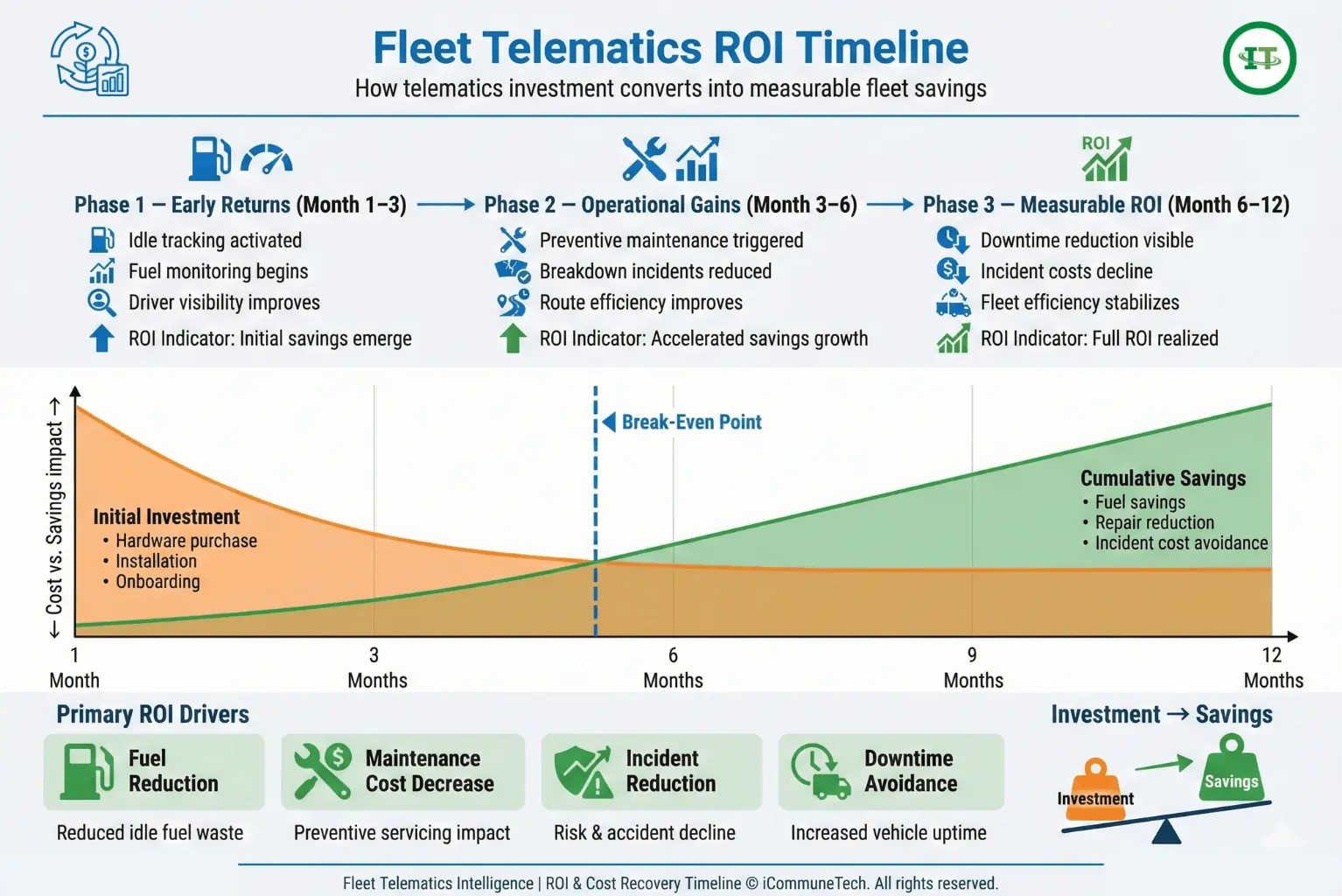
Safety improvements reduce insurance and liability claims by identifying risky driving behaviors before incidents occur. During scheduled service intervals, planned maintenance reduces unplanned repairs and keeps vehicles in service longer across high-usage fleets.
Real-Time GPS and Vehicle Tracking for Fleet Visibility
Operational fleet decisions depend on knowing vehicle location and movement during active service execution. Fleet telematics refers to systems that collect vehicle location and movement data for real-time fleet oversight. Accurate location data replaces manual status checks, helping reduce dispatcher workload and response delays during active routes. 29% of operators cite real-time vehicle location[3] as the primary benefit of fleet tracking.
Live GPS feeds support dispatch decisions by confirming vehicle availability and position during time-sensitive routes. Within telematics fleet management systems, teams reroute vehicles around congestion and service delays using live data. Dispatchers assign nearby assets as real-time tracking confirms vehicle proximity and current availability.
Fleet telematics solutions improve route planning by comparing planned routes against continuous vehicle movement data. Systems compare planned routes against actual travel patterns to identify inefficiencies affecting delivery timing. Managers adjust schedules using dwell time insights to reduce delays and missed service windows.
Geofencing uses virtual boundaries to trigger alerts when vehicles enter or exit predefined locations. These alerts notify teams immediately when vehicles cross defined operational or service boundaries. This capability supports service validation by confirming vehicle presence at required locations.
Historical trip replay strengthens accountability by allowing supervisors to review completed routes and deviations. These patterns reveal delays and idle clusters that teams can address through scheduling and routing adjustments. Consistent vehicle tracking supports faster decisions by providing reliable location data during daily operations. Across fleets, fleet management telematics converts location data into clearer dispatch, routing, and service decisions.
Maintenance Management with Telematics: Proactive Alerts and Diagnostics
Unplanned breakdowns disrupt schedules and inflate repair costs. Preventive maintenance uses vehicle condition data to schedule service before breakdowns disrupt operations. Systems monitor vehicle health during operation to detect issues before failures cause downtime.
Engine fault codes provide early signals that maintenance teams can address before component damage escalates. Technicians address problems early because alerts highlight issues before vehicles become inoperable.
Service reminders replace fixed schedules with condition-based triggers. Mileage, engine hours, and usage patterns determine service timing. Fleet telematics solutions help reduce unnecessary shop visits while maintaining equipment condition.
Preventive maintenance scheduling improves fleet availability by reducing unplanned repairs and roadside breakdowns. Planners coordinate service windows around route demand and asset usage. This approach lowers roadside incidents by aligning maintenance timing with actual vehicle usage patterns.
Asset lifespan extends because timely maintenance prevents accelerated wear and component failure. Wear patterns stabilize across engines, brakes, and drivetrains. With reliable diagnostics, fleet management telematics shifts maintenance from repair to preservation and asset longevity.
Fuel Management: How Telematics Helps Slash Fleet Fuel Costs
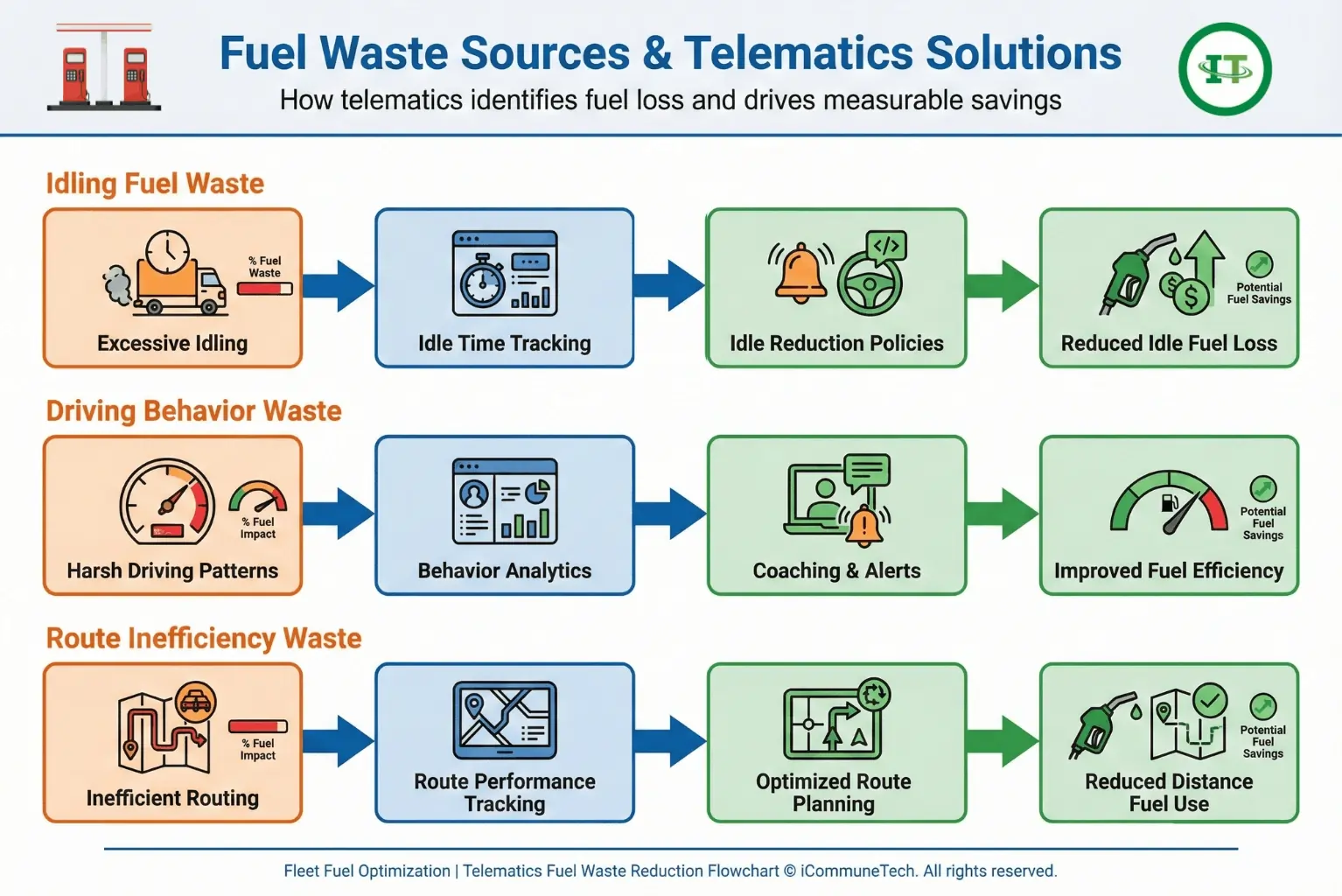
Fuel expense ranks among the largest variable fleet costs. Fleet telematics supports fuel control by linking driving behavior, routing decisions, and vehicle condition to consumption. Systems link driving behavior and routing data to fuel consumption to identify controllable inefficiencies. Idling analysis identifies wasted fuel during stops and dwell time. Within telematics fleet management, reports show idle duration by vehicle and route.
Reducing idle time can lower fuel spend across daily operations by limiting wasted consumption. Speed and acceleration tracking expose inefficient driving patterns. Rapid acceleration and sustained speeding increase consumption and engine wear. Fleet telematics solutions flag these events for targeted coaching.
Behavior adjustments reduce fuel use by limiting idling, speeding, and inefficient acceleration patterns. Route efficiency analysis compares planned paths against actual travel. Detours, congestion, and poor sequencing inflate fuel use. Systems recommend adjustments based on distance, traffic, and stop density.
Fuel reporting dashboards consolidate usage, trends, and outliers. Managers review cost per mile across vehicles and service areas. Accurate reporting supports fuel savings by improving visibility into cost drivers and usage patterns.
Enhancing Driver Safety and Behavior Monitoring with Telematics
Safety programs lose effectiveness when monitoring data feels punitive rather than corrective. Fleet telematics supports risk awareness by identifying unsafe driving patterns through objective vehicle data. Effective systems preserve driver trust by using data for coaching rather than punitive enforcement. Industry data shows that 27% of respondents[4] identify improved driver safety and behavior as a key benefit of telematics systems.
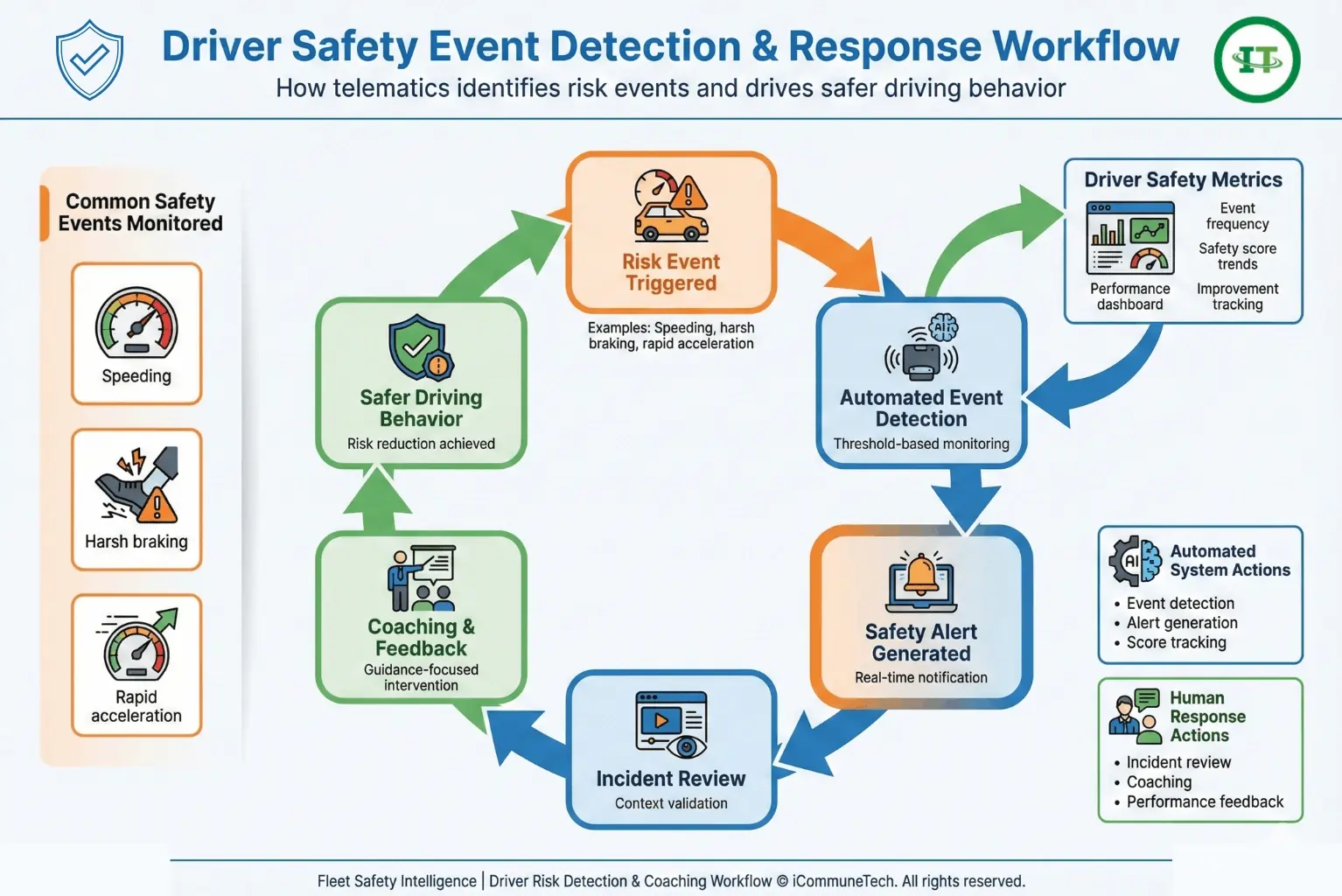
Risk detection begins with automated event capture from vehicle sensors during operation. Harsh braking, rapid acceleration, speeding, and sharp turns signal increased exposure to safety incidents and collision risk. Behavior monitoring tracks repeated driving events to identify risk trends instead of isolated incidents. Managers identify risk trends across routes, vehicles, and operating conditions.
Coaching programs convert operational data into measurable driving improvement. Drivers receive feedback tied to specific events and outcomes. Fleet telematics solutions support scorecards, trend views, and coaching workflows. This structure promotes accountability because drivers receive consistent feedback tied to measurable safety events.
Safety improvements extend beyond incident reduction alone. Insurers recognize documented behavior improvement and reduced claims frequency. Lower risk profiles influence premiums and renewal terms over time. Compliance teams rely on consistent records during audits and investigations.
Dash cameras expand visibility during safety events and disputed incidents. Video Telematics combines dash camera footage with vehicle data to explain incidents and driving behavior. Clear data-use policies shape how drivers perceive monitoring programs. Applied transparently, telematics limits organizational risk by improving driver behavior and documenting incident context.
Driver Safety: Monitoring and Reducing Risky Behaviors
Risk exposure increases when unsafe driving patterns go unnoticed. This reality makes fleet telematics essential for structured safety oversight. Systems measure behavior through objective event data rather than subjective observation.
Speeding remains a leading contributor to collisions and liability claims. Within telematics fleet management, speed events trigger thresholds based on road context. Managers address repeat violations through coaching instead of discipline.
Fleet telematics solutions highlight recurring driving patterns across routes and drivers. Harsh braking and rapid acceleration appear more within these patterns, contributing over time to increased component wear. Targeted feedback reduces incident frequency and maintenance expense.
Seatbelt usage data supports compliance and injury prevention. Exceptions highlight training gaps or policy enforcement needs. Consistent monitoring strengthens audit readiness and risk reporting.
Driver scorecards consolidate safety metrics into clear performance views. Scores track improvement across weeks and service cycles. With transparent metrics, fleet management telematics links safer driving to lower claims, reduced liability, and controlled operating costs.
Cameras and Video: Integrated Dash Cams for Fleet Safety and Compliance
Video systems add context when incident data alone lacks clarity. Fleet telematics supports visual evidence by linking video footage directly to vehicle and event data. Cameras activate when fleets require documented accountability and risk validation.
Forward-facing cameras capture road conditions, traffic behavior, and external events. Dual-facing units record both roadway activity and in-cab behavior. Within telematics fleet management, this coverage balances incident review with driver protection.
AI-based event detection flags collisions, harsh maneuvers, and near misses. Systems trigger recordings based on predefined thresholds. Fleet telematics solutions limit video review to relevant events, reducing oversight burden.
Incident review workflows support fair and efficient investigation. Managers access timestamped clips linked to vehicle data. This linkage clarifies fault, accelerates claims handling, and reduces dispute resolution time.
Video records support regulatory and insurance compliance. Evidence strengthens defense against false claims and liability exposure. When deployed with a clear policy, fleet management telematics uses video to protect drivers, validate incidents, and reinforce safety standards.
AI, Analytics, and System Integration: Next-Generation Capabilities in Fleet Telematics
Data volume increases as fleets scale across vehicles, assets, and operating regions. This shift places fleet telematics on a path toward advanced analysis and automation. AI in fleet management supports this shift by processing large data sets quickly. These systems identify patterns that manual review cannot maintain at scale.
The objective focuses on converting operational data into forward-looking decisions. Predictive analytics identify patterns across maintenance, safety, and utilization records. Within fleet systems, actionable analytics forecast component wear and service risk. Planners act before failures disrupt schedules or increase repair costs.
Automation reduces manual oversight across recurring operational processes. A further 44%[5] of fleets plan expanded telematics data usage within three years. This trend signals rising demand for connected insights and automated decision support. AI-driven rules trigger work orders, route adjustments, and compliance actions without human intervention.
Fleet telematics solutions streamline workflows tied to vehicle status and behavior data. System integration connects telematics data with dispatch, payroll, and maintenance platforms. Shared intelligence removes data silos between operational teams. Telematics vehicle tracking gains value when connected to scheduling and service systems.
Shared fleet data helps teams align decisions during planning and operational reviews.
Applied analytics support consistent decisions across maintenance, safety, and utilization planning.
Data Analytics: Transforming Telematics Data into Actionable Fleet Intelligence
Raw data holds limited value without structured interpretation. This challenge positions fleet telematics analytics as a decision-support layer. Systems convert high-volume inputs into prioritized operational signals.
Dashboards present key metrics in consistent formats. Within telematics fleet management, teams track utilization, safety events, and maintenance status. Clear layouts reduce time spent searching for relevant information.
Patterns emerge during reviews of route performance, driver activity, and service history. Repeated behaviors can indicate inefficiencies or developing risks over time. Fleet telematics solutions support these comparisons using historical operating data.
Patterns become visible when route performance, driver activity, and service history are reviewed over time. During scheduled route and maintenance reviews, recurring driving or service patterns identify process gaps or early warning signs. Fleet telematics solutions support these comparisons by organizing historical data across defined time periods.
Performance benchmarks establish measurable standards across the fleet. Vehicles, routes, and drivers are compared against defined baselines. With consistent analytics, fleet management telematics supports informed decisions that improve reliability, cost control, and operational accountability.
Fleet Management Integration and Custom Telematics Solutions
Disconnected systems slow decisions and increase manual workload. This reality positions fleet telematics as a unifying data layer across operations. Integration determines whether insights scale or remain isolated.
Enterprise resource planning (ERP) and Transport Management System (TMS) integration links vehicle activity with financial and logistics systems. Within telematics fleet management, mileage, labor hours, and service data flow. Teams reduce duplicate entry and reporting delays.
Open APIs enable secure data exchange across platforms. Developers connect telematics data with scheduling, maintenance, and compliance tools. Fleet telematics solutions support modular expansion, allowing teams to add features such as maintenance, safety, or compliance workflows without replacing the core platform.
Custom workflows align data flow with operational processes. Triggers launch work orders, alerts, or approvals based on defined conditions. This flexibility supports region-specific rules and asset types.
Automation triggers reduce response time across routine events. Fault codes generate service tickets without manual review. Geofence events update job status and customer notifications. Fleet management telematics scales with operational growth and increasing complexity while avoiding major changes to core systems.
Fleet Telematics Data Ownership: Who Controls Your Fleet’s Information?
Control over operational data influences compliance, flexibility, and vendor risk. These concerns place fleet telematics data ownership within strategic planning discussions. Clear governance reduces exposure across legal, operational, and commercial boundaries.
Data ownership defines who holds rights to collect, store, and use vehicle information. Within telematics fleet management, fleet operators retain ownership of generated data. Service providers function as custodians responsible for processing and secure storage.
Data retention and deletion expectations are defined during vendor contract reviews, alongside limits on reuse and external disclosure. These terms govern how fleet data is accessed and shared, shaping how telematics platforms handle aggregation and secondary usage. Clarity here protects long-term operational independence.
Access rights determine who can view, export, and integrate fleet data. Role-based controls restrict access across drivers, managers, and external partners. APIs govern how data moves into payroll, maintenance, or dispatch systems.
With defined ownership and access controls, fleet management telematics supports transparency, compliance readiness, and informed decision-making without surrendering control of critical operational information.
Data Rights in Telematics Contracts: Retaining Control and Avoiding Hidden Risks
Contract terms shape how operational data gets used and retained. This reality makes fleet telematics agreements a governance concern, not a technical detail. Clear rights protect long-term operational flexibility.
Data portability defines whether information can move between systems. Within telematics fleet management, export rights support platform changes or system upgrades. Contracts should specify formats, timelines, and access methods.
Vendor lock-in emerges when data access becomes restricted through limited export options or proprietary data formats. Limited exports or proprietary formats increase switching costs. Fleet telematics solutions should allow full data retrieval without service disruption.
Compliance and privacy obligations extend beyond the platform provider. Regulations govern driver data, location records, and retention practices. Agreements must define responsibility for compliance failures and breach response.
Access controls determine who can view or share sensitive records. Role-based permissions limit exposure across internal and external users. With defined rights and safeguards, fleet management telematics supports transparency, compliance, and informed contract decisions without creating hidden operational risk.
Monetizing Fleet Telematics Data: Opportunities and Cautions
Operational data creates value beyond internal use when handled responsibly. This potential places fleet telematics data monetization within strategic evaluation. Opportunities exist through aggregated insights, benchmarking services, and data-driven planning, yet controls remain essential.
Aggregated insights offer value without exposing individual fleet activity. Trends across regions, vehicle classes, or usage patterns inform planning and benchmarking. Within telematics fleet management, aggregation reduces competitive and privacy risk by removing fleet-level identifiers and individual activity traces.
Insurers, planners, and service providers use shared fleet data during reviews to inform pricing, risk evaluation, and infrastructure planning. Fleet telematics solutions may facilitate these exchanges through anonymized datasets.
Privacy safeguards define acceptable data use boundaries. Personal identifiers and precise location records require strict protection. Consent frameworks and anonymization reduce exposure across stakeholders.
Regulatory constraints govern how data may be shared or commercialized. Jurisdictions impose limits on data retention, cross-border transfer, and secondary use for commercial purposes. Organizations must assess compliance obligations before pursuing revenue models.
With measured governance, fleet management telematics supports ethical data use.
Balanced approaches protect trust while enabling responsible value creation from operational intelligence.
Conclusion
Fleet operations have reached a point where reactive management no longer keeps pace with scale. As vehicles, assets, and service demands grow, timely and accurate data becomes a baseline requirement.
That data is essential for maintaining operational control. Fleet telematics as an operational intelligence layer gains sharper cost oversight. They adapt to change with less friction across daily operations.
Future performance depends on how effectively data connects dispatch, maintenance, safety, and compliance. Strategic system integration supports this connection across teams. Clear data ownership and focused analytics define resilience amid regulatory pressure and operational complexity.
Looking for Greater Control, Lower Operating Costs, and Safer Fleet Operations?
See how iCommuneTech centralizes fleet data to improve visibility and decision-making across operations, without disrupting existing workflows.
For clearer fleet visibility and control, contact us for next steps.