Fleet Management Trends Shaping the Future of Transportation
Fleet management trends show how software platforms, data, and automation are reshaping fleet control cost, compliance, safety, and asset performance. Modern fleet operations now depend on connected systems that link vehicles, drivers, and operations teams through shared data rather than manual processes and disconnected tools.
The fleet management software market was valued at USD 32.36 billion in 2025 and is projected to reach USD 152.89 billion by 2034[1]. These systems provide visibility into vehicle usage, operating cost, emissions, and service performance, which supports better decision-making at scale.
Sustainability targets, regulatory disclosure, and rising operating costs are pushing fleets to rely on analytics and automation instead of manual tracking. Data-driven fleet management platforms help reduce fuel spend, improve uptime, control emissions, and maintain compliance across large and distributed fleets.
In this blog, the major fleet management trends are explained across technology, sustainability, operations, and workforce management to help fleet leaders make better platform and investment decisions in a changing transportation environment.
How Is Technology Transforming Fleet Management Operations?
Technology like fleet management software is transforming fleet management operations by shifting operations from reactive to proactive, data-driven, and connected systems.
Commercial vehicles represent about 85% of fleet management demand[2], where optimization and analytics generate a strong ROI. Vehicle tracking and automated scheduling give fleets real-time operational control across routes and assets. This improves utilization accuracy, reduces delays, and supports consistent compliance execution.
This shift defines SaaS feature requirements, including real-time analytics, workflow automation, and scalable integrations. Product managers, CTOs, and fleet operators use technology-to-feature alignment to guide platform selection. This approach supports effective deployment across mixed fleets and diverse regulatory environments.
How Does Big Data Improve Fleet Decision-Making?
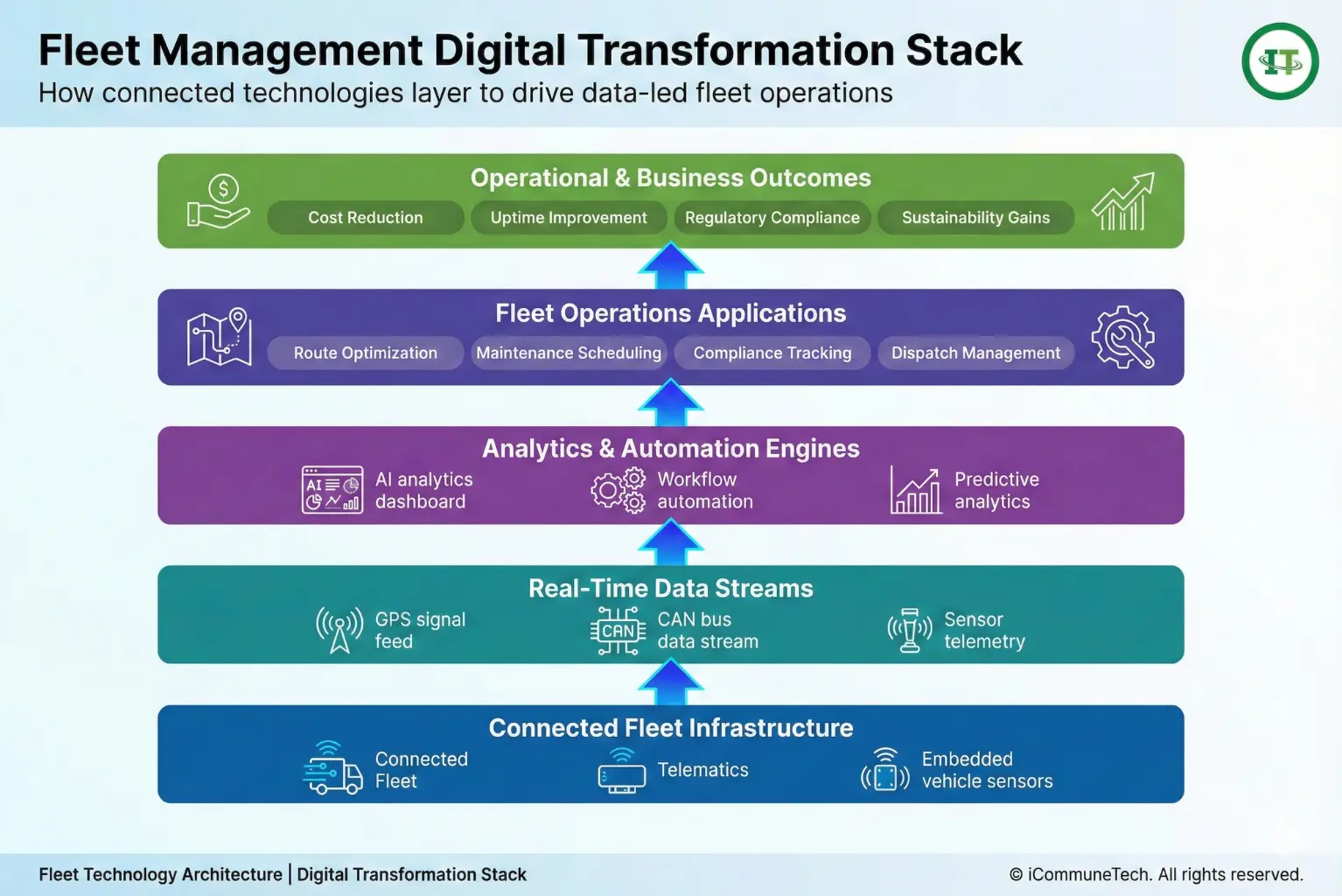
Fleet intelligence is powered by large-scale data and advanced analytics, with AI in fleet management enabling faster and more accurate operational decisions across fleet operations.
- Ingest telemetry, route, and driver data into centralized platforms for unified visibility.
- Collect continuous vehicle and operational data to build a strong analytics foundation.
- Process historical and real-time inputs to generate forecasts and operational insights.
- Use AI in fleet management models to improve demand forecasting, route planning, and maintenance scheduling.
- Maintain scalable performance as data volume grows across expanding fleets.
- These analytics outputs help reduce operating costs and increase vehicle utilization by improving planning accuracy across routes, schedules, and asset usage.
How Do Telematics Systems Enable Real-Time Vehicle Tracking?
Telematics platforms deliver core features of a fleet management system through dashboards streaming GPS, sensor, and CAN bus data. Real-time vehicle tracking exposes route deviations and asset delays, enabling faster response during service disruptions. APIs connect fleet telematics systems with OEM systems and compliance tools, addressing integration complexity.
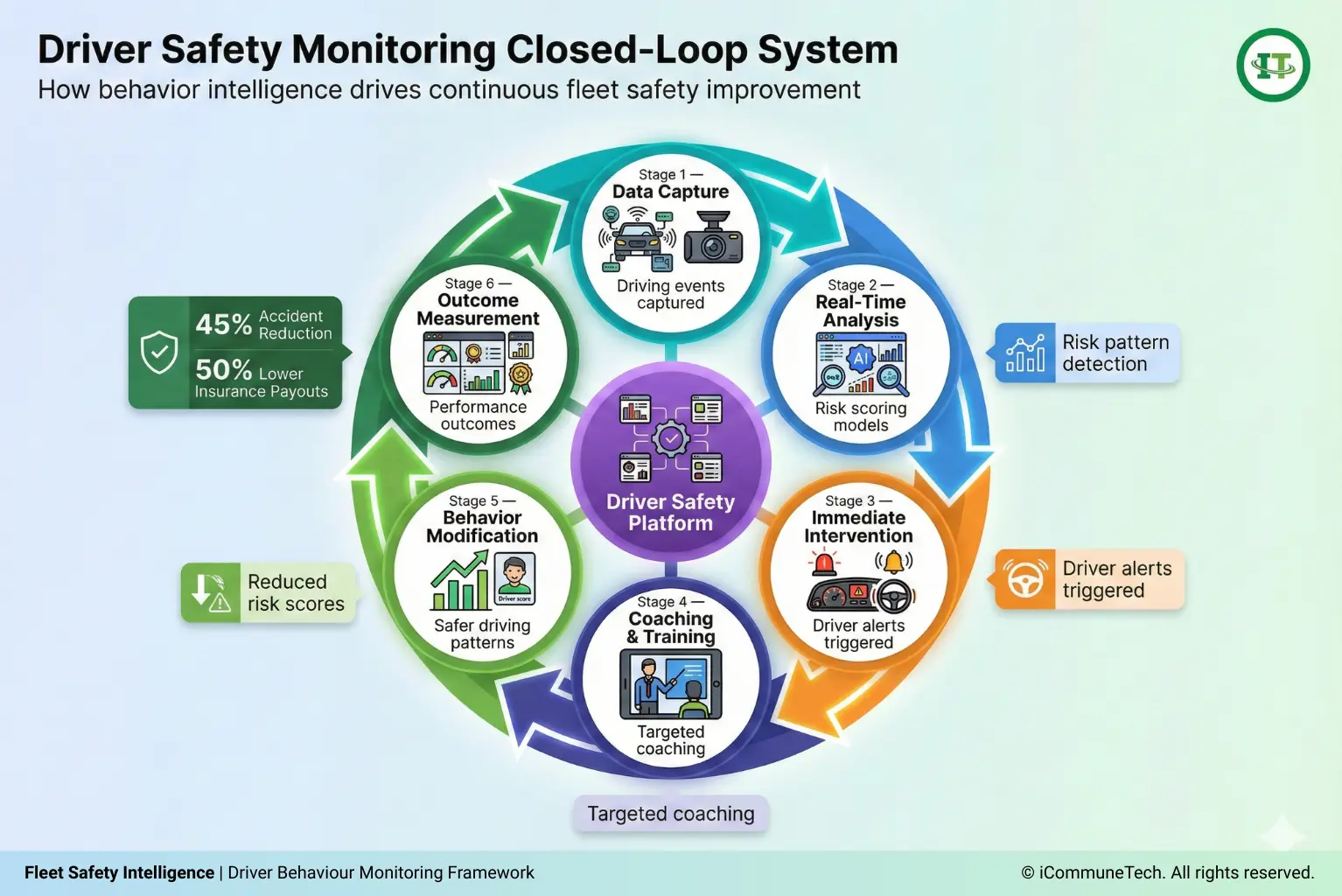
Live vehicle tracking and automated logs shorten incident response times and simplify compliance verification. Improved visibility and accountability help telematics adoption reduce accidents by up to 45%[3]. Insurance payout costs can also fall by up to 50% as incident data[3] becomes more reliable.
How Do Connected Vehicles and IoT Systems Optimize Fleet Operations?
- Sensors connect vehicles to IoT platforms to capture real-time location, status, and usage data.
- Interoperable systems allow OEM and third-party hardware to share data without vendor lock-in.
- Cloud platforms process device data to automate routing, maintenance planning, and dispatch workflows.
- Decision engines use live sensor data to trigger predictive and preventive operational actions.
- Connected technologies support autonomous functions that reduce manual coordination and operational workload.
How Are Fleets Adopting Electrification and Sustainable Strategies?
Fleets are adopting electrification and lower-emission vehicles based on charging access, route patterns, and total cost of ownership rather than just vehicle price.
Infrastructure availability across depots, routes, and regions determines the electrification pace and cost. SaaS platforms analyze usage, charging capacity, and emissions data to plan rollouts and meet reporting requirements. Emissions and cost data help compliance and procurement teams select compliant vehicles and maintain consistent audit readiness.
How Are Electric and Hydrogen Vehicles Gaining Adoption in Fleet Purchasing?
Electric and hydrogen fleet vehicles are evaluated using total ownership cost, including purchase price, energy costs, infrastructure, maintenance, and downtime. Infrastructure readiness and route constraints then shape deployment decisions across fleet types.
| Factor | Electric fleet vehicles | Hydrogen fleet vehicles |
|---|---|---|
| Range | Suited for fixed routes | Better for long-haul duty |
| Charging or fuel | Charging requires depot upgrades | Fueling depends on limited stations |
| Costs and metrics | Lower fuel costs, strong ROI, lower emissions, and higher downtime | Higher fuel costs, mixed ROI, low emissions, and lower downtime |
These differences help fleets match vehicle technology to route length, infrastructure availability, and cost targets.
How Does Sustainability Reporting Support Environmental Compliance?
Regulatory frameworks, ESG standards, and the GHG Protocol define the emissions and activity data fleets must report. These requirements shape how fleets collect, validate, and structure sustainability data for compliance reporting.
Fleet SaaS platforms use standardized data models to structure emissions data and generate reports that help auditors and executives ensure compliance. Traceable emissions data and standardized reports help teams meet regulations, pass audits, and maintain operational transparency.
How Do Optimization and Maintenance Improve Fleet Operational Efficiency?
Fleet operators measure performance using cost control, vehicle uptime, and scalability metrics. Optimization algorithms apply route and asset data to improve efficiency across vehicles, routes, and schedules. Route optimization reduces fuel spend, idle time, and service delays across daily fleet operations.
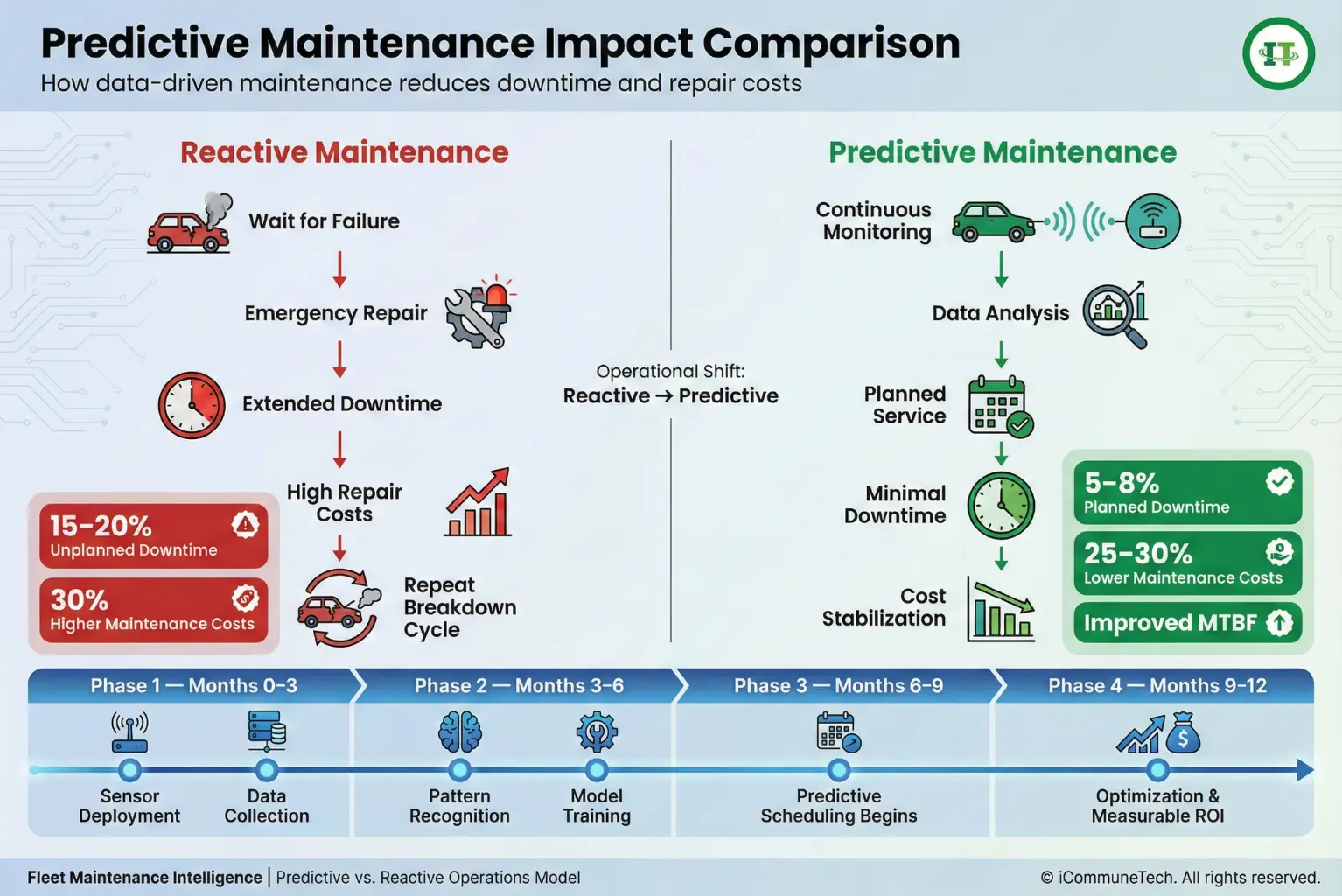
Maintenance strategies focus on fleet maintenance optimization supported by data-driven triggers. Predictive maintenance uses sensor inputs to improve reliability and plan service windows.
Analytics benchmarks provide measurable outputs to compare performance across vehicles, routes, and depots. As optimization and maintenance processes scale, fleets reduce service delays and maintain cost control during growth.
How Are Route Optimization and Fuel Management Systems Evaluated?
Integrating with route planning software streamlines operations and reduces costs. Industry research and analyst surveys report that advanced route optimization typically reduces fleet fuel expenses by 15%[4] by improving routing accuracy and real-time decisioning. Real-time sensor data enables dynamic route adjustments based on traffic, weather, and vehicle status.
| Aspect | Evaluation focus | Operational impact |
|---|---|---|
| Inputs | Traffic data and delivery windows | Higher schedule accuracy |
| Tools | Route optimization and fuel management systems | Lower fuel cost |
| Performance | Real-world route and constraint handling | Faster delivery time |
| Assessment lens | Fleet management market benchmarks | Scalable route optimization |
How Does Predictive Maintenance Reduce Fleet Downtime?
Predictive maintenance uses diagnostics, usage logs, and historical fault data to forecast service windows before failures occur. Analytics models refine predictions using load cycles and historical trends to improve accuracy.
Fleet buyers assess MTBF metrics to validate downtime reduction and maintenance effectiveness. Planned maintenance schedules reduce unplanned failures and improve overall fleet availability.
Analytics models use historical faults and load cycles to improve failure prediction accuracy. Fleet management market buyers assess MTBF trends to validate downtime reduction and maintenance effectiveness.
Predictive fleet maintenance schedules plan interventions that reduce unplanned failures and improve fleet availability.
How Do Workforce and Safety Tools Improve Fleet Operations?
Workforce and safety platforms use driver behavior data to reduce incidents, improve retention, and trigger targeted safety alerts. Training platforms shorten onboarding time and reinforce safe driving standards through structured learning modules. Fleet safety solutions link coaching data with Driver Behavior patterns and incident outcomes to measure safety performance.
Workforce management tools connect scheduling, certification tracking, and driver feedback to performance benchmarks that reduce gaps and support retention. Centralized safety visibility helps managers improve oversight without disrupting daily fleet operations.
How Do Next-Gen Safety Features and Driver Behavior Monitoring Improve Fleet Safety?
- Track speeding, braking, and fatigue to identify high-risk driving patterns early.
- Use behavior data to detect unsafe actions before incidents occur.
- Convert monitored driver actions into measurable risk scores for safety improvement.
- Trigger targeted alerts to correct unsafe driving in real time.
- Link improved behavior scores to reduced claims severity and insurance costs.
- Insurers use these KPIs to assess fleet risk during performance reviews.
How Are Fleets Addressing Labor Shortages with Workforce Management and Training?
Fleet labor shortages continue to increase across operations and logistics roles. Workforce analytics identifies scheduling gaps, onboarding delays, and skill shortages across fleet teams. Workforce management tools align staffing with demand to reduce shortages and improve coverage. Up to 30% of current work hours could be automated by 2030[5], increasing the need for proactive workforce planning, reskilling, and talent management across fleet operations.
Learning management systems (LMS) support driver training programs tied to role requirements and skill development. Analytics link productivity gains with retention outcomes, enabling teams to measure workforce platform effectiveness and long-term staffing stability.
How Do Fleets Approach Strategic Planning and Financial Management?
Fleet management trends drive multi-year planning by enabling lifecycle forecasting and long-term asset modeling. Planning tools support financial forecasting by modeling demand, asset mix, and replacement timing across lifecycle stages.
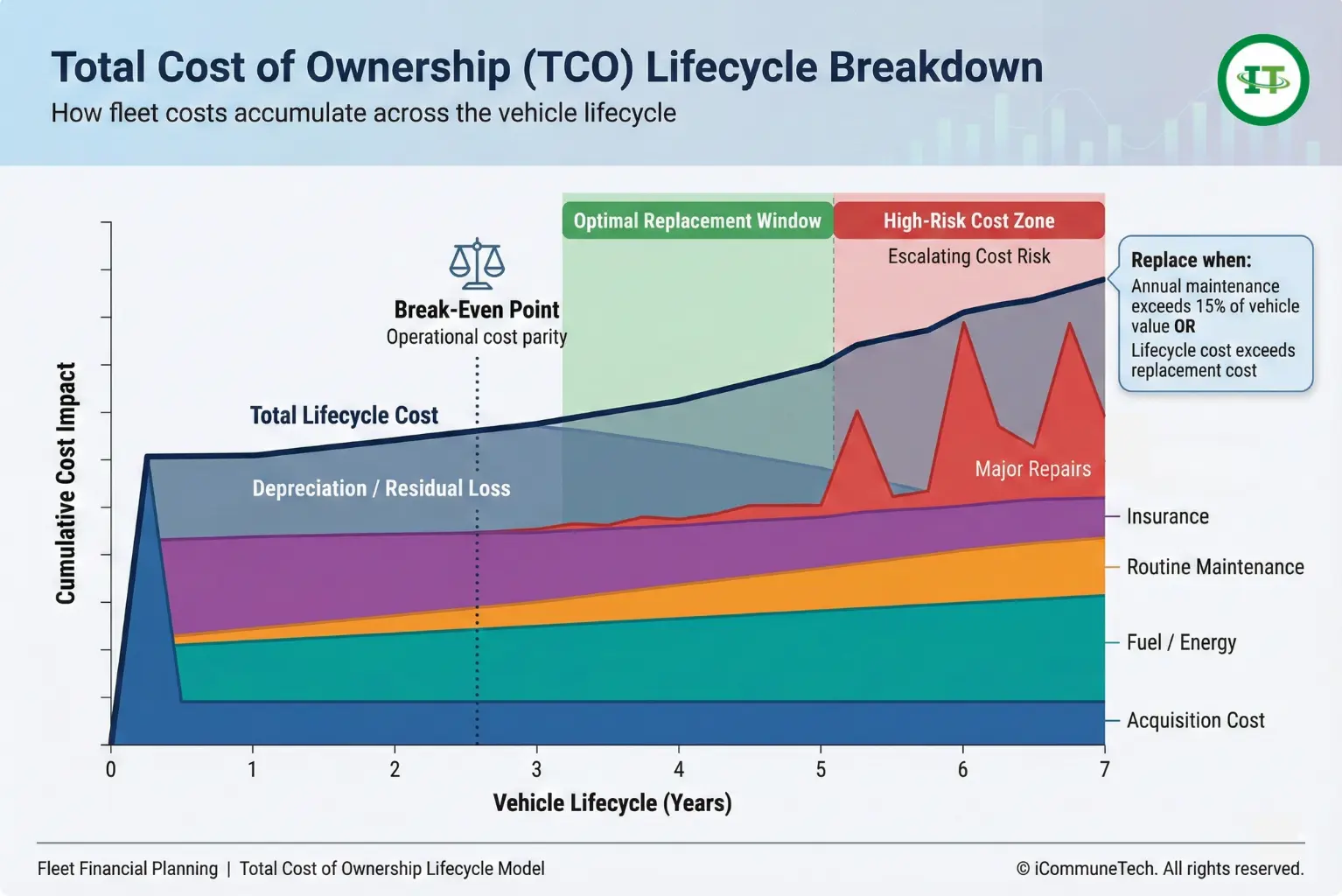
Finance and operations teams use a fleet planning strategy to align capital allocation with service and resilience goals. Lifecycle analysis tracks the total cost of ownership across purchase, operation, and resale decisions.
Procurement evaluates leasing models based on asset lifespan, usage intensity, and monthly payment structures. These tools connect forecast accuracy with disciplined fleet cost management.
How Do Replacement Strategies and Total Cost of Ownership Shape Fleet Decisions?
- Fleet management market decisions depend on asset age, usage patterns, and operational risk exposure.
- Fleet replacement strategy compares planned replacement and run-to-failure models using TCO analysis across lifecycle stages.
- Depreciation curves and maintenance costs define breakeven points and risk thresholds as assets age.
- Total cost of ownership models evaluate lifecycle cost across purchase, service, and disposal.
- ROI improves when replacement timing reduces downtime, repair volatility, and unplanned maintenance events.
How Do Leasing Models and Platform Integration Improve Admin Efficiency?
Fleet management market buyers evaluate administrative workload across leasing and finance workflows. Fleet leasing models reduce admin effort by standardizing contracts, billing cycles, and payment processing. Platform integration automates data exchange between ERP and finance systems, reducing errors, speeding processing, and improving reporting accuracy.
These capabilities improve admin efficiency by streamlining workflows, increasing reporting accuracy, and supporting scalable financial operations.
How Do Fleets Build Resilience Against Operational Disruptions?
Fleet visibility and coordination help fleets manage logistics management challenges caused by disruptions, capacity constraints, and policy shifts. Resilience planning evaluates response mechanisms to supply chain shocks, regulatory changes, and asset constraints.
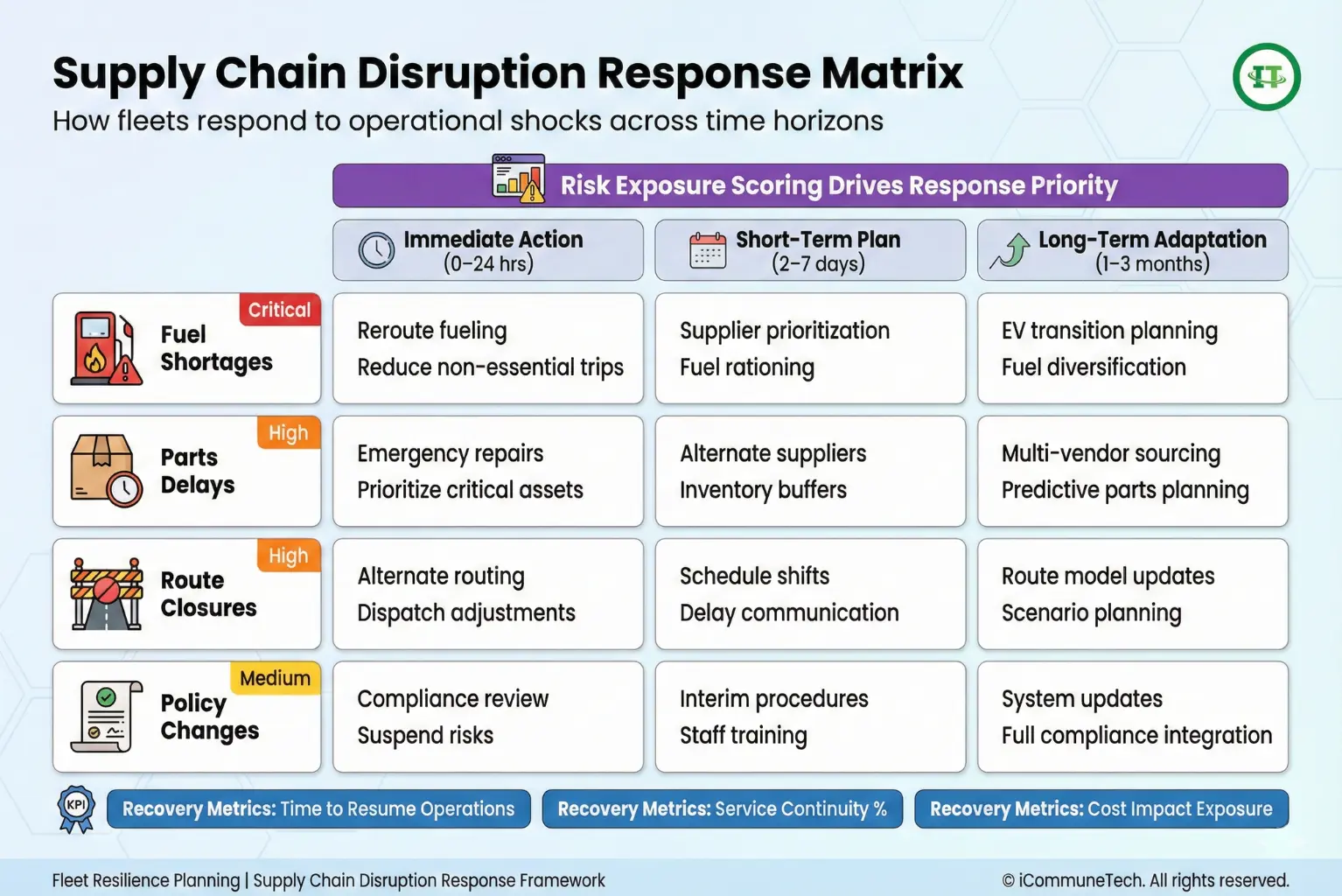
Modeling tests response effectiveness for fuel shortages, parts delays, and route closures. These models guide adaptive sourcing and routing decisions during disruption events.
Resilient fleet operations depend on flexible sourcing strategies and real-time routing adjustments. Risk scoring prioritizes exposure across regions and asset classes, strengthening response readiness. For cold storage fleets, continuity planning and live operational signals protect cargo integrity during disruption events.
How Do Fleets Deal with Supply Chain Disruptions and Policy Shifts?
Fleet management trends reveal exposure to shortages and regulatory shifts across logistics networks. Case studies analyze how supply chain disruptions impact routes, capacity, and service levels.
Fleet SaaS tools model scenarios using policy changes and inventory signals to identify adaptive routing and sourcing strategies. These insights generate contingency plans that guide scheduling and supplier adjustments. Policy changes trigger response playbooks, while recovery time and service continuity metrics measure how effectively fleets restore operations.
How Do Asset Utilization Trends Differ Between Logistics Fleets and Refrigerated Trucks?
Fleet management industry trends show utilization patterns differ across logistics and Cold Chain operations. Cold chain fleets prioritize uptime and temperature control to prevent spoilage, while logistics fleets focus on route density and asset turns to maximize utilization. Cold chain logistics trucks require continuous monitoring across routes and dwell points to limit spoilage risk.
Refrigerated fleet trends focus on utilization optimization to reduce spoilage, while general logistics fleets target capacity efficiency. Sector analysis links utilization rates, downtime risk, and spoilage as core KPIs that define optimization opportunities by sector.
How Do Remote and Integrated Fleet Management Solutions Improve Operational Visibility?
The fleet management market requires consistent operational visibility across distributed fleets and changing operating conditions. Reliable connectivity and rugged devices ensure uninterrupted remote monitoring across routes and depots, even in harsh environments.
Cloud platforms enable remote fleet management through centralized control, diagnostics, and data access. System integration links vehicles, sensors, and enterprise tools, improving visibility through integrated fleet systems.
Seasonal readiness improves when maintenance planning uses live asset data to prevent disruptions. Fleet technology centralizes visibility and control without adding additional field hardware or manual processes.
How Do Remote Management and Rugged Devices Support Distributed Fleets?
Fleet operators use remote management tools to monitor devices and vehicles across distributed fleet locations. Rugged tablets maintain device availability in harsh environments, reducing field hardware failures during operations.
Remote monitoring and rugged devices reduce field downtime and improve reliability by preventing device failures and unplanned outages. Consistent hardware performance lowers device failure rates across mixed fleet operating environments.
How Do Winter Maintenance Strategies and Predictive Upkeep Improve Fleet Readiness?
Historical weather patterns and maintenance logs inform winter service schedules and help identify recurring failure patterns. Winter maintenance models combine weather forecasts with usage data to time inspections and servicing.
Predictive upkeep uses forecast and usage data to reduce parts waste and prevent roadside breakdowns. This approach improves seasonal readiness by reducing cold-weather failures and unplanned repair costs.
How Do Cybersecurity and Data Privacy Protect Connected Fleet Management?
As vehicles, users, and systems connect at scale, cybersecurity and data privacy risks increase across fleet operations. The table maps key risk areas to platform controls that protect fleet data and ensure operational continuity.
| Risk area | Platform control | Operational outcome |
|---|---|---|
| Cyber threats | Encryption and access controls | Reduced data breach exposure |
| Data access | Role-based permissions | Controlled data usage |
| Compliance | Security standards alignment | Audit readiness |
| Market lens | Fleet management software risk priorities | SaaS risk prioritization |
| Protection focus | Fleet cybersecurity and data privacy controls | Data privacy assurance |
Embedded security controls mitigate breach risk by enforcing access policies and audit logging.
How Are Telematics and Fleet Management Systems Secured Against Cyber Threats?
Fleet management market platforms face rising exposure to unauthorized access as connected telematics systems expand. Security reviews assess access paths across telematics devices and software layers to identify architectural weaknesses.
Penetration testing evaluates defenses against fleet cyber threats and validates control effectiveness. Security frameworks provide compliance benchmarks that guide telematics cybersecurity architecture and monitoring practices. These practices reduce attack surfaces and cyber threat exposure, while incident metrics track security improvements over time.
How Do Fleets Ensure Compliance with Data Privacy Regulations?
- Fleet management market platforms review regional data privacy laws to define SaaS compliance requirements for data handling and storage.
- GDPR and data residency regulations shape platform design, access controls, and storage location policies.
- Consent frameworks enforce fleet data compliance across driver and vehicle records.
- Governance models document data processing activities to support audits.
- Data privacy improves when GDPR fleet management aligns consent and governance controls with legal mandates.
How Do Training and Change Management Support Digital Fleet Adoption?
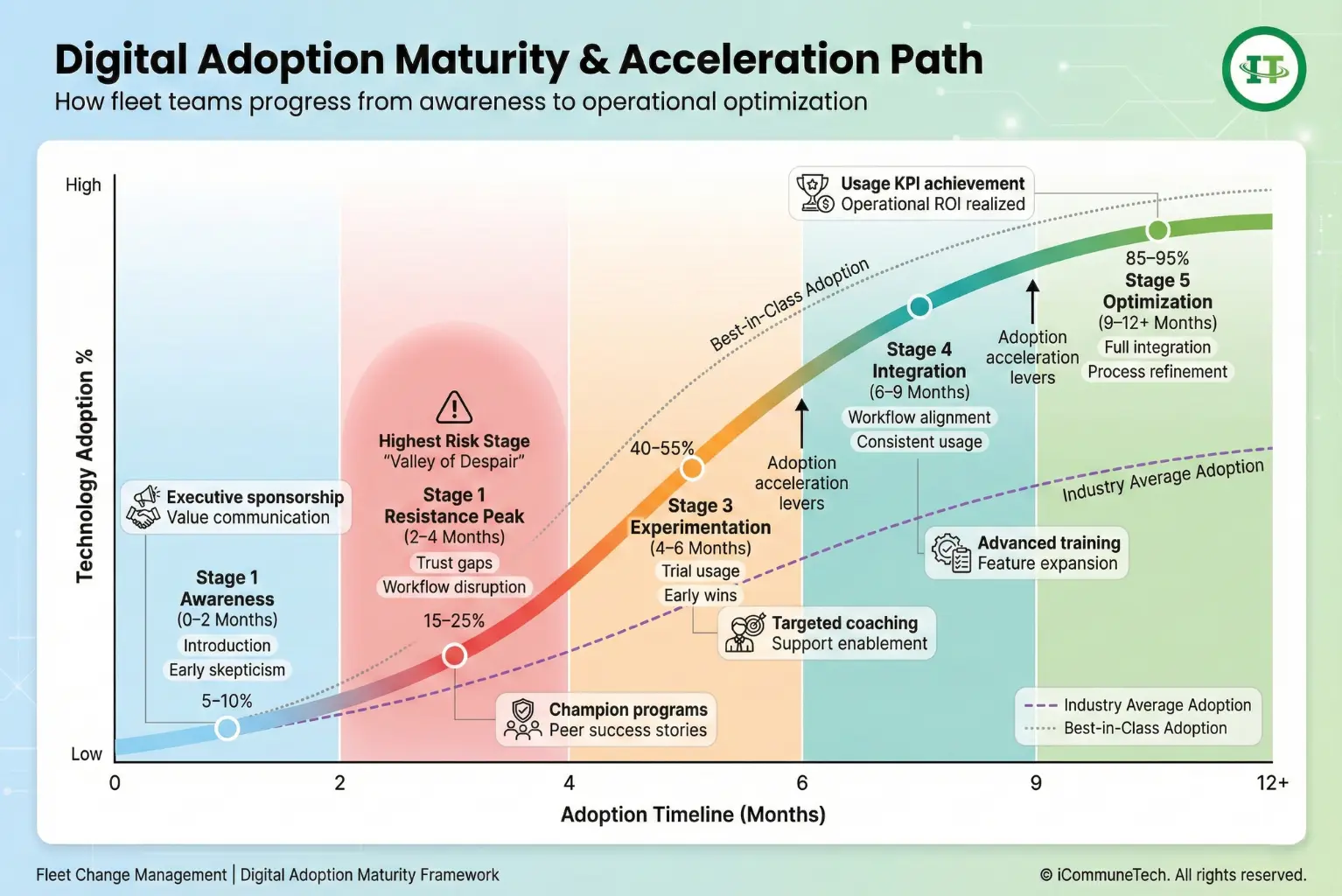
Digital adoption slows when fleet teams lack training and resist new workflows introduced by fleet technologies. Change management frameworks align rollout timing with role-based enablement to reduce resistance. Training programs and structured onboarding support consistent tool usage across locations.
Fleet change management links training guidance with defined usage standards to improve adoption rates. Adoption accelerates when training links daily workflows with measurable performance outcomes.
How Do Fleets Overcome Resistance to New Technologies Among Drivers and Staff?
Fleet management industry trends show resistance driven by usability gaps and trust concerns among drivers and staff. Adoption strategies apply behavioral analysis and feedback loops to identify workflow friction points.
Training effectiveness improves when education aligns with daily tasks and role expectations. UX design reduces adoption friction by improving task clarity and system confidence. Targeted coaching addresses driver technology resistance through focused enablement.
Usage frequency is tracked as a core KPI showing how fleet technology adoption drives measurable operational performance gains.
How Are Fleet Teams Upskilled for AI, EV, and Data-Driven Operations?
Fleet management industry trends require new skills across software-led operations.
- Skill development programs assess alignment with AI in fleet management and EV systems to support emerging technology adoption.
- Training software platforms deliver role-based learning through structured modules mapped to deployed tools.
- Fleet workforce upskilling closes gaps across analytics, diagnostics, and control systems.
- Training content aligns with operational technologies and daily execution requirements to achieve capability readiness.
How Does Fleet Sustainability Reporting and ESG Benchmarking Support Decision Making?
| Evaluation area | Assessment focus | Business outcome |
|---|---|---|
| Market context | Fleet management trends shaping disclosure expectations | Executive alignment |
| Benchmark scope | Comparative fleet ESG benchmarking against peer performance | Investor confidence |
| Metrics | Fleet emissions, fuel and utilization metrics | Comparable reporting |
| Standards fit | Alignment with ESG frameworks, investor criteria, and ESG goals | Audit readiness |
| Output | ESG benchmarking reports for executives and investors | Informed capital allocation decisions |
Benchmark reports compare fleet emissions performance against industry peers and disclosure standards. Results support executive strategy, investor communication, and progress tracking against defined ESG goals.
How Do Fleets Measure and Report Carbon Emissions and Fuel Transition Progress?
Fleet management market platforms aggregate fuel and mileage data across diverse fleet types. Carbon accounting models standardize calculations to improve fleet emissions reporting accuracy and consistency.
Fleet emissions intensity metrics normalize outputs by distance and load, enabling comparable measurements across fleet types. These metrics support the evaluation of emissions performance during mixed-fuel operations.
Dashboards track emissions trends over time, allowing fleets to measure fuel transition progress and validate reporting accuracy throughout planning cycles.
How Do Fleet Operations Align with Corporate ESG Goals and Investor Expectations?
Fleet management industry trends require fleets to connect operational data with board-level and executive reporting. Fleet KPIs map directly to corporate ESG frameworks, enabling structured review by boards and executive leadership.
ESG dashboards and fleet data systems translate fleet performance into metrics supporting disclosure, governance, and audit processes. The outcome is strategic alignment between fleet operations, executive priorities, and investor ESG expectations through consistent reporting and governance.
Conclusion
Fleet management trends indicate automation and data-driven coordination across fleet operations. Decision-making will shift from periodic reviews to continuous optimization driven by connected data.
Platforms recognized as the best fleet management software unify technology, governance, and execution to set the industry pace. The next phase of transportation favors fleets that design for adaptability, resilience, and long-term digital scale.
Ready to turn fleet management trends into measurable results?
See how iCommuneTech helps fleets unify data, improve visibility, and support resilient, compliant operations.
Get in touch today
Irshad Pathan


Web Development Expert
Irshad is a senior technical expert at iCommuneTech. He manages the iCommuneTech's Web Development Team, and has hands-on expertise in web development, Laravel development, Logistics, fleet management, and Supply Chain Management. He mentors the in-house team and enjoys describing his experience in words.
Read More Insights By Irshad →