
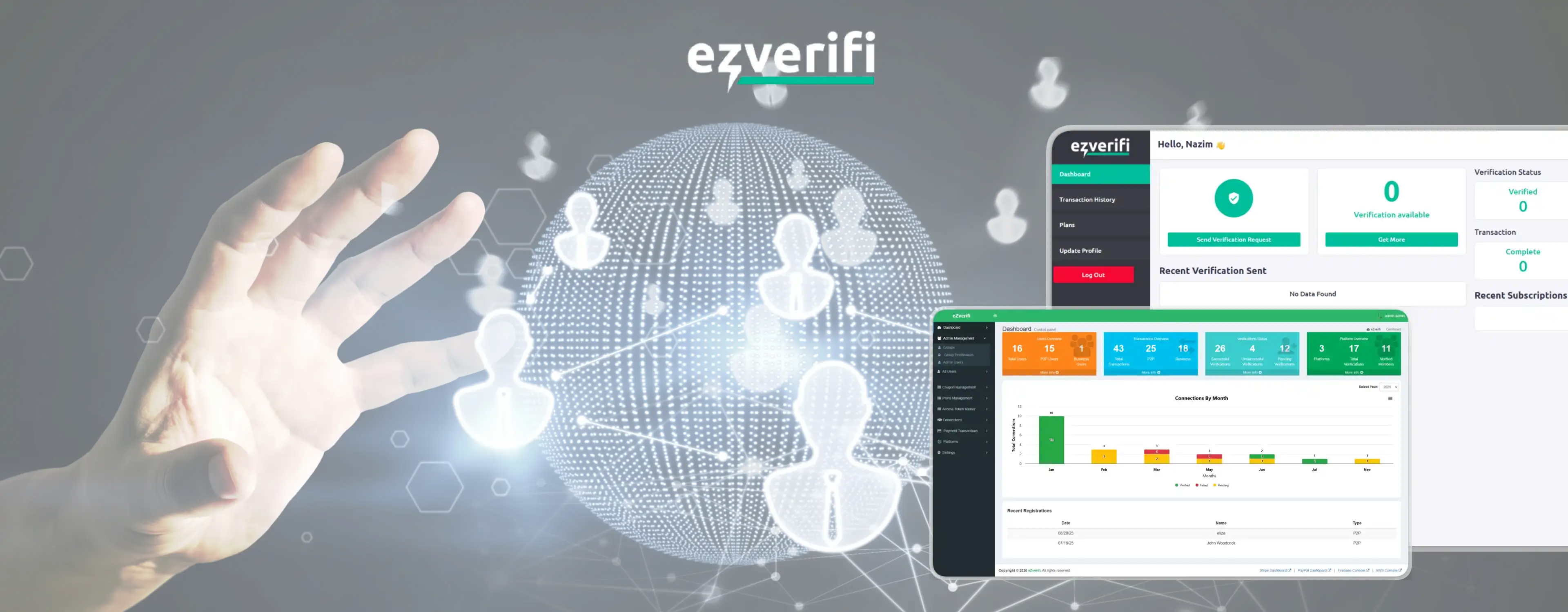
eZverifi Restored a Platform Handling 50+ Verifications Through a Complete Laravel and Firebase Rebuild
iCommuneTech rebuilt eZverifi’s stalled peer-to-peer verification platform through a full Laravel 9 rebuild, database recreation, and Firebase OTP integration, delivering a 100% working demo environment, a Phase-2 contract signed on the final delivery day, and ROI within 6 months.
INDUSTRY
Peer-to-Peer Verification Platform
TECHNOLOGIES
Laravel 9, PHP 8.1, MySQL, Firebase Authentication & Messaging, Blade Templates, GitHub, AWS (RDS, S3, CloudFront, EC2/ECS ready), Rekognition,Terraform/CloudFormation notes
PROJECT TIMELINE
50 Days (10 Weeks) – Started August 23, 2024
About The Client
eZverifi is a peer-to-peer verification platform founded by Dennis Woodbury, Founder and CEO, and based in Virginia, USA. The company has been in operation for 6+ years, supporting verification workflows through a digital platform designed to handle document verification, identity checks, and related validation processes.
At the time of engagement, eZverifi’s platform was completely stalled due to a fragmented legacy setup. The codebase was split between a legacy PHP application and an incomplete Laravel build, with no working database, missing environment configurations, outdated or broken third-party integrations, and zero documentation or a running demo environment. These issues left the product non-functional and prevented the team from demonstrating the platform to investors or onboarding users.
eZverifi’s goal was to revive and modernize the platform into a stable, production-ready product, rebuild the application in Laravel 9, recreate the database from scratch, implement Firebase authentication and messaging, integrate required third-party verification APIs, and prepare the system for AWS-based production deployment, while restoring a fully working and demonstrable version of the product.
Scale of Operations
eZverifi operates a peer-to-peer verification platform with a small team of 2–10 employees, supporting 10+ users and processing 50+ transactions and 50+ verifications through the platform.
- Supports peer-to-peer verification workflows for registered users
- Processes document verification and related validation requests
- Handles verification activities through integrated authentication and third-party APIs
- Operates on a centralized application rebuilt for stability and scalability
- Maintains verification flows validated for demo and operational use
eZverifi uses the platform to manage verification processes through a single system, enabling consistent handling of transactions and verifications while supporting current operational scale and future growth.
Before Engagement Tech Stack
Before our engagement, eZverifi relied on a legacy peer-to-peer verification platform built on a fragmented and incomplete technology setup. The system consisted of a legacy PHP application alongside a partially built Laravel application, with missing and outdated dependencies that prevented the platform from running reliably.
The platform had no working database, seed data, or environment configuration, making it impossible to run or demonstrate. Firebase authentication was only partially set up, and several third-party API integrations were outdated, broken, or incomplete. With the codebase split between legacy PHP and an unfinished Laravel application, no version control, and zero documentation or runnable demo, work stopped progressing for months, leaving the platform completely non-functional and unable to be demonstrated to investors or users.
Goals at the Time of Engagement
At the time of engagement, eZverifi aimed to revive and modernize its peer-to-peer verification platform into a build that was reliable enough for real users. The objective was to rebuild the broken and incomplete system, restore a fully working application, and set up a codebase that could be maintained and extended, which could handle new features and future releases.
The work focused on cleaning up legacy code and resolving runtime problems, rebuilding the application in Laravel 9 with a clean project structure, and recreating the entire database schema from scratch since no working database was available. The team implemented Firebase authentication with OTP-based login flows and messaging, integrated third-party APIs for document verification, geolocation, Rekognition, and analytics, and made the application AWS-ready for production deployment.
Additional goals focused on updating the UI/UX using the provided Figma designs, making the platform fully responsive, delivering production-ready code with proper documentation and version control, and restoring a fully functional local and demonstrable version of the product.
- Modernize and stabilize the existing peer-to-peer verification platform
- Rebuilding the application in Laravel 9 with a clean project structure
- Starting over with a fresh database design
- Implement Firebase authentication, OTP login flows, and messaging
- Integrate third-party APIs for verification, geolocation, Rekognition, and analytics
- Prepare the application for AWS-based production deployment
- Update UI/UX from provided Figma designs and ensure full responsiveness
- Deliver production-ready code, documentation, version control, and a deployment plan
- Restore a fully working local and demonstrable version of the platform
Challenges And Solutions
When eZverifi reached out, the team couldn’t get the platform to run. The code was split across different projects, key setup steps were missing, and there were no notes explaining how anything fit together. Some features existed, but there was no working flow that could be launched or shown, which blocked any further development.
Challenge 1No Working Database or Seed Data
There was no functioning database or seed data available. The original schema was missing, and no environment existed to support development or testing, forcing the team to rely only on demo videos and partial legacy code for reference.
Business Impact
The absence of a working database, a split legacy PHP and incomplete Laravel codebase, and missing environment configurations left the eZverifi platform completely stalled and non-functional. With no running demo or production environment, the team was unable to onboard users or demonstrate the product to investors. Development had been blocked for months due to outdated dependencies, broken third-party integrations, and scattered assets with no version control or documentation.
These challenges created a high risk of losing investor confidence and future funding. The inability to run or showcase core verification flows—including authentication, document verification, and messaging—prevented the platform from progressing toward its next growth phase.
Reverse-Engineered and Rebuilt Database
We reverse-engineered the entire database schema from demo videos and legacy code references. A fully normalized database was rebuilt from scratch using migrations and seeders, restoring a stable data foundation for the platform.
Split Codebase with Legacy PHP and Incomplete Laravel
The application logic was divided between a legacy PHP system and an unfinished Laravel application with missing and outdated dependencies. This fragmentation prevented the platform from running reliably.
Full Laravel 9 Modernization and Clean Architecture
We rebuilt the entire application in Laravel 9 using clean architecture and best practices. All outdated dependencies were upgraded, and the legacy PHP logic was fully consolidated into a single, maintainable codebase.
Zero Documentation and No Runnable Demo Environment
There was no technical documentation, no setup instructions, and no working local or production environment. As a result, development had been blocked for months.
Production-Ready Codebase with Documentation
We delivered a fully working local and demo-ready version of the platform, complete with proper documentation, version control, and a clear deployment plan, restoring development momentum.
Missing Environment Configuration and Firebase Access Issues
Critical environment files were missing, and Firebase authentication and messaging were only partially configured, causing login and verification flows to fail.
Firebase Authentication and Environment Restoration
We recreated the missing environment configurations, implemented Firebase authentication with OTP-based login flows and messaging, and validated the setup with the client to ensure stability.
Broken or Incomplete Third-Party API Integrations
Integrations for document verification, geolocation, Rekognition, and analytics were outdated, broken, or never completed, limiting core verification functionality.
Centralized and Stabilized API Integrations
We rebuilt and centralized all third-party API integrations, ensuring document verification, geolocation, Rekognition, and analytics worked reliably within the application.
No Version Control and Scattered Project Assets
There was no version control history, and assets were scattered across Google Drive, increasing the risk of data loss and making collaboration difficult.
Centralized GitHub Repository and AWS-Ready Setup
All assets were organized into a structured GitHub repository with proper version control. The application was prepared for AWS deployment using RDS, S3, CloudFront, and EC2/ECS, ensuring production readiness.
TECHNOLOGIES & TOOLS
Technology Stack and Implementation Tools
For eZverifi, the platform was rebuilt using a backend-focused technology stack to modernize the peer-to-peer verification system, integrate third-party APIs, and make it AWS-ready for production deployment. The selected tools aligned with the client’s goals of restoring a fully functional platform and supporting future scalability.
Backend and Framework
Database
Authentication & Messaging
Frontend / Interface Logic
Version Control & Deployment Tools
Cloud / Infrastructure Tools
EC2/ECS ready, Rekognition)
Infrastructure as Code / Deployment Notes
Complete System Architecture
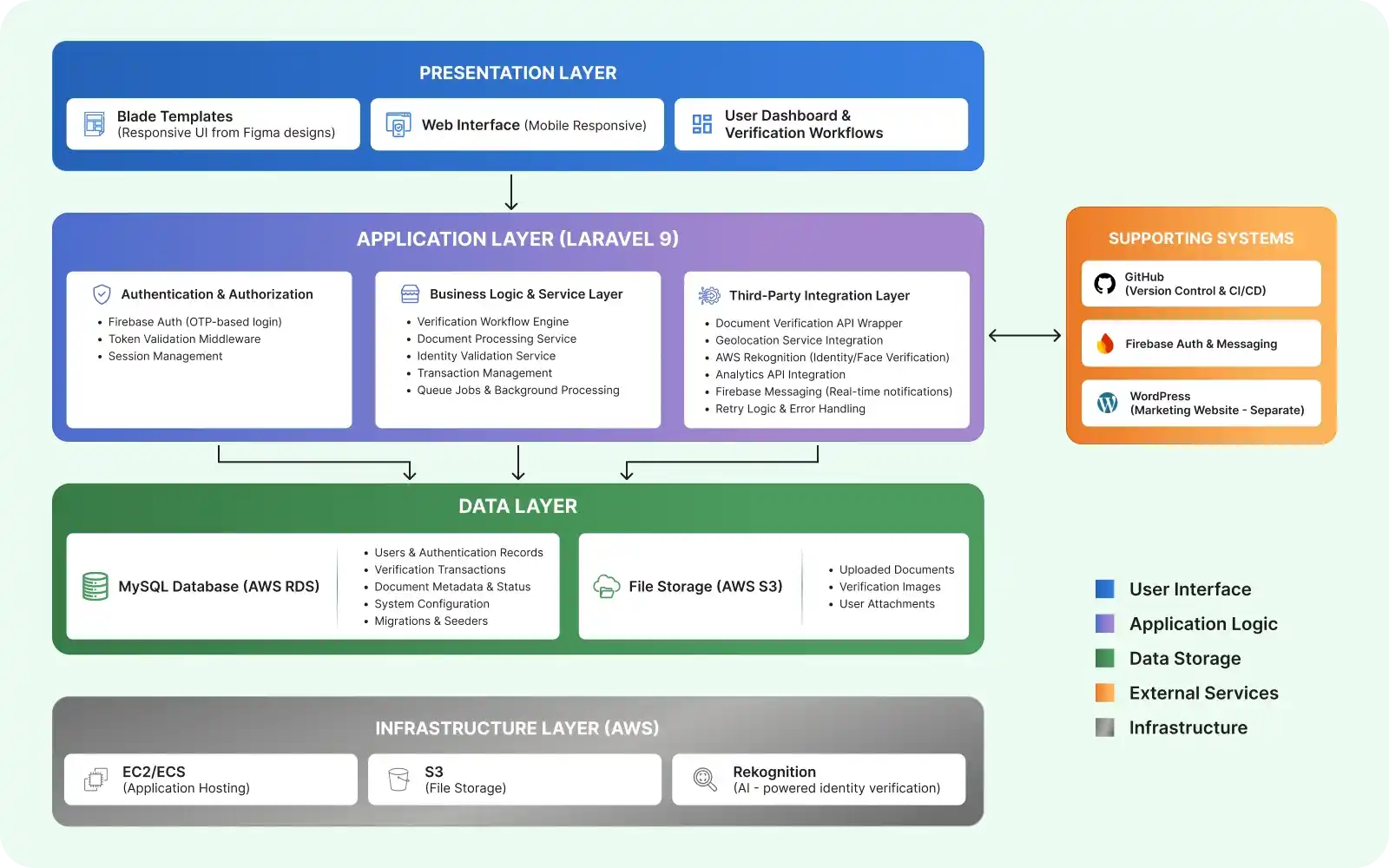
Complete System Architecture – eZverifi Identity Verification Workflow
Outcome
Restoring Platform Stability, Demonstrability, and Investor Confidence
The stalled eZverifi platform was rebuilt into a stable, demonstrable product through a full Laravel rebuild and database recreation. Core verification flows were restored, including OTP, document uploads, geolocation, and Rekognition-based checks. Production-ready code, documentation, and an AWS deployment plan restored ownership, investor confidence, and readiness for Phase-2 launch.
100%
Platform Restoration
The application was restored from a completely non-functional state to a fully working local and demo-ready environment.
Under 6 Months
Restored Product Momentum & ROI
Rebuilding the platform into a fully working, demo-ready system restored product momentum and investor confidence, enabling eZverifi to achieve ROI within six months of delivery.
Measurable Business Transformation & ROI
End-to-End Verification Flows Re-enabled
All core verification processes (Firebase OTP login, document verification, geolocation, and Rekognition) were fully implemented, tested, and ready for demonstration.
Operational Continuity Regained
A clean Laravel 9 codebase with migrations, seeders, and documentation eliminated development blockers and removed dependency on fragmented legacy systems.
Renewed Investor Confidence
The ability to demonstrate a stable, working product directly addressed investor concerns subjects and reduced the risk of lost funding opportunities.
Long-Term Business Impact
The client signed a long-term maintenance and Phase-2 development contract on the day of final delivery, confirming confidence in the rebuilt platform and its future scalability.
Platform Transformation: Before and After
Before (Legacy eZverifi Platform)
- The platform was completely non-functional with no running demo or production environment.
- Split between legacy PHP and an incomplete Laravel application with outdated and missing dependencies.
- No working database or seed data; schema had to be inferred from demo videos.
- Firebase authentication was partially configured and not working reliably.
- Document verification, geolocation, Rekognition, and analytics integrations were broken or incomplete.
- Missing .env configuration and Firebase project access issues prevented the app from running.
- No version control history; assets scattered across Google Drive with no documentation.
- Not production-ready and unable to support cloud deployment.
- Unable to demo the product to investors or onboard users.
- Development has been blocked for months with no clear path forward.
After (Rebuilt Platform)
- Platform restored to a fully working local and demo-ready environment.
- Clean, modern Laravel 9 codebase rebuilt from scratch using best practices.
- Fully rebuilt MySQL database with normalized schema, migrations, and seeders.
- Firebase OTP authentication, token validation, and messaging are fully implemented and validated.
- All third-party APIs are integrated through centralized wrappers and tested end-to-end.
- Environment configuration recreated and validated, enabling consistent local and demo setups.
- Centralized GitHub repository with an organized codebase and complete technical documentation.
- AWS-ready architecture prepared for RDS, S3, CloudFront, and EC2/ECS deployment.
- Client regained the ability to confidently demo a stable, working product.
- Foundation established for Phase-2 development and production launch.