1-Minute Dispatch System Through Automation and Real-Time Tracking for Transportation of America
iCommuneTech enabled Transportation of America to reduce dispatch load time to under 1 minute by providing SMS/email notifications and API integrations that improved driver and customer communication and removed unnecessary workflow steps.
INDUSTRY
Transportation and Logistics
TECHNOLOGIES
PHP, MYSQL, JavaScript
PROJECT TIMELINE
12 weeks (3 months)
About The Client
Transportation of America (TOA) is a Pomona-based logistics company with 17 years of operations, supporting both regional and long-haul freight. Led by CEO Anthony Woods, the company manages a full logistics workflow that includes driver coordination, load assignments, client communication, scheduling, and billing.
As the business grew from a small fleet to a full-service operation, TOA’s internal team began facing increasing pressure during dispatch and daily transportation activities. Manual updates, fragmented tools, and limited system automation created slowdowns for dispatchers, drivers, and back-office staff, especially during fast-moving delivery cycles.
Scale of Operations
The company operates a 100,000 sq. ft. distribution facility in Pomona, California, equipped with 55 dock doors and strategically located near the Port of Los Angeles/Long Beach. The facility functions as a high-velocity distribution center, processing approximately 200 containers daily through unloading and reloading operations.
- Processes high container volumes daily within a fast-paced port-adjacent distribution environment
- Supports nationwide shipping with multimodal logistics capabilities
- Provides cross-docking, transloading, and warehousing services managed through an integrated Warehouse Management System (WMS)
- Specializes in freight consolidation for LTL, truckload (dry and refrigerated), flatbed, and intermodal shipments
These operations enable efficient freight movement, rapid container handling, and centralized warehouse management across a nationwide logistics network.
Before Engagement Tech Stack
Prior to our engagement, Transportation of America relied on a backend-driven system with limited automation and constrained technical capacity to support maintenance and development.
This limited setup made it difficult for the team to scale operations, integrate third-party services, automate communication, or track drivers in real time. These limitations ultimately slowed dispatch and added to employee workload.
Goals at the Time of Engagement
At the start of our engagement, Transportation of America aimed to modernize and streamline its transportation operations. Their priorities included consolidating driver, load, and client management into a single platform, enabling real-time driver tracking, and automating dispatch notifications.
A major need was the ability to see where drivers were in real time and to send out dispatch updates automatically, without someone having to message each driver individually. They also needed their system to connect with QuickBooks and EDI, so billing and data sharing wouldn’t require repeated entries. Along with these changes, the team hoped to improve the overall interface and build a setup that could grow with them over time.
- Bring driver, load, and client management into one place so the team doesn’t have to switch between different tools.
- Make it possible to see drivers’ real-time locations and send dispatch updates automatically.
- Connect the system with QuickBooks and EDI to avoid doing the same work twice or relying on manual data entry.
- Cut down the time spent preparing invoices by automating the process where possible.
- Improve the interface so dispatchers and admins can move through their work more easily.
- Set up a system that can handle new features and support the company as it continues to grow.
Challenges And Solutions
When we met Anthony Woods, he needed a simplified loading and delivery process supported by timely notifications. However, because the team lacked internal technical capability, they faced challenges getting critical tools running such as automated alerts, integrations, live tracking, and streamlined invoicing.
Challenge 1Lack of SMS Notifications to Drivers
Drivers weren’t receiving SMS updates automatically during dispatch, so the team had to follow up with each driver individually. This slowed communication and made it harder to keep deliveries on schedule, coordinate loads, and manage day-to-day operations efficiently.
Automated SMS and Email Notifications
We implemented automated SMS and email notifications that trigger instantly during dispatch. This ensured drivers and employees receive timely updates without manual intervention, improving communication accuracy and allowing the team to manage daily operations with fewer delays and follow-ups.
Lack of API Integrations (EDI, QuickBooks)
The system didn’t connect with EDI or QuickBooks, so the team ended up entering the same data manually over and over. This slowed down their daily work and made unnecessary workload to keep information consistent when sharing updates with partners and customers.
EDI API Implementation
We implemented EDI API integration to streamline data exchange with clients and partners. This eliminated manual entry, minimized errors, and allowed Transportation of America to handle operational updates more efficiently while maintaining accurate information across all connected stakeholders.
QuickBooks API Integration
We added QuickBooks API integration to automate financial processes and reduce manual effort. This cut down the repetitive work of updating billing records by hand and helped the team keep financial data consistent and accurate without extra effort.
No Live Driver Location Tracking
The team could not view the real-time location of drivers, making it difficult to monitor delivery progress or respond quickly to route changes. Without live tracking, dispatchers relied on manual check-ins, which slowed decision-making and affected planning accuracy.
Live Location Capability
The team lacked real-time visibility into drivers’ locations. This made it difficult to monitor delivery progress, and any unexpected route changes or delays required manual intervention. Dispatchers had to manually confirm each driver’s location. As a result, updating delivery records took longer, and mistakes occasionally appeared in the tracking logs.
Manual Invoice Generation and Sending
Invoices had to be prepared and shared manually with customers and internal staff, which required extra effort from the team and caused more errors in records. This manual workflow often led to delays in billing and made it difficult to keep clients updated on time.
Automated Invoice Processes
We introduced automated invoice generation and sending directly from the system. This reduced manual workload, improved accuracy, and ensured both customers and TOA staff receive timely invoices without additional effort, creating a more consistent and efficient billing process.
TECHNOLOGIES & TOOLS
Technology Stack and Tools
For Transportation of America, we built a streamlined, scalable transportation management system optimized for dispatch, load management, and real-time tracking. The technology stack was chosen to ensure high performance, reliability, and extensibility for future growth.
Backend and Framework
Database
Frontend / User Interface
Complete System Architecture
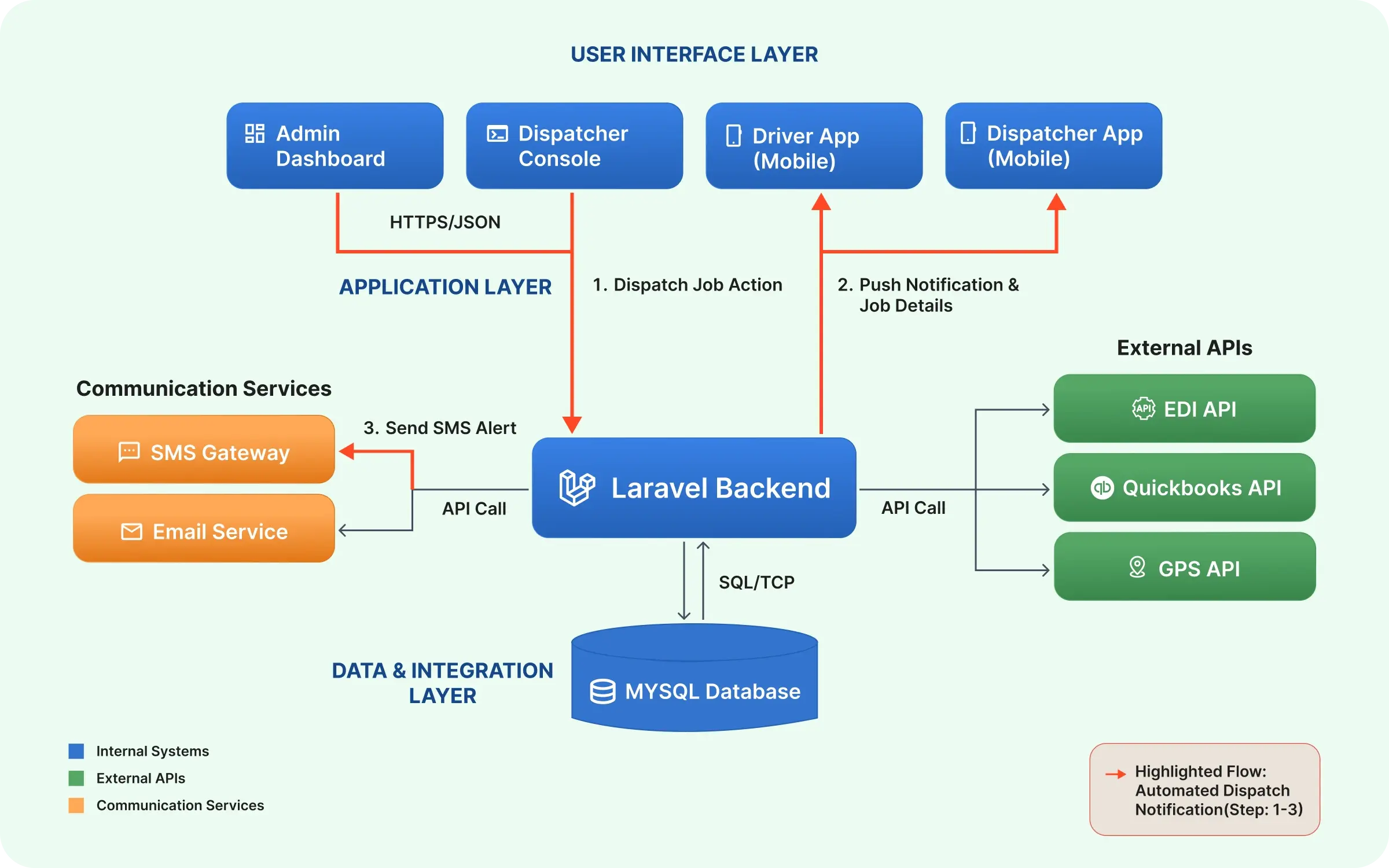
Complete System Architecture – TOA Unified Dispatch Platform
Outcome
Faster Operations with Real-Time Automation
Faster Notifications and Streamlined Operations
With automated SMS and email notifications in place, TOA could update drivers and staff right away during dispatch. This reduced manual follow-ups, kept everyone informed, and helped the team handle changes more smoothly.
Reduced Dispatch Load Time
The automation and process changes, updated routines, and better ways of working significantly reduced the shipping and delivery time to less than one minute, enabling the team to manage a higher volume of shipments efficiently and without delays.
Improved Customer and Staff Communication
Drivers, employees, and customers received consistent, real-time updates, minimizing confusion and miscommunication. This improvement enhanced teamwork, smoother collaboration, improved communication across the operations team, and created a more reliable delivery process.
Accurate and Automated Invoicing
Automating invoice creation and delivery cut down manual work, reduced mistakes, and ensured invoices reached both customers and TOA staff on time.
Streamlined Data Management Through Integrations
Connecting EDI and QuickBooks cuts down repeated data entry and manual checks, letting staff focus on higher-value tasks rather than administrative work.
Overall Operational Impact
These improvements made TOA’s daily operations smoother and easier to manage. Staff no longer had to track updates manually, and drivers, employees, and customers received information quickly enough to avoid confusion. With automated alerts, real-time updates, and integrated tools, TOA moved shipments with better control, fewer mistakes, and clearer, accessible records.
Implementation Timeline
The implementation was completed over a 12-week (3-month) timeline, structured into four clearly defined phases to ensure controlled rollout, system stability, and operational readiness.
Phase 1
Weeks 1–3: Planning & Setup
Requirements gathering and system audit
API credential setup for EDI and QuickBooks integrations
Phase 2
Weeks 4–8: Core Development
Development of SMS and Email notification system
EDI API integration
QuickBooks synchronization implementation
Phase 3
Weeks 9–10: Testing & Pilot Rollout
User acceptance testing
Driver and staff training
Pilot run covering 25% of daily operations
Phase 4
Weeks 11–12: Full Deployment
Full system rollout
Ongoing monitoring
Performance optimization