Efficient Modernisation of 20-Year-Old TMS SaaS
iCommuneTech transformed TMSCLOUD operations by modernizing architecture and automating fuel tracking, invoicing, and ELD data, which increased their customer satisfaction by 60% and efficiency by 90%.
INDUSTRY
Transportation Management Software
TECHNOLOGIES
Laravel, MySQL, AWS Cloud, ELD API Integration, Metronic Theme
PROJECT TIMELINE
6 Months (Development, Testing, Deployment) + Ongoing Support
+60%
CLIENT SATISFACTION
40% → 90%
OPERATIONAL EFFICIENCY
6 months
ROI ACHIEVEMENT
About The Client
Daryn Duff is the CTO of TMSCLOUD, a leading transportation technology provider with 20 years of experience serving the logistics industry. TMSCLOUD develops an integrated Transportation Management Platform (TMS) that unifies dispatching, accounting, fleet management, driver workflows, maintenance planning, compliance, and fuel tracking into a single, scalable system.
Headquartered in California, TMSCLOUD’s vision is to simplify and streamline transportation operations for carriers and dispatch teams, providing configurable and automated workflows that reduce operational friction, ensure compliance, and support growth. By leveraging deep domain expertise in trucking operations, billing complexities, and fleet management, the platform is designed to solve real operational challenges while enabling clients to scale efficiently and operate reliably.
Scale of Operations
TMSCLOUD supports a broad range of customers, from owner-operators to enterprise carriers, and manages hundreds of fleet operations across the U.S. Their platform handles:
- Thousands of daily dispatch events and trip assignments
- Fleet maintenance schedules and asset tracking
- Real-time driver management and compliance records
- Integrated accounting and invoicing for multi-entity operations
Because of their two decades of experience behind them, many enterprise customers rely on TMSCLOUD for mission-critical operations, so uptime, data integrity, and predictable performance are non-negotiable.
Before Engagement Tech Stack
Prior to our engagement, TMSCLOUD’s architecture included a mix of legacy and partially modernized components.
This combination of old and new created architectural inconsistencies that hindered feature velocity, increased maintenance burden, and raised security concerns.
Goals at the Time of Engagement
At the start of our engagement with Daryn Duff and the TMSCLOUD team, they were focused on outdated system components while removing long-standing areas where work kept getting stuck. Their priority was to put fuel records and TMS operations in one tool instead of two, put fuel records and TMS operations in one tool. They also wanted to move away from their legacy PHP 5.6 setup to Laravel for improved security, stability, and scalability.
Another key focus area was to replace manual spreadsheets for fuel logs and invoices with real-time updates. Along with this, the team wanted to streamline logins, remove duplicate data, and improve the interface for dispatchers and admins.
- Combine Fuel Management and TMS operations into one unified system instead of running two separate tools.
- Migrate from legacy PHP 5.6 to a secure, scalable Laravel framework.
- Enable real-time fuel expense tracking and automated invoicing to remove manual entries and delays.
- Reduce operational friction by removing duplicate logins and eliminating data duplication across systems.
- Upgrade the user interface to a modern, responsive layout suitable for dispatchers and administrators.
- Create a scalable foundation that could support growing fleet operations and future feature additions.
Challenges And Solutions
When we began working with Daryn Duff, he was managing Fuel Management and TMS activities on two separate systems. Each tool had its own login, its own interface, and stored its own data. This made daily tasks slower for his team and created unnecessary back-and-forth between platforms.
After reviewing how both systems were being used, we worked with Daryn and his team to bring Fuel Management and TMS functions into one connected platform. The goal was simple: remove the back-and-forth between two tools and give users a single place to handle daily work.
Challenge 1Two Systems For One Workflow
Fuel Management and TMS were on separate URLs with individual logins. Teams frequently repeated entries, causing mismatched data and errors, which slowed dispatchers and increased manual corrections during peak hours.
Business Impact
Separate systems increased manual work, caused data mismatches, and slowed updates. Dispatchers and managers lacked timely visibility, reducing efficiency and operational accuracy. The absence of a unified platform also limited growth and resulted in missed business opportunities due to disconnected workflows.
API Integration with ELD Providers
We integrated ELD APIs consolidated driver logs, routes, and fuel usage, providing a single source of truth. The Metronic-based UI was streamlined for dashboards, tables, and routes, optimized for desktop and mobile access.
Modern UI/UX with Metronic Theme
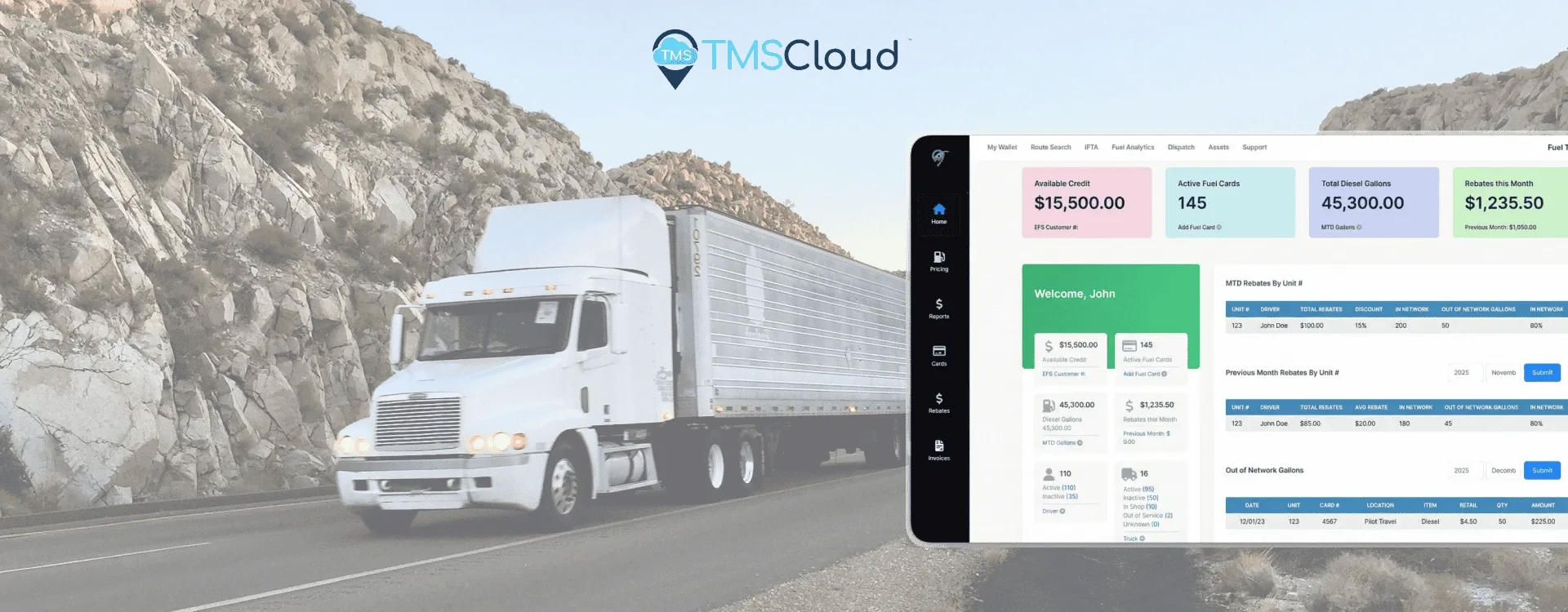
The platform’s screens were redesigned using the Metronic theme. Dashboards, tables, and route views were simplified so dispatchers could find what they needed faster. The layouts were also adjusted for mobile and tablet use, which helped teams working in the field.
No Instant View of Fuel Expenses
Manual fuel entry caused delayed and incomplete updates, requiring report corrections and slowing billing. Accounting had to recheck figures, while dispatchers and managers lacked up-to-date fuel usage for planning and cost tracking.
Real-time Fuel Expense Tracking and Invoicing
We added automatic fuel entry updates so the team no longer had to type numbers in by hand. Fuel records were linked directly to TMS actions, allowing dispatchers and admins to see updated costs, usage, and invoices in one place.
Old Codebase Limiting Updates
The PHP 5.6 codebase hindered adding improvements or new integrations. Security updates were slower, UI changes delayed, and development time focused more on maintenance than building new features.
Migration to a Secure Laravel Platform
The older PHP 5.6 codebase was replaced with Laravel 10. This made the platform easier to maintain and opened the door for new improvements. We also added clearer user roles, stronger API rules, and better logging to support ongoing development.
TECHNOLOGIES & TOOLS
Technology Stack and Tools
We build the entire Fuel Management System on a rock-solid modern stack that prioritizes performance, security, scalability, and fast iteration—precisely what a 24/7 fleet operation demands.
Backend Framework And Core Technologies
(with Laravel Octane + Swoole)
+ Laravel Passport hybrid
Database And Caching Layer
(Multi-AZ)
store
Cloud Infrastructure And AWS Services
mode)
Frontend And Admin Panel
Complete System Architecture
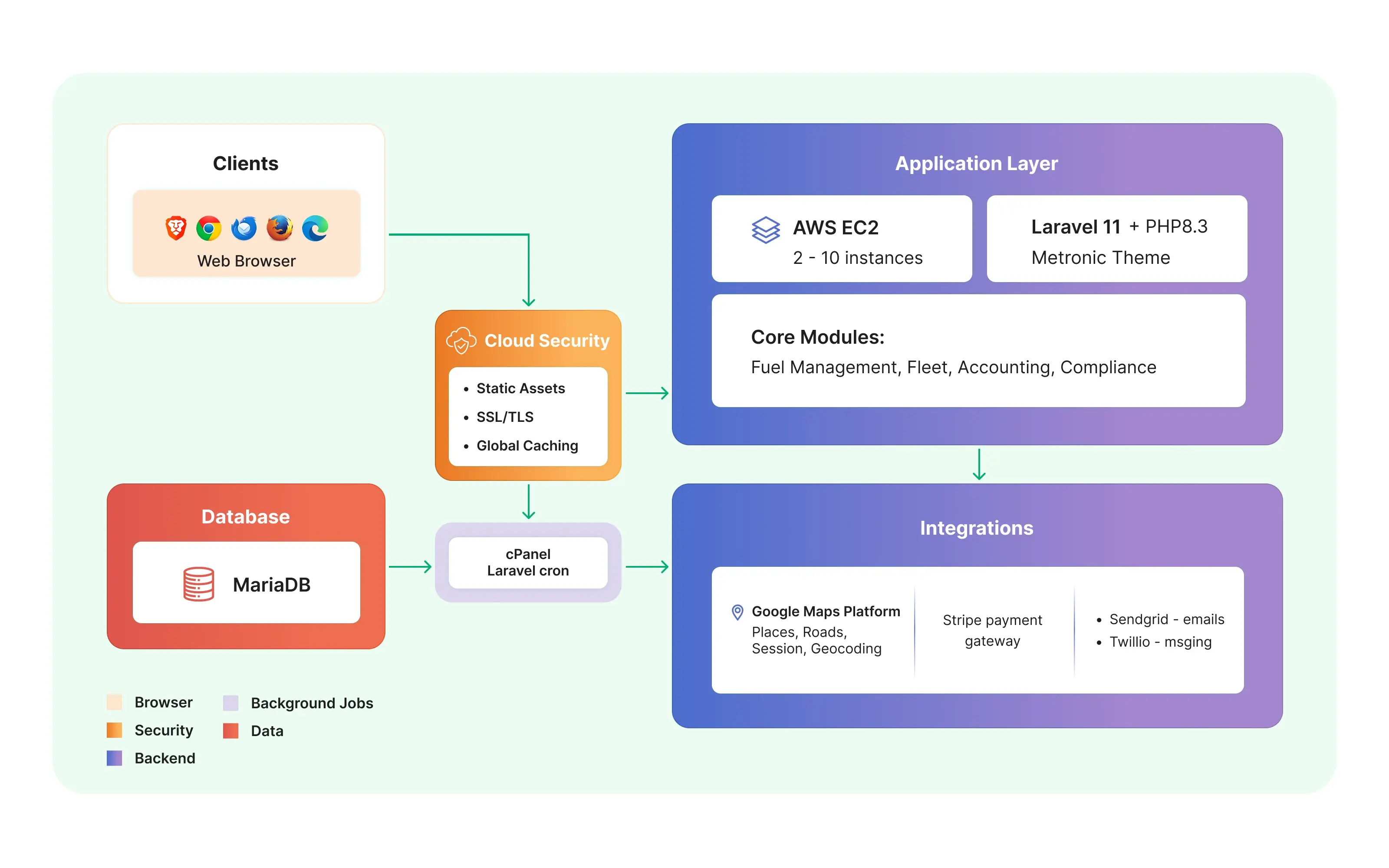
Complete System Architecture – TMSCLOUD Unified Platform
Outcome
Elevating Productivity, Satisfaction, and Visibility
The transformation delivered far more than just cleaner workflows, it reshaped how TMSCLOUD operates day-to-day. After implementation, Daryn Duff and his team saw measurable improvements across efficiency, customer satisfaction, and cost control.
The biggest win came from dispatchers, admins, and drivers now work together seamlessly. Automated fuel updates, synced ELD data, and a modern interface reduced delays, minimized manual entry errors, and provided clearer operational visibility.
+60%
Client Satisfaction Improved
Faster turnaround and transparent workflows increased dispatch accuracy, reduced support tickets, and improved communication, lifting NPS from 7.2 to 9.1 and strengthening customer trust.
40% → 90%
Increased Efficiency in Fuel and TMS Operations
By automating fuel updates and linking them to TMS actions, the team reduced manual effort and errors. Tasks that once took hours now take minutes, minimizing routing, dispatch, and reporting bottlenecks, boosting efficiency from 40% to 90%, and enabling scalable operations without extra headcount.
$500/month
Savings in Operational Costs
Minimizing errors, duplicate entries, and downtime saved $500 per month, totaling $6,000 annually, improving profitability and reducing manual reconciliation between dispatch and accounting teams.
30%
Faster Fuel and Invoice Management
By linking fuel entries to TMS events and consolidating invoices into one interface, the team eliminated hours of manual reconciliation each week. This speed improvement had a clear impact on gave the team a clearer picture of their cash flow and smoother billing cycles.
Measurable Business Transformation & ROI
6 Months
Return on Investment (ROI)
TMSCLOUD achieved full ROI within six months, driven by cost savings, improved accuracy, reduced manual workloads, and higher customer retention.
NPS: 7.2 → 9.1
Customer Satisfaction Score (NPS)
The unified interface and consistent data accuracy boosted Net Promoter Score from 7.2 to 9.1, reflecting improved trust, transparency, and service consistency.
6 months
Implementation Timeline
The 6-month project covered full development, QA testing, and deployment, followed by post-launch support for fixes, performance enhancements, and ongoing feature upgrades.
Platform Transformation: Before and After
Before: Operational & System-Level Pain Points
- Separate platforms for Fuel & TMS causing duplicate entries
- Manual fuel entry delays processes and triggers errors
- No real-time visibility into fuel expenses
- PHP 5.6 codebase limits updates and integrations
- Workflow delays from switching between platforms
- Increased workload for dispatch and accounting
- Delayed or inaccurate reports disrupt billing and client updates
- Lost sales from missing unified platform
- Dev time spent maintaining legacy code over new features
After: Modernized Platform Gains & Performance Boosts
- Unified Fuel & TMS platform
- Real-time fuel updates, no manual entry
- 60% improvement in client satisfaction (NPS 7.2 → 9.1)
- Operational efficiency increased from 40% → 90%
- $500/month saved by reducing errors & duplication
- 30% faster fuel and invoice processing
- Instant visibility into fuel costs, usage, and trip insights
- Faster, secure development with a modern codebase
- Full ROI achieved within 6 months
” The new unified TMS + Fuel Management platform completely changed the way we operate. We now track everything in real-time, invoice faster, and provide better service to our clients.”
Sustained Growth and Future Roadmap
The modernization initiative has provided TMSCLOUD with a stable, scalable foundation that meets current and future workload demands. By consolidating Fuel and TMS workflows on a modern Laravel framework, the platform now performs more responsively for dispatchers work on it, faster deployment of updates, and more accurate data across all functions.
These improvements have led users to report improved user experience and reduced issues, contributed to new enterprise acquisitions, and reduced day-to-day operational friction for internal teams. With a cleaner architecture and cloud-ready infrastructure, TMSCLOUD is ready to implement advanced analytics, enhanced automation, and expanded ELD integrations as the next phase of its product roadmap.
The result is a platform designed for current needs and future growth as carrier requirements evolve.